🎵 Recording ⌨ Space / ←→

Mark 14-16

04/16/2026 · Tue/Thu 12:00-1:15 PM · Brad Bannon · Boston College
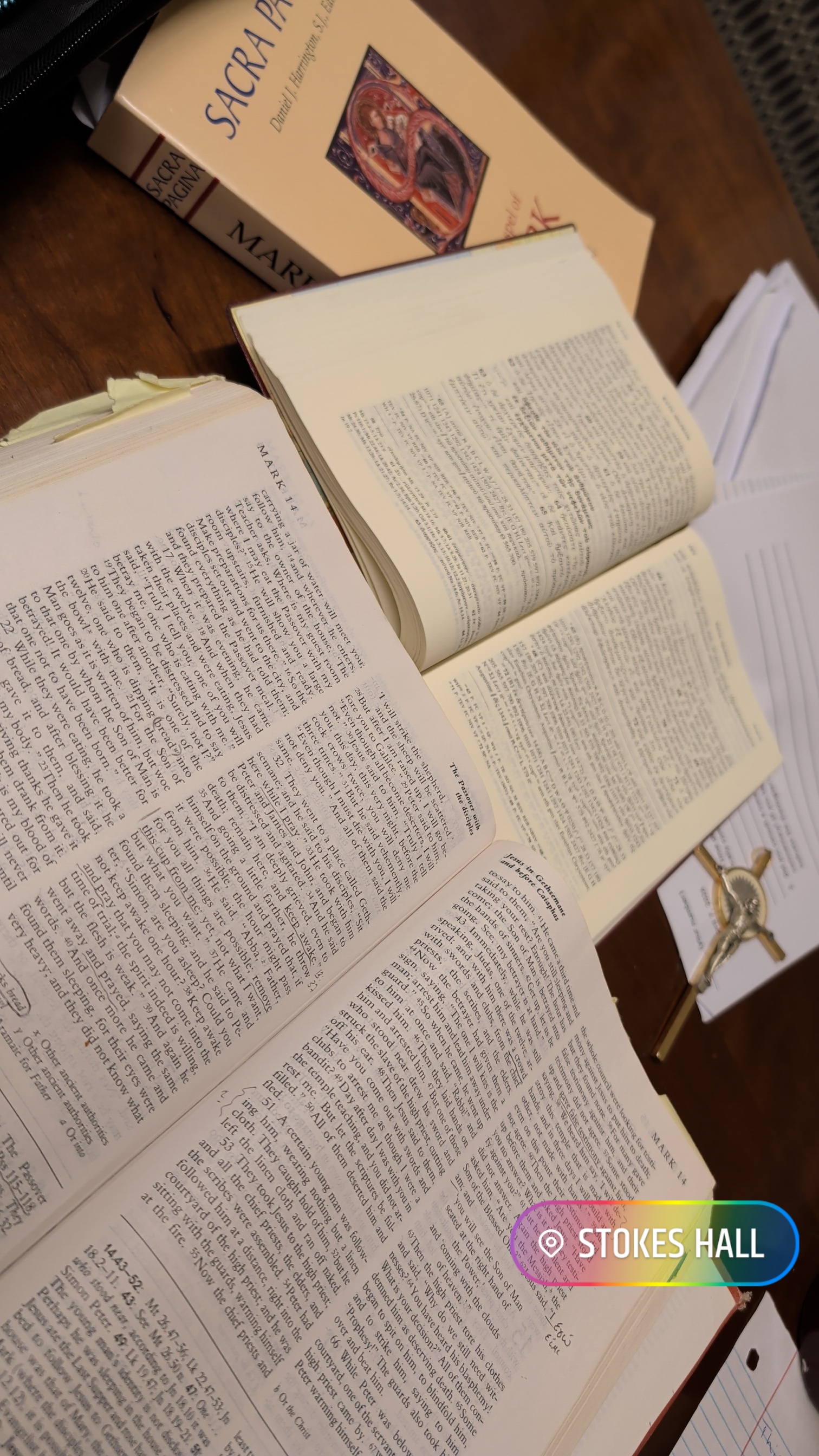
Chalkboard photo 1 from 04/16/2026

📄 Synopsis

This session focused on the concluding chapters of the Gospel of Mark (14-16), employing Clooney's method of comparative theology where students led the discussion to 'see their neighbor through the text.' The class explored the narrative of Jesus’s final days, beginning with the unnamed woman’s anointing of Jesus at Bethany, which the instructor characterized as a 'christening for burial.' Students compared Jesus’s internal struggle in Gethsemane to Arjuna’s dilemma in the Bhagavad-Gītā, noting that both figures ultimately submit to their respective duties (dharma). A significant portion of the lecture examined the shifting role of the 'crowd,' which transitions from supportive followers to a source of pressure that influences Pilate’s decision-making. The session concluded by highlighting the irony that the first human to acknowledge Jesus as the 'Son of God' in Mark is not a disciple, but a Roman centurion witnessing his death.

Key Takeaways

  • The unnamed woman who anoints Jesus with costly ointment performs a 'christening' that prepares his body for burial, redefining his role as a Messiah.
  • Jesus’s prayer in Gethsemane ('remove this cup from me') highlights his human vulnerability and his ultimate submission to divine will, paralleling Arjuna’s struggle with duty.
  • The 'crowd' acts as a significant character in Mark, exerting social pressure that leads to the abandonment of Jesus by his disciples and his condemnation by Pilate.
  • Pontius Pilate is depicted as a figure motivated by political expediency and the desire to satisfy the crowd rather than a commitment to justice.
  • Mark’s Gospel emphasizes the failure of the male disciples, contrasting their betrayal and flight with the steadfastness of the women who witness the crucifixion and resurrection.
  • The Roman centurion is the first human character in Mark to proclaim Jesus as the 'Son of God,' a title previously only recognized by demonic spirits.
  • The instructor noted that the Gospel of Mark focuses heavily on Jesus's suffering and abandonment, such as the detail that both bandits mocked him on the cross.

🎤 Transcript Tap any timestamp to jump the audio player

Opening Silence and Meditation

Brad
Let's get started, please. We'll take a moment to just be still and be quiet. We'll transition, please. Let's take a breath together. Go ahead and breathe in and out. Word? Word. So I know some of you have registration today. Yeah? Who has registration today? OK. No worries. Do your thing. OK? No worries. And yeah, just to answer the question I've already been asked, I have no control over— whether I have no control over the students in my class at all. So I tried for this semester, actually. I was like, you know, it's really super helpful to have, you know, folks take two semesters with me. But, and so I went to the chair of the department stuff, and they're like, nope, you have no control over who's in your class. So, you know, deal with it. So, so the best I can do is is try my best to get people to drop on the first day, which I was really successful in with this section this semester. But in my 10:30 class, I think I had one drop. And in this class, I think I had like 12 drops. So I don't know, whatever.
2:32

Administrative Agenda and Registration

Brad
But I have no say over that. And okay, let's see. I've got an agenda here. Registration, did that. Discussion leaders today. Who are our discussion leaders today? Delaney? Aiden? Who's got a hand? Hannah seems not entirely sure.
Student
Hannah?
Brad
Um, hey, Chang. Um, Jaron. Eduardo. Olivia. Um, and Devin. Is that it? Yeah, and Wilkes. So, all the next thing on my list, no class on Tuesday. I mean, you don't have this class on Tuesday. You have your Monday schedule, I think, on Tuesday, right? Which means that next Thursday will be our last class in this unit, last class on the Gita, and we'll wrap up the Gita then. It'll also be our last discussion leader day. And so as usual, yeah, come prepared with a commentary or something on a passage. We're gonna do it a little bit differently. So, you know, we definitely want to read the rest of the text. So what are 15 through 18 or 14 through 18? No, it's a bunch of chapters. But we're gonna focus way more narrowly. No way we can cover all of that and Some of it's like low-key a little bit repetitive, um, IMO, but, um, but we're going to focus especially on chapter 15. Even more specifically, we're going to focus on the first 5 verses of chapter 15. So chapter 15, verses 1 through 5.
Brad
And if you're a discussion leader that day, then definitely look up a commentary on those 5 verses. They're very enigmatic, and probably as many commentators as we look up, they'll have as many different possible interpretations of those 5 verses. So, a lot of reasons why it's one of my favorite classes of the semester. And you've also got another additional assignment for next Thursday. So in addition to the Gita passage, so finishing up the Gita and focusing especially on those 5 verses from 15 There's also a few good verses from chapter 18. 18:66 is one of the most famous verses in the Gita. So, you know, I don't want to say that you can't do other verses, but we'll definitely focus on those 5, and then maybe 18:66 would be a good thing to add to it. But in addition to that, I would like everyone to please watch a movie. The movie is called Black Panther, the first one. And so Black Panther, I've assigned that for this course a number of times, and it just fits in so perfectly.
Brad
So there's obviously a lot of Gītā parallels in there, but there's also quite a lot of Christian symbolism and Christian There's plenty to talk about for Black Panther. So if you've already seen it— I know most people have already seen it— I still want you to watch it again, right? So the goal, the assignment is to watch it between now and next Thursday and, you know, take some notes on it. I mean, you don't have to like take a whole bunch of notes, but just jot some things down, right? So we can have a good discussion about Black Panther. Spanish, you know, as a way of wrapping up our sort of comparative course. Then your final podcast will be due after next Thursday. So wait until next Thursday and then, you know, after that. You know, preferably before the following Tuesday, but yeah, so aim for that. The last two, I believe, We have 2 classes after that, and so for those 2 classes, I sometimes take attendance, sometimes don't, but in either case, that's not part of your attendance grade. It doesn't factor in.
7:19

Attendance and Contextualizing the Gospel of Mark

Brad
So when I take it, it's just for my own record keeping, not for your— not grade-wise. So, yeah. And I'll say a little bit more about your reflection paper next Thursday, but your reflection paper will be due that last day of class. I think that's— oh, and if you haven't done your initial meeting with me, then tomorrow is the last day. So office hours today and tomorrow, and also last chance to kind of wrap up any makeups. If you have a makeup from the last 3 weeks, then you can still make that up. But let's get that done. Yeah, and then this— not entirely— yeah, this way, this morning as I was driving in, I was on the way— oh, hodos— but I was on the way Here, I was listening to Bloomberg Radio, and there was a press conference held by the Secretary of War. And during the press conference, he gave a rather lengthy— I mean, not that lengthy, but a clear exegesis of the Gospel of Mark focused on chapter 3.
Brad
And the episode that we studied at the beginning of the semester talking about when Jesus healed the paralytic in the temple on the Sabbath. And so I don't know. I guess my point is just simply that what we're studying here actually does have real-world applications to things still relevant. So yeah, just found that, found that interesting. Good? Questions or anything on anything? All right. So what we're going to do today is a little bit different. Some of you have had my class before, have seen me do this before. But I really want to practice theology today in the way that I outlined it in chapter 1 of the textbook, whatever, if it's a textbook thing that I wrote, which is, you know, Clooney's method of comparative theology is that the goal of discourse is to see our neighbor through the text, right? So anchor our discourse in the text, but with the goal not only of understanding the text, obviously understanding the text is part of it, but maybe even more important than that is to see our neighbor through the text.
Brad
And so along those lines, a lot of times we get in a pattern, this is mostly entirely on me, but of me kind of engaging with students back and forth in the discussion. But I really want to have— I want you guys to have a real discussion anchored in the text. So we'll lean on our discussion leaders. Fortunately, by this point, I have your voices pretty much down. So I'm going to turn around and sit in this chair and listen as you guys have a discussion. So we'll let the discussion leaders take the lead at first, but that doesn't mean that it's only open to discussion leaders, yeah? Anybody can jump in on that discussion. But let's give our discussion leaders sort of a first go at it. So we'll take until 20 till, so, you know, about 6 minutes or so in your teams so you can kind of, you know, decide what sort of things you want to discuss and that kind of stuff. Talk it through a little bit as a prelude to having the big discussion.
11:32

Small Group Discussion on Gospel Passages

Brad
At 20 till, you know, everybody can kind of— hopefully somebody will jump in and take the lead. And we don't have to go— I'm not going to, you know, regulate it. I want you to do that. So, you know, try to cover everything from 14 to 16, but you don't have to go like 14, 15, 16. You know, you can jump around a little bit, but try to keep Um, you get that. You'll do great. Word.
Student
Peace.
Brad
Go for it. Try to focus on the text a little bit more, please. If you're registering— are you registering? Got you, got you. If you're registering, it's okay, you're registering. I'll chime in.
Student
And I also think that like, I would even go like, there are ways that you could have like, can you invite Jesus to parties?
Student
Of course, like, if there has like a mass following of people. I also want to talk about the pirate one.
Student
He said that it's like, I feel like the pirate one is portrayed more peacefully than the—
Student
Yeah, because this one, like, he seems like powerless, right?
Student
He seems like he gives Go, whatever he says, go.
Brad
Uh, pretty sure I can hold that.
Student
About what?
Student
About that. If one of you betray me and then he's like He's just like, I don't know him, I'm not associated with him.
Student
Why is he sad? She told him to do it.
Student
Cuz he really—
Brad
cuz he like, he didn't think he was going to, and then he realized he did. Involuntary, but like, I guess what he previously done.
Student
Well, he was, he was very confident in his loyalty.
Student
So Peter's a good guy, you know, it's like he's human.
Student
Why did he do that?
Student
He didn't want to go to jail. Yeah, they were like, look, it's crazy to me that like, not reading the actual—
Brad
What's myrrh? It's a spice. It's like, smells nice. It's usually used in like incense and that kind of stuff, but here it's also apparently like a painkiller No one attacks things like that.
Student
And then he just says, hey guys, why don't you come with sources below? And they're like, probably. And then a bunch of people gave false testimony, all of which didn't agree, and they still accepted it.
Student
That is amazing.
Student
Great job.
Student
Why are you attempting to hurt his reputation?
Brad
What's so just about this?
Student
It's just funny.
Brad
Yeah, it was funny. Okay, kind of whoever wants to get it started. Just got to take charge, Eduardo. You just got to take charge.
19:29

Student-Led Discussion: Betrayal, Greed, and the Role of Women

Student
All right, so starting, starting in chapter 14, something me and my group talked about was kind of verses 5 through 9 when the woman anoints Jesus with the ointment. He tells them at the end, they're all confused like why she would do that. And she tells He tells them at the end, what she has done will be told in remembrance of her. We kind of viewed that as she had this opportunity to sell this ointment. She could have profited off of it, but instead she makes a sacrifice, and that's what makes it so memorable. So we think taking actions of sacrifice are the most memorable types of actions, and if your duty calls you to do that, you should do that.
Student
Yeah, kind of adding on to that, we talked about verse 7, how like the people get mad that she didn't sell it and give it to the poor. And then Jesus kind of like points out some hypocrisy. He says, for you always have the poor with you, and you can show them kindness to them whenever you wish. Like, you know, who are you to be like, oh, you should have given this to the poor? Like, how about you go give something to the poor? And I think that kind of relates to like the modern world, like people always kind of get upset when other people don't donate like enough to charity, but in reality, like, they haven't donated anything.
Brad
Yeah.
Student
Yeah, I think that verse also stuck out to us. We were kind of talking about, in particular, the role of women in these last few chapters, first with the woman who puts the ointment on Jesus, and then with Mary Magdalene. You know, the women who first experienced Jesus's resurrection. And I think that it's kind of interesting because like up until this point, like, yeah, women have like had like a role in the story, but obviously it's very central around Jesus and the disciples. But in this part, it kind of emphasizes that the women are actually seeing something that the disciples don't see. And in a commentary by Elizabeth Lorenza, she kind of talks about how like the women are almost like disciple, like the model of discipleship in these last chapters, especially in contrast to the disciples betraying Jesus. So it's just kind of a contrast of those who follow Jesus, but the women who stuck by him and actually saw his purposes.
Student
Going back to Wilke's point with the fact that the woman was really doing what she could, like proportional to what she had, like the next verse, she has done what she could with what she had. I think that really stands out in the fact that you should always be willing to serve, but you should never use that comparison point against other people. But as long as you do enough of what you have, like, that's really embodying the spirit of Jesus.
Student
I think also something that I noticed is that In verse 7, when it says, "For you always have the poor with you, and you can show kindness to them whenever you wish, but you will not always have me." I think in the past, like, we've seen Jesus kind of say, like, like, don't tell anyone of my identity, whereas here he's like being more open with that he is the Son of God. And I mean, this is also like leading up to the betrayal and the crucifixion, that he's like trying to spread the good news and make it more known about who he is.
Student
I think it's interesting to note that in a sense, obviously if you're a Christian, Jesus is always with you, but in this context he's meaning like physically, I'm no longer with you, so you can't do acts of service towards me. But you'll always have the poor with you, so you can kind of do acts of service in my name towards them.
Student
It's interesting as well, the act of greed is the inverse of sacrifice and giving, and it's the act of greed that ultimately is the reason that Jesus died, is Judas betraying him for money. And just goes to show that everything that Jesus was trying to preach against the act of the inverse of that is ultimately what got him killed.
Student
But I think at the same time, like, what got him killed and like that greed also kind of reinforces his authority because that betrayal and those acts of greed are something that he predicted. And with his death, those predictions were fulfilled. So even though he's God, I don't think his authority was undermined. I think his death was actually the most indicative of his authority as the Son of God.
Student
I agree with that because I feel like a lot of the times we're— especially in the later chapters, we see like Jesus telling the disciples that something's gonna like come to fruition and then they just don't believe it, but then ultimately like it does happen. When he's like, oh, like you will betray me 3 times, and the disciple goes like, no, like I won't, but then he ends up doing it. I think that kind of shows that like the idea of like humans do have free will, however everything like God is omniscient, so like he knows the path that we're gonna take, but we still have the ability, like, to have free will, which it seems kind of contradictory, but I guess it's kind of just the way it is.
Student
Yeah, I think that's a good point, especially with, like, the free will, because, like, a lot of people kind of think about, like, God and Jesus is like, you know, why don't they, like, step in? Like, why didn't God step in to, like, save Jesus or all that stuff? And apart from, you know, Jesus being the Son of God, I also think it's like, we are human because we have freedom in God's image, and we wouldn't be, like, of God's creation if we didn't have that freedom and that free will. And I think that that's like a big part of Jesus's story is that he chooses to die, and he chooses to kind of, you know, like, he kind of accepts his fate because he knows what God has in store for them.
Student
Yeah, I think that's a great point, especially in Mark 15:31, where the chief priest kind of like mocking him for like, oh, he saved all the others, but he cannot save himself. So like, I think that just kind of like shows that, you know, like in our eyes, like, oh, if we have all this power to tell the future, like we're gonna do something, we're gonna benefit ourselves. 'But Jesus didn't do it.' But instead, like, he was trying to use his power to benefit as many people as possible rather than just, you know, try to get himself out of trouble.
Student
I think we also see in verse 49 when Jesus says, 'Day after day I was with you in the temple teaching, and you did not arrest me, but let the scriptures be fulfilled.' So he's kind of like making the point that, like, they've said time and time again, like, all of these dangerous, or like we're going to lose our following. But out of fear, they didn't do anything. And so finally, that's what they have done something like Jesus, when he says, let the scriptures be fulfilled, he knows that this has to happen in order for him to be able to save everyone.
Student
I think kind of backtracking a little bit to, you know, obviously, maybe we noted that Jesus already knows what's going to happen. I find it really interesting in chapter 14, it's verses 35 through 36, Jesus is actively asking God to remove this duty from him. And it kind of reminds me of Arjuna in the sense that like, he's talking with Krishna during this whole exchange, and he just really does not want to fight his own family, just in the same way that Jesus really doesn't want to die. And I think it points to an even bigger point of like, even if you don't necessarily like your duty, you can sit there and contemplate it kind of like Jesus does here, Arjuna with Krishna. But if you find that in conclusion, that is your duty, you still have to fulfill it.
Student
Yeah, on duty, I think like In a way, even though it's like kind of a more negative context, like you could talk about that with Pilate too, because Pilate kind of expresses that he doesn't really like— he's not killing Jesus because he feels so strongly about Jesus's guilt. It's more so that he's afraid of the guilt or of the crowd and of his own perception. And I think that that's a really interesting point on the notion of duty as well, because It's more so about his own weaknesses, like to perform his own duty.
Student
I think that the image of crowds and the influence of the masses is a really prominent theme throughout these chapters and Mark as a whole, because they really act as just a force of pressure. And they're really what's able to kind of guide the disciples away from Jesus because there's so many of them. There's that idea of fear versus faith that really attracts them. Since they're human, they fall susceptible to that fear. So even though they do believe in Jesus, their loyalty falters because there are so many that are there and being stirred against them.
Student
Because they're human, they can't really understand the magnitude of what's going on. Edouard brought up 36, where Jesus is kind of questioning his duty. The verses that come after that cement the fact that he needs to do his duty because the disciples are falling asleep. They're not understanding what's to come. They can't understand what's to come because they're human. So it kind of reaffirms to Jesus that he must go through what's going to happen. And even when we think about chapter 15, where Peter is denying Jesus after being— after reaffirming to Jesus that he won't deny him, he starts to deny him in the moment because his human self-preservation kind of takes over, where he promises to not deny him in the beginning, but when faced with persecution and death by Jesus, he finds himself starting to deny Jesus in the moment.
Student
And I think it just shows the difference between the human aspect of all the disciples and the divine aspect of Jesus being able to see through that and how the disciples, because they're human, just can't grasp what Jesus is trying to tell them and ultimately end up denying him and allowing him to be the sole person that gets crucified.
Student
I also think like on that theme of crowds, like on the other side of that with like the chief priests and especially with Pilate, I think it's interesting when he asks the crowd, like, when they're saying crucify him and he says, why, what evil has he done? But they keep shouting crucify him. So Pilate, wishing to satisfy the crowd, hands him over to be crucified. I think that's a moment where even though the chief priests and like they can't find a testimony that's valid to have him to be crucified, and then even Pontius Pilate may be like, but why? But he's using the crowd itself to like kind of make the decision for him so that it seems more justifiable, which I think is what, um, the priests have been looking for all along because they were fearful that they would lose their crowd and their following, um, in trying to harm Jesus.
Student
Um, just to make another comment about verse 36, I feel like it kind of highlights the potential between like the human desire to like not to like avoid like pain and suffering, but also the desire to like stay like obedient and like devoted to God. Like, um, it says, remove this cup from me, which kind of highlights that human desire. But then Jesus says get not what I want, but what you want, which kind of still maintains that obedience and that devotion.
Student
I think the conversation we've been having about like having a following and then also like devotion can kind of be tied into like the commentary that I was looking at. It's by— I don't know if I'm saying right, I think it's like Chad Meyer, and he is like, he wrote a book about how Jesus can be construed as a political figure. And I think like the idea of like having a following and like people being very devoted to you, like you can kind of see that correlation pretty clearly. And then also like looking deeper into it, we can almost see Jesus as a political figure who's attempting to, like, bring justice into a world that— and like a regime that is unjust, like a place where people who are like Pharisees or in like high places of power within the church are corrupt. So I think this interpretation of like this commentary can definitely be seen because Jesus is coming as like in a sense, a political figure who's trying to bring justice to the church and also like the world, who has like this following that we were talking about.
Student
Yeah, I think I agree with that. I think it also reminds me of another political book, which is The True Believer by Eric Hoffer, which is kind of about, um, crowd mentality and like how, you know, when there is such strong crowd mentality, crowds are so susceptible to fall into the contagion of a corrupt leader. And I think that just as much as, you know, Jesus was a good crowd leader, there was equally bad crowd leaders that all turned against him. And I think that kind of mindset, it is like a political shift of like good and evil and kind of the idea of justice, especially after Jesus's Jesus does die and people kind of start to realize like, oh, we were wrong. I think that the crowd mentality can like really, you know, lock a lot of people in ways of thinking that aren't essentially rational. And I think that this story is a very, very good example of that.
Student
Yeah. Building off what you just said, I think what perfectly describes it is chapter 15, verse 39. Now when the centurion who stood facing him saw that in this way he breathed his last, he said, truly this man was God's Son. So it's almost like as a person you can fulfill your duty or whatever actions you need to do, and even though people may not necessarily align with it or agree with it, after your duty's been completed, they might come to see why you had to do what you had to do, just as the— when— sorry, this is the way this soldier didn't realize, like, oh, Jesus was doing this and preaching all this in his mission because he had to until he completed his last action of dying for our sins.
Student
I think that, like, kind of ties into the idea that really the revelation was the most strong in the moments that he was abandoned, because when he was abandoned, especially like within this chapter, I think that's when even those who were like his prominent adversaries were very clearly able to see that Jesus was this Messiah and that he did have power, even though the crowd voices were saying so differently for so long.
Student
One of the ways that we learned to look into a text is to look into it instead of taking it out. And one thing that I noticed, at least throughout Mark 15, is the continual symbolism of the number 3. So it's like, you would destroy and build the temple in 3 days. He said, the disciples would, like, yeah, that's the word, betray him 3 times. It was dark for 3 days, and then he, like, it was talking about something like until darkness came over the whole land until 3 in the afternoon. And I think, like, maybe that can be related to, like, the 3 heads of the Trinity, like Father, Son, Holy Spirit. But I just thought it was interesting interesting that the number of 3 was being repeated so many times because I know numbers can play a really big role in like trying to analyze the Bible and passages.
Student
So I thought that was interesting. I feel like this whole like passage kind of reminds me of the idea of the difference between seeing versus hearing. So for the Gita, Arjuna, once he finally sees Krishna's true form, he finally realizes the gravity of the situation and how important his duty really is versus when he was just hearing about how powerful Krishna was. And here, when people are hearing that Jesus is the son of God and all these things, they don't really believe him until like after he dies and rises again on the third day, and people like actually see and believe that.
Student
I think it definitely speaks to how the disciples and just other people, how much faith they actually have, you know. Um, Peter, kind of after he realized that he fulfilled the prophecy, he broke down and wept. And then Arjuna, when he saw through the divine eye everything that Krishna was seeing, he also kind of had the same thing, like a breakdown. I think had they been more faithful and more believing of, you know, Jesus or Krishna, I think they would have had a more mild reaction because if they truly believed, they wouldn't have felt like they were, you know, giving them— falling short of where they should be.
Student
Yeah, I think on that point of like seeing versus hearing, you can also kind of see it with the disciples and how you were talking about, you know, true belief versus just believing what's in front of you. I think that obviously when the disciples were following Jesus, they were, you know, big believers in Jesus and what he was doing. But then as soon as like the voices of the crowd became louder than Jesus's voice, that's what they were listening to. So they were no longer seeing Jesus, but they were instead kind of seeing what the crowd was telling them and what the crowd wanted them to see. And I think that, you know, in terms of belief, you kind of have to have continuity in between what you see and what you hear and what you actually kind of feel is true.
Student
Um, looking back on the last podcast that we did, like, we had the activity where we had to like compare Arjuna to or like the situation to like a current or like modern figure who's like in the same position. And I think that, um, that may have been more like impactful or honestly like helpful than I realized in the moment because I feel like when you're reading something so that has so much depth to it, it's really easy to like glance over it and kind of just like pretend you understand the whole thing. And so I was thinking of like not necessarily a modern comparison but maybe something else so I to try and understand it. And I don't know if anyone's ever seen The Chronicles of Narnia, but I read something that C.S. Lewis, that he based that book in like that movie. It's like a biblical allegory for like Jesus and the resurrection, like the lion, like Aslan, who's like the king of Narnia, which also kind of relates to like the political affiliation of Jesus.
Student
But I thought that was interesting how like artists can use like their forms of like communicating the gospel. And so I thought that maybe equating this to like something else that is related to like popular culture might help people to understand 'cause it did for me.
Student
One thing that I found interesting or like noteworthy was the fact that the way in which Judas carried out the betrayal was like with a kiss. And I know that's like a really famous part of these chapters is like that Judas uses like this gesture that is typically associated with love and loyalty. To commit like the greatest act of treachery. So I felt like that juxtaposition was interesting and like was able to highlight just like the profundity of the betrayal very well.
Student
This is like looking more of a question that I had, but maybe it's because of the time period, but does anyone know, like, was it normal to just like go around kissing people back then? Like, I don't know, like, I feel like that's just such like a thing you would associate, at least like nowadays, with like lovers or like family. And I guess like the disciples were a family in a sense, but I don't know if anyone knows the context of that because I thought that was interesting too. And I know that that's a pretty famous passage.
Student
So it's definitely a religious thing because I remember one time when I was younger, I went to like—
Brad
I go to Greek Orthodox Church.
Student
The priest kissed me.
Student
I got really caught off guard.
Brad
I think it's more of a religious thing, kind of like an affection kind of thing. That standpoint.
Student
Yeah, I also like to hear it like with like royalty, like in the past.
Student
Also from like The Godfather, I think that's like, it's like where he kisses his nephew or something to show like you betrayed me and I'm gonna kill you or something like that. So maybe that has a connection.
Student
I was a bit confused about When Jesus is on the cross and he kind of calls out to God, like that very famous part, he's like, my God, my God, why have you forsaken me? I don't know. I think that obviously it's a very powerful moment, but also at the same time kind of confusing because Jesus already knows kind of what's about to happen. And he kept saying, this is what's going to happen.
Student
This is what's going to happen.
Student
This is what's going to happen. And then he finally gets there and he's like, dang, why did it happen? You know, like, I don't know, that part kind of like threw me off a little bit. Um, and then especially also because after Jesus dies, he then is resurrected and sits at the right hand of God, and so God doesn't ultimately forsake him.
Student
I take that as like the way that Jesus is like 100% man and 100% God, like that's kind of like the human side coming out and like we kind of see like that parallel to like Peter in the sense of like fulfilling something and then like kind of being upset that that thing is being fulfilled. I think that parallel is kind of clear because I feel like it's so easy just to associate Jesus as like, um, like a leg or an arm of God, but also like it's hard to acknowledge that like he was a human too. So like anything that we would feel like in that moment, he's also feeling. So I think that could maybe be like why he like called out to God in that instance.
Student
Yeah, I agree that it definitely showed more kind of like the human side of God. And when I was reading that part, I kind of felt that it was kind of like, like for me, like my dad would like always be telling me something. He'll be like, oh, you have to like do your homework and this will happen. You do it, this will happen. And I'll just keep on pushing it back, pushing it back, or just keeping it at the back of my head and not really focusing on it. And then in the end, when you say, yeah, this will happen, and I'm like, dang, why did it happen? But it's like— so I thought it was very similar to that. Yeah, essentially just the human side of Jesus coming out.
Student
Yeah, something I noticed when I was reading it is Mark's gospel doesn't have the penitent thief thing. So when he's crucified, he's crucified next to two bandits. And in the stories I'd heard before, it was like one of them asked for his forgiveness, the other mocked him, and then basically he was given forgiveness as Jesus died. In this case, they both joined in mocking him, which I guess to me I was like, okay, so Mark was really focusing on emphasizing the cruelty and suffering Jesus experienced leading up to and during his crucifixion as as opposed to highlighting this final act of forgiveness and how even at the very end you can be saved kind of thing.
Student
Yeah, it's interesting because it doesn't even mention the— at least I don't think it mentions Jesus saying, like, Father, forgive them for they do not know what they've done. So, you know, a lot of the other gospels are very, very focused on, again, like you said, Morris, like Jesus as this like forgiving figure up until the very end. But Mark just leans in so heavily on just purely his suffering.
Student
Um, kind of throughout the ending of the gospel, I thought there were kind of like 3 like main people or like archetypes of people. There's like the Judas who like, you know, you have to watch out for them because like they're willing to betray you for like anything or for money. And that's like, you know, someone you need to watch out for in life. And there's like the Pilates who are like willing to like abandon their own sense of morality just because like the crowd or other people say to do it. Who like, you know, they don't have like their own compass. Like they just listen to what other people say and like they're they're able to get peer pressured. And then there's also like the Jesus, which is like the glaringly best kind of like person and the end of this gospel. I guess also Peter would fall under the Judas category.
Student
I thought like Jesus's reference to Peter, like at his burial site, to the woman or the was indicating like the spirit of forgiveness because he was able to recognize that even though this betrayal exists, like the disciples are still like a part of them and like his mission can continue even through like the people that betrayed him.
47:40

Instructor Lecture: Symbolism and Passion Narrative in Mark 14-15

Brad
Right on, cool. Turn the tables, just turning me, I guess. Nice job. I want to draw some attention to some things that didn't get mentioned, but also lift up some of the things that you guys did mention. So really, really good. Going back to Devin's point about the role of women. So this is a major theme throughout the text. And we see some important women, some important things that happen. We see women filling very important roles throughout the gospel, and no less so here. And good use of Elizabeth. She was one of my teachers. Yeah. And a real expert in this text. So some of the things about the role of women, right? Women, somebody in the other class had this great phrase I thought was really cool. They said they're significant bystanders. So significant bystanders in that some of the most important roles in the text are played by women who don't have names. And in some cases, the women who have names seem to be less important than the women who— I mean, the women who do have names are less important than the women who don't have names.
Brad
And so, yeah, maybe even some of the people, maybe the most important people throughout the text, men and women, are those that are unnamed. But let's roll back to chapter 14 and this very important scene. Oh, another thing that wasn't mentioned, everybody seemed to pass over, the fact that it was at Passover. So Passover is a really, really important detail. It's not just a casual detail here. So Passover is critically important. This is the festival of the Passover, and in order to really understand what Mark is trying to say here, really have to understand in the context of Passover. Yeah, Nicholas?
Student
Because Jesus considered the Lamb of God, the slaughter of the Lamb of God, the Passover, blood of sheep.
Brad
Yes, exactly right. On chapter 14, verse 12, let's see. On the first day of the unleavened bread, when the Passover lamb is sacrificed, And the disciples said to him, where do you want us to go? It is on the one hand interesting, I mean, it is interesting that there's a lot of emphasis on eating the bread, right? Dipping the bread, so the unleavened bread, of course, but dipping the unleavened bread. So that's if you've participated in Passover, if you know about Passover, a lot of Passover Seder involves dipping, you know, dipping the unleavened bread in salt water and parsley and salt water and bitter herbs and that kind of stuff. So there's a lot of dipping activities. And now contemporary Passover, you don't have lamb. And the reason for that is because there's, you know, the lamb is supposed to be sacrificed at the temple. And so because the temple isn't there, it's always like next year in Jerusalem. So you end the Passover Seder, meaning next year when the temple is there, then we'll be able to have the Passover lamb.
Brad
And so here, that maybe they're not having— I mean, they could be having the Passover lamb, but it seems to be that they aren't because Jesus himself is the Passover lamb. But interesting that it's not the lamb that's his body, but actually the bread that's his body. But even before then, so we've got the Passover, so they're getting ready for the Passover, and this unnamed woman, while he was at Bethany in the house of Simon the leper, he sat at the table, and a woman came with an alabaster jar, very costly ointment of nard, and she broke the jar open and poured the ointment on his head. So remember, one of the questions we've been asking all semester you know, at least half this half of the semester is what does it mean to call Jesus the Messiah, right? So Mashiach means the one who's anointed, primarily the one who's anointed with oil, which is typically intended as a coronation, right? Anointed as king. But throughout the other messiahs in the Hebrew scriptures, it's not so much the anointing with oil as king.
Brad
That is, I mean, that is important, but it's more that the— it's an anointing by God, right? So God is the one that's choosing. It's not just me choosing to anoint somebody with oil. But so he is chosen by God as the one, but it's the— but it's this woman, this unnamed woman, who is the one that actually performs the christening, right? So, and she christens him, and he explains that it's not for his coronation as King of the Jews, but instead a coronation, anointing. So verse 8, she has done what she could. She has anointed— so christened is the Greek word— my body beforehand for its burial, right? So he's being christened for burial. So his kingship seems— I mean he becomes king through his death, um, not, not in a super literal political way, but also in a political way. Um, Delaney really liked to bring up the, uh, the role of the crowd.
Brad
So the crowd does something, as I've said before, like the crowd is a significant character throughout the text, and we see a major shift in the crowds in these chapters compared to, you know, well, Palm Sunday, which we read last time we read Mark's Gospel, and everything before then, right? The crowd is always this— the crowd— I like how you said it. I don't know if it was you or commentary that you read, but that the crowd kind of pushes, pushes me, right? So in some cases pushing the disciples toward Jesus, and in some cases pushing them away from Jesus. And here it's sort of like, I mean, they're— so the role of the crowd is significant here. And, and they turn on him, right? So the crowd is all behind him waving the palms, you know, ushering him into Jerusalem. But then Pilate, you know, Pilate's— a couple of things about Pilate. So Pilate, on the one hand, highly significant that he's a Roman governor, right? So he's the person that's actually in charge, right?
Brad
Herod is the king of the Jews, but Herod can't wipe his own butt without Pilate's permission kind of thing. So Pilate's really the one in charge. And, you know, he's just there to keep the peace, really. He didn't even care what's going on as long as taxes are going to Nero, as long as taxes are going to Rome. It's all he really cares about, right? And so he's doing this thing to kind of keep the peace, but his motivation is keeping the crowd happy. As I think it was Delaney who said, right, that there's not even about— or yeah, Devin also said the voices of the crowd become louder than Jesus. And so just paying attention to a little bit from chapter 15 Now at the festival, verse 6, so the festival of Unleavened Bread, the Passover, a man called Barabbas— fun little fact here, Barabbas is an Aramaic word, bar meaning son of and abbas meaning the father, so he's the son of the father, which is an important title also given to, I mean, to Jesus here also. Praying to the Abba, the Father.
Brad
And then verse 8, so the crowd came and began to ask Pilate for them to do according to his custom, meaning release somebody. And he says, do you want me to release the King of the Jews? And they said, no, crucify him. And then Pilate says, you know, Pilate's like, I mean, I like how one of you said it, that it's not, he's not, his interest isn't so much in right and wrong, what's just or unjust, but what the crowd wants, right? Sort of keeping the crowd happy. And so Pilate, verse 15, so Pilate, wishing to satisfy the crowd, released Barabbas for them. Because that's kind of all he cares about. Then another highly significant Yeah, a few highly significant things, but one is the centurion, right? So one of the things that I pointed out is that we are told, we the readers of Mark's Gospel, we the audience of his— I mean, we're not the original audience, of course, but we're still, you know, Mark's audience. So Mark's audience, Mark's reader, is told right in verse 1, right? The very first word.
Brad
Here's the beginning of the gospel of, you know, Jesus, who is the Messiah, the Son of God, right? So we're told all of these things right in verse 1, but none of the characters in the text know it. The only characters in the early part of the text that proclaim him or acknowledge him as the Son of God are all whom? No, not the disciples. We do have this moment in chapter 8 where Peter says, 'You're the Messiah,' and he says, 'Yeah, don't tell anybody.' So, um, yep, it's the Roman guard. So the centurion is the first human character in the text, um, that now— that calls him the Son of God. Before then, yeah, it's all the unclean spirits, the demonic spirits. As soon as they recognize him, they're like, 'Don't have us do anything with that? So repeatedly, the unclean spirits or demonic spirits, whatever you want to call them, they consistently acknowledge him as the Son of God. But the first and only human character in the text that acknowledges him as the Son of God is the centurion. And that happens right as he breathes his last, or after his death.
Brad
Let's look a little bit more at the details here of the crucifixion. So we're told, verse 25, this is chapter 15, it was 9 o'clock in the morning when they crucified him. Then there's on the right and on his left. Remember back in the— around the Transfiguration, the disciples were like, hey, we want to be on your right. Who's going to be— who's going to be your right-hand man? Who's going to be your left-hand man? And we're whatever, and Jesus was like, get behind me, Satan, like you don't get it or whatever. Because the people that are actually on his right and left are the criminals, right? The other people who are being crucified, two bandits on his right and left. And really good observation about some, you know, comparing or contrasting really with the other gospels, right? Eduardo pointed out in another gospel, Father, forgive them. And Boris pointed out that like the criminals don't repent the way that they do in the other gospel.
Brad
So, so yeah, and then verse 29, "You would destroy the temple and build it in 3 days," which actually we've never seen Jesus say that in this gospel, right? So it's, I mean, it could just be a detail Mark forgot to mention earlier, right? It's almost kind of how I read it. And then the Messiah, King of Israel. So Messiah here directly being a political designation. And as Olivia pointed out, right, Chet Myers, Chet Myers, one of the most important, I mean, super important commentator on Mark's Gospel, real expert in the text who really reads it, hit the text The commentary you're referring to, the title of it is Binding of the Strongman, right? From, I think, chapter 4 where we saw that binding of the strongman, which Chet Myers gives a very, very extensive interpretation of Mark's Gospel as an anti-empire text, as a, you know, really talking about the occupation of Israel by the Roman authorities. So political occupation, which is also religious, with religious aspects, right? Particularly like the, we saw the swine, right? I am Legion, the demons in the swine, or the demon in the man called Legion, sorry.
Brad
The demons are called Legion and then they're cast out and they go into the swine, right? So the interpretation I gave back then actually comes from Chet Myers. And then so here we have a centurion who, centurion, and, you know, notably is not Jewish, right? Definitely an occupying force and doesn't know anything about what does it mean to be Messiah, right? So one of the students in the previous class pointed out that like maybe it's the fact that he has no expectation patience about what does it mean to be a Messiah. That's why he's able to understand it in a way that the disciples aren't, right? The disciples, they, you know, acknowledge him as, okay, you are the Messiah, right? Who do people say I am? You're the Messiah. But they understand that in a political sense, right? But here, the political— it's still a political sense, but a political sense in a very different way. Not as him being a political leader, but instead what? Another important detail, so verse 37 and 38.
Brad
So Jesus gave a loud cry and breathed his last, and the curtain of the temple was torn in two from top to bottom. So this is an important detail. And immediately after that, we're told about the centurion who, you know, acknowledges him. So usually this is regarded— we already saw in chapter 13 last week about the importance of the temple, right? And Jesus said, I'm going to tear down this temple and not one brick will stand on it. And they appear— people are saying, you know, he's going to raise this temple in 3 days. And here the temple curtain— so the temple curtain I don't remember if I said this last time or not, but the temple curtain separates the inner sanctum, the Holy of Holies, right, which marks the spot where Abraham almost sacrificed his son Isaac. And now here we have Jesus, who's the Son of God, who's being sacrificed, and the temple, the curtain that separates that Holy of Holies, that inner sanctum, is being opened. That inner sanctum, the whole what's called the Holy of Holies, is traditionally only a human.
Brad
The only time any human would ever enter there is in Yom Kippur. Yeah, and I'm getting Rosh Hashanah and Yom Kippur confused, but that's that one day of the year, only one person who's chosen by lot, only somebody who's the right person who's a high priest and all this kind of stuff. That person gets to go into the Holy of Holies. We see this, um, this is how Luke's Gospel opens with, uh, in, in the Holy of Holies. Um, but in here, um, so that it's a symbolic act, right? So the ripping of the curtain, the tearing of the curtain, the idea is that God is present in the Holy of Holies, right? God is— that's God's temple, the house of God, right? And now this God is radically open to everybody, so no longer limited to those religious leaders, so, you know, the chief priests and scribes and that kind of stuff, but instead now radically open, even open and available to this Roman centurion who's the one that recognizes him and says, truly this man is God's Son. And this, this character, also unnamed, right, comes up again in verse 44.
Brad
Then Pilate wondered if he was already dead, and summoning the centurion— presumably there are more centurions, but we're only talking about the same one— and asked whether he'd been dead for some time. When he learned from the centurion that he was dead, he granted the body to Joseph. We have more Yeah, another unnamed character here is the servant girl. So you guys talked about Peter and Peter's triple denial, but don't overlook the role of the girl there that kind of prompted that denial, right? Again, an unnamed character, but an unnamed girl who seems to show who is associated with the high priest there. Yeah, please, Nicholas.
Student
Something interesting that I was trying to remember which gospel it was in, but I think it was John where Peter cuts off the ear, then Jesus puts the ear back on and heals him. I just thought that was an interesting comparison because we were talking about different gospels and differences in that specific moment.
Brad
Yeah, yeah, I was overhearing a little bit of that. I don't remember which gospel it is either, but I'm inclined to think it's Matthew or Luke just because they're copying him. So maybe copying him and then adding that detail, right? That's, as you said, like it's overlooked here. It's just like, yeah, yeah, interesting. As soon as we start to compare and contrast the gospels, particularly the three synoptics, then I think it opens us up to notice things that maybe we wouldn't have noticed otherwise, right? So like, what is this gospel writer trying to say? And notice that their interpretation of Jesus and the events are different, right? Which, I don't know, even that would be another way to teach this course, right? Would be to just compare the gospels. And what do we do with that? So, you know, acknowledging those differences. Some differences may be significant and some not so much, but nevertheless, what do we do with those differences? Open question. A couple other themes. One is the role of prayer.
1:07:38

Comparative Christology and Gospel Variations

Brad
So I've emphasized a few times that Again, if we were comparing gospels, Luke's Gospel, Jesus is praying like all the time, right? Pretty much anytime he does anything significant, he prays first and then he does something significant. When he's healing, he prays. When he's— he just prays all the time. We see Jesus pray a few times in Mark's Gospel, but much more so in these passages that we read for today. And those prayers are significant. They went to a place called Gethsemane. He said to his disciples, sit here while I pray. And then, I am deeply grieved even to death. Remain here and keep awake. There's this whole thing about keeping awake at the end of chapter 13 also. What I say to you all, keep awake. And then he says, specifically to the disciples, keep awake, and they don't. And then he prays, right? And going a little farther, he threw himself on the ground. So very dramatic description, throwing himself on the ground, and prayed that if it were possible, the hour might pass from him. Abba, Father, for you all things are possible.
Brad
Remove this cup from me, yet not what I want, but what you want. As you guys drew attention to um, but just pointing out, you know, what is it, what is it, um, what is this prayer, what do we make of this prayer, and how do we interpret the relationship between Jesus as the Son of God and the God to whom he's praying. Um, and again, how this might be quite different if we were to look at, say, John's Gospel, where Jesus has what we call, uh, in the biz, a high Christology, meaning super divine, right? As Olivia kind of drew attention to, like, later tradition regards Jesus as both fully human and fully divine. Not clear that that's what the Gospel writers would have said, but John's Gospel seems to hold Jesus as very divine, even to the point where we don't see him eating or drinking, or no one— he tells people, don't touch me, right?
Brad
Seems to It's not entirely clear that he has a normal body like you and I do in John's Gospel, whereas in Mark's Gospel we see him get hungry, we see him get angry, we see him throwing himself on the ground. We see him. Yeah. Yeah.
Student
So it also doesn't include the divine birth story either?
Brad
No divine birth story. So then in Matthew and Luke, where we have these divine birth stories, they're seeing him divine, but in different ways. Right. So no divine birth story. And a very human kind of physical Jesus in Mark's Gospel. Yeah. Thank you for bringing that up. Others? Other point? Totally random, random detail. This naked young man. Just, I don't know, there's a few random details in here, like a certain young man was following him wearing nothing but a linen cloth. They caught hold of him, but he left the linen cloth and ran off naked. Like, that's such a random detail, isn't it? Another somewhat random detail of chapter 15, verse 21: they compelled a passerby who was coming in from the country to carry his cross. Definitely a throwback to like chapter 8, verse 34: whoever should be my disciple should take up their cross and follow me. Here we see Jesus didn't actually carry his own cross, but Simon of Cyrene— Cyrene is actually in Libya— so this person from Libya who's the father of Alexander and Rufus.
Brad
Like, here we have so many people that are playing really, really highly significant roles in the gospel. They get no name at all. And then we get this character who doesn't seem like the most important character, but we're told where they're from and who their kids' names are, which is interesting. Cool. I think, yeah, I mean, we're out of time now, so I look forward to hearing more of your thoughts on this when we get to your podcast. For next Thursday, the Gita and Black Panther.
Student
Yep.
1:12:19

Closing Remarks and Office Hours

Brad
I have office hours right now.