🎵 Recording ⌨ Space / ←→

Mark 14-16

04/16/2026 · Tue/Thu 10:30-11:45 AM · Brad Bannon · Boston College
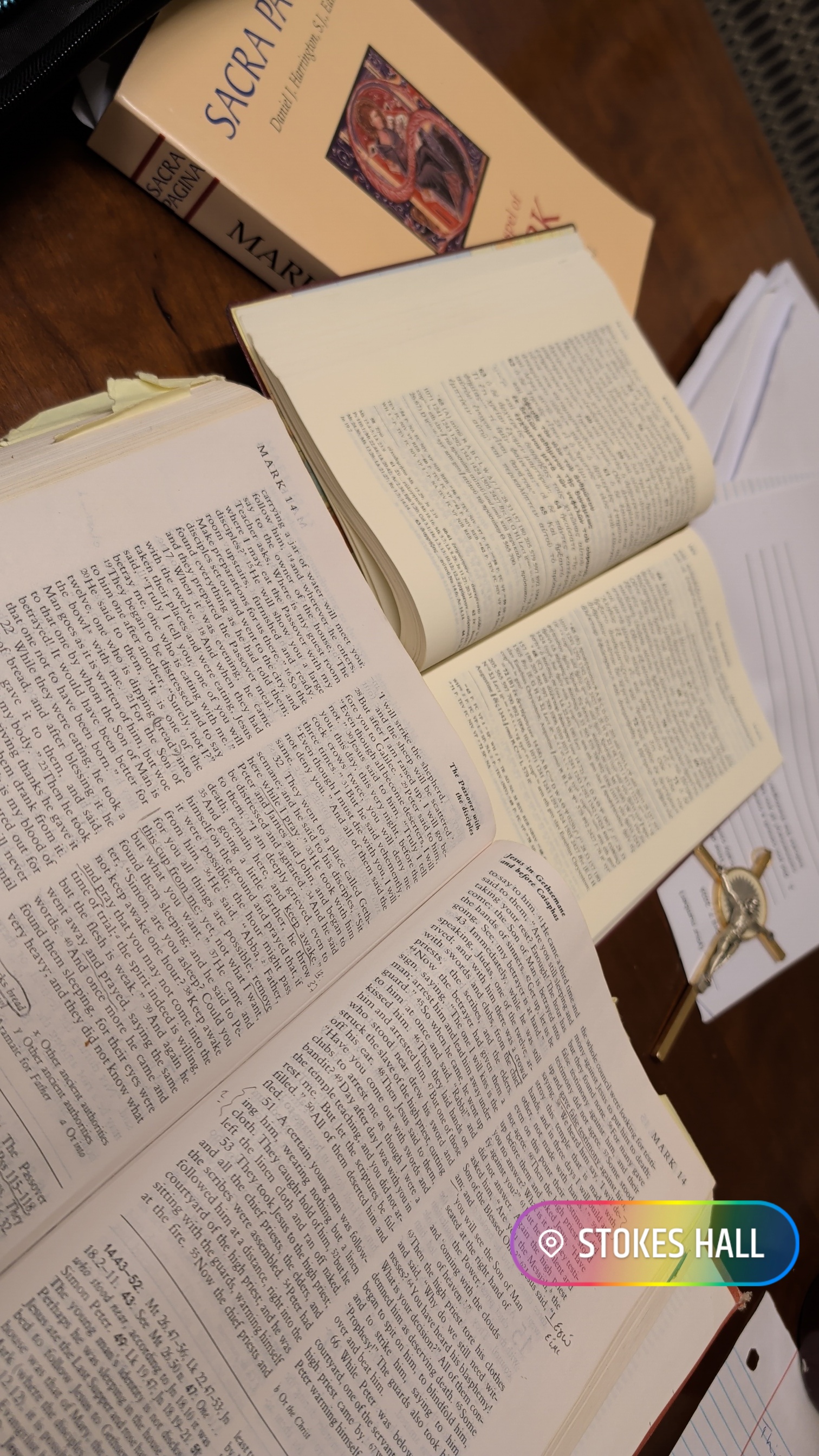
Chalkboard photo 1 from 04/16/2026

📄 Synopsis

This class session focused on the concluding chapters of the Gospel of Mark (14-16), examining the theological implications of Jesus’s passion, death, and resurrection. The discussion began with the Last Supper, where students contrasted Jesus’s earlier miracles of physical feeding with the spiritual nourishment of the Eucharist, drawing a comparative parallel to the Hindu concept of the 'one becoming the many.' A significant portion of the class was dedicated to the humanity of Mark's portrayal, highlighting Jesus’s profound human vulnerability in the Garden of Gethsemane. Students analyzed his prayer to 'Abba' and his plea to remove the 'cup' of suffering as evidence of a spiritual struggle that mirrors Arjuna’s crisis in the Bhagavad-Gītā. The dialogue also explored the failure of the male disciples—specifically Peter’s denial and Judas’s betrayal—contrasted with the 'significant bystander' role of unnamed women who anoint and witness Jesus. The session concluded by examining the centurion’s recognition of Jesus as the Son of God, suggesting that a lack of preconceived messianic expectations allowed a Gentile outsider to see what the inner circle could not.

Key Takeaways

  • Mark’s Gospel shifts from Jesus as a miracle worker filling stomachs to a sacrificial figure filling souls through the institution of the Eucharist.
  • The humanity of Mark's Gospel is evidenced by Jesus’s human vulnerability, fear of death, and his agonizing prayer in Gethsemane.
  • Jesus’s struggle to align his will with the Father’s purpose serves as a comparative parallel to Arjuna’s duty (dharma) in the Bhagavad-Gītā.
  • The 'crowd' functions as a dynamic force that shifts toward condemnation, influencing the actions of the disciples and Pilate.
  • Unnamed women in Mark serve as 'significant bystanders' who perform essential roles like anointing Jesus for burial when the male disciples fail.
  • The centurion, a Gentile outsider, recognizes Jesus as the 'Son of God' immediately following his death, highlighting the theme of universal recognition.
  • Peter’s denial illustrates the impact of social pressure and fear on faith, contrasting his earlier promises of loyalty.
  • Mark’s use of Aramaic phrases like 'Abba' emphasizes the raw, human intimacy and suffering of Jesus.

🎤 Transcript Tap any timestamp to jump the audio player

0:01

Opening Meditation and Transition

Brad
Ready? Howdy, everybody. Let's take a moment and transition, please. Just take a moment to be quiet and still. Let's take a breath together. Go ahead and breathe in and out. Word? OK, let's see. So it's in Georgia. And that's it, yeah? And OK, so I know Aiden has registration. And Luke has registration. Anybody else have registration? All right. OK. So Allie, Grace, and Lily. Good luck. And who are our discussion leaders today? All right. Let me jot these down. So Scott, Katie. Caroline, Iona, Brett, Lauren, Kellen, Casalia, Śaṅkara. Is that it? Is that— that's not him. Oh, Kat. Sorry. Yeah, all right, cool. A couple of business things. One, no class on Tuesday because it's Monday schedule, so you don't have my class on Tuesday. And I have an additional assignment for next Thursday. So next Thursday we'll finish the Bhagavad Gītā. And for the Bhagavad Gītā, we'll finish everything. So we'll go ahead and finish the chapters. They— I'll just be honest, they get a little bit repetitive. These aren't the great— I mean, whatever, they are what they are, right? But there's some super interesting passages in there.
3:18

Administrative Notes and Final Podcast Instructions

Brad
There's a number of things from chapter 18 we could focus on. 1866 is one of the most famous verses, but But every time I've taught this class, I really like to end by focusing our attention on chapter 15, the first 5 verses of chapter 15, so verses 1 through 5 of chapter 15. So, you know, I'd really like you to focus your attention on those, and those, you know, those of you who are leaders that day or looking to, you know, be a leader that day, really focus on the commentaries, you know, see what the commentaries have to say. Read those verses very closely. They're enigmatic, to say the least, and super interesting. But the additional assignment is I would like you to watch the movie Black Panther. Probably most of you have seen it before, but I'd like you to watch it again even if you've seen it before. So I think it raises a lot of interesting discussion points, not only for The Bhagavad Gītā, I mean, it's clearly related to the Bhagavad Gītā, but there's also, you know, Christ character with death and numerous death and resurrections.
Brad
So it's a really interesting comparative, opens, you know, interesting comparative opportunities. The final podcast, your final podcast, you should do after next Thursday. And yeah, then I don't— I sometimes take attendance of the last 2 days, but they won't— they're not a factor in your grade. So the attendance grade ends next Thursday. So it's just today and next Thursday, and that's it. And If you have any makeups to do, you can only make up over the last, you know, 3 weeks, but time's running out for that. And if you haven't done your initial meeting with me, tomorrow is the last day. So today and tomorrow. Cool. That's all I got. That's all the business stuff. So then let's turn our attention to the text. I want to do things a little bit differently. Today. So I want to definitely get into a circle and we can spend a few minutes, you know, we'll go to maybe a quarter till in your teams and then at a quarter till we'll shift to the big discussion. And I may or may not face the wall.
Brad
But I'm not going to talk for at least the first 20 minutes or so. So I really want the discussion leaders to lead the discussion. And, you know, we can— we don't necessarily have to— I mean, we should pretty much go in order, I guess, but we don't have to be as regimented as I have been in the past, you know, don't talk about Chapter 15 until we finish 14, that kind of stuff. We can cover these 3 chapters collectively. By the way, this wasn't exactly part of my thing, but this morning on the way— Oikos, a little Greek joke there— on my way to BC, just as actually as I was pulling into the parking garage, I was listening to the news and the Secretary of War was holding a press conference. And during the press conference, He offered a rather extensive exegesis of Mark, Mark's Gospel, chapter 3. He went into some detail about the story of the healing of a paralytic on the Sabbath in the temple. So Jesus goes into the temple in Mark chapter 3 and heals. Heals a paralytic, then, you know, the Pharisees jump all over him.
7:30

Contemporary Relevance and Discussion Setup

Brad
So anyway, sometimes the things that we teach in here are directly relevant to contemporary affairs, and this would be one of those examples. I don't really need to say anything more about that, but I thought it was interesting. So words, let's go 5 minutes in the groups and kind of organize in the circle. And I'm— I think I'm gonna turn around and face the wall for a little bit. I actually know All of your voices, I think.
Student
Oh, well, no, I know I have golden nuggets, but I'm saying like an addition. Thanks, thanks, all great. It's all about what you hear in Mass, the foundation of Christian practice and communion. My highlight though is in the last chapter, usually it's Jesus, uh, he's no longer giving literal bread like you get example in like part chapter 6 or part chapter 8, uh, 5,000, 4,000, like this is more like spiritual bread. And so it's like shifting from like America, from America worker to, from filling people's stomachs to filling their souls. And that's kind of a theme throughout where like he's no longer an America worker, he's actually using something of a different style. And it shows again in the next part of chapter 14 when they're in the garden with his like the inner circle of disciples.
10:05

Student-Led Discussion: Gospel of Mark Chapters 14-16

Brad
You have stuff like, "Awake and pray that you may not fall into the time of trial.
Student
The spirit needs its willing, but the flesh is weak." Which is kind of showing how earlier it was super easy for disciples, they were energetic and would do all the cool stuff, like watching Jesus heal people, or arguing with themselves, because they'd be like, "You're crazy." But now that they're like, "I just like to go to sabbath," I am, and it's like the moment in the record that he like— oh yeah, he's like the main man. He used to be all hush-hush about being the son of God, and now like he's willing to like be set to the blast zone. He's like put to death because he's like being the son of God. I don't know, 7 to 14. Yeah, that's great.
Brad
Let's stay there.
Student
Um, chapter 15 was probably, uh, now when the Messianic period, the Messianic expansion saw that he saw that in this way he had essentially this manpower advantage. This is really obvious because the Romans had divided their forces on, uh, people like Gentiles, Jesus is the Son of God, so he's like a soldier of the enemy right now. I like his inner circle.
Student
That's it.
Student
Kind of silly.
Student
And it just shows how the story after the death of Jesus falling from the corner works. And like, now that the circle is part of the suffering, like, the enemy of God is really falling.
Student
I don't know.
Student
Chapter 16.
Student
Resurrection.
Brad
Sounds like some folks have already moved on, so let's shift to discussion.
Student
Yeah.
Brad
Also, part of why I'm turning around, just to make it obvious, the goal of theology, as Claudia said, is to try and see your neighbor through the text. And so a lot of times, I mean, A lot of times in class, it winds up being a discussion between me and the class. And so, and that's entirely on me, really is. But, and so part of my trying to get away from that is turning around. It's not because I don't want to see you, it's because I want you to see each other. So really try to see each other, hear each other, try to get in discourse with each other. Don't try to win points with your professor, that kind of stuff. Put the text at the center and, you know, practice theology the way I've tried to describe all semester. You can disagree with each other and you have different perspectives. You can bring in, you know, it's always good to bring in some expert views, but do that as a way to kind of guide the discussion, really, you know.
Brad
So try to have an organic discussion, try to forget that I'm here or that you're doing an assignment, and instead just really try to see see one another and hear one another through the text.
Student
Hey guys, chapter 14. A lot of stuff going on. We have Passover, we have chief priests trying to have disciples betray Jesus and like paying the money. But something I'd like to highlight midway through Mark 14 is While they were eating, he took a loaf of bread, and after blessing it, he broke it, gave it to them, and said, take this, this is my body. Then he took a cup. After giving thanks, he gave it to them, and all of them drank from it. He said to them, this is my blood of the covenant, which is poured out for many. This is, uh, uh, 22. Um, so obviously this is like foundation of Christian practice of communion, but more specifically tying it to earlier, uh, chapters is Usually, like, Jesus, like, he, he, in this section, he stopped giving them literal bread. Like, for example, in Mark chapter 6, like, he gave 5,000 people bread. In Mark chapter 8, he gave 4,000 people bread.
Student
And now it's instead of literal bread, he starts and like kind of shifts from being this miracle worker from like filling stomachs to like— I kind of botched how I thought about it, but like filling souls. Like, he's giving himself to others, which by this point late into Mark, like, I guess what I realized is it's less about the miracle workers, the miracle work of Jesus, but like people getting out of this like cloud of like not understanding who he is. And like, I guess as Andrew told me, it means to like find it, have the disciples and people following him like means to heal themselves, not just through the healing of Jesus.
Student
I feel like that makes sense.
Student
It sort of also reminds me of like, um, what we've been talking about, like in all the Hindu texts we've been reading about like the one becoming the many. I feel like I really liked what you said about like killing the soul and stuff, because I feel like it's sort of like— I don't know, he's saying like, this is my body, so he's like sort of like giving a piece of like him towards like other people's soul. And I feel like that's like the one becoming the many. I don't know, it's interesting to think about.
Student
I agree.
Student
It's also kind of like throughout Mark you have all these instances of disciples and everyone kind of losing their faith, where there's a lot of humanity in like, we kind of need that check-in with our faith and then some sort of touchpoint. And so then Jesus kind of recognizes this and gives them a touchpoint before he obviously knows he's going to get killed. Trade and, you know, be want, but like he gives that kind of as a way to like keep communion.
Student
I also like Augustine that was talking about how it's just like, this is the blood of— oh, this is my blood of covenant—
Brad
is talking about like the bringing the connection between like the people that are there and God.
Student
It's like connecting them all together before he goes to have to die. Earlier on in the chapter, there's another part that kind of relates back to that, of others not understanding what Jesus is saying, like the part with the woman and the ointment. And I kind of looked into this more because I just was kind of confused as to why they would include this at this point. And then obviously reading on, it made more sense because here the woman is kind of prophesying what's going to happen to Jesus, but yet it becomes like a lesson for the others to come. Him as well. So it's like, I think there's just a lot of layers to this one part. First, obviously it's saying that like Jesus is going to end up going to his burial. And I also found like in the commentary at the beginning of the week of this that like the way that she does this is kind of painting Jesus as a king, which also relates to what will happen after. It's like using the same imagery.
Student
It's kind of the first mention of Jesus as a king, which is something that he'll be mocked at, at like the crucifixion. And I also thought it was just interesting that it's just this random woman. There's no real description given to her, and there's no title given to her. Earlier on, it was said that it was a Phoenician woman. That was another example of one of the few times another woman was shown in this text. But this one doesn't really have a description. And I think it's just purposeful to end up relating to the message that Jesus tries to say at the end, where he says, she's performed a good service for me, for you always have the poor with you. You can always show kindness to them whenever you wish. So I think that this one section kind of showed a lot and hits on a lot of things you just said, like the understanding part, like the role of other people in recognizing who Jesus is. I just thought of that.
Student
Yeah, I agree. I liked that the Gospel of Mark is keeping, like, giving the clear understanding of what faith actually is. And in chapter 14, I mentioned to myself that he was trying to show us that faith is not like the absence of fear. You can have— you can fear, but at the same time you can have faith. And for example, in verse 36, when Jesus said, "Abba, Father, for you all things are possible. Remove this cup from me. Yet not what I want, but what you want." So Jesus clearly, he doesn't want like suffering for himself, but he still chooses to like align with his higher purpose and goal over his like personal comfort. And also I've connection with the Bhagavad Gītā, where like Krishna tells Arjuna to remain steady and like act according to his specific role and to not rely on emotions. And I think in both texts, the real test is like whether someone can act rightly according to their like roles when they got like feelings that don't allow them to actually act rightly, I guess. And I think this is really interesting and hard at the same time.
Student
Yeah, I agree with it's hard to do what's right when the situation doesn't like provide itself easier, or like having not seeing the higher purpose and what you need to do for example, a few verses after that, 38: Keep awake and pray that you may not come into the time of trial. The spirit indeed is willing, but the flesh is weak. And this kind of connects to the higher purpose of like Jesus, like, as like the Messiah. Like, it's like, like, it's easy to follow this Messiah who he was like, he was trying to be secretive of being the Messiah. Like, it's easy to follow as a disciple when times are easy, like when Jesus was doing the cool things like healing people, or them arguing amongst themselves like who would be the greatest in his kingdom. But like when they're in this garden, like his inner circle, like they want to escape the suffering and they like want to sleep. And that connects to the earlier section in chapter 14 mentioning about the ointments. Like even like you're not really seeing the clear vision.
Student
Like in verse 5 they say for this ointment could have been sold for more than 300 denarii and the money given to the poor. But like, they are arguing about like the most effective way to like be like the best disciple or like the greatest in his kingdom. But then like in the next page, like they're falling asleep on the job and they're like not suffering alongside Jesus. So like they're not following that like higher purpose.
Student
I noticed that also in chapter 16 where Mary like came to his tomb and like brought spices so that they could anoint him. And I feel like that was like kind of like a running theme where it's like these women like followed and like stayed with him and then like anointed him. And then the same thing with like the other woman with the Yeah, the ointment. And they did all this for him and kind of believed in him. And then his disciples were, like you said, falling asleep or leaving him or betraying him. And I feel like that was very much a running theme throughout 14, 15.
Student
Oh, a couple of verses before the one You said, um, what I kind of liked was, uh, Mark 14:34, which was, and he said to them, I deeply grieve even that death remain here and keep awake.
Student
Going a little farther, he threw himself on the ground and prayed that if it were possible, the hour might pass from him. He said, Abba, Father, for you all things are possible.
Student
Remove this cup from me, yet not what I want but what you want. Um, so it was kind of like showing like a more human side of Jesus, like I thought this was a good thing that they added because God is known as the Son of God, and he's this mighty and powerful person. But he's still human, and he's still sorrowed by his death. And I related it back to the Gita, where it's like action is inevitable. And it's like you kind of have to do it. It's like his duty, even though it's not the most ideal thing for anyone. But it's kind of like, oh, you have to do this is your duty. And like, um, not that you have to separate the emotions, but like he's still feeling sorry about it, but he kind of knows what he has to do.
Student
So I kind of—
Student
that was interesting.
Student
Yeah, it's kind of like— I was really similar, really important as well, like seeing how I can say vulnerable he was in this moment compared to a lot of— like majority of the text is a lot more like he's trying to give those orders and he's going back. So when he was giving the bread and the blood, like her body blood, like with all of that, like very much like how he's given the orders, like very much you can tell like he's almost in charge per se. But in this case, like it's very much showing like, oh, like then they like God's actually in charge. And like, I think showing this moral side of him during this time was really important.
Student
I kind of connected the verse that was read earlier about like how he had to go through with sacrificing himself for God's plan and to fulfill his duty. I connected that back to verse 24 when he says, he said to them, "This is my blood of the covenant which is poured out for many." He's kind of suffering or sacrificing himself in that way to help the many. And I connected that back to a verse, or yeah, that we read a while ago in of the suffering servant, where the Lord sacrifices himself for the sins of the many. And I actually read a commentary about this where he's pouring out his blood for the many so that they can be saved. And like, kind of like what you were getting at before about how they can like— it kind of touches the soul rather than just healing them from like his actions. It gives them the ability to heal themselves. So then I should know that like he is a suffering servant servant who's sacrificing himself to save the many.
Student
And back to the part where we talked about how he's more vulnerable in this chapter, I think that one of the things that kind of made me realize this was one of the last lines, I think it's— yeah, it's verse 21 at the end where he's talking about the one who betrayed him, which obviously we know is Judas. But he says, "It would have been better for that one to not have been born." And when I read that, I was kind of stunned that it would be written like that. Like, I thought that was really harsh and like it went against— like, even though I'm not religious, like, I thought it kind of went against what I thought would be something that Jesus would say. Like, I was thinking like, okay, wait, everyone has like their purpose and everyone should have been born and everyone like has their role in life, whether it be bad or good. But then I like— so I looked at the commentary to kind of see, and I didn't really get too much of an answer on just this one line.
Student
Like, it was kind of just stating it again, but Then throughout the commentary, he was talking about how it made me realize again, this is not Jesus who's writing this. It's Mark. So I was wondering, as we're talking about the vulnerability, maybe it's kind of also the influence of Mark as he's writing this. This was traumatic for them. And obviously, it wasn't— these last 2, 3 chapters aren't necessarily uplifting at all. So I was wondering if maybe it was just the stress of what they were witnessing that caused them wrote it in this way. Maybe it's more of a community saying it would have been better for that one not to have been born. But I mean, it also could be something that Jesus would say, I guess, because we have seen his more human side, like yelling at the disciples earlier on, like getting angry. And so I thought this line was pretty interesting. And I thought maybe it said more about how this was written and the influence of the writer and the community and the time period and everything.
Student
I thought that was interesting, but I would definitely agree that Jesus does seem to be more vulnerable. And I think it's meaningful that it's closer to his death, because I think that makes him more human and more shared with the human experience than just being this divine figure.
Student
I was going to say that too. It definitely shows that Mark is writing this and not Jesus, because I agree that Jesus has those flashes of humanity, but also throughout the whole gospel, he knows he has to be betrayed and killed at some point. So it's like, it's necessary that Judas was born and all that. And so it's like, he might resent it, but like, he still accepts it. And so like, that I definitely think is Mark kind of ad-libbing. But then also like another example of that, like it's a human writing this, is 14:10 that I saw where it's like, then Judas Iscariot, who was the one who snuffed his blow, went the chief priests in order to betray him to them when they heard it, kind of blah, blah, blah. But it doesn't give a lot of backstory into why he went to the chief priests, what he was doing. All right, you followed this guy around all of Israel, and then now you're deciding, ship him off to get nailed to the cross. It's kind of like, well, why? And it's like, well, Mark doesn't really know why. About.
Student
You can just write like what happened.
Brad
Interesting question.
Student
I think that's a very interesting perspective because I kind of had like the same questions about like, like in 1477, 1433, and 1461, I feel like the way Jesus was like kind of like described was very different to how he like normally was described. Like more like he's normally very like selfless and humble, but then he said like, "For you always have the poor with you and you can show kindness to them whenever you wish, but you will not always have me." Like, I feel like that sounded like a little bit selfish in a way. And then like when he like got really distressed and like threw himself on the ground, like I feel like a lot of like how he was portrayed in 14 was like much more like, like you said, like human. Human, like, I don't know, just like very different to like how he normally was portrayed.
Student
I read a commentary about this. I was confused about the verse that Caroline brought up, verse 7, because it seems, again, like you said, he was really portrayed in the way that a lot of people would perceive him, like very selfless and everything like that. So in the commentary that I read, it was saying that Jesus wasn't saying that you shouldn't give to the poor. He was saying that you should, you have to care for the poor, but there's something larger at work. So it's not all about the 300 denarii that they could have been paid. They could be paid like twofold, threefold, however much more, because God can end poverty, disease, sin, and death. So with having faith and doing all the things you should do, anointing Jesus and helping him fulfill that and having faith in him, you can help the kingdom of God come to be, and then you can help end poverty rather than just helping a couple people who are poor and giving them that money.
Student
So I think that kind of helps— helped me to understand why he might have acted like that, further than like they're betraying his humanity.
Student
I agree.
Student
I think it was just another scenario where he kind of has to reality check the disciples, just because they've kind of been focusing on the wrong things at all times. So I think I saw that very similar, where it's just kind of Jesus making sure they know what the priorities are, especially since he knows he's about to die very soon. He's just trying to cherish all of that.
Student
Kind of speaking about that, he's about to die very soon. Let me find exactly the one that's the best. It's when Pilate is kind of like going through all of like the preparations and the trial and all that, and then it's Mark 15, um, around— start at like 12. Pilate spoke to them them again, then what do you wish me to do with the man you call the King of the Jews? They shouted back, crucify him. And then 14, Pilate asked them, why? What evil has he done? And, uh, they still said crucify him. So it's like you have the executioner basically saying, well, what's the point? Like, this guy hasn't done anything wrong, and yet they're still trying kill him. So I just thought it was interesting that it's like, this is like an officer of the court that's saying this isn't right, but then you have the leaders who are afraid of Jesus's power and still want him dead.
Student
And it feels very similar to the John the Baptist one. I mean, I want to say the king didn't necessarily want to kill him, but like his— was it his daughter? Yeah, it was his daughter who really wanted. So it feels like an interesting callback where it's kind of just a crowd mentality of he needs to die. And I think Jesus probably knew he needed to die there too, so it kind of just added to it.
Student
Yeah, like for me, like how we're talking about this, like they didn't want to do it, but they kind of have to. Reminds me of what we talked about a lot with the Gita as well, like doing duty. Like, I don't know if this case is maybe— does maybe pilots do need to, you know, I'm saying go kill Jesus, but I guess it was part of his orders. He had to do what's maybe not what he wants to do, but he has to do what he has to do because it's his duty in this case. So I thought that was pretty interesting.
Student
Yeah, I think the peer mentality also comes up a lot.
Student
Someone else brought up how the disciples were afraid of what was going to happen.
Student
They were looking to film Jesus, and they're afraid, so they stay silent.
Student
And I saw somebody else talking about like how it's kind of encouraging for readers to like decide what they're going to do with their own emotions instead of like them choosing the right path.
Student
I think this part's also like— this is one of the parts I said I think those seem to be able to connect to like modern day. Like this idea of like a crowd and like kind of just standing on a soapbox and saying whatever and then like just not having an answer as to why someone is bad or why someone should be punished for what they've done. Like I think of that is really transferable to a lot of what we see in the world right now. So I thought this part was really interesting. And I think it's very much like this is the kind of thing that Jesus stands against very much. It's literally him standing against this idea of just saying crucify him without actually any justification. So I think this is really foundational to what at least I have perceived Christian be like at its core. And I think it's something that like understanding this part better, I think would like do a lot of good like for our world right now. But I think this part, yeah, I just thought it was interesting.
Student
I thought it was like I had a really good like modern parallel.
Student
Yeah, I think this part also again, once again proved us that Jesus's like disciples, they're actually people, human, they can betray. And like about Peter's denial as well, I paid more attention to this one when he said like, I do not know this man you're talking about. But before he was saying like, oh, I don't care, like I will die with you and I will stay on your side. But at the end he just said that he doesn't know him. And it once again shows that like under the moment of like fear and social pressure, a lot of people cannot withstand this and they just fall apart and like Peter did. And I was just curious how Jesus felt when he actually knew about everything. He knew that he is going to be betrayed, but by like one of his closest disciples. He knew that, uh, like Peter is gonna deny, uh, knowing Jesus. And he knew that he's going to like death and he's going to suffer. But he was, uh, actually portrayed and showed as he was like a being stable, I guess.
Brad
I guess for Peter in this situation, I think it's—
Student
this is very interesting because going back to chapter 14, that Jesus point-blank tells him, said, you're gonna betray me 3 times.
Student
And like, when this actually happens, I think it's interesting.
Student
Like, you got to put yourself in that moment.
Student
Like, someone tells you you're gonna do something, like, so in the back of your mind, it's like, do I like go along with that? Like, Peter, in this sense, like, he could definitely have been thinking like, oh, like Jesus told me I'm gonna betray him 3 times. And obviously under the feeling, you're maybe not thinking about that, but I think it's a very interesting portrayal there when he's like, he's already been told he's gonna betray him 3 times and then he actually does it. Like, maybe not like, because I guess that's the fate of what's to happen, but it's kind of weird to see how like he's still just going along exactly with that and maybe not trying to change anything as Jesus already spoke about it.
Student
I wonder what the timeline was or not. Like if it was like you ate breakfast that morning and then after you didn't have them, or if it's like enough time for it to actually take too long.
Student
Yeah, I think, I don't know, I think nonetheless it's probably not. Yeah, it's hard to listen to that, like that slipped your mind as well.
Student
Peter did kind of realize like before the crow, like for that crow, um, yeah, like before the third time, he was like, oh, like, I remember what Jesus said. He said I was going to deny him, and he like broke down crying. So I'm guessing like under like what both of them said, like under societal pressures and just like being in the heat of the moment, you're very like— it's easy to kind of like fall under that pressure and kind of like not really stand where you might believe. Like you might believe one thing, but because of all this pressure and like what the crowd is doing, it's like, oh, like I kind of have to go along everyone was saying. And another thing that I thought was like transferable to like today's world was when Jesus was saying like, "My God, my God, why have you forsaken me?" For chapter 5, or Mark chapter 15, verse 34.
Student
I thought it was like another very vulnerable side of him.
Student
He's kind of like, not like shaken with his faith, but he's kind of like questioning like, oh, like, why is this happening to me? And that's like split for a moment. And I think that scene today where it's like when you're going through a hard thing, you're like, oh God, like, why are you putting me through this? If you love me, like, you're a God, like, why am I going through this? Why is this happening to me? And I think it's easy for you to kind of like have your faith shaken or kind of question it. So I think that's like a good way to like summarize it. Like, it's like normal to like kind of have that—
Student
not doubt, but like to have that like Yeah, I like this quote as well because it shows that again, faith means— it doesn't mean like constant confidence. It shows like spiritual struggle that Jesus faced in that moment, and he's not like distant from pain and uncertainty, and he was completely lost and And I think it actually connects well with like Arjuna and in the Gita, because both characters, they move through confusion and emotional collapse before reaching actual like deeper meaning. And I think this was the final part for Jesus before he like reached the ultimate goal and the actual meaning.
Student
Kind of what you said before, it's like in the moment it's like hard to see like the greater end or like the greater outcome. Like in the moment, because he's probably like, oh, I'm just suffering, this is painful, and he doesn't maybe in the moment just like realize like, oh, there's like greater things to come after this.
Student
This part was also really interesting too because After Jesus dies, then someone which they name as a centurion, which like I was trying to look, it's just like someone who wasn't like of the faith, like said, "Truly this man was God's Son." So right after he dies, somebody who wasn't actually part of the faith, wasn't one of his followers, wasn't Jewish, says like, oh, like, and recognizes like him as the Messiah. So I thought that had to be like significant in something. So like after looking looking at it, this is like a point where now, Link's confession shows that anybody can access the religion. Anyone can recognize the divinity of Jesus and recognize God. And this is opening up the gospel to be more accessible to everyone, which we saw earlier on as well in interactions with Gentiles and So I think that this part, like right after Jesus dies, for someone else to be like now understanding of the faith just shows that like no matter what stage Jesus is in, whether he's like here on Earth or like about to die, dead, like risen again, like anyone can still access the faith.
Student
And I think that that like is really like the point as well, like that Jesus is trying to make. Like he never tried to force anyone to understand, but like everyone was able to, if they truly understood what he was saying, if they recognized that this was really him and who he was. So I thought that was interesting as well, for that to happen right at the surprise. I also thought that part was interesting that someone else who wasn't of the faith realized it, because it's kind of going to, like, all the disciples, like, they would have worked the entire time and been aware of themselves. But it's happened multiple times, like, someone who wasn't sure was the one who was able to.
Student
Yeah, I think, yeah, this specific quote I also paid a lot of attention to it because it just showed that the recognition that Jesus got, that happened at the moment that actually it was looks like maybe it did fit for a lot of people. So Mark, I think he was trying to reverse the normal idea of power that is usually like being portrayed through like greatness and control and victory. But in this case, it was revealed little sacrifice and endurance that Jesus actually showed to us. And I think this specific idea also connects to, like, Guia's topic that true greatness comes from right actions but not from, like, external success.
Student
Going back to something that was said earlier about the role of women in this, I also mentioned it in the Spanish and the German, right after this it says that there were also women in the distance. Among them are Mary Magdalene, Mary, the mother of James, the younger, and Joseph. So I think that here, women are kind of interesting in this text to me because they never really play that active of a role, but they're always kind of like bystander or near witness or just one part in Jesus's story. But I think whenever they show up, it's significant. And they always kind of play a significant bystander role. They're not insignificant. Feeling. They don't just stand there as witness, like they always have— there's always some meaning. And I think here, like, they are shown to be like true followers of Jesus who— I mean, it's unclear whether or not they truly understand, um, because I just don't think they were— maybe that's kind of Mark's influence. Like, I don't think he like really describes them enough and like goes into detail about them enough.
Student
But I think that, um, they're definitely shown to be loyal followers regardless. And like, it's Mary, Magdalene and Mary who see where his body is laid, and they're the ones who bring the spices to anoint him at the end. So I think I thought it was just interesting how they portrayed him and how it's kind of a combination of their importance but also the limitations maybe at the time that they weren't really given a lot of attention in the text. But definitely important to Jesus' story. They seem to at least understand that bit about like who Jesus is and like the importance of him and this journey that he's on. I feel like that's interesting. I feel like that's sort of like aligns with like the way like modern social movements like work too.
Student
I feel like women often like, I don't know, like at least historically women have often like played like supporting roles while like not like being seen as like the forefront people but like being like people that always like supported like moving behind the scenes and stuff. I don't know, so that was like an interesting thing to point out.
47:14

Instructor Synthesis: Comparative Theology and Symbolism

Brad
Cool, right on. I'm gonna switch sides. Yeah, really super, super interesting. I want to— yeah, I think you I think it was Lauren who said the centurion was able to recognize him because he wasn't trying to look for something in particular. Yeah, that's a really, really important point. It's hard for me to hear that without thinking of my opening lecture. That's sometimes— sometimes not having information makes it easier to see what's before our eyes, right? Sometimes if if we're looking for something in particular, then we see what we're looking for, right? Confirmation bias or something like that. And I mean, that's really exactly what the disciples' problem is, isn't it? I mean, they really expect to see him in this, you know, they expect the Messiah to be what they expect the Messiah to be, right? And then so They're like, are you the Messiah? And he kind of, you know, acknowledges that, but, um, but they just still are so convinced that they're, you know, what their preconceived notions are, um, are, uh, all right. Really good discussion, um, a lot, um Why is there no mention of the lamb? Yeah.
Student
I was going to talk about the bread more and the significance of it being unleavened is that it doesn't have time to rise.
Student
So it's a quicker thing.
Student
This passage seems like a bit rushed to like his execution, so Jesus, like, this might demonstrate like how it was rushed at the end and like he only had like a little window of time to like try to preach to everyone that he was the Messiah and like give his body in like the form of a lemon bread.
Brad
Mm-hmm, yep, yeah, Callum?
Student
Like, I feel like many times throughout this and just like Christian ideology, Jesus is compared pair to like a lamb or like sheep shepherd. You always have that. So in theory, you could say that Jesus is the lamb here to be sacrificed for everyone else to then be like saved.
Brad
So they don't talk about the lamb during the Passover Seder because the real lamb hasn't been sacrificed yet? Yeah, okay. Yeah, because there is a lot of emphasis on the, the timing, right? Even like to the hour. And this is one of the places where the Gospels, you know, vary a little bit, but specifically told in— yeah, I mean, sort of like hour by hour, right? The festival, but like 15:25, right? It was 9 o'clock in the morning when they crucified him. And then there's, it was noon, when it was noon darkness came over the whole land until 3 in the afternoon. And then at 3 o'clock Jesus cried out with a loud voice, "My God, my God, why have you forsaken me?" in Aramaic, interestingly. And yeah, yeah, I think that seems like a legitimate interpretation. Good. Also, one point here Verse 38, so chapter 15, verse 38. Very, very important detail here, not to be overlooked, that Jesus gave a loud cry and breathed his last, and the curtain of the temple was torn in two from top to the bottom.
Brad
Um, and I think, Castalia, I think you brought this up, right, that anyone can access the gospel if they recognize him. And there's something— and drawing that directly, your point was about the centurion, which is the next verse, right? The centurion who faced him, who stood facing him, saw this way he breathed— that in this way he breathed his last. Awkward grammar. He said, "Truly this man was God's Son." So the only human character in the entire text that recognizes or says that he's God's Son. So that's important, right? We've seen other characters in the text that recognize him right from the beginning. Of course, we're told in verse 1, but we're not a character in the text. We're the, you know, audience. But— But the other characters in the text, they're all unclean spirits, right? So they're the ones that proclaim him as God's son. But this is the first time that a human does. And here it is after his death. And it's, as Kathleen pointed out, not a Jewish person and not a member of the disciples, not a follower.
Brad
So, you know, I think connecting these two ideas together, because he didn't have this expectation, because he, you know, yeah, because he didn't have that expectation, maybe then he was able to understand this in a way different. We could also maybe, you know, we can speculate. All we can do is speculate about who Marx's actual audience is. You know, there's a lot of debate among scholars, and I'm not going I'm not going to get into that, you know, quagmire, if you will. But some scholars, you know, suggest that maybe Mark was writing in, if not in Rome, then at least in the Roman Empire. So not, I mean, of course, this is the Roman Empire. But I mean, closer to Rome, more in the dominant Gentile, environment and writing to. I mean, I think probably a mixed audience, definitely some Jews, but definitely, I mean, Mark keeps translating Aramaic to his audience, so they don't know Aramaic. He keeps explaining Jewish customs to them, so maybe they're not Jewish. So maybe their audience looks a lot more like the centurion than the disciples, right?
Brad
The disciples are constantly failing and open question as far as whether or not they fail even in the end or not. I think you could read it multiple different ways. But no doubt, right, that the centurion is the one human character that really seems to understand him and even continues to have an additional role, right? So there's— Verse 39, when the centurion stood facing him, he saw that it was, yeah, truly this man was God's Son. But then verse 44, then Pilate wondered if he were already dead, and summoning the centurion, presumably, I mean, it doesn't say a centurion, it says the centurion, so presumably the same centurion, and asked him whether he had been dead for some time. When he learned from the centurion that he had been dead, that he was dead, then he granted the body to Joseph. Yeah, so interesting to say the least. Another thing that was brought up in the, in the, in your discussion, but maybe needs a little bit more attention, is the notion of anointing, right? So he is anointed And so Mashiach or Christ means the anointed one.
Brad
And so it's good to pay attention to who anoints him, as you guys did discuss a bit. Castilleja again said that, you know, the women never play— I like how you said it— significant bystanders. They're significant bystanders. And women in this, in these few chapters, there's so many women, most of them not named. There does seem to be a difference between women who don't get a name and women who do get a name, and it seems like the women who don't get the name are actually more important than the people that do get a name. But some of the women who don't get a name are the woman who anoints him. Right, so Mashiach means anointed one, Christ the anointed one. So here he is actually anointed by one who, um, by a woman who has no name, who doesn't— we don't know anything about her other than she comes in with this, um, I mean, so she doesn't have a name but she has really expensive perfume, um, and she even gets reprimanded or in trouble for that. And then we've got another unnamed woman in the whole Peter episodes, right?
Brad
So while Peter— this is chapter 14, verse 66— when Peter was below in the courtyard, one of the servant girls— which apparently servant is not in the Greek, but according to my commentaries I read, but just says one of the girls. It seems like maybe she was a girl associated with the high priest. Well, I mean, says that, right? So one of the girls of the high priest came by, and when she saw Peter warming himself, she stared at him and said, you were also with Jesus, the man from Nazareth. But he denied it. Then the cock crowed. Then the servant girl, on seeing him began again to say to the bystanders, this is one of them. So, you know, she plays a pretty important role here. Again, a woman without a name. And then, of course, we've got the women, women at the end of the gospel. Another thing I want to draw attention to, so a theme that we've discussed throughout the semester, throughout this half of the semester, is the role of the oklos, the crowd, right? So as I said, the crowd plays a very important role.
Brad
It's another— it's a character within the text, really, with an important role to play. And that role shifts dramatically in these chapters, right? In fact, you could even say that the reason that Judas And some of the other— Peter, Judas and Peter, so maybe even all the disciples. The reason that they shift their, you know, begin to deny him and shift the way that they interact with him and respond is because the crowd has already shifted, right? So the crowd goes from like Palm Sunday where they're, you know, waving their palms and certainly in the beginning of the text where They're crowding, the crowd is crowding, you know, his house and trying to get in to get the— bringing the paralyzed person on the mat and all those kind of things, right? And the woman in the crowd with a hemorrhage, you know, it's in a huge crowd and all that kind of stuff. So the role of the crowd plays an interesting role here. And for example, Pilate, right? So Pilate— important to recognize that Pilate is a Roman governor, right? He's the one that's really in charge here.
Brad
We can pretend like Herod is in charge because he's the king, but Herod just does whatever Pilate says to do, right? But Herod can have all the freedom as we he wants as long as he doesn't do anything that contradicts what Pilate says, right? So Pilate's the pilot. But yeah, it's kind of funny. I didn't even— it was an accident. So the crowd— yeah, the crowd keeps coming up here over and over again. Trying to look for the first time, but so chapter 15, verse 7, verse 8. So the crowd came and began to ask Pilate to do for them according to his custom. Then he answered them, do you want me to release the King of the Jews? Because he thought it was jealousy of the chief priests, right? But then they're rabble-rousers or whatever. And then the crowd shouts back, crucified him! Pilate says, why? What evil has he done? They say, crucify him! So Pilate, wishing to satisfy the crowd, releases Barabbas. By the way, anybody look up what Barabbas means? Barabbas is a name, but it's also Aramaic. Bar means son of, and Abba, Abba means father, right?
Brad
So the son of the father. Yeah. It's an interesting name. And then, yeah, crowd, crowd, crowds, right? And then the crowd is gone, right? So there's no crowds, obviously, in the end. Other thoughts? Yeah.
Student
I thought a little after this, in chapter 15, where the Simon of Cyrene character jumped out to me.
Brad
Yeah.
Student
I was reading past it, and the footnotes, it says that like Simon in this effect replaces Peter because he helps him carry the cross.
Brad
Yeah.
Student
And they said Peter's original name was Simon. And this is when he proved incapable of Peter himself taking up the cross because he denied Jesus. So I thought that was like a pretty important connection.
Brad
Yeah. Yeah.
Student
Interesting.
Brad
I didn't even think about that. Peter. Originally I'm seeing Simon. Yeah, and I did, I mean, even this time reading it, I mean, there's so much detail, right? I mean, this person that hasn't appeared before or since, and then we're told not only where he's from, it was Simon of Cyrene, the father of Alexander and Rufus. Like, what is up with those details, right? Why is this so much detail about this character that otherwise Seems— yeah, one of the commentaries I read said that, you know, maybe these, these people, at least Alexander and Rufus, maybe are actually known to Mark's original audience. So maybe they knew this person. That's really just speculation though. There's nothing in the text that would, that would confirm that. Other thoughts? What do you think about this super enigmatic ending? So, I mean, no one sees him, right? He's just There's this curious fellow that appears to the women in the tomb. So chapter 16, verse 4: When they looked up, they saw that the tomb, which is very large, but already been rolled back.
Brad
As they entered the tomb, they saw a young man dressed in a white robe sitting on the right side, and they were alarmed. But he said to them, do not be alarmed. 'You were looking for Jesus of Nazareth who was crucified.' So interesting, no title there, just his, yeah, Jesus of Nazareth, which would be the most natural way to explain them, right? You know, but not Son of God or not Messiah or not the Son of Man or anything, but just straight up Jesus of Nazareth who was crucified. 'He has been raised.' So interesting passive construction there, right? He didn't raise himself or something. He just has been raised. He's not here. But go tell his disciples and Peter. So isn't Peter one of the disciples? So why? So that could give credence to what Evan was saying about maybe he's not really— maybe he's not the rock that we— Peter means rock— that we think he is, right? But is in this, for this gospel, right? In other gospels, Peter plays a much different role, but here maybe Mark doesn't, you know, hold Peter in such high regard.
Brad
Maybe he's not one of the 12. I don't know, is that reading into— what do you think? The disciples and Peter, does that mean anything? Is that significant at all? What do you think, Brett?
Student
I think it could be either end of the spectrum. Or it could be the disciples are above Peter and Peter is lesser than them. Or it could be the disciples are lesser than Peter. I don't have an opinion either way.
Brad
I mean, it could be one of those details I'm reading too much into, right? Or it could be significant. That's the problem with reading text like this. It's hard to know what is super important and what's not. Yeah. It also seems kind of strange, like the chapter prior, they kind of really went into detail to his reaction after he was denied everything else. It seemed like he had some kind of realization too at that moment. So maybe his faith has understood the disciples. But it's also kind of strange they went in depth into his reaction instead of what all the other disciples were thinking. Yeah. I mean, why all this detail about Peter? What's the whole Peter thing even mean, right? I mean, you're going to the Deny me, no I'm not, and then almost immediately denies him, you know. And yeah, why those details at all? Yeah, yeah, man. I mean, I don't know if it's like 100% correct, but like I think it kind of sets up like the stage for to show how like forgiving Jesus is like in the future.
Student
Because I'm pretty sure that Jesus ends up forgiving Peter, and it just shows you the principle of no matter how far you can stray away from your faith, God's always going to accept you.
Brad
So even the inner of the 12, even those that are closest to him, still trip up and make mistakes. So even they will be forgiven kind of thing. Yeah, Castille?
Student
Always had a more active role in trying to figure out what was going on.
Student
But I think he did it in a different way from the other disciples.
Student
I think the other disciples very much are like, they're trying too hard to find something that they're not going to find. Like we were saying, they're trying too hard to look for what Jesus is, and they're missing it completely. I think Peter has defied Jesus in the past and questioned him a bit. And I think that his failure here is what ends up being his success of realizing that he was looking in the wrong direction and like Jesus knew what was going to happen. And like, I think that he realized that he should have trusted what Jesus had said all along. And like, in that trust is where he kind of failed. And because now he recognized that, that ends up making him like understanding of what Jesus was and what he was trying to do. Um, so I think it is significant that they like separated him here. I think like maybe even Peter himself— I mean, I have no idea.
1:08:03

Lecture: High vs. Low Christology and the Humanity of Jesus

Student
Any of the other texts, but like maybe Peter himself is kind of separating himself from that too, and like, oh, like now I actually understand more, now I'm recognizing what the disciples have been missing this whole time.
Brad
But again, I'm not sure. I mean, I'm not— none of us are. Yeah, but great, great thoughts for sure. Awesome. Other thoughts? What do you think? I mean, we haven't really talked. So another theme running through the text is about prayer, right? And so I've raised the issue of prayer a few times, that Jesus doesn't pray a whole lot during Mark's Luke's Gospel, he's praying like right, left, and center. But in here, we haven't seen him— we've only seen him pray like a handful of times. And then here, of course, we get a great deal of detail about his prayer, right? And for 14, as you guys discussed already in some of your, in some of your comments, but anything else that I have to add there about Yeah, I mean, you know, I guess most importantly maybe verse 36. He said, Abba, Father, for you all things are possible. Remove this cup from me, yet not what I want but what you want. Um, yeah, so yeah, what do we think? This would raise questions of Christology, right? So Christology is like, what does it mean to to say Jesus is the Christ.
Brad
And what's usually called high Christology versus low Christology or other kinds of Christology. You're nodding. So, like in John's Gospel, for example, John's Gospel is usually seen as extremely high Christology. Not even entirely clear whether Jesus in John's Gospel has a body, whether he eats and poops and that kind of stuff. He seems to be almost an avatar, just like a descent of God, you know, not even in the flesh, but just here. Whereas, you know, in Luke and Matthew, you've got the birth narrative, and so there's at least some notion that maybe Jesus is actually he's genetically God's Son, whereas here we don't have any sort of birth narrative or that kind of thing. So some people would argue that Mark's Gospel has the lowest Christology, meaning he is Christ in, you know, in this sense, but not— so yeah, I don't know, what do we mean by God's Son? That may be another way of saying it, right? What does it mean? What's the relationship between Jesus and God's— I mean, he's calling God Father and also asking to remove this cup from me.
Brad
So there's at least some distinction between, you know, God as Father and Jesus as the Son.
Student
Yeah, I think that, like, as we said before, like, I think this whole— these 3 chapters are really making Jesus seem more human to me. Like, I think him calling God Father and not God is in this moment is significant because I think that it shows that like what he's saying here is that he does not want what's going to happen to him, but you know, his father does. And I think that that's like very human. Like, I think that's like such a human experience to like not want something for yourself and know that others want it for you, or like to have to do something that you don't want to do. Like, we all do that like every day, I think. So like, I think that this makes him seem more human, and maybe— I don't think it like denies his like divinity in any way, but I think it just shows that like the connection between him and God is one of the Father and Son, which is like obviously like a uniquely human— I'm not even human, I mean like animals sing things.
Student
So like I think it just is like a very grounded experience, and I think that that's like what's trying to be said here.
Brad
Great thoughts, great insights. Yeah, it also seems like to like During the moments where he's praying and telling disciples to pray with him, there's definitely some fear in what he's kind of saying. He's like, I want you guys to be with me. He's afraid of death. And it also kind of puts him in more of a human aspect because, again, there's that moment where he doesn't have complete faith in what, obviously, God is having for his plan to die on the cross. So that moment of fear kind of puts him in more of a human and lower Christology. So in the same way that Manny was saying about, like, we can identify with Peter, somebody who kind of trips up and falls, like, even Jesus, right, as this very human character. Maybe we saw him get angry a number of times in the text, and maybe, you know, in the same episodes we saw it wasn't so much he was doing the healing but the faith of the others was what caused them to be healed.
Brad
And, um, and we saw him get hungry and tired when the Syrophoenician woman showed up at his house, and like specifically told he's hungry and tired. And here I think, you know, I don't necessarily see the word fear, but seems like he's afraid, right? I mean, he's asking, I mean, what do we mean by 'remove this cup from me'? Seems, I mean, seems like it means I don't want to be crucified, right? I don't want to have to go through this turmoil.
Student
No?
1:13:49

Closing and Weekend Outlook

Brad
Cool. All right. Well, good. We'll have a good weekend. And we'll wrap up the Git next Thursday. And yeah, see you then.