🎵 Recording ⌨ Space / ←→

Gītā 1-2:47

03/17/2026 · Tue/Thu 12:00-1:15 PM · Brad Bannon · Boston College
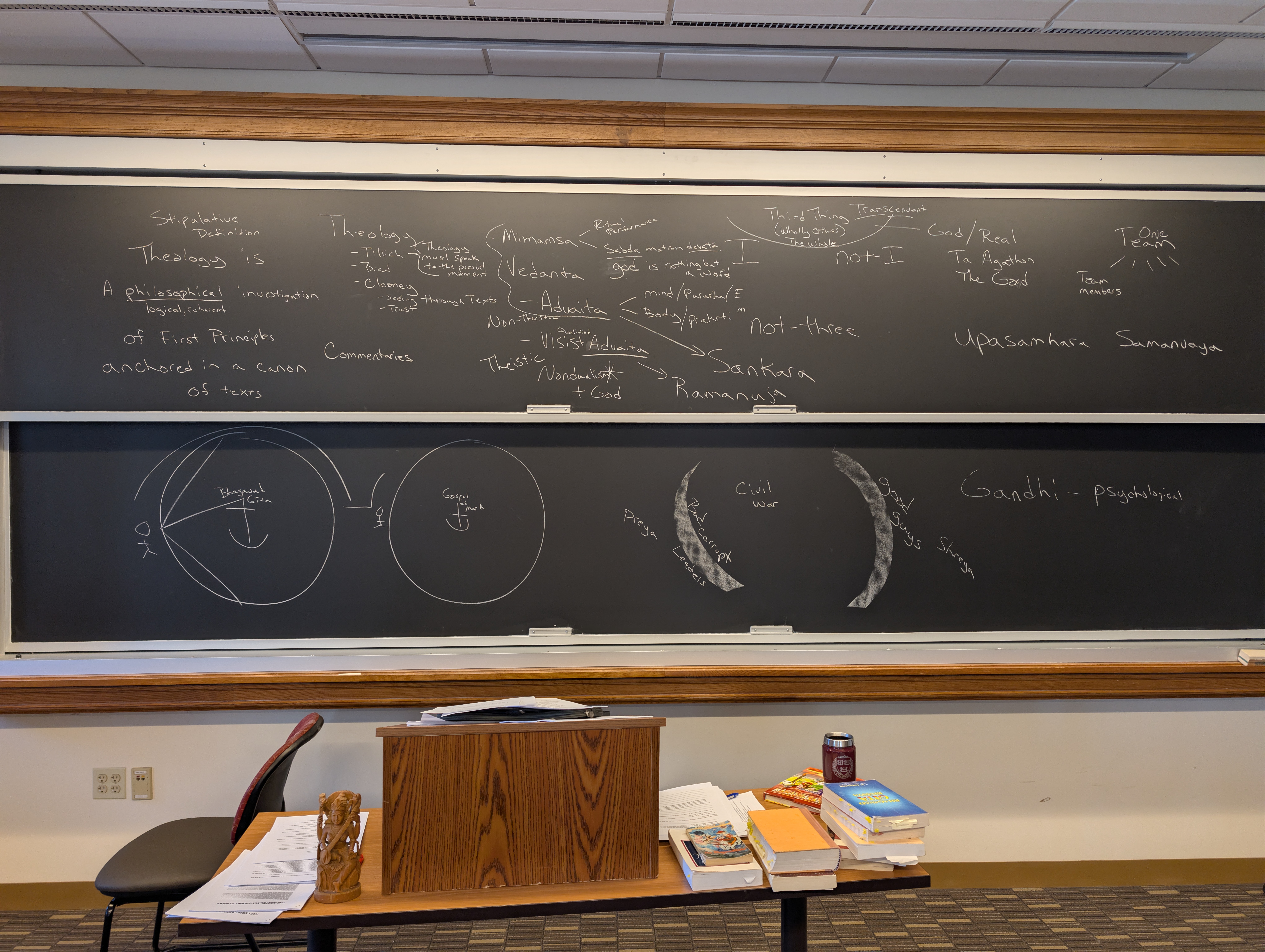
Chalkboard photo 1 from 03/17/2026

📄 Synopsis

In the class session on March 17, 2026, the course transitioned into the study of the Bhagavad Gītā. The instructor reinforced the stipulative definition of theology as a philosophical investigation of first principles—I, Not-I, and the Wholly Other—anchored in a canon. Drawing on Paul Tillich, the class emphasized that theology must speak to the present moment, and through Francis Clooney’s concept of 'seeing through texts,' students were encouraged to view their neighbors through the lens of sacred scripture. The lecture contrasted different schools of Hindu thought, including the ritual-focused Mīmāṃsā, the non-dualist Advaita Vedānta of Śaṅkara, and the theistic Viśिṣṭādvaita of Rāmānuja. The instructor provided a theological framework and a visual model of the battlefield of Kurukṣetra to help students approach the text. Using the chariot allegory from the Katha Upanishad, the instructor explained the relationship between the senses (horses), mind (reins), and the self. While the class touched upon the beginning of Chapter 2, the discussion focused on introductory definitions and the psychological interpretation of the text as an internal struggle of conscience. The session concluded with the instructor explaining the chariot allegory and the importance of using commentaries to gain multiple perspectives on the verses.

Key Takeaways

  • Theology must always speak to the present moment, addressing the 'here and now' rather than serving as a mere history of past beliefs.
  • The stipulative definition of theology for this course is a philosophical investigation of first principles (I, Not-I, and the Holy Other) anchored in a canon of texts.
  • Francis Clooney’s concept of 'seeing through texts' suggests that the goal of studying sacred scripture is to see one's neighbor differently through the lens of the text.
  • Mīmāṃsā theology posits that 'God is nothing but a word' (Shabda matram devata), focusing on the efficacy of ritual over the agency of a deity.
  • Viśiṣṭādvaita Vedānta, associated with Rāmānuja, is a 'qualified' non-dualism that is explicitly theistic, contrasting with the absolute non-dualism of Advaita.
  • The chariot allegory from the Katha Upanishad represents the body as the chariot, the senses as horses, the mind as reins, and the intellect as the charioteer.
  • The instructor encourages the use of commentaries, such as those by Śaṅkara and Rāmānuja, to look up specific verses and gain expert perspectives.
  • Dharma (duty) is specific to one's role; for Arjuna, his duty as a warrior and general is a central theme of the text's opening.
  • Gandhi's interpretation of the Gītā views the battle as a psychological allegory where Krishna represents the voice of moral conscience.
  • The class utilized a 3D visual model to understand the layout of the Kurukṣetra battlefield and the characters involved in Chapter 1.

🎤 Transcript Tap any timestamp to jump the audio player

Opening Attendance and Meditation

Brad
Alrighty, let's get started. March 17th. Yaroslava, Aiden, and Delaney, right? So we're missing Yaroslava, Aiden, and Delaney. All right, let's take a moment, please, and That's— that'd take better— on the table. Um, let's take a moment and just be. Harder— easier said than done, right?
Student
Let's take a breath together.
Brad
Go ahead and breathe in and out. Actually, I want to try, uh, um, not try. There's no try. Um, I'm gonna chant the first verse of the Gītā since we're starting the Gītā today. Um, On the field of Dharma, Dharmakṣetra, which is the field of the Kurus, the Kuru clan. We have like a million things to do today. But I guess we should start with the quiz, right? Start with the quiz. You may use the copy of the Bhagavad Gītā that you printed for today. In fact, you should. But nothing else, please. And definitely no screens.
3:05

In-Class Quiz and Assignment Collection

Student
I've committed to the bed now. Yeah. Oh, of the quiz?
Brad
Oh, I don't have an extra copy yet. That was the assignment. It's the printer.
Student
Okay. Um, yeah, just, just do your best on this one. Can I just like— You're still writing.
Brad
You're probably writing more than you need to write. Good. We pass them this way, please.
11:19

Lecture: Defining Theology and First Principles

Student
Good. All righty.
Brad
Um, so a lot to do today. As much as I would love to spend the whole time just talking about these verses that we read for today. It's our first day studying the Gītā, so I need to give a little bit more setup and help you approach the text in the right way. So I want to roll back to the very first lecture and some of the things that I said on day 1 that never stopped being true. And so let's— I want to reemphasize those. One is I don't— I didn't really say anything about Paul Tillich. I don't even think I dropped his name in that first lecture. But I did give you his central idea, which is that theology must speak to the present moment. Theology must always speak to the present moment. If it doesn't have something to do with here and now, today, or at least in the near future, like your life and that kind of stuff, then what's the point, right? Theology has to have something to say to our world here and now. That's the whole point of it.
Brad
And Pope Leo actually said almost exactly that a couple of weeks ago, that theology has to have something to say to here and now. It's the whole point. It has to have something to say to who we are right now. So we're not studying the past. This is not a history class. You know, these texts are old, they're part of history, so it's not like it's not like history is unrelated, but we aren't studying what people used to think or what texts used to be important. We're studying the text and what they have to say to the here and now, right? Right now, right here and now. So please, not just with the Bhagavad Gītā, but also with the Gospel of Mark, for everything we're doing for the rest of the semester, everything we've done to date as well. But please don't forget that theology must speak to the present moment. Another thing about theology, and some of this was in the opening lecture and some of it was in the opening chapter, but I've given you my stipulative definition. What is a stipulative definition? What does stipulative mean?
Brad
Stipulate means I'm just going to say it, right? It's like if you're playing pickup basketball, you know, like just like street ball, whatever, you know, in the park, you can either play make it take it or not make it take it, right? Do you play make it take it or not make it take it? You're saying yes. One of those two, right? It doesn't really matter which one you do. But it does matter that you stipulate which one you're going to do, right? I can't like, you know, make a basket and then say, oh, we're playing make it, take it, right? We've got to stipulate it ahead of time. Right. So that just means that this is— it could be arbitrary or it could be temporary. But stipulative just means this is what— this is the definition we're using for the— for this semester. Right. Not trying to make any global arching claims that this is the definition that all theologians ever should use. It's not even the definition that I use all the time. But for this semester, our stipulative definition of theology is this. Theology is a philosophical investigation, right?
Brad
And so in order to be philosophical, it has to be logical. It has to be internally coherent, right? You can't have interpret this one way and then interpret this other thing in a totally contradictory way, right? So it has to be logical and coherent. Or it's not philosophical. Has to be an investigation, meaning you don't know the answers ahead of time, right? If you know the answers ahead of time, then you're just trying to prove your point. You're not investigating, right? So investigating means I'm open-minded and I'm trying to learn something new. So logical, coherent, philosophical inquiry would also be fine, of first principles. What are the first principles?
Student
For us, big questions.
Student
Who are we?
Student
Why are we here?
Brad
Things like that. Yeah, I mean, specifically 3, and you've given us 2 of them. Who am I? Who are we? What does it mean to be a person, right? Philosophy of person. This is very much in that sort of vein. All science is like, where are we, right? What is this world that we find ourselves in? So, right, so we've covered philosophy and science and those 2 questions. And then the last one? So who am I? Where am I? What does the world need me to be? Sure, yeah, that's a fine way to put it. Or you could put it another way, Lucas. What's our purpose? What's our purpose? That's a fine way to put it. Why am I here? Why am I here? Yeah, yeah, any of those, right? Any of those. So the way I like to phrase the first principles in the most sort of I don't know, trying to find something that's not preconceived, you know, sort of like not— what do you call it— like culturally anchored, is these three. So "I," right? We all have this experience of being self, right?
Brad
Of subjectivity, being a conscious being that sees the world. So we all have an experience of what "I" means. And then "not I" is just anything that's not "I," right? Pretty Pretty straightforward. So then there's Nicholas over there. Nicholas is not I, right? And so the table is also not I, right? So there's I, and then there's a whole lot in the universe that's not I. And so part of the investigation is like, what are the boundaries between those, right? Are there any real boundaries between me and Nicholas, or just perceived boundaries, or Are we genuinely different selves, right? Or the same self or some other possibility, right? So just leaving those questions open for the moment. In fact, trying to answer those questions in a way that's anchored in a text, right? So we may answer the questions one way in one text and then we may answer the same questions a different way in a different text, right? We could even, as we'll see today, answer the same questions differently in the same text. For sure. And then that third thing, right? So I, not I, and then, right?
Brad
It could be that there's me and then there's all this not me and then that's just it. And there's no meaning, there's no purpose, there's nothing matters, right? So that sort of nihilistic, just nothing matters. So then that's it, right? There's me. And then a whole bunch of not me. And it doesn't really matter, right? We're all going to die. So what's the point? Or if there is some sort of meaning or purpose, then that would take us to something transcendent, right? Some sort of— and there's a whole lot of different names for this third thing. Some people, some philosophers call it the third thing. Some philosophers, especially in continental philosophy, like Western like continental philosophy, like French and German philosophy in the 20th century refer to it usually as the wholly other, the entirely other, right? So there's me and Brian, and Brian and I are different, but, you know, we're not like that different, you know? I mean, we're still atoms and molecules, and we have, you know, so I mean, different, but so there's I and then not I, but then this wholly other is something just totally completely different, right?
Brad
Something that we can't even conceive or something like that. So the holy other could also be referred to as like the whole, right? Or team and team members. All sorts of ways to construct that abstraction. Most often in Western philosophy, it's referred to just by this word, God, right? Usually with a capital G. Many philosophers refer to it as the Real, usually with a capital R though, right? Or the Real, not just real, but the Real. Some people call it the Really Real because that makes a difference. Socrates refers to it as ta agathon, right? He gives it a few names, but ta agathon is his preferred name. ta agathon just means the good, right? And all you really need to do for most of For a lot of Christian theology, you just start with Socrates' understanding of the good, and then you just erase an O and you get to the God. And it's pretty similar. But you get the idea, right? So we've got these three first principles. And so what we're trying to do this semester, especially for the remaining of the semester, is try to keep those options open, right?
Brad
Maybe even have alternative ways to construct I, not I, and the holy other. Definitely not trying to tell you answers to those questions. I'm actually trying to do the opposite, right? To destabilize your assumptions about those three first principles. Cool? So philosophical investigation of first principles anchored in a canon of text. And so what we're going to be doing for the rest of the semester, every Tuesday, anchoring our discourse in the Bhagavad Gītā and try to see multiple perspectives, right? Try and get Sophia's perspective and Isabella's perspective and Jayden's perspective and Brad's perspective and Śaṅkarācārya's perspective and Alice's perspective, right? Try and get differing perspectives on the text on Tuesdays. And then on Thursdays, do exactly the same thing, but just with a different canon. Right? And so part of the idea is not to try and pretend like these say the same things. They don't. Don't pretend like they are the same. They're not. But instead, trying to say that, you know, tying back to what Clooney has said. 3 things that I want to say about Clooney. One is that— That's the third thing I forgot. Something like that.
22:01

Lecture: Seeing Through Texts and Hermeneutics

Brad
So, Clooney's text that I talked about in chapter 1 of the course reader is this book called Seeing Through Texts, right? And I gave some images in the chapter of this āśrama that I visited in Kerala where they have like an area where you sit on the floor and you have like a lectern kind of like this on the floor where you put the text, right? And the point is, this is where you come to study the text, whatever text it is, right? Could be the Bible, it could be the Quran, it could be the Hadith, it could be the Veda, it could be the Bhagavad Gītā, it could be the Gospel of Mark, it could be anything, right? A sacred text. And you put that sacred text in front of you, and that's what anchors your discourse, right? You're not talking about something unrelated or whatever. You're talking about that text. But as Clooney says, the point of talking about the text is actually to see your neighbor through the text, right? So the text is important. It anchors the discourse.
Brad
But the goal is not purely or exclusively to see the text, but to see Tana differently, right, through the lens of the text. And to see Lucas differently through the text, right? So to see our neighbor through the lens of the text. And so, you know, trying to see our neighbor, or not I, through the lens of however this text is, right? So that's kind of what seeing through text is. But he also— there's another aspect of it, which is that when we're talking about sacred texts, we have to approach them in the right way, right? So what makes a text sacred is that it is sacred for people. It is— they read those texts differently. Sacred means set apart, right? So these texts are set apart from other kind of texts. It's not like a geology textbook or a calculus textbook where you read it and you learn it and then you move on, right?
Brad
It's something that anchors your understanding, that North Star that I talked about in that first day that you keep coming back to, especially when you get in times of, you know, major decision or crisis or whatever in your life. You keep coming back to those kind of texts. So Clooney's point is that if we want to read a sacred text that's not sacred to me, then I have to at least try to put myself in the shoes of somebody for whom it is sacred, right? I have to try and approach this text in a way that a Hindu would, right? If I'm studying the Quran, I'd have to study the Quran in the way that a Muslim would, right? I'm not gonna be successful in that. I'm not gonna be fully successful in that, but I can come pretty close if I try, right? So that idea is that I want to try and approach the text with a level of trust that the trust has something to teach me, right? I don't know what that thing is. That's what makes it an investigation.
Brad
But I trust that the text is saying something valuable to me, right? Um, just a different way of approaching the text. And then the last thing from Clooney, this idea of bibliobiography, that basically if we do that, if we approach the sacred text in a way that's, you know, a way of trust and, you know, deference even, right? Then the text, if it's worth studying, which these texts are, then it should have an impact on how I think about myself and my place in the world and my meaning or purpose, right? So it should become a part of my identity, in other words, right? So that's what he means by bibliobiography. So my biography becomes shaped by the bibliote— by the books that I read. Cool? Good. Questions?
Student
Yeah.
25:41

Lecture: Mimamsa, Ritual, and Advaita Vedanta

Brad
Um, all right, uh, so let's shift gears a little bit. Um, still have more lecture though. Um, so I have said that this semester— I'm sorry, the rest of the semester. I keep treating this like it's a new semester. For the rest of the half, the second half of the semester, I really want you to engage with commentaries, right? So the idea of a commentary is like, I really want to know what Olivia thinks of the text. I just want to know Olivia's perspective, right? But I also think that it's important for Olivia to read something from an expert, right? Not a lot. I mean, I want you mostly to interpret the text for yourself. That's by far the most important part. Of the second half of the course. I want to know what you think of the text. So just be honest, right? Read it, engage with it. But in order to genuinely engage with it and approach it all those kind of ways, it's helpful to read some perspectives from some experts, right? People who have devoted their entire life to reading the text, people who care deeply about the text, right?
Brad
Whether we're talking about the Gospel of Mark. So I've got— I brought a couple more commentaries um, today. The Sacra Pagina, which is like a, um, you know, really kind of more of a Catholic commentary. I mean, it's Catholic commentary on the Gospel of Mark. Um, and then this, um, other commentary, which is more of a Protestant commentary on the same text, right? So differing perspectives on the same text. Um, and the way, uh, that I want you to engage with these, and there's literally a library full of them here, so you don't have to choose. You can choose any of them, um, or engage with, um, AI is not a terrible way to do it either if you're careful. Um, but the way to do it is to not read it cover to cover because it's not the point at all for this course especially, but instead to, you know, read the text that's assigned for that day and then pick out a verse like, oh, I want to go deeper into Mark chapter 4, verse 10, or whatever, right?
Brad
And then you go and you look that up in the commentary and see what the commentators have about it, have to say about it. Even better would be to get two different commentaries on that same verse, right? So you get multiple perspectives.
Student
Cool.
Brad
And then do the same thing on the Hindu side of things. Um, and the primary way to do that, um, I think— I mean, you could do the same thing, get a commentary. This is Shankara's commentary on the Bhagavad Gītā, and this is Ramanuja's commentary on the Bhagavad Gītā. And you could do the same thing, right? Go and look up verse 247 in here, see what Shankara has to say. Same thing in here, see what Ramanuja has to say. Or much more easy would be to use the AI that I've given you on that, enter on that website, the study tool, right? Because it it has— it's not just the generic AI, it's an AI with a knowledge base, and that knowledge base includes these texts in Sanskrit and in English. So, and it also has these other commentaries, in fact, Gāmbhīrānanda and some others. Cool, cool. So that's commentaries. A few more things. So I want to recap what we've done in the first half of the semester. So that you have some context and understanding for the new thing that we're going to do for the second half of the semester. Right?
Brad
We're going to continue studying advaita vedanta. We're not done with that. But I feel like many of you, some of you have a real good grasp on advaita vedanta. I think it's lovely. It's really awesome to hear and to see in your podcast. And some of you are still struggling with it. But we're gonna move on. So we're gonna continue reading from Shankara's perspective, the advaita perspective. We're gonna add this vishishtadvaita perspective. But let me just do a little bit of a review. So we've got these shaiva darshanas, right, the 6 perspectives, and we've mostly been focusing on mimamsa and vedanta. I mean, we've mostly been focusing on vedanta, but we did a little bit of mimamsa. Right? But I wanted you to understand that there's 6 primary Orthodox perspectives, right? I'm only giving you one. And even within that one, we're going to see there's a lot of diversity. But part of why I gave you mimamsa— so mimamsa is a ritual— it's an interpretation grounded in the ritual text, right? So philosophical investigation of first principles anchored in the brahmanas, which are texts about rituals, right? Ritual sacrifices that need to be performed.
Brad
I showed you that video that I recorded in Bangalore with the fires and all that kind of stuff, right? So that's what we're talking about. So ritual performance of ritual sacrifices, usually with fires like the ones that we've, you know, seen described a few times. And one of the things that I taught you about mimamsa— I didn't teach a whole lot about mimamsa, But one of the things I taught you was this phrase, right? "Shabda matram devita." God's— I think lowercase g really makes more sense here— God is nothing but a word. Shabda, right? Shabda matram means nothing but a word. God is nothing but a word, right? So, and as I told you then, mimamsa— mimamskas actually disagree with one another. About whether or not the gods exist, but they fully agree with each other that it does not matter. How could that be true? How could it not matter whether the gods exist or not? Anybody want to go to shot? Yeah, Wilkes.
Student
Maybe it's kind of like how it's like myths. The importance isn't whether or not the story happened, but rather the point of the story and the knowledge you learn. So like in a similar sense, like, it doesn't matter if these gods like actually did this or not, but rather like the story and like the knowledge you get from it.
Brad
Good. That's great. Yeah. Other reasons? So the way the mimamsa— I mean, that's a great reason. But the way the mimamskas look at it is The rituals that are described in the scriptures are efficacious. They work. They do, they work, right? So, the text is, rule number one of astika is the Vedas are sacred. The Vedas reveal truth, right? So, if the Vedas tell you to do this ritual, then there's a point to performing the ritual, whether you understand it or not, right? The ritual is efficacious. In order to perform a sacrifice, you have to sacrifice something, right? It's kind of what the Katha Upanishad is about. You've got to sacrifice something valuable, but you've also got to sacrifice it to someone, right? So the mimamsas say, well, God is nothing but a word, and what the most important thing about that word is, it has to be in the dative, because you're sacrificing to Indra, or to, you know, vishnu, or to someone else, right? So it's got to be in the dative.
Brad
And it matters that you pronounce the word correctly and you pronounce it at the right time and you sing the right hymn to the right deity at the right time. Whether or not that deity actually exists is completely irrelevant because that deity, if it exists, has no agency whatsoever. If I sacrifice to Max, let's just make Max a deity for the moment. So if I sacrifice to Max because the ritual says sacrifice to Max and I do that, Max has no agency in whether or not to give me the reward of that sacrifice. Right? In the same way that if I go to Burger King and order a Whopper, right? And I pay for the Whopper, they have no choice in giving me the Whopper. Right? They have to. I've done my part, they have to do their part. They're obliged to do their part, right? So the mimamsa say it doesn't really matter whether the gods exist or not. If they exist, they have to do their part, and therefore they have no say in the matter whatsoever, right? You see why it doesn't matter? Yeah, but all those things are true too.
Brad
So also, if there are no gods, then the performance of the ritual may be morally edifying, that sort of stuff, right? I think Dylan said earlier, like, it's the discipline, right? Makes you the kind of person that's disciplined to do the rituals and to memorize the text and that sort of stuff is what really matters. So enough about mimamsa. Part of that, though, was just to emphasize that non-theistic, right? Or at least the possibility of non-theistic theology. And then we looked at advaita, which is— I usually describe it as atheistic. A lot of others will call it non-theistic. I think atheistic is more accurate, but whatever, whatever those words mean. So advaita, what does the word advaita mean? Yes, Sophia? Is it non-dual? Non-dual. Literally not two. Non-dual. Yep. So we got to understand what are those things that are being said are not two. There are a lot of different candidates here, but one of them is definitely the I and the not I, right? So the I and the not I are not two different things, but also mind and body, right? Mind and body are not the same thing, right?
Brad
You know that because if I were to drop dead right now, my body would still be here, right? But my mind, not so much. So they're not the same thing, but they're also not two different things.
Student
They're not—
Brad
one can't exist without the other. Right. So we could— and there are theologians who— non-dualist theologians who say maybe even not-three would be a more helpful name. Right. So it's not just the not-two, I and not-I, but also that holy other. Right. So God or truth or the transcendent, the real, the good, whatever you want to call it, right? That's not other than I and not I, right? So these different— these three things, I, not I, and the holy other, are just kind of differing perspectives or different loci or different ways of looking at reality. Cool. So What we're going to do the second half of the semester, we're going to continue doing advaita, but now I want to try and give you a little bit of understanding of vishishtadvaita Vedanta. So we've still got the word advaita in there, right? So non-dualism, but vishishta really kind of means like asterisk. Probably the best translation for it is just like asterisk, right? So like non-dualism asterisk footnote, right? So like 'Non-dualism plus,' and the footnote is God, right? So non-dualism plus God. So it's explicitly theistic.
Brad
And so we're going to read— other than that, they're very similar. But so I don't expect you to get the relationship between these other than that. It'll take a little bit of time. It took me years, actually. To really appreciate vishishtadvaita. Cool? Yeah, please. Curious what the word "qualified" has to do with it. Because I remember reading that in the notes for like the— Really, it just means like a qualification. So it really just— it really means asterisk. I think it's probably the best way to say it. So it's like non-dualism, but there's a qualification, right? So non-dualism, except for, right? So we could say Nicholas and Brad are not two, but God is not quite either one of us. Right? So yeah, I don't want to go too much into what— I don't want to give you misleading, but we'll— yeah, for now. Is it good? Yeah. Yeah. Cool. All right. I think— I'm doing okay on time. A little bit more of this lecture and then— okay, so quick story. This weekend I spent way too much time vibe coding. Oh, it was super fun.
38:48

AI Visualization of Bhagavad-Gita Chapter 1

Brad
I had— yeah, by the end of the weekend I had two different AI agents going simultaneously. It was super cool. I spent like probably 13, 14 hours creating this thing that I'm about to show you, which is way too much time on something like this, but it was super fun. And then around 10 o'clock, yeah, 10 or so PM on Sunday night, I was like, fuck it, I gotta go to I gotta teach in the morning, all this kind of stuff. It's time for me to stop with all of this madness and go to bed. So I was like, I've been working on this website forever. I'm gonna try and get it uploaded so that, you know, Hannah will be able to appreciate it during class on Tuesday and all that kind of stuff. So I told that agent, hey, go push this to the cloud, right? Deploy this. Deploy this app. And I was like, okay, on it. And then while it was deploying, it said, It said, oh no, all my files are being deleted. And I was like, what?
Brad
And I look, and so I had another agent running that was supposed to just be doing a diagnostic. It wasn't supposed to be changing anything. But that cloud agent decided to delete my entire Google Drive. So like 2 terabytes of data, you know, like all of my class recordings, not just this this class recording, but class recording going back years, all of it was deleted. All of it, everything was deleted. Fortunately, I did recover it. I did get it all back, but it was a super stressful Sunday night. I don't know, I thought it was funny. All right, you want to see what I spent 12 hours and change vibe coding? So this you already know, right? The Bhagavad Gītā. So then I added this little visualize the battlefield. This is a Three.js in React. So, the first verse of the Gītā is, dharmakshatriya kurukshetra samaveda yudhyutsava. So dharmakshatriya, on the field of Dharma, which is also the Kurukshetra, the field of the Kurus. And so, I've been teaching this text for many years, and even the other day I told you, like don't get bogged down in chapter 1, right?
Brad
Chapter 1 is kind of a difficult read, but I wanted to try and visualize chapter 1, so we'll enter the field. And so yeah, here it is. So by the way, the AI was really proud of these dust particles. These dust particles, it went on and on about it. It's like, you know, do you want me to add more dust particles? I think we're good That's partial. So this is the— and I was like, the background is lame. It's like, what do you mean? I don't know. I still think the background is lame. So this is the Kurukshetra. We've got a battlefield. And we've got the two armies. One army over there. We'll call those the bad guys. And good guys over here. And now we've got Arjuna. Arjuna is the general. Of the army, and he's sitting there in his chariot, which we'll talk about in a moment. And yeah, you can move around just like Minecraft kind of thing. You can go up and down, you know, and you can even go over here and let's say like, who the hell is Vikarma, right?
Brad
And you can click on Vikarma, it'll show you the actual verse from the Bhagavad Gītā. Where he's mentioned, right? You yourself, Bhishma, and Kripa, the ever victorious. And this is a visual representation just based on other descriptions we have of this guy. So at least it's, you know, and I eventually want to add some, you know, scrape some art archives so we can get some, you know, more legitimate non-AI art.
Student
Versions.
Brad
And so you can see Bhishma, right? He's a little pixelated, but— sorry, that's Kripa. I wanted to show Bhishma. So it has some problems. Also, anybody remember the Katha Upanishads? So in the Katha Upanishad, volley 3, we have allegory of the chariot. Yeah? What do you remember about the allegory of the chariot? Yeah, Yaroslav?
Student
So you have basically a few items in that chariot, the chariot by itself, then you have the body, senses, the horses, the intellect, and who like, and actually the chariot, the charioteer who like manages all of them.
Brad
Yep, good. And so the horses represent the 5 senses, right? And I challenged the AI, I was like, you know, obviously the horses have to be all different because they represent the 5 senses. Senses. So it's like this one, they gave pink ears, this one blue eyes, this one blue nose, this one I guess is feeling or something like that, and the other one has like an orange mouth. So you've got all the five senses represented here by the horses of the chariot. The reins represent the mind. I was going to ask that, but, right, so we all have senses, but it's a question of whether or not We're driven by our senses, driven by our passions, drawn towards this thing or that thing, right? Should I smoke this or not smoke this? That kind of stuff. And so then we've got the charioteer, right? Who's the decision maker. And then we've got this mysterious figure in the Katha Upanishad, which is the self, right? So the charioteer and then the passenger is your as Saraswati explained. And so here we have a chariot. The whole Gītā takes place in a chariot.
Brad
And it's a discourse between these two guys, Krishna, who in this case is the charioteer. I think reasonable to note that they're kind of reversed, right? So in the Katha Upanishad, it's the charioteer would be angel, right? And then the passenger would be the atman within. But here it's almost— I don't know, is it reversed? It seems a little bit reversed, which maybe is intentional, I'm sure. Anyway, so you could click and see Krishna and that kind of stuff. So with this in mind, this is our context of the Gītā. And totally worth 13 hours of my time this weekend, right? Sure. So what I really want you to try and do is, to the best of your ability— I know it's your first time reading the text, most of you, right? But I want you to try and read the text, read whatever verse you try to focus on for— you know, don't try to Don't try and interpret the whole thing, right?
Brad
Read the whole— read whatever is assigned for that time, and then narrow, narrow your focus into, you know, between 1 and 4 verses, something like that, you know, 5 at the most. But most of the time it's going to be 1 verse that you really kind of narrow in on. I mean, understand it within the context, all that kind of stuff, but let's try and interpret 1 verse from multiple different perspectives. Right? So obviously your perspective is, at the end of the day, the most important, but let's try and get some other perspectives too, right? So it'd be great, especially if you're a discussion leader, to try and give us Shankara's perspective, which is that advaita perspective, but also Ramanuja. I think I forgot to mention his name. So Ramanuja is sort of like the lead theologian within this school, right? So we're going to try and read it from both perspectives. But we don't have to choose these two. We could also choose Gandhi. Gandhi was very moved by the Gītā, very influenced by the Gītā. He was very troubled by the fact that the Gītā is set in a battle, right?
Brad
A violent— he did not like that at all. And he thought, he wrote, he commented on that pretty much anytime he spoke about the Gītā. He was like, I don't really like the fact that it's a context of a battle, I think people are more likely to misinterpret it. At least that's his interpretation. And so the way Gandhi looked at it— Gandhi also, you know, I think more— there's a lot of debate, but I think more on the advaita side, the non-theistic side of things, definitely reads the Gītā as a work of psychology, right? As a psychological— so On the face of it, the Gītā is about a civil war, right? You got the good guys and the bad guys. And the bad guys— we'll save a lot of time this semester if you'll just concede the fact that the bad guys are bad. I mean, the whole war kind of started because the bad guys raped the wife of the Pandavas. So, I mean, they're bad people, they're corrupt people. They're in a position of power, right? So they're in charge, but they're using their power for selfish means, for corrupt means.
Brad
This is not hard for you to imagine, right? This is a thing that happens. So they're bad corrupt leaders in positions of power. And then there's the good guys, right? But Gandhi didn't look at it like that at all. So coming back again to how I started this whole thing, right? Theology must speak to the present moment. So none of this is about the past, right? We aren't reading this as a myth that tells us something about some historical event. It's not. It's not a historical event. It's not interpreted that way. Like, almost nobody interprets that way. I say almost because it's kind of a new thing that's been— anyway, I don't want to get into that. But throughout most of history, it's not been interpreted as history. It's been interpreted as a myth that has something to say to us here and now about who I am, where I am, why am I here, right? So Gandhi interprets this purely psychological. So he doesn't see the— so we could say the chariots, right? Take the chariot as the body, exactly like it says in the Katha Upanishad.
Brad
So the chariot is the body, and then inside of the body you've got both of these different aspects, right? You've got Samuela, but then you've also got that sort of voice of conscience, right? So we could take Krishna, we could interpret Krishna as a character representing moral conscience, right? So that moral conscience that's saying, "Hey, this is the thing that you got to be doing," right? Not this other thing that you want to be doing, or, you know, we can always come up with reasons not to do the right thing. And so that moral conscience is that voice, that superego, whatever you want to call it, that's calling us towards the good. Right? So yeah, very much like Paul, right? Paul actually in the New Testament— Paul, we're not talking about Paul, but Paul views the moral conscience as the way that God speaks to us. Right? So God speaks to us through that moral conscience. Here I think Gandhi is saying something very similar. Right? That God speaks to us through that moral conscience, that voice in our head that's calling us towards do the right thing, telling us to do the good. Yeah?
Brad
So you don't need— so you could even just from that one interpretation, you could get a theistic or an atheistic perspective, right? So that voice of moral conscience could be the voice of God, or it could just be the voice of moral conscience, and you don't need anything beyond that, right? Cool. Word. Right on. Then let's use our remaining time, if there's no questions, to hear from our leaders. So as usual, we'll take— let's take about 3, 4 minutes and just to get everybody talking. And then, yeah, then we'll hear from the group leaders.
Student
Pairs of opposites.
55:50

Class Discussion: Arjuna's Dilemma and Krishna's Response

Brad
60. Sorry, it's okay. All right, who wants to get us started? Yeah, Ben.
Student
So I looked at the commentary, and what I took from it that was really important is, talk about Arjuna and how, as being sympathetic and having general moral feelings and that lack of fight. But the commentary stated that this was a noble emotion misplaced and applied in the wrong direction. Arjuna was able to understand the distinction between self versus body. However, his lack of foundation— if he knew the self is eternal, there would be no grief with loss. I thought that was really opening. I kind of took that when I read it the first time, but then reading the commentary, that really kind of made sense to me.
Brad
OK, right on.
Student
Through that, what they were trying to come Okay, good.
Brad
So he's right to feel compassion. He's right to be concerned about killing. Right. But in this context, he's missing— he's misplacing that. Yeah, it's good. Yeah.
Student
Gina, we were kind of zooming in on some verses that we understood. 2:17, it says, but now that to be indestructible by which all this is pervaded. The destruction of this imperishable one, one that they can form. We kind of were like atman, like right away, like no one can destroy our atman and like our souls are eternal, but our like bodies are not. So that's kind of what we're talking about mostly.
Brad
Okay. Yeah. Good. Yeah. Jaron. I think also the way that Krishna was able to to show Arjuna to not be able to grieve within the context of the self by telling him that, like, if you're killed, you win heaven.
Student
And if you die—
Brad
or sorry, yeah, if you're killed, you win heaven, but if you triumph, you enjoy earth. So in both situations, it's kind of a win-win.
Student
And I think that was able to help Arjuna come around to it.
Brad
Okay, yeah, good. Yep, that's right.
Student
How the third alter anything was to do nothing at all. I think, I forget which one of the two said it, but he was—
Brad
and which verse it was—
Student
but he was like, I'd rather be killed than to kill.
Brad
Yeah.
Student
And then he was shamed for that.
Brad
Yeah.
Student
So it was kind of like, as a warrior, you have a duty to fight. So it's better to fight and end up with one of those two scenarios, whether you either go to heaven or triumph on earth, than to have this shame of doing nothing at all.
Brad
It reminds me, I mean, especially the way you phrase that, right? We just recently, a couple weeks ago, had the trial of the chief of police in Uvalde, Texas, right? So in this case, somebody who didn't do their duty, right? So their duty was to go and stop this shooter who was killing all these kindergartners, and right, and so did not do his duty, and so on trial. For that. Yeah, of course.
Student
It's not just that, you know, he pacifies bad guys. Krishna says it's like his Dharma that he has to do this. So it's like almost kind of spiritual duty. And then he even says, which we thought really interesting, that the concepts of killing actually don't exist if you just realize that the self is always existing. So, you know, all bodies are destined to die. So whether or not they— it seemed like whether or not they die early doesn't actually matter as much as the fact that you realize that you're not killing or being killed, it's just yourself is gonna move to a different body.
Brad
Which then raises the question, what does matter then, right? Yeah, exactly.
Student
Like, you know, cold-blood murder, does that suddenly not matter anymore because they're just moving to another body?
Brad
Great. Yeah.
Student
Yeah, I kind of talked about this on my quiz, but like, it— like Krishna's explanation Surreal Nation almost seemed like a little— you could interpret it a bit nihilistic, like being like, well, we're gonna die and then we're gonna be reborn and it's just gonna keep happening for everyone here.
Brad
So like, so why do anything?
Student
So why do anything? But also like, why be worried? Like, go fight. And then that raised me to question like, well, like, what role does like Dharma have on that and karma? And like, is there like a driving force at all?
Brad
So the future is going to happen whether I do anything or not, right? So then what is my motivation for doing anything? And what is that future that I'm trying to bring into being? I just want to get some more voices in. But yeah, go ahead.
Student
We were talking a lot about the end of Chapter 1 when Arjuna actually collapses, and Shankara's commentary on that is that that was actually necessary for him to receive the lesson of the Gītā. Gītā is kind of like an act of gnosis. His ego as a warrior was stripped away from him, and then at that point he was able to receive the knowledge of the Gītā. But then we kind of compared it to in Chapter 2, um, I, uh, his name's Sri Aurobindo, I think. Yeah, yoga. Yeah. And he says that, you know, we have a unique role in the unfolding of the divine so that you have to just be yourself, be your authentic self, because that's who you were meant to be. So his idea is directly contrasting what Shankara says. So, you know, you have these two different perspectives that, you know, just be who you are, which is a warrior or a fighter or whatever, and that's who you're supposed to be. Or you could strip it all away and then learn yourself as, you know, the atman.
Brad
Right on. Yeah, word. Uh, Sri Aurobindo, by the way, I wrote my first book about him. He's very much advaita, but as you point out, doesn't always agree with Shankara. Yeah, folks.
Student
I think it's interesting that Arjuna's main reasoning for not wanting to kill these people is the fact that they're kin. He says in chapter 131, he says, Krishna, I see no good in killing my kinsmen in battle. And how he's kind of like— our relationships with people like shape how we treat them. And like, I guess the follow-up to that is like, is that fair in the sense that like everyone is brahmin? Like, is it fair to— that that's your preoccupation to kill someone? Like, oh, these are my kin. He says earlier like these are his elders, um, there is teachers, father, son, etc., etc. And like, is that a fair reason to like withhold something? Like, isn't everyone equal?
Brad
OK. Yeah, sure.
Student
This is just a clarification, but in the Gītā, are the two opposing sides— they're related, right? Aren't they cousins?
Brad
Yeah, they are literally cousins. Yeah.
Student
OK. Yeah. OK. So then going back to this point, I think the family aspect of it all, I think that was a big part of Arjuna's objections. To the whole thing. And I don't know, I think it would be interesting if Krishna spoke on that part because it's one thing to kill someone who you don't know, but that's your family and those are your teachers and the people you're related to.
Brad
Yeah, let's get Eduardo in here.
Student
Yeah. Following up on that, on 2:14, Krishna says, contact with matter makes experience heat and cold, pleasure remain. And then a little further down, 2:15, he essentially says like when you let go of these matters that make you feel these things, you can reach immortality. So it almost seems like if you fulfill your duty without any regard of like what you feel, you'll be liberated in some sort of way. Like regardless of if they're family or not, just do and you'll be free.
Brad
Just do the right thing and what happens may not exactly— what happens might be out of your control, right? But it's just doing the right thing. And yeah, I mean, so on this question of kinsmen, right, let's— I don't know, for some reason I like the Uvalde, Texas analogy, right? So like, in that particular case, right, the police officers who didn't go in to, you know, stop this guy who was killing all the children, would it matter? Like, does it matter if the shooter was their cousin? Would you be like, "Oh, I understand why he didn't go stop the guy from shooting because it was his cousin." So this is Krishna's argument, right? It's like, it doesn't matter if it's your cousin. What matters is Dharma, right? Good, bad, right? So people are doing bad things, it's your duty as the general of the army, right? As the head of police, That is literally your job, is to stop. So he is head of the military. Yeah, Lucas?
Student
Going off of that, we were talking about— we understood that Krishna was saying— in the end, he says, your right is to action alone. And I feel like he was saying, don't act out of your emotions, which we thought was right. But then we were considering, what's Arjuna's role? Because he's also a prince. Just to think about his warrior responsibilities as a leader of the army and he has to conquer these bad guys, but then he has to also think about the families. If this soldier just died, the families are going to be separated. So we were kind of wondering, where does his Dharma lie, or what should he actually prioritize?
Brad
Yeah, so if we look, what he's really concerned about there is caste in society. So he's saying, if we go into battle, then we're going to kill a lot of men, and then we're going to— there's going to have too many women, and they're going to have to intermarry, and then all the caste divisions are going to break down. And Krishna seems to not care about that at all. He's like, that doesn't— that doesn't— that's not even something you should be thinking about, right? Why are you even worrying about that?
Student
Right?
Brad
What matters is, as you point out, he is a general. He is in that position. He's not just Bob, right? He's the head of the military. He's the head of the police, right? I mean, really the military. And so that is his job. He is the general, right? And so what his duty is may not be your duty or my duty, but it is his duty, right? And so in this situation, we got to keep that in mind. Yeah, Ben, and then Boris.
Student
Yeah, and I noted both of those, like, a huge thing in the commentary was like Arjuna's duty as a warrior. Like it stated like pleasure, pain, victory, loss should be treated as equal. Like this is the path of liberation. And like you can't be like enslaved to the outcomes of your actions. Yet there was like that stark understanding that like the self is eternal and untouched by action, yet action still matters. So like I wrote down and like it seemed like the commentary was trying to like probe at as well. Like if self is already eternal and free, why does it matter how we act at all? Like, should you follow that? Like we said, that just moral, like Dharma, and like the duty to do what you're supposed to.
Brad
Great, good. Yeah, for us, we also just found 246 and 247 really interesting.
Student
But in 246, Krishna basically says that the Vedas, once you like know the Vedas, so I mean, he says the Vedas are not as useful as a well when there's water all around you.
Brad
Yeah.
Student
And 247, he also mentions, you know, you You also only need to focus on action, not what that action brings. So it's very, I guess, interesting to A, only look at what you're doing in the present moment and I guess not care on what it'll bring. And B, you pass knowing, you also actually have to act on the knowledge, which almost seems like it's denouncing— we learned about, I think it was like Janaka, where it was like, you know, enlightenment through knowledge. That's kind of nothing. It seems like he's very much endorsing enlightenment through action as opposed to anything else.
Brad
So if I— so following Gyana Marga, if I know that everyone is brahma, if I know that Boris is brahmin, and I know that— if I know that everything is brahmin, then does that lead to any differing actions, right? And so again, we're coming back to what is the right ethical action in this situation, and does knowing that, you know, the shooter and the I keep going back to this Evaldi Texas thing, right? But in that case, the shooter is brahman and the children are brahman, right? So then does it matter if you're— does it matter, right? And I think Krishna would say yes, it does.
Student
I feel like there's a really big moral or like logical leap that not Arjuna, who's the other one?
Brad
Krishna.
Student
Krishna takes between like everyone gets reborn and then like, so it's okay to kill? Like, I think there's something missing there. Like, why is it your agency to kill someone else or like decide when it's their time to get reborn? Like, um, Krishna's example is like getting new clothes. Like, you know, they've like served their purpose, you get a new one. But like, why do you get to decide when someone else has served their purpose? Like, even if the idea of like brahman is like, well, they're like kind of me, it's still like, why do you get decide when you've served your purpose, you know what I'm saying? So like, why do you get to decide someone else's agency?
Brad
Yeah, and great question, right? Yeah, really good question. Yeah. Gina and Brian.
Student
We were kind of talking about like, is that like being a good mentor or like not? And like how he doesn't really give like Arjuna like a choice. He kind of just like, let it like, he like lets it like Yeah, I mean, he never really tells him, do this, right?
Brad
I mean, I mean, he kind of maybe a few times does. I mean, it clearly seems clear he says you should fight, right? But he also frequently emphasizes it is your decision, right? No one can make you do it. So, you know, at the end of the day, Arjuna is the one that has to decide, even though he is kind of leading him in what one direction.
Student
We were also with like what Boris was saying, talking about 247 a lot, um, you know, the idea of the desireless action and how a lot of it's about sacrifice and doing the right thing because it's the right thing to do. And that just reminded me a lot of what Immanuel Kant had to say, you know, you're acting from duty, um, because it is the right thing to do and that you should just expect everyone else to do the same thing. So I guess in the sense of, you know, Uvalde, Texas, you're supposed to just do the right thing because it's the right thing to do, even if it's your cousin or your teacher or your brother or whatever. You just have to do the right thing that you wish everyone would do in the same circumstance. If you were the kindergartner, if you were the shooter or whatever.
Brad
Yes. Yeah, great. Yeah.
Student
Well, I guess kind of like the— like a question to follow that up is like, how do you decide like what the right thing to do is? Like, these are two opposite viewpoints. One is like, well, I shouldn't kill them because I don't think it's the right thing to do. Do because I'm a kin. And then the other one is like, well, it's the right thing to do and it doesn't really matter. So it's like, who gets to decide what shreyas is? Because here, like, they both think they're being shreyas. Like, they both think they're like acting for like the greater good. And so like, how do you know like what the right course of action is?
Brad
I mean, so really important. And I'll answer it. I'll give you a straightforward answer, which is that you don't know. And so very much in the Gītā is you don't know, you know, you have a lot of evidence saying this is the right thing, this seems to be the right thing, but you don't know. And so Arjuna, at the end of the day, he's viewed as this character of indecision. His major flaw, if you will, is indecision, right? So he's got all this evidence saying this is the right thing to do, And he's like, oh, but I'm still not sure. Even though there's overwhelming evidence that, hey, these people are doing terrible things. You're the general. It's literally your job. That's your function. And you have to do your job because no one else is going to do your job. But at the end of the day, he still is always like, I'm not sure. Yeah, Lucas.
Student
I feel like one, it's going back to separating and prioritizing his role as a warrior And I feel like Krishna, the whole time he's talking to him and responding to him, is like, we're talking about the battle and fighting. And I feel like we were thinking about it like with Gandhi, psychologically, that you can think about just this action right here and this day to day, and then you focus on outcomes later because that's not your job right now.
Student
Yep.
Brad
So Gandhi— and thanks for bringing it back to Gandhi too, because Gandhi was saying What Krishna keeps saying is, "It's your duty to fight." And Gandhi, as I think most of you know, was really fiercely nonviolent. But he also, his nonviolent movement kept saying, "You've got to fight. You've got to fight. You can't just sit by. You can't do nothing. You've got to stand up to oppression. You've got to stand up to bad actors. In his case, he would say, you know, stand in front of the bullet, right? Don't shoot the guy kind of thing, right? But so, but the option was never don't fight. 2:47, I mean, it's not accidental, it's not random that I chose that verse. And so we can, we can, we can continue talking about the verses from chapter 2. I think I said the other day that Chapter 2 contains the synopsis of the whole Gītā. We can look at everything that comes after Chapter 2 as sort of like an unfolding of it. So we can keep coming back to Chapter 2 all for the rest of the semester. But good, that was great for today.
1:13:43

Closing and Office Hours Announcement

Brad
I have office hours Thursday, but I can do office hours now if you wanted to make up a quiz.