Gītā 1-2:47
03/17/2026 · Tue/Thu 12:00-1:15 PM · Brad Bannon · Boston College
📄 Synopsis
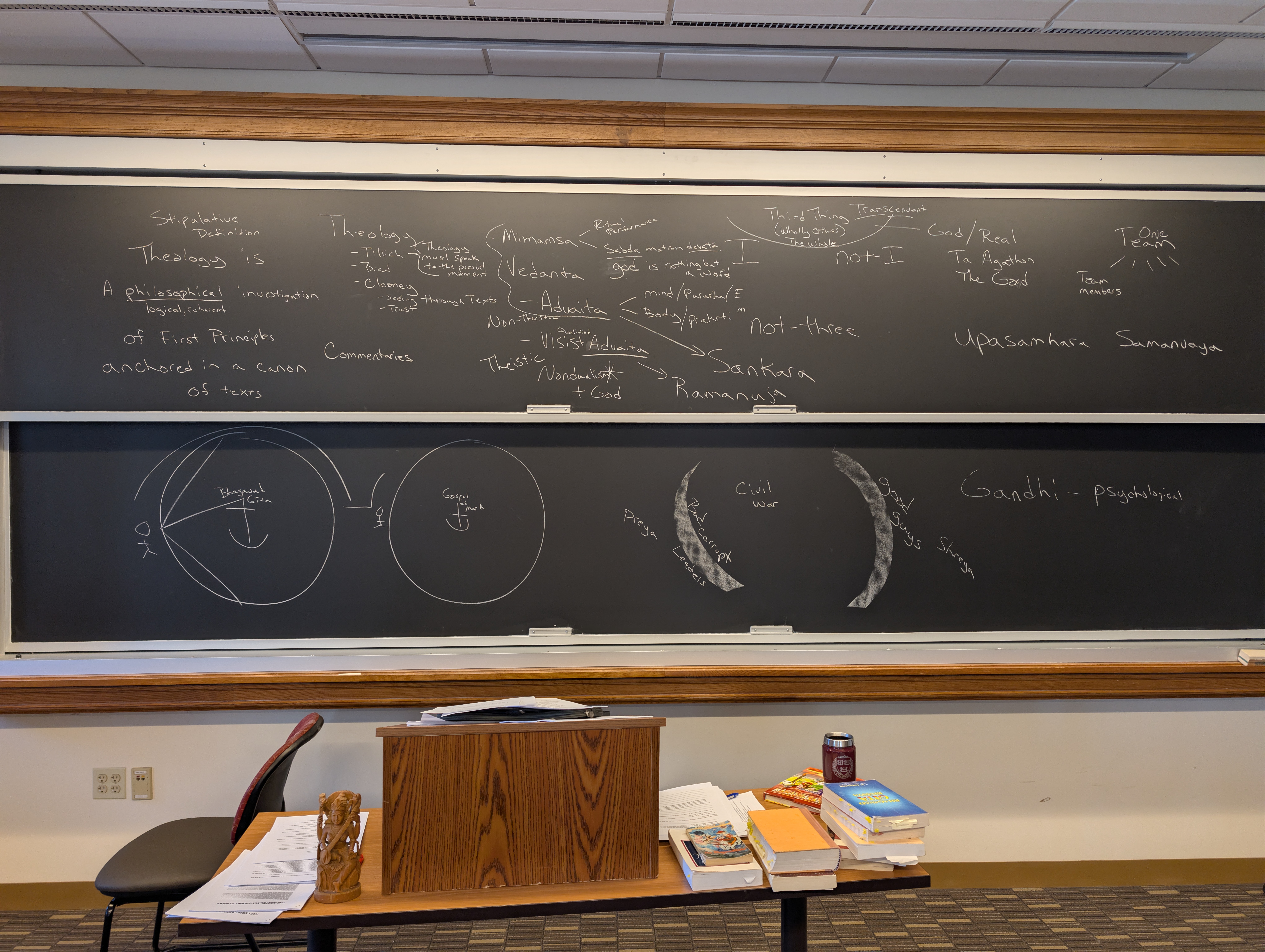
In the class session on March 17, 2026, the course transitioned into the study of the Bhagavad Gītā. The instructor reinforced the stipulative definition of theology as a philosophical investigation of first principles—I, Not-I, and the Wholly Other—anchored in a canon. Drawing on Paul Tillich, the class emphasized that theology must speak to the present moment, and through Francis Clooney’s concept of 'seeing through texts,' students were encouraged to view their neighbors through the lens of sacred scripture. The lecture contrasted different schools of Hindu thought, including the ritual-focused Mīmāṃsā, the non-dualist Advaita Vedānta of Śaṅkara, and the theistic Viśिṣṭādvaita of Rāmānuja. The instructor provided a theological framework and a visual model of the battlefield of Kurukṣetra to help students approach the text. Using the chariot allegory from the Katha Upanishad, the instructor explained the relationship between the senses (horses), mind (reins), and the self. While the class touched upon the beginning of Chapter 2, the discussion focused on introductory definitions and the psychological interpretation of the text as an internal struggle of conscience. The session concluded with the instructor explaining the chariot allegory and the importance of using commentaries to gain multiple perspectives on the verses.
⚡ Key Takeaways
- Theology must always speak to the present moment, addressing the 'here and now' rather than serving as a mere history of past beliefs.
- The stipulative definition of theology for this course is a philosophical investigation of first principles (I, Not-I, and the Holy Other) anchored in a canon of texts.
- Francis Clooney’s concept of 'seeing through texts' suggests that the goal of studying sacred scripture is to see one's neighbor differently through the lens of the text.
- Mīmāṃsā theology posits that 'God is nothing but a word' (Shabda matram devata), focusing on the efficacy of ritual over the agency of a deity.
- Viśiṣṭādvaita Vedānta, associated with Rāmānuja, is a 'qualified' non-dualism that is explicitly theistic, contrasting with the absolute non-dualism of Advaita.
- The chariot allegory from the Katha Upanishad represents the body as the chariot, the senses as horses, the mind as reins, and the intellect as the charioteer.
- The instructor encourages the use of commentaries, such as those by Śaṅkara and Rāmānuja, to look up specific verses and gain expert perspectives.
- Dharma (duty) is specific to one's role; for Arjuna, his duty as a warrior and general is a central theme of the text's opening.
- Gandhi's interpretation of the Gītā views the battle as a psychological allegory where Krishna represents the voice of moral conscience.
- The class utilized a 3D visual model to understand the layout of the Kurukṣetra battlefield and the characters involved in Chapter 1.
🎤 Transcript Tap any timestamp to jump the audio player
Opening Attendance and Meditation
In-Class Quiz and Assignment Collection
Lecture: Defining Theology and First Principles
Lecture: Seeing Through Texts and Hermeneutics
Lecture: Mimamsa, Ritual, and Advaita Vedanta
AI Visualization of Bhagavad-Gita Chapter 1
Class Discussion: Arjuna's Dilemma and Krishna's Response
Closing and Office Hours Announcement
THEO 1432: The Religious Quest · Brad Bannon · Boston College
Generated by Mitra