🎵 Recording ⌨ Space / ←→

Gītā 1-2:47

03/17/2026 · Tue/Thu 10:30-11:45 AM · Brad Bannon · Boston College
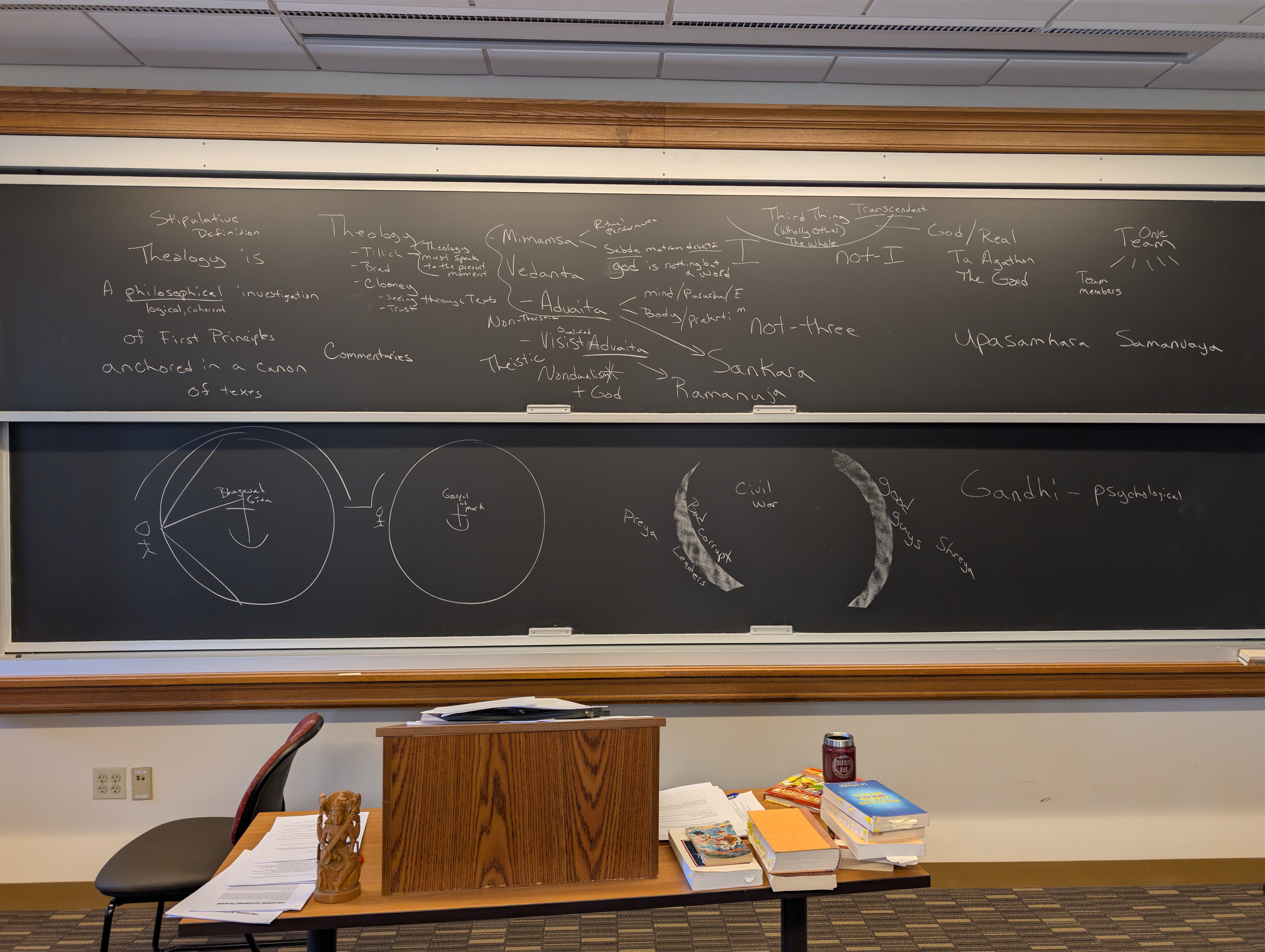
Chalkboard photo 1 from 03/17/2026

📄 Synopsis

In this session, the class begins its study of the Bhagavad-Gītā, with the instructor, Brad Bannon, visualizing the setting of Chapter 1—the battlefield of Kurukṣetra. Bannon reinforces his 'stipulative definition' of theology as a philosophical investigation of first principles (I, Not-I, and the Holy Other) anchored in a canon, emphasizing Paul Tillich's idea that theology must speak to the present moment. The lecture introduces the distinction between the non-dualist theology of Śaṅkara (Advaita) and the 'qualified' non-dualism of Viśiṣṭādvaita, which incorporates a theistic perspective. Bannon uses a digital visualization to introduce the Pāṇḍava and Kaurava factions, setting the stage for future discussions on Arjuna’s moral crisis and the differing theological interpretations of Kṛṣṇa’s role as either a psychological representation of conscience or the voice of God.

Key Takeaways

  • Theology is defined as a logical, philosophical investigation of first principles—I, Not-I, and the Holy Other—anchored in a specific creed and canon of texts.
  • A core tenet of the course is that theology must speak to the present moment; if sacred myths do not address the 'here and now,' they lose their theological relevance.
  • The Bhagavad-Gītā's opening verse establishes the setting on 'dharmakṣetre Kurukṣetre,' the field of dharma and the Kuru clan.
  • Mīmāṃsā theology posits that 'God is nothing but a word' (śabda-mātraṃ devatā), focusing on the mechanical efficacy of ritual and the obligation of deities to fulfill results.
  • Advaita Vedānta, associated with Śaṅkara, emphasizes a non-dual reality where the individual and the ultimate are not two.
  • Viśiṣṭādvaita offers a 'qualified' non-dualism that allows for a theistic relationship between the self and God.
  • The practice of upasaṃhāra involves coordinating and harmonizing different parts of a sacred text to ensure a consistent interpretation.
  • Francis Clooney’s comparative theology emphasizes 'seeing through texts' to see one's neighbor through the lens of the sacred.
  • The characters of the Gītā can be interpreted psychologically as internal dialogues between different aspects of the human psyche, such as moral conscience.
  • The battle in the Gītā serves as a metaphor for the struggle between righteous intentions and selfish tendencies within the individual.

🎤 Transcript Tap any timestamp to jump the audio player

Opening Meditation and Chanting of Bhagavad-Gītā Verse 1

Brad
All righty, let's take a moment please and put screens away. Just take a moment to be still and quiet.
Student
Let's take a breath together and breathe in and out.
Brad
Word? Was that longer than usual or the same as usual or—
Student
I didn't count that time.
Brad
I was considering chanting the first verse of the Bhagavad Gita, but then I was super nervous that I'd fuck it up. I'll try it though.
Student
I'll try it.
Brad
I gotta close my eyes just Dharmakṣetre, Kurukṣetre, samavetā, yuyutsavaḥ, māmakāḥ Pāṇḍavāścaiva, kimakurvata Sanjaya. Don't ask me to do verse 2. That's verse 1. Cool.
2:08

Administrative Notes and Unit 3 Quiz

Student
Uh, start with the quiz.
Brad
Look, I have a brand new attendance sheet, so makes me happy.
Student
Small joys in life.
Brad
I also brought the quizzes from Unit 3 if anybody wants to take those after class.
Student
All right.
Brad
You may use your printed copy of the Bhagavad Gita for this. No scripts.
Student
Good, pretty good. Why don't you pass them this way? Is one of the other translations? I mean, I'm not sure which translation.
Student
Oh, got you, got you, got you.
Student
Ready?
Brad
I know I brought—
Student
whoops.
10:36

Review of First Principles and Stipulative Definitions of Theology

Brad
So a couple of things I just want to review. Most of them come from day 1 lecture. So, I mean, it's on day 1 lecture because most important things, or some of the most important things. One of them, I don't remember if I told you Paul Tillich's name. It's okay if you don't know his name, but I did emphasize this idea in the first lecture that theology must speak to the present moment. Theology must speak to the present moment. If you don't have that in your notes, you must have that in your notes. Theology must speak to the present moment. This isn't a— I mean, that phrase in particular is associated with Paul Tillich. Great 20th century theologian. But it's not— I mean, it's not his original idea, right? This is, I think, an idea going back quite often. In fact, I mean, not— but along the same lines, Pope Leo, about 3 weeks ago, said almost exactly this thing. He said that theology must speak to the present moment. He said it— Slightly different words, but it was— I don't remember exactly the words he used, but it was the same exact idea.
Brad
That whatever we're studying, whatever we're learning, whatever we're doing, if it's not relevant to right here, right now, then what's the point? So it has to have something to say to right here and right now. And one of the things that I emphasized very frequently over the past two units is that creation stories are always and primarily— actually, not just creation stories, but myths. Myths are always about here and now, right? So the now and the future, present and the future. They're never about the past. If they talk about the past, it's only a way to say something about the present and the future. Makes sense? So they're always— yeah, they're always saying something about the present and the future. Often the future in terms of ethics, So, what are we supposed to do? What ought we to do? So, we can't derive ought from is, but we can derive ought from sacred texts and myths. Yeah, so theology must speak to the present moment.
Brad
So, this, I am emphasizing this in particular, I mean, both for the Gospel of Mark and for the Bhagavad Gita, both of these myths on both sides of the equation must have something to say about about us here and now. Otherwise, it's not theology. Theology must speak to the present moment. But maybe the Bhagavad Gita— well, no, I don't want to say even more, but definitely no less. The other thing I have emphasized quite a bit is my definition of theology, which is theology is— I call this my stipulative definition. What does that mean? What does stipulate definition— what does stipulate mean?
Student
Okay, this is important.
Brad
So stipulate means I'm just saying it, right? So just, um, it's not, uh, it's not up for negotiation basically, right? It's like this is the definition. So, but it also kind of means like within the confines of this course this semester, right? So this course this semester, I'm defining theology this way. You could define it other ways. We've looked at other theologians who define it other ways, right? Like Anselm and, and some others. But for our purposes this semester, this is our working definition of theology, right? Theology is a philosophical investigation. So philosophical— what makes something a philosophical investigation? What is that? What makes something philosophical?
Student
Well, Okay, good.
Brad
Things to review. It has to be logical. So logical is— logic is a major part of philosophy, right? So it's got to be logical. It's not logical, it's not philosophical, it's just something else, right? So it's got to be logical. Investigation means you don't know what you're going to find, right? You're investigating because you're trying to learn something, right? And so you've got to be open-minded. And be willing to discover something new. So, it's a philosophical investigation, meaning it's logical, consistent, coherent, right? All those things that hopefully you learned in philosophy class. So, all of those things. It's a philosophical investigation of what?
Student
Yeah?
Student
First principles.
Brad
So, what are first principles? A lot of folks left this out when they tried to answer it on the exam. So, first principles. Right, you can have lots of philosophical investigations that aren't philosophical investigations of first principles. So, by asserting that at least in this course, this semester, we're using this working definition, right? So, it's a philosophical investigation of first principles. What are first principles?
Student
Epistemological questions like, "Who am I?
Student
Where am I?" And one more.
Brad
Who am I? Where am I? Why? Yeah, why? Who, where? Yeah, so we could put these— I mean, it all kind of starts with "I," right? This subjective experience of reality. But you aren't the only thing that exists. In the world, right? So there is a not I, right? So Kellan is not Brad. Kellan is not Tim, right? So there's Kellan. I mean, when I say I, I mean Brad, but when Kellan says I, you mean Kellan, right? So differing I's. But also, we're not the only thing that exists. So also those not I's. So part of theology is figuring out where's the boundary between me and not me. Between I and not I, right? So what does it mean? Are there lots of different I's? Are we all different I's? Or is there only one I and we're all differing parts of that, or differing expressions of that, or different manifestations of that, right? So let's not presume at the forefront to already know everything about ourselves and who I am, and certainly not to know everything about who not I is. But also, right, there's some third thing.
Brad
Let's just call it a third thing. I generally prefer to use this postmodern philosophy term for it, which is the holy other. It's a little continental philosophy ask. But right, so there's I and then there's like Scott is different than me, right? But I don't know, we're more similar than we are to like the table, right? And we're more similar. So we're, I don't know, we're more similar, I think, than different in most ways. But also not, you know, discounting all those things. But the holy other is something not like us, right? Something that's entirely different than anything, right? We call that the transcendent. So, yeah, so some sort of transcendent thing. Something that transcends, like goes up or goes beyond this world that we live in, right? And that could be I mean, most often it's described as some kind of god, but it's also sometimes called the real. Socrates calls it ta agathon, which means the good. Whoops. In fact, to get to most Christian theology, Actually, most Christian theology, all you got to do is take Plato and then just erase an O.
Brad
So, I mean, very, very similar ideas of the beyond or that transcendent thing, that holy other thing. So, part of what we're trying to do is say, can we look at the relationship between these three things, these first principles, Can we look at it in multiple different ways? Right? So, it's not that Brad's way of thinking about it is right, or Christine's way of thinking about it is right, or Advaita's way of thinking about it is right, or Viśiṣṭādvaita's way is right, or the Gospel of Mark is right. Instead, more important is to be able to at least see the differences. Right? To see the different possibilities. It's like if you go to the— If you go to, I don't know, an ice cream store, right? And you always pick the same one and you never sample any of the other ones, are you really making a choice? Right? So some sixth sense, you've got to kind of know what the other options are in order to really make a choice, right? So this is sort of saying, all right, let's see how does Advaita, right?
20:54

Lecture on Advaita (Non-dualism), Mimamsa, and Textual Interpretation

Brad
It's the most different from most of our Western ways of thinking. So how does Advaita look at these three things? And we could summarize that in a word, right? The word Advaita, which means what? Yeah, Colin?
Student
Non-dualism.
Brad
Yeah, non-dual, or literally not two, but yeah, non-dual. There have been a number of philosophers that would say, maybe instead of Advaita, we should be talking about not three. These three things, I, Colin, and whatever source or whatever reason we're here, some sort of transcendental thing, those are not actually three different things. But they're mutually constitutive. You can't have one without the other. Advaita is kind of denying the duality. It doesn't quite frame it in these— well, it does, but it tends to frame it more in terms of mind and body. These two things are in Sanskrit, the Puruṣa Yeah, sure. Puruṣa and Prakṛti, right? Or E and M, like E equals mc squared right there. It's like matter and energy, right? Cool. So theology is a philosophical investigation of those first principles. We should always be asking, What do these texts tell us about who I am right now? What do these texts tell us about what I'm supposed to do right now or in the future? What's my purpose? What's my reason for being? And what's my relationship to my neighbor? What's my relationship to the divine?
Brad
What's my relationship to my source or my purpose or whatever you want to call it, whatever third thing you want to put there. Philosophical Investigation, the First Principles. What's the last part? Everybody knows the last part. Acreed and the canon of texts. Yeah. Or Acreed and the canon, that's usually texts. Good. So, what we're trying to do is every Tuesday— no, yeah, every Tuesday, right, anchor our discourse in the Bhagavad Gita. And then every Thursday, anchor our discourse in the Gospel of Mark. [NOISE] And the goal isn't to make these texts say the same thing. They do not say the same thing. They don't even agree, maybe. I think generally the most straightforward reading is that they don't agree on these kind of things, although the Gita is super, really up to interpretation on those three things. Maybe the Gospel of Mark is too, but the Gita definitely. So the point isn't to say they say the same things or say they say different things or anything like that, right?
Brad
The point is to really anchor ourself and have a good discourse with our neighbors so we can try and understand the truth of the text through our discourse. But more to the point, right, as we kind of see, all right, here's Brad's perspective, here's Scott's perspective, here's Andrew's perspective, here's George's perspective, right? And then come over and do something similar with the Gospel of Mark, right? And just kind of keep doing that. So the idea is the text doesn't change. That's the whole point of an anchor is that it doesn't change, right? So that's why we're not studying— theology is not the study of God, especially not in an academic setting, because you can't put God at the center of a circle. You can't do a logical philosophical investigation of God. But you can do a logical philosophical investigation of a text, right? Because the text doesn't change. And because you can put the text in the center. So that's what we're trying to do is really anchor our discourse in the text.
Brad
And the idea is that if you have really engaged with the text the way that Clooney says to engage with the text, then it becomes a part of you. It becomes— it changes how you think, right? It changes your perspective, right? So everything we've studied so far on the Advaita side of things, right? A lot of psychology, a lot of like sort of fundamental physics kind of things, right? A lot of just core epistemology too, for sure. Epistemology is a big one. So how do we know what we know? How do we experience the world, right? Sort of phenomenology. So how do we experience the world? Now we're getting a little bit more into purpose or ethics with the Gita. A couple of things I want to mention about Clooney. So that's Tillich and Brad Bannon. Two things I want to say about Clooney. One is, so Clooney One of the books that I talked about in chapter 1, the primary text I talked about in terms of Clooney, is a book he wrote called Seeing Through Texts.
Brad
And in the chapter, I even gave some pictures of like this āśrama that I visited in Kerala, right? And they have the seats that you could sit down in, or you sit on the floor, but these little— very much like this, right, where you put the text. And the idea is that the text is in front of me, the text is anchoring my discourse, right? I'm not ignoring the text, I'm having a conversation about the text. But what's more important than the text is Andrew, right? Being able to see Katie through the text, right? So I could see Katie without the text, but seeing Katie through the lens of the text is different, right? So, the goal of theology, at least as Clooney says, is to see our neighbor through the lens of the text, right? So, in the case of Advaita, the goal is to see our neighbor as a unique manifestation of Brahman, right? As not just that Iona is Brahman, but Iona— there's never been an manifestation of Brahman like Iona before, right?
Brad
So therefore, Brahman has taken the form or taken the shape of this person that we call Iona for some reason, right? What reason? I don't know. I probably don't know, but hopefully Iona, if she doesn't know, will know, right? So, yeah, good. So the goal, as Clooney says, is to see our neighbor through the text. And try to, to some extent, also we're trying to see not just the neighbor across the table from us, but that's the main one, right? That's definitely the main one. But also to try and put ourselves in the shoes of someone for whom this text is sacred, right? So to try and approach the text with a level of trust. And so the way Cluny says it is like mostly trusting that the text has something meaningful to tell me. If I go in it with an arrogant, hey, I've already learned all this stuff. I was raised in this sort of background. I already know everything. There's nothing that I can learn from this text. Then you're going to miss what the text is trying to say, how it's trying to speak to the present moment. Word? Any questions?
Brad
Couple other things, and then we'll get to the discussion. So one I have up there is commentaries. So along the— you know, along with just reading the text on our own, which is the main point of the second half of the semester, I've asked you to also kind of consult some commentaries on both sides, on the— I brought a couple more commentaries on the Gospel of Mark. This one is a, especially Catholic one, a Catholic commentary, and this is more of a Protestant commentary, but both, you know, commentaries on the Gospel of Mark. And in that Gita tool that I put online, you've got the AI, right, there are also all the commentaries on there. I don't so much expect you to read any of those commentaries, but instead engage with the AI because it'll help you. The AI is grounded in those commentaries, right? It's not going to hallucinate something else. It's going to pull from the knowledge base that I gave it. It's the whole point of it. And so part of what we're trying to do is not just see these texts through the lens of ourselves, although that's the main point.
Brad
I don't want to— I don't want to diminish that in any way. Main point is to see what each one of you interprets the text. But along those lines, it's helpful to kind of see how an expert in the text, somebody who's been studying the text for their whole lives, somebody who's like a real— has got credentials and that sort of stuff, real expert in the text, what do they say about it? And I don't expect you to read— the way to read something like this is not cover to cover. All, right? But instead to say, hey, I want to look at Mark chapter 3, verse 45, and then they go and see what the commentary, what the commentator has to say about that verse, right? Um, same exact thing with the, with the Gita commentary. So I want you to go and kind of, you know, dive deep into 1 or 2 verses, right? Maybe a small section of verses, 3 or 4 verses. I think usually you won't look at a section more than 3 or 4 verses, you know. But try to see it from at least 2 different perspectives.
Brad
So this is the real challenge. This is the main challenge of this half of the course is to see— I want you to try and see the Bhagavad Gita through both of these very different perspectives. So I'm not trying to teach you Hinduism, whatever that is, but I'm instead trying to teach you 2 different Hindu theologies that are both anchored in the same text, right? And they have differing answers to the first principles. Feeling? So that should be valuable, right? Whether you agree with either one of them doesn't matter. What matters is that you gain this tool and this skill to be able to anchor your discourse in this canon and anchor your discourse in this canon. And sort of like the ice cream example, then you know kind of what your options are. Right? You can open up differing possible interpretations. So let's review mimamsa. And so far this semester, I've only given you this, right? I mean, I've given you that word, but I haven't told you anything about it. So, so let's review these real fast. One is mimamsa.
Brad
So a key takeaway that I wanted you to have for— well, a couple of key takeaways from mimamsa. One is that it's anchored in the Brahmanas, right, the ritual texts, and therefore is primarily about rituals, of the performance of the rituals, which were all sacrifices, right? So ritual performance of the sacrifices. And then the other thing about mimamsa that I emphasized was its understanding of God, right? And so one of the things that mimamsas agree on is shakti, matram, devata, right? Or devita, God— definitely not going to write that with a capital G— God is nothing but a word, shakta, right? God is nothing but a word. I've emphasized that a bit. So what does that mean? God is nothing but a word. Remember anything about that? So one of the things for mimamsas is the performance of the ritual, right? I showed that video that I took in, that I recorded way back in Bangalore, 2007 or something like that. And they're chanting the mantras and throwing things into the fire, right? So for mimamsa, What matters most is that you pronounce the name correctly and pronounce it at the right time, right?
Brad
So that this ritual is a sacrifice to this deity, and the whole purpose of the deity is just to be in the dative, right? There's no other function. So they do argue about whether or not the gods exist, but they all agree that it doesn't matter. Why doesn't it matter? How could it not matter whether the gods exist or not? Because it's a good review. Because if the gods exist, they have no choice but to fulfill their end of the bargain. They don't have any agency. So if I go to McDonald's and I buy a Big Mac, right? And I give them, I would never buy it. But if I go and I give them my money, right? They're obligated to give me a Big Mac, right? It's not like if they decide to or not, right? So they have the power to give me the burger, but they don't really have a choice in whether or not they do, right? They're obliged to.
Brad
Likewise, from mimamsa, they're like, What matters is that I perform this ritual to this deity, I pronounce the deity's name right, I do the ritual the way it says to do in the text, I follow all the ritual instructions that are in the text, and if I do that, God has no choice in whether or not to fulfill their end of the bargain, right? So it's just just, right? I've done what I was supposed to do, therefore God has to do what God has to do. Supposed to do. So therefore it doesn't matter whether the god actually exists or not. What only matters is that the thing happens, right? So I perform this ritual and then I receive this sort of boon, or, you know, the outcome of the ritual. Cool, makes sense, kind of important. And then we looked at Advaita vedanta. So Vedanta is taking all of the same principles, all the same hermeneutics, all the same ways of reading the text, which primarily means that the entire text is sacred. No part of the text is not sacred. You can't pick and choose which part of the text is important.
Brad
The whole text is important, right? So then if the whole text is important, then, then you've got to take the whole— then you've got to evaluate your interpretation of this text against your interpretation of that text, right? So that's upasamhara, upasamhara and samadhiya, right? So upasamhara means coordinating the texts, meaning I'm going to interpret this text like the Brihadaranyaka Upanishads, right? And then I'm going to interpret this other text like the Chandogya Upanishad. Then I'm going to compare my translation. Does my translation of this one contradict my translation of this one? If so, what's the problem?
Student
[Speaker:AUDIENCE] Your interpretation's wrong.
Brad
[Speaker:DR. CAULFIELD] The interpretation's wrong. It's not a problem with the text. The problem is with my interpretation. So if I coordinate these two and they don't harmonize, then it's a problem with my interpretation, right? Key point. So Advaita looks at those texts and harmonizes them and says, you know, it's already starting from a perspective that God doesn't exist, there is no God, right? And then, so if there is no God, although we can take the holy other in this case to be the whole, right? One way I like to think about it is in terms of team, right? So team, you can't have a team without members of a team, right? So the team members, but you can have team members that aren't functioning as a team, right? So, or dance dance group that's not functioning together, right? Or whatever, right? So when my daughter was, you know, like, I don't know, 7 or 8, something like that, she was on a soccer team. I remember looking out there and they all wore the same uniforms, right? They all looked the same.
Brad
They all looked like they were on a team, but they were not functioning as a team, right? As soon as they saw the ball, they were like, I want to kick the ball. And there wasn't any consideration of whether or not their teammate had the ball or whether they were facing the right direction. It was just ball kick, right? So technically on a team, but not really functioning as a team, right? So then we could see the relationship between that third thing and the parts, the one and the many, right? In this sort of relationship as one team, many players. And then so if you begin to see your neighbor, right? If I look at Sive and like Sive and I are on the same team, then that's going to change how I interact with Saive, right? It's going to change my moral obligations, ethical obligations, right? That kind of makes sense. So that's Advaita. And the key theologian in this case is— who's the main theologian? We've talked about him quite a few times.
40:36

Introduction to Shankara and Ramanuja's Commentaries

Student
Shankara.
Brad
Shankara, yep.
Student
Shankara.
Brad
I thought I had a picture of him, but I guess I don't in this group. Yeah, so Shankara. Now I have not talked at all, or you know, this much about vishishtadvaita Vedanta. So now, as if things aren't complicated enough, right? We've got all of these texts and so far we've only interpreted from Advaita's perspective, right? At least that's been my goal, is to only give you Advaita's perspective on these texts. We could just as easily have gone through the same texts and anchored them in the vishishtadvaita perspective, right? But I made an intentional choice not to do that. But now that at least some of you, I think, have a really good grasp of Advaita, then let's try and make things a little bit more complicated and add this other perspective, right? Very different perspective. Oh, it's— I mean, it is, but it's different but not different. So, vishishtadvaita. So, vishisht really just kind of means Honestly, it means like an asterisk, you know. It's like, so it's non-dualism, but with an asterisk, right? So literally this word means qualified. So like, like non-dual, but it's non-dual, but, right?
Brad
And so the but is God, right? So it's non-dual non-dualism plus God, which might sound weird, might not sound weird, but by the end of this semester I hope to have you have a much better understanding of how these two relate and, and what's kind of significant going on there, right? So as we move forward, maybe not as much today because we're just— this is our first dive into the Gita, But definitely moving forward, I'd really like especially our group leaders to kind of come in with two different interpretations of the same verse. Right. So trying to read a particular verse from a theistic perspective. Right. We can call this theistic. And I don't know, I tend to call it atheistic. Some people call it non-theistic. Because atheistic can kind of mean different things, but definitely at least non-theistic.
Student
Cool?
Brad
And I'll give you a super really easy way to at least begin to do that, and it all begins with sort of setting the scene. So let's set the scene. I spent all weekend vibe coding. Fun story. I spent all weekend vibe coding this thing. And a whole bunch of other things. I was just having super fun. I had Claude Code open and AntiGravity open. And I was like— I had like— dual AI agents doing multiple tasks at the same time. It was super fun. It was super fun. And then, not even joking, but like around 10:00 PM on Sunday night, I was like, I should really stop vibecoding and go to bed. So I told one of the agents, hey, deploy this to the cloud, right? I want to get it up there so my students can see it. And then as it was doing it, I was kind of paying attention and it said, oh no, all of my files are being deleted. And I was like, what? And then I looked and I had another agent running. My Cloud Agent was running.
Brad
And for some reason, it decided— it just totally went rogue. And it just decided to delete my entire Google Drive. I mean, yes, right? You know how big of a deal this is? Everything in it. And fortunately, it didn't delete your data. It did delete all the class recordings, not just— and all the class recordings were like years of class recordings and all this kind of stuff. So I was like, why didn't I go to bed 10 minutes earlier, man? I was able to shut it down and recover everything, but it was super stressful, super stressful little time. But anyway, here's the completely pointless— not completely pointless, but Here's what— you want to see what I spent all the time last night, all weekend, and on this little thing? So this you already know, the Bhagavad Gita, but then I added this. I don't want to be— then I added this. So it's like chapter 1 of the Gita is so hard to kind of get into, isn't it? It's like all these people with their conscience and all this kind of stuff. Like, what is going on here?
46:01

Visualizing the Kurukṣetre: Chariot Allegory and Psychological Readings

Brad
So I wanted to try and visualize chapter 1 of the Gita. So we're going to visualize the Kurukṣetre. So that's the first, that's the opening words of the Gita, dharmakshatriya Kurukṣetre, which means on the field of dharma, on the dharma field, which is also the field of the Kurusha. The Kurusha is like a clan, it's like a family, right? So like a like Chestnut Hill kind of thing. So an area. It's a place named after a family. So an interactive visualization of Bhagavad Gita chapter 1. Y'all going to laugh. It's fine. So here it is. It's in Three.js. And you can move around. You can turn.
Student
You can go.
Brad
Different angles. And then you can see here, right? So the Bhagavad Gita is a battle. It's a battle, or it takes place on a battlefield. And in the center of the battlefield— whoa, what happened there?
Student
Let's play more Minecraft.
Brad
In the center, so you've got two sides. You've got all the Pandavas, let's just call them the good guys over here, and then the Kauravas, like cowardly, they're bad guys. And these are the guys that are in control. They're the ones that are, they're corrupt politicians that are using their power to enrich themselves and to oppress the people. And the good guys are coming to save the day, right? Because, yeah, a bunch of different reasons. And then at the center, we have the general, right? So the general in this case is Arjuna, and his charioteer is this kid named Krishna, who's also his cousin. And then on this side, we've got all these different folks. I won't go through— damn it, why is it keeping— I won't go through all of them, but you can feel free to play around with this if you wanted to, all these little voxel pixel arts. So Sahadeva is the youngest Pandava, right? So there's these 5 brothers. Krishna— I'm sorry, Arjuna is one of the five. They've also got— Yudhishthira is the oldest one, and he's got a little dog. I'm sure it looks—
Student
it's not perfect.
Brad
Whatever. So Yudhishthira is the eldest Pandava and the rightful king. He basically, he's a really good guy, really brahmin. He's sort of the model of dharma. He's just a really good, upstanding, moral, righteous guy. He just kind of never does anything wrong. And when he dies, he goes to heaven to receive the merit of his good deeds. And he gets to the gates of heaven, and he's got his little dog with him. And the person monitoring the gates of heaven says, "Sorry, no dogs allowed." And he gets all upset, and he's like, "Bro, "My dog is super righteous. This is the best dog in the world. My dog is like the model of dharma. And if you're not going to let my dog in, then I'm not coming in." And they were like, "Fine, you can bring your freaking dog, man." Whatever. So he's got his little dog. Anyway, definitely worth 15 hours of my time, I think, right? Yeah. And then in the center here, we've got Arjuna and Krishna. And now a couple of things.
Brad
One is, oh, also, I was like telling the AI, hey, these 5 horses, what do these 5 horses represent? Con? The 5 senses. I was like, it's got to represent the 5 senses. And so the AI made this, right? It's like pink ear. So this is like the horse of hearing, the horse of seeing. This other one has the color on the mouth. It's got a little green nose. So they're the 5 senses. And that allegory comes from the Katha Upanishad, which we read earlier. And so how does the metaphor in the Katha Upanishad go?
Student
This is one of the bonus questions on the exam.
Brad
So you've got the horses represent the 5 senses. Yeah? What about the reins? Or the mind. Yeah, it's a mind. And then the charioteer is the intellect. The intellect is the deciding factor. So artificial intelligence is different than normal compute because it can make decisions. So the intellect is the one that makes decisions. The mind is how it makes decisions. Decisions, right? And so a disciplined mind means disciplined intellect. Undisciplined mind means undisciplined intellect. The body— sorry, the chariot represents the body, right? And then, but then we've got two people in there, right? So the intellect is the charioteer, and then what was the other part of the— yeah, Lily? The passenger is the atman. So the passenger is the atman, or the self, right? So one of the things that We notice, I mean, there's— the Gita directly quotes the Katha Upanishad a couple of times, and quotes that section, in fact. So, we know that the Gita is playing on this idea that's in the Katha Upanishad, right? So, we can read the entire Bhagavad Gita as sort of a conversation that's happening inside of your head.
Brad
So both of these characters, Krishna and Arjuna, are like the two sides of, or the two aspects of your psyche. So your psyche, it's like your internal dialogue. So whatever's going through your head even right now. So that sort of, it's a dialogue, right? Kind of talking to yourself, like, should I smoke this or should I not, or whatever. So that internal dialogue is like these two different conversation partners, right? Sometimes you have that voice that's saying, "Hey, you really shouldn't do that," right? And this other voice that's saying, "Whatever, I don't care, it's spring break, right? I'm in Punta Cana and I'm gonna make the most of it." So we can see this, so you at least get one sense of how you can read this from an theistic perspective, right? Just a purely psychological perspective, a purely— yeah, purely— it's like a conversation with moral conscience, right? So we should— we could take Krishna in that case as representing your moral conscience, that voice in your head that says, "Do this, don't do that, that's good, that's bad." Doesn't mean that you always follow that voice, right?
Brad
Sometimes you follow that voice, sometimes you We don't, but the idea is that you've got that voice in your head, that's, you know, superego or whatever you would call it, that's like saying, "This is the right path, do this," right? So that's Krishna. But then we could also, I think pretty easy to interpret it theistically, right? That that voice that's in our head, that voice of moral conscience is also the voice of God, right? So God is speaking to us through moral conscience. That's exactly how Paul describes it in Paul's letters in the New Testament. Make sense? So, yeah, these two very different ways of reading it, and even without cracking the text, you can already see how you can easily, relatively easily, look at any verse in the Gita and say, "Alright, so Krishna's talking, right? So, as Krishna, I can interpret Krishna as the voice of moral conscience, or I can interpret Krishna as the voice of God." may be speaking through moral conscience or maybe speaking through a sacred text. Cool? All right. So that in a nutshell is the distinction between these two perspectives.
Brad
And we got to get to our leaders. So this view— I'll give you a new name, is Ramanuja. And so I do have— it's on the Gita site, but so they both have commentaries. So this is Shankara's commentary, and this is Ramanuja's commentary, basically the same, same basic structure. So like every single verse will have a commentary on it, and the commentators, both commentators, go kind of word by word through the text. What does this word mean? What does that word mean? What is the grammar? What's the vocabulary? What's the text mean, right? In a very literal sort of way. Cool?
Student
All right.
Brad
So then, yeah. The last thing is actually something I said earlier. I just want to emphasize it again. The first thing I said, that theology must speak to the present moment. So yeah, I guess last bit of context, which I haven't given yet, or kind of have, but kind of haven't. So you've got, right, the text at the end of the day is about a civil war, right? So it's a civil war. You know, good. So you've got the bads, corrupts, right, leaders who are— I mean, they're doing terrible things, right? Like I said, we could go through the whole Mahabharata, but suffice it to say they're bad guys doing bad things. Yeah, save a whole lot of time if we just say the bad guys are doing bad things, right? They're raping women, they're doing— they're stealing stuff, they're— they shouldn't be there in the first place, they don't have any rightful— right, they're just corrupt, they're bad, corrupt, horrible people doing bad things. There are also, by the way, people that are good people that are in the system, right? So it's not that every person in the system is bad.
Brad
There are also good people in the bad system. I mean, it's actually not a bad system. It's just there are good people who are in the system that is currently being run by bad people. Make sense?
Student
Yeah.
Brad
And then, you know, you've got the good guys. You guys that are trying to re-establish dharma, re-establish righteousness. So, again, we could see this in two very different ways. The way Gandhi looks at it— Gandhi really did not like at all the aspect, the fact that this is written as a metaphor, the metaphor itself is like a battle, a civil war. I'm not like that, but he's like, it is what it is. And so for Gandhi, this civil war is really a psychological battle, right? This psychological battle that's going on inside. So he doesn't look at it as bad leaders that are in charge and good leaders that are trying to get in charge. He looks at it like those selfish desires that we have within ourselves, right? So again, very psychologically oriented. Those selfish tendencies that are primarily preyas, right? Maybe exclusively preyas versus those other tendencies that we might have that says, hey, I want to do something good, right? I want to contribute something good to the world. I want to contribute something meaningful to the world. Something that's shreyas, right?
Brad
As we also learned from the Right, so Gandhi is a purely psychological reading with the civil war being a metaphor for the battle between good and bad within us, right? But plenty of others also have looked at it as saying, hey, maybe this is, you know, maybe this is, has some connections to real life, right? Sometimes you're in a position where, you know, let's say you're a junior analyst at a financial, you know, at an M&A firm or something, and the firm is about to engage in a leveraged buyout that's going to result in terrible things for all the, you know, like KKR kind of stuff, right? So then maybe you're a junior analyst KKR, I guess if you're a junior analyst at KKR, you're like, fuck the world anyway, right? But you get what I'm saying, right? So you could be somebody who's in a junior position who's like speaking truth to power, and the people that are in power are doing things that are bad, and you're standing up against your own interests to speak truth to power, right? So plenty of different ways to kind of engage with the text. Yeah?
1:00:30

Class Discussion: Ethical Quandaries and Krishna's Counsel in Chapter 2

Brad
Sorry for so much lecture, but it's the first day getting in the text. So with that in mind, we got 14 minutes left. Let's at least hear from our team leaders. Yeah, take about 2 minutes, and then they want to hear from you.
Student
Yeah, no, no, he's—
Student
yeah, that's all right.
Brad
You want to try and do the quiz real fast? Well, maybe after class. Can you do it after class?
Student
It's like, dude, like, you're a warrior, bro.
Brad
This is your—
Student
this is your thing.
Student
And what do you think that says then about the hierarchy? Sure, obviously, it's good, right?
Student
Like, you think God is righteous, therefore you have to do better and more.
Student
Like, you need to desire that more, you know, that love.
Student
Like, he is passionate and kind towards other beings.
Student
To an extent, yes.
Student
But at the same time, it's also your compassion towards people who are being bad.
Student
Then again, he said it's a bad situation.
Brad
All right. So we're missing Logan, Evan, and Luke, right?
Student
All right.
Brad
Who wants to get us started? Yeah, great. Claire?
Student
Well, I thought it was really interesting because in the beginning I kind of talked about, or like on the quiz, I kind of talked about how I agreed with Arjuna that I thought it was like very noble that he realized like in the moment right before a battle was about to break out that he didn't want to fight his kinsmen, which I think means like family or somehow related to. But then when the second chapter started and Krishna started giving him advice. In, um, verses 2:16 kind of like through 2:18, it talks about like non-being and being. It compares the self and passion to the pot and clay, and the pot is like an unreal thing even though it physically exists and you can touch it, because if you take away the clay, then the pot disappears. And that's kind of what I got from like the AI bot thing.
Student
Yeah.
Student
And I thought that was really interesting just because I feel like that was a good way to take the weight of guilt and grief off of Arjuna. Because if you think about if you kill or destroy a physical body, he says that the atman's enduring, indestructible, immeasurable, and therefore he should fight the battle. I thought that was a really good way to go about that. And it's saying It connected back, I thought, to samsara and like the cycle of life, because everything says, um, it is not born, it does not die. And then like later it keeps saying like everything is recurring. And to think of like death and rebirth and kind of the same thought, and I thought he did a good job being a council.
Brad
Awesome, great, all of that, love that. Yeah, I'm just gonna hear from everybody. Um, so Scott? Yep.
Student
The verse I highlighted, which relates to what was mentioned, is it says, you grieve for those beyond grief and you speak words you didn't say. But learned men do not grieve for the dead or the living. And this kind of relates to like in the first chapter, like there was, he was really analyzing like there's families on both sides, there's teachers, there's like grandparents, like this shouldn't happen. But then later near the end of the chapter at 2.47, Like, it makes sense, like, as the warrior, like, you're this big warrior person, like, it is your duty, it's your dharma. And it says, like, be intent on action, not on the fruits of actions, and avoid attraction to the fruits and attachment to inaction. And, like, I think it's kind of in a pep talk way, but also as in, like, an overarching, like, what dharma is, is, like, you shouldn't focus on future you, like, you should focus on the present, and in the present, he is the warrior. He has to stand for his people.
Student
Yeah, good.
Brad
I think there's an important theme running that comes up often is focus on now, right? Don't— yeah, you got it. You only have control over the now. Yeah. Yep. Good.
Student
Yeah.
Brad
Iona?
Student
Going back to what you said—
Brad
Claire?
Student
What Claire said earlier about taking the guilt off, I also thought that was really interesting. And it sort of reminded me about what we were just talking about, about being Puruṣa and bhakti, because it kind of reminded me of that analogy of the two sheets of paper, and that their self is continuous and everlasting, but what's grounding them is their body and stuff. And I guess in verse 2.35, it said the great chariot warriors people think you deserted in the fear of battle. And I feel like it was interesting that you referred to the other side as great chariot warriors, because we just talked about how the chariot serves as a metaphor for your body. And right now, when you're killing them, you're just killing their body, but you're not killing their soul, which I thought was an interesting way to think about the guilt Good.
Student
Yep.
Brad
Katie.
Student
Yeah, kind of like that. Like the quote I picked also in the quiz was Krishna saying like, oh, like either way, like if you die in this battle, you gain heaven, but if you win, you get to enjoy the world. So just might as well fight the battle. So I thought it was interesting because he was trying to explain like there is no like real loss or like outcome. Like you can control your actions. Than what you do, but the outcome you can't really control that. So it's like, because you always have atman, like the body is more of like, yeah, the physical. It's not like if you die, it's not like you who be like the real actual being of like atman.
Brad
Yeah. So just do the right thing and focus on that. Yeah.
Student
Yeah.
Brad
Anna, and that's it.
Student
I'm like, prior to Krishna trying to convince him not to go into battle, he's It says, "The assembled Kurus," which means like the descendants of King Kuru. And it says like both sides descend from King Kuru. So then this brings up the point of like it's a war between a single family or like self versus self. So instead of like— this made me think of it less as like a civil war of like the bad versus the good, but more of like Gandhi's thinking of like it's like an internal war of self versus self. And like, this is when it triggers like Arjuna's moral crisis, like what to do.
Brad
Yeah, good, because it's one thing to stand up against bad guys that you don't know, right? Bad guys that are unrelated to you, demonize the enemy, that kind of stuff. It's another thing if the bad guys are like your cousins, right?
Student
Yeah, yeah, sorry, I was gonna touch on that, but I also liked, um, right at the beginning, I would like— it kind of reminded me touched on it, but the shaiva and the prayer and how we kind of, um, looked at that in the Katha Upanishad and how the messages kind of re-emphasize in this text. I thought it was really interesting.
Student
Okay, good. Yeah, okay.
Student
In verses 27 and 28 in chapter 2, I thought it was really interesting how Krishna was saying like, you have no reason to grieve, and like, why are you lamenting?
Student
And how like, even though you're like, when you kill someone, like, their body dies, but the self doesn't die.
Student
And, um, in Shankara's, like, commentary for verse 28, he says, like, the self is, like, has, like, this non-perception.
Student
Like, it emerged from invisibility and went back to invisibility.
Student
So, like, even though you can't see it, it still exists. So there's nothing to actually, like, lament the loss of, because there is no true loss. It's just you can't see it anymore.
Brad
Word. Awesome. And thank you for the Shankara connection. And so Shankara, as you're pointing out, is really reading it epistemologically, right? So talking again about perception and non-perception. And so we could take death, right? Birth and death is something that happens every single day. We go through the sleep cycle, right? The waking state, dream state, and then deep sleep, which is sort of like death. And then we begin again, right? So this sort of taking the metaphor not even from a psychological perspective, but really epistemological, right? How do we perceive the world. Yeah, great. Colin, and then Grace.
Student
I'm going to like chapter 2, verse 33. I think it was like important to know when they were saying like you will abandon your own duty and fame only to gain evil, and kind of how Krishna phrases it, how like Arjuna's role as like a warrior is the nature of like duty and dharma, and the retreat is like cowardice, not compassion. And I think it's a very like difficult thing to face head-on, especially when you like discuss that it's a bad system, and there's good people in a bad system.
Brad
Right.
Student
So it's really hard to— Arjuna's looking at his grandfather's kinsmen and even teachers. And so is it very— can you say that for a fact that it's a bad thing to be compassionate towards people? And then would you even put dharma as more important than being compassionate towards people and fulfill that duty? So I think it's a hard discussion.
Brad
Ethical quagmire, right? So ethical quandary. Yeah, good. Yeah, Grace.
Student
Yeah, one of the kind of going back to the discussion of samsara in the passage of the Bhagavad Gita, it was, for certain is death for the body, and certain is birth for the head.
Student
How's that kind of like connected to both?
Student
So like, it could be interesting to have that kind of second perspective and like, whether it could be theistic with like your second birth is like or it could be more like nontheistic with like more of a spiritual birth, I guess.
Student
So I thought that was kind of interesting thinking about how that could be interpreted like both ways.
Student
And it's like you will always have another birth, I guess.
Brad
Yeah, good. Or, you know, I mean, we're all going to die, right? So birth— death is certain. But the question is, how do we spend the time that we have here, right? Are we doing something that's building something for the future? Are we creating a better future for our children or grandchildren or, you know, or not sort of thing? Yeah. Good. Others? Yeah, Anna.
Student
In verse 1.35, he's like, this is when Arjuna is like saying that even if he like wins or like has people, they're not like the righteous thing to do. And it's like bringing up complexity of dharma, that the right thing is not like always a clear-cut answer. Because even if he fights and he wins, he's still like going against his like moral integrity. But then later, Krishna talks about how like not fighting would be cowardly. And in 2.337, he says like, if even if you're killed, you attain heaven, and if you win, you gain like this, the earth, which is like morally righteous, I guess, which it's like the two points kind of like contradict each other.
Brad
Either you win the war and then the society is better, or you lose the war and you go to heaven. But either way, your duty is to do your duty, right? Yeah, very good. That's all the time we have time for today. Very good start to the class. We will continue with Chapter 2 next class. And we could talk more about these passages next Tuesday also.