🎵 Recording ⌨ Space / ←→

Aitareya Upaniṣad (III.1-4)

02/19/2026 · Tue/Thu 10:30-11:45 AM · Brad Bannon · Boston College
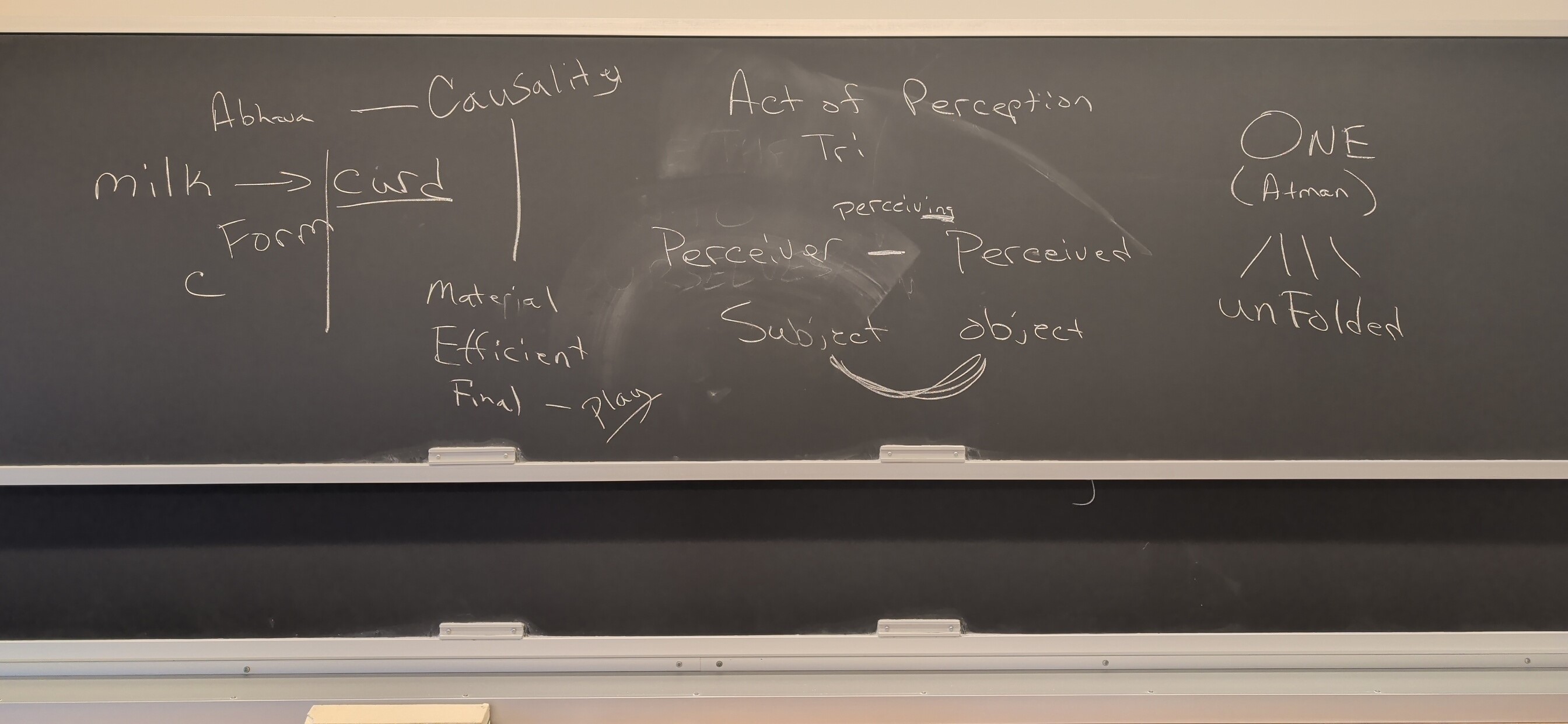
Chalkboard photo 1 from 02/19/2026

📄 Synopsis

This session explores the Aitareya Upanishad through the lens of Advaita Vedanta, focusing on the intersection of cosmology and epistemology. The class examines the creation narrative not merely as a physical origin story but as the emergence of self-cognition and the 'opening' of the senses. A significant portion of the discussion is dedicated to the 'three births,' interpreting them as stages of consciousness and the continuity of the Self across transformations. The instructor introduces Prabhakara’s Triputi Pratyakshavada to illustrate how the knower, the known, and the act of knowing mutually arise within the one Atman. Finally, the session addresses the nature of birth and death as transitions in state rather than absolute beginnings or endings.

Key Takeaways

  • Creation in the Aitareya Upanishad is an epistemological event where the origin of the cosmos occurs simultaneously with the origin of self-cognition.
  • The 'three births' can be interpreted as the biological birth, the continuation of the self through offspring and nourishment, and the transition after death.
  • Triputi Pratyakshavada posits that every act of perception involves the simultaneous arising of the perceiver, the perceived, and the act of perceiving.
  • In Advaita Vedanta, the distinction between subject and object is epistemological rather than ontological.
  • Hunger and thirst are described as inherent to creation, requiring 'co-sharing' in all offerings, signifying that ritual and worship are never purely spiritual but embodied.
  • The human form is deemed 'well-made' and sufficient for the gods because it possesses the capacity for true consciousness and self-recognition.
  • The Aitareya Upanishad collapses the boundary between the macrocosm and the microcosm, turning the human being into a 'living altar' where cosmic deities inhabit the senses.
  • Advaita emphasizes that you do not become Brahman because you already are Brahman; liberation involves realizing this identity.

🎤 Transcript Tap any timestamp to jump the audio player

Opening Transition and Silent Meditation

0:00

Review of Shatdarshana and Epistemological Frameworks

Brad
Alrighty. How do y'. All. Let's take a moment and, you know, transition. Reset. Take a moment to just be still. It. Let's take a breath together and breathe in and out. Word. Alrighty. Start with a quiz. I'm going to play the mantra. Hope it won't bother anyone. If you know Sanskrit, then it should help on the quiz. Sam.
0:10

Philosophical Investigation of Epistemology and Material Causality

Student
Ramayana
Brad
Jam. It.
Student
Sam.
Brad
La. Sa. All right, cool. Be sure you write your number on there and try to put the, you know, put them all the same direction, please. Yeah, I got you. 25. Go ahead and pass them. Okay, cool. Thank you. I think this is the first time I've had a bonus question. Right. Usually the bonus questions will be worth some. I mean, a lot more. Right. In this case, the bonus question is worth 10 and entire rest of the quiz is only worth 9. So I think bonuses should be like, you know, bonus. Right. Anybody get the bonus? No. He gave you the question and the answer in the chapter. Let's go over the quiz quickly. Yeah. So the mahavakya Prajnanam brahman means what? Yes, I've. Consciousness is brahman Consciousness is brahman Yeah. Other things you could have put there, but that's the usual translation. What does the word prakyana mean? Fear. Yeah, knowing. So pra meaning like intense. Right. Intensification in jnana. I mean, knowing. So, like, knowing. I don't know. Vamadeva is significant because he. Yes, guys. brahman in the womb. Yep. He realized his identity with brahman in the womb.
Brad
Prabhakara is a theologian whose epistemological framework is relevant to how dharma understands birth and death. What perspective, what shatdarshana does he belong to? That's right. Good. That's a tough one. Right. According to the chapter Prajnana, brahman describes brahman as the object of the a Ding an sich that can be grasped by the outside when approached using a phenomenological method of inquiry. True or false? Everybody's nervous about that one. Huh? Let's see. Is that in the chapter somewhere? See, people just like copy it. So somebody just copied the whole thing. Somebody's got the entire thing selected right now. Yeah. purana brahman is not. Defining brahman as an object of study points toward what you already are. Right. You're not an object of the world, your consciousness or your being that is conscious by which the world is known. So false on that one. And Shankara reading, the four Mahavakyas represent four different truths about brahman each unique to its Own Veda true or false? False.
Student
Different angles on the same tree.
Brad
Yeah, I use the example of, like, cameras, like, taking different camera angles. It's not to say that they're all exactly the same, but they work together. Right. So exactly like seeing different angles of a die. Right. So you're all looking at the same thing. But. So they're. They're a little bit different, but they're not different. Truths about brahman Aitareya Upanishad begins with the creation narrative that parallels the Purusha Sukta, but retells it with an epistemological emphasis, asking how the one knows itself as bini. Certainly true. Right. I think that was emphasized a few times. And I also. I'm trying to teach you this idea of. Right. Samanvaya and. Or Upasamhara and Samanvaya be awesome if that person deselected the chapter. So the Nasadiya Sukta. So part of what I want you to do is see the Purusha Sukta, which we've talked quite a lot about, right? The person that divides into the many, the one becoming the many. But you need to recognize that the Nasadiya Sukta is also from the same. From the same text. Right. They're both the Rigveda samhita.
Brad
They're all part of the vedas, you know, have to kind of reconcile all of these things together, find ways to coordinate and harmonize them. So the idea is that the Purusha Sukta is looking at it a little bit more ontologically, that is the relationship between the one and the many, whereas the Nasadiya Sukta is focusing on it a little bit more epistemologically. Right. So how do we know? We know by making a distinction between the knower and the known. Everything that Rambachan chapter was about. Chapter argues that moksha in advaita vedanta is primarily about becoming brahman through sustained ritual practice or karma. No, there's karma marga, which. That would be. karma marga is attaining moksha through ritual practice. But we're studying the jnana marga, right? Which is attaining moksha through wisdom or knowing. And advaita emphasizes strongly that you don't become brahman because you already are brahman right? So you can't become what you already are. And mahavakya means great sentence, great saying, great utterance. Maha is great. And then vakya can mean any of those things. And then trimurti Pratyakshavara. I mean, obviously, this Is a bonus question, right?
Brad
So, I mean, it's supposed to be hard. It would be disappointing if everybody got it right. But then there's this. I don't know. Whoever wrote this chapter got super carried away and gave you this link and created this whole webpage that says at the top. What does it say at the top? Random facts from Brad that are actually super relevant. Chapter 11. Easter Egg Triad. You know what an Easter egg, right? Is? Yeah. So this particular Easter egg, if you click on the Easter egg, which is a golden egg, but if you click on this egg, it starts to break. And if you tap it twice, it becomes an eagle, right? So it's really Easter egg for y'. All. Right? All this stuff on Kumarila Bhatta, that's the milk curd guy, right? For Prabhakara and he were pretty big competitors. I don't feel like this whole thing. Oh, yeah. Mega bonus quiz. Question and answer for Thursday. Bonus question. Explain. Provocative. Triputi Pratyakshavada in six words, know or known and knowing mutually arise. And you can click all these things. Claude. Claude did all this for me. That was pretty cool.
Brad
Yeah, I thought all these were pretty good, actually. Cool. Any questions? Also, I put an Easter egg in chapter eight, too, but I didn't ask you about it on the quiz because I'm lame. But here's the Easter egg from that. Actually, if I click on this link, it's going to bring me to this video. And this is a video that I recorded. I made, actually. Keep the sound off for a second. But I'm the cinematographer here. That's my. One of my brief forays into, I don't know, anthropology, I guess. So this is a Vedic ritual. One of the. One of the Vedic rituals which we've talked a good bit about, but just so you can see a little bit of it. So as we learned from the Katha upanishad in the fire sacrifice, right, which is in the shape of an eagle, the whole sacrificial arena, or the yajna, is in the shape of an eagle. And there's three fires in there. Likewise, this has three fires. So here's the big one we'll also see. So you can see there, he's dripping ghee. Ghee is like clarified butter. I mean, it's not like clarified butter.
Brad
It is clarified butter, which is, you know, means of fat. So it burns. And this is called the ladle. And so he's pouring. You know, he's pouring. I believe it's ghee here. Clarified butter down this ladle. And It'll drip down into the fire. Right. So this is sacrifice. Right. So sacrifice involves putting things into the fire. And in this case, at this particular moment, it's ghee. But there are three fires in this very, very small room on the upstairs level of a small apartment building in the middle of Bangalore with, you know, 10, 15 million people, whether or not there's another offering. So this is another oblation, so something that's going to be put into the fire, and you can see how it's wrapped up, how it's. Yeah, the shape of it and everything in it. Right. So those will all be described in great detail in the Brahmanas saying, you know, you should prepare the rice this way, you should organize the oblation this way. Right. So all these rules in the Brahmanas, which are described how you're supposed to prepare this. But kind of crazy, isn't it?
Brad
You got this, like, massive fire and this. There's a tiny window, that window. There's another window right behind me which is smaller than that one. And you can hear them saying, suave. There are three fires, so this is another one, another ritual. And the fire here is super tiny, Comparatively, at least. This is the third fire. So you have one in the east, one in the west, and then one in the south. yajna I didn't really have a place or time to kind of like, cover that stuff, so we just got of squeezing it in today. Good. Any questions about any of that stuff? Cool. Good. All right, let's dive yajna. Should we start as usual with a little bit of group time so you can get your legs under you and get organized? We can also kind of shift the tables a little bit and just take a few minutes to kind of get your bearings. We're missing georgia and tim, manny, ali, Sam. It. Sa. I think. He's switching. Yeah, I. I did notice. I did notice the variation. I was like, wait, no, Scott was leader last time.
Brad
He always put the leader next to me. So, Yeah,
Student
I don't know why I'm.
Brad
Right now. It. Yeah, Already good. All right, so we got Andrew for group one. Is it Kellen? Are you leader? Yeah. Yep. Fig. Group two. Is it Christine, who's your leader? Is it.
Student
Oh, me too.
Brad
Yeah. I mean, you only have three and. And you're missing one. So you don't have to have a leader today if you weren't prepared. But were you planning to lead? Okay. S. Is that. Yeah, just picking up on context clues. Is it Cat or Claire? Guess wrong there. Okay. Lauren, Two. Fear. Fear and shit. Yeah. Yep. Okay, cool. Let's do the same thing we did last time. I think I wasn't allowed to talk, so let's do that where I'm not allowed to talk. Couple of things just to set it up. One is still, I want us to keep practicing this Upasamhara and Samanvaya, right? Everything that we've been studying on the Hindu side of the equation, all of it is shruti, right? So everything we've read so far, I mean, except for Ramachandra, is shruti. And so the idea is we're supposed to be, you know, if all of it shruti, then you. You're not supposed to just like, pick and choose cafeteria style. I'll have a little bit of that. I'll have a little bit of this. Right. But all of it shruti. So you have to kind of hear it together, right?
Brad
So I have this. This theme, you know, coming up, about ear training and trying to, you know, learn to hear the. The shruti. And so, you know, that's true writ large. We want to kind of see and listen, you know, to how all of the texts fit together. Right. The Purusha Sukta and the Nasadiya Sukta and the Hiranyagarbha Sukta. I think all of them are kind of relevant here. And, you know. Right. Together with all the other upanishads we've read, every, you know, everything we've read on the Hindu side, yeah, should in some way harmonize. In some ways should harmonize, right? And the other thing that we want to do simultaneously is try and adhere all four of these mahavakya together. Right? Now we've only got two of them, right? But so we're trying to hear, you know, what's the relationship between that thou art and consciousness is brahman and how do we kind of make sense of all of these kind of things? Right? So we're still trying to read this and hear this, I should say, primarily from a Advaita Vedanta perspective.
Brad
I'll talk about this massive pile book a little bit, but let's roll with it. So we'll take. I'll take at least, you know, 20 minutes to shut my trap and listen to you also torch past.
Student
I was going to say the part about chapter two, about the rebirth was really interesting.
Brad
I like that.
Student
It's like reborn, kind of re.
Student
Recognizing who you are.
Student
The eos was kind of, like, confusing. I was like, oh, so you're born, like, even before you're born in the womb, you have this, like, sort of, like, knowledge and, like, understanding where you grew up.
Brad
I don't know.
Student
And then the three births part.
Student
Oh. So it was, like, a little bit
Student
confusing because you have your first birth in the womb, and then again the nutrients from your mother and then something else. I'm not really sure, but I just thought it was.
Brad
You want to point directly to that passage? I know I'm breaking my rule, but.
Student
Yeah, like, the second and third part in chapter two says it becomes one
Student
with the woman's self. Just like she nourishes the self of
Student
his that has come to her, and then she, being the nourisher, should be nourished.
Brad
Yeah.
Student
Then it says underneath, this is his second birth. So it's like, I'm just like, taking it as, like, the vedas like, through the mother. How the second birth and being nourished. And then this self of his appointed as a substitute for righteous deeds. Then this other self of his having accomplished what was to be accomplished and
Student
having reached old age, departs.
Student
Departing from here. He is born again. That part kind of confused me a little bit because. Is it, like, about age? I wasn't really sure.
Brad
Great questions. Saif, did you want to.
Student
I wasn't really on that point, but I was more talking to talk about chapter one and just how I found really interesting. I think that your training that was spoken about, like, how it kind of reminded me a lot of Genesis and the story, how there was one, the map, creating many, and. And how the humans were kind of created lots. That was really interesting.
Brad
Okay. I don't really want to call on people, so, yeah, y. Go for it.
Student
I kind of want to go back
Student
to the point about, like, the three births and specifically where they talk about, like, understanding in the womb, because I found it really interesting that it was like I came to know all the births of the gods in the womb. Because the whole point of, like, enlightenment is, like, it's already in, or brahman is already inside you. So I was wondering, like, is enlightenment, like, just remembering because you already had it in the womb, would you just have to remember it in your life? And then with that, then is like, ignorance acquired and not or not natural.
Brad
And talking about the births, I thought, like, the third birth was rebirth after death. So kind of like how we become something totally new because our physical body's no longer and our spirit kind of comes out. So that's kind of how I took it, but I don't know if that's correct.
Student
So kind of going off the second birth, this could be totally wrong. But I took like this is his second birth as being like almost like the father's second birth is like he's nourishing his son through his wife. So it's like your first birth is when you were born. Your second birthday is when like you nourish your child kind of. And then the third being when you die. Again, that could be wrong. But that's just like how I should feel.
Student
Yeah, I kind of saw it like that too. Kind of going back like the dead of the parents aspect that we talked about where part of a parent's job and then like a child's job is to carry on what the parents dharma them and to continue on with like the generation. So like by having kids of their own and continuing those lessons, kind of like that's how I took the second bird also.
Student
I think for me, like even with just the three birds overall, kind of on a higher level, it was interesting to see like that about like each through these three stages, like the self still flows through each one of them. Like the body changes the other day. Like their consciousness stays the same. It just flows through from, you know, body to body. But the other day it's still.
Brad
So.
Student
I wanted to mention the whole like text that it's really interesting that it's like doesn't tell the creation just as a cosmological event. It's more like account of experiences that become more structured. And the shruti, it moves from like worlds to a person and then to opening of things like speech, breath, satya mind and so on. So the creation, it's not only like universe came and that's is also like how knowing becomes possible. So it just shows that the origin of the cosmos is like simultaneously with the origin of cell cognition.
Student
I also found that interesting and I found it really interesting that it began
Brad
with the often instead of matter and
Student
that like moxo seems to me to be like releasing the material desires and the first thing they start with is the non material desire. But I also found it interesting that hunger and thirst were built into the creation, which is like a material desire from the beginning.
Student
I also want to talk about hunger and thirst and the way that they said that like they're not ne. Like they don't get their own like peace, but they get like a share of all of the rest of what's in the body. I actually had a question, I wanted to pose that like when they said that like when you honor all of the rest of the like death and Speech and everything. You also have to honor hunger and thirst as well. My question was just like this, I think was the second story we read when. Like the one about Yama and when he was with death. Like, do we think that because he was honoring death and had to honor hunger and thirst as well, is that why he had to fast for three days during that, like, ceremony?
Brad
Please. What? I mean, I don't have an answer to that. It's a good. What's the question? Do I have to honor. What was the question again?
Student
Like, did he have to fast in an honor of hunger and thirst as well as death?
Brad
You mean Naciketas Yeah. That's an interesting perspective. I don't know. I wouldn't say yes or no. I'd just say it's an interesting question.
Student
Another thing for me that stuck out about that chapter one, we were talking about the senses, like, I don't know if maybe just like the way it translated, but the continual repetition of the words burst open, like when the senses came from everything and you know, burst open from this, burst open from that. Found that kind of interesting. You could have used like a lot of different words, could have used it. But burst open kind of in a way is like, oh, like it came like flying out, like in every direction. I just found that repetition. Definitely something was interesting there.
Brad
Yeah.
Student
And me and my group kind of noticed this when we were talking about it, how it seems like they use language that relate to the three beginnings that we talked about earlier this semester. Like open like an egg. Talking about like the embryo was one of them. Talking about seeds. And I think umbrella was mentioned again. But that was just a cool kind of connection from earlier in the semester, kind of. And the prusia. So like they're all kind of. All three of those theories are kind of all coming together.
Student
We also talked about that how, like we could see there's a, like one paragraph where they mentioned like the sun, the egg and the seed all together. And how it's like just repeating that, like, one becoming the many in like
Student
a bunch of different ways.
Student
I just remember within the cell.
Student
I wanted to go back a little bit to the opening invocation because at first I was thinking like, yeah, that's interesting, but I just like skipped this part. But then after reading the whole thing, I think I understood that it's like a message for us that knowledge is not just an information. It's like an alignment of speech and mind. And the, like the whole shruti is
Brad
just
Student
needs to become like more internal to Us and we actually need to understand it. And like, the first words like, may my speech be established in my mind. I think it's like message to us to use, like, more reflective way. After reading the whole thing,
Brad
The question
Student
I had those, like, kind of confused almost the like, mind coming from the heart and then the moon coming from that. I was kind of confused with the correlation because I could kind of understand like your mind, like coming from like your theoretical heart, but not like, actually.
Student
So if anyone, I was confused by that too. I was also confused. Like, it just. I thought a lot about how through so many traditions people talk about the heart and so much consciousness coming from the heart. When really, like, if you look at the organ itself, you're like, it could be the same as any other organ, but somehow all of these different triggers. Traditions talk about the heart as being like the core of our being. And almost like it's only been recent that the mind has really. We've seen that the mind is what drives everything we do. And so I was very curious about that. Where it was the heart and then the mind, not the other way around.
Student
Yeah, I think like, when deities, they enter the mouth, eyes, ears and so on. Feels like the text is just destroys or collapses the boundary between like the cosmos again and the human being. So the like, big picture becomes more narrow and it's like mirrored in a small picture. So fire becomes speech, sun becomes satya moon becomes mind. It just turns human into some kind of living altar, I would say. And it just shows that the human is not just an individual creature. It's like a lot of stuff combined together. And it again sends us back to the Purusha Sukta, where it's like one becomes many, but many is like one.
Student
I had another question like that when it was talking about like, how the different senses related to different parts of the body.
Brad
I.
Student
Well, first of all, I thought it was like interesting when I was talking about food, how none of the other senses could fully grasp it or it wasn't being processed or you can't understand it, like eat the food by just naming it, thinking about it. Stuff like that I thought was very interesting, but I was confused. Like the connection between death, the navel and the out breath kind of didn't understand that.
Student
We kind of talked about death in the outbreath breath as like out breath being your last breath. Like when. So that means death.
Student
But I.
Student
We couldn't understand the navel also why the out breath was the one who was able to grasp the food that we Were confused on that. Like I don't know how the wind kind of relates to the food but nothing else. Like the skin touching it wouldn't do it or anything like that.
Student
I thought about it as like obviously this isn't true for everything you eat but like you have to kill what you eat in a sense. Like it has to take its last breath for you to then eat it. But it. Beyond that I wouldn't have.
Brad
I never had.
Student
I kind of took it like in that sense. Maybe it's like the food in a way is kind of like some sort of spiritual nourishment versus like actual physical nourishment. Nourishment like that's only like we've seen like through like su. Like that it would construct the fact you're speaking about it. So maybe in the situation like that kind of spiritual nourishment comes through your
Student
breath and through your mouth.
Student
Yeah, I agree.
Student
I also think with like death. I think with like the sinus story
Student
we talk about like some of the
Student
like six like ways of thinking about that. Like an oriented moksha through like death. I guess I think it's might be like kind of like a mirroring of like how when you like have your out breath that's like the only way that you can like truly like achieve this. Like I mean I guess it's like considered food but like it could kind of be like a symbol for like some sort of knowledge that you can't grasp when you're like not dying.
Student
I guess I kind of took it like similar to that as like the senses can't grasp like something in reality unless the consciousness lets them. And so like that was the only one that was like allowed to grasp it with.
Student
I just thought it was interesting. I know we talked about, I think it was in the first lecture but how like nothing in the shruti is like extraneous or like any repetition has to mean something new. So there's a couple times where it's like it said like this abode three times in a row. Or like the gods love what is in the direct twice in a row. Like there's just things like that that I know they have to mean different things. I just don't know how to unpack that or if that's like a translation thing or something like that. But I just thought we should note that.
Student
I also got the part about how the like questions like are me and the person. And the example that Professor Brad gave about the insight be and how like if you can observe something Then that is not the. Like that thought is not your deepest you. I just thought that was a really interesting way of like interpreting the text and understanding it.
Student
We also brought it back to Sunset but talking about like limitations and how he was born and he had like all the three bounds human limitations placed on him. And I was wondering if this was kind of like some sort of contradiction. I don't know because it's like we're inclined to believe that we're limited but this was telling us to think or it was telling us like no, you're not limit. You just have been thinking that way. But I was confused just because I thought from a week learned that like we were born with these, these limitations and then how to transcend those. But yeah, I didn't understand like how they. One isn't disagreeing with the other.
Student
I kind of thought the message from the story was similar. This one of like moksha is within you and you have to like find it. So it's like the same thing of
Brad
there are loads of.
Student
You just have to like get past them. That's how I took it.
Student
We've discussed like about that point.
Student
Like how do we know for that level, like we're past. I don't say like enlightenment but like I guess it's like kind of almost what it is. Like those like deeper thoughts that aren't like surface level which I thought that was like interesting. Like things will come to you. And especially because the last part talks about like consistent consciousness and how we're guided by that. But then it's like how do you
Student
really know once you're there?
Student
Also the same as Epistor. I just thought it was kind of in harmony with it in terms of like how it went from something living, the cosmos to something human being. And that's kind of a thing. It's something personal.
Brad
Could you say that again?
Student
Just like how like the sacrifice is no longer just cosmic, like it becomes like more of a personal thing within the human being. It's all in hand. But that was interesting.
Brad
Yeah.
Student
I think in the chapter one like second section when the hunger and thirst are like introduced. I think this part was really important because they, they demand a place
Brad
from
Student
admins, like made them co shaders and they became one as in like co shaders in almost every offering, I would say every offering. And it just shows them that even like worship and sacrifice are never purely spiritual. It's more like they still connected with the desire and some kind of need in something. So the text is like showing that the embodied lack sits underneath of every ritual. And the question that I had, it's about like when he brought them a cow and they said this is not sufficient for us. And then he brought a person, they said like, oh, it's okay. So what makes the person actually sufficient? Because based on the previous information, we can say that a person is like same thing as many. And so basically cow is like same thing as many as well. So why person is more sufficient?
Student
That was something I found really interesting. Again, why, you know, why humans versus animals? What I kind of took is like the overall section was that at least humans were created, that we have true consciousness. And so this is what the gods were looking for in this scenario. Like, humans are like, humans are well made. Which is something that I found interesting. But it's also got an interesting thing. Like what is, you know, maybe like in these stories, like why we're of these other animals created by God to be, you know, maybe like this well made situation with this true consciousness.
Student
While I agree with that, where it's like, that's why the gods were satisfied by humans was that point of true consciousness. But then like, why we were made with true consciousness versus, like why not other animals? I think that a could come down to just like chance and. But I don't think it would come down to chance because like, nothing is meaningless in these scripts. So I think, I think there's something purposeful there and I know in other traditions and things like that that the gods make someone who can worship them because the gods need to be nourished by that worship. And then we're nourished in turn by worshiping them.
Brad
Good. My purgatory is over, so I'm going to chime yajna, I think it's an important point, Brent, and I think it actually connects with reading for Tuesday, for next Tuesday, next week. I think it's in there. It's definitely in the Braharanya Kayupanishad. I think it's in the section that I gave you. But you know where. Yeah, I'm pretty sure it is 14 where it said that, you know, the gods, the gods need. They need food, they need all these things. They need worshipers, right? They need people that are going to sacrifice to them, otherwise they don't eat. Right. And so it actually says, like, if you've understood that you are the self, right, if you've understood that you are brahman then why would you give anything to the gods? Right? And then so because the gods are also brahman and you're they're no more brahman than you are. Right. And then. So you would stop doing that. And then, so, yeah, the Brihadaranyaka actually says like the gods may fear you knowing this because if you fear it, then you're gonna stop sacrificing to the gods. Which I think is on your point. Right? Yeah.
Brad
Good insight. Yeah.
Student
Question, explain, like part about the
Brad
end of chapter yajna. I really wish I could. Yeah, that would be, that would be cool if I could, but I, I can't. I mean, it's. It seems like a little bit of a play on Indra. All right. Therefore he's called Idandra. Him who is Idandra? They call Indra indirectly for the God's love. What is indirect? I have no idea. Yeah, I really do not have any idea. I mean, other than it's a play on Indra. But I think you got that from the context as well. Beyond that, I'm not exactly sure. Anybody have some questions that I can't answer? And the answer is definitely yes. You have so many questions I can't answer. I'd love to go back to Christine's question, the three births. Yeah, I mean, let's. Again, I don't. I mean, my typical pedagogy is not to give you clear answers, especially when we're reading scripture, but instead to guide you towards questions that I think are important and get you to explore those questions. I think this is an important question. Right. So what is going on with these three births? And can we think about it? Yeah.
Brad
Can we think about it in terms of that, of a non. Dual progression? So in a person. So we've got the purusha there, right in the beginning. The embryo becomes so there even in that very first sentence. Right. We've got a connection maybe to the Purusha Sukta that we read before the purusha. And then we've also got the embryo, right? So the Hiranyagarbha Sukta that we read before. So we're already kind of harmonizing them right here in the first sentence. And we've got the seed, which is also in the Haruna garba, right? The seed comes, the plant comes from the seed. The limbs come from the seed. One bears the self in oneself and one deposit, it deposits in a woman. We all know what that's about. Then one causes it to be born. This is the first birth. So that's pretty literal. Right. And then I think the, the last birth is pretty, pretty clear. Death departing from here. He's born again. So it's the kind of the birth after death. Yeah. What is that second birth? Right. That's the one that's super confusing. Right.
Brad
So it becomes one with a woman's self just like her own limb. Therefore it does not harm her. She nourishes the self of his that has come to her. She being a nourisher, should be nourished. The woman bears the embryo. She nourishes the child even before birth and from the very beginning. So in the womb. Right. When he nourishes the child before and from birth, he nourishes his own self. So what is this pronoun stuff? Right. He and she and thereby for the continuity of these worlds. For thus are these worlds continued. This is his second birth. I don't know. You want to throw out some possible interpretations or thoughts or. Yeah, I mean don't, don't be afraid to spitball. Yeah, Ken, I feel like that line
Student
for thus are these worlds continued in my like view is the main highlight where by giving birth and having a child that will then continue the births, you're allowing the world to continue. Because if you don't have children, if you don't reproduce, then the world is
Student
just going to stop.
Student
Like you don't, you don't continue anymore. So by continuously they like reproducing in society or allowing,
Brad
I mean, won't keep going unless. Yeah, yeah, exactly. Right, yeah.
Student
And we also talked about how like the nourishment, his nourishment to the baby could be like, like him passing on his brahman Cuz like you become brahman in the womb.
Student
So like in that way like that's like the continuality of like this world
Student
is like continuing like the brahman like
Brad
continuing to produce people. Okay. Yeah. I feel like kind of like the
Student
he nurtures his own self part is referring to how like a child is like a part of yourself. So through nourishing your child, you're also technically like nourishing yourself. And so it's like this connection.
Brad
Yeah, good. I mean that's true regardless of whether we believe in a data like non dualism or not. Right. I mean the child is an extension of yourself. Right. This could be taking it a step further, but yeah, that's definitely true. Right. So I mean when you're taking care of your own child, you're taking care and extension of your own self. Yeah. Good. Is there a way to see it a step further than that? Yeah. Brent?
Student
Well, I feel like consciousness as itself and like brahman is like when you're in the womb and like you're a little kid, like, like an infant. Obviously you're not very conscious. So that, like, as the infant is being nourished, that's when they kind of gain their consciousness throughout. But then from, like, the other side, where, like, he nourishes. Yeah. He nurses. So once he's able to take care of himself, that's when he has his own consciousness and that's when that continuity of the world is created.
Brad
Okay, good. Definitely on the right track there. I like how you said not very conscious. Right. So maybe instead of thinking about consciousness. I don't really love that word consciousness. But if we think of being conscious as less of a binary, on or off, this is conscious or this is not conscious. And instead more of a spectrum, like this is more conscious or this is less conscious. Right. So then if we. Yeah, I don't know, riff on that for a minute.
Student
I was gonna say it kind of like adds onto the point where it says, like, in the womb, you kind of like, re recognize yourself. Like, you're not like, losing or gaining you. It's just like you already had it. So I think, like, the nerd inertia part is kind of like that. Like the re recognizing part.
Brad
Okay, good. Yes.
Student
So kind of what you're saying there is, like, with consciousness not being binary. They were going to say that, I guess, like, if you at the point you find liberation, is that when you're most conscious per se. And then like, say, you know, you go through the other birds. Like, does that kind of reset for you? Like, how does that, you know, work in that sannyasa.
Brad
So then. So then if I understand you're saying so, then enlightenment or like, full understanding would kind of be the most conscious you could be. Right? Yeah, I think. Yeah. Good. Yeah.
Student
This reminds me of, like, the passage we read the class before about, like,
Student
when the father was teaching the son. And it's kind of like the passing of consciousness, like from father to son, like the teaching and like becoming aware.
Brad
So again, not so much passing consciousness, like, as binary, but passing some of what you know. Right. So making them more conscious by. So through that knowledge, yet one becomes more conscious. Yeah.
Student
Would the second birth then be once you remove the ignorance of seeing or of realizing that you are brahman Once you realize that, then you are born again.
Brad
Yeah, I mean, I think. I think at some point we gotta tackle this rebirth thing. Right? So, I mean, we have here, you know, born again, second birth, multiple births, being born over and over again. I think Though maybe we want to kind of interrogate what we might mean by birth. Does birth just mean sort of being? I mean here's pretty liberal, right, with the generative organ and the seed and the woman. But can we start to see it not as literally talking about sex and sexual reproduction, but as birth and death in a different and more epistemological sense? Maybe. Elorin, I have a question connection to
Student
like about changing stages of your life. Because like there's the householder stage which could be like once you have a child, like you're kind of in a new stage of your life. And then there's the like enlightened stage is the last one which will be like your death.
Brad
Okay, good. Yeah, right. So then seeing birth and death more is like transitions and state. Right. Rather than clear beginnings and endings. Yeah.
Student
You could also look at it as like the first birth is like the idea that like you are aware that you are an aware being. Like that you have like a self and not necessarily like the self and that you are capable of knowledge. And like the second birth is the point at which like you understand what consciousness is. And then maybe the third in depth is like you understand that you've reached like your limit of what you can
Brad
know and that you achieve.
Student
And then like that might actually be death, but like it could be after. Cuz I think if we take away like the actual like actually being birthed and actually dying, like if it's this is just like what you are able to obtain in knowledge, like it could be that maybe.
Brad
Okay, good. Yeah, sh.
Student
Yeah.
Brad
So
Student
I think the part where Lama Deva is like realizing the truth while still in the womb, it's like a strong signal that liberation is, is not a reward for like later performance in the life, but more about like that knowledge is not produced by time. It's like, I don't know, the. The decisive change is more epistemic and a recognition of identity is kind of not an ontological upgrade. So yeah, I think in my mind it was the way it's like you don't need to be like 80 year old monk to understand life. You can be in the world, but like of course not the direct way, but like you can be a small child for example, and you can already ask yourself some questions that actually show that you want to like understand life or you actually maybe understand life. So yeah, I think that's, that's what I concluded from this part.
Brad
Good. Yeah, good, Let me. I think better with chalk. So let's try and. Yeah, All right. So We've got epistemology, right? Let's roll on this quick. Is this bonus question that I asked. So that kid Prabhakara and what he calls the tree, trimurti prachaka. I'm not even gonna try it, but yeah, trimurti Prachaksha. The idea is that in every act of perception there are three entities that arise together, right? And those three are. The knower can't have an act. I mean, you know what? Hold on, I'm saying perception. So let me use perceiver. It would be the same for knower. But so when I see anything, right? To have an act of perception, there must be three things that are simultaneously revealed. There has to be a perceiver, right? There can't be an act of perception unless there's a perceiver, right? And then what else? Perceived. Perceived. There's got to be something that is perceived, right? You can't perceive nothing. You can only perceive a thing, right? Something, whatever that thing could be something you can physically perceive or something you perceive in your mind, but still has to be something, right?
Brad
So the perceiver and the perceived. And then there's also sort of the act of perceiving. I mean, the ing there is important, right? So you've sort of got. I don't know, I would call these subject and object. And then the ing is the delta T, right? I mean, you got to have time, right? So space, space and time, right? Captured in this triputi pratyaptavada, right? So on that. So that's one thing, right? Then the other one is. So then if there is. If there's only the one, right? So the one. In this case, let's just call it to be simple. So the one self of all, then that one self, if there is only one, then that one can't have any act of perception, right? Can't have an act of perception unless it perceives. What if there's nothing exists except for the one self? Even the word exists. It's kind of crawling up my spine as I say it, right? But like, what does the word exist mean? Let's start there. Do we know Latin? Existere. Sorry, I wrote that half in Greek for some reason. Ek meaning out, right? And sestere meaning standing.
Brad
So you can't. So nothing can exist unless it stands out, right? This word means stand out. But you can't stand out unless you're standing out from something, right? Whatever it is, you can't stand. You have to stand out from something, right? So then there has to be a distinction in this case, you see the connection between these, right? So the perceiver and the perceived have to stand apart from one another, right? If I. I mean, let's just make it super obvious, right? Look at your hand. 8. So can you see your hand? You can perceive your hand. So you perceive your hand as an object that's being perceived. But why am I using that example? Because it is part of you, right? You know, it's part of you. You can see it's part of you. So you can't see it unless it's an object of your perception. But at the same time, you know that it's not an object of your. I mean, it is an object of your perceiving in that particular moment, but it's not separate from you, right? So it's an epistemological and a linguistic separation, right? The perceived.
Brad
In this case, my hand is separate than the perceiver, which is my visual cortex or my mind, but they're not ontologically separate, right? My hand is not other than myself, right? Now, if I look at Kellen, right? I mean, Kellen is not like my hand, right? Right. Because I don't take Helen everywhere with me, right? So we are more clearly separate from one another, right? But this is saying that we're actually one, right? There is one self and there's only one self. And that one self has unfolded, right? Like that piece of paper, right? That I folded and unfolded. And then. So you can't have a distinction between perceiver and perceived. I mean, you have to have a distinction between perceiver and perceived for there to be any perceiving, right? Or perception. But those two don't have to be separate from one another, right? They could or they could not be, right? I'm not saying that just because this hand example proves that Christine and I are the same self. It's not the thing at all, right?
Brad
In fact, all evidence, all physical perception evidence is that Christine and I are not the same self, right? But the shruti, then. So then the shruti, as a brahman has to reveal something that can't be known by any other means, right? So if one has faith in the shruti, that it's revealing something that is connected be known by another means. Well, maybe this is it, right? So then Christine and I appear. We perceive one another as separate selves. But the scripture, the shruti is saying we're not separate selves, right? There is only one self, the self of all beings, and the self that is Christine and the self that is Logan and the self that is Iona and the self that is Brad and the self that is that tree out there are all one self, right? And so we perceive one another as objects. We perceive one another as separate. We perceive and know, right? We could do the same thing with knowing, right? So the knower and the known in this act of knowing. So we know one another as objects.
Brad
But on the one hand, like as we've said, I know even if I know Andrew as an object, I also know or believe, I think I have to say believe, that Andrew is a separate self, right? That is not just an NPC in Elon's game, but that is actually a subject, right? And then. So I can't know Andrew as subject. I can only know Andrew as object. Andrew can only know Brad as object. But hopefully you believe that I'm not just an object of your perception, right? We're not solipsistic. It's not like everything, nothing exists except for Andrew. But instead begin seeing every other as oneself. Kind of get sense of here. So then in terms of that second birth, then I mean, on the one hand, you know, like I think it was Kaylan was saying, right, that you're taking care of your own child, right? Which is next to of your very self. And that's going to be true regardless of advaita. That's just true. Because genetics, right? But maybe Adoita is taking it a step further, right?
Brad
And saying that one's offspring is not just an extension of my genetic code or myself as a distinct genetic individual, but an extension of the self, right? And you can't have a continuation of the. Of everything without transformation, right? So matter and energy are neither created nor destroyed, but in a constant state of transformation, right? So then we could start to take. You're starting to see how we can get birth and death in here, right? So the perceived is born at the same time as the perceiver. But born here doesn't mean coming out of your mama's hoo ha. Right? It means sorry for that. It means like these two have their. They begin at the same time, right? You can't have one without the other. They mutually arise, right? Mutually arise. Yeah, mutually arise. There was one more thing I was going to do. Oh yeah? So then what if we were to take something like the milk curd example. Keep bringing this up, right? So the point being that Abhava brahman each of the Pramanas reveals something that cannot be known by any other brahman right?
Brad
And it can't conflict with the other Pramanas either. So, Abhava brahman What does it reveal? Something about the nature of causality. This isn't so much about milk or curd, it's about causality. Right? And they gave the various tapas of causality. One being we've got now, I think this, based on the podcast, I think this deserves some review. Also. Three different tapas of causality. What are the three different tapas of causality? Quickly. We got a minute, huh? Yeah. Kaylin. Material causality. Yep. What's another one? Huh?
Student
Efficient.
Brad
Efficient and final. Right? Anybody create something with their. You did, Right? So this is your creation. Right? And so what's the material cause of that? The Play doh. Play doh. Right. So clay, right? It's all just clay. Play doh. Really? Play doh. What's the efficient cause? Colin? Right. What's the final cause? Why'd you make it just one or two? It's fine. That's the final reason, Right? Just because it's fun. Right? So we could even say it's an act of play. Right? We'll come back to that later. Right? So then could we say. I'll end on this. Right? Could we say that? So one of the things we said before is that the milk only becomes the material cause of the curd at when once becomes at the moment that the milk ceases to exist. Right. To stand out. So. And it ceases to exist because it has become the curved. Right, so but this is a transformation, right? So from one form to another form. Right, but the. But it's a. Yeah, transformation. Could we say that the. I'm just going to try and restate it. Right?
Brad
So the milk only becomes the cause of the curd at the moment that the milk seems. Ceases to exist. Could we also say that the curd is only born here? I'm using that word in a way that we don't usually use it. Right. But could we say that the curd is only born at the moment that the milk dies? Right? So then we start to see birth and death not as, you know, sexual reproduction, but instead birth and death more generically as, like, beginning and end. Right? So then the end of the milk as milk is the beginning of the curd. As curd. So transformation There. Word peace. See you on Tuesday. I have office hours today. I didn't even talk about all these, man. I brought all these. Like, I had a reason to say that was really cool, by the way.