🎵 Recording ⌨ Space / ←→

Hindu and Christian Theologies in Dialogue

01/29/2026 · Tue/Thu 10:30-11:45 AM · Brad Bannon · Boston College
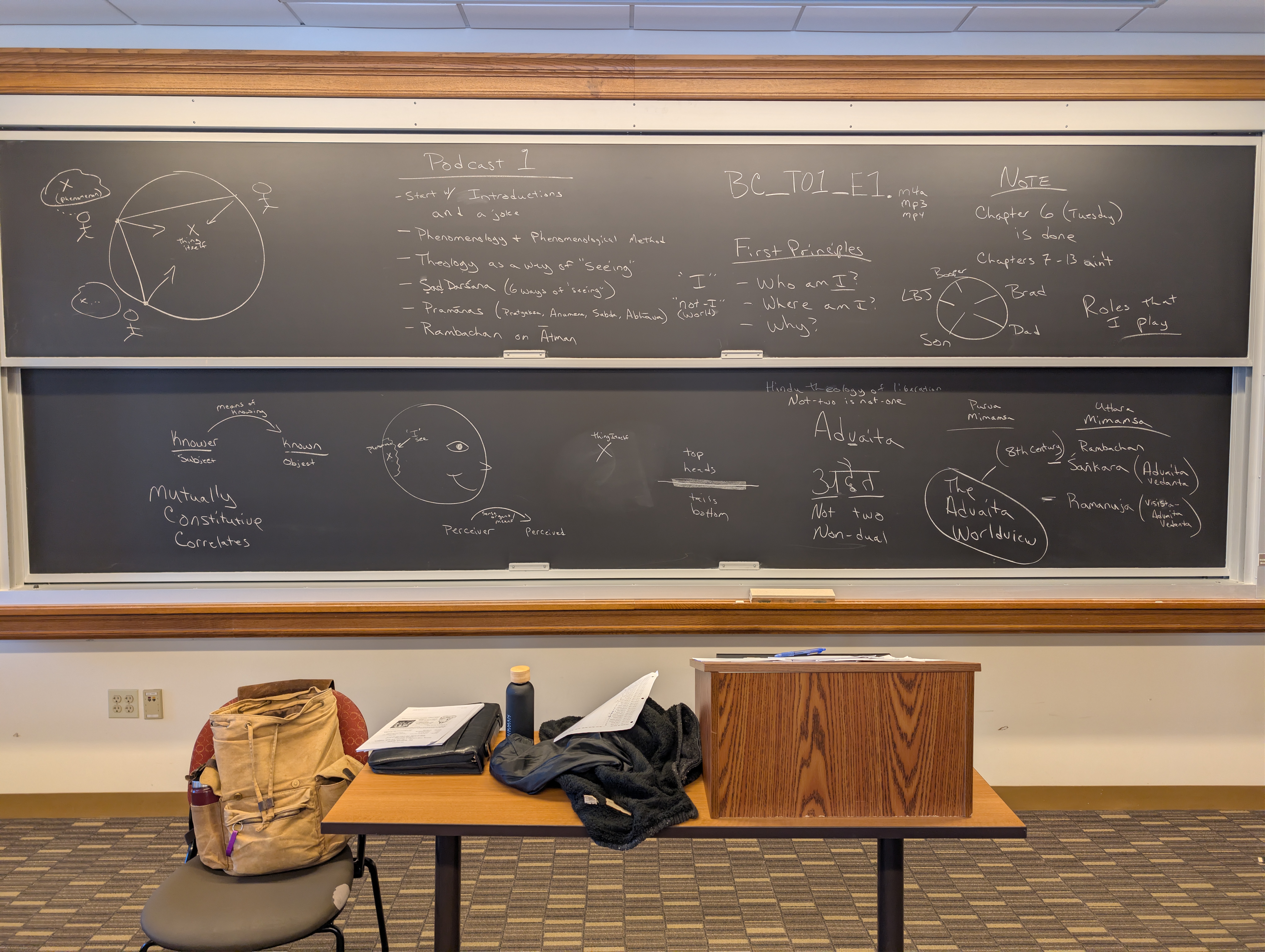
Chalkboard photo 1 from 01/29/2026

📄 Synopsis

This session transitions from the administrative organization of student 'Podcast Yajna' teams to a deep dive into the Advaita (non-dual) theological tradition. Dr. Bannon reinforces the phenomenological method, emphasizing the critical distinction between the 'thing itself' and the 'phenomenon' created by the mind. The class explores the Advaita Vedanta perspective through the writings of Anantanand Rambachan, specifically focusing on the 'Parable of the 10th Person' to illustrate how spiritual ignorance often stems from overlooking the self. The discussion moves into the definition of theology as the philosophical investigation of first principles anchored in a canon of text. Using the concept of 'mutually constitutive correlates,' the instructor explains that categories like 'knower' and 'known' or 'father' and 'son' refer to one another and are relative to context. This leads to the core definition of Advaita as 'not two,' a framework for understanding the relationship between the individual self and reality.

Key Takeaways

  • Theology is defined as a philosophical investigation of first principles anchored in a canon of texts.
  • The phenomenological method involves identifying the thing itself, describing the phenomenon (how one understands it), and listening to the perspectives of others.
  • The 'Parable of the 10th Person' serves as a metaphor for the human condition where the seeker overlooks the fact that they are the very thing they are searching for.
  • A central Upanishadic solution to the human problem is the realization that 'the seeker is the sought.'
  • Human identity is a mix of various roles and names—such as son, father, or brother—that indicate specific ways of relating to others.
  • 'Mutually constitutive correlates' are pairs of terms, like 'knower and known,' that define each other and cannot exist in isolation.
  • Advaita, or non-dualism, suggests that while the knower and the known appear as two, they are fundamentally 'not two.'
  • The 'Uttara Mimamsa' school of Hindu philosophy focuses on the later part of the Vedas and includes major theologians like Shankara and Ramanuja.
  • Scripture functions as a 'mirror' that reveals truths about the nature of the self that cannot be known by any other means, such as direct perception.
  • The theological method used in the course involves placing a sacred text at the center and giving different perspectives on it.

🎤 Transcript Tap any timestamp to jump the audio player

Opening Stillness and Breathwork

Brad
Take a moment to transition. Reset. Clear your heads and just be still for a moment.
Student
It.
Brad
Let's take a breath together. Go ahead and breathe in and out.
Brad
Word.
Brad
Word.
Brad
All right, so
1:19

Administrative: Team Assignments and Attendance

Brad
no quiz today.
Brad
Does mean that I need to take
Brad
attendance, but I think I'm going to take attendance once we get the teams totally worked out.
Brad
I want to make sure that everybody's got a team and that you get some time in teams.
Brad
So is there anybody that's unsure about their team?
Brad
Okay.
Brad
Anybody else?
Brad
All right, let's gather together with your teams.
Brad
Just group together and we'll come up
Brad
with some team numbers and you can come up with team names in a couple days and then we'll figure out. I think you guys are probably going to be with somebody around there, right?
Brad
Yeah.
Brad
Okay, so go ahead and get with
Brad
your team if you know who your team is and then
Brad
figure it out.
Brad
Does anybody have fewer than four people?
Brad
Must be.
Brad
You may have more than four people.
Brad
You have more than four? Five.
Brad
Okay, so I think I'm gonna have
Brad
to peel off one team member and.
Brad
But then we're still 32, I think is divisible by. I don't teach math, but that's what I remember.
Brad
Oh, wait, who are we missing?
Brad
We're probably missing some people.
Brad
All right, let's just go through the
Brad
list and we'll figure out. Okay, so Evan.
Brad
Evan. And okay, so. Evan, you're going to be on team eight.
Brad
Okay.
Brad
We'll come up with a better name
Brad
than Team 8, but for now it'll
Brad
be Team 8 and. Veer. Veer, who's your team?
Brad
We're going to call you Team 7.
Brad
Danielle.
Brad
Hi.
Brad
Team 5.
Brad
Seems right to me.
Brad
Andrew. I think it should be team one. Seems right. Ava.
Brad
See, that worked out.
Brad
Right, so then you should be team six. Right?
Brad
Eight, seven.
Brad
Six, five, four, three. I don't know how that worked out.
Brad
Saive,
Brad
who's on your team? Okay, how about team five?
Brad
Yeah, this is not gonna work out.
Brad
Aiden. Yeah.
Brad
Wait, are you on their team?
Brad
Oh, right.
Brad
Yeah. Okay, you got a number then.
Brad
Yeah.
Brad
So team. What did I say? Seven?
Brad
Yeah.
Brad
Cool. Ally,
Brad
so you have a team number yet?
Brad
5. Logan. 5. Caroline, do you have a team number yet? 5. Wait, did I mess up?
Brad
I missed.
Brad
I'm so bad at things.
Brad
Damn it.
Brad
How did I do that?
Brad
All right, Luke,
Brad
team eight.
Brad
Cool.
Brad
Claire,
Brad
you're one of the team fives.
Brad
Okay.
Brad
Claire, you're going to be team five.
Brad
Logan, you're gonna be team four.
Brad
Who else is on?
Brad
Okay, so Logan's four.
Brad
Ally, Is four.
Brad
Yeah.
Brad
Sive, you're four.
Brad
And then Danielle, you're five.
Brad
Yeah.
Student
Yeah.
Brad
Okay. Colin, seven.
Brad
Right.
Brad
Kellen. Okay, Give me two
Brad
because that makes sense.
Brad
Zongir, do you have a team Eight. Kaylin, eight. Iona, you need a team, right? Okay. We're gonna come back. Castalia, two. Scott, one. Anna, two. tamas.
Brad
Does anybody.
Brad
Wait. Okay, so is Tim. He's on your team.
Brad
Okay. Georgia, team one. Cool. Katie. Yeah. Formerly known as team five.
Brad
Lillian,
Brad
team six. Cool.
Brad
Christine.
Brad
Right.
Brad
Okay, got you. Manny, you have a team right now. Four Sophia, team one. Lauren,
Brad
Cat. Five.
Brad
Brent,
Brad
seven.
Brad
Right. Grace, team six. Okay. All right, so let's see how many
Brad
we got on team eight.
Brad
One, two, three.
Brad
Four.
Brad
Yeah. Four. On team eight. Team seven, we've got Veer, Aiden, Colin,
Brad
Brent.
Brad
Four.
Brad
Team one, we've got Andrew,
Brad
Scott, Anna and Tim.
Brad
No.
Brad
Andrew, Scott,
Brad
Georgia and Sophia.
Brad
Okay, Team two.
Brad
No, Team six. This totally makes sense. This just logic here. You actually dvaita a couple of times.
Brad
All right, so team six, Ava, Lillian, Lauren, Grace. Team four, Sive, Allie, Logan.
Brad
And here's where we got the thing.
Brad
Right.
Brad
Katie and Manny. Right. So I think.
Brad
And then we don't have a team 3 yet. Correct. So I think we're going to have one of you five slide over to team three.
Brad
And then we'll have Iona and Christine. And then one of you. Any volunteers?
Brad
You cool?
Brad
All right, three. Okay, so Manny's now team three. And then we're still missing a three. Right.
Brad
Team five, how many people we got?
Brad
Raise your hands.
Brad
Team five.
Brad
One, two, three, four.
Brad
Good.
Brad
Team eight.
Brad
We already did this, right?
Brad
Did we go through all of them? Everybody have 4? 4 except for team 3. How does this work? I don't understand this.
Brad
Am I confused? Okay. All right.
Brad
So that could be it.
Brad
That makes sense.
Brad
It does go to 31.
Brad
You're right.
Brad
Okay, cool.
Brad
So we got our teams then, right?
Brad
Yeah.
Brad
Word. So, next thing. So take a few minutes with your teams.
10:21

Podcast Yajna Assignment Guidelines and Logistics

Brad
Yeah.
Brad
So these two ladies right here.
Brad
Yep.
Brad
So take a few minutes with your
Brad
team and
Brad
need to decide a few things.
Brad
One is maybe trade contact info or whatever.
Brad
Set up a group chat or. However you want to. However you want to do it. Pick a time that you're going to meet.
Brad
I'm pretty flexible on the due date.
Brad
My preference is to have it, you
Brad
know, before my commute on Tuesday. But, you know, I understand that the hardest thing about this assignment is finding a time for everybody to meet. So, you know, I'm pretty flexible of that, especially with the first couple of. First couple of Them.
Brad
So figure out time to meet and then figure out your leadership days. So we've got four leadership days, you
Brad
know, for the next unit. So everybody pick a day we're gonna have. Right, so Tuesday is on the three
Brad
hymns of the Rigveda.
Brad
Thursday is on the. The brahmana. And then next Tuesday on the Katha And then next Thursday,
Brad
believe it
Brad
or not, we're going to go over
Brad
to the Christian tradition. We'll have some Christian texts there.
Brad
So just, you know, decide amongst yourselves which day works best for you, and
Brad
then you can let me know.
Brad
And team three, obviously you'll be.
Brad
It's fine.
Brad
Just. There will be a day that you
Brad
won't cover, and that's not a big deal.
Brad
Yeah, the other thing, before you break
Brad
into teams, you can chat about how you're going to. No, no, go ahead, do that.
Brad
Do that. And I'll talk about the next thing
Brad
in a few minutes.
Brad
Yeah, so take a few minutes.
Brad
Get to know each other, whatever.
Brad
Chill.
Brad
It's all good.
Student
So obviously,
Student
No, I like.
Student
Okay, Well,
Student
I forgot I bought tickets.
Student
Gets, like,
Brad
Anytime from, like, 1 to 5.
Student
I don't know how we still got, like, okay, freshman.
Brad
So everybody just brings, like, something they
Student
want to talk about.
Brad
It's like, drill.
Student
I'm just, like, doing it on my phone. Were, like, leaving practice in the car.
Student
I'm like, please work. I was like, this is so lame.
Brad
Cool. Got it all worked out.
Brad
Yeah.
Brad
Right on.
Brad
So for podcast yajna like you to follow this format.
Brad
Just kind of follow this little agenda.
Brad
So start with introductions, you know, just upanishads, whatever. Whatever you want to say about whatever you say. And I don't know, it's like, I
Brad
like to get people laughing at the
Brad
front, at the beginning.
Brad
I think it's, you know, sets the right tone. Just do something fun, silly, whatever, and
Brad
tell a joke or.
Brad
Or sing a song or dancing.
Brad
Doesn't really work because it's audio pretty
Brad
much, you know, but, I don't know, do something fun, funny, whatever. Don't overthink it. Then I like. I'd like everybody to kind of have something to say about each one of these things. I think normally for podcasts, after this, we typically have, you know, four things
Brad
to talk about and four people to talk about them. So you can, you know, basically take
Brad
a turn leading this time. We have a little bit more than that, a little bit more to come, and I'd really kind of like to have everybody, you know, I don't know, like, you could dvaita however you want. Everybody could kind of talk about phenomenology, phonological method, basically, you know, the opening day lecture, theology, chapter one.
Brad
And
Brad
yeah, you get the idea.
Brad
Right.
Brad
You can then dvaita up the.
Brad
You could do however you want on this.
Brad
So don't, you know, as long as
Brad
you kind of go in through all of these things and starting to see how things connect together.
Brad
As you can see, there's a lot on seeing and vision.
Brad
Right.
Brad
Even the phenomenology and phenomenological method, largely about seeing and vision and.
Student
Yeah.
Brad
And then kind of end off on Rambachan.
Brad
I don't expect you to understand Rambachan at this point, but I expect you
Brad
to kind of be struggling with it
Brad
and working with it.
Brad
Right.
Brad
Trying your best to understand it. And I think especially on this one, it's very likely that, you know, each
Brad
one of you are going to understand part of Rambachan and through the discourse, you hopefully might, you know, begin to understand it better. Right.
Brad
So if each of you understands a little bit different parts or understands a
Brad
different way or whatever, you know, through
Brad
the discussion about it, then you can at least, at the very least maybe clarify some questions.
Brad
Right.
Brad
So like, Brad's got to answer this, you know, in class or whatever.
Brad
Good questions. Yeah.
Student
Like, do you want to say kind of like lead one to six, or do you want us all to have a five minute conversation around those sections where the time is equally spent?
Brad
Yeah. So for most of the podcasts, for
Brad
all the ones after this, you kind of do like we did last semester,
Brad
which is basically like a five minute,
Brad
each person lead five minutes or so. And again, that's not talk for five
Brad
minutes, that's lead discussion for five minutes.
Brad
Right.
Brad
So talk for a minute or something and then open it up for discussion.
Brad
But for this one, I just want
Brad
you to kind of go through all these things.
Brad
You could have, you know, a different
Brad
person start off like, hey, why don't
Brad
you kick off this conversation and I'll kick off the next one? That sort of thing. Right. But I just kind of want you to talk through all of these for this one. Yeah. So a little bit less regimented.
Brad
Good.
Brad
I'll say a little bit more about future podcasts when we get there, but does that kind of answer your question?
Brad
Yeah.
Brad
Any other questions?
Student
Yeah, after we introduce ourselves, if every time we talk, do you want us to be like, oh, Katie, saw the.
Brad
Yeah, that would be super helpful, especially for the first one or two podcasts. I've been doing this for A long time.
Brad
And I do tend to learn people's voices pretty quickly, but it takes me a couple times.
Brad
Right.
Brad
And so especially for the first one. Especially for the first one. Obviously, I don't know your voices right now. Barely know your faces.
Brad
So. So, yeah, if you.
Brad
You could say things like, you know, good points.
Brad
You know, Katie, good points.
Brad
Logan, you know, what do you think, Scott?
Brad
That kind of stuff. So you can kind of, however you want to drop each other's names, or you can just say, hey, this is Brad talking.
Brad
You know, however, yeah, it doesn't matter.
Brad
But, yeah, it's good for me to
Brad
kind of connect people's voices and names, and it'll take me a couple of podcasts to do that. Other questions?
Brad
Just a couple really super basic things. So when you meet, you can meet
Brad
in person or online most of the time at B.C.
Brad
students meet in person because you're all here. So I think meeting in person is ideal.
Brad
And if you meet in person, then obviously those.
Brad
Who's on Tim's. Tim's.
Brad
Right.
Brad
So Tim, I don't think, may not
Brad
be able to make it, so can have him join in.
Brad
So y' all can either all meet Vi remotely or you can all meet
Brad
in person, and then he'll join in by phone or something.
Brad
It's up to y' all how you do that.
Brad
And. But I think generally, if you're meeting in person, then just use, like, a
Brad
cell phone, you know, to record it.
Brad
Just use your voice recorder, kind of
Brad
set it down in the middle of everybody. Don't slide it around.
Brad
That's, you know, if you're picking it
Brad
up and moving it around, and I get lots of, you know, noises in there.
Student
That's.
Brad
I'm usually listening to it with earbuds or something like that. So it's, you know, just try to make sure everybody's about equidistant. You know, this is not a professional podcast. I'm not gonna, you know, doc you or anything like that because of the sound quality, but just for my own ease of listening. It's good if everybody's kind of relatively the same distance from the microphone and
Brad
just leave it there and don't need to edit.
Brad
Please don't edit.
Brad
Just hit record. You don't need to pause it.
Brad
You don't need to do anything.
Brad
Just hit start, and then when you're done, hit stop. That's all you got to do.
Brad
I will create folders for you.
Brad
So I'll create a shruti for
Brad
each team, and I'll share that with all the members of your team. So when, you know, after you're done
Brad
recording it, just have one person, you know, upload that file to the. To the folder that will be shruti.
Brad
I do expect you all to take equal responsibility in that.
Brad
Obviously one very kind person is going to volunteer to do the recording and
Brad
uploading, but don't just. And it's not all on that person.
Brad
If they get distracted or forget to
Brad
upload it or whatever, then it's your
Brad
job to kind of make sure that it gets done. And if they forget or whatever, if
Brad
there's a failure, then you should reach out to them and say, hey, I don't see it in the folder yet. That sort of thing.
Brad
File name is important.
Brad
So the file name
Brad
should be BC
Brad
that stands for Boston College.
Brad
Then underscore, just visually. And then T for team.
Brad
And then whatever your team number is, you don't have to put a zero
Brad
in front of it, but it's helpful.
Brad
So like team one, team two, team three, Then another underscore, and then the
Brad
letter E for episodes.
Brad
And then in this case it'll just be one.
Brad
You don't need to put a zero in front of that because we're only
Brad
going to have five.
Brad
And then don't mess with the file extension. Hopefully, you know what the difference between a file name and a file extension is.
Brad
If not, this would be a great
Brad
time for you to learn those sort of things. So leave the file extension, whatever it is.
Brad
Right.
Brad
So for most of them, wind up being something like M4A or MP3. If you're doing it video, then it
Brad
might be MP4, but just leave that where it is. Don't delete it and don't change it to something else, because then the file won't work.
Brad
That's it.
Brad
Cool.
Brad
Makes sense.
Brad
So then,
Student
yeah.
Brad
Any other questions
26:15

Lecture: The Phenomenological Method and Seeing

Brad
as far as all of the things up here? You know, we can definitely review any of them today, but among all of them, I feel like maybe I should say a little bit more about phenomenological method. I know I talked a lot about
Brad
phenomenology on day one, but maybe not
Brad
as much about the phenomenological method. So let me just run through that super quick. So phenomenology, key aspect of phenomenology is distinguishing between the thing itself. And
Student
your.
Brad
The phenomenon. Right.
Brad
So whatever.
Brad
So that's the phenomenon.
Brad
So the phenomenon is obviously a creation
Brad
of your mind that hopefully correlates to
Brad
the thing itself, but certainly is not identical to the thing itself. So then, you know, the Idea is you should begin by saying, you know, I want to talk about this.
Brad
That's identifying the thing itself.
Brad
Right.
Brad
Let's talk about atman or let's talk about Saddarshana, or let's talk about Abhava
Brad
brahmana or something that's sort of saying, all right, I want to talk about this. Then, you know, describe the phenomenon.
Brad
Like, how do you understand it? Right.
Brad
So what do you understand about it? What does it mean to you? Describe it in your own words.
Brad
And then.
Brad
And then basically, you know, shut up and listen. Listen to the people around you.
Brad
Right.
Brad
And then so the other folks should
Brad
chime in and say, hey, you know, my understanding of this is a little bit different. Or, you know, oh, yeah, that everything you said. But then also this other thing, Right.
Brad
Or I find this super helpful, you know, related to
Brad
finance or psychology or whatever.
Brad
Right.
Brad
So kind of giving differing perspectives on the thing itself.
Brad
That's it. That's pretty much the phenomenological method. Right.
Brad
So identify the thing itself, describe the
Brad
phenomenon, and then listen to the people
Brad
around you and then just repeat that.
Brad
Yeah, makes sense. Cool.
Brad
And then.
Brad
Yeah.
Brad
So then obviously theology and theological method is basically doing this, but putting the
Brad
text at the center.
Brad
Right.
Brad
And then giving different perspectives on that. Good.
Brad
Right on. So. Oh, and did you pick your leadership days?
Brad
Yeah.
Brad
Okay. So,
Brad
Yeah, you know what?
Brad
I don't really need to know your
Brad
leadership days, do I?
Brad
I don't need.
Brad
I don't need to know. You can just as long as you know them and you come in prepared on your leadership day. I know that sounds. Seems like maybe I do need to know what your leadership days are.
Brad
I don't need to know them right now, though.
Brad
So as long as I could.
Brad
You can tell me on Tuesday, Right.
Brad
At least everybody will know who's leadership on Tuesday. Cool.
30:01

Course Context: Rigveda and the Myth of Sunahshepa

Brad
Oh, so those of you who've.
Brad
Those of you who've had me before,
Brad
familiar with this Brad issue, those of
Brad
you who've not,
Brad
you know, I'm writing this as we go, right. So I'm writing this textbook.
Brad
I wrote this chapter six, actually, before I wrote anything, this was the first thing I wrote,
Brad
but the rest of it.
Brad
So chapter six is done. Chapter six is ready for you to read. Printout, whatever.
Brad
So on the Rigveda, feel free to dive in chapter seven through 13.
Brad
I know the texts that are in
Brad
there and the texts are in your
Brad
reader, but that's all that's in there right now.
Brad
So I am going to write some
Brad
introductions to these texts.
Brad
Yeah.
Brad
So I'm going to write more introductions in context and that sort of thing for the texts and I'll always try to stay as far ahead as I can, but obviously chapter seven is a little bit late right now, so I'm gonna get on that.
Brad
And yeah, at the very worst we'll
Brad
just go with the text that's there. Right. But I want to give you some context on this myth of Sunashipa.
Brad
I kind of.
Brad
Yeah. As I was planning this course and
Brad
designing this course, this particular text became increasingly important. So I really wanted to give you some. Some context and introduction to this particular text before we just dive in on this story about Tsunasheva. Cool.
Brad
Let's, you know,
Brad
let's take a few
31:55

Small Group Discussion: Rambachan and the Nature of Atman

Brad
more minutes in your teams and let's
Brad
try and dive into this text by Rambachan which I asked you to read
Brad
for Tuesday and to.
Brad
Yeah, I feel like this is a challenging text, right? Difficult, difficult read. And yeah.
Brad
So I don't know. Why don't you start with kind of what did you understand about it?
Brad
Just chat amongst yourselves. Chat with your teammates about it.
Brad
What did you understand about it and
Brad
what completely confused you.
Brad
Obviously more specific questions are generally better or easier for me to respond to.
Brad
But yeah, let's just chat about it.
Brad
Take until 10 after.
Brad
Think.
Brad
It.
Student
But then you have the Anna which is like all the influence talk about your physical body. It's not like you're feeling.
Student
It.
Brad
What.
Student
Stuff like from the Veda that says Brahminous.
Brad
It's also worth mentioning.
Student
The offer also talks about the significance
Student
of scripture as like a mirror. The eyes can't see at any but the meat.
Student
Something about how like scripture helps you see yourself. Yourself and then like your physical. Also something about atmos being self luminous like a sun. It doesn't need another light to show itself.
Student
Very interesting too.
Student
It. Sam. It.
Student
Is it just like impossible for the math department or they just like don't recommend it. Was it like actual classes or was it just you had a fun. And we all live together.
Brad
So.
Brad
Okay.
41:09

Class Discussion: The Parable of the Tenth Person

Brad
Any thoughts questions? Start with some questions or thoughts or anything.
Brad
Anything to say.
Brad
It's okay.
Brad
We'll get. We'll get more comfortable chatting in class. I knew if I waited long enough.
Brad
Someone jump in.
Brad
Yes, got it.
Student
Or is this some references material we're talking about now or about podcast stuff?
Brad
I mean really anything.
Brad
But I was thinking.
Student
Yeah, well, we talked about the significance of the importance of scripture or the truth. Like identifying like that meant is like it's a knower but you can't like treat it like as an object that you could like physically look at but through scripture you can kind of use it as like a mirror to like see yourself.
Brad
Yeah, word.
Brad
Great, that's good.
Brad
Yeah.
Brad
So super, super important role for scripture in there.
Brad
Yeah.
Brad
And one of the things that we
Brad
talked about with the Pramanas, right. Each one of the Pramanas, they reveal
Brad
something that you can't know by any other means. Right.
Brad
Direct perception. Obviously you can't know what ice karma tastes like unless you taste ice karma
Brad
So there's no substitute for direct perception.
Brad
But there's also things that you can
Brad
only know from the beta.
Brad
Right.
Brad
And so in this case that's what we're talking about.
Brad
Yeah.
Brad
So something about the nature of the self. Right, yeah.
Brad
Great.
Brad
Thanks for getting us started, Scott.
Brad
Others
Brad
thoughts, questions? Everybody's trying to make eye contact but not for, not for too long.
Brad
We can go through the text. Yeah.
Brad
So you know what, let's start by.
Brad
I think this parable of the 10th person is pretty important parable
Brad
also I
Brad
think I've given you enough context for this but let me just re repeat
Brad
it just to be clear.
Brad
So we've gone over the Sadarshana, right. The six perspectives, the six ways of viewing the Veda.
Brad
And as I said, we're going to
Brad
spend most of our time talking about
Brad
these two, the last two, the two Mimamsas. But really we're going to spend even
Brad
most of our time just on the
Brad
last one, Uttar Mimamsa. And there's two major figures within Mimamsa Uttaramsa.
Brad
Super.
Brad
These are probably the two most famous
Brad
theologians within Hindu tradition and their names
Brad
are Shankara and Ramanuja.
Brad
And we're going to.
Brad
Rambachan is an expert, one of the world experts on Shankara and so definitely
Brad
a disciple of Shankara, A great.
Brad
Yeah.
Brad
Exponent on Shankara.
Brad
And so Shankara, Shankara is an 8th century.
Brad
Yeah.
Brad
8th century theologian from southern, from southern
Brad
India and talk more about, you know,
Brad
historical context and that kind of stuff.
Brad
But so this is a text by Rambachanda vedanta tradition.
Brad
Right.
Brad
He's trying to teach.
Brad
This is actually from. This is chapter three of a book called the.
Brad
Worldview.
Brad
Also I'll just mention I pronounce this word Etueta.
Brad
I pronounce it that way because my guru, my teacher pronounced it that way.
Brad
And so partly because I learned it
Brad
from him, but also out of respect for him, I continue to pronounce it the way he pronounced it.
Brad
It's one of those words that
Brad
tends to be pronounced a little bit differently in the northern part of India than in the southern part of India. You know, not totally different than the
Brad
United States, where things, you know, pronounced differently. Different parts of the country. So in the north, they tend to
Brad
pronounce this as a V. So advaita,
Brad
or some people say advaita. So really pronounce that advaita. That's a pretty common way of saying it.
Brad
I say advaita because that's the way
Brad
my teacher said it.
Brad
So to. Typically, this letter V is sometimes pronounced
Brad
like a V and sometimes like a W. Right. Which is a double V, actually, but whatever.
Brad
So
Brad
all that to say
Brad
this parable
Brad
of the 10th person is super important to Shankara.
Brad
He brings it up quite a few times. He.
Brad
This is a. Yeah, for him, this
Brad
is a really powerful little parable.
Brad
So he uses it with some frequency.
Brad
Anybody want to kind of walk us through it?
Brad
I know you had the quiz on it the other day, but anybody brave enough to kind of say, all right, here's the parable of the 10th person.
Brad
Yeah, Logan, thanks.
Student
So there's this group of 10 people. I forget exactly who, but I believe that they were kind of more holy in nature. And they were crossing this river with rapids, and it's kind of kind of tedious crossing. And as they were crossing it and they got to the other side, they counted out, you know, how many people crossed. And they only counted the night.
Brad
Yeah.
Student
And so they started panicking and wailing, you know, oh, we lost somebody.
Brad
Yeah.
Student
And then somebody who was nearby, I believe it was Carpenter, came up to them, was like, what's the issue? You know, you guys.
Brad
Okay?
Student
And they're like, no, we lost somebody.
Brad
Yeah.
Student
And he goes, all right, who'd you lose?
Student
Like, how many people?
Student
And they said, we only counted nine.
Student
We have 10 people before.
Student
Count them out and realizes There are actually 10 people.
Brad
Yeah. The.
Student
The person who was doing the county with the group leader was. Didn't count themselves.
Brad
Right.
Student
So it's kind of. I kind of took it as a parable to show, like, the. There's, like, ignorance when you're not aware of yourself, when you don't identify yourself, not count yourself out.
Brad
Solid recap.
Brad
Yeah.
Brad
Fire. That's great.
Student
Yeah.
Brad
So the.
Brad
Yeah, you said all the important things. So traditionally, you know who they are. They're pilgrims.
Brad
They're on some sort of pilgrimage.
Brad
They're on sort of a spiritual mission.
Brad
It's not super important to the story, but it's. Yeah.
Brad
So they're on some Sort of spiritual mission.
Brad
But they're kind of missing the point, right.
Brad
Of it.
Brad
There's something that they're missing.
Brad
And, yeah, what they're missing is to count themselves everything.
Brad
You said you've got all the important parts.
Brad
There's one other little subtle detail that's
Brad
not that Ramachandran doesn't mention, but this
Brad
idea that they got to these rapids
Brad
and the boatman wasn't there.
Brad
Right.
Brad
Usually you're waiting for or. So there's a person that can ferry them across in a boat and that person's not there, so they decided to go ahead and brave the rapids.
Brad
But that little detail is also a
Brad
not so subtle reference to the Buddha.
Brad
The Buddha referred to himself as a boatman, right.
Brad
And his teachings as a boat.
Brad
And so the idea is that when you're kind of creating, crossing this dvaita of understanding reality, understanding yourself and your
Brad
place in the world, then the Buddha's
Brad
teachings are something that can help you
Brad
cross from this side of the shore to the other side of the shore. And then the Buddha very famously said,
Brad
once you get to the other side of the shore, you don't need the boat anymore.
Brad
Don't lug this boat around. So Buddha said, don't believe any of
Brad
the things I say, meaning, you know, it's to be used, Right.
Brad
Philosophy that you're supposed to put to the test, see if it works for you. And if it works for you, then
Brad
once it works, you don't need it anymore.
Brad
Right.
Brad
So a little bit of a subtle. Subtle reference to Buddhism there.
Brad
But yeah, the main point, as Logan
Brad
said, is that they. They've forgotten themselves. Right? They're leaving themselves out.
Brad
When I wrote an article a few
Brad
years ago and said maybe this parable would be even easier to understand if instead of, you are the 10th person,
Brad
they said, you are the first person, because it's really the first person that they're leaving out. So the first person meaning I.
Brad
Right. So they're leaving the I out.
Brad
And so kind of studying the world, but leaving themselves out. Good.
Brad
Any
Brad
questions? Super important parable, I think, you know. Yeah, probably keep coming up to that.
Brad
One of the things there that I underlined that I think is relevant and
Brad
a theme that I think comes up a few times.
Brad
Ramachandran says, how does the teacher in
Brad
the upanishads instruct the student about the nature of atman? That just the upanishads solution to the human problem is to point out that
Brad
the seeker is the sought. Right.
Brad
So there again, like, the pilgrims were on the pilgrimage, they were Seeking something.
Brad
But in reality, what they were missing was not something.
Brad
You know, it's not a journey.
Brad
You don't have to go here or there to get there. And you don't even have to cross the river.
Brad
Right.
Brad
It's just a realization that the seeker
Brad
is the one that's thought or the
Brad
knower is the one that is to be
Brad
realized.
Brad
I don't want to say known, because the knower can't be known.
Brad
Good.
Brad
Questions, thoughts.
Brad
We move on to this. Who am I? So now on page 33, 33, 34, this could. Ramana Maharshi
Brad
has got his dates there.
Brad
1879 to 1950. Quite a popular figure, you know, even in India today. Quite.
Brad
You know, you see quotes from him and he's quite a famous exponent of,
Brad
again, of advaita, and some great quotes
Brad
by him worth paying attention to.
Brad
So there he said, South Indian teacher Ramana Maharshi, who always brought inquiries back
Brad
to the fundamental issue question about life after death.
Brad
For example, Ramana might reply, why do you want to know what will happen to you when you die before you
Brad
know what you are right now,
Brad
first
Brad
find out who you are, what you are right now. And then questions about God were similarly treated. Why do you want to know about God before you know about yourself?
Brad
How can you know about God if
Brad
you don't know about yourself? So start with what's in front of you.
Brad
Right?
Brad
Start with yourself.
Brad
So again, coming back to that,
Brad
the self.
Brad
Questions, thoughts.
Brad
That's the problem with the way I've
Brad
started this course is I had so much lecture that now it's like, wait, this is a lecture course, not a discussion course. But we're going to correct that soon.
Brad
Good.
Brad
So there's a lot in here about method. Speaking of method, let's roll back to
Brad
the definition of theology that I gave you on the first day of class.
Brad
And then again in chapter one.
Brad
Anybody have that memorized or at least written down somewhere?
Brad
So what is Brad's stipulative definition?
Brad
Pretty safe bet that that's going to
Brad
be on the midterm.
Brad
Right. So what is Brad's stipulative definition of theology?
Student
Yeah, the philosophical investigation of first principles anchored in canon.
Brad
Yeah, great. Philosophical investigation of first principles.
Brad
So what are first principles. Anchored in a canon of text? So the anchored in the canon of text, obviously is the beta.
Brad
Right.
Brad
But what are those first principles?
Student
Yeah, like who am I?
Student
Why am I here?
Brad
So it's what the title of this section is, right? Who am I? So who am I? You know, where Am I. I just think of, where am I? Right. What is this world around me?
Brad
What's the nature of world around me?
Brad
And why?
Brad
Right.
Brad
Why am I here? Why are any of us here? But particularly, why am I here? Right.
Brad
I mean, you kind of got to
Brad
answer both of those.
Brad
But yeah. So those are the first principles. So self, or as I said, in God's self, in society, right? I, not I.
Brad
And then the holy other, something that's,
Brad
you know, something that transcends this world. So in the imminent world, there's me
Brad
and then there's y'.
Student
All.
Brad
You're not me, right? And then, you know, but beyond I
Brad
and you, some holy other.
Brad
Yeah. So here the question is, who am I? Although, as we'll see, maybe consistently, you can't really answer any of these questions
Brad
without answering all of them, right?
Brad
You can't really say who. Who you are unless who you are somehow relates to the people around you, right?
Brad
How you fit into the world. So that also kind of answers this question.
Brad
And maybe even.
Brad
You certainly can't know who you are if you don't know why you're here. And you can't know why you're here if you don't know who you are or. Right. Or how you fit into the world.
Brad
So part of the point is that
Brad
you really have to answer or tackle
Brad
all three of these at the same time.
Brad
I want to draw your attention here. Page 34. So let's try and write this idea of naming. If I were to say, I mean, I. So let's just talk about me for a minute. So people call me different names.
Brad
Some of you probably aren't even sure what you're gonna call me yet, right? But my name's Brad, and a lot of people call me Brad. That's my name, right?
Brad
For others, there's a couple of folks,
Brad
three that call me that. So that's a different kind of relationship.
Brad
Still me, right?
Brad
Still the same person, but it indicates
Brad
a different aspect of relationship, right?
Brad
So when I'm asking the question, who am I?
Brad
Well, I'm Brad, and people call me Brad, right? That's one kind of relationship. And that helps me understand who I am and how I relate to the world. But dad is also who I am. But it's my most important identity by far.
Brad
But that's an important identity for a
Brad
small group of people, right?
Brad
And indicates a particular way of relating to others.
Brad
And then there's my dad, who calls me son. So even a smaller group of people who refer to me as son, but that's also an important relationship.
Brad
Right.
Brad
So who am I is inseparable from
Brad
my relationship to my parents, my relationship to my kids, and my relationship to all of the people that call me Brad.
Brad
Right. Students and teachers and friends and neighbors, that sort of stuff.
Brad
Yeah. Then there's.
Brad
There's also a very small group of
Brad
people, meaning two people that generally refer
Brad
to me as lbj. Lbj.
Brad
That's what my sisters call me.
Brad
My sisters, I mean they don't refer, they don't address me as lbj.
Brad
Well, sometimes they do, but usually they just refer to me as LBJ when they're talking to each other.
Brad
So my sisters, yeah, lbj. My sisters are older than me and
Brad
yeah, so they refer to me as
Brad
lbj, which stands for little Baby Jesus, which might sound like a nice thing.
Brad
They don't mean it in a nice way.
Brad
Right.
Brad
I mean, like, oh yeah, little baby Jesus again.
1:00:02

Lecture: Advaita Vedanta and Mutually Constitutive Correlates

Brad
So small group of people that refer to me as that. And there's another one I was thinking of, but oh, my mom.
Brad
My mom calls me Booper.
Brad
So the point being that who I am is a mix of all these different identities.
Brad
And so who I am may change from one moment to the next based on context, based on where I am and my web of relationships.
Brad
Right.
Brad
So Rambha says it like this.
Brad
The importance of human relationships is reflected in the ways in which these individual inform our self definitions. I may describe myself as a husband, son, brother, uncle, nephew, disciple or friend
Brad
depending on the particular context.
Brad
All these tell me about.
Brad
All these tell about me in relation
Brad
to someone else and explain the intricate
Brad
web of relations in which I'm involved and the many human roles that I play.
Brad
This is actually kind of an important
Brad
phrase, roles that I play.
Brad
We will be talking quite a bit
Brad
about play, the nature of play and
Brad
the various meanings of that word as
Brad
the semester goes on. But so I'm just kind of signaling,
Brad
drawing your attention to that word.
Brad
We'll come back to it later in the semester.
Brad
Cool.
Brad
So the point, I mean there's multiple points here, but one point is that
Brad
my identity is inseparable from my relationships.
Brad
Right.
Brad
So I like that phrase, sort of web of relationships. So you know, we're all sort of these different webs of relationships.
Brad
And then he points to a particular method. A method of this method comes from
Brad
Shankara also, but the method of distinguishing
Brad
between knower and known. And maybe, maybe you'll notice that really
Brad
the rest of the chapter is about that, right.
Brad
About the relationship between knower and known.
Brad
So hopefully we've got A sense from this example that names, right?
Brad
Words are kind of kinds of names. Names.
Brad
Words signal not just entities like the thing itself, but also our relationship to that thing. Right? So words indicate some sort of relationship.
Brad
They're relative to context.
Student
Right.
Brad
And then what he's trying to point out is that these names or these words and particular, particular knower and known also are relative terms. They're.
Brad
You can't have one without the other.
Brad
Right.
Brad
You can't have a knower unless they know something.
Brad
Right.
Brad
And something can't be known unless there's a knower.
Brad
Right?
Brad
So let's say father and son are opposite terms. Yeah, but as I just showed, I
Brad
can be a father and a son
Brad
at the same time, but not in
Brad
relation to the same people.
Brad
Right?
Brad
So the names dad and son refer
Brad
to me, but me in differing kinds of relationships. Right.
Brad
Likewise, the words knower and known refer to one another.
Brad
You can't have one without the other.
Brad
Right.
Brad
These. Philosophically we refer to these as mutually
Brad
constitutive,
Brad
or sometimes I call them mutually
Brad
constitutive correlates,
Brad
although I think the last
Brad
word is samhita superfluous.
Brad
They're correlates, meaning they relate to one another.
Brad
Right.
Brad
They're correlative to one another and they're mutually constitutive.
Brad
Constitutive means what makes something what it is. Right. So what constitutes being a knower?
Brad
Well, what constitutes being a knower is knowing something. Right? You can't know nothing.
Brad
If you know nothing, then you're not a knower.
Brad
Right?
Brad
So knowing being a knower means that
Brad
there's something that is known and. And that thing that is known can't be the knower because that's what it means to be known.
Brad
Right. So
Brad
this can get super confusing, but.
Brad
So these can also be referred to as subject and object.
Brad
Right.
Brad
But keep in mind the object here is not the thing itself, but the object is the phenomenon.
Brad
Right.
Brad
So when I say I, or maybe let's jump over to perceiver and perceived same relationship, but maybe a little bit more hands on. So I can't be a perceiver unless I perceive something. Whatever I perceive, that's the perceived. Yeah, but it can't be perceived unless there's a perceiver.
Brad
Right?
Brad
So they're mutually constitutive. You can't have one without the other.
Brad
They define one another. They're like
Brad
inside and outside.
Brad
Right.
Brad
You can't have an inside unless there's an outside.
Brad
Right.
Brad
You can't have an outside unless there's an inside.
Brad
You can't have a left unless there's a right.
Brad
You can't have a male unless there's a female. You can't have a top without a bottom, right?
Brad
Shoot.
Brad
I don't have a coin, but let's
Brad
say I had a coin, right? You know what a coin looks like, right? So a coin, you've got, you know,
Brad
heads and tails, right? Or just more simply top and bottom.
Brad
And I could. So top and bottom are not the same thing, Right?
Brad
They're actually opposites.
Brad
But you can't have a coin without
Brad
both the top and the bottom. Right. If I were to somehow cut it in half, right?
Brad
Then I still have a top and
Brad
I still have a bottom. In fact, now I have two tops and two bottoms, right?
Brad
So no matter how many times I
Brad
dvaita it, you know, like a magnet, you've always got a North Pole and a South Pole, Right? No matter how many times you dvaita it, you've always got North Pole and South Pole, Right.
Brad
You've always got a top and a bottom.
Brad
You getting the point of what I
Brad
mean by mutually constitutive correlates?
Brad
You can't have one without the other. This is critical key point.
Brad
Yeah.
Brad
Anybody confused about that or.
Brad
Good.
Brad
So then these two things, right? Can we agree that top is not
Brad
bottom and bottom is not top? They are two.
Brad
Right.
Brad
But as I just said, you can't
Brad
have one without the other.
Brad
Right?
Brad
Therefore they're not two.
Brad
Right.
Brad
Like it's one coin, one coin with
Brad
a top and a bottom. You can't have a coin without a top and a bottom. The top and the bottom are two, but they're both part of one coin
Brad
and therefore not two.
Brad
Yeah.
Brad
Why does that matter? What does the word adoita mean?
Brad
Should have started with that. Although I did give it the other day, didn't I?
Brad
What does edita mean?
Student
Yeah, it means like non dual.
Brad
Yeah.
Brad
Non dual, not two.
Brad
Yeah. So not literally a meaning.
Brad
Not.
Brad
And dweta meaning to. So usually translated as non dual. Yeah.
Brad
Which is because it's a, you know,
Brad
if we use it as an adjective.
Brad
So non dual meaning we could say
Brad
like a coin is non dual, right? Meaning it's always has a top and a bottom. Top and a bottom are not the same.
Brad
A friend.
Brad
You can't have a sibling unless there's more than one.
Brad
Right. So starting to see how these things are related. Right. So then there can't be a perceiver
Brad
unless there's something perceived.
Brad
So they're mutually constitutive correlates, same as the others. So they're not the same thing. So they're not one.
Brad
Right. But they're also not two.
Brad
Yeah.
Brad
And Rambachan wrote another book.
Brad
He wrote a few, but he wrote
Brad
another book
Brad
called
Brad
Hindu Theology. Of Liberation.
Brad
And the subtitle of that is not
Brad
two is not one
Brad
meaning. Right.
Brad
In order for me to be a dad, I have to have kids, right? And those kids are not me.
Brad
We're not the same one. But we're also not entirely two.
Brad
Right?
Brad
That's what it means to be related to one another.
Brad
Yeah.
Brad
So it's pointing to a particular relationship or relationship of one thing to the other. You got all of that? So then it shouldn't be a huge jump then to see the same relationship
Brad
between knower and known, Right? So it's a bit more abstract than
Brad
all of the other ones, but it's just more meta really.
Brad
Right.
Brad
So there can't be anything known unless
Brad
there is a knower.
Brad
Right?
Brad
And the knower is defined by what it knows, Right.
Brad
You can't be a knower unless you
Brad
know something and what is known.
Brad
It's just grammar, really.
Brad
It's grammar and logic, Right? So if this sounds like, hey, this
Brad
is just grammar, then like I told
Brad
you, the mmomskas, that's what their really
Brad
expertise is, is in grammar.
Brad
So grammar is
Brad
important here. Good Gosh, I'm almost out of time, aren't I?
Brad
Any other, any other questions about this
Brad
text or any questions about anything?
Brad
Questions, comments, thoughts?
Brad
Or if you want to try and put it in your own words and
Brad
say, do I get it?
Brad
The awareness section happen help. Yeah, feel free to questions.
Brad
So let me, I guess end on this then. So going back to the first principles, right? So if we, if we do
Brad
recategorize these so here in form of questions, but I could categorize them as I and then not I. So what makes you not I is
Brad
because you're not me, right?
Brad
So then I, as a sentient being
Brad
in the world, experience everything that's not me as not me, right?
Brad
So from that perspective, world, Right?
Brad
Another way of saying not I would be world.
Brad
So I experience the entire world as an object, right?
Brad
Something known with respect to me as the knower. Right? So I'm always a knower and what
Brad
I know is, is things that are not me.
Brad
Right?
Brad
And then so he also goes into
Brad
this section about the body, right? So I can know my body, but
Brad
I know my body as an object, right?
Brad
I know my hand.
Brad
I know that if someone were to
Brad
amputate my hand, then it wouldn't be me anymore.
Brad
Right.
Brad
So there's something about it that's. Yeah.
Brad
Kind of helping a little bit.
Brad
Yeah.
Brad
Make sense out of this. We're going to continue on a data very frequently this semester and we'll keep coming back to a lot of these ideas.
Brad
So, yeah, I think.
Brad
Yeah, I'm out of time.
Brad
Have a good weekend.
Brad
Hopefully have everything clear.
Brad
And I do have some quizzes, so if you wanted to make up a quiz I've got, you could do that right now.
Brad
And I have office hours today and office hours tomorrow online. I look forward to your first podcast. Have fun with them, you know, so have fun. That's good.