🎵 Recording ⌨ Space / ←→

Hindu Ṣaḍdarśana

01/27/2026 · Tue/Thu 12:00-1:15 PM · Brad Bannon · Boston College
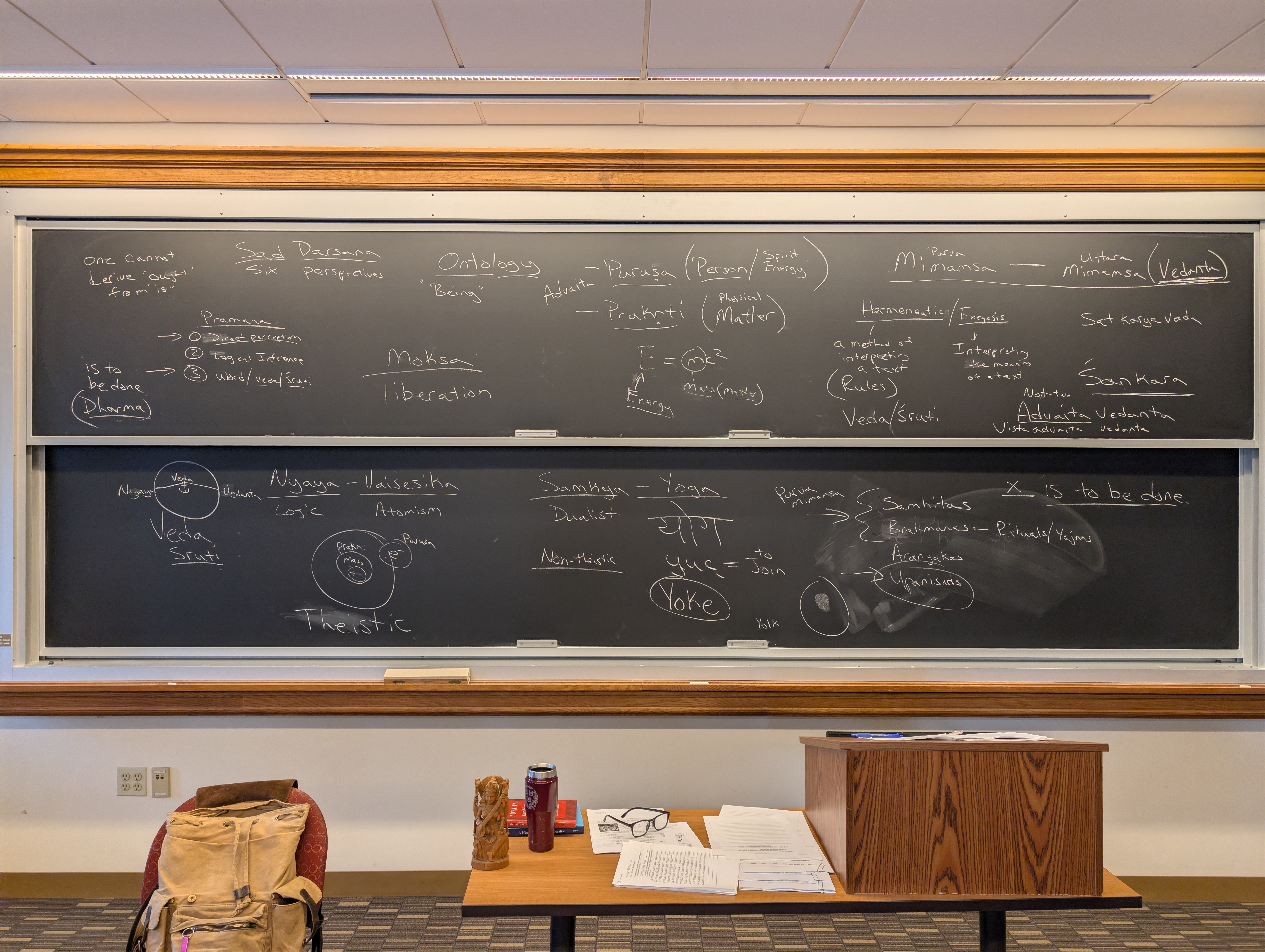
Chalkboard photo 1 from 01/27/2026

📄 Synopsis

In this session, the class explores the Ṣaḍdarśana, the six orthodox schools of Hindu philosophy, as systematic frameworks for interpreting the Veda. The instructor categorizes these schools into three pairs of 'sister perspectives' to examine their differing ontologies—the study of being and existence. The first pair, Nyāya (logic) and Vaiśeṣika (atomism), presents a theistic view where reality is composed of indivisible atoms containing both material and spiritual properties. The second pair, Sāṃkhya and Yoga, offers a dualistic ontology centered on the relationship between Puruṣa (spirit/energy) and Prakṛti (material matter). These schools view spirit and matter as eternal, separate entities that temporarily join to form individual beings. The instructor emphasizes that Yoga, derived from the root 'yuj' (to yoke), is a method of bringing these two aspects into balance rather than seeking their permanent separation. Finally, the class briefly introduces the two Mīmāṃsās (Purva and Uttara), which the instructor notes will be the primary focus for most of the remainder of the semester.

Key Takeaways

  • The Ṣaḍdarśana are six orthodox (āstika) perspectives that arose to systematically codify and defend the Veda against Buddhist rejections.
  • Ontology in Hindu theology focuses on the fundamental nature of being, specifically the relationship between Puruṣa (spirit/energy) and Prakṛti (material matter).
  • The Vaiśeṣika school proposes an atomistic view where every indivisible building block of reality contains both material and spiritual properties.
  • Sāṃkhya and Yoga are dualistic schools that view spirit and matter as two separate, eternal entities that temporarily intersect to create individual existence.
  • Yoga is etymologically linked to the word 'yoke,' signifying the temporary joining of spirit and body that requires intentional balance through practice.
  • The instructor identifies Mīmāṃsā and Vedānta as the 'two Mīmāṃsās' (Earlier and Later) which will be covered in detail throughout the rest of the semester.
  • The course will involve reading the four Mahāvākyas from the Upaniṣads and the entire Bhagavad Gītā in the second half of the term.

🎤 Transcript Tap any timestamp to jump the audio player

Opening Transition and Mindfulness Meditation

Brad
All right, let's take a moment to transition.
Brad
Just be still physically and try to calm your mind, clear your mind.
Brad
Mm-hmm.
Brad
Let's take a breath together.
Brad
Go ahead and breathe in and out.
Brad
Word? Word.
1:09

Reading Quiz: Parable of the 10th Person

Brad
All right, I'm going to go no notes for the quiz.
Brad
Also, let's, um, let's start at the same time.
Brad
So I'm just gonna just keep them face down if you don't mind, make sure everybody gets one, pass them around. And in the meantime, um Take attendance. I won't normally have to take attendance, but it's also helpful as I'm learning everybody's names. And I think we might have to make some adjustments. Okay, Nicholas, right?
Brad
Anybody, if you forgot your number, also you can ask me.
Brad
Samuela Wilkes.
Brad
We're missing Jaden.
Brad
Gina, Hannah, Elliot, Felipe, Felipe, no, Blake, Angel, Max.
Brad
Max? No Max.
Brad
Alice? Boris?
Brad
Tana?
Brad
Delaney?
Brad
Uh, 54? No problem. Um, Joran? Ben? Brian?
Brad
Olivia, Devin, Sophia, Dylan, Aiden, Cooper, Nathan. No Nathan.
Brad
Lucas, Jake.
Brad
Isabella, Yaroslava, Heqing, Mickey, and Eduardo.
Brad
Anybody I didn't call? Yeah, OK. What's your name?
Brad
Francis.
Brad
Francis.
Brad
All right, yeah, we tried it. OK, so I don't know who dropped.
Brad
So Francis, you'll be number 72.
Brad
So, um, any extras? Everybody got one now?
Brad
Okay.
Brad
All right, go ahead and flip it over. Let's just chat about it for a second before you dive in.
Brad
So please put your number up there.
Brad
Some folks did it wrong last time, so I just created a space.
Brad
First question, you know, how much time did you spend reading this?
Brad
There's obviously no way to know, but just be honest there.
Brad
And then for question 2, so I'll just read it.
Brad
In your own words, explain your understanding of the parable of the 10th person.
Brad
If you have no idea, if you don't remember, if you're just drawing a blank on What is the parable of the 10th person?
Brad
Then just explain anything that you learned from the reading assignment.
Brad
But if you know the parable of the 10th person, then talk about that.
Brad
Cool?
Brad
And don't write a book.
Brad
Don't write more than just there. It's not about how much do you remember.
Brad
It's just what did you learn about it? What did you take away?
Student
What's my number again?
Brad
Yeah.
Student
I might have done it wrong the first one.
Brad
You're fine.
Brad
57. You remind me of mine too.
Brad
Remind me of your name.
Brad
Elliot. Elliot, right. 46. Just take another minute to kind of round off your answers.
Brad
No need to write too much.
Brad
By the way, I will eventually return your quizzes to you. It may be like a semester later, but it'll be fun.
Brad
Okay, everybody good?
Brad
Yep.
Brad
All right, go ahead and pass them up, please.
11:43

Administrative Updates: Course Website, Vocabulary Guides, and Midterm Review

Brad
So as you're doing, as you're passing them out, I want to, I added a couple of things, mostly one thing, I added to the course website.
Brad
So if you visit the course website, Yeah, this is your homepage. As before, right, the syllabus is in there.
Brad
Thanks, Maggie. And I think for most folks, using this link, right, the agenda and assignments is the most useful because it jumps you right to, you know, the agenda and assignment. So then you can kind of, you know, scroll down. So, you know, take you to the readings and that sort of thing.
Brad
But the thing that I added was this vocabulary reference and study guides created by Claude mostly. So basically this just covers—
Brad
not basically, this exactly covers the handouts that I gave you in class that we've been going over the past the past few classes, and we'll finish up today and Thursday, which is also in the syllabus here, Chapter 3, just all those terms.
Brad
And basically this just takes all of those terms, gives you clear definitions.
Brad
You do not need to know the devanagari. You just need to know the term and the definitions. And, you know, kind of goes through all of them, but in addition, I mean, there's really not much on here that's not, you know, on this sheet that I already gave you, but there are also some, you know, flashcards, so you can go to flashcard mode, quizzes, and give yourself quizzes, you know, and reset them and that kind of stuff to do them over again, matching games, fill in the blanks, just kind of things to help you prepare for the midterm.
Brad
So all of these things will be on the midterm.
Brad
This is not everything that's going to be on the midterm, but this is probably most of the things that is going to be on the midterm. So, so yeah, just a little kind of helpful— I hope it's helpful— reference guide and that sort of thing. But like I said, they are all also here.
Brad
Does anybody need a copy of this?
Brad
I have some more. I also have some more copies of the syllabus if anybody needs one. Okay.
Brad
Good.
Brad
So, yeah, we will also on this Thursday, so I'm not going to give you a new assignment for this Thursday. So your assignment is to just continue, you know, learning these terms, including the avatars of Vishnu, so probably won't go over that.
Brad
This week, but, but, you know, it's mostly just memorization.
Brad
So memorizing those, you know, I'm not going to ask you to list the 10 avatars of Vishnu in Sanskrit.
Brad
I'm not going to ask you to do that, but I may give you the Sanskrit term and then ask you, you know, which, which one is which.
Student
Yeah, sorry, can I have one?
Brad
Yeah, absolutely.
Brad
Anybody else need one?
Brad
So on Thursday, we'll play a game in class. Be a team-based game.
Brad
Sort of like a Jeopardy style game.
Brad
And it'll just cover vocabulary.
Brad
So cover the things that we've already covered. Cover the things that are on here, right?
Brad
Really?
Brad
So, yeah, just sort of a fun way to review and things on Thursday.
Brad
Any questions about any of that?
Brad
Oh, I forgot to show you—
Brad
I forgot to show the morning class too.
Brad
But also on this sheet, there's also a link to the class recordings.
Brad
So if you click there, You know, it is in the syllabus, but just to make it a little bit more obvious. So all the recordings are there. Obviously, you're in the noon class, so, you know, if you want to, if you missed, if you missed for any reason whatsoever, you can make up all the absences that you missed. I've also been trying to take a picture of the board at the end of class so that way you've got the recording, and then you can also kind of look at the the board images there. And eventually maybe I'd like to automate a process, kind of make this a little bit more handy. But anyway, that's, uh, yeah, just that.
Brad
And I did, as some of you requested, I did bring printouts of the previous quizzes. So Obviously, if you just added the class or— it doesn't matter. If you missed the class for any reason, it really doesn't matter what the reason is.
Brad
If you missed a class for any reason, you can make it up. So I just care about you learning the material so that way you can listen to the recording and make sure you're caught up with the reading assignments, and then you can do the quiz whenever. So I brought some with me.
Brad
And I'll have a little bit of time after class today.
Brad
Normally my office hours are on Thursdays, but I try to hang out a little bit on Tuesdays just to accommodate folks that need that. But I can't stay too long because my German Shepherd, she has, you know, a bladder that's only so big, so. I have to get home to let her out.
Brad
Good? Cool.
Brad
Right on.
Brad
Then, so our main task today, like I said, there won't be any new reading for Thursday. If you didn't read Ramanuja or if you, you know, need to reread it, then we will discuss it in class on Thursday.
18:19

Contextualizing the Rambachan Text and Mandukya Upanishad

Brad
We'll play the game and we'll also discuss this class, this text on Thursday. A few things about this, even before we get into the content, you know, I mean, I think it's just really, really a good ideal reading for this course and for this.
Brad
It may seem pretty advanced for where you are right now. I mean, it is very advanced for where you are right now. But a lot of this core ideas, the most important concepts in this text, we're gonna keep coming back to.
Brad
We're gonna keep going back over and over and over again.
Brad
And when things start to really click in the class, then you'll see that.
Brad
You'll see, oh, it's just Brad's just saying the same shit over and over again, right? It's just, it all, when it clicks, it clicks. And actually, pretty much everything in this chapter Yeah, I mean, it's about the nature of the atman, but I just also want to point out that a lot of the things in here, a lot of the texts that he talks about in this reading are texts that we are going to be reading. So, you know, some of this is an introduction to those texts, and some of it, you know, I'll keep pointing back, keep referring back to this text, and even recommend that you reread sections of it.
Brad
For example, pages 39 and 40, the bottom of page 39 and most of 40 is on this text, the Mandukya Upanishad.
Brad
That's the text that we're going to be reading the class before spring break, so Thursday before spring break.
Brad
And that is one of the, that's the source of one of the mahavakyas.
Brad
He gives you all 4 of the mahavakyas there on page 32. That's also on the sheet, so, you know, part of the things I've asked you to study and memorize. Actually, they're on the top of the back, the 4 mahavakyas, and we're going to be reading each one of those texts. So we'll read the Brihadaranyaka the Chandogya, the Aitareya, and the Mandukya Upanishads.
Brad
So, you know, some of the—
Brad
and obviously he references the Bhagavad Gita a lot. We're going to be reading the entire Bhagavad Gita in the second half of the course.
Brad
So anyway, I assume that you have lots of questions about it, and we will go over those on Thursday.
Brad
So I'm not just throwing you to the wind with this text.
Brad
We'll go over it, but I figure for a longer, more difficult text like this, it's good to give you a weekend rather than say, hey, read this by Thursday, right? So that's why I gave it to you for today, but we won't really talk about it until Thursday.
Brad
Today I want to finish going over the Shad Darshana. So lots to cover today. And try and close this portion out. So, a quick review: 'Shad Darshana' means the 'shad' or the six darshanas, or perspectives, right, ways of seeing. You could, just to choose a, I don't know, random example, you could think about it as like a playing die, right? So, like, if the the entire Veda was a single playing die, then each of the 6 darshanas are like seeing this Veda from a differing perspective, right? So they're all looking at the same thing, the Veda, but they're all offering differing perspectives on the Veda, right? So they're all astika. Now, one quick history note here.
22:15

Introduction to Shad Darshana: Codifying the Hindu Tradition

Brad
So basically there was this kid named Buddha, I mean, it's actually Siddhartha Gautama, and he studied astika, he studied the Hindu texts, he studied the Hindu theology, the things that we're studying, and the most ancient texts. A lot of the Upanishads actually weren't kind of finished when Buddha was around, but he read all of them and then eventually rejected them. Right, and eventually said it's not for me, right?
Brad
And he developed a philosophy or a theology that's in a lot of ways very similar and uses a lot of similar kind of language, but it's also certainly unique, you know, to his own perspective. But what happened was basically his views were pretty popular and they spread really wildly across India. And so a lot of the, you know, sort of orthodox Hindu, you know, practitioners, you stopped, right? They rejected their Hindu traditions and became Buddhist.
Brad
So according to some historians, like, you know, at one point, you know, the majority of the India, Indian subcontinent was Buddhist.
Brad
And so if you're a Hindu priest and somebody who cares, somebody who's astika, someone who cares about the Veda, and that happens, then that kind of sends you into crisis mode, right?
Brad
Like, hey, wait, we've got to defend the tradition, we've got to formalize the tradition, kind of codify the tradition, right? And defend the tradition, basically saying, you know, our positions are reasonable, our traditions are logical, and come up with a more systematic way of understanding the tradition.
Brad
So that's basically what the Shad Darshana is. So these 6 these 6 perspectives arose as a way to sort of say, hey, let's codify and explain and approach the Veda in a very much more systematic way, but there are multiple ways of doing that, and so you've got these 6 shastras. Yeah, so I want to spend most of today talking about jnana, Vaisheshika, Samkhya, Yoga, and then a little bit of the two Mimamsas. But we're going to spend most of the semester talking about the Mimamsas. So today will be, you know, most of what we're going to learn about these four, we're going to learn today, and that's it. So the, the six perspectives, the Shad Darshana, are usually divided into 3 pairs, right? Sister schools, sister perspectives, closely related, and so we're going to study them in these pairs, these pairings, and each of them, all of them are astika, right? Meaning they accept the Veda as shruti, as revealed, as as authoritative scripture.
Brad
But they have a number of different perspectives on several things.
25:43

Ontology: Purusha (Spirit) and Prakriti (Matter) in Nyaya and Vaisheshika

Brad
And today I want to focus on ontology. So ontology is a Greek word meaning the discourse about ontos, or being. So what does it mean to be? What's the nature of being? What does it mean to say that something exists?
Brad
And that sort of thing. Is my right hand a different being than my left hand?
Brad
I think most people would say no, right? But my shoe is a different being than my foot, right?
Brad
So what is a being?
Brad
What's the nature of being? That sort of thing.
Brad
Now the 6, or at least the 3 pairings of schools have significantly different perspectives on being, and so let's go through that. At the core, what they all agree on is that the two fundamental properties or fundamental entities are these: purusha and prakriti, fundamental elements of existence. Two kinds of entities, you could say: purusha and prakriti. Now, next week we're going to read a text called the Purusha Sukta. I've already mentioned it more than a few times, and we'll keep coming, but it's super important. And in that, we'll translate purusha as person, which is absolutely—
Brad
I mean, it's really the primary meaning.
Brad
So purusha means person. It's usually translated as person, but in this particular context, it probably makes more sense to translate it as spirit or energy. Something immaterial, something—
Brad
yeah, spirit or energy.
Brad
prakriti is much easier to translate.
Brad
That's just material matter, physical matter, physical material matter, right? Stuff that—
Brad
yeah, so I think we can understand this in some sense, and like Einstein's theory of relativity, right? You've got E equals mc squared. So m represents something with mass, right? Some sort of physical material stuff, right? Physical matter, something with mass.
Brad
That's the m, and then the c squared obviously is the speed of light.
Brad
Moving very fast, which gives us energy, right? So matter and energy are not the same thing. Right? Just ask the folks in Hiroshima and Nagasaki.
Brad
Right?
Brad
I mean, right? Matter turned into energy at a very high rate of speed. So matter and energy are not the same thing. But the question of all of these schools, all of them agree that matter and energy are not the same thing.
Brad
And all of them agree that matter and energy are these fundamental aspects of reality.
Brad
But the question is, how do they relate to one another?
Brad
If I were to drop dead right now, you know, collapse on the floor, I don't know.
Brad
Isabella, would you stay until 12:15?
Brad
Or would you just like, I'm out of here, bro's dead?
Brad
Get help.
Brad
Oh, that's super nice.
Brad
Yeah.
Brad
But so if I were to die right now, my matter would still be here, right? My body would still be here.
Brad
But whatever that thing that's moving my body, that's animating my body, the energy, spirit, whatever, the thing that's making my body move, my body would stop moving.
Brad
That's what we call death. In order to have a living being, I'm pretty sure you need both of these. You need matter and you need energy.
Brad
That's what a living being is, is both of these things.
Brad
Then the question is, how are these two things related?
Brad
And for that, we'll turn to the differing perspectives, because there are differing perspectives on that.
Brad
So let's begin with Nyaya and Vaisheshika. So Nyaya, the word Nyaya really is synonymous with logic. This is a fiercely logical school. The greatest theologian here is Gautama, who wrote a bhā��ya on the Nyaya Sūtras, which I translated part of in my doctoral studies. And just really, really, really meticulous logical school, right? So focused a lot on anumana, or logical inference. So how can we go from direct perception, what we see, hear, taste, touch, how can we go from there to logical deductions or understanding, you know, understanding more than just what we directly perceive. So, you know, school of logic. And their sister school, or sister perspective, Vaisheshika. Vaisheshika is usually translated or summarized with this word atomism. And the basic idea of Vaisheshika is that everything in the universe can be is made up of indivisible atoms.
Brad
Atom means indivisible.
Brad
So these entities that are the basic building blocks of reality. When you get down to the basic building blocks of reality, which they refer to as atoms, each one of those atoms, every atom that exists, has both of these properties. Both matter and energy. So both purusha and prakriti at the atomic level. So we could think about this, I mean, as you know, I tend to be very scientifically minded.
Brad
It's probably why I'm attracted to all these perspectives. And so from, if we were to think about a particular atom, right, you've got proton and a neutron, right, in the nucleus of the atom.
Brad
Which have weight or mass, and then you've got virtually massless electron that's in constant motion spinning in various valences around that nucleus.
Brad
So from this perspective, we can think of the nucleus basically as the property, the physical matter, the material stuff, and purusha is that which— I mean, when we draw it on the picture, picture like this, I put the electron in a particular place. But, right, you know, from studying physics and Heisenberg and particularly Heisenberg, right, that the—
Brad
where the electron is at any given moment is a probabilistic equation, right? You get the point, right?
Brad
So part of the point is that—
Brad
Energy, purusha, is something that can only be measured over sort of delta T, right?
Brad
So you need a change over time in order to even measure energy, right?
Brad
You can't take a measurement of energy without some sort of change in state.
Brad
Whereas weight, you can, right?
Brad
Matter, you can.
Brad
That's what mass is.
Brad
Makes sense? So then if we're thinking about, you know, what is Wilkes or what is Brian, then Brian is made of billions, actually, of atoms, right? And each one of those has both the physical and immaterial aspect, right? Both matter and energy, both matter and spirit. And then so we can understand this, right? So like Boris has been through tons of changes in your life, right? You don't look the same now as you did when you were 5 days old, right? You have more atoms now than you did when you were 5 days old, right? So then we can understand, all right, so why is Boris different now than he was when he was 5 days old?
Brad
Well, I mean, obviously you're different because like your atoms are different, right?
Brad
So your molecules are different. So then your personality is going to change as your atoms change, right? Makes sense? So then Boris is sort of an amalgamation of all these kind of things, but what Boris actually is, is something that's in constant flux because that's what eating and pooping are, right?
Brad
Or you're becoming, you're turning things into you and then things are you're expelling things.
Brad
Cool? All right, so that's perspective number 1. Also, jnana marga and Vaisheshika tend to be theistic. So according to Gautama, the Veda, as we've learned, is shruti, which means that which is heard, right? But the Veda that is heard is spoken by spoken by someone else, right?
Brad
So that speaker there is God.
35:24

Samkhya and Yoga: Dualism, Chariot Allegory, and Moksha

Brad
That brings us to Samkhya and Yoga. We will talk about Samkhya and Yoga a bit more when we get to the Bhagavad Gita, because they're discussed a lot in the Bhagavad Gita, and so we'll use those— we'll use those language and such when we get there. But for now, main things I want you to know is that Samkhya and Yoga are what we call dualist, right? So the two fundamental aspects, or the two— like, dualist means two, so dualistic ontology means just there's two beings, and those two beings, or two entities, are ones we've already discussed, right?
Brad
purusha and prakriti.
Brad
But here we're not talking about the atomistic level.
Brad
We're talking about the opposite extreme.
Brad
So that there is only one. This is captured in the word universe. Universe means one plane of existence. So the material universe is one.
Brad
That's the uni part.
Brad
So one material universe. But also one animating soul, a world soul, a universal soul, a soul that, or a spirit that animates everything.
Brad
Everything that's animated is animated by that one thing.
Brad
And the way that I find particularly helpful to explain this, and the way that Samkhya in fact explains it, or one of the ways Samkhya explains it is this.
Brad
Let's imagine that we had—
Brad
I should bring in bed sheets or whatever.
Brad
But imagine this was like a big bed sheet, right? And, you know, the 4 of you grabbed a corner and just pulled it real tight, right? So that it's nice and taut.
Brad
And then we got 4 other people to pull another bed sheet nice and taut right below it, right? So for the sake of the metaphor, let these be, you know, Prokriti and purusha, right?
Brad
So two fundamental ontologies, two fundamental existent things, existing things. And they don't touch and they don't mix, right?
Brad
So purusha and prakriti.
Brad
Now what if I were to come along with my finger, right?
Brad
I can't really do this, but imagine the other one's still there.
Brad
I came around with my finger and I pushed down on this so that the two touch, right?
Brad
Now, wherever you got the image in your head, right?
Brad
So wherever those two touch, that's—
Brad
let's call that a joining, right? Or, yeah, a joining. So where those two join, now they're joined in a particular way.
Brad
They're not—
Brad
they don't become one, right?
Brad
By pushing two bed sheets together, they don't become one bed sheet.
Brad
There's still two bedsheets. They're still ontologically separate, but they've now come into, they've been joined or come into contact with one another.
Brad
And wherever those come into contact, you know, we can call that Dylan or Nicholas or Boris.
Brad
So then if I were to take my hand like this and go down on the sheet, then it would touch in like, you know, five different places.
Brad
Right?
Brad
And so each one of those different parts is an aden or a tanna, right?
Brad
Follow?
Brad
Right?
Brad
And here's the thing, right? So ontologically, they're separate. They don't become joined permanently.
Brad
They're just temporary joinings, right?
Brad
So if wherever these two touch, let's call that a brad, right? So I'm Part of the point is that purusha is just one thing and it's eternal. And prakriti, the physical universe, is just one thing and it's eternal.
Brad
But the joining is not so much.
Brad
So on that great day when Brad was born, that's like these two joined.
Brad
And then on that super sad day when Brad dies, they unjoin.
Brad
So the stuff that I am, the physical material stuff that I am, it's still going to be here after I'm not joined anymore.
Brad
And the spiritual entity, the spiritual stuff that I am, that's still going to be in existence.
Brad
But they're not joined as Brad anymore. So Brad has a beginning, a birth, and Brad has an ending, a death. But what that is, is just the beginning and the ending of this joining of these two eternal entities. Follow?
Brad
Yeah, you're also—
Brad
I have a question.
Brad
Yeah.
Student
What is the first incentive or the factor that makes the joining process to begin to interconnect these two meaning, you know, the energy and the matter? What does make it interconnect? Why you cannot separate them?
Brad
Yeah, really, really good question, and different yoga theologians will have differing answers to that, but the goal for most of them is, is moksha, which means to— well, so it's not a question of whether or not whether or not you want to be liberated from the joining, right? Because yarasava is a joining of those two, and your point is like, what causes those two to be joined?
Brad
The simple answer is action or karma.
Brad
So people take certain actions, primarily we're talking about sex, right?
Brad
And then that causes an offspring.
Brad
But For here, the point is like who you are as a person, what Jaroslava is, is a joining of both spirit and matter, right?
Brad
And so moksha is not unjoining those two things because that's who you are, right?
Brad
But instead, moksha is either understanding that relationship between spirit and matter or maybe even more importantly, bringing them into a balance, right? So then we can understand yoga. So yoga, you know, pretty much what it means in everyday parlance in the US, when I say yoga, you're probably thinking of, right, exercises, something you do at the gym or something like that, right? Which is not wrong, but these yoga asanas, or yoga postures, yoga poses, I think a good way to look at it is like this, right?
Brad
So we're all physical bodies and immaterial, you know, metaphysical minds or spirit, right?
Brad
But if you're anything like me at all, sometimes you get super in your head, right? So like they get out of balance.
Brad
I'm in my body, but I'm so focused on whatever I'm obsessing about, whatever I'm thinking about, whatever I'm thinking about, that I get super up here, and I kind of neglect my physical body. Sometimes I don't even eat or sleep because I'm so focused on this or that or whatever. Sometimes it can be the reverse, especially if I'm I don't know if I'm like building a fence or taking care of the cow or something.
Brad
Sometimes my body gets super exhausted and all I can think about is my body, right?
Brad
I'm super hungry or I'm very tired, you know, so I get very much in my body, right?
Brad
So you get the point. The point being that who I am is both of these things, but sometimes I kind of get out of tilt, right? So I'm like, tilted so much in my head, or I'm tilted so much in my body. Yoga is about bringing those back into balance.
Brad
Then, by performing certain exercises, or asanas, poses, and breathing exercises. Breath, actually, breath is not exactly synonymous with purusha, but very close.
Brad
When I die, I stop breathing.
Brad
So breathing is a sign of that energy, that purusha, going in and out.
Brad
That's the vital breath, the vital source going in and out of my body.
Brad
And so the yogic poses, yogic exercises, and even yogic liberation, or moksha, is sort of understanding the relationship between spirit and matter, not privileging either one of them, right?
Brad
Because you can't have a will unless you have both of those things joined together, right? And so the goal isn't just for Wilkes to stop existing, but for Wilkes to understand both of those things in balance or whatever.
Brad
Yeah.
Student
If both are eternal, you said, like, where— after you die, like, what do they say about, like, where your energy goes?
Brad
Yeah.
Brad
So great question. So the— so it doesn't go anywhere, right? So the bedsheet should be really helpful here, right?
Brad
So then who you are is— well, you are both of those things, right?
Brad
You are physical matter, and you are that spirit or energy. And so when you die, right, or when you're born, it's just these two things coming together and stopping being together.
Brad
But the entities themselves, which is really who you are, those don't stop existing, right?
Brad
So they stop being you as an individual, but you as an individual are these two fundamental properties, and they don't cease.
Brad
But they do stop being you, so I don't want to pretend like that's not a big deal. Does that answer your question?
Brad
So then you could think about it like you stop being separate from the rest of the purusha, the rest of the person.
Brad
So who you are— so then That can be another way of understanding moksha.
Brad
Moksha is realizing that even right now, even before you die, you are that one person, and you are the fabric of the—
Brad
you are the material cosmos, and you are that sort of metaphysical cosmos too, right?
Brad
The binding or the The mistake of ignorance is thinking that you are, from yoga's perspective, ignorance is thinking that you are separate from everything else. You can see how this is quite different from atomism though, right?
Brad
On those grounds.
Brad
Good.
Brad
Any other questions?
Brad
Cool.
Brad
Right on.
Brad
Oh, this word yoke. So yoga comes from the root word yuj, which means to join, and it's where we get the word in English yoke, Y-O-K-E. And just from teaching this a lot, I know I gotta clarify, we've got these two almost homonyms. Homophones, yolk, Y-O-K-E, and yolk, Y-O-L-K.
Brad
So we're going to talk about this, Y-O-L-K, next week.
Brad
What's a yolk?
Brad
Time out.
Brad
Part of an egg, right?
Brad
So you've got an egg, and the yolk is like the yellow part inside, right?
Brad
So that's yolk.
Brad
That's next week. That's not what we're talking about.
Brad
What I am talking about is this word, yoke.
Brad
And I tried to draw a chariot in the earlier class.
Brad
I won't try again because it was an abomination and I erased it immediately.
Brad
But let's say that you've got a chariot, right?
Brad
We're gonna talk about a very important chariot allegory later in the semester. But let's say you're in a chariot, right?
Brad
So there's a person in a chariot.
Brad
You know what a chariot is, right?
Brad
Like a, yeah, something with wheels and tied to horses, right?
Brad
And so in this particular case, let's say we've got 2 horses, right? And we've got to tie those horses to the chariot.
Brad
How do we do that? Usually you put a yoke on them, Y-O-K-E. Which is basically you put this thing around their heads, right?
Brad
You put their—
Brad
so that they can't get out of it.
Brad
And then you've got the two horses, right?
Brad
The two horses that are in one yoke that ties them together, right?
Brad
So importantly, right?
Brad
The two horses don't become one horse in the same way that the two sheets of paper don't become one sheet, right?
Brad
purusha and prakriti don't join, they don't become one, but they are sort of temporarily tied together. And so, that's in fact what the word yoga means. It's referring to those two things that get yoked together, joined together, and that yoking is temporary, but it's a temporary of these eternal things.
Brad
So, purusha is eternal, prakriti is eternal.
Brad
He's eternal, but the joining as a kooper is temporary.
Student
Is that why the exercise form of yoga is trying to connect your spirit with your body and movement?
Brad
Yeah, absolutely. So it's about trying to bring those two into balance, and in some cases may also be focused not only on your own breath, but also the breathing of those around you, trying to understand That there's this one person and that Olivia is that one person and Devin is that one person, but you're in separate bodies, separate joinings. And those joinings are important.
Brad
I don't want to pretend like they don't matter.
Brad
But ultimately, it's these two primary entities that are eternal.
Brad
Good? Right on.
50:11

Mimamsa Hermeneutics and Advaita vs. Vishishtadvaita Vedanta

Brad
Okay, so then that brings us to the star of the show, so to speak, the Mimamsikas. So, oh yeah, so just continuing on this sheet, so Nyaya and Vaisheshika, logic and atomism, generally theistic.
Brad
Advaita, realist, we don't have to worry, I don't even like that word, and they teach that God is the author of the Vedas.
Brad
Samkhya and yoga, dualist, purusha and prakriti, two bedsheets, matter and energy. So one thing I didn't mention is that in Samkhya and yoga, like in the Yoga Sutras, God is only mentioned once, and it's in one verse, and it's not even that important.
Brad
So like the yogins and the Sankhyans, they just don't really even talk that much about God. It's not good or bad, it's just like not even, so it's just like not an issue. It's like not something that they discuss really. So the existence or non-existence of God is just not considered relevant. Pretty much the same way with the Buddha actually.
Brad
And moksha is properly discerning between purusha and prakriti., and, you know, also kind of bringing those into balance, as we said. Now, turning to Mimamsa and Vedanta, so I think for the time being, I want to refer to these as Purva Mimamsa and Uttara Mimamsa.
Brad
So Purva means earlier Mimamsa, and Uttara means later Mimamsa.
Brad
And when we— that shouldn't necessarily be historical, like this one came first and that one came later, but instead more in terms of the text that they're focusing on. So the Purva Mimamsa is focused on the early—
Brad
so early Mimamsa is focused on the early part of the Vedas, and Uttara Mimamsa is focused on the later part of the Vedas.
Brad
Vedas, right?
Brad
So not so much a temporal distinction as a which part of the Veda are they concerned with.
Brad
And so Mimamsa, Purva Mimamsa— usually if I say Mimamsa, I mean Purva Mimamsa. Purva Mimamsa is a school of hermeneutics and exegesis, so these are super important terms.
Brad
Those of you who had God, Self, and Society with me hopefully know at least this term, hermeneutics, which is—
Brad
hermeneutics is— well, I'm using it plural, so hermeneutic or hermeneutics.
Brad
A hermeneutic is a method of interpreting a text, right?
Brad
So rules about interpreting a text, guidelines, grammar, lots on grammar, Lots on— a lot of grammar, a lot of rules about interpreting texts. And exegesis just kind of refers to the actual interpretive interpretation of the text. So not a huge difference between these words. Exegesis is interpreting the meaning of a text.
Brad
Ex meaning out and egesis meaning like you're trying to pull the meaning out of the text, right?
Brad
Eisegesis would be reading something into the text, which is something that is maybe a major problem in our society, right, where people pick and choose scriptures and they say that they make the scripture mean what they want it to mean, right? That's eisegesis.
Brad
Exegesis is saying, I'm gonna approach the text and try to get the meaning of the text on its own, right, without biases.
Brad
So bracketing, all those kind of things that I talked about on day 1 with phenomenology. So trying to approach the text and just interpret the meaning of the text as it is, and hermeneutics is like different methods that help you do that, right?
Brad
So that's the idea.
Brad
The text that we're talking about is obviously the Veda or the shruti.
Brad
Questions so far?
Brad
Great.
Brad
So, recap of what I said the other day. The other day we were talking about the puranas. What is a purana?
Brad
What does purana mean?
Brad
Valid sources of knowledge. Valid sources of knowledge, exactly.
Brad
And so direct perception, seeing what's in front of my eyes, hearing what's in front, you know, touches my ears, that's a valid source of knowledge, right?
Brad
Sometimes that can be mistaken.
Brad
I could be tired or intoxicated or something like that, right?
Brad
Or maybe it's dark outside, maybe the conditions aren't right for me to see.
Brad
But for the most part, direct perception is very reliable, very good.
Brad
Logical inference, you know, Logic inference helps us to know something that we can't see.
Brad
I see smoke, therefore I infer fire would be the typical example.
Brad
Part of the point is that each pramana reveals something that cannot be known from the other pramanas. Likewise, the third pramana, śabda word, which is synonymous with the Veda or the shruti. So, part of what all of these schools agree on is that, I mean, what makes them astika is that they agree that this is a brahmana, that the Veda is a source of valid knowledge. Even though they offer different interpretations of it, different readings of it, but nevertheless, they all agree that the Veda is authoritative, and they all agree that the Veda, the scripture, reveals something that cannot be known from any other source.
Brad
In fact, I didn't talk about this in the other class, but another section, but this is super helpful, I think. There's all these mimasikas, another rabbit hole that I went down when I was in my doctoral studies one time.
Brad
There's like thousands and thousands of pages written by these Mimamsakas, these Mimamsa theologians, about this one verse in the Veda, and the verse basically says, "Do not eat poison." And they spent thousands and thousands of pages trying to think, What could this verse possibly mean?
Brad
The one thing that they all agree on is that it doesn't mean don't eat poison.
Brad
Right? Why?
Brad
Because you don't need the scripture to tell you not to eat poison.
Brad
All you need to know not to eat poison is, you know, let's give some poison to Wilkes and see what happens.
Brad
Right?
Brad
And then it's like, all right, well, we know from experience this is poison.
Brad
Therefore, don't eat it, because if you eat it, you'll die. You don't need the scripture to tell you that, right? So all these words spent over that verse, right? So it has to mean something else. That's sort of an extreme example, but the point being, the Veda tells us something that can't be known by any other means, right? If you can know it from I think of these two as shorthand just for science, right?
Brad
So if you can know it through science, then you don't need the Veda, right? The Veda is there for things that can't be known through science.
Brad
And the mimamsikas, so the mimamsikas, the most important part of the vedas are the verbs, and not just any verbs, but verbs that are in a particular verbal tense.
Brad
And that verbal tense is things that are to be done, right?
Brad
So yeah, X is to be done, right?
Brad
So I could say anything, X is to be done. Let me make this a little bit more concrete, right?
Brad
So the Vedas, so science, Direct perception and logic, logical inference. Science tells us what is.
Brad
We don't need the Veda to tell us what exists. We've got science for that purpose. But science can't tell us what we should do.
Brad
It only tells us the way things are.
Brad
It doesn't tell us the way things should be or what things should be done.
Brad
And one can't derive ought from is. So therefore, how do we know what we ought to do? How do we know what should be done or ought to be done? And the answer to that for Mimamsa is the Veda. The Veda tells us what is to be done. Now then, from a Mimamsa standpoint, let's see how many of you are following well enough to understand This. So then from a māmā��sā standpoint, dharma does not exist.
Brad
Why?
Brad
Yeah?
Brad
Because we wouldn't know what is to be done without the Veda.
Brad
Okay, good, true. More? So we wouldn't know what is to be done advaita, and the dharma is something that is to be done. So why doesn't— so that's how we know it is through the Veda, but what does it mean to say that it doesn't exist?
Student
Yeah? Does it have to do with causality?
Brad
It does have entirely to do with that. Yep. So let's review what we did on causality on Thursday, right? So, as I said, through Abhava Purana, or, yeah, through Abhava Purana, we learn the relationship between material cause and material effects, right?
Brad
And so, as we said there, Kamarala Bhatta gives the example of milk and curd, right?
Brad
So, the milk becomes the cause of the curd, but the milk only becomes the cause of the curd at the very moment that the milk stops existing.
Brad
Right?
Brad
So when the curd is there, the milk no longer exists.
Brad
Right?
Brad
And it's only at that moment that the milk is the cause of the curd.
Brad
Right?
Brad
Similarly, the Veda doesn't tell us what is, the Veda tells us what should be, right? Ought to be.
Brad
So if Samuel is sitting there reading the Brahmanas, right?
Brad
And you're reading the Brahmanas and it says like, one who's desirous of justice, let's say, right?
Brad
Somebody who desires justice should do this. And Samuel is like, oh, I desire justice, right?
Brad
Then I should do this thing, right?
Brad
Then you become obligated to do that thing. To bring that thing into being. So the idea is you can only do justice, right? Is, but we learn dharma because we learn what is to be done, what is to be brought into being. So something that doesn't currently exist, right?
Brad
Therefore, If it doesn't currently exist, then we can't know it through direct perception or logical inference. We can only know what is to be brought into being by reading the Veda. Good?
Brad
So you get the connection between that and what I taught on Thursday?
Brad
Right?
Brad
Word. Cool. Now, one of the things I want to emphasize this semester is that the— so we're going to focus a lot of attention on Vedanta or Uttama Mamsa. I think everybody who teaches this course, or everybody who teaches any course similar to this, focuses a lot on Vedanta for for good reason, I think.
Brad
But we're going to approach Vedanta as Uttaramām��a.
Brad
So really understanding the point is that you can't just dive in and read and interpret the Upanishads while ignoring all of the rest of the Veda, right? I already said the Veda is like massive.
Brad
Like, I mean, no way any of us are ever going to read the entire Veda throughout our entire lives.
Brad
But we're going to read a little bit of the samhitas on Tuesday, we're going to read a little bit of the brahmanas next Thursday, and we're going to read one of the Upanishads the following week, right?
Brad
And what I want you to see is how they relate to one another, how they fit together, right? So how they build upon one another and the relationships between them. And this is how Mimamsa, I mean Uttaramimamsa, or the theologian that we've been talking mostly about this semester, and we'll continue talking mostly about Shankara. Shankara, you know, is an uttaramimamsaka, and basically saying, all right, we've got all these rules that we're supposed to apply to the Veda, right, to know what is to be done, what is to be brought into being, and vedanta just takes those and applies them to the Upanishads.
Brad
Cool? Questions?
Brad
So just for a little bit more context, the reading that I asked you to read for today, Rambachan's text, On the Nature of the Atman. So he is a Vedantin, so he's very much in this category. He's very much a student or disciple follower of Shankara, and he's reading the text through this lens as well, right? So we're gonna do a deep dive, as deep as we can go, into Vedanta and these thinkers.
Brad
Now the two Yeah, good.
Brad
Any questions? Yeah.
Student
Isn't the whole point of Advaita Vedanta that it's non-dualist? So like the only thing that exists is the energy and the physical part doesn't exist?
Brad
Okay, good, great question.
Brad
So within Vedanta there are three, well really two, really two main perspectives. One is advaita Vedanta, and the other is vishishtadvaita Vedanta. We will dive into these more, you know, maybe a little bit more on Thursday.
Brad
But you're absolutely right. Advaita means non-dual.
Brad
That's what today's text was largely about. Advaita means non—
Brad
literally means not two.
Brad
But no, it does not mean that this is real and that that's not real.
Brad
In fact, advaita very much insists that These two things are not two things. So, in fact, the word advaita means—
Brad
I mean, that's what it means.
Brad
purusha and prakriti are not two different things.
Brad
So, this whole time I gave you— I said these are two different things.
Brad
But then I began by giving an example of an atom.
Brad
So, I mean, the whole idea of an atom is that it is not two things.
Brad
So, the nucleus of an atom and the electron of an atom.
Brad
They're not the same thing, but they're both parts of an atom, right?
Brad
And so, but then in the dualist schools, they are clearly two things, right? That's a key point.
Brad
They are two things.
Brad
The whole thing I just said about, you know, from a yogic perspective, when these two things joined together, you get a devan, right?
Brad
And that devan is temporary, but the entities themselves are eternal, right?
Brad
Advaita is saying that these two things, they never were separate.
Brad
They never were two different things, right?
Brad
They're not two different things.
Brad
And so the individual self that is devan and the body that is devan those are not separate from the self of all beings.
Brad
So one of the things that Ramayana keeps mentioning a few times is that enlightenment is sort of seeing the self in all beings and all beings in the self. So understanding these two things as not two.
Brad
I mean, there's a lot more to say on there.
Brad
I know that that's not even at all complete, but can I give you a little bit?
Brad
Yeah, really great, really great question. So then vishishtadvaita is saying, sure, these two things are not two.
Brad
That's the advaita part. But the vishishtadvaita means qualification, so like an asterisk, right?
Brad
So like, these two things are not two things, but there is one thing that is exceptional, and that exceptional entity is God.
Brad
So basically you've got advaita Vedanta, which is rather firmly atheistic, right, in most uses of that word, and vishishtadvaita, which is very theistic, right?
Brad
So two different interpretations of Vedanta, very, very closely related, both of them Uttaramimamsa, both of them within the same school, one atheistic and one theistic.
Brad
And we're going to study both this semester, right?
Brad
And so we're going to study, and when we get to the Bhagavad Gita, for example, one of the things that I will challenge you to do is try to read, you know, any given verse, you know, pick out a verse from the this unit or whatever, and try to read it from both of those perspectives, right?
Brad
Try to read it from a purely more psychological, scientific, non-theistic or atheistic perspective, but then also read it through a sort of a lens of a personal deity, a personal God, a theistic perspective, right?
Brad
Good? Other questions, thoughts? Any questions at all? Yeah, folks.
Student
Are these all mutually exclusive, or are they kind of one or the other? If this is supposed to help people join back against Buddhism or over Buddhism, wouldn't this all just make Hinduism way more split, separated, and decisive?
Brad
I mean, it could go that way. In practice, though, In order to be, for anybody in any one of these schools, the expectation is if you're well-educated and you really understand, like let's say you're a Nyaya person, right? You've committed to Nyaya. Then from a Nyaya perspective, you not only have to understand your school really well, But you have to understand all of the schools, all of the perspectives, well enough to be able to say why they're wrong.
Brad
Right?
Brad
So you have to be able to articulate your perspective, you have to be able to articulate the yoga perspective, and then say, "Here's where yoga is wrong." Right? And be able to— your answer, your argument, isn't just your opinion or your logic, but it has to be anchored in the scriptures. So, all of these are different. We could think about them as, right, so theology is a philosophical discourse about first principles.
Brad
Who am I?
Brad
Where am I?
Brad
Why am I here?
Brad
Anchored in a particular canon of scripture, right? So, all of these theologies are anchored in the Veda. All of them take the Veda very, very seriously.
Brad
I mean, couldn't take it more seriously.
Brad
But you've got Nyaya over here arguing these things, and then advaita, vedanta, say vedanta over here, arguing these things. And they may be in some places diametrically opposed, right?
Brad
Quite different.
Brad
But they're still anchoring their discourse in the scripture.
Brad
Does that answer your question? Yeah. Good.
Brad
Any other questions?
Brad
Yeah.
Brad
So they're kind of similar to Christian denominations in that sense?
Brad
Yeah, I think so.
Brad
Because they've got a common set of scriptures. So you could say Lutheran versus Catholic, for example. Then Lutherans and Catholics both have the same set of scripture. And they're both arguing different things.
Brad
About that scripture.
Brad
Yeah, or even the four Gospels, you know, you can even look at the four Gospels in a similar sort of way.
Brad
Word. So, um, I know Dylan, you wanted to talk about teams. We'll have to straighten out the teams on Thursday, and in addition to straightening out the teams, uh, we'll also discuss leadership days, so you can chat about it with your team in the meantime if you want to. So Leadership Days will start with next unit, so next week.
Brad
So there's 4 classes in Unit 2, and, you know, Tuesday, Thursday, Tuesday, Thursday. How you divide them up amongst your team is up to you. Just each of you pick a turn.
Brad
You know, all that's explained in the syllabus. And Thursday, did I already say we're going to play a game?
Brad
So the game will basically be— covering these terms.
Brad
I got office hours now and a few minutes of office hours and then more office hours on Thursday.