🎵 Recording ⌨ Space / ←→

Hindu Ṣaḍdarśana

01/27/2026 · Tue/Thu 10:30-11:45 AM · Brad Bannon · Boston College
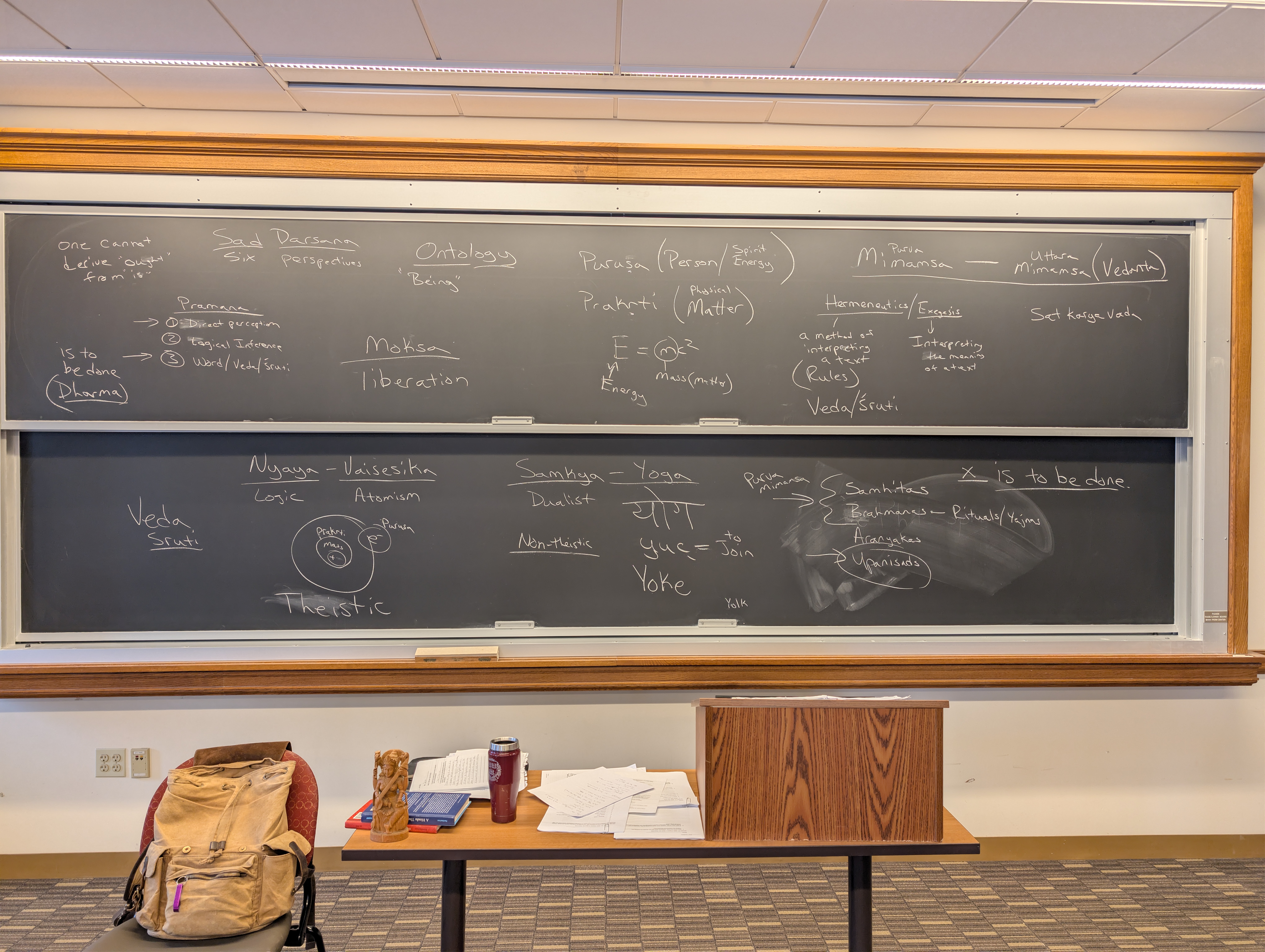
Chalkboard photo 1 from 01/27/2026

📄 Synopsis

This session provides a systematic overview of the Ṣaḍdarśana, the six orthodox schools of Hindu theology that accept the authority of the Vedas (āstika). Instructor Brad Bannon organizes these schools into three primary pairings based on their unique ontologies and approaches to the relationship between puruṣa (spirit/energy) and prakṛti (matter). The lecture begins with Nyāya and Vaiśeṣika, which emphasize logic and atomism, viewing reality as a complex amalgamation of indivisible building blocks. The discussion then shifts to the dualism of Sāṃkhya and Yoga, using the 'two bedsheets' analogy to explain how individual beings are formed through the temporary union or 'yoking' (yoga) of spirit and matter. Finally, the class introduces the exegetical traditions of Mīmāṃsā, distinguishing between Pūrva Mīmāṃsā (focused on rituals) and Uttara Mīmāṃsā or Vedānta (focused on the Upaniṣads). The session concludes by emphasizing that these schools represent different 'faces' or perspectives on the same Vedic truth, providing students with a framework for the comparative theological work to follow.

Key Takeaways

  • The Ṣaḍdarśana are the six orthodox Hindu schools that affirm the authority of the Vedas, often categorized as 'perspectives' on a single truth.
  • Ontology in these traditions centers on the distinction and relationship between puruṣa (spirit or energy) and prakṛti (physical matter).
  • Nyāya and Vaiśeṣika represent a realist, theistic approach that views the universe as composed of indivisible atoms containing both material and spiritual properties.
  • Sāṃkhya and Yoga are dualistic schools that describe the individual as a point of contact or 'yoking' between a single universal spirit and the material world.
  • The term yoga is derived from the Sanskrit root yuj, meaning to join or bind, similar to the English word 'yoke.'
  • Yoga is not the act of joining spirit and matter (as they are already joined), but the practice of bringing them into harmonious balance.
  • Mīmāṃsā is a school of rigorous exegesis and hermeneutics, focusing on establishing strict rules for interpreting sacred texts.
  • Pūrva Mīmāṃsā focuses on the ritual portions of the Veda, while Uttara Mīmāṃsā (Vedānta) focuses on the philosophical Upaniṣads.
  • Dharma is understood in the context of Mīmāṃsā as an 'injunction'—a specific action that is to be done as revealed by scripture.

🎤 Transcript Tap any timestamp to jump the audio player

Opening Meditation and Breathing Exercise

Brad
All right, let's take a moment and transition to bring your mind and attention where your body is.
Brad
Just take a moment to be still. Let's take a breath together.
Brad
Go ahead and breathe in and out.
Student
Word? Word. Word.
Brad
Alrighty.
1:15

In-Class Quiz and Attendance

Brad
Start out with a quiz.
Brad
Don't stress over the quizzes too much, you know.
Brad
Mostly just to see if you did the reading and also to gauge how much you're learning from it, but that may not, you know, I don't expect anybody to kind of retain 100%.
Brad
Let's do this.
Brad
Let's just start with them face down so we can all get a start at the same time.
Student
Can we use notes or no?
Brad
No, let's not use notes on this one.
Brad
There's really only one question on here, and, um, that question has two options.
Brad
One, you can answer the question that I've asked Or you can answer a different question if you want. Yeah, everybody got it? All right, go ahead and turn it over. So make sure that you write your number in the top left-hand corner, then write your name. First question is just how much time did you spend on the reading?
Brad
And then for question 2, so in your own words, either explain your understanding of the parable of the 10th person, so just you know, briefly, very briefly in the space provided, or just explain anything that you learned from the reading assignment if you're like totally drawing a blank on the 10th person.
Student
Thank you. Get in.
Student
Take another minute.
Brad
If you're still writing, you're probably writing more than you need to.
Brad
Go ahead and take attendance while we're doing this.
Brad
Evan.
Student
Here.
Brad
I will learn everybody's names soon. Veer.
Student
Here.
Brad
Danielle.
Student
Andrew. Here.
Brad
Ava.
Brad
Syve, I think she's trapped in Ireland, actually.
Brad
Aiden, Allie, Logan, Caroline, Luke, Claire, Collar.
Brad
Kellen, uh, Zongir, uh, Caelan, Iona, uh, Castalia, Scott, Anna, um, Tim broke something. On the ice? Georgia? Katie?
Brad
Lillian?
Brad
Christine?
Brad
Manny?
Brad
Sophia? Lauren?
Brad
Brent?
Brad
Brent?
Student
No, Grant.
Brad
Um, Kat. Um, Grace. Anybody I didn't call? All right, right on.
Brad
Um, cool, go ahead and pass those up.
Brad
Don't forget to write your number. If anybody doesn't know their number, I can remind them. Yeah, um, remind me your name. Christine.
Student
Christine.
Brad
25.
Brad
Yeah, remember your name?
Brad
Iona. 17.
Brad
Everybody else good?
Student
Cool. And the gang, I did bring I did bring the former quizzes.
Student
The four—
Brad
we've had five so far, counting today. So I brought the other four because I know there's been a lot of shuffling, a lot of adding and dropping.
Brad
So, you know, I mean, you obviously have the chance to make up anything that you missed. So if you have space and time after class today, you can actually do it right here.
Brad
My next class is the same class as in here. I have two sections of this class back to back in this room, so you can just take it right here.
Brad
And obviously, probably not enough time to do four, but you could do one every day, no problem. And I do eventually, you know, grade and return the quizzes. It just might be like a semester later. So yeah, cool.
12:19

Midterm Preparation and Study Guide Overview

Student
I wanted to show you something else, thinking about the midterm. No way for me to not be in the way.
Brad
So on the homepage for the course, there's a link to the course syllabus.
Brad
And I think more handy, I think, is this link that goes right to the agenda. So it'll jump right to wherever— jump right to the agenda.
Brad
Then I just added this with the help of Claude. Just created like a little study guide of vocabulary.
Brad
This is not going to cover everything on the exam, on the midterm, but a lot of it, really a lot of it.
Brad
So yeah, you know, I mean, it's basically, not basically, it is the information that's on this sheet just with a little bit more definitions and that kind of stuff. So the same sheet that we've been going over for the past few classes, and we'll finish up this week.
Brad
Anybody need a copy of this?
Brad
I have a few more. So it's also, you know, obviously in the course reader, and now here also, in addition to these, you know, pretty straightforward types of Hindu texts, shruti, smriti, itihasa, puranas. So in addition to all of these things, there's also flashcards, so you can go in and like enter study mode and review the flashcards, or there's multiple choice quizzes, and you can like reset it to, you know, do it over again, matching game, fill in the blanks, a sort of just little study guide, study tool kind of things to help you learn this, these vocabulary terms, which is really just, you know, pretty much memorization.
Brad
Good?
Student
Yeah?
Student
Is the midterm going to be kind of like the previous quiz on vocabulary or is it going to be more like fill in the blank?
Brad
It'll be some—
Brad
so I think I mentioned this before, one of the priorities for me is it should be easy to grade.
Brad
So it will be a lot of multiple choice but some fill in the blank. So really short answer. I wouldn't expect anything more than a sentence in length. So pretty much all, mostly all vocabulary. It's really what I'm interested in for the midterm. Good, cool. I'll say more about that when we get closer.
Brad
Okay, so there's a lot to cover in this reading. And a few things that I want to do before we even kind of get there.
15:53

Introduction to the Shad Darshana (Six Perspectives)

Student
So, I do desperately want to try to finish giving you some kind of introduction to the Shad Darshana.
Brad
So, let's see, we're back to this, back to this sheet that we've been working on for a while now.
Brad
And we've covered, you know, most of these things.
Brad
I think hopefully that as you learn from this reading or as you picked up on this reading, I think there's a lot of vocabulary in this reading that we've already covered. There's a lot of texts in this, a lot of scriptures and texts discussed in this text that we've already given a little bit of introduction to, but what we will be going over in much more detail.
Brad
So for example, he has a passage, if you have this with you, it's here. Handy.
Brad
There's a passage, Madhva, page 39, 39 into 40. He spends quite a few, what, 4 paragraphs or so, at least 4 paragraphs discussing the Mandukya Upanishad, and this is something we're going to read in a couple of weeks, so I think it will be very, very good for you when we get to the Mandukya Upanishad in a couple of weeks, probably 3 weeks.
Brad
No, it's actually the week before spring break, actually. So right before we read that, I think, you know, it'd be super good idea to kind of review what's in here.
Student
And, you know, part of the idea is to really understand how everything, how these two texts fit together, right?
Brad
There's a page 42, he talks about the Hiranyagarbha.
Student
We'll be reading the Hiranyagarbha Sutta next week. A couple of pages, he talks about the Purusha Sukta.
Brad
We'll be reading that for Tuesday.
Student
He talks about the, on page 32, right at the front, he gives the 4 mahavakyas, which is on this list, right?
Brad
The They're on the back of that page.
Student
So the four mahavakyas, obviously I want you to know those, but even more importantly, in Unit 3, we're going to be reading all four of those passages.
Brad
So we're going to read a passage from the Chandogya, from the Brihadaranyaka, from the Taittiriya, and from the Mandukya Upanishad, as I already said. So, you know, I want you to kind of I hope you'll begin to see how all of the pieces fit together, including the Abhava pramana that I went over in some detail last Thursday. So I didn't just accidentally pick that pramana to focus on. It's not just because it's wicked cool, but also because it's deeply significant philosophically, theologically. So I will eventually not be nervous in here.
Student
All right, let's see. I want to, I want to just try and quickly go over a couple of the śāntar��ana that we're not really going to be discussing very much this semester, and then spend a little bit more time on the two Mimamsa traditions.
Brad
So, 'Shad Darshana' means, hey, 'Shad Darshana', as I've given you many times, right, means the six darshanas, or perspectives, I think is a good definition of it.
Brad
If you wanted to, you could sort of like, I don't know, just to choose a random example, You could sort of think about it as like the veda is like a playing die and each of the 6 systems are kind of like a different face or different side, right?
Brad
So they're all different perspectives on the same thing, right?
Brad
So they're all astika, which is, you know, means they're saying yes to the Vedas, so they're orthodox schools of Hindu theology, and they give these different sides.
Brad
Now there's also If we, as I pair them there, there's 6 distinct perspectives, but they're usually kind of paired, well, pretty much always paired in these pairings, these 3 pairings.
Brad
So the first is Nyaya and Vaisheshika.
20:55

Ontology: Purusha (Spirit) and Prakriti (Matter)

Student
So I want to go through these by talking about ontology. So ontology, for those of you who've had me before, we had Section 9 ontology last semester. For those of you that haven't, ontos means being and logy means like the study of or the discourse about being.
Brad
So what does it mean for something to be? When we say something exists, what does it mean to say that it exists?
Brad
What's the nature of being?
Brad
That sort of stuff.
Brad
Now these 6 systems have differing ontologies, and primarily they have 3 different ontologies, and that explains the different pairings. So one thing they all agree on is that there are these 2 sort of fundamental, fundamental ways of being.
Student
And those are purusha and prakriti. purusha and prakriti. So purusha, to this point, we've mostly been translating this as person, and we'll continue.
Brad
Translating it as that's kind of the basic meaning of it, but in this context I think we can understand it better in terms of words like spirits or energy. Yeah, spirit or energy, right?
Brad
I think those work better for this particular content context.
Brad
prakriti, really just means matter.
Brad
So physical matter. Yeah, really we mean physical matter.
Student
So in terms of scientific—
Brad
in terms of science, right, one might think of Einstein, right?
Brad
E equals mc squared. So m representing mass.
Student
Right?
Brad
Or shorthand, we can say matter, you know, times the constant squared, speed of light squared. So it's a speed thing, right?
Brad
And energy. So these two things are not the same thing, right?
Student
Matter and energy are—
Brad
related to one another, but they're not the same thing.
Brad
You could ask people in Hiroshima and Nagasaki, right?
Brad
They can affirm that matter and energy are not the same thing. There was matter, material, meaning like the nuclear bomb, and then it converts into energy in a massive explosion represented by that c squared.
Brad
So, right, if I were to drop dead right now, Scott, would you stay until 11:45 or, yeah, 11:45?
Brad
I'd call someone.
Brad
You'd call someone?
Brad
All right. You'd get out of here, right?
Student
Yeah.
Brad
I had a teacher that almost died. She passed out during class one time. I was the teaching fellow and she just, she was up. Giving her a lecture on Hindu temple architecture. Actually, pretty interesting lecture for literally me and no one else in the room. But she was giving her lecture on Hindu temple architecture, and then she stopped and she just kind of like started, you know, doing this, swaying, right? Then she just like hit the deck. And she had a— it was like a big, like 110 people, 110 students in the class. And so she had like a microphone, like one of the Madonna mics or whatever. I think it was, you know, like a, you know, I mean, Harry Styles mic or whatever, like a cool mic. And she's like laying down on the floor behind the podium just talking to the class. She eventually did get up and paramedics came and, and she continued her lecture on Hindu temple architecture. She finished it. Paramedics were like waiting at the door, and they're like, yeah, you can take me to the hospital after I finish my lecture on Hindu temple architecture.
Brad
Anyway, my point is—
Brad
I do have a point here besides just to ramble and entertain.
Student
My point is that if I were to die right now, my body would still be here, right? But my spirit or energy may be Not so much, right?
Brad
Or at least it would no longer be there in the same way, animating or moving my body, right?
Brad
So we got an idea between the difference between matter, physical body, physical matter versus energy.
Student
You can represent it in any of these different ways, right? So two fundamental ontologies. Now, each of the six systems deal with these in differing ways, right?
Brad
So let's go through these differing ways. Nyāya and Vaisheshika.
26:32

Schools of Logic and Dualism: Nyaya, Vaisheshika, Sankhya, and Yoga

Student
Now these schools or these perspectives, as I mentioned here, Nyāya is virtually synonymous with logic.
Brad
It's a school of logic.
Student
Oh, I should—
Brad
a tiny bit more context.
Brad
So this kid named Buddha came along, right? He was Siddhartha Gautama, and he came along and was, you know, trained in Hindu theology, learned the scriptures, studied with a guru, and that sort of thing.
Brad
The upanishads were actually not that the upanishads were kind of still being written at that time, so around the same time as the upanishads, as the earliest ones, but he was studying all these things and then rejected it, right?
Brad
So nastika tradition, as I taught last week, but when he did that, his teachings actually became quite popular, so his Buddhism spread very quickly throughout India, and maybe, you know, according to many historians, maybe even became the dominant form of religious practice and belief in India, which then caused all of the, you know, the Hindu priests and the Hindu—
Brad
yeah, the Hindu priests to kind of get a little bit like, whoa, wait, we're losing our footing here, right?
Student
We're losing—
Brad
all these new kids are coming along and believing in things that are different.
Student
So then they really kind of reclaimed the traditions, began to defend the tradition, and began to reform the tradition, right?
Brad
A little bit like, maybe a little bit of a parallel, like the Catholic Reformation, right? So you had the Reformation when Martin Luther left the Catholic Church and became, you know, founded the Protestant Evangelical Church. And then the, for those of you know that history, then the Catholic Church began to reform itself, right?
Brad
It's actually the origin of the Jesuits.
Brad
It's like basically the history of Jesuits is founded in as part of the Catholic Reformation.
Brad
Similarly, you had a similar sort of Hindu Reformation going on, and they were like, hey, defending. You could think of it like defending the tradition, right? So, hey, let's go back and give logical defense of the tradition, logical systematic way of understanding the scriptures.
Student
And so Nyāya is that school of logic, and then the sister school Vaisheshika, usually sort of summarized in this term atomism.
Brad
So I want to explain that atomism because it's really about this fundamental ontology.
Student
So if we can all agree that matter and energy are not the same, right, but both exist, right, but exist in very different ways, right? You can't even measure energy. You can only measure energy in terms of delta T, right?
Brad
So you can measure matter in terms of, you know, mass.
Student
You don't need a delta T there.
Student
But delta T, or, you know, change over time, is how we measure energy, right? So we measure them differently. We think about them differently. They are different. But the question for all of these tools is how are they related?
Brad
What's the nature?
Student
How are they related? Nyaya and Vaisheshika, for the most part, agree that everything in the universe is composed of individual atoms.
Brad
Atom means something that's not divisible, right? Something that's a fundamental building block. And whatever that fundamental building block is, we could hypothetically call it something like an atom, right? Where you've got a proton and a neutron in there, right?
Brad
And then you've got the electrons kind of spinning around that proton and neutron in the center.
Student
Like in a hydrogen atom, right?
Student
So this would be like a fundamental building block. And as—
Brad
Nyaya and Vaisheshika think of it, right?
Brad
So you sort of have something that has mass, so some physical entity, and then you also have something that doesn't have mass but can be measured in terms of delta t, right?
Brad
So some sort of energy.
Student
So basically you've got, right, purusha
Brad
I'm sorry, prakriti. And Purusha Sukta. Sort of a simplified way of looking at it, but I think pretty accurate to Nyāya��a Vaish����ika Sukta.
Student
Any questions about that? So then on the one hand, right, we've got Colin, and Colin is made up of lots of atoms.
Brad
And some of those atoms, well, each one of those atoms has like a physical material aspect to it, but then also some sort of non-material or something like the spirit or energy. Now, Colin is not one atom, but like billions of atoms, right?
Brad
So then if we're trying to figure out what is a Colin or who is Colin, Colin from this standpoint would be, well, there's something unique about all of this mass of atoms, right?
Brad
But like we change over time.
Brad
Yeah, so when you're born, when you were born, you didn't look like this, right? When I was born, I didn't look like this.
Brad
I had many of the same atoms, but obviously far fewer of them when I was newborn. Than I have now. So I have more atoms now.
Brad
And those atoms are different.
Brad
The atoms that make me up are different, right?
Brad
So then we can understand why a person changes over time from this perspective, because a person is sort of a complex amalgamation of fundamental physical and energy properties.
Brad
Follow?
Brad
Okay, any questions about Nyāya Vaishyāśika? We're not really digging into them this semester, pretty much other than what I just said, right?
Brad
So this is in philosophy, at least in the West, we call this a realist school.
Student
Realist meaning both purusha and prakriti are together.
Brad
I don't even know if that term really is helpful, to be honest. These schools are, or these perspectives are generally theistic, so both Nyaya and Vaisheshika, in part of my doctoral studies translated a part of Gautama's Nyaya Sutra, Bhā��ya's commentary on the Nyāya Sutras., and in theory refers to—
Brad
so, as I said, the veda is that shruti, and from a Nyāya Vaisheshika perspective, that veda is heard by the rishis, that we already said, but from a Nyāya Vaisheshika, that is spoken by God. So, the veda is, you wouldn't say maybe authored by God, I mean, we might say that, but spoken by God, right?
Brad
So heard by the rishis from God.
Brad
So generally a theistic school. Then next, talk a little bit about Sankhya and yoga.
Student
So yoga is, you know, obviously something that's popular in the, in the US, at least certain forms of yoga, which are definitely related to, closely related to this.
Brad
We will come back to Sankhya and yoga more when we get to the Bhagavad Gita.
Student
There's just so so much about Sankhya and Yoga philosophy in the Gita that it would be foolish to totally omit it, so we'll talk about it a bit then. But the basic idea, Sankhya and Yoga are dualist. So, not atomist, but dualist.
Student
So, the two, right?
Student
So, here we've got atoms, and those atoms are all made of prakriti and purusha, right? As we said here, you only have two fundamental properties in the same material universe and the spiritual universe, but these are not looked at as divisible, right?
Brad
So in the terms of Nyāya Vaishyāśika, they're indivisible, but they're indivisible at the atomic level, right? So they can be divided down to atoms, but each one of the atoms has both of those physical and immaterial aspects.
Student
Sankhya, though, they're—
Brad
so the example that I find especially helpful is if we think about two sheets, right?
Student
So if we had—
Brad
it'd be even better if they were bed sheets, right?
Student
Let's say we just pretend that we had bed sheets and like Via took a corner and Scott took a corner and Colin took a corner and Jean-Guy took a corner, right? And each of you kind of pulled that sheet taut, right? So it could be some give and play like a bed sheet, you know.
Brad
But to be mostly taut.
Student
And then let's say we had 4 other people take another bed sheet, right, and pull it taut, right?
Student
And let's say that they were suspended, you know, but not touching, right?
Brad
So kind of got the visual image.
Brad
I'm not very good at holding them up, but so they're—
Student
so let's think of this as like purusha, right?
Brad
So one shiva, one purusha, one person, one being, one energy, right? As an entity, and then the entire material physical universe as one thing, right?
Brad
One universe.
Brad
I mean, that's literally what the word universe means, right?
Brad
One entirety, the whole physical universe.
Student
Now, if I were to take my hand—
Brad
imagine I've got both of them there—
Student
imagine I've got these two bed sheets and I were to take my hand, you know, like this, or even like this, right?
Brad
And put—
Brad
push down on the top one, then the two sheets would, like, touch, right? So when you have those two sheets, purusha and prakriti, touching, then we could call that an Iona, right?
Student
So then Iona is not the entire purusha and not the entire prakriti.
Student
In fact, not really either one of those, but Iona is a point where those two come into union.
Student
Follow? Right?
Student
So one self, one purusha, one spirit or energy, and one physical universe, but with lots of differing points of contact, right?
Student
And those points of contact—
Student
so importantly, when I— if I were to do this, let's say I had— I did it multiple times, right? And so then here we could have like an Iona, and here we have like a Sophia, and here we have a Aidan?
Brad
Of course.
Student
Andrew.
Student
Andrew.
Student
So then there's still one spirit of all, right? One person of all, and still one material universe, right? So then when Andrew was born, Right? It's not that the spirit of Andrew came into existence or the material of Andrew came into existence. Both were already existent. What is new is the union of those two.
Student
Right?
Student
So then that union, you know, we give the name Andrew. And then one day, sorry to tell you, that union is going to be disunioned.
Brad
Right?
Student
And then there will be no more Andrew. But the things that are Andrew both the physical matter that make you up, that's still going to be here, right?
Brad
And then the spirit or energy that moves that matter is still going to be here.
Student
It's just no longer going to be joined as Andrew, right?
Brad
Make sense?
Brad
Does that make sense?
Student
Yeah?
Student
So the word yoga in Sanskrit comes from the root word yūt, which means to join.
Brad
Yeah, to join.
Student
To join or to bind. In English, we have the word yoke.
Brad
Don't get confused, there's a homophone, yolk.
Student
What's the difference between—
Student
we're going to talk about this one next week, but what is yolk versus yolk?
Brad
Anyone?
Brad
Should be an easy question.
Student
No? No?
Student
So if, okay, let's say you've got an egg, right?
Student
And inside of an egg is like a yellow part, right?
Student
So like a chicken egg, right?
Student
So you've got the yellow parts inside of a chicken egg, right?
Student
And then you've got the white, like the, right?
Brad
You guys know this, right?
Student
That's the yolk, right?
Student
So that's Y-O-L-K. That's not what we're talking about.
Student
We'll be talking about that next week.
Brad
But this other yoke, Y-O-K-E, is—
Student
let's say you've got—
Brad
well, very, very important metaphor that will come back for the second half of the semester, more than that— is let's say we've got a, you know, a person in a chariot.
Brad
Right?
Brad
So it's a person in a chariot and they've got their— they're tied to different horses. Should I even attempt to draw a horse?
Brad
I can't draw a horse. We'll just do it for fun, right? Perfect. That's just— that's such a horse. No?
Student
Okay, hold your applause till the end. So if you've got two horses, right, two horses, and you yoke them together, Y-O-K-E, you put a yoke on them, right?
Brad
It's a thing, you've probably seen what I mean, right?
Brad
It goes around their head and it kind of locks onto their head, right?
Brad
And then it joins to another.
Student
So you've taken two you have two horses, let's say, and you've yoked them together.
Brad
So you haven't made one horse, but they literally can't go apart from one another, right?
Student
All they can do is go straight.
Brad
If one of them goes this way, the other one either has got to go that way or fight against it, right?
Brad
So they're yoked together.
Brad
They're not one horse, they're two horses, but they're temporarily yoked together.
Student
Follow? See the connection here, right? Yoga is the yoking together of purusha and prakriti, and any yoking together is like a yoga, a logan or a mani, right? And then so yoga, the practice of yoga, you know, even the meditation that we do at the beginning of class, part of this is, it's not to to join matter and energy together because they're already joined together, right? But we could say sometimes they get a little bit out of balance, right? Sometimes, at least speaking personally, sometimes I can get really— most of the time I can get super into my head, right?
Brad
So into my head that I sometimes forget to eat, or sometimes forget to do things, right? Or sometimes I'm I'm not even paying attention to where I'm driving.
Brad
I'm just, you know, I'm just so in my head, you know what I mean?
Student
Right, so that's sort of too much on—
Brad
so you could think of like kind of out of balance, right?
Student
So I'm like way too much in this side of things and not so much focused on my body. Other times, maybe if I'm extremely hungry, right, maybe I get so into my head that I forget to eat and then I get really hungry, then all I can think about is my body.
Brad
Or if I'm super exhausted or tired from shoveling snow or something, then my body may ache, and then I'm very much in my body.
Student
Yoga is about trying to bring those two into harmonious balance. If we get too much in our head, you do these poses and asanas. Asanas just means pose. You just do various poses to help you kind of bring your body and your mind back into balance.
Brad
Make sense? That's the gist.
Student
Sankhya and yoga, turning to the theistic side, so Nyaya and Vaisheshika, as I mentioned before, are theistic generally. There's plenty of—
Brad
I don't even care about this realist, I feel like it's not super helpful, but they are theistic, whereas Sankhya and Yoga usually are referred to more as non-theistic.
Student
So by non-theistic, you know, that's not atheistic, it's not theistic, and it's not atheistic, it's just non-theistic, right? So for Sankhya and Yoga, The question, I mean, the words, I mean, very synonyms for God are basically nonexistent in the Yoga Sutras.
Brad
They just don't talk about it. It's just not an issue. There's no issue there with the existence of God or the nonexistence of God.
Brad
They're sort of like silent on the question of theism.
Brad
Cool? Any questions about Sankhya Yoga?
Brad
Anything on the sheet that I didn't— so dualist, purusha and prakriti, two bedsheets analogy, existence of nonexistence of God is not considered relevant.
Student
So, moksha. So, moksha, as you know, Moksha means— what does moksha mean?
Brad
Liberation, right?
Student
So then, liberation is going to be different based on your understanding of reality. Liberation from what to what is going to be a little bit different in each one of the schools. So for here, we could say for Nyāya and Vaisheshika, liberation could be, you know, devotion to God, or it could be understanding the atomistic nature of reality as a means to understanding our relationship to God or the divine.
Brad
For Sankhya and Yoga, liberation really kind of means bringing these two into balance, right?
Brad
Finding a harmony finding your balance between purusha and prakriti. And also maybe recognizing that, you know, that as I said before, Andrew is just the point where purusha and prakriti get joined.
Student
But you aren't purusha, right? I mean, you are, but you aren't, right?
Brad
So the part we call Andrew is just the particular joining, but who you really are is this one purusha, the self of all beings, is indivisible.
Student
Liberation then would be understanding yourself as purusha, not as prakriti, but understanding yourself now as somewhat in balance of those two things. This semester I want to spend most of our time talking about Mimamsa and vedanta. And I think a very— I think it's increasingly helpful to describe these as purva Mimamsa.
49:16

Mimamsa and Vedanta: Hermeneutics, Exegesis, and Ritual

Brad
Purva means early, so the earlier Mimamsa, and uttara Mimamsa. Uttara meaning the later Mimamsa.
Student
Most of the time this school is referred to as Vedanta, and they often refer to themselves as Vedantins, but for now at least I want you to understand these as really, really, really closely related sister schools or sister perspectives. And at the core of it, so Mimamsa is this very logical, rigorous, meticulous exegetical school, right?
Brad
They practice hermeneutics. Hermeneutics and exegesis.
Student
Anybody know what hermeneutics and exegesis means? Either? Okay, good to know now then. So hermeneutics basically means a way of interpreting a text, right?
Brad
So, yeah, let's define this word as a method of interpreting a text. And exegesis just kind of means like— I mean, it's pretty synonymous. So it's like interpreting a text, interpreting the meaning of a text.
Student
So exegesis means you're—
Brad
ex meaning out, and exegesis means you're taking the meaning out of the text, right?
Brad
So the meaning is there in the text and you're kind of pulling the meaning out of it, right?
Brad
Eisegesis would mean you're reading it in, reading into it, right?
Brad
So like you have an idea of what you think the text should mean or what you want it to mean, and and then you read, you kind of search.
Brad
You've seen people do that before, right?
Brad
People do that a lot with scriptures and with other constitution and other things.
Student
They take a phrase and then they kind of twist it to mean whatever they want it to mean, right? That's eisegesis. Exegesis is, um, we're gonna take the text as it is and try to pull the meaning out of it. And hermeneutics is just sort of various methods for doing that. So rules, really we're talking about rules, rules for interpreting a text. So Mimamsa, this is what Mimamsa does.
Brad
They basically say, all right, we've got the text, and of course, of course here what we mean is that the veda, right, shruti, this the Rigveda, Samaveda, Yajurveda, Atharvaveda, and all four of the divisions, right? The samhitas, brahmanas, aranyakas, and upanishads.
Student
So that's the shruti, and Mimamsa are concerned with coming up with very, very strict, very strict rules about how to interpret the texts and how to not interpret the texts.
Brad
So you can be consistent, right?
Student
You don't want any cognitive dissonance.
Brad
You don't want to go and interpret this text one way because you feel like it and then use totally different rules for interpreting another text just because you want it—
Brad
because it doesn't say what you think it should say or whatever, right?
Student
So, so yeah, basically strict rules of interpreting a text.
Brad
Now the difference between—
Student
I All of this is true of both of these schools, and in fact, they use the same rules, the same methods, the same hermeneutics, the same methods of interpreting the text. The only significant difference between the Purva Mimamsa and the Uttara Mimamsa is which text they're focused on, right?
Brad
So, I gave you before, It's abomination right there.
Brad
Get fired for that.
Brad
So you've got the samhitas, which we're reading. We're reading some samhitas for Tuesday.
Brad
And then the aranyaka— I'm sorry, the brahmanas.
Brad
We're reading some brahmana passages for next Thursday.
Brad
And then you've got the aranyakas and the upanishads.
Student
And the brahmanas, as I said before, these are really about the rituals, right?
Brad
Rituals or yajnas.
Student
Samhitas are hymns.
Brad
And the rituals, for example, will tell, like, use this particular hymn in this particular sacrifice, right?
Student
And describe who does it, all those kind of things. We went over that before, but just to remind you, so the difference between Mimamsa and purva Mimamsa and uttara Mimamsa is purva Mimamsa is really focused on these In other words, we're going to use these rules for interpreting a text so that we consistently, faithfully, logically, without cognitive dissonance, interpret the rituals, right?
Brad
So that we know how to do the rituals and we all kind of read it, read the text in the same way and perform the rituals in a consistent manner, right?
Student
Uttaramamammsa then takes the rules, the same exegetical hermeneutical rules, and applies them to the upanishads.
Brad
Follow?
Student
So that's a key point.
Brad
So then, for this semester, we're mostly focusing on Uttaramamsa or Vedanta, and probably, I think I can say pretty confidently, anybody teaching this course course, would focus on that, but we're going to focus on it through this particular lens, right?
Student
So understanding that you can't really read and interpret the upanishads, at least not in an orthodox Hindu way, unless you're reading it through the lens of the sacrifices in the earlier part of the veda.
Brad
Does that make sense?
Student
We're gonna read these, I mean, we're gonna read these also, but the passages of the text that I read are going to build on one another, right? So we're gonna read the Purusha Sukta, Hiranyagarbha Sukta, and the Nasadiya Sukta from the samhitas, then we'll read these passages about sunashipa from the brahmanas, and then we're gonna read the Katha Upanishad, which is about performance of rituals, and about, I mean, it's clearly referencing the earlier portions, right? So we're gonna try and use these hermeneutics to read those earlier texts, and then we're gonna try and build on that.
Brad
Does that make sense?
Brad
So in other words, we're gonna try and read these texts the way, you know, orthodox Hindu theologians would read these texts, right?
Student
So anchoring our discourse not only in the texts, but also in the methods of interpreting the texts.
Brad
Word?
Student
Cool.
Brad
Alright, a couple of things from this page that I haven't gotten to. So the very first sentence of the Bhūravaveda Brahminsūtra is, I gave you there, "Atato dharma jñā��yāsa." Athato means now then, so now then, a jnana means like an academic scholarly investigation into dharma, so what is dharma, so meticulous exegesis, as I said, of the brahmanas or ritual portion of the veda, the veda tells us 'What is to be done and how?' I want to take a moment, I want to take a moment on that.
Student
So, the brahmanas, and you'll see this, you know, when we read this passage, the brahmanas don't usually say, 'Hey, do this.' I mean, there's usually a lot of stories and a lot of things in there, And it can be difficult, I mean, if you're a non-expert, and I would count myself way in that category, right, of reading those texts, you might not even know that it told you to do something, right? But one of the principles of Mimamsa, of Mimamsa exegesis or Mimamsa interpretations, is that the most authoritative part of the text is what's called the injunction.
Brad
The injunction is something that tells us to do something. This, you know, let's say X is to be done. So that's sort of the grammatical form, right? There's a grammatical form that's basically whatever verb, you know, you put it into this form and it's like X is to be done.
Student
So last week, last week we went over the— running out of space—
Brad
last week we went over the pramanas. What's a pramana?
Student
Valid source of knowledge.
Brad
And so one of those is pratyaksha, right?
Brad
I'll just put them in English.
Brad
Direct perception. Obviously, you do not need the scriptures for direct perception. You just see, hear, taste, touch, whatever. Then there's logical inference. Again, don't need the scriptures for that. And then third is shabda, or word, meaning the veda or the shruti. Veda and shruti are synonymous, as is shaiva, actually.
Student
So, as I said last week, Each one of these reveals something that can't be revealed by any other means of knowledge.
Brad
We spent some time talking about Abhava pramana, which reveals something about the relationship between material cause and material effect.
Student
You can't know that from any other means of knowledge.
Brad
Direct perception doesn't matter how many times I tell you what ice cream tastes like. There's no substitute for tasting ice cream, right? So direct perception is just irreplaceable. Or I think I talked about snow.
Student
And whereas the scripture reveals something that can't be— I mean, likewise, the scripture reveals something that can't be known from any other source, right? So as I said last week, one cannot derive ought from is.
Brad
Right?
Student
So direct perception tells us what is.
Brad
Science tells us what is.
Brad
Math tells us what is.
Brad
I hope you remember the lesson I gave on Abhava the other day, right?
Brad
And the relationship between milk and the curd and all that kind of stuff, right?
Brad
Cause and effect. If I were to say that dharma does not exist, for a mamsikas, what does that mean?
Student
Let's quick review. So the—
Brad
you've got milk, right? You got a bowl of milk, and then later you've got curd or yogurt, right?
Brad
So the—
Brad
as I said the other day, the milk only becomes the cause of the curd at the very moment that the milk ceases to exist. Right?
Brad
So then I also said, I gave you the doctrine of Satkariyavada, which is on the list there.
Brad
Yeah, the effect pre-exists in the cause.
Brad
Right?
Brad
So I am the cause of the future, or Satkariyavada.
Student
From that perspective, dharma, in that case, we can take like the yogurt. So the yogurt doesn't exist, dharma doesn't exist, but it is something that is to be done.
Brad
It's something that's good to be done, something that should be brought into being.
Student
So then if there's some, you know, if a player's reading the puranas and you're reading it and it says, oh, you know, somebody that fits your description, and you're like, okay, that fits my description, right? And then it says, this is to be done.
Brad
It's like, okay, I fit the description, and this tells me something that I should be doing, right?
Student
So then the thing that is to be done is dharma, and then whether or not dharma exists or dharma comes into being depends on Claire and Claire's actions.
Brad
Follow, right?
Student
So karma means action.
Brad
And if you read in the scripture, this thing is to be done, then you should take action to bring it into being.
Brad
Pretty simple, right?
Brad
Good.
Brad
So the authority of the scripture lies in what is to be done, which can't be known by any other force, by any other source. Interestingly enough, I think it's interesting.
Brad
The mimamsikas— sorry, I'm distracted by the fact that I only have 10 minutes left.
Brad
So I've got this line in there, right? Shabdamatram devita. God is nothing but a word.
Brad
Let me give you one sort stock example, right?
Student
So there is a brahmana that describes a ritual. It's a very important ritual. We'll describe this ritual in more detail later, but the ritual is a ritual to honor or to worship the garhapatya fire, the fire that's in your household, and So garbhapatya means just like the fire that's in the house, right?
Brad
Your normal— the fire that you cook your food with, the fire that heats your house, the fire that's, you know, the household fire.
Brad
Very, very important, right?
Brad
Especially if you zoom back a couple of thousand years ago, right?
Brad
The fire in your house, you know, it's important, right, for all these things.
Student
So this is a ritual to honor the household fire, to give it emphasis to the importance of it.
Brad
And in that ritual, it says, use this hymn that is written to Indra, right?
Brad
So it's a hymn praising Indra, the king of the gods, sort of the corollary to Zeus. He's like the god of thunder and lightning and all this kind of stuff.
Student
So this hymn is all about Indra, but the brahmana says, use this hymn that's all about Indra to worship the fire. Right?
Brad
And you might think, well, this hymn that's all about Indra, shouldn't we be using it to worship Indra, right?
Student
But the aham brahmasmi says no. The brahmana clearly says use that hymn to worship the household fire, right?
Brad
So the household fire is the center of attention here.
Student
And so even though we might infer logically that this hymn about Indra is to worship Indra, actually that hymn is used to worship the household fire, right?
Brad
And then along those lines, we've got this sort of central teaching or common teaching, shabda matram devata, meaning shabda, right, you know that word means word, devata means God, matram means nothing but, like the full measure of, right?
Brad
So God is nothing but a word, and for Mimamsas, the most important thing about God is that you pronounce the word properly at the proper time, period, right?
Student
So whether or not Indra exists or not, that doesn't even matter, right? What matters is that you use that hymn when you're worshiping the fire. —right?
Brad
What matters is your actions, not anything else, right?
Student
And, yeah, so generally we'd say theist, non-theist, and then more controversial— I mean, you know, there's definitely some atheist schools within Mimamsa and some theistic schools within Mimamsa. We'll study some of both.
Brad
Good?
Brad
Okay, so 6 minutes left. Any questions?
1:09:09

Closing Announcements and Podcast Group Coordination

Brad
Sorry for so much talking. I promise that when, when next week rolls around, this course—
Brad
this course hasn't even started yet. This course is starting next week, right? So after your first podcast, then things will shift significantly. Questions?
Student
Yeah.
Student
I'm not in a podcast group yet.
Student
We got to fix that then.
Brad
Let's handle that. Oh, no. I mean, it'd be good to handle it now, wouldn't it?
Brad
That's the next class.
Brad
For Thursday, I'm not going to give you anything new.
Student
There's not going to be a reading assignment.
Brad
We will cover this Ramayana text.
Brad
I know there's so much. You probably have tons of questions about it.
Student
We will discuss it.
Brad
Obviously, we'll discuss it in your podcasts.
Student
But we'll also discuss it in class.
Brad
Looking for Iona. Iona, are you in a group?
Student
Yeah. Okay. Okay, so you're not in a group yet. Okay.
Brad
Alright, we're gonna have to figure that out on Thursday because we're out of time.
Student
On Thursday, we'll figure out, we'll solidify the teams at the beginning of class.
Brad
We'll also settle on leadership days, so you can chat with your teammates if you want between now and then about your leadership days for the next unit, right? So each one of you should choose one day that you're going to focus on, right?
Student
Tuesday, Thursday, Tuesday, Thursday.
Brad
So how you divide it up is totally up to you.
Student
And—
Brad
but you can let me know that on Thursday, at the end of class on Thursday, so I'll have time.
Student
For Thursday, I'd like you to continue memorizing, learning all of these. Terms.
Brad
So Thursday we'll finish this sheet, including the back, which are the 10 avatars of vishnu.
Brad
So use that tool that I showed you at the beginning of class, it's on the website, right, to review your vocab and that sort of thing. And definitely reread Ramanuja's text, if you, you know, if you didn't read it as closely, review that, bring any questions. Thursday we'll just go over those kind of things, and maybe we'll play like a game in class. I mean, we will play a game in class.
Student
So it'll be a team-based game, and basically you'll do well if you've studied the terms, right?
Brad
It'll just be a game based on, you know, how well you've understood the vocabulary.
Brad
So how well you've memorized vocabulary.
Brad
You don't even have to understand it. You just have to memorize it. Right?
Student
Word? Cool.
Brad
If anybody wants to take a quiz, I've got them. I can give it right now. Otherwise, I'll see you on Thursday. I ended 3 minutes early.