🎵 Recording ⌨ Space / ←→

Hindu Pramāṇa-s and the nondual relationship of material cause/effect

01/22/2026 · Tue/Thu 12:00-1:15 PM · Brad Bannon · Boston College
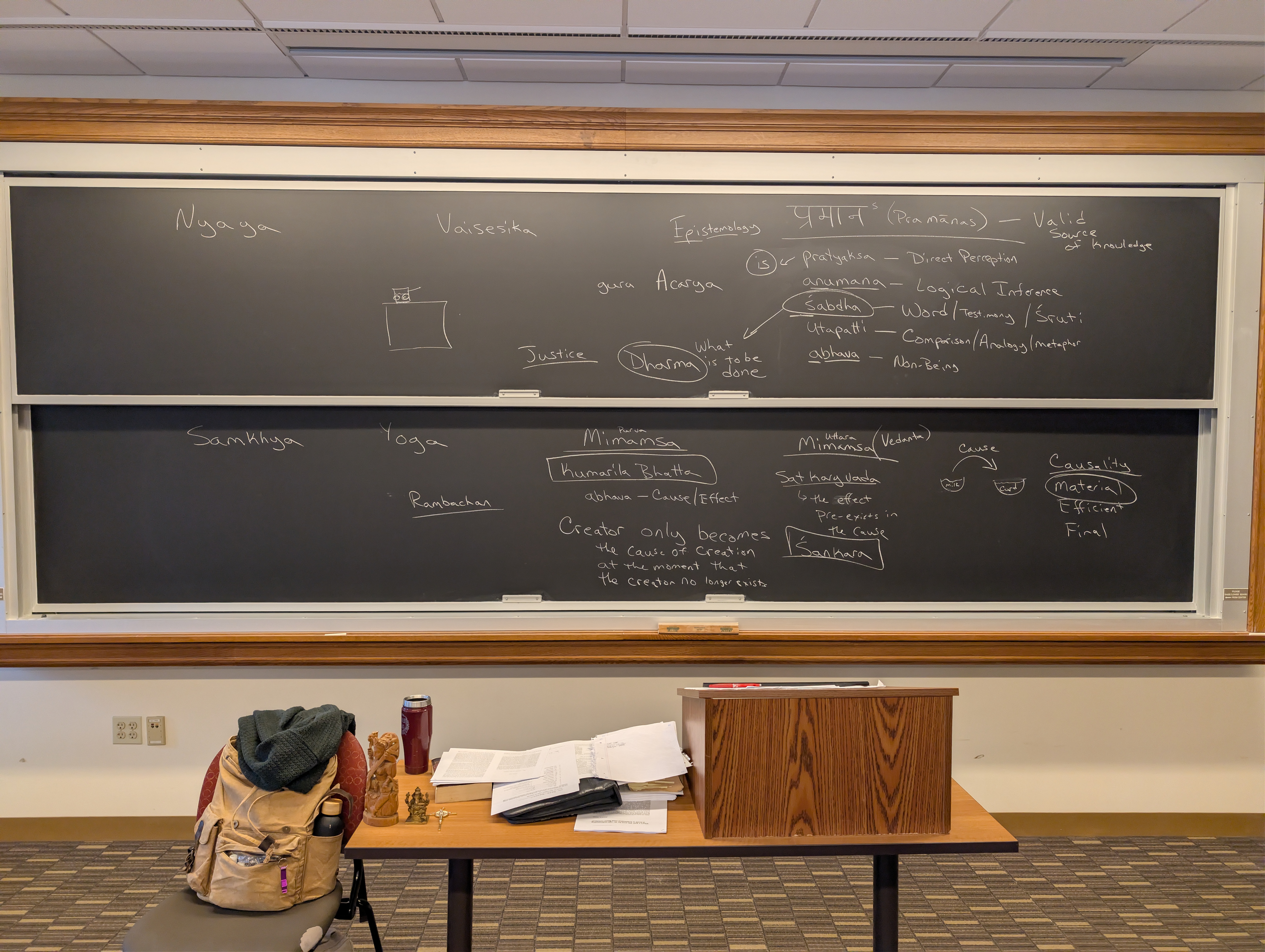
Chalkboard photo 1 from 01/22/2026

📄 Synopsis

This session explores the foundational epistemological frameworks of Hindu theology, specifically focusing on the pramāṇas, or valid sources of knowledge. Instructor Brad Bannon delineates the hierarchy and functions of pratyakṣa (direct perception), anumāna (logical inference), and śabda (the sacred word or testimony). The lecture covers the four types of Hindu scripture: śruti, smṛti, itihāsa, and purāṇas. A significant portion of the discussion is dedicated to the controversial pramāṇa of abhāva (non-being), which Brad studied during his doctoral work. Through the example of milk and curd, the class examines material, efficient, and final causality, debating whether the absence of an object can be directly perceived or must be inferred. The session concludes with an introduction to the six orthodox schools (darśanas) and the role of the theologian Śaṅkara in interpreting the relationship between scripture and experience.

Key Takeaways

  • The pramāṇas are recognized as valid sources of knowledge, with pratyakṣa (direct perception) generally considered the most immediate and least problematic.
  • Śabda (the word) is a unique source of knowledge because it reveals truths, such as ethical 'oughts' or what should be done, that cannot be discovered through science or perception alone.
  • According to Śaṅkara, sacred scripture (śabda) cannot contradict direct experience; if a text seems to say fire is cold, it is the human interpretation that is flawed, not the reality of the fire.
  • Abhāva (non-being) is a source of knowledge that Brad suggests teaches us about material causality by identifying the absence of an effect (like curd) in a cause (like milk).
  • Causality can be understood through three lenses: material cause (the physical process), efficient cause (the agent who sets it in motion), and final cause (the purpose or intention behind the action).
  • The term 'utapādhi' (or 'uttappati') refers to comparison or analogy, a source of knowledge used to explain an unknown object by comparing it to a known one.
  • Hindu scriptures are categorized into four types: śruti (revealed), smṛti (remembered/human origin), itihāsa (histories/epics), and purāṇas (stories of deities).
  • The 'moment of intuition' in epistemology is described as the point where sense perception, a mental phenomenon, and a word are synthesized into knowledge.
  • The six orthodox (āstika) schools of Indian philosophy are defined by their acceptance of the Vedas as an authoritative source of knowledge.
  • Brad emphasizes that different pramāṇas reveal different kinds of information; for instance, science (perception and inference) tells us what 'is,' while scripture tells us what 'ought' to be.

🎤 Transcript Tap any timestamp to jump the audio player

Opening Transition and Breath Meditation

Brad
Alrighty, let's take a moment to transition. Just take a minute to keep your body and mind still.
Brad
Let's take a breath together.
Brad
Go ahead and breathe in and out.
Brad
Word irony.
1:21

Administrative Setup: Quiz Procedures and Student Numbering

Brad
Before we do the quiz, I came up with a solution, I think. So on the quiz, I want you to, in the top left-hand, up here, top left-hand part of the page, I'm gonna have you write a number, right? So you have a little, there's not a box on yours, but just write a number up there in that top corner.
Brad
That way, you know, when I go through The quizzes, I can easily just put them in order, right? And that way I can get all of your quizzes together in one stack and, you know, just do the job of collating. Yeah, so I'm going to go through and take attendance today and give you a number.
Brad
And also, if I mispronounce your name or if you would like a different—
Brad
you may call you a different name I'll call you whatever you want. Just now would be a good time to correct me.
Brad
So Nicholas, prefer Nicholas?
Brad
40, your number 40.
Brad
Samuela, 41. Wilkes, 42. Jaden, 43. Gina, 44. Hannah, 45. Elliot, Elliot, Philippe, Philippe, did I say it right?
Brad
Yep. 47.
Brad
Blake, 48. Angel, Angel, okay, 49. Max, 50. Alice, 51. Boris, 52. Tana, did I say it right?
Brad
53.
Brad
Delaney, 54.
Brad
Joran, did I say it right?
Student
Joran.
Brad
55.
Brad
Ben, 56. Brian, 57. Olivia, 58. Devin, 59. Sophia, 60.
Brad
Dylan, 61.
Brad
Aiden, 62. Cooper, 63. Nathan, Nathan, no Nathan. Lucas, 65. Jake, 66. Isabella, 67. Yaroslava, 68. He Chang, is that—
Brad
did I pronounce it right?
Student
Yeah.
Brad
69.
Brad
Micky, 70.
Brad
And Eduardo, 71.
Brad
Cool.
Brad
Right on.
Brad
So, yeah, just put that number in the top left-hand corner.
Brad
I noticed in the morning class a couple people put it on the right-hand side. It's like literally the only way you can mess it up, so don't do that, right? Put it in the top left-hand corner.
Brad
Cool.
Student
Good.
Brad
Should work out very nicely.
Brad
Start back here.
Brad
Keep on and pass it that way. Oh yeah, take everything off to your desk Anytime notes?
5:27

In-Class Quiz and Attendance

Student
Wasn't the number we just like put on the top of the sheet?
Student
It doesn't mean—
Brad
Keep that number for the semester. It's just to help me pollinate.
Brad
Okay, um, your name is Elliot?
Brad
Elliot.
Brad
46.
Brad
Is that really it? We're out of quizzes?
Brad
No extras around? Diacritics are not necessary.
Brad
Looks like most folks are done.
Brad
All right, cool.
Brad
Go ahead and pass them out, please.
Brad
Um, for anybody, I think there's a few people that joined the class even just today. So if you're joining the class late, this is quiz number 4, but You can make up the quizzes. Olivia already made up quizzes, right? So you can feel free to make up the quizzes. The recordings are on. Everything's on the syllabus, right? So including the instructions to make up.
11:41

Review of Hindu Sacred Texts: Shruti, Smriti, and Itihasa

Brad
Let's review really quickly.
Brad
So does anybody need this sheet? I've handed out the last 2 classes.
Brad
It's also in the textbook.
Brad
But I have 2 copies left.
Brad
I have 1 copy left.
Student
Anybody else need it?
Brad
All right. So we're still making our way through this page.
Brad
We're still—
Brad
we won't even get through the first page today, actually. That was my ambition, but it didn't happen in the morning class. So, yeah, let's do a quick review, and then we're actually going to do our team form. We're going to form into teams today. So, but let's start with a quick review.
Student
So, one of the most important things from the other day was the 4 different types of scriptures, 4 different types of sacred texts.
Brad
Parts, we should say, right, within the Hindu tradition.
Brad
First one is shruti, right, that which is remembered, or that which is heard, right? So shruti, or the veda, so the entire veda is shruti, and the vedas, you know, is divided into 16 different parts, you know, 4 by 4, and so this is one of those this is 1/16 of the veda, this is the Rigveda samhita, so the Rigveda samhita, so just the hymn portion, just the hymns is here, and this is just in Sanskrit, so not much to see here, but I thought I'd bring it just to kind of pass it around so you can have a look just at a sample of that. Second part is smriti, yep, that which is remembered. So, not revealed scripture, not— this is so everything other than the shruti. shruti is not from human origin, but everything else is, right? So the second would be smriti, and here's just one example, the Brahmasutra. I brought a copy of it.
Brad
You'll be disappointed to know that there are no pictures in this particular copy of the text, ones with pictures are definitely more fun, but so this is, it's a text on eroticism, so I think I mentioned that the other day, so, but the sutras, sutra means really, really short, right, really short little aphorisms, usually the sutras are not even a complete sentence, most of the time they're incomplete sentences, they're just like part, just like the bare bones that you need.
Brad
Actually, they're not enough information really, so in order to read any sutra, you really need a commentary, so typically you'd read, you know, like the Brahmasutra with a commentary by an authoritative person, so they're the ones that say, okay, here's this little fragment of a sentence, and here's what it means, right? And sometimes it may be just, you know, 4 or 5 words in a sutra, but then the commentator will write like 10 pages of commentary on those, right?
Brad
What they mean, why is it here, what's the significance of it, you know, that sort of stuff.
Brad
So I passed this around, this is just the Brahmasutra, so one of the many sutra texts. Below that, a little less authoritative, is the itihasa, which means histories, stories, really these epic poems. So this is a graphic novel version of the Mahabharata.
Brad
As I mentioned, the actual Mahabharata is really, really, really enormous, right?
Brad
Massive.
Brad
If you had it all on your shelf, it would take up a lot of room on the shelf. Um, but this is just an abridged version for kids, and this does have pictures. I got this actually to read to my kids when they were little kids, and, you know, it's just—
Brad
it's exciting stories, right? Lots of heroes, lots of villains, lots of drama, lots of, you know, arrows, and just exciting stuff. So this is the, like I said, a kid's version of the Mahabharata.
Brad
Tiny Tot Publications.
Brad
There's, you know, even in India, even like on Netflix India today, you can get like lots of stories that come directly from the Mahabharata and the Ramayana, that sort of thing. So this is an example of itihasa. And then last are the puranas. I didn't bring a copy of the puranas, We will read a little bit, have a little tiny bit of sampling of the puranas later, much later in the course, second half of the course, when we get to the Bhagavad Bhagavad Gita.
Brad
We'll—
Brad
I'm not exactly sure I'm gonna accomplish all these things, but I want to try and slide a little bit of reading, discussing the puranas while we're talking about the Bhagavad Bhagavad Gita. So these are stories about deities, and we'll read a little bit of the Bhagavata pramana, which is the stories and legends about Krishna, including like things that he did as a child, things he did as a teenager, things he did as an adult, and that sort of stuff. So those are the 4 types of scripture.
Brad
I also brought this, which I keep in my office.
Brad
This is a very tiny but complete copy of the Bhagavad Bhagavad Gita. In fact, not only is it the entire Bhagavad Bhagavad Gita, but it's the entire Bhagavad Bhagavad Gita in English and in Sanskrit, so in translation.
Brad
And I'll pass this around.
Brad
You can see each page is a different verse.
Brad
There's 701 verses in the Bhagavad Gita, and so each page has the Devanagari, the Sanskrit text at the top, and then a translation at the bottom of the page.
Brad
I got this for whopping $1 at N&D.
Brad
I wish I bought more, actually.
Brad
So, in the Bhagavad Bhagavad Gita, as I mentioned, so that's 18 chapters out of the Mahabharata, which is itihasa, but those 18 chapters are considered smriti, maybe even shruti by many.
Brad
So it has a very high status. Within the tradition.
Brad
Cool? Any questions about the kinds of texts?
Brad
So next week— sorry, next week we'll continue our framing and that sort of stuff, but then the following week then we'll dive into the text. So the following week, Unit 2, we'll read some of the samhita, some of the brahmana, some of the upanishads.
Brad
For Tuesday, I like it to read this text by Professor Rambachan, one of my gurus, and yeah, great proponent of advaita vedanta.
Brad
It's—
Brad
I made a mistake, actually. I tried to print 2 chapters, but it only printed 1.
Brad
So I'm just going to give you 1, I guess. So sorry about that. You got shortchanged. You don't get to read the other chapter.
Brad
But please read this for Tuesday.
Brad
This will be— we might not entirely engage with it a whole lot on Tuesday.
Brad
But we will especially—
Brad
this will be important as we move forward. So sort of first foray into advaita.
Brad
Ramanuja and this text would fit into this category, uttara mimamsa, or vedanta is another name for it. I wanted to cover all the 6 systems and the pramanas today, but based on the morning class, that's not going to happen.
Brad
So we'll do the pramanas and at least try and get a little bit about these 2 systems today, or these 2 darshanas.
Brad
But before that, since you've got Podcast 1 due coming up really soon, you need teams, right?
20:40

Administrative: Podcast Team Organization and Grouping

Brad
That's the which is pretty essential.
Brad
So I'd like to take a few minutes now and see how we do just organizing yourselves into teams.
Brad
I think for the most part, you could just gather with folks around you.
Brad
I think my only rule is I would prefer not to have 4 men or 4 women on a team.
Brad
As long as there's not 4 men on a team or 4 women on a team, should be A-okay, yeah? So we're looking for members.
Brad
We're looking for 4 people on a team. And I think probably the folks around you would be good.
Brad
But do you want to take just 5 minutes and chat with the folks around you?
Brad
And if you don't like the people around you, if they smell bad, then feel free to move away from them or something.
Student
Yep.
Brad
And while you're doing that, it'd be great if you could just take a piece of paper And write down the 4 names on your team for me.
Brad
Olivia, you're a freshman?
Brad
Yeah. But you're a TA?
Brad
I am.
Brad
Wow, cool.
Brad
Okay, good.
Brad
Does everybody have a team?
Brad
I'm not interrupting, keep going, but does everybody have a team?
Brad
Thank you.
Student
Are reflection papers and stuff in the theology office?
Student
Are you still working on that?
Brad
I need to bring them in.
Student
Yeah, I'm sorry.
Brad
I started doing it last night. All I have to do is put them into folders and bring them in.
Brad
But I started doing that last night.
Student
I was like, this is—
Brad
Me and him still just have 2 people.
Brad
So.
Brad
Okay.
Brad
Is there— I don't know who's not in the team still.
Brad
There's 1 person out.
Brad
So we'll put that person in your team.
Brad
And, um. Yeah, we might actually only have 31 in the class, so that may—
Brad
you may go swim.
Brad
Are we good?
Brad
All right, right on.
Brad
It does happen sometimes where people get in a team and they don't totally vibe, don't totally click with folks.
Brad
And that's never an impossible problem to deal with. So you can always shuffle, you can always trade, you can always, you know, you can even trade on your own or whatever. It's all good. But for the most part, people really enjoy the process and really like, you know, get pretty close to the members of their team oftentimes.
Brad
Sometimes, only in 2 cases do they get married to somebody on their team. But that has happened over the 10 years.
Student
I've had two that happened twice where people got married to somebody in their podcast team.
Student
So that happens.
Brad
Cool, good.
26:35

Introduction to Pramanas: Valid Sources of Knowledge

Brad
Let's dive in because I'm gonna run out of time here.
Brad
So I really want to—
Brad
I definitely want to cover the pramanas today.
Brad
So pramana, the word pramana means valid source of knowledge.
Brad
So pramana is a valid source of knowledge.
Brad
I already taught you the term astika, right? So astika, those who say yes to the vedas, the orthodox schools, of which there are 6, right?
Brad
So there's 6 darshanas, or perspectives, on the veda, and all 6 of them, except the first 3 of the puranas, they say these 3 are valid sources of knowledge. There's no dispute among any of them on that. But then there's 4 more that are not universally accepted, and some of them Some schools accept all 7, some schools accept some, some schools only accept 3, but all of them accept these 3. So we're just going to go over these 5 today for this course. So pratyaksha is the most, and they are also in order of authority, of authority or trustworthiness, really they're in order of trustworthiness.
Student
That's not the right way to say it. They're all valid sources of knowledge.
Brad
They're all trustworthy.
Brad
They're just in the order of—
Student
you'll see, you'll see.
Brad
So the most—
Brad
the least problematic is pratyaksha, right?
Brad
So pratyaksha literally—
Brad
aksha means eye and prati means like in front of, right?
Student
So literally that which is in in front of your eyes.
Brad
So pratyaksha is not just visual perception, it's also like whatever hits your eardrums, or whatever you can touch.
Brad
So direct perception is how it's usually translated. So direct perception, talking about using your five senses to directly perceive what's around you, and that's pretty authoritative. So if I tell you something and you can see that I'm gaslighting you or something, you're not going to believe me, right? You're going to be more likely to trust your direct perception. But it does happen, you know, if you're very tired or if you smoke something super fun, then maybe you see things that aren't there or you don't see the things that are there, right? So sometimes our 5 senses can deceive us.
Brad
But that's not the norm.
Brad
Mostly we can trust what we see. Mostly we can trust our direct perception.
Brad
So the idea is that direct perception is absolutely a valid source of knowledge, but that doesn't mean that anytime you see something, you're 100% sure that the knowledge you get from that is trustworthy. Does that kind of make sense?
Brad
So direct perception is a valid source of knowledge. It'd be like, let me say calculus.
Student
I'm not, I barely scraped through in calculus, TBH.
Brad
But so a calculus textbook is a valid source of knowledge.
Brad
But Brad reading or explaining a calculus textbook doesn't mean that just because the textbook is a valid source of knowledge doesn't mean that I'm going to understand it properly. That makes sense, right?
Brad
So, pratyaksha is a valid source of knowledge, but sometimes because of certain things, mostly having to do with being in an altered state of mind, which often in the commentaries has to do with being very tired, right? If you're very tired or it's dark outside—
Brad
dark is another one, right?
Brad
Like a standard example is if I'm walking through the yard, maybe I'm going to the barn to feed the cow or something, right? And it's late at night and it's dark and it's summertime and I'm walking through the yard and I can see but not see very well, you know, and I see something and I think it's a snake, right?
Brad
So I almost step on a snake.
Brad
If I see that snake, it's gonna cause my, you know, parasympathetic nervous system, you know, my nervous system is gonna kick in, heartbeat's gonna beat faster, right?
Brad
I'm gonna have real effects.
Brad
Physiological effects as a result of the fear that I experience from seeing this thing that I think is a snake, and then I shine my flashlight on it and realize it's just a garden hose, or it's just a rope, or something like that.
Brad
It's not a snake.
Brad
So pratyaksha is reliable, but that doesn't mean that you're never going to see things that aren't there.
Brad
You get the point?
Brad
anumana. anumana literally means— anu means after, and mana means thinking. So literally, it's the thinking that comes after.
Brad
The thinking comes after what?
Student
Well, pratyaksha, right?
Brad
So pratyaksha is direct perception, no intermediary. This would—
Brad
direct perception, by the way, I have to clarify, does not mean watching something on a screen. Right?
Brad
If you're watching it on a screen, that's a medium.
Student
It's not direct perception.
Brad
Right?
Brad
So watching a video, something is not direct perception.
Brad
I mean, you're directly perceiving the screen, but you're not directly perceiving whatever is being conveyed on the screen.
Student
Right? So it means no intermediary between your sense organ and the thing that you're seeing.
Brad
So yeah, phenomenology.
Brad
anumana is thinking that comes after, so it's usually translated as logical inference, meaning I, for example, I—
Brad
again, it's something that comes after, so I see with my eyes, I can see smoke over there, therefore I logically deduce you know, some cool freshman have some weed, or there's fire over there, basically, right? So then I see smoke and therefore infer the existence of fire, right? So seeing smoke, that's the pratyaksha part. Inferring the existence of fire, that's the anumana part, right? So you can see why it's definitely reliable, right? But there's more opportunities for mistake.
Student
Right?
Brad
So maybe I think I see smoke, but actually it's just water vapor or something like that, or a cloud or fog or haze or something like that.
Student
Right?
Brad
So, or maybe they're vaping. Who knows?
Student
Right?
Brad
So then there's more opportunities for failure. Again, it definitely means that it's reliable.
Brad
It's a valid source of knowledge, but that doesn't mean that it's infallible.
Brad
Yes, please.
Student
Does it have anything to do with intuition? Is it like heuristical in our life? Like intuition?
Brad
So, in epistemology, the word intuition, especially in this system, intuition is an important word, but it probably doesn't mean what you are intending it to mean, right? So intuition in epistemology, it's the moment when you grasp what is there.
Brad
So a lot of times intuition—
Brad
what do we normally mean?
Brad
What do you mean by intuition?
Student
By intuition, I mean some knowledge that we have in our head that allows us to do the automatic quick response to some factor. So in order to make some intuition, like logical, Let's say some inference. I need to know something before, but my brain processes it so automatically, so I don't think about it. It just comes.
Brad
Yeah, that's—
Student
It's not that one.
Brad
No, not that one. Yeah, yeah, not that one. So, yeah. So the intuition in epistemology is like, I see something, I don't know what I see, and then I kind of, you know, then I decide that this thing is a rope, right?
Student
Not a snake.
Brad
So the moment of intuition is when— actually, this gets— in this school of thought, they say that the moment of intuition is when you basically have to put a word. Words are important, right? So like, I see something and I'm like, the hell is that? And then I say, "Oh, it's a rope." So when I put this word with that phenomenon, so you've got the thing itself, the rope, then you've got my phenomenon, the visual image of it that I have in my head, but that's not intuition yet. The intuition or moment of cognition is when I put all of those things together. Okay, this thing itself and my phenomenon and this word, they all go together.
Student
So, many of these philosophers say you need those three things to have an intuition or a cognition.
Brad
Good.
Student
But in order of anumana, if we translate it as 'seeing that comes after,' how would it differ from intuition? What does make it logical?
Brad
So, I mean, I don't want to get too deep into the weeds because then it can cause more confusion than clarity. But so when you see something, right? So in order to see something, right, you've got to have your eye And then you've got, I don't know, that's a mushroom tree. But just because my eyes see that thing, that's not yet an intuition. It's definitely not knowledge.
Brad
So intuition is the moment that sense perception becomes knowledge. So it only becomes intuition.
Brad
Knowledge when I have— first of all, I have to have a visual image, right, the phenomenon in my head, right, which is created by my brain. And then I grasp this word, oh, that's, I don't know, broccoli, which might be spelled that way. I can't spell in any language.
Brad
But then if I— so the moment of intuition would be I've got, you know, I see broccoli and I can, you know, ideally I'd like another person to verify it, right? So then Jaroslava looks at this thing and says, yeah, that's broccoli, right? So then we both have a visual image or phenomenon of our head and we both grab the same words.
Brad
But you need those three things in order in order to have a moment of intuition.
Brad
Now the moment of intuition, it could be wrong, right?
Brad
Like I said, it could be that I'm seeing a rope.
Brad
My eyes are seeing the rope, but the phenomenon in my head is a snake, right? So then in that case, they spend, philosophers, theologians spend a lot of time on that one. 'Cause it's like, wait, pratyaksha is the most reliable, the most authoritative, the most dependable, so how could it ever be wrong, right? And if it's ever wrong, then how do I know when it's wrong and when it's right? So does that at least kind of help?
Brad
It's a great question. Definitely a lot more depth we could dig into, but for now, I just want you to—
Student
yeah, I think it's good.
Brad
So anumana, that logical inference that comes after direct perception.
Brad
Shabda means word.
Student
Word?
Brad
Shabda means word.
Brad
It's also sometimes translated testimony. Because obviously not every word is a source of valid knowledge, but the idea is that actually when these—
Brad
when the astika theologians, when any of these orthodox theologians, when they use the word shaiva, what they really mean is the shruti.
Brad
The word that is heard, the word that is the veda. So they mean the veda. So the veda is the word, you know, in the same way that a lot of, you know, a lot of people just in everyday common language in English, you know, say like, I trust the word, meaning the scriptures, right?
Brad
Meaning the word of God or the scriptures. Yeah.
Student
Why would the shruti not be the top one?
Brad
Oh, good question.
Brad
So there's a little bit of a danger in putting the hierarchy the way I am in terms of— because all of them would say they're all equally valid.
Student
They're all equally valid sources of knowledge.
Brad
None of them are more important or less important than others.
Brad
But they also put them in this order because there's more opportunities for us to kind of make a mistake, right?
Brad
So, but the mistake isn't with the instrument of knowledge.
Student
It's not with the source.
Brad
It's with us. For example, if I give you instructions to go to my house, and then you follow those instructions and you don't get there, it could be that I gave you bad instructions, or it could be you misheard something or you misunderstood something.
Brad
Right? So it doesn't mean that my word was faulty necessarily.
Student
It could mean that you misheard or misunderstood. So there's more opportunities to misunderstand.
Brad
There's more areas for fault. That make sense?
Brad
More opportunities for, you know, for a bug in the system, right?
Student
So I'm trying to look for like a coding example, but, you know, like a fault, right?
Brad
But they're all equally valid. And not only that, but this is the next point I want to make. All the theologians emphasize that not only are they all equally valid, but they also reveal different kinds of knowledge, different kinds of information, right?
Brad
So there are different ways of knowing, and the things that you know from them are different.
Brad
So this kid Shankara— keep bringing him up, keep— will bring him up—
Student
Shankara says that if the scripture said that fire is hot, he said even if the scripture I'm sorry, even if the scripture said that fire is cold, even if it said that 1,000 times, it's not going to make fire cold, right? Fire is not cold. Fire is hot.
Brad
So if the scripture says it, it doesn't make it so, right?
Student
The scripture doesn't say fire is cold, right?
Brad
Because it's valid.
Brad
But his point is that even if it did, it doesn't change the reality, right?
Brad
So they can never be in conflict. If the scripture—
Brad
this is a really important point that I didn't hit hardly enough in the morning, but if—
Student
shit, I already forgot the point.
Brad
I actually did.
Brad
Oh, if your interpretation of the scripture contradicts your experience in the world, It doesn't invalidate your experience in the world, and it doesn't invalidate the scripture.
Student
It means that your interpretation of the scripture is off, right?
Brad
So if the scripture says something and your experience contradicts that, it means that your interpretation of the scripture is wrong, right?
Brad
Not that the scripture is wrong and not that you're—
Student
you got it.
Brad
Yeah, one thing, so these two, if we were to kind of combine pratyaksha and anumana together, I think we could basically say that's science, right?
Brad
Everything, all science, all scientific knowledge, all scientific learning, all science, you know, I mean, we could tackle these other ones, but the science would definitely be those two, right?
Brad
So scientific observations, direct perception, right? So that's what you want in science is directly observing it and then using logic, inference, math, deduction, you know, those sort of things in order to infer truths beyond that.
Student
So that's science.
Brad
Shabda, or the word, doesn't contradict that. It doesn't— it can't contradict it, and part of why it can't contradict it is because it teaches us different kinds of knowledge, right? So Shankara emphasizes that śabda is śabda because it teaches us something that we couldn't possibly know from these other valid sources of knowledge, right? So Let me give you a very, very important example. It's more than an example, but a very important example.
Brad
Science, pratyaksha, anumana, they are valid sources of knowledge to teach us what is, right? So I don't need the scriptures to learn everything that I could learn about that tree, right?
Brad
I can go, I can I could study the tree, I could observe the tree, I could conduct experiments and comparisons and do science, right?
Brad
And it's going to teach me everything that I can learn about what the tree is, right?
Brad
But it can't tell me, that's not going to tell me what I ought to do, right?
Brad
So in Western ethics, we usually say that one, cannot derive ought from is.
Brad
Just because I know science really well doesn't mean that I can derive ethics from that.
Brad
Ethics is what I should do, what I ought to do, but that's something that is different from what is, right?
Brad
So the scriptures, say, especially Shankara, they tell us what ought to be done, right?
Student
So it's a valid source of knowledge to tell us what ought to be done, and how they interpret that and what that means is going to be different for different theologians, but that's going to be universally true, that scripture tells us what ought to be done. Make sense?
Brad
Good.
Brad
Any questions so far?
Brad
So, the next one is utapādhi, which is comparison, usually in the form of analogy. Or metaphor, maybe even an example, something like that, right? If I'm trying to teach you about something, maybe you've never seen a giraffe before, you have no idea what a giraffe is, right?
Brad
No idea.
Brad
And I'm trying to explain to you what a giraffe is, then I might look for something like, oh, do you know what a horse is?
Brad
You know, so it's like, well, it's like a horse, but it's also not like a horse, right?
Brad
So in what ways are it like a horse, and what ways are not like a horse, right?
Brad
So uttappati, or comparison, it can be a very, very helpful source of valid knowledge, but you can see how it can be problematic, right? Because maybe I say it's like a horse and you think, you know, you can ride it or something, right?
Student
But I don't know, can you ride a giraffe? I know giraffes can't dance.
Brad
Some of them can dance.
Student
You know that book, Giraffes Can't Dance?
Brad
No? Oh, it's a good book. Okay, that one we're not going to talk too much about. Ababa.
Brad
So Ababa, you know how when you're going to go into like a little rabbit holes that, like, get interested in something. You're researching something and you, like, start following a path.
Brad
Oh, I'm interested in this. I want to learn more about this. You know, kind of follow a little rabbit hole.
Brad
You know what I mean?
Brad
When I was doing my doctoral studies, I got interested in Abhava, and I kind of chased down that rabbit hole for, like, 8 months.
Brad
Just got totally lost in what all these different thinkers think about Abhava.
Brad
And it's, uh, so I want to spend some time on it Now, as much as I'd love to go through the 6 systems today, based on the previous class, I'm only going to have time for a little bit from these 2.
Brad
And I want to spend most of that time talking about Abava. By the way, I have a student who graduated from Boston College years ago. She took my class, took this class, like, yeah, about 8 years ago or something like that, 8 or 9 years ago. She's now a partner at PricewaterhouseCoopers, so that's, you know, it's not shabby.
Brad
And I mention that because when she gave her— when she did her interview at PwC, she talked about ABABA, which is kind of cool, I think.
Brad
I don't know.
50:02

Theological Investigation of Abhava and Material Causality

Student
Worked for her.
Brad
So let me talk about ABABA. So ABABA, it's super controversial, like I said. Most of the Most schools don't accept it, only a couple do, and even within the couple that do, sometimes they argue over whether or not it's a valid source of knowledge. But I'm going to give you the argument of this kid, Kumara Labhatta. So Kumara Labhatta is one of the greatest theologians within the Purva Mimamsa school. So we'll just talk a little bit about Purva Mimamsa and uttara mimamsa together. Today, and like I said, he's one of the greatest theologians within the pramana and mamsa school. And he accepts Abhava as a valid source of knowledge. Now, a couple of things just to emphasize what I already said.
Brad
One is that the valid, these pramanas, valid sources of knowledge, they reveal something that can't be known by other means.
Brad
Means. So, like I already said, pratyaksha and anumana can tell us about the world as it is, but they can't tell us about the world that we're supposed to do. What is ethically good?
Student
What is ethically bad? What ought to be done?
Brad
So, śabda is good for that. Abhava, then, if it's a valid source of knowledge—
Brad
and this is part of what the different schools argue about—
Brad
they say, well, abhava at most is You know, some combination of these.
Student
It's not its own independent valid source of knowledge.
Brad
But Kumarla says, no, it is. And not only is it valid, it's a valid source of knowledge because it teaches us something that we couldn't know by any other means.
Student
Right?
Brad
So what is that thing that it teaches us that we couldn't know from any other means? And the answer to that is it teaches us about causality. And so we'll come back to that. So the word abhava, literally, 'a' means 'not' and 'bhava' means 'being,' so abhava means 'non-being.' And I'll explain it the way Kūmarālabhātā explains it. So he says— actually, before I get to that, Those of you who've had me before probably, hopefully, causality, maybe you remember the different kinds of causality. There are 3 or 4 different kinds of causality. When we say this is a cause of that, we can mean several different things. Anybody remember those different?
Brad
3, 4 different ways of causality. Let me teach them like this. Let's say I, let's say you roll up to New Hampshire, walk into my house, walk into my house and you see the stove, right? And sitting on the stove is a is a pot. Not that kind of pot, but the kind that you put water in. And so there's a pot on the stove and there's a fire underneath it, right? And somebody, my kid, one of my kids comes in or something and says, why is the water boiling?
Brad
See, that's a question. It's a question of causality, right?
Brad
Why is the water boiling? So let's try and answer this question in 3 different ways. And hopefully those 3 different ways will help you understand the 3 different kinds of causality, right? So one is physical, right? What's called material cause. So material causality. So the material cause.
Brad
So in this case, why is the water boiling? What's the material—
Brad
I'm looking for physics. Anybody know physics and science?
Brad
So can you give me a—
Student
Fire, hot temperature, which makes water heat and then boil.
Brad
The heat from the fire is then transferred to the pot, which then is transferred to the water in the pot. And when the water in the pot reaches a certain temperature, right? So that, yeah, the heat is conducted. And then that, when it reaches its boiling point, then it turns from liquid into gas, right? Which causes expansion.
Brad
In elevation, right?
Brad
So it rises and expands and it causes these convection currents inside, right?
Brad
So that's a material causality, right? So why is the water boiling?
Student
Because of all of those things, right? So heat going, you got it, right?
Brad
But then what if Brad's being an asshole, right?
Brad
My kids are like, why is the water boiling?
Brad
And I say, well, because I turned on the stove. So I did it.
Student
I'm the reason that it's there.
Brad
So I put the water in the pot.
Brad
I put the pot on the stove.
Student
And I turned the fire on.
Brad
So all of those material things are happening because I was the cause of it.
Brad
So I didn't cause physics, but I I set everything in motion.
Brad
Does that make sense?
Brad
This is called the efficient cause, efficient causality.
Brad
I can give you another really obvious example. If I hold this pen and then I drop the pen, if I say, why did the pen drop? Can you give me the material causality?
Brad
Gravity.
Brad
Gravity. And what's the efficient cause? Me.
Brad
Still me, right?
Brad
I dropped it. So I caused it. I caused gravity.
Student
Well, I mean, gravity happened without me, but you get it.
Brad
Then that brings us to the final cause.
Brad
Final cause, students sometimes get tripped up.
Brad
It's not maybe the normal everyday sort of meaning of the word final cause.
Brad
But so if I say, you know, if I drop the pen, so you understand the material causality is the gravity, the efficient causality is me, but the final causality in this case is because I am a teacher and I'm trying to teach you something.
Brad
Something.
Brad
So the reason that I go through the exercise is because I have something I'm trying to teach.
Brad
That's the final cause. Does that make sense?
Brad
So if my kids walk into the kitchen and they see the pot of boiling water and they say, "Dad, why is the water boiling?" I'll say, "Because we have company." Because Brian's here.
Student
And when you have company, It's a polite thing to do to make some tea or make some food or something like that.
Brad
So I put the water in the pot, I put the pot to boil because I want to be hospitable.
Brad
I want to be friendly.
Brad
So yeah, those are three different answers. So physics, that's material causality.
Brad
Me, I'm the efficient cause.
Brad
And then the final cause would be because I'm trying to accomplish something.
Student
What is the thing I'm trying to accomplish, right?
Brad
So, with those three examples or those three clarified, when Kumar Labhatta says that Abhava helps us to understand causality, what he really means in this case is material causality, just to be very clear, right? And he gives this example that's really super, super cool.
Brad
So he says, all right, let's imagine that I've got a bowl of milk.
Brad
So I go out to the barn and I milk the cow and I put it in a bowl. And then I set the bowl on the counter and I just leave it there.
Brad
For a couple of days.
Brad
What's this milk gonna be like after a couple of days sitting out on the counter?
Brad
Could be spoiled, right?
Brad
What causes milk to spoil? Bacteria, right? So bacteria causes them— it eats the sugars in there, right? And it's—
Student
and it causes it to Yeah, so the bacteria eats the sugars and then, you know, turns them into waste.
Brad
What is yogurt?
Brad
Yogurt's just the same thing, right?
Brad
So yogurt is when you take milk and then you add some live bacterial cultures.
Brad
Those bacterial cultures, you know, we don't want—
Brad
if you just set it on the counter, yeah, it's going to spoil because the bacteria that are going to eat the sugars aren't the bacteria that you and I want to eat.
Student
Right? So the yeast and other kind of cultures.
Brad
But if we take the same bowl of milk and we inoculate it with some good bacteria, right?
Brad
You go to the store and you get some Chobani or whatever that has live active cultures and you put those into the—
Brad
if any of you made yogurt before? Yeah, I mean, this is how you do it, right? You just take a bowl of milk, you know, You know, you add some— you just add some cultures to it, right?
Brad
And then those cultures proliferate and they become milk. I'm sorry, they become curd, right?
Brad
So the milk, if you— if the conditions are right, then the milk will become curd, right?
Brad
So what does it have to do with anything? I promise this would be so worth the time.
Brad
Trip.
Brad
Is that the mushroom?
Student
Okay, so I thought that was funny.
Brad
Maharalavatsa says, all right, so we go and we look. We look at this bowl of milk.
Brad
We see the bowl of milk. We see that there's no curd.
Brad
So the people that argue against the bhava say you're not seeing the absence of curd, right? You're seeing the milk and then you're inferring the absence of curd, right?
Student
Because I see milk here and I don't see any, you know, is that seeing?
Brad
Can you see something that's not there or do you see something that's there? This is so many of the debates.
Brad
There's thousands and thousands of pages written on that.
Brad
Like if I, like right here, Literally right here, there is not a bowl of milk.
Brad
How do I know there's not a bowl of milk?
Student
Because I can look and I can see that there's no milk. So am I seeing the absence of milk or am I seeing a table?
Brad
You see the debate at least, right? So the people that reject it are like, you're just seeing the table, bro.
Brad
You're not seeing the absence of milk, right? You're seeing the table and then you're inferring, okay, because I see the table and I don't see milk, then there's not a milk. There, right?
Brad
But Karmala, about this point, is a bit different. So, all right, I look with my eyes, so that's pratyaksha, and I see the milk and I don't see any curd.
Brad
And then I look later and I see curd and I don't see any milk, right?
Brad
Then what we infer from that is that the milk is the cause of the curd, right? How is that not logic? Well, Kamarala explains it like this, and this is— I don't know, this is honestly something that totally blew my mind when I first understood it.
Brad
Kamarala Bhatta says the milk only becomes the cause— and please understand we're talking about material causality, right? So the milk only becomes the cause of the curd at the very moment that the milk ceases to exist.
Student
Ababa.
Brad
The milk only becomes the cause of the curd at the very moment that the milk ceases to exist.
Brad
Follow that?
Brad
Right?
Brad
So I can't say milk is the cause of curd until the milk has become the curd, at which point there is no more milk. Follow?
Brad
Why is this such a big deal? Does it seem like a big deal?
Student
Does it seem cool, first of all?
Brad
Right?
Student
So the cause only becomes the cause at the moment that the cause no longer exists.
Brad
Right? Follow that? So let me give you one— this is a theology class— one theological example of why that really— of why that's really significant. So in the next week—
Brad
no, not next week, 2 weeks from now— we're going to read the Purusha Sukta. The Purusha Sukta is super important text.
Student
It's already come up a few times in the readings, and will come up more.
Brad
But in the Purusha Sukta, the idea is that in the beginning, right, before there were Wilkes, and before there was Brads, and before there were Bryans and Samuelas, right, before there was anything, there was just one person, right? We can call that person God if you want, right?
Student
The creator.
Brad
One person, nothing else, right? Imagine that you were the only thing that existed in the entire universe.
Student
Nothing else. Not any other persons. Not any other things.
Brad
You want to live in that world, Boris?
Brad
What does it sound like?
Brad
Mind-numbingly boring, right?
Brad
Absolutely nothing to do.
Brad
Nothing to be done.
Student
Nothing to fear.
Brad
Nothing.
Student
Just boring, right?
Brad
Just absolutely boring.
Brad
So in the beginning was this one person with nothing to do, and then that person said, Bro, this is way too boring, right?
Student
I'm not gonna— I don't want to just be me, right?
Brad
I wish there were more stuff. I wish there was some diversity. I wish there was some other stuff around, right?
Brad
But material causality—
Brad
where is this other stuff going to come from? Stuff can't come from anywhere other than the Creator, right? So the Creator says, all right, yeah, I'm one, but this is boring. 'Let me become many.' So then the one becomes many, and then there's other things.
Brad
So the one is the cause of the many, but—
Brad
wait, follow where we're going here.
Brad
So we could say the creator— can we call this thing the creator? The creator only becomes The cause of creation— anybody want to finish it?
Brad
When the creator ceases to exist, right?
Brad
So the creator only becomes the cause of creation at the very moment that the creator ceases to be. Now, you could push back on that and say, what? Like the milk, right?
Brad
So the milk no longer exists because it's become the curd, but the curd still exists, right? Isn't that very much the point? So the cause from this perspective, the cause exists as the effect. So we're talking about the relationship, material cause, the material relationship, sorry, the relationship between the material cause and the material effect. That leads us to another super important doctrine that I'm glad I have time for today, which is the—
Brad
it's called the Satkarya Vada. Vada means like doctrine or teaching, and Satkarya means in this case that the— bless you—
Brad
well, the way it's usually summarized is that the Effect pre-exists in the cause.
Brad
Right?
Brad
So we could say that the, the curd exists as a potential, right? Doesn't exist as curd, but it exists as a potential in the milk. Right?
Brad
I mean, physically we can understand that. There's sugars, there's all all these sort of organic compounds that are there.
Brad
And then they have the potential to become curds, but they only become the curd once they've been through the process of, you know, being consumed by bacteria, etc., right? So the curd pre—
Brad
I'm sorry, yeah, the curd pre-exists in the milk, but it exists as possibility, right? Not as actual.
Brad
So the— when the milk actually becomes curd, the milk actually doesn't exist, right? But the curd exists as a possibility even before it becomes actual.
Brad
Make sense? So then, from that perspective, then we could say, remember that one person, the purusha, right?
Brad
The person that I talked about a minute ago, the creator that was the creator before there was anything else, right? So then we could say Olivia existed as a possibility in that creator, right?
Brad
But not as an actuality, right?
Brad
So the only way for Olivia to actually exist is for the creator to stop being the creator and then become Olivia. Does that make sense? Right? So the effect pre-exists in the cause.
Student
Sattva, rajas, and tamas.
Brad
That make sense?
Student
Is this a little bit mind-blowing, or is it mind-numbing?
Brad
Yeah, or both.
Student
Do you say that the creator doesn't exist anymore?
Brad
I mean, that's got to be the— so we could say that the creator doesn't exist anymore in the same way that the milk doesn't exist anymore, the curd curd is still there, right? So it's not that the creator is no longer totally in existence, but we could say the creator has become you and me, right? So then, so the language that's usually used is, well, as Kumaralavatta and some others say, bada abhada, different but not different, right? So in the same way that the curd is different than the milk, but it's also not different than the milk, right? You're still talking about atoms and molecules, right? Matter and energy are neither created nor destroyed but are in a state of constant transformation, right? So the atoms and molecules still exist, but they don't exist as milk anymore.
Student
They exist as curd.
Brad
So the Creator no longer exists as one but continues to exist as the many.
Brad
Others?
Brad
Yeah.
Student
So does that mean that there's just like an infinite number of creators then?
Brad
So it doesn't exactly become multiple, and it doesn't multiply, right?
Brad
So the creator doesn't become— doesn't multiply itself per se. It's more—
Brad
it's dividing, really.
Student
It's dividing, right?
Brad
The word that's usually used, the best word, is unfolding.
Brad
Okay, I'm just going to use this for example, right?
Student
So let's say in Sanskrit the word is advaita, which just literally means unfolding.
Brad
And so you've got this one, right? And it's like, this is like super boring, right?
Brad
I'm the only thing that exists, right? So this one exists and there's there's nothing for, there's no playmates, right? There's nothing for it to play with, there's nothing for it to, nobody for it to talk to, anything like that, right? So then the creator unfolds, and now I want you to kind of imagine the folds here, right, as different individuals, right? One fold could be Mickey, one fold could be Boris, one fold could be Olivia, right?
Brad
So then the folds are still one piece of paper, right?
Brad
So the one, on one hand, it's now many, right? When it was just one, there were no folds, right? So no diversity, just homogeneity, right? But then when that one unfolds, it's still one, right? It hasn't become two.
Student
Right?
Brad
So it's non-dualist, but it's also not exactly one anymore.
Brad
Make sense? Right?
Brad
So you could—
Brad
yeah, good, right? Questions?
Brad
All right, so we got it. We got it basically as far as the other class did, so that's good. For For Tuesday, like I said, I'd like you to read this text by Ramanuja, and as I said, he's in this camp of vedanta.
1:13:32

Closing and Reading Assignments for Next Class

Brad
Yes?
Student
Are we having a quiz based on this stuff?
Brad
For Tuesday, I'll just have—
Brad
I'll create a quiz based on this reading, so I'll take some things from this reading.