🎵 Recording ⌨ Space / ←→

Hindu Pramāṇa-s and the nondual relationship of material cause/effect

01/22/2026 · Tue/Thu 10:30-11:45 AM · Brad Bannon · Boston College
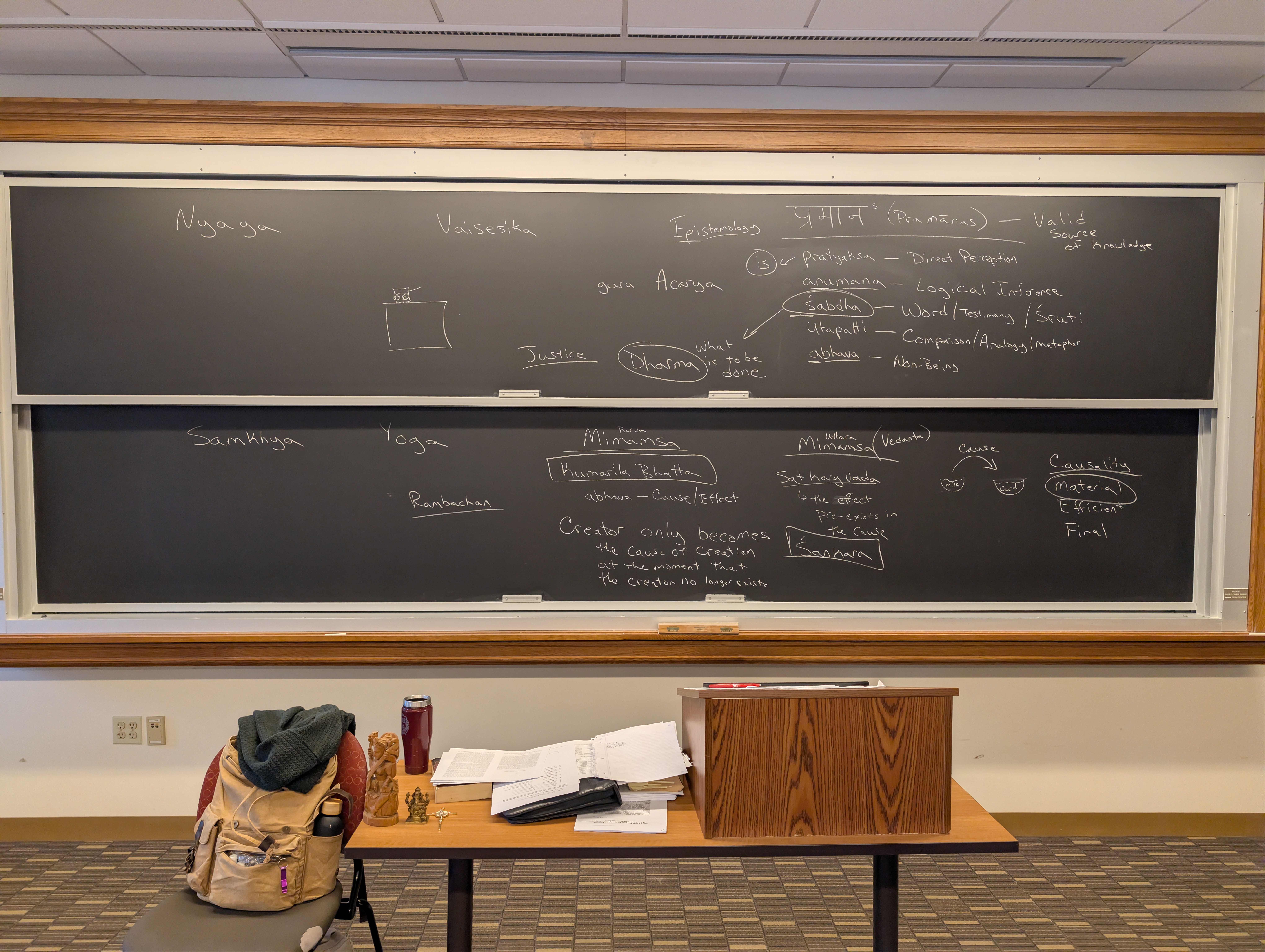
Chalkboard photo 1 from 01/22/2026

📄 Synopsis

In this session, Professor Bannon explores the ṣaḍdarśana (six orthodox schools) of Hindu philosophy with a specific focus on epistemology—the study of how we know what we know. The lecture centers on the pramāṇas, or valid sources of knowledge, distinguishing between direct perception (pratyakṣa), logical inference (anumāna), and verbal testimony (śabda). A significant portion of the class is dedicated to the concept of abhāva (non-being) as argued by the Mīmāṃsā theologian Kumārila Bhaṭṭa. Through the analogy of milk transforming into curd, the class examines material, efficient, and final causality. Professor Bannon presents a philosophical exploration of how a material cause only truly becomes the 'cause' at the moment it ceases to exist in its original form to become the 'effect'.

Key Takeaways

  • A pramāṇa is defined as a valid source of knowledge, which is distinct from the knowledge itself.
  • Pratyakṣa (direct perception) is the most fundamental pramāṇa because it involves no intermediary between the perceiver and the object.
  • Anumāna (logical inference) allows for the deduction of truths, such as inferring fire from the presence of smoke, though it is considered more fallible than direct perception.
  • Śabda (verbal testimony) specifically refers to the authoritative words of the Śruti (Vedas) within the six orthodox schools.
  • The theologian Kumārila Bhaṭṭa argues that abhāva (non-being) is a unique pramāṇa necessary for understanding the relationship between cause and effect.
  • Material causality suggests that a cause, such as milk, only becomes the cause of an effect, such as curd, at the moment the cause no longer exists.
  • Final causality refers to the underlying motivation or purpose behind an action, such as the desire to be a hospitable host.
  • The term 'uttappati' (likely a transcription error for Upamāna or Arthāpatti) is discussed as knowledge gained through comparison, analogy, or metaphor.
  • An Ācārya is a highly respected teacher and expert who has written authoritative commentaries on sacred scriptures, distinct from a general Guru.
  • The class discussed the physical examples of Śruti (Rigveda Samhita), Smṛti (Brahmasutra), and Itihāsa (Mahābhārata) to illustrate different categories of sacred texts.

🎤 Transcript Tap any timestamp to jump the audio player

Opening Transition and Breathing Exercise

0:01

Lecture: Epistemology and the Six Pramanas (Sources of Knowledge)

Brad
Howdy.
0:02

Theological Deep Dive: Abhava, Causality, and the Creator

Brad
Let's, uh, put everything away and just take a moment to transition.
0:04

Closing and Reading Assignments for Next Class

Brad
Let's take a breath together.
Brad
Go ahead and breathe in and out.
Brad
Word?
Student
Word.
Brad
I forgot to say, uh, on the first day, um, that I have pretty severe ADHD.
Brad
I know I'm not alone in that.
Brad
And I can't really imagine sitting still at a desk for 75 minutes multiple times a day. That's just, yeah, I mean, I've done it. I did it for, you know, I was a student for 16 years, so done it. But that's just to say, if it's like super hard for you to sit still in a chair for 75 minutes, I get it. Feel free to get up and move around, whatever. You know, I had a student a couple of years ago came up to me and she said, you know, I just can't, I just can't sit still for 75 minutes. And I was like, yeah, totally, I can't either. And she's like, it's okay if I get up and kind of pace around the room? And I was like, sure, I do it, you know. And so we got in kind of like a rhythm. She would like pace up and down this, the left side of the room, and I would pace up and down. We kind of got into like little rhythm back and forth.
Brad
I don't know what the people in class thought, but I've always thought, like, what would happen if, you know, all 32 of you just got up and started pacing at the same time? I don't know, cross that bridge when you come to it.
Brad
Anyway, keep meaning to say that.
Brad
So, all right, let's— I have a new system.
Brad
It's an idea. Let's try this new system. So I'm gonna give everybody a number, 1 through 31. And let's just run through the— I'm still learning everybody's names and things, but what is today, 20? 22nd.
Brad
All right, so Evan?
Brad
Yeah.
Brad
Okay, you'll be number 1. Okay. Veer, you'll be 2.
Brad
You think you get the pattern now, right?
Brad
Danielle, 3. Andrew, 4. Ava, 5.
Brad
Just remember your number. Is it Saive?
Brad
Kuni?
Brad
Yeah.
Brad
6.
Brad
Aiden, 7. Allie, 8. Logan, 9. Carolyn. Carolyn, Caroline, Caroline, 10. Luke, 11. Claire, 12. Colin, 13. Kellen, 14. Zongir. Did I say it right? Zongir. 15.
Brad
Kaylin? Yeah.
Brad
16.
Brad
Iona? Iona?
Brad
No. Castalia?
Brad
Did I say it right?
Brad
Yeah.
Brad
18.
Brad
Scott?
Brad
19.
Brad
Anna? 20.
Brad
Tim?
Brad
21. Georgia, 22. Catherine, did you say Catherine Park?
Brad
Right.
Brad
Katie, right?
Brad
Yeah.
Brad
By the way, K-A-T-I-E.
Brad
So 23. Lillian, 24. Christine.
Brad
No.
Brad
25.
Brad
Manny, Manuel.
Brad
What?
Student
Yeah, Manny's good.
Brad
Manny. Did I just make that up or did you tell me Manny before?
Student
I'm pretty sure I told you.
Brad
Okay. M-A-N-N-Y or I-E?
Brad
Y.
Brad
So you're 26.
Brad
Sophia, 27. Lauren, 28. Cat, 29. Brent, 30.
Brad
And Grace, 31.
Brad
Anybody didn't call? Okay.
Brad
So here's the brilliant idea.
Brad
So I'll pass out the quizzes.
Brad
And what I want you to do is up in the top left-hand corner, you know, make a little box about 1 inch by 1 inch, whatever. Top left-hand corner, that's all that matters. You write your number up there, right? That way I can easily sort them later, right? Brilliant idea, right?
Student
Super, super easy.
Brad
Cool.
Brad
All right, let's jump in, get the quiz out of the way. I'm going to start.
Student
Uh, no notes.
Brad
Thank you.
Student
Mhm.
Brad
Everybody got one?
Student
Excuse me.
Brad
Yeah.
Student
I added this class yesterday night and I didn't get added like into the Canvas page, so I'm not sure of the contents.
Brad
Probably not, yeah. So you have to— I mean, you can always make it up later.
Student
I'm in the same boat.
Brad
Okay.
Student
Yeah.
Brad
And you don't need to worry about diacritics. If you know the diacritics, great, but you don't need to worry about the diacritics.
Student
You need another minute? Ready, printer son?
Brad
Go ahead and pass them forward. Don't need any fancy passing now because we've got the numbers.
Student
Oh, thank you.
Brad
Cool.
Brad
Um, I do have, uh, some extra one of these, um, handed them out both last two classes.
Brad
So this is just the vocabulary things we're going through. Anybody else need one? Alright, so we're continuing where we left off. So we've already covered the 4 purusharthas, the 4 stages of life, brahmacharya, grihastha, sannyasa, the 4 varnas, the 4 kinds of texts, shruti, smriti, itihasa, and purana. It was on the Quiz from Jay. I did bring some, by the way, so this is a, yeah, not really much to see here if you don't know any Sanskrit, but this is a copy of the Rigveda Samhita. So this is just, remember there's the 14 different parts of the veda, sorry, 16, right, 4 times 4. So this is the Rigveda Samhita, pretty much the oldest, the oldest portion of the scripture. And I'll just, I don't know, pass it around, not really much to see there, but so that's the shruti, right? And then there's smriti, and so I brought an example of that, so this is the Brahmasutra, no pictures in this particular copy, so just boring old text.
Brad
But yeah, so at least you can get a sense of, you can glance at it and you can see the, this is normally what you'll see in a sutra text like this. You'll see the numbers there, those are the verse numbers.
Brad
So the Brahma sutra, sutra is very short, so they're usually very short sentences.
Brad
They're actually not usually even grammatically sentences, they're just sort of portions of a sentence. And I mean sometimes they're sentences, but they kind of really need a commentary, you really have to, you really need a commentary to understand what they mean, so normally you have a sutra commentary, a sutra and a commentary, and those commentaries will be by, you know, the most important figures within that field, those authorities that have kind of drifted to the top over time, so anyway, at least you can get a glimpse at, you know, what the Brahmasutra Looks like you can just pass that around. Then there's the itihasa.
Brad
So itihasa, as we already went over, right, these epics. This is a—
Brad
this one does have very exciting pictures. I got this when my kids were kids so that I could— I mean, they're still kids, but you know, when they were little kids, so I can read it to them. But this is like a comic, you know, a graphic version, graphic comic, what do you call it, graphic novel version of the Mahabharata. So the real Mahabharata is like massive, massive, right? But here's a very shortened version of it. And you can see, I mean, there's lots of, I mean, there's lots of action. It's an action-packed story. Lots of heroes, lots of villains, lots of fighting, lots of all sorts of stuff. So the Bhagavad Gita, as I mentioned, is 18 chapters within this massive, this massive epic. And I did not bring any copies of the purana, puranas actually, but we'll read a little bit of some puranas. On some of the Vishnu Puranas, the puranas about like the Bhagavata Purana, which is lots of stories about Krishna. So we'll read some stories about Krishna when we get to the Bhagavad Gita.
Brad
And I also brought a copy of the Bhagavad Gita. This is, believe it or not, not only the entire Bhagavad Gita, but this is the entire Bhagavad Gita in Sanskrit and in English.
Brad
And pretty much one verse per page, or even one verse— yeah, one verse per page. So you can see there's the, um, the Devanagari at the top. Um, yeah, Devanagari at the top and then a translation, um, in there. I got this, uh, in India for a whopping $1.
Brad
It's a good deal. So anyway, any questions about anything that we've done so far?
Brad
Any questions about what we did on Tuesday or last week? I know throwing a lot of information at you, a lot of things, a lot of vocab, a lot of things to memorize, a lot of things to learn. That's gonna be true today and next week as well. So But then we'll shift, like I said, with Unit 2. We also really need to form our teams. I'd love to do that. I would love that to be done. I mean, we could do it today, right? Let's try it.
Brad
How many of you—
Brad
so you know what I'm talking about, right? So you'll be in teams of 4. 4 is a good number. And so be teams of 4.
Brad
My preference is to have a couple of men and a couple of women, ideally.
Brad
That's the ideal.
Brad
It doesn't always work out that way. But I prefer not to have 4 men or 4 women on one team. So let's try to avoid that.
Brad
Beyond that, I don't really have any rules.
Brad
You know, in a perfect world, have, you know, lots of different genders, lots of different majors, lots of different years, freshman, junior, sophomore, people from all different parts of the country or the world. You know, the more diversity in the groups generally the better. But, you know, it's Boston College, so we'll do it. Work with what we got.
Brad
You want to take a few minutes and see if you can team up on your own. And we got a couple—
Brad
we've got a few empty seats, right? I already lost my attendance sheet.
Brad
Yeah, why don't you take a few minutes, chat with the folks around you, and we'll see where we are in a few minutes.
Brad
If we've got teams, then Works. And if not, then, I don't know, try and figure that out.
Brad
Yeah?
Brad
All right, go for it. Take 5 minutes or so. Get to know the folks around you.
Brad
You guys like to play? Sure, why not?
Brad
You're Georgia, right?
Student
I know you threw a riot, I think.
Student
I'm Scott. I'm Nate's roommate.
Student
Good to meet you.
Brad
And what's your name, by the way? Andrew.
Student
Andrew.
Brad
That works out, guys.
Student
That was good. Good mood.
Student
I heard you went to Indiana for—
Brad
or not Indiana, Miami.
Student
That seems really cool. Miami kept it kind of close, like first half. I found kind So that was week 1. I'm finally back in DC.
Brad
Cheers.
Brad
I will, I will take a sip of the potion.
Student
I, from previous experience, I found it's like similar to like beanpot vibe where it's like a crazy queue and not everyone gets it. I'm like, it's okay, but I'm a senior, I participate in all senior activities.
Brad
Same with beanpot. I've always been behind at like getting on top of the beanpot in this singing it for 2 of my 4 years there, so I had to like really lock it in.
Student
I'm like, we, we have to make some adjustments.
Brad
We're moving.
Student
It's a lot of fun.
Student
That is a 6-man. Well, it's phenomenal because last year I lived off campus, and then sophomore year I lived in a 9-man. So having only 5 other roommates instead of 8 is pretty awesome. If you really want 4, you could do 4, but you are guaranteed to have to stand there.
Brad
How do we do?
Brad
We got teams? Yeah, right on. Cool.
Brad
All right, let's do this.
Brad
Let's do this.
Brad
Let's just jot them down on a piece of paper somewhere.
Brad
Yeah, let's just do that. How about just take a moment. You have a piece of paper?
Brad
Hopefully, yeah, just rip out a piece of paper if you don't mind, or just one piece of paper per group.
Brad
Even half a piece of paper. I just want to, if you could just jot down everybody's names and just, you know, so that you're all together.
Brad
Cool?
Brad
Eventually I'll ask you to come up with some team names.
Brad
But, um, you don't need team names just yet. You can give it a little bit of thought, maybe for the first podcast.
Brad
Good, yeah, just pass those up when you're done.
Brad
So your first podcast is due in like 10 days or something like that. So basically you should record it after next Thursday and preferably before the following class, so between Thursday and Tuesday. I know that one of the most difficult things about, you know, the assignment is finding time to meet, finding a time where everybody has to meet. So I'm pretty flexible on all of that, especially for the first one.
Brad
You know, as you're getting to know each other and those sort of things.
Brad
But that's the ideal, right?
Brad
So after next Thursday, I mean, it could be right after class. It could be, you know, it could be right just like after class on Thursday and before class on Tuesday. That's the ideal.
Brad
Prefer—
Brad
my preference would be to have them like Sunday night or Monday night. I typically Listen to them on the drive in, you know, on Tuesday mornings and Thursday mornings. So, you know, and I like collate them and all that kind of stuff.
Brad
Oh, you understand how to name the files?
Brad
We got plenty of time. I'll talk about that another time. But that's in the syllabus as well. All right.
Brad
Cool.
Brad
Good.
Brad
So everybody's in a group?
Brad
Everybody's on a team?
Brad
Fire.
Brad
All right, let's— I think we just started doing the pramanas on Tuesday.
Brad
We didn't actually make it to the pramanas in the noon class. Y'all are just better than them, I guess, is the— yeah, so far. I don't know, for some reason we always make it a little bit further in this class than in there.
Brad
So, pramana. So pramana means—
Brad
anybody remember what it means?
Brad
Yeah, exactly right. Valid source of knowledge. So it's— or properly measuring the world would be even more literal, but valid source of knowledge, that's absolutely what I want you to know. Now, a valid source of knowledge is different than valid knowledge, right?
Brad
Just because, I mean, I could say that the, I don't know, your calculus textbook is a valid source of knowledge, right? But that doesn't mean that if then, you know, if I say if I read something doesn't mean that I'll understand it.
Brad
Does that make sense?
Brad
I mean, it definitely does not mean that I'll understand it. 100% I will not understand it. I barely scraped by in calculus in college. My daughter's 17 and she's already, she's like kicking ass on calculus, but me, not so much.
Brad
So valid source of knowledge is different than valid knowledge, right? Just because you read it, just because you see it, doesn't mean that your knowledge is correct.
Brad
But the point is that the source is valid.
Brad
The source is a valid source of knowledge.
Brad
So these are all ways of knowing, or as I taught you on day 1, right? Epistemology.
Brad
What's epistemology?
Brad
Yeah?
Brad
How we know what we know.
Brad
Exactly right.
Brad
Yeah, so the study of knowledge, literally it's episteme.
Brad
What does our knowledge stand on? What's the basis or foundation for our knowledge?
Brad
But yeah, the right answer is how do we know what we know.
Brad
So these are all methods of knowing, and according to all of the astika the, the Shaddarshana that we're studying today, all of them consider the first 3 valid sources of knowledge, and then on the subsequent ones there's 4 others that are accepted by some, but they're not universally accepted.
Brad
But I want to, yeah, I want to talk about all these.
Brad
By the way, I had one of my former students from here, gosh, was it like 8 years ago, something like that?
Brad
She's now a partner at PwC.
Brad
But she, during her interview at PwC, she talked about Abhava. And so I don't know.
Brad
So stuck with her, I guess.
Brad
So let's get—
Brad
let's lead up to that.
Brad
That was supposed to be enticing.
Brad
In some way.
Brad
So pratyaksha, as I went over the other day, right, prati-aksha, so aksha meaning eye and prati meaning like right in front of your eyes, right?
Brad
But it doesn't just mean eyes, it's direct perception, right? So the best translation of it would be direct perception, and that's without any—
Brad
so the direct is super important.
Brad
Direct means without any intermediary, right? Without any media.
Brad
No media between you and what you see.
Brad
So definitely not a screen or video or something like that.
Brad
That would not be pratyaksha.
Brad
The pratyaksha would be what's directly in front of your eyes, what directly comes into your ears, what directly—
Brad
so all those kind of things where I talked about phenomenology on day 1. That would be a good example of pratyaksha.
Brad
Anumana, the thinking that comes after direct perception, so usually translated as logical inference, you know, such as, I see smoke over on the hill, therefore I can infer fire.
Brad
Right? So you got it.
Brad
But it could be fallible, right?
Brad
It could be that I'm not actually seeing smoke.
Brad
Maybe it's water vapor or fog or something like that, right?
Brad
So there's more room for error, you could say. But nevertheless, it is a valid source of knowledge. Shabda.
Brad
Shabda means Word.
Brad
Shabda means word, and it's usually translated or explained as testimony.
Brad
So generically it means word, generically it means testimony, but more specifically for all of these 6 systems, it means shruti, right? It means, yeah, it means shruti.
Brad
shruti, of course, means the veda, right?
Brad
The 16 parts of the veda. So not the Mahabharata, not the sutras, not the other commentaries, not the Dharma Shastra, not any of that stuff, but the shruti itself, so the vedas.
Brad
Which would include the upanishads.
Brad
Then I think that's as far as we got on Tuesday, right?
Brad
So then picking up there, so these are accepted by all of the shaiva darshana, all the six systems.
Brad
Then most of them accept uttappati, which is, you could translate it as comparison, or analogy, metaphor.
Brad
So if, you know, yeah, I mean, by giving it a similarity, right? So if I were trying to—
Brad
I had that when I was in Ghana, had this experience, went to a tiny little village and stayed there for a few days. And there was a— all the children in the village wanted to come and, you know, talk to me and ask me stuff. And we went through this very formal thing. It doesn't matter. But this young girl, she was probably 12 or something. She emerged as the only one brave enough to, you know, talk to the white man. And she was like the leader of the group and they all kept asking her stuff. And one of the questions she asked, she asked all these really great questions, but a lot of her questions had to do with snow. And she was like, we've heard that there's this thing called snow, and like, can you, is that real? I was like, yeah. And she's like, snow is like, we think snow is like frozen water falling out of the sky. And I was like, yeah, that's right. And they're like, doesn't it like knock you out? Like, how doesn't it not like knock you out cold, right?
Brad
Like, it's ice falling from the sky, right?
Brad
So all these questions. Um, why did I even tell that story?
Brad
The part of it is, um, so her under way of understanding snow, right, was, okay, the only experience I've had with frozen water is ice, and that's not something that you experience all the time in Ghana. Primarily you experience that like when you go to the store and they and they have Coca-Cola in the freezer, right?
Brad
And so there's like ice cubes.
Brad
So, you know, trying to explain like hail is actually kind of what you're talking about, right?
Brad
Hail is also frozen water that falls from the sky.
Brad
But so the point is, in order to explain something to somebody who's never had any experience with it at all, sometimes you use an analogy or a metaphor or something like that, right? So if you have no experience, then then you can use a metaphor or analogy. We're going to use a number of metaphors and analogies.
Brad
Utopate is a very common way of teaching advaita, which we're going to start diving into soon.
Brad
But with any metaphor or analogy, there's always some right ways to understand it and some wrong ways to understand it, right? So they can be a little bit fraught.
Brad
So even a really, really good analogy or good metaphor can still lead you astray, right? Can lead you to misunderstand, misinterpret, right?
Brad
So that's part of why— that's part of why it's not accepted. The main arguments against why these other ones aren't accepted is that most of the schools will say Actually, these other things that are being accepted are actually just logical inference, right?
Brad
So you're just using logic in a different way.
Brad
And then lastly, I want to come to abhava. So abhava literally means—
Brad
so a means not, bhava means being. So literally it means non-being, and this is, you know, sometimes you're like doing some research, doing, you know, learning something, and you kind of follow down a rabbit hole or whatever and see where it leads.
Brad
I fell down the abhava rabbit hole for about 8 months during my doctoral studies. Just got really, really, really fascinated with this pramana and the debates around it and the discussions around it.
Brad
So all of the shad-darshana, all of the six perspectives, have arguments about this, whether they're arguing in favor of it or arguing against it.
Brad
But I want to talk a little bit about this kid from this school We're gonna spend some time talking about each one of the 6, but for the sake of Abhava, I want to talk about this kid Kumarala Bhatta.
Brad
And in— yeah, and he's got the typical way of Hindu theologian like Kamaralabhatta, like a really high—
Brad
these are called acharyas.
Brad
Acharya means teacher, but there's two different words, right? Guru means teacher. Guru is just like generic teacher. Anybody that's teaching, I'm a guru. Just anybody who's a teacher is a guru.
Brad
I'm not an acharya, Acharya is a—
Brad
you only get that title if you've—
Brad
I mean, you've got to write extensive commentaries on all the scriptures and then be accepted. It's kind of like being a doctor of the church, to give an analogy, right? So there's only, what, like a dozen doctors of the church, you know, those who are considered most authoritative theologians.
Brad
So that's acharya, the most respected teachers, the most authoritative, the experts, right? So those main experts, and Kamaralabhatta definitely meets that category. So he's an acharya, he's an expert within the field of mimamsa, and specifically purva mimamsa. I'll come back to those terms, but right now focusing on Abhava. So, in his commentary, he— so all these acharyas, they'll begin by kind of going through all the pramanas and how to use the pramanas, how to understand the pramanas, and yeah, how to apply them, what makes them pramanas, what makes them valid sources of knowledge, and how to properly understand them. And so Kamaralabhatta mentions that these, the different pramanas, they aren't just equally valid sources of knowledge, but they—
Brad
each one of them kind of give you information that you couldn't get from any other source, right?
Brad
So each one of them, you mean, you can use them one to validate the other, right? Checks and balances and that sort of thing. But as Kamaril Labata mentions, each one of them kind of gives you different insights. And the Mimamsa, both Mimamsa groups, certainly very much agree with that. So there are things that, for example, direct perception.
Brad
There's no substitute for direct perception, right?
Brad
There's just no substitute for direct perception.
Brad
Direct perception gives you information that no one else could know, right? I could talk to you about snow and what snow is like and describe snow and give you allegories of snow.
Brad
Snow, none of that's going to replace the experience of seeing snow, feeling snow, laying down, making snow angels, right?
Brad
That kind of stuff.
Brad
So no amount of testimony from somebody else is going to help you understand it.
Brad
No matter how much I describe it, or you understand it logically, or study it under a microscope, that's still not the same as you know, experiencing snow or skiing down a mountain or something, right?
Brad
So each one of them kind of leads to differing kinds of knowledge.
Brad
Different— yeah, that's right.
Brad
So Kamaralabhatta says, what makes abhava—
Brad
so he starts with that premise that every—
Brad
each one of the pramanas leads us to different kinds of knowledge. They're each valid for different kinds of knowledge. And Abhava is different in the kind of knowledge it reveals. And he emphasizes, so then what kind of knowledge does Abhava reveal?
Brad
As he says, Abhava teaches us about the relationship between cause and effect.
Brad
So, and he uses this very, very interesting example. I think it's very interesting.
Brad
Let's say, you know, let's say we had a bowl, a bowl full of milk, right? Just a bowl of milk.
Brad
Now, if you had a bowl of milk and you were to let it just sit there, right?
Brad
Just take a bowl of milk directly out of the cow, you know, and then just let it sit on the counter or something and leave it there for a few days, then what's gonna happen to it? Yeah, it'll rot.
Brad
Okay, so you're not going to want to drink it or eat it, right? Yeah, what else can you say? Describe that a little bit more.
Student
Yeah, like ferments and solidifies.
Brad
So yeah, so it solidifies and gets a smell to it, right?
Brad
What's causing that? Pretty much all smells come from what?
Brad
I mean, all organic smells come from some form of bacteria, right?
Brad
So you've got, uh, so you've got natural bacteria that are in the milk, and then you just leave it there at room temperature for a couple of days, and those bacteria are going to eat the sugars that are in the lactose, and they're going to convert that from liquid milk into what we call curd, right?
Brad
So curd.
Brad
And if you go to like the grocery store and you buy yogurt, right? Look on the package of yogurt.
Brad
Sometimes it'll say live active cultures, right?
Brad
So what that means is it's got— and it'll list the kinds of bacteria that are in there. So yogurt, just, you know, normal yogurt at the store is the product of milk that has been consumed by these bacteria, right?
Brad
And so the bacteria convert the sugars and the lactose to yogurt, right, into curd. Following so far?
Brad
So what does this have to do with anything? So Kumar Labatta says, all right, so when you go and you look, so we've got day 1, We've got milk.
Brad
Now I'm using my eyes, pratyaksha.
Brad
I mean, I could taste it, other things. I can use my direct perception to see the milk.
Brad
Move it around, slosh it around. I see milk.
Brad
So I see the milk, and also I don't see any curd.
Brad
I only see milk, no curd.
Brad
And then I come back a couple of days later, and I don't see any milk, I only see curd. So both cases I'm using pratyaksha. I'm using my eyes to see the milk, and then I'm using my eyes to see the curd. When I see the milk, I see the absence of curd. When I see the curd, I see the absence of milk.
Brad
All that's just at the level of pratyaksha. All that's just direct perception. Now we know that the milk has become the curd, right? It's not like there was milk there and then somebody snuck in and then took away all the milk and then put in curd, right? The milk turned into curd. The milk transformed into curd, right? So we could say that the milk is the cause of the curd. Folks like Kumar Labhatta aren't just satisfied with that, like, "Okay, I saw the milk one day, I came back the next day, it was curd, therefore I know that milk is the cause of curd." The people that argue that Abhava is not a purana say, "That's just logic, bro." You go in and you see the milk, That's direct perception.
Brad
Then you see the curd.
Brad
That's direct perception. And then you use your logical inference to deduce that the milk is the cause of the curd.
Brad
So it's not a purana for others.
Brad
But Kamar Labhatta argues, no, no, something different is going on here. He says, first of all, if you're really paying attention, let's say you're just like locked in, right? And instead of putting a bowl of milk there and then coming back in a couple of days later to see what happened, you're just like locked in, right?
Brad
It's like, I'm gonna just sit here and wait until it turns into curd.
Brad
And it's fully curd when there is no more milk to see, right?
Brad
So you're seeing the absence of the milk when you're seeing the curd.
Brad
But that's not the—
Brad
all that's still just pratyaksha and Anumana.
Brad
What Abhava reveals to us is the relationship between cause and effect.
Brad
Now, you probably hopefully studied this in logic class at some point, but there's various different types of causality. So one is Material.
Brad
Anybody know the types of causality?
Brad
So material cause, efficient cause, final cause.
Brad
This is good enough for now. So material cause.
Brad
So the So let's see.
Brad
Material cause. So the material cause here is the milk, right?
Brad
So the milk is the material, the matter, that becomes the curd, which is matter, right?
Brad
So this matter is transformed into this other matter.
Brad
The efficient cause in this particular case would be bacteria, right? So the bacteria is what's causing this material to transform into this other material, right?
Brad
So if you—
Brad
let's say that I used to make yogurt.
Brad
I don't have a gallon— I don't have a gallon of milk right now, so I don't.
Brad
But let's say I did, right? And so I took, milked the cow, and then I took some live active cultures, right, some from some other curd, added it to that milk, and then, you know, kept it between 85 and 100 degrees for 24 hours.
Brad
Then I'd have yogurt, right?
Brad
That would be the—
Brad
so the material is both the milk and the bacteria.
Brad
The efficient cause is the the bacteria, and you could say the process. But the final cause— the final cause doesn't mean— the final cause isn't the yogurt, which you might think from that term. But the final cause is whatever causes me to do it. So I'm doing this because I want to eat. I'm doing this because I want yogurt.
Brad
I am doing it because—
Brad
let me give you a better example. Let's say you walk into my house and you see the stove sitting there, and on top of the stove is a pot, right? Not some pot, but just pot. And so inside of the pot is some water. You know, there's a fire going underneath it and the— right? So there's a fire underneath the pot of water, right?
Brad
And then the water starts to boil, right?
Brad
You know what boiling water looks like. So if I were to go up and I were to say to you, why is the water boiling? Could you give me material efficient and final cost?
Brad
Why is the water boiling?
Brad
What's causing the water boiling from a material perspective?
Student
Yeah?
Student
The heat from the fire.
Brad
Yeah.
Brad
So heat is transferred from the fire into the metal, which then gets conducted into the water molecules.
Brad
And then the water molecules, when they reach boiling point, and they turn from liquid into gas, which causes them to have bubbles.
Brad
That's the bubbles. And then, you know, you get convection currents and, you know, go all sorts of physics and chemistry along those lines, right?
Brad
So that's the material, the material cause. What's causing the water to boil? Why is the water boiling?
Brad
Because heat is being transferred from the fire into the water and that process is happening. Right?
Brad
What's the efficient cause?
Brad
It's good I'm giving a second example.
Brad
So the efficient cause in this case would be me. Like, I'm—
Brad
I turned on the fire. I put the water in the pot.
Brad
I put the water, the pot on the stove. So in this case, I am the efficient cause. I'm putting water on the stove.
Brad
I'm causing all of this stuff to happen.
Brad
So I'm not causing the transfer of heat. That's the physics.
Brad
That's the matter and energy is doing that.
Brad
I'm not controlling the physics, but I am the cause of what the arrangement of all of these things. So in that case, the material cause is the fire and the heat and the water and the natural properties of H2O, etc. The efficient cause in that case is me.
Brad
But if I were to say, "Oh, why is the water boiling?" There could be another answer. What's the final cause? Yeah.
Student
Like something like you're trying to make pasta?
Brad
Sure, yeah, absolutely. That could be a fine answer.
Brad
I'm trying to make pasta.
Brad
Or another similar answer would be like, because you're here, right? And it's a polite thing to do to serve tea or to serve pasta or to serve something else, right? So the final cause is because I have a guest in my house, right? As a— whenever there's a guest in my house, I should serve them some tea or coffee or something nice, right?
Brad
So the reason that the water is in the pot on the stove doing all that material cost is because of my motivations.
Brad
You got the difference between material efficient and final cost?
Student
Good.
Brad
Important distinctions. Kamara Labhatta, I promise, is going to blow your mind when you get this.
Brad
This is going to be so worth the trip.
Brad
Kamara Labhatta says that using this milk and curd example, Abhava helps us to understand causality.
Brad
What he means here is the material cause, right? Material causality.
Brad
Here's the thing that just like totally, totally rocked my world when I understood it.
Brad
Kamar al-Abad says the milk only becomes the cause of the curd at the very moment that the milk no longer exists.
Brad
Definitely worth writing down, I think. Let me say it again.
Brad
The milk only becomes the material cause, right? The milk only becomes the cause of the curd at the very moment that the milk no longer exists. It's mind-blowing, right?
Brad
I saw Claire was like, oh, what?
Brad
Yeah.
Student
Is this talking about like the milk as like a whole or just like a specific piece of the milk that we think?
Brad
Yeah, so I mean, I think for the sake of the example, just take it as the whole thing, right? So yeah, you could say, all right, so this piece of milk is going to become curd at a different moment than this other part of milk. That's your question, right? But for the sake of the example, let's just assume that, you know, either way you take it, you could take it this little chunk. So this little chunk, the milk only becomes the cause of that curd, whether it's a whole bowl or a little piece, but it only becomes the cause at the moment that the milk no longer exists.
Brad
It should be mind-blowing, right?
Brad
But it is.
Brad
It's also completely 100% true. There's no doubt logically. You follow the logic?
Brad
So the milk only becomes the cause of the curd at the very moment that the milk no longer exists.
Brad
Got that?
Brad
Can we make it theological? So let's say, hypothetically, let's say that in the beginning, the origin of the universe, before there was Scotts and Brads and Mannys, there was just one person, right?
Brad
One person, the original person.
Brad
We could call it God if you want, right? So this one person, God, was the only thing that existed, right?
Brad
There was nothing else in existence except for this one person.
Brad
And so then that one person, how do you think that person's gonna do with their day? It'd be just like crazy boring, right?
Brad
Like absolutely mind-numbingly boring.
Brad
So maybe this person says, hey, this is like super boring, maybe I will, you know, multiply or become many.
Brad
So unfold or become many.
Brad
So that one original person— let's just say God for the sake of— yeah, I mean, Kamar Labhatu would, right? So then God wants to become more than just— wants there to be more than just God in existence. Then that person wants to become the cause of the multiplicity.
Student
But what?
Brad
There's nothing.
Brad
There's no other stuff.
Brad
There's no other matter. There's no other stuff to make the universe out of.
Brad
There's only this one person. So then this person has to make the universe out of themselves.
Brad
So when that person makes the universe out of themselves, they're no longer one person. So, in other words, the creator only becomes the cause of creation Anyone want to finish it?
Student
When the creator no longer exists.
Brad
Isn't that— that's like kind of mind-blowing, isn't it?
Brad
Right?
Brad
So the creator only becomes the cause of creation at the very moment that the creator no longer exists. Worth the trip?
Brad
Yeah, that was totally worth it, right? Come on, that was worth it.
Brad
Okay, so significant insight there, and deeply related to everything that we're gonna be doing, you know, particularly in Unit 3.
Brad
Yeah, especially, well, Unit, all semester, whatever.
Brad
It's gonna be super important.
Brad
Any questions? Anybody that doesn't get it? Anybody wants me to explain it again or find a different way to explain it?
Brad
Yeah, Colin? Would that mean like the creator then is like a part of everyone?
Student
Because he's the one that like feeds to everyone.
Brad
Absolutely right. So then the milk, I mean, so some other folks, the Uttaramamsas, have a different doctrine.
Brad
It's closely related to this called sattva, karya, vada.
Brad
Basically, vāda just means like teaching. Sātkāryavāda basically means that the effect pre-exists in the cause.
Brad
So this is kind of the opposite of what you said, or it's kind of the reverse of what you said, but it's the same. Logically, it's the same, right? So the effect, in this case Colin, right, pre-exists. So before you were Colin, I mean, your matter, your energy, even your possibility, your ability to be aware, your awareness, right, or your consciousness, that existed before it was Colin, right? But it was not Colin then, right? So it pre-exists in the cause.
Brad
So therefore, you could say, right, you asked it the other way around.
Brad
Does God exist in you, right? Sure, that's definitely true.
Brad
But here it's kind of just phrased the other way around, right?
Brad
So that you preexisted in God, right?
Brad
So you're just sort of an unfolding or an effect.
Brad
That's not to discount what's unique about you at all. We will emphasize, I will emphasize that frequently, right? There's a reason that, I mean, I already said, As you already, I think, all agreed, right? If you were the only thing in existence, there was nothing else in existence, that would be crazy boring, right? There would just be— that would be nightmarish, wouldn't it? I can't even imagine anything worse than just existing and nothing else existing, right?
Brad
There's definitely a Black Mirror episode or two about that.
Brad
But So then why is there more than one? Why did the one unfold as many? Well, because it's more fun.
Brad
Because it's more— I mean, that's definitely an answer, right? Because it's more fun.
Brad
And if you put it another way, let's say you had a chance, you know, you live this great life of yours that you're living Live a great life and then you die.
Brad
Sorry, rip, you know, it's gonna happen, right? But you reach the end and then let's say you reach the end and you've got a choice, right?
Brad
And somebody says, hey, do you wanna try, you know, do you wanna have another go around, right?
Brad
And you know, but you can't be Scott again. You already did Scott, right?
Brad
You already lived that experience. You gotta be somebody, something new, right?
Student
Right?
Brad
Would you choose that?
Brad
What would you choose? I know what I would choose.
Brad
I would choose professional drummer. I'm not even kidding. Yeah, next time, next go around, if I have an opportunity, professional drummer. That's just it.
Brad
I don't even care if I'm a good professional drummer. I'd rather be a bad professional drummer than not a professional drummer.
Brad
But would you choose another go around? Yeah, would you want to be an eagle?
Brad
I mean, you're all eagles, but you know what I mean.
Brad
I saw an eagle fly over my property 2 days ago.
Brad
Or a fish or a turtle or something else, or tree, you know.
Brad
What if you could be everything, you know, just like keep going around until you experienced everything? This is the idea. So then the material cause, the matter and the energy, matter and energy are neither created nor destroyed, but they're in constant transformation.
Brad
So then whatever exists now is a material effect of whatever material existed before. So cause and effect are merely temporal phenomena. And the cause only becomes the cause at the moment that it no longer exists because it's now the effect.
Brad
Right?
Brad
Should be clear. That should be clear.
Brad
Right?
Brad
So the cause no longer exists now because it is the effect, but it wasn't the cause before the effect existed. Right? It only becomes the cause at the moment that it becomes the effect. Should be a little bit of a head-scratcher, but logically it's there.
Brad
Cool. So any questions about the pramanas?
Brad
You at least get how this reveals something different than, say, like the smoke on the hill, right?
Brad
So smoke on the hill, I see smoke, pratyaksha. I infer the existence of fire, right?
Brad
That's Anumana.
Brad
But fire and smoke—
Brad
I mean, in fact, I'm using inference because those two are coincidental, right? Can't have fire without—
Brad
I mean, you can't have smoke without fire, right?
Brad
That's what smoke is.
Brad
So this, on the other hand, is teaching us something different. Right? So then, Shabda, as they emphasize— I'm doing, yeah, I guess I'm just doing Mimamsa first, which is A-okay. So then, for many of these Sikh systems, but particularly now on Mimamsa, Shabda reveals something that can't be known from any other sources. This is another thing. So here I gave you Kamar al-Abbadah. He's sort of like the greatest theologian, or one of the greatest theologians within the Madhva school.
Brad
And then a kid I've mentioned a few times before, and I will continue mentioning, Shankaracharya.
Brad
So Shankaracharya, maybe a contemporary of Kamar al-Abbadah. There's definitely Stories about the two of them getting in public debates and things.
Brad
But very closely, very closely, you know, close but not close.
Brad
One of the things Shankara mentions is that the puranas, they all reveal something different. I mean, kind of along the same lines of what I just said. It's not just that they're all valid sources of knowledge, but they all reveal something slightly different, and Shankara is super, very, very concerned with shakta, with the words, with the shruti, with the scriptures, right?
Brad
And so his point is, and one of the things he says with some frequency, is that even if the scriptures said 1,000 times over that fire is cold, it doesn't make fire cold. Fire is not cold. Fire is hot. But he also says, you know, but scripture would never say fire is cold because that would be true. That would be false, right? And scripture isn't false.
Brad
But the point being that scripture teaches us, or shruti or Shabda, teaches us something that can't be known from any other valid source of knowledge. And what it teaches us is— well, actually, both of these agree.
Brad
It teaches us what is to be done.
Brad
In Western ethics, the same idea is communicated in terms of you can't derive ought from is. So no amount of studying physics, no amount of studying No amount of studying science is going to tell you ethics.
Brad
It's not going to teach you what should be done.
Brad
It's only going to tell you what is.
Brad
So pratyaksha tells you what is. So pretty much all science would fall under pratyaksha, nana-mana, direct perception, logic, math, all those kind of things. That's science. Shaiva teaches us something that we can't know from those other sources, and that is something that is to be done, right?
Brad
And in Sanskrit, this is called dharma.
Brad
So dharma, right, watch this.
Brad
So we said that the milk only becomes the cause of the curd at the moment that the milk no longer exists. Here we've got kind of the opposite.
Brad
What is to be done is something that does not yet exist, and then your job is, once you understand what is to be done, is to cause it to exist. Let's say justice. So then justice, for example, is something that can only be done when it doesn't exist. So if you've got a case, let's say, of injustice, then because there is injustice, there's an opportunity to do justice.
Brad
Does that make sense? So justice is the thing that is to be done.
Brad
And in that case would be correcting an injustice. So then the injustice no longer exists at the moment that the justice is done.
Brad
Make sense? So obviously, I am basically out of time. And we didn't get very far in all of these.
Brad
Oh, no, I'm not out of time yet.
Brad
OK, so we did— we didn't do a lot. No, we did a lot.
Brad
We've got a lot more that I wanted to do today.
Brad
So for Tuesday, yeah, for Tuesday I gave you this handout.
Brad
It was actually supposed to be 10 more pages in addition to this, but whatever, we'll take it a little bit easy for this time.
Brad
And just read this.
Brad
So I'd like you to read this.
Brad
This is a chapter by Anantanand Rambachan, and he is a member of this school, Uttaramamammsa. Uttaramamammsa, we'll talk about next next week.
Brad
We can also call this Vedanta. And yeah, sorry, I'm not gonna try to squeeze in more.
Brad
I think we're good.
Brad
I have office hours today and online office hours tomorrow, and we'll see you on Tuesday.
Brad
Peace.