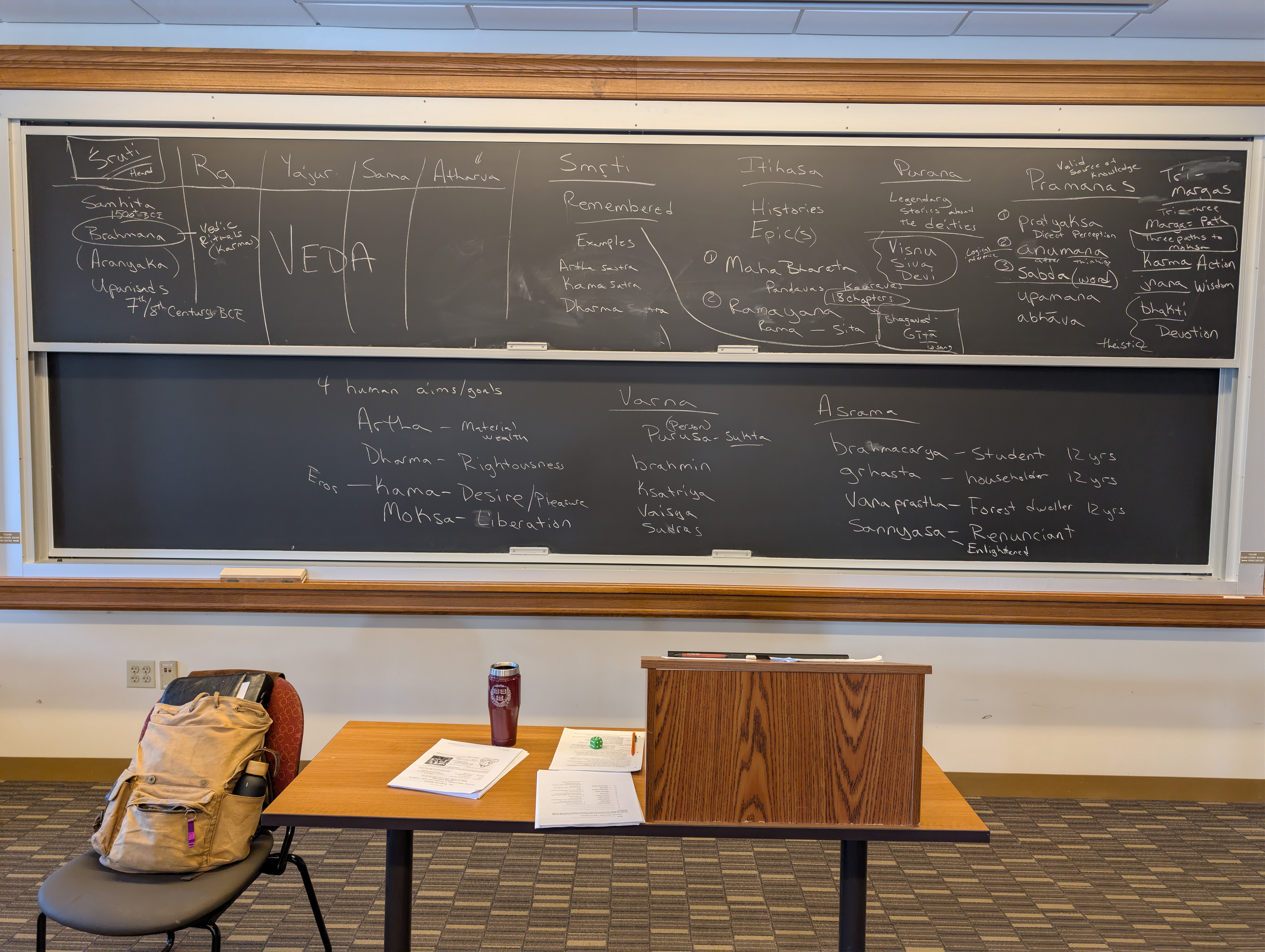
Mapping the Hindu Canon: Authority, Structure, and the Paths to Liberation
01/20/2026 · Tue/Thu 12:00-1:15 PM
Synopsis
In this session, Professor Bannon explores the structural frameworks of Hindu life and the categorization of sacred literature. The class begins with a review of the four Puruṣārtha (human aims) and the four Āśramas (stages of life), emphasizing the transition from the disciplined student and householder to the reflective forest-dweller and the enlightened renunciant. A significant portion of the lecture is dedicated to the distinction between Āstika and Nāstika traditions, defined by their acceptance or rejection of the Veda's authority. Professor Bannon details the internal structure of the Veda, explaining the four recensions and the four functional divisions: Saṃhitās (hymns), Brāhmaṇas (ritual manuals), Āraṇyakas (forest texts), and Upaniṣads (the final portion). The discussion also covers the broader categories of Smṛti (remembered texts), including epic poems (Itihāsa) and mythological legends (Purāṇas). The session concludes by discussing the importance of memorization in the student stage and the role of the renunciant as an enlightened guide.
Key Takeaways
The Puruṣārtha represent a holistic approach to human existence, balancing material success and pleasure with ethical duty and spiritual liberation.
Āstika traditions are defined by their affirmation of the Veda as an authoritative canon, whereas Nāstika traditions like Buddhism and Jainism reject this authority.
Śruti refers to 'that which is heard' and is considered unauthored, eternal wisdom perceived by ancient seers (Ṛṣis) rather than composed by humans.
The Veda is structured into four recensions—Ṛg, Yajur, Sāma, and Atharva—which are traditionally preserved through specific family lineages and rigorous memorization.
Smṛti texts are of human origin and, while highly revered, remain secondary in authority to the divinely perceived Śruti.
In the Vedic tradition, the act of memorizing sacred texts is viewed as an ethical discipline and a primary obligation of the student stage.
Theology in this course is defined as a philosophical investigation of first principles anchored in a specific canon of sacred texts.
The four stages of life (Āśrama) correspond to different relationships with the Veda: from memorization and ritual performance to reflection and eventual renunciation.
The principle of Ahiṃsā (non-harm) is a central teaching of the Jain tradition, rooted in the belief that all living creatures share the same essence.
The Upaniṣads are the final portion of the Veda, often written as dialogues between teachers and students or family members.
Transcript
Opening Transition and Meditation
Brad:
0:04
Alrighty. Let's take a moment to just transition. Definitely put away screens and devices. Please. Take a moment to still your mind and your body,
Brad:
0:28
everything outside.
Student:
0:51
It.
Brad:
1:20
Take a breath together. Go ahead and breathe in and out.
Brad:
1:29
Word.
Student:
1:31
Word.
1:35
Vocabulary Quiz and Administrative Notes
Brad:
1:35
So, as promised, let's start with a vocab quiz.
Student:
1:42
Just.
Brad:
1:47
No notes or anything.
Student:
2:08
It's. It.
Brad:
3:15
One note. Number 11. Brahmana is not wrong, but it really
Brad:
3:21
better would be Brahman for number 11. Sorry about that.
Student:
4:42
It's. It. It's.
Brad:
8:17
Everybody good. Round off.
Brad:
8:24
Looks like most folks are done.
Brad:
8:41
We good? Okay. Why don't you pass them out?
Brad:
8:50
Middle out.
Brad:
8:55
Anybody seeing Silicon Valley TV show
Student:
9:02
good?
Brad:
9:03
Be a terribly inappropriate joke.
Brad:
9:49
Also if anybody wasn't here. If you want a copy of the handouts from Thursday, A couple more. Okay.
10:12
Review of Quiz Vocabulary: Puruṣārtha, Varṇa, and Āśrama
Brad:
10:12
So, yeah, we'll quickly, very quickly review the quiz vocab.
Brad:
10:19
I think the chapter spelled it out pretty clearly, so I don't want to
Brad:
10:22
belabor the point, but.
Brad:
10:24
So the four Puruṣārtha, Artha, Kāma, Dharma and Mokṣa, usually given in that word, Artha, Kāma, Dharma and Mokṣa. So Artha, material wealth, Right. We all have a desire for material wealth. There's nothing wrong with that. So say the Hindu scriptures. But you don't want to Preyas material wealth at the expense of the others. Right.
Brad:
10:52
So they're all equally valid.
Brad:
10:54
And there is a little bit of a hierarchy. So Artha sort of seen as the most basic level. Kāma a little bit higher. Some schools reverse those. And then Dharma and Mokṣa definitely the third and fourth place. So, you know, it's fine to Preyas material wealth, but not if that means like defrauding someone or harming someone or stealing from someone. Right. So pursuing material wealth, but not at the expense of Dharma or righteousness. Ethics being good person, likewise Kāma. Right.
Brad:
11:28
Nothing wrong with pursuing pleasure, but not
Brad:
11:32
if it means hurting someone, harming someone else. Right.
Brad:
11:35
So pursuing pleasure within the realms, within the confines of Dharma, and then lastly, Mokṣa. So the whole point of life is
Brad:
11:46
to understand the purpose, meaning, purpose of life.
Brad:
11:48
Right. Attain liberation, which can mean very different things in the different
Brad:
11:58
schools of Hindu thought.
Brad:
12:00
But all of the orthodox schools share these four aims or goals. So important to know, as I wrote to you, if you've studied any Western philosophy, in my philosophy class at Fitchburg State, to teach the erotic dialogues of Plato. So Plato wrote a series of erotic dialogues like the Symposium and the Phaedrus dialogue and some others, and all about Eros. There's almost a direct corollary between the Greek term Eros at Least in that ancient Greek philosophical tradition of Eros and the Hindu notion of Kāma. Very, a lot of similarities, probably, very,
Brad:
12:49
probably both emerging from a common ancestor of thought. And so Artha mentioning, they're not exactly
Brad:
12:56
the same, but more similarities than you might expect. For example, Eros, also called Cupid, shoots arrows at people.
Brad:
13:08
So does Comma, shoots arrows at people. Arrows, love arrows. So a lot of sort of similarities between the two philosophically and sort of mythologically as well.
Brad:
13:23
Then the other two things for today, Varṇa and Āśrama. We will come back to discuss Varṇa more in a few weeks, a couple weeks when we get to the Puruṣasūkta. The Puruṣasūkta or the hymn of the person describes this one person in the beginning, that one person sacrifices itself, the one becomes many it.
Brad:
13:49
Different verbs you could use there, like the term unfolding, Avyakta, unfolding.
Brad:
13:56
So you know, if. Yeah, so the idea is that something can unfold and become multiple without ceasing to be one. Right.
Brad:
14:08
So like if I had a piece of paper and Yajña we'll come back to that.
Brad:
14:13
So, so the fourfold aspects of society. So society, you could think of all of society or even all of living beings, all living beings as one person, but really here, society as one person can't have society, can't have a functioning society without all four of these categories. You need scholars or teachers, Brāhmaṇa, scholars, professors, religious leaders, priests, you know, so religious scholars, but also, you know, just scholars, just teachers. Kṣatriya, basically anything in government falls under here. Everything from the king to the general to the Mehtar maid. Right.
Brad:
14:57
Pretty much anybody in government falls into the Kṣatriya category.
Brad:
15:02
Vaiśya, any kind of merchants, that sort of thing.
Brad:
15:06
Right. People who make things, people who produce
Brad:
15:08
things, people who crafts, people and that kind of stuff. And then Śūdra at the, you know,
Brad:
15:15
those who are in more service oriented roles. Right, Yeah, I think you could include nurses and doctors and that sort of thing.
Brad:
15:26
So that's the Varṇa we'll come back to. Yeah, we'll come back to say more about that later. And then the Āśrama, so the four stages of life, Brahmacarya generally. I mean, I put 12 years because that's some, some traditions enumerated that way. Certainly wouldn't be super rigid about that. But the idea is that you begin
Brad:
15:53
with BrahmacaryaBrahmacarya literally kind of means like following the teacher around.
Brad:
15:57
So you're an apprentice, you're a student,
Brad:
16:00
you follow the teacher around and you
Brad:
16:04
know that's your learning stage. During the Brahmacarya stage, your primary. One of your primary obligations is to
Brad:
16:10
memorize the entirety of the Veda.
Brad:
16:13
So you're not even studying the Veda to say, what does it mean?
Brad:
16:17
You're just focused on memorizing it, right?
Brad:
16:22
And then Gṛhastha. Gṛhastha literally means grabbing, right?
Brad:
16:29
Same root word. So householder, someone who holds a house doesn't so much focus on the house so much as the household, right?
Brad:
16:38
So
Brad:
16:42
having kids, basically, right? If you have kids, you're a householder, you're in that stage.
Brad:
16:48
During the Gṛhastha stage, the householder stage, one of the primary obligations is to
Brad:
16:53
perform the Vedic rituals.
Brad:
16:55
So performing the. Yeah, so ritual performance.
Brad:
17:00
So here you're just kind of memorizing the Veda.
Brad:
17:02
Here you're kind of doing the Vedas, right?
Brad:
17:04
Vānaprastha stage. So Vana means forest.
Brad:
17:07
Prastha means like one who lives in.
Brad:
17:09
So like one who lives in the forest or the forest dweller stage. The idea is that you can't you become eligible for Vānaprastha stage, really?
Brad:
17:19
When you're, when you don't have parenting responsibilities anymore, right?
Brad:
17:22
When your kids are or old enough to kind of take over from you, your kids don't need you so much anymore, then if you're, especially if you have kids and then your kids take over the family business or like take
Brad:
17:35
over running things for you, then you
Brad:
17:37
might enter the Vānaprastha stage. The idea is that basically here you memorize the entire Veda.
Brad:
17:45
Here you do what the Veda says, practice the rituals.
Brad:
17:49
Then it's only at the Vana process stage, when you retire into the forest and you begin to start reflecting. What does all this mean?
Brad:
17:56
Right?
Brad:
17:56
Why do we do these things? What do the scriptures actually mean?
Brad:
17:59
What's the point of doing the rituals? You know, what's the point of all of it?
Brad:
18:03
So it's sort of like a reflective stage. It's sort of another learning stage, another student stage, but more like a philosopher
Brad:
18:12
who retires to a cave or retires to the forest to reflect on the
Brad:
18:16
meaning and purpose of life. But that meaning and purpose of life
Brad:
18:19
comes from reflecting on the scriptures and reflecting on the rituals, etc.
Brad:
18:25
And then the idea is that if you Preyas that well, and you do well in that stage, then eventually you'll reach enlightenment. That could happen at any time during that period. And then once you reach the state,
Brad:
18:40
once you enter enlightenment or become an
Brad:
18:41
enlightened person, then you're Sannyāsin. And so Sannyāsin is usually translated as the renunciant or renunciant stage. If you go to Varanasi or if you've been to Varanasi you'll probably see Sannyāsin all over the place. You can identify Sannyāsin in many ways, but one of ways is they will usually wear a saffron colored robe. Very simple, very simple, plain clothing, often
Brad:
19:13
saffron colored, which saffron actually incorporated like a wide range of hues, from sort
Brad:
19:19
of pink to orange. And sannyasin typically renounces. I mean, obviously they renounce all material possessions, but they renounce actually everything, including their own name.
Brad:
19:37
So you renounce your identity, you renounce family, you renounce everything.
Brad:
19:40
Right.
Brad:
19:41
And you don't own anything.
Brad:
19:43
You sort of live a very free lifestyle. You know, this can take many different forms. It could be that you go to an ashram and live with a community of renunciants, or it could be that you live on your own. Lots of different ways to be a sannyasin, typically, you'll see Sannyāsin usually have a bowl. And the idea is that you're supposed
Brad:
20:04
to put food in the bowl.
Brad:
20:05
And ideally, really, you're not supposed to just put food in the bowl and
Brad:
20:10
then keep on your merry way. You're supposed to put food on the bowl and then Sat-Cit-Ānanda down and talk with the Sannyāsin and learn from the Sannyāsin and, you know, study with them, that sort of stuff.
Brad:
20:20
So the Sannyāsin is somebody who's enlightened, enlightened enough to renounce the world. They're kind of at one with the universe, at one with everything. And they're just here as a guide
Brad:
20:31
here as a. Yeah, here's a guide, here's a teacher, that sort of stuff.
Brad:
20:38
Any questions about any of this? Cool.
Brad:
20:46
Awesome.
Brad:
20:47
All right, we'll kind of come back to some of these things, circle back around to them in various ways. But we're going to have another vocab quiz on Thursday, and I want to go over those words. Now, I'm not going to give you anything for reading.
Brad:
21:05
I know I said that before, but
Brad:
21:06
I'm really not going to give you anything for Thursday. I want to see how well you
Brad:
21:10
absorb what I'm teaching right now in
Brad:
21:12
the lecture, so let's dive in.
Brad:
21:19
So if you still have this sheet
Brad:
21:23
that I handed out the other day, just going to try and make our way through a little bit more of
Brad:
21:30
it still, even by the end of
Brad:
21:32
the day today, we'll still only be
Brad:
21:35
on the still on the top half
Brad:
21:37
of this one page for the most part. So I'm going to do this in a little bit different order than I did it in the morning class. So there are
Brad:
21:54
actually. I can erase this.
Brad:
21:59
There are four kinds of. When we use the word scripture, what does the word scripture mean? Anybody know, like, literally?
22:05
Theological Framework: Āstika vs. Nāstika Traditions
Brad:
22:09
I like etymology. You know what? Writing.
Brad:
22:11
Writing.
Brad:
22:12
Yeah.
Brad:
22:12
Script writing. Right.
Brad:
22:13
So scripture, that which is written.
Brad:
22:18
And
Brad:
22:20
so we use this term in English scriptures.
Brad:
22:29
Let's just say four kinds of sacred texts. Scripture means writing a sacred text.
Brad:
22:41
Something that's written down, something that's written. Written.
Brad:
22:44
But in Āstika. Oh, let me give those two first. So two words I want you to know. Āstika and Nāstika. Literally, these words mean saying yes and saying no. Āstika means saying yes. Nāstika means saying no.
Brad:
23:06
Saying yes to what?
Brad:
23:08
Saying yes to the authority of the Veda. So Āstika,
Brad:
23:17
saying yes to Veda as.
Brad:
23:26
As an authoritative scripture. Nāstika, obviously, then saying no. Right.
Brad:
23:31
No to authority
Brad:
23:37
of Veda.
Brad:
23:42
And I'm not going to really say anything about Nāstika this semester other than the next couple minutes.
Brad:
23:50
So the two most prominent schools within
Brad:
23:53
the Nāstika tradition are Buddhism.
Brad:
24:01
Just going to put Buddha and Jain.
Brad:
24:05
Jainism.
Brad:
24:06
So both of these traditions, I mean, I wouldn't mind Shanti sneaking a little
Brad:
24:13
bit of Jain philosophy in here later this semester, But I'm not going to
Brad:
24:20
do much Buddhist because there's literally a class for that.
Brad:
24:23
Right.
Brad:
24:24
Where you can take a different version of this class, but focusing on Buddhist
Brad:
24:28
and Christian and dialogue versus Hindu and Christian and dialogue.
Brad:
24:31
So the Buddha was
Brad:
24:35
this guy originally named Siddhartha Gautama.
Brad:
24:37
And he was raised in a more
Brad:
24:40
traditional family, more traditional Hindu community and society.
Brad:
24:45
His family and especially his teachers.
Brad:
24:48
He studied with a sannyasin. And what did he study with the
Brad:
24:53
Sannyāsin Well, he studied mostly the Vedas,
Brad:
24:55
the Śruti, and went along with it for a long way and then eventually said nah. Right.
Brad:
25:04
Nāstika. No, it's not.
Brad:
25:05
For me.
Brad:
25:07
It wasn't so much that he rejected
Brad:
25:09
the meaning of the scriptures, it's that he rejected the authority of the scriptures. Right. So like I said, theology. What is theology? How do I define theology?
Brad:
25:25
What's our working definition of theology? Yeah.
Student:
25:29
Study of first principles, grounded in the canon of text.
Brad:
25:32
Excellent. Yeah. So then the Gnosticas would just say,
Brad:
25:35
you know, this canon of texts, it's not our canon. Right.
Brad:
25:40
So Buddhist theology then would be, you
Brad:
25:44
know, grounded in the teachings of the Buddha grounded in the teachings of the Sangha, the community that, you know, comes
Brad:
25:50
after the Buddha but kind of a community that rejects that doesn't mean that
Brad:
25:56
they say the Vedas are wrong. They're just saying that the Vedas are not revealed scripture.
Brad:
26:03
Does that make sense?
Brad:
26:04
Right, so just saying no, it's not authoritative Jain tradition.
Brad:
26:09
Likewise, Buddha and Mahavira lived really close in time to one another, possibly contemporaries. And the Jain tradition also is a Nāstika tradition, also Grace out of the,
Brad:
26:28
out of the Vedic tradition, but Grace
Brad:
26:30
out of it in the way of
Brad:
26:31
saying no to the Vedic tradition, at
Brad:
26:34
least saying no to the authority of the scriptures.
Brad:
26:37
Jainism is very, very grounded in natural theology, nature and that sort of thing,
Brad:
26:44
and also in core idea that there
Brad:
26:49
is only one living person, right? One essence of all beings, and that essence, that being, that person is, you know, equally present. And I mean in all of us. Right? So then
Brad:
27:06
one of the main principle central teachings of Jainism is the idea or doctrine of Ahiṃsā which means no harm, right?
Brad:
27:17
Don't cause any harm. So
Brad:
27:20
Jain monks and Jain nuns, you
Brad:
27:24
know, especially very observant Jains will, you'll see them like sweep the ground in front of them so they'll have a little broom and like sweep the ground in front of them. Walk very slowly and sweep the ground so they don't accidentally step on a
Brad:
27:40
living creature or insect or something like
Brad:
27:42
that, because all living creatures are part
Brad:
27:45
of the same essence or same person
Brad:
27:48
and so don't cause any harm.
Brad:
27:51
Likewise, a lot of monks and nuns will wear a face mask, simple face mask, when, you know, over their mouths for the purpose of like not accidentally
Brad:
28:05
inhaling, you know, a bug that's flying by or something like that. Right?
Brad:
28:09
So really, really, really focused on doing no harm. But as I said, part of this Nāstika tradition, there's no real place for Jain theology, at least not in the
Brad:
28:25
curriculum here at Boston College.
Brad:
28:27
So, you know, may try and sneak a little bit of it in here and there.
Brad:
28:32
But we're mostly, for this semester, we're
Brad:
28:35
really going to focus on the Āstika traditions. Right? So those who say yes, sometimes Āstika is translated as orthodox Hindu thought, which is not wrong, but you got the
Brad:
28:48
literal meaning now, Right.
Brad:
28:50
So in terms of the Āstika tradition, there are four kinds of sacred texts, right? Any questions about Nāstika?
Brad:
28:57
Because I'm just not going to talk about them again.
Brad:
29:01
So in terms of the Āstika, four kinds of primary texts.
29:05
Understanding Śruti: Revelation and the Role of the Ṛṣi
Brad:
29:05
One is the Veda.
Brad:
29:07
Actually, I'm going to put Śruti I
Brad:
29:10
want you to know the word Śruti.
Brad:
29:14
So Śruti. Śruti means literally that which is heard. Literally, it means heard. But so the Śruti is that which is heard.
Brad:
29:33
The idea is that there are different ways of understanding from.
Brad:
29:39
I should also mention, this is not a religion course, just to be perfectly clear. This is a theology course, right?
Brad:
29:47
And theology, as well said, is a
Brad:
29:49
philosophical investigation of first principles anchored in a canon of texts, right?
Brad:
29:54
Religion. Then we would study religious practices and
Brad:
29:57
religious communities and what do people do,
Brad:
29:59
and that kind of stuff where we'll
Brad:
30:02
maybe do a teeny, teeny, teeny tiny
Brad:
30:04
bit of that here and there. But that's not what this course is about, right? This is a theology course.
Brad:
30:10
But that said, if we were to
Brad:
30:12
kind of compare across traditions,
Brad:
30:16
then Śruti
Brad:
30:19
would be lumped under the broader category of revelation.
Brad:
30:26
That's not right.
Brad:
30:30
The. The problem with the word revelation is it kind of entails that something is revealed. You need agency there, right? You need something revealed by somebody, to somebody. Śruti, it's Intentionality sort of passive here. It's not something that's spoken by someone
Brad:
30:48
and then heard by someone else. The idea is that the Ṛṣi, in other words, to know.
Brad:
31:01
By the way, I don't really care so much, you know, about diacritics, but this R with a dot under it is a vowel.
Brad:
31:14
So it's like. It's like R I, but like a.
Brad:
31:20
Kind of like you're rolling your tongue, right? So like a rolled R. So Ṛṣi. I already said S. If it has any kind of diacritic, then that's going to be like an sh. So Ṛṣi.
Brad:
31:33
Ṛṣi literally means seer or perceiver.
Brad:
31:42
So the Veda is not. The Veda or the Śruti does not have an authority. It's unauthored. It's not from human origin.
Brad:
31:53
The Ṛṣi are the ones that wrote it down.
Brad:
31:56
The Ṛṣi are the ones that passed it down. But they did that because they first heard it.
Brad:
32:02
So the idea here is that if a Ṛṣi is someone who's so in
Brad:
32:07
tune with reality, they're so in tune
Brad:
32:10
with the Artha they're so in tune with reality.
Brad:
32:15
And part of the way they become
Brad:
32:17
attuned through reality is, you know, I
Brad:
32:19
mean, various ways, but they become so in tune with reality that they can just hear the truth, right?
Brad:
32:26
They can hear. They hear the truth, right?
Brad:
32:30
So they hear.
Brad:
32:30
So the revelation doesn't occur from someone necessarily, but instead it's just like the
Brad:
32:38
Ṛṣi the seers are the ones that heard it. And then. So then they. They are the, what we would call
Brad:
32:44
the authors of the Veda.
Brad:
32:45
But importantly, the Veda is not authored. It has no author. It's a parochea, not from any human origin.
Brad:
32:51
The Ṛṣi are just the ones that heard it and then passed it on.
Brad:
32:54
Does that make sense?
Brad:
32:56
So why does this Mehtar This matters for a number of reasons. One is because if one attains enlightenment,
Brad:
33:05
if you become a Sannyāsin and if you attain enlightenment, then you're able to hear the Śruti, right? It's not just something that happened once upon a time. It's not something that happened from God to a person, but it's something that's like in the fabric of the cosmos, right? So it's something that's available to be
Brad:
33:25
heard directly by any of us.
Brad:
33:28
Right. And so through studying the Scriptures, right.
Brad:
33:30
Through becoming, you know,
Brad:
33:36
in fact. Yeah.
Brad:
33:39
In fact, you could say that theology
Brad:
33:43
from this perspective is sort of like ear training, right? Like training your ears to hear the truth.
Brad:
33:50
And then once you have Trinity your ear, then you just hear it. Right.
Brad:
33:53
It's directly perceived. Does that make sense?
Brad:
33:55
So direct perception
Brad:
33:59
is.
Brad:
33:59
We're going to come back to direct perception in a few minutes.
Brad:
34:04
So Śruti. I'll go more into the Śruti in a moment. Śruti is the most authoritative. And then the other three are Smṛti
Brad:
34:16
which is that which is remembered. And then itihasa,
Brad:
34:31
etihasa, usually translated as history, but really these are epic poems. Like epic stories poems. And then lastly puranas,
Brad:
34:55
piranhas are legends, legendary stories, let's say myths. Legendary myths about the deities.
Brad:
35:13
So let's dive a little bit more deeply into each one of these four. One of the things I will give
Brad:
35:19
you on the quiz on Wednesday, Thursday, is I basically just want you to kind of repeat. I want you to know the four.
35:30
The Four Recensions and Divisions of the Veda
Brad:
35:30
So the.
Brad:
35:30
The Veda is divided into 16 categories, or 16.
Brad:
35:34
Yeah, 16 parts.
Brad:
35:38
There's four, what are usually called recensions.
Brad:
35:41
The four recensions, Rig Yajur Sama and Atharva. The Ṛgveda is the oldest recension, most ancient texts. And the Atarva Veda is by far is much younger than the other three. The Atarva Veda is even among the
Brad:
36:04
most orthodox Hindu theologians. Some of them actually reject Atarva and
Brad:
36:09
say it's not part of the Veda
Brad:
36:12
or it's a little sus or something like that. Everybody accepts these three, I think.
Brad:
36:17
Don't know of anybody that rejects those three.
Brad:
36:21
These three have a tremendous amount of overlap with one another. So there are entire texts that are just verbatim the same. There's large texts that are mostly the same. And then there are texts that are
Brad:
36:35
unique to each one of the four.
Brad:
36:39
I think at the risk of just, at the risk of giving a bad
Brad:
36:45
comparison, but I don't think this is a bad comparison.
Brad:
36:49
But just if you're trying to look for some sort of corollary, you could
Brad:
36:53
think of like the three Gospels, the
Brad:
36:56
Synoptic Gospels versus the Gospel of John, right?
Brad:
36:59
So there's a lot of overlap between
Brad:
37:01
the three Gospels, but there's also a
Brad:
37:03
lot of difference between the three of them.
Brad:
37:06
And then you've got John, that's just
Brad:
37:07
like, what's he doing?
Brad:
37:08
Right.
Brad:
37:09
So likewise, Rig Yajir and Sama, a
Brad:
37:13
lot of similarities, a lot of overlap.
Brad:
37:15
And then the Tarva is like, what's going on there? You know what I mean? Yeah.
Student:
37:18
Are those accounts from different seers?
Brad:
37:21
So great question. The
Brad:
37:27
better way to think of it
Brad:
37:28
would be like communities of seers. Right?
Brad:
37:32
So this is like from a community of seers.
Brad:
37:36
This is from a different community of seers. So yeah, communities of seers.
Brad:
37:42
And yeah, another important thing to know about them is the idea.
Brad:
37:51
So I've said a few times that when you're a Brahmacarya your expectation is that you memorize the entirety of the Veda. But let me kind of clarify that a little bit. It's not that generally you're not expected to memorize the entirety of the Veda.
Brad:
38:10
You're expected to memorize the entirety of your recension.
Brad:
38:14
Right.
Brad:
38:14
So like, your recension means you're born into a family and your family for the last thousand years have memorized the Ṛgveda. Right. So your duty, as, you know, somebody in that family is to memorize the Ṛgveda.
Brad:
38:30
Or maybe you're born into a more
Brad:
38:32
of a Yajir family.
Brad:
38:33
Right? So then you're expected to memorize that portion of the Veda.
Brad:
38:38
So
Brad:
38:40
not too many people are, you
Brad:
38:42
know, aspire to memorize the entirety of all four recensions, but certainly some people do.
Brad:
38:49
Right?
Brad:
38:50
But that's traditionally the idea is that
Brad:
38:52
your family is responsible for one recension of the Veda.
Brad:
38:55
And then you get together with people who discuss, you know, other recensions.
Brad:
38:58
And then you have have discussions, theological discussions that kind of Gṛhastha. All the different recensions.
Brad:
39:06
Good. That's pretty much all I want you
Brad:
39:09
to know about Rig Yajur Sama and Atharva.
Brad:
39:13
So just want you to kind of
Brad:
39:15
know those terms and know what they.
Brad:
39:17
Just know what I already said. Right.
Brad:
39:21
Within each one of these recensions, you have all four of these parts. So these four parts, right, there's the Ṛgveda Samhita, the Yajurveda, Samhita, Sāmaveda Samhita, Atarva Veda, Samhita. Right? The Ṛgveda Brahmana, the Yajurveda Brahmana, Sāmaveda Brahmana, Atharvaveda, Brahmana. So these four divisions Grace all four of the texts collectively. All of these taken together is called the Veda, right? So if we say the Veda, the Veda means all of this.
Brad:
39:57
Right. Collectively.
Brad:
40:00
But then you could sort of divide it into these 16 pieces or 16
Brad:
40:04
parts, by the way.
Brad:
40:08
So just to
Brad:
40:11
give a little more
Brad:
40:12
context for the course, right now, right now we're in unit one. Unit one is a lot of framing, a lot of basic, a lot of vocabulary, a lot of trying to give you some sort of foothold into the
Brad:
40:25
text that we're going to be diving into. Beginning in unit two, right? So from unit two all the way
Brad:
40:30
through the end of the course, we're
Brad:
40:32
just going to be anchoring our discourse in texts.
Brad:
40:36
Right now I'm trying to talk about what the texts are more abstractly, high level, historically kind of thing. But then beginning with unit two, just to give you insight into how I laid the course out, right. So in unit two, we're going to read. We're going to have a day where we read three hymns from the Ṛgveda Samhita, right? Then that'll be.
Brad:
41:01
Not that you really need the dates
Brad:
41:02
right now, but that'll be. I mean, that'll be the beginning of unit twos, right?
Brad:
41:06
So may. I'm sorry, February 3rd, right? We're going to read three of these.
Brad:
41:11
And then the next class, February 5th, we're going to read a text from the Aitareya Brahmana.
Brad:
41:18
So Brahmana. Right?
Brad:
41:22
Then we'll read. We aren't really reading Aranyakas. And then we'll read the KaṭhaUpaniṣad So in unit two, we're going to read one of these, one of these
Brad:
41:30
and one of these.
Brad:
41:31
Right? Then unit three, we're actually going to read four of these, one from the
Brad:
41:37
Ṛgveda one from the.
Brad:
41:39
We're going to read one from each one of the four parts of the beta, right?
Brad:
41:43
So we're kind of going to go down and this way in unit two
Brad:
41:50
and then unit three.
Brad:
41:53
So with that in mind.
Brad:
41:54
So the Samhitas are the oldest portion of the beta, dating back at least
Brad:
42:02
1500 years BCE some of them maybe not quite as that old, but most
Brad:
42:08
of them actually quite a bit older than that.
Brad:
42:10
So some, the ones we're going to
Brad:
42:12
be reading perhaps as old as Bhāṣya. So you're talking about like 5000.
Brad:
42:19
You're talking about some of the oldest extant human literature.
Brad:
42:24
Period.
Brad:
42:25
Yeah. Is that also kind of likewise?
Brad:
42:31
No, it's a terrible comparison, actually. So the Gospels are short, right?
Brad:
42:40
These are really, really, really massive. Yeah.
Brad:
42:42
And the Gospels, yeah, I mean, have a lot more. You don't read too much into that comparison.
Brad:
42:49
So it's fraught comparison in a lot of ways. And definitely in terms of length, I
Brad:
42:54
mean, really, the only thing, the only
Brad:
42:57
good use of that comparison was that there's three that are very similar and then one that's not right. Yeah, good question. Other questions.
Student:
43:07
Yeah, when you say that you like,
Student:
43:10
only memorize the door,
Student:
43:14
do people only
Student:
43:15
marry within that subsection as well, or do they like if you have two different families that kind of study different sections of the Vega.
Student:
43:23
Yeah, like, how does that.
Brad:
43:24
Yeah, yeah, yeah, Great question, great question. So in terms of like, contemporary practice,
Brad:
43:32
I actually don't have any idea.
Brad:
43:36
I think that. Yeah,
Brad:
43:41
yeah, I think that, you know,
Brad:
43:43
there's 1.2 billion Hindus, you know, and there's a million. There's, you know, like a billion different
Brad:
43:52
ways to answer the question.
Brad:
43:54
So certainly some families would.
Brad:
43:57
Yeah, I really want to maintain that integrity. Hey, you should marry only within families
Brad:
44:03
that are part of our tradition.
Brad:
44:06
I think a lot of parents wouldn't so much care,
Brad:
44:12
but that's maybe not
Brad:
44:14
so much true about Āstika versus Nāstika.
Brad:
44:17
So that most parents would care a lot more about. Right.
Brad:
44:20
So it doesn't really Mehtar as much if you keep it within our recension. Maybe some benefits even to kind of
Brad:
44:29
having your kids, you know, but then
Brad:
44:30
it's also like, what recension do your kids learn? So, yeah, I mean, I have to
Brad:
44:37
be care because those sort of.
Brad:
44:39
Yeah, not something I know a whole lot about, but a really good question.
Brad:
44:45
So something that's some orthodox practitioners would
Brad:
44:49
care a lot about, but I think probably a lot, not as much.
Brad:
44:54
It'd be kind of like, you know, does a Catholic. Do Catholic parents care if their kids marry a Protestant?
Brad:
45:03
Maybe not as much as if they were to marry, you know, Muslim or Hindu or something. They may care more.
Brad:
45:12
Does that make sense?
Brad:
45:14
But then a lot of parents would be like, whatever doesn't Mehtar Right. So, yeah, good question.
Brad:
45:20
Other. Other questions I will always tell you
Brad:
45:24
if I don't know the answer. And a lot of questions, especially religious sort of questions, I don't know.
Brad:
45:32
Good.
Brad:
45:33
Okay, so four division.
Brad:
45:36
Okay, so samhitas. The Samhitas are hymns. And like I said, we'll read some of them so you'll have a better
Brad:
45:42
understanding of what they look like once we read some of them.
Brad:
45:45
Brahmanas are. They're usually translated as
Brad:
45:51
ritual manuals. Manual manuals telling you how to perform rituals.
Brad:
45:56
Right.
Brad:
45:57
And those rituals.
Brad:
46:00
Sorry, it's really hard for you to see that, isn't it?
Brad:
46:04
So the Brahmana portion describes Vedic rituals, how to perform rituals. And so it would not only describe, like, this is how you perform a ritual, but also who is supposed to perform a ritual. So it may describe a text. And when you read the text, it's like, okay, Jaden meets that description of
Brad:
46:29
a person who should perform this ritual. Now
Brad:
46:34
if that's the case, right. If it describes a person like Jaden, then Jaden's obligated to perform it whether he reads the scripture or not, Right?
Brad:
46:43
Sort of like my syllabus. Like, you're responsible for everything in there whether you read it or not.
Brad:
46:46
Right? So like, if you're obligated to perform the ritual, well, you better read their scriptures because then you'll know that you're
Brad:
46:53
obligated in how to do it.
Brad:
46:54
Right? But you're obligated whether you read it or not. Right. Likewise. Or corollary to that is that you're not responsible for performing it if you
Brad:
47:05
don't meet the description.
Brad:
47:06
Right? So if you read the description and
Brad:
47:08
it's like, well, that doesn't describe me. I'm not this kind of person. Then you're not obligated to perform the scripture to perform the ritual.
Brad:
47:16
And in fact, many would say it's
Brad:
47:18
inappropriate for you to perform the ritual.
Brad:
47:21
So at least that's what the Brahmanas are. That's what the Brahmanas do they describe.
Brad:
47:26
This is the kind of person that
Brad:
47:27
should perform this ritual.
Brad:
47:28
And here's what the ritual entails.
Brad:
47:30
And then if you're the kind of
Brad:
47:31
person that performs it, then you should perform it.
Brad:
47:34
Yeah.
Student:
47:34
What's like the. You said, like, even if you didn't know you fit that description, you should still perform it. Like, what's like the issue with not
Student:
47:44
performing it if you're not aware of
Student:
47:45
that, if that makes sense.
Brad:
47:47
So sometimes there are.
Brad:
47:48
There are significant consequences, right?
Brad:
47:51
So like, if you perform this ritual, then you will receive this reward. And if you don't perform this ritual, but you're expected to, then there's some consequence.
Brad:
48:01
Right,
Brad:
48:03
the rituals. I'll just give you one example.
Brad:
48:11
There's a ritual that's supposed to be
Brad:
48:13
performed when you reach age 60, but it's not just anybody who reaches age 60.
Brad:
48:18
It's only if you meet certain qualifications.
Brad:
48:20
And even if you meet those qualifications, you only meet those qualifications once you turn 60.
Brad:
48:26
Right.
Brad:
48:26
And if you perform those, then, you know, it leads to, let's say, a longer life. Right. So if you don't perform it, then
Brad:
48:35
you won't have the longer life, sort of Śraddhā.
Brad:
48:39
And yeah, there are some other ones, a lot of them. We will talk more about them when
Brad:
48:45
we get to the Bhagavad Gita. And.
Brad:
48:52
Yeah, so the idea is that.
Brad:
48:56
Yeah, I think I explained it well.
Brad:
48:58
Yeah.
Student:
48:58
Are there any rituals that are supposed to be performed like consistently, or are they kind of one off thing?
Brad:
49:03
Oh, yeah, yeah, yeah. So many. Yeah. And they're.
Brad:
49:08
Yeah, there are many different rituals that
Brad:
49:10
are supposed to be performed every day,
Brad:
49:12
and there are many more that are
Brad:
49:15
supposed to be performed every fortnight, every 14, you know, the new moon and the half moon.
Brad:
49:22
And then there are others that would
Brad:
49:25
be performed annually, you know, like at the harvest festival and that sort of thing.
Brad:
49:30
There are rituals that are performed at the birth of a child.
Brad:
49:33
There are rituals that are performed when
Brad:
49:35
you want to get pregnant.
Brad:
49:36
There's a lot of them in that category, actually.
Brad:
49:39
Yeah,
Student:
49:42
but like, because we're kind of comparing it, like, I guess different denominations just as a tied to Christianity, like Christians, like with crossing Catholics, they just kind of choose different interpretations of the same text. Is this like different sections of the text or is it just different interpretations of the same text?
Brad:
50:02
So for, for simplicity's sake, these are
Brad:
50:08
like, you could buy a copy of the Ṛgveda. Right.
Brad:
50:10
And it's a set canon of texts.
Brad:
50:13
Right.
Brad:
50:14
And so the Ṛgveda would include all four of these sections and it could be complete.
Brad:
50:22
Yeah. Does that answer your question?
Student:
50:23
So then would it kind of be like how like the original split with like Christianity and Judaism, like they kind of chose their own ancient texts and went their own separate ways. Like, would that be more of a.
Brad:
50:35
In terms of the different recensions? No.
Brad:
50:37
So, I mean, there's plenty of exceptions, but by and large, Āstika, Orthodox Āstika,
Brad:
50:47
Hindu theologians accept all four recensions of the Veda.
Brad:
50:52
Like I said, the Atharva one is
Brad:
50:53
maybe a Little bit more controversial, but not even that. Right. And
Brad:
51:00
so, yeah, even if you're, like,
Brad:
51:02
from a Yajir family and your.
Brad:
51:04
Your responsibility is to memorize the Yajir,
Brad:
51:06
that doesn't mean that the Sāmaveda is, like, less sacred.
Brad:
51:10
Right? It's just not your portion. It's not yours to memorize. Yeah. Good. Other questions?
Brad:
51:21
Okay, so, all right, so the hymn portion, then the Brahmanas, by the way, the Brahmanas, which describe the rituals, most of the time, a ritual will require
Brad:
51:34
you to recite a hymn, right?
Brad:
51:38
So the Samhitas are used within the
Brad:
51:41
Brahmana, within the rituals, right?
Brad:
51:43
So the Brahmana will describe a ritual,
Brad:
51:45
and then that ritual will say, okay, during this ritual, you're supposed to chant
Brad:
51:49
this hymn or recite this hymn.
Brad:
51:52
So the Samhitas are used in the rituals.
Brad:
51:56
So Aranyaka means the forest text. And it's closely related to the Vānaprastha stage of life. The idea very much like here is that, you know, you memorize the Veda,
Brad:
52:11
then you perform the Veda, so memorizing the whole thing. And then really during the Gṛhastha stage,
Brad:
52:17
you're focused on performing those rituals.
Brad:
52:21
The describe in the Brahmana, there's very little emphasis on understanding it, right?
Brad:
52:28
Almost none. So the points, you don't need to
Brad:
52:32
understand a ritual in order to perform it. The only thing you need to know
Brad:
52:36
is what to say and when to say it and who's supposed to say it.
Brad:
52:40
Right.
Brad:
52:41
And so there's not much emphasis on whether or not you understand it or not.
Brad:
52:47
But at the Vānaprastha stage, that's when you begin to reflect on, okay, what does it mean?
Brad:
52:52
Right.
Brad:
52:53
And so the Aranyakas are sort of texts that are reflecting on the rituals, reflecting on the Samhita portion, and, you know, asking, what does it mean?
Brad:
53:05
And the Upanishads are broadly seen as like, the more Mehtar version of those. Right?
Brad:
53:12
So the more complete, the more the final portion. By the way, I forgot to tell this to the morning class, but the Upanishads are also called Vedanta.
Brad:
53:30
Anta means the end, and Veda means Veda. Right? So the Vedanta literally means the end of the Veda. So it's the end portion of the Veda. Right. End has both double meanings that it has in English as well. Right. So not just the end, like, oh,
Brad:
53:46
it's the last part, but also the
Brad:
53:48
end, like, it's the goal, right?
Brad:
53:50
It's like once you understood it, then you've understood everything. Right? So the final. The final end.
Brad:
53:54
The telos.
Brad:
53:55
The means the goal.
Brad:
53:56
Right. So the, the culmination or the. Yeah, the Upanishads, the oldest ones date back to 7th or 8th century, at least in their current form. And the newer ones even up to
Brad:
54:15
like the 2nd or 3rd century CE,
Brad:
54:18
but most are in this 7th, 8th century, up to about Sat-Cit-Ānanda century BCE and they're almost all, all written in dialogue form. Like I said, we'll read some of them, right? We'll read the Kata Upanisha.
Brad:
54:32
We'll read one from each one of the recensions.
Brad:
54:35
So you'll see that they're mostly written
Brad:
54:37
in form of dialogue.
Brad:
54:38
Sometimes in dialogue between husband and wife, sometimes in a dialogue between father and son, sometime in a dialogue between teacher and students or whatever.
Brad:
54:47
Yeah.
Student:
54:47
Samuel, would you have to like read
Student:
54:50
like each of them from like the same detail to the Brahminal, like in order? Because it kind of sounds like each of them built off of the previous one.
Brad:
54:59
Yeah, I mean, that is true. They definitely do. Right. During the Brahmacarya stage, the emphasis is really on memorizing. Not even reading per se, but just memorizing. My teacher in Varanasi he had two kids, son and daughter. And his emphasis, when I was there learning with them, they were like,
Student:
55:30
like
Brad:
55:30
7 and 10, something like that, around
Brad:
55:32
that age, and the emphasis was on memorizing them. They had to memorize the entire, their
Brad:
55:38
entire recension before they even learned Sanskrit, before they started studying vocabulary, before they started translating anything.
Brad:
55:46
Right.
Brad:
55:47
So they, they spoke English and Hindi
Brad:
55:50
and Kannada because we were in. Because it's the local dialect, local language,
Brad:
55:57
which is not Sanskrit. So they're memorizing Sanskrit and not even beginning to translate it into.
Brad:
56:05
It's actually quite important that it's emphasized
Brad:
56:09
that you shouldn't even start to think
Brad:
56:11
about what does the text mean until you've memorized the whole thing.
Brad:
56:15
But once you've memorized the whole thing, you're absolutely right that you want to
Brad:
56:21
understand how the parts fit together. You want to see how they interrelate. Right.
Brad:
56:24
So you can't, from that perspective, you
Brad:
56:27
can't really understand any of the dialogues
Brad:
56:29
within the Upanishads unless you already understand
Brad:
56:33
the rituals and the hymns. Right? Yeah.
Student:
56:35
Is there like a certain age that you're expected to memorize your portion?
Brad:
56:43
That's probably another question that'd probably better for somebody else. I think traditionally I've often heard this 12 year period, but it's not that it's not birth to 12 years. It's kind of once You've received the Upanayana, which is the sacred thread. Once you are initiated into the Brahmacarya stage, which may be 7, 8 years old, then you begin that Brahmacarya stage. And typically, it's fun. Followed in this particular pattern. But the goal is, you know, you've
Brad:
57:18
got to memorize all of it and
Brad:
57:20
then begin learning the Sanskrit text and grammar. Yeah, yeah.
Student:
57:26
What's the, like, goal of memorization?
Brad:
57:28
Is it, like, how in Islam they
Student:
57:29
have to, like, recite it or.
Brad:
57:32
So I mean, memorizing it is seen as a duty. Right. So I mean, like, it's your obligation in order to pass on the Veda to your kids.
Brad:
57:43
So you got to memorize it before you can do that.
Brad:
57:45
But I think, you know, you could do that by just like, printing it
Brad:
57:48
out and handing it to them. Right.
Brad:
57:50
But I think more the goal is
Brad:
57:52
that if this is going to be
Brad:
57:54
something that's going to guide your life.
Brad:
57:56
Right.
Brad:
57:56
And help you make decisions between right and wrong, help you make. Be the right kind of person.
Brad:
58:02
My.
Brad:
58:03
My mentor has actually written quite a
Brad:
58:07
bit on that, that just like the
Brad:
58:09
discipline required to memorize the text is already a high bar, that if you're
Brad:
58:16
the kind of person that is disciplined enough to memorize the whole text, then that teaches you how to be a disciplined person.
Brad:
58:23
Right.
Brad:
58:24
You can't.
Brad:
58:24
You can't memorize something that massive without being disciplined. So just the practice of being disciplined enough to memorize the text is already ethically beneficial. Right.
Brad:
58:34
And then also being the kind of
Brad:
58:36
person that can reflect on it in a larger sense, then gives you the sort of intellectual chops to be able to be the kind of person that can reflect and make good decisions. Does that make sense?
Brad:
58:46
So it's not so much the content.
Brad:
58:48
I mean, the content matters, obviously, but it's not. It's not even an emphasis entirely on the content as much as on being the kind of person that memorizes these things, respects the tradition and. And values the tradition enough to go through these things.
Brad:
59:02
So whether or not you disagree with your father or your grandfather or your uncle or something over how to interpret
Brad:
59:10
these, that's not a bad thing at all, right? That actually philosophical discourse grounded, anchored in the text, differences between the perspectives on what does the text mean? Absolutely valid, 100% valid.
Brad:
59:25
Right, right. But the idea is that by.
Brad:
59:27
Yeah.
Brad:
59:28
Is that good?
Brad:
59:29
Yeah.
Brad:
59:30
Other questions.
Brad:
59:31
Yeah.
Student:
59:31
So people are supposed to translate it individually, or is there, like, a common translation that they're supposed to subscribe to?
Brad:
59:36
Oh, good question. So, I mean, From a really orthodox perspective, you're supposed to memorize the whole thing, and then you're supposed to learn Sanskrit. So, like, translating it would be, you know, you can always discuss, like, okay,
Brad:
59:51
in this language, should we translate it this way or that way?
Brad:
59:53
Right.
Brad:
59:54
But the emphasis is always anchoring in the primary text and that the.
Brad:
59:58
The primary language, even Devanagari. So Devanagari is the.
Brad:
1:00:02
The script, right? Which means the.
Brad:
1:00:05
The writing of the gods. Right? So like, the.
Brad:
1:00:08
So it is translating it is already
Brad:
1:00:11
a little bit deficient.
Brad:
1:00:13
Right.
Brad:
1:00:13
So we could discuss or argue over translations, but the important thing is to know it in Sanskrit. Good.
Brad:
1:00:23
Cool.
Brad:
1:00:25
All right, I think enough about Veda. Let me say a little bit about these other texts. So as I said, there's four different kinds of sacred texts. So far, we've only talked about Śruti, right? So Veda, Veda and Śruti you can take as anonymous.
1:00:45
Secondary Sacred Texts: Smṛti, Itihāsa, and Purāṇas
Brad:
1:00:45
They refer to the same thing.
Brad:
1:00:48
So the Śruti means the veda. I mean, Śruti means herd.
Brad:
1:00:51
But what we mean is the veda.
Brad:
1:00:56
So Smṛti So we had in the quiz for today, Artha, Kāma, Dharma, Mokṣa. And there are Smṛti texts associated with each one of these.
Brad:
1:01:14
Each one of these disciplines, right?
Brad:
1:01:16
So the Artha shastra. Shastra you can just take like a. A textbook, I think would be a fine translation of shastra. So the textbook about Artha, right. So this is about ethical business practices. It would be about, you know, how
Brad:
1:01:31
to build a business, how to, you
Brad:
1:01:33
know, how to manage a business, how to do all those things.
Brad:
1:01:36
Right. Marketing and everything.
Brad:
1:01:38
Right. So these sort of very ancient texts on how to, you know, ancient business
Brad:
1:01:44
manuals, really, that's what it is, right?
Brad:
1:01:47
The KāmaSūtra People probably at least
Brad:
1:01:51
heard about the KāmaSūtra So the
Brad:
1:01:52
KāmaSūtra is a Sūtra just kind
Brad:
1:01:56
of means it's a different.
Brad:
1:02:01
It doesn't Mehtar Let's just take it
Brad:
1:02:02
to mean a text, right? So a text about Kāma or desire. And so the KāmaSūtra tells different ways of achieving physical pleasure, mostly through sex, but not only through sex.
Brad:
1:02:17
And Śraddhā.
Brad:
1:02:19
So the text about Kāma, Dharma, shastra, likewise are about manuals, rules about Dharma or righteousness, how to be a good person. Now, a couple of things about Smṛti One is, as I've already emphasized, they are not nearly as authoritative as the Veda, right?
Brad:
1:02:39
Veda is the most authoritative.
Brad:
1:02:42
The Veda is unauthored, right?
Brad:
1:02:46
It's one of the things they're unauthored,
Brad:
1:02:51
meaning they don't have a human author, not from human origin.
Brad:
1:02:57
Whereas Smṛti is remembered.
Brad:
1:02:58
Remembered by humans. They do have human authors, Right? So which means that they could be fallible. Right? So if something's unauthored, if it's spoken by the universe, then maybe we misheard it.
Brad:
1:03:10
But that's not that. If you hold that view, then you're not Āstika, Right?
Brad:
1:03:15
Āstika means. Okay, the Ṛṣi heard the Veda and recited it accurately. But skriti is staged. It's definitely by humans. Right? So it's human author.
Brad:
1:03:28
So humans wrote the Smṛti and humans
Brad:
1:03:32
couldn't make mistakes, basically.
Brad:
1:03:33
Right. Maybe they misheard something or misremembered something, but generally it's very high. I think a good corollary. I'm in danger of making too many comparisons here. But just to give you a foothold, you could think of the Veda as sort of a corollary to the Hebrew and Greek scriptures. Right? The Bible, basically. And then Spriti would be more like, you know, Augustine or Aquinas or Eckhart
Brad:
1:04:06
or, you know, different major theologians.
Brad:
1:04:09
Right? So the particularly there. Yeah. So theologians talking about how to leave, how to lead a good life. Right? So Aquinas, I mean, very, very highly revered. Right? So, yeah, very highly revered, very highly regarded, super important. But Aquinas isn't the same as, like,
Brad:
1:04:31
the Gospel of John.
Brad:
1:04:32
Right? So if there's any discrepancy between the Smṛti and the Śruti, Śruti always takes authority, Right. The Dharma shastras, a lot of times when you hear about, you know, the Varṇa rules, so caste rules, or jati rules, rules about who can marry whom or, you know, castes, especially caste. That's like, from birth origin, right? I could be a scholar. I can be a scholar just by learning and becoming a scholar. Right.
Brad:
1:05:10
So I don't need. Doesn't have to do with who my parents are. Are Right.
Brad:
1:05:13
I can become a warrior just by training and becoming a warrior.
Brad:
1:05:17
It doesn't Mehtar who my parents are. Right.
Brad:
1:05:18
But some of the Dharma shastras say, well, you can only be Kṣatriya if
Brad:
1:05:23
your parents are Kṣatriya, or you can only be a Brahman if your parents are Brāhmaṇa.
Brad:
1:05:26
Right. So that's one of the differences between, like, the Smṛti versus the Śruti. Make sense? Itihasa. So Itihasa basically means histories or epics. Principally, there are two. And for this course, we only want you to be aware of these two. The two are the Mahabharata and the Ramayana. So the Ramayana we're not going to really engage with this semester other than right now. So the Ramayana is a long poem, great. You know, exciting story about Rama, who's Incarnation of. Of the God Vishnu. And he's kind of half Incarnation, so. And it's about him and his wife Sat-Cit-Ānanda basically, fast. The short version is Rama's wife Sat-Cit-Ānanda gets kidnapped by a demon, and then
Brad:
1:06:40
Rama goes and rescues her. Right.
Brad:
1:06:44
So the whole Ramayana is about this
Brad:
1:06:46
epic story of Rama going and saving his wife Sat-Cit-Ānanda It's very long, but that's the. That's the gist.
Brad:
1:06:54
The Mahabharata, we will read a portion of this semester. So the Mahabharata, Maha means big. And Bharata is like the Indian name for what we call Varanasi And
Brad:
1:07:11
so
Brad:
1:07:11
the Mahabharata is a massive, massive text. It's roughly the size of Homer's Adhyāsa and Iliad.
Brad:
1:07:20
It's twice the size of Homer's Adhyāsa and Iliad combined. So it's very, very big, very long story.
Brad:
1:07:28
If you were looking for, you know, comparisons or corollaries, we could kind of have like, you know, the Veda is correlated more or less with the Bible, right? The Smṛti correlated, as I already said, with like, the doctors of the church.
Brad:
1:07:44
So like Augustine and Aquinas and the Councilor, the councils and stuff like that.
Brad:
1:07:49
The Itihasa would be more like John
Brad:
1:07:52
Milton's Paradise Lost or Chaucer's Canterbury Tales, right?
Brad:
1:07:56
So, like, lots of stories. And those stories are exciting.
Brad:
1:07:59
Those stories are entertaining.
Brad:
1:08:00
Those stories have important morals and ethical,
Brad:
1:08:04
you know, points to them.
Brad:
1:08:06
And so the idea is these are stories that you can tell your kids at night. These are stories that you can, you know, you tell your story, you tell these stories to your kids, and they're entertained by them. But then when they get a little bit older, they're like, oh, okay, now
Brad:
1:08:19
I understand the moral of the story or the point of the story, right?
Brad:
1:08:23
I want to be like Rama. I want to be like Arjuna.
Brad:
1:08:26
I want to be like this person or that person, right?
Brad:
1:08:29
So they're exemplary figures, good guys and bad guys. And you want to be like the
Brad:
1:08:34
good guys, don't be like the bad guys, right?
Brad:
1:08:37
So that's basically the Itihasa. The Mahabharata is a huge epic about these cousins, the Pandavas and the Kauravas, basically, good guys and the bad guys. And like I said, it's massive text. In most of the text, the good. The bad guys are Winning.
Brad:
1:08:58
But, you know, good guys come through in the end.
Brad:
1:09:01
Out of this massive text, I don't even know how many chapters are in it, but hundreds of chapters in the Mahabharata. Out of those Hundreds of chapters, 18 of them are called the Bhagavad Gita.
Brad:
1:09:16
So we are going to read these
Brad:
1:09:17
18 chapters in the second half of the course. So after spring break, we'll read these 18 chapters.
Brad:
1:09:24
Bhagavad Gita. Gita means song.
Brad:
1:09:27
So it's the song of the Bhagavad.
Brad:
1:09:28
Bhagavad means Lord. So the song of the Lord, the Lord's song.
Brad:
1:09:33
Now, one thing is, over the past. Well, over the past centuries, over the past centuries, this. These 18 chapters have been elevated. They're still technically part of the Itihasa. They're still technically part of the Mahabharata, but those 18 chapters have been elevated by many to the status of Smṛti Right. It's very high. And some folks would. It's almost been as like, the synopsis
Brad:
1:10:11
of the Vedas, like a summary of the Veda.
Brad:
1:10:14
So it's not quite at the level of Śruti, but maybe even almost.
Brad:
1:10:21
The Puranas.
Brad:
1:10:23
We may read a little bit of
Brad:
1:10:24
the Puranas later in the semester. Mostly focused on the Vishnu Prājña So the Puranas are legendary stories about the deities.
Brad:
1:10:33
That's really all you need to know about them for the quiz on Thursday.
Brad:
1:10:38
So legendary stories about the deities and the sort of main, most important ones,
Brad:
1:10:45
at least in terms of, like, popularity and that kind of stuff.
Brad:
1:10:48
And Hindu, among the Hindu, within the Hindu religion, we could say today are the Puranas about Vishnu, Shiva and Devi. So Vishnu. But actually both of these kind of
1:11:05
The Tri-Mārga: Three Paths to Liberation
Brad:
1:11:05
fall under that category.
Brad:
1:11:06
So stories about Krishna and Rama and others. The Shiva Puranas are stories about Shiva and his wife Parvati and the Devi, primarily Devi Mahatmya.
Brad:
1:11:19
But there's lots of Devi Puranas. So Devi means goddess.
Brad:
1:11:24
So stories about the goddesses and stories,
Brad:
1:11:27
again, they're very exciting. They're very, you know, they're sort of.
Brad:
1:11:31
Yeah. Legends, legendary stories.
Brad:
1:11:36
Good. Okay, four minutes left. I want to try and very quickly cover the three.
Brad:
1:11:47
The tree Marcus. And then we won't cover the Pramanas today.
Brad:
1:11:52
So tri Marga. Marga means path and tree means three. So the tree margas are the three paths. And the idea is that again, among the Āstika traditions, among the orthodox traditions,
Brad:
1:12:07
by and large, these three paths are considered equally valid, but not equally valid for everyone, but equally valid.
Brad:
1:12:16
They all Lead to the same place, right? So using the app metaphor I gave the other day of like, climbing up a mountain, right? There can be multiple paths to the top of the mountain. The point is to get to the top of the mountain, right? So we could say that Mokṣa is basically, you know, Mokṣa is liberation.
Brad:
1:12:34
Mokṣa is getting to the top of the mountain.
Brad:
1:12:36
The goal is to get to the
Brad:
1:12:37
top of the mountain.
Brad:
1:12:38
How do you get to the top of the mountain? Well, you could follow any one of these paths, right? The path of Kāma, the path of
Brad:
1:12:44
Jñāna or the path of Bhakti.
Brad:
1:12:47
Kāma means action, right? Not any of the things that Jojo
Brad:
1:12:50
Siwa says, but, right, action.
Brad:
1:12:53
And Jñāna means wisdom, and Bhakti means devotion. So, of course, Thursday, that's all Kāma means action. Gyana means wisdom, Bhakti means devotion.
Brad:
1:13:05
And these are the three paths to liberation or Mokṣa.
Brad:
1:13:09
But let me say a little bit more about them. So Kāma means action. But traditionally and really before the Bhagavad Gita, which kind of changes the meaning of Kāma a bit, prior to that, Kāma really meant performing the Vedic rituals. In fact, this section, the Brahmana section, is called the Kāma Khanda, the section about Kāma. So when traditionally the word Kāma means those Vedic rituals, right? So take not just any action, but the actions that are described in the
Brad:
1:13:46
Brahmana portion of the Veda, right?
Brad:
1:13:48
So if you are this kind of person, if you're desirous of sons or you're desirous of a long life, or you're desirous of heaven or something like that, and you meet these qualifications, then you're supposed to perform those actions, right?
Brad:
1:14:01
So Kāma Kanda means performing the rituals
Brad:
1:14:04
in the Bhagavad Gita. The.
Brad:
1:14:07
The term gets more radically reinterpreted just
Brad:
1:14:12
simply to mean action, right? Any action, all actions are karmas. So any action can lead to Mokṣa.
Brad:
1:14:19
So we can talk about that later.
Brad:
1:14:21
Jñāna means wisdom, and primarily it means studying the Upanishads. So studying the Vedanta, so sacred wisdom, right? So the wisdom that's revealed in the scriptures. So by studying the scriptures, particularly the Upanishads, which are the end of the Vedas, the highest meaning of the Vedas. So again, you can't really understand the Vedant, you can't understand the Upanishads unless
Brad:
1:14:44
you understand those other portions, right?
Brad:
1:14:47
But you could understand those portions and not understand what they mean, right? So you could just perform the rituals, not understand what they mean. And that still leads the Mokṣa, right? So just following the doing the actions, or you could not do them, but understand what they mean.
Brad:
1:15:02
And that could also lead to Mokṣa, right?
Brad:
1:15:05
And then Bhakti, the last one, Bhakti just means devotion. And so the only thing you really need for Bhakti is God.
Brad:
1:15:12
You don't need God for the other ones, right?
Brad:
1:15:15
But you need God for Bhakti because devotion means being devoted to God. Right? And, and this one is radically open. Anyone can do Bhakti. All you need is to be devoted, right?
Brad:
1:15:27
Which can be interpreted in an enormous wide variety of ways. Word.
Brad:
1:15:32
Have a good weekend. If you want to make up a quiz, one or two, you can do that right now or Thursday after class. I'll have office hours a little bit today, but then more properly on Thursday.