🎵 Recording ⌨ Space / ←→

Introduction to Hinduisms

01/20/2026 · Tue/Thu 10:30-11:45 AM · Brad Bannon · Boston College
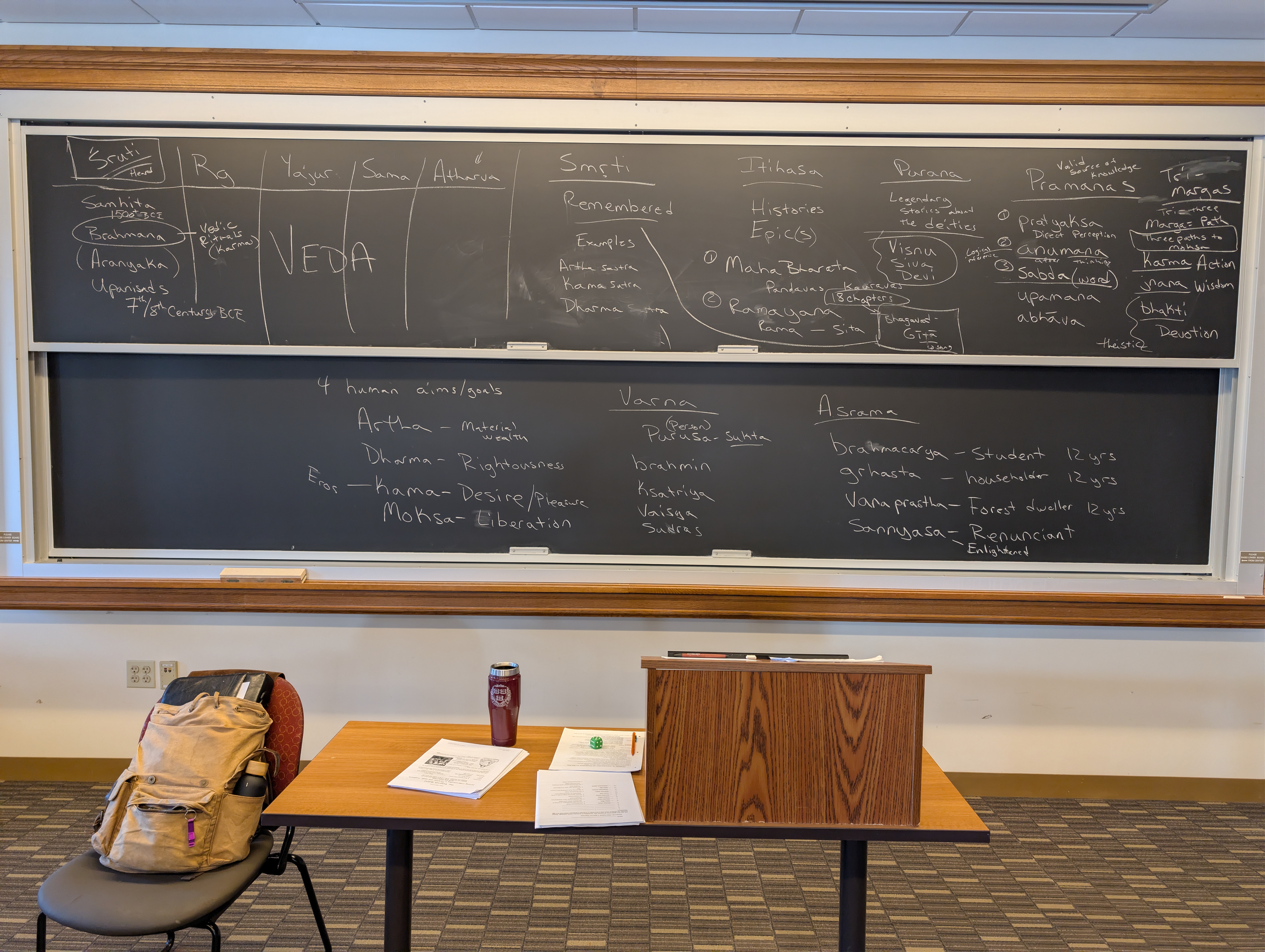
Chalkboard photo 1 from 01/20/2026

📄 Synopsis

This session provides a structural overview of Hindu theological frameworks, focusing on the categorization of sacred texts and the practical application of theology in daily life. The instructor, Brad Bannon, delineates the four human aims (purusharthas)—Artha, Dharma, Kama, and Moksha—emphasizing the necessity of balancing material pursuits with righteousness and ethical responsibility. The class explores the hierarchical authority of scriptures, distinguishing between Śruti (divine revelation 'heard' by rishis) and Smṛti (tradition 'remembered' and authored by humans). Bannon further details the internal structure of the Veda, including the chronological layers from the ancient Samhitas to the philosophical Upanishads. The lecture introduces the concept of the Tri-Mārga (three paths) to liberation, specifically focusing on the path of action (karma) as the performance of Vedic rituals. Throughout the discussion, Bannon distinguishes the astika traditions that accept Vedic authority from nastika traditions like Buddhism and Jainism.

Key Takeaways

  • The four human aims—Artha, Dharma, Kama, and Moksha—must be pursued in a balanced manner, with Dharma acting as a check on material wealth.
  • Śruti refers to the most authoritative category of Hindu scripture, considered direct revelation heard by ancient sages known as rishis.
  • The Veda is structured into four chronological layers: Samhitas (hymns), Brahmanas (rituals), Aranyakas (forest reflections), and Upanishads (philosophical wisdom).
  • Astika traditions are those that affirm the authority of the Veda, while nastika traditions, such as Buddhism and Jainism, reject it.
  • The Tri-Mārga refers to three paths to liberation, with the path of action (karma) originally meaning the performance of Vedic rituals.
  • Karma in a theological context refers to 'action' or 'Vedic ritual' rather than popular Western misconceptions.
  • Smṛti texts, while sacred, have human authors and are less authoritative than the unauthored Śruti.
  • The four stages of life (ashramas) include the student stage, householder stage, forest dweller stage, and the renunciant stage (sannyasa).

🎤 Transcript Tap any timestamp to jump the audio player

Opening Transition and Breath Meditation

Brad
Let's take a moment and transition. Try to put all devices away and just clear your head.
Brad
Focus on your breath. Try to still your mind and bodies.
Brad
Let's take a breath together.
Brad
Go ahead and breathe in and out.
Brad
Word? Word.
1:19

Vocabulary Quiz and Administration

Brad
Um, great. So A little vocabulary quiz as promised.
Brad
Pretty straightforward.
Brad
No notes or anything, so just clear everything away. You know what, it's gonna be like a million actors.
Student
Hi. Oh, I am just joining this class, so I hope you want me to still take— Oh yeah, sure.
Brad
Okay, at least put your name on it. Sounds good. Um, one little adjustment, uh, for number 11. Um, brahmana is not wrong, but it's a better word would be Brahman.
Brad
Okay, looks like most folks are dying together.
Brad
30 seconds.
Brad
I still don't have a system for passing them in yet, so I'm going to come up with one, but let's just kind of go down the middle if everybody's done. Okay, so yeah, so that way we'll just go this way. Pass them to the end, put yours on Top. They'll be sort of kind of close to in order.
Brad
Everybody ready?
Brad
Pass them this way and then pass them forward, please.
Brad
As I said before, you know, one quiz grade isn't going to make or break you.
Brad
Sort of like the cumulative performance over the semester. And really, the quizzes are mostly to help you prepare for the midterm, right? So cover a lot of the same material there.
Brad
Thanks.
Brad
Alright, so let's do some more vocabulary today. I want to, I think the chapter is, it's written pretty, well, let's start with any questions.
Brad
Do you have any questions about about the chapter.
Brad
We can review those terms very quickly.
8:24

Review of the Four Human Aims (Purusharthas)

Brad
So the four human aims, the four purusharthas, anyone want to give them to us?
Brad
Not all at once?
Brad
Anybody want to give us one of them?
Student
Yeah, Arjuna.
Brad
Artha, so what is artha?
Brad
The pursuit of material wealth. I mean, it's a human aim, isn't it?
Brad
I mean, that's why you didn't come to Boston College, because you wanted to be poor or something, right?
Brad
So wealth, material wealth, material possession, it's a legitimate human aim, right? Got to be kept in check by the other ones.
Brad
It's not unregulated.
Brad
It's not you pursue any of these without attention to the others, but all four together, right? Little checks and balances, that kind of thing. So, four human aims, goals, pursuits, whatever.
Brad
So, artha, yeah, material wealth.
Brad
Next one?
Brad
Another one?
Brad
Yeah, in the back. Dharma is like righteousness, or like following the religious laws. So there again, right? I mean, they got to be balanced, right?
Brad
So you want to— I mean, pursuing material wealth, nothing wrong with that, right?
Brad
There's the Arthashastra, there's like a lot of scriptures that, you know, outline how to run a business, how to manage a business, how to build a business. All those sort of things. But you could build a business, you could pursue wealth by defrauding people, or taking advantage of people, or stealing.
Brad
But that would be adharmic.
Brad
So you got to kind of pursue both at the same time. So you want to pursue material wealth and possessions, but not at the expense of dharma or righteousness.
Brad
So being a good person, I think the easiest translation of this Well, the best translation is to not translate it at all. But righteousness is not wrong.
Brad
Ethics is not wrong.
Brad
Goodness is not wrong.
Brad
Right? So dharma is all of those things. We'll talk a lot about dharma this semester. But that's, you know, quick. Yeah, next one.
Student
kama.
Brad
kama, yep. Which is?
Student
Pursuing pleasure, desire, and love.
Brad
That's right. Yeah.
Brad
It is—
Brad
if you've studied any Western philosophy, particularly Socrates or Plato, Plato wrote a series of erotic dialogues.
Brad
And so the kama is almost directly—
Brad
I mean, it means almost exactly the same thing as eros. In Greek, right? So they're very, very, very similar. They have very similar deities. Eros is a person or a deity, shoots arrows and that kind of stuff, right? kama is also a deity, shoots arrows, and very similar, a lot of connections between the two.
Brad
But kama at the end of the day is just desire, right?
Brad
Pursuit of pleasure, pursuit of enjoyment, physical pleasure, including included amongst them, but desire, pleasure. And you've probably already aware that there's a sacred text within the Hindu tradition called the Kama Sutra, which is a bunch of sutras or texts about pursuit of physical pleasure, right? Primarily sex, but not not only exclusively sex.
Brad
Good. Last one. Yep.
Student
There's samskara, which is spiritual freedom.
Brad
Yep, moksha.
Brad
Moksha.
Brad
Moksha, spiritual freedom, is great. Freedom, or I usually just say liberation, but spiritual freedom, spiritual liberation is absolutely Absolutely part of that.
Brad
Good.
Brad
So again, you know, there are theologians that would rank them. Artha is sort of the lowest, kama above that, dharma above that, and then moksha is sort of the final end.
Brad
So within the Hindu traditions, within Hindu theologies, there's tons and tons and tons of diversity.
Brad
There's almost nothing you can say that would be true of every Hindu theologian.
Brad
That's, you know, not entirely untrue with Christian traditions as well, but even more so. Nevertheless, these four purusharthas, they're pretty universal, at least on the list.
Brad
Then what was next on the quiz?
13:37

The Four Varnas and Stages of Life (Ashramas)

Brad
Yeah, so I don't want to spend too much time on varna, ashrama, dharma, but there's the varnas, and we'll talk about these more, especially in a few weeks when we get to the Purusha Sukta.
Brad
So the Purusha Sukta, yeah, we'll come back to this, but the hymn of the person, sukta means hymn, hymn of the person, And the idea in that text is that in the beginning there was this one person, God, we could say, but before there was any sort of diversity, there was unity.
Brad
That one person, purusha, divided itself to become many, right?
Brad
Sort of like, yeah, divided itself or sacrificed itself, partitioned itself, unfolded itself. But it's the one unfolding or partitioning or dividing to become the many, right?
Brad
So, yeah, and those four divisions are, you know, the brahmin comes from the head, or the mouth more specifically, then the kshatriya from the arms and the shoulders, and the vaishya from the legs, and then the shudras from the feet.
Brad
And again, we'll talk about these four divisions, particularly when we get to the Purusha Sukta in a couple weeks, but I want you to know the terms at least.
Brad
For now.
Brad
And then the ashramas.
Brad
So ashramas are what? Yeah.
Brad
Oh, sorry, that wasn't a hand. No, really.
Brad
Yeah.
Student
They're the four sequential stages of life.
Brad
Yeah, so I mean, you know, anybody who lives to a—
Brad
anybody who's lucky enough to live to a ripe old age is probably going to go through some various forms of at least most of these stages.
Brad
There is one or two that you can skip, but you can't skip the first one.
Brad
So brahmacarya means what?
Brad
Yep.
Student
Student stage.
Brad
Student stage, yeah. So just being a student, kind of Kind of etymologically, it kind of almost means like following the teacher around, right?
Brad
So that's what students do, they kind of follow the teachers around. So brahmacharya, student stage, traditionally these are divided, your life is pretty much divided into 4. So if, you know, let's say, Usually it's 12.
Brad
So usually 12 years in the brahmacharya stage, and then 12 years in the grihastha stage, which is next. What does grihastha mean?
Brad
Yep, it's like the householder or family life. Yeah, it literally means householder, one who holds the house. So, but the essence of being a householder isn't whether or not you own a house. The essence of it is whether you have, you know, kids, right? Basically. So you're a father or a mother.
Brad
So that householder stage, it generally lasts around that long. And then we move into more of the retirement stages, if you will.
Brad
So the next stage is Varna means forest. So the forest dweller.
Brad
I mean, just for symmetry, they're usually kind of described as 12 years each, but You know, I don't know anybody that would live exactly what's 48 years and do 12 years. You know, it's not quite like that rigid, but as a rule of thumb.
Brad
And then, so the idea is once you've— once your parent—
Brad
once your kids have moved out of the house, once you're no longer sort of bound to parental duties, right, you've kind of maybe, maybe been replaced by your kids.
Brad
Your kids are kind of taking over or in the process of taking over the family business and that kind of stuff.
Brad
Then you move into more introspective stage, right?
Brad
So this is kind of another, this is kind of another student stage, but, but a much more advanced.
Brad
It's like grad school, honestly, kind of.
Brad
Right, which is where one retires into the forest and reflects on the scriptures.
Brad
So the brahmacharya stage involves you memorizing the entire veda. Grihastha entails you performing the rituals and doing the duties, you know, doing what the veda says, basically. Vanaprastha then is when you start to reflect on why did I do all of these things, right? What do these rituals mean?
Brad
What do these hymns mean?
Brad
What's the What's the point of all those things that I did, right?
Brad
So memorize the entire veda, do the veda, follow the instructions, then kind of reflect on what does all of that mean, right? Kind of come to some sort of understanding of the deeper, more philosophical, theological meaning and the point of the scriptures.
Brad
And then finally, last stage. Yep.
Brad
Sannyasa.
Brad
Yep, sannyasa.
Brad
And sannyasa typically the renunciant stage, and definitely not any particular number of years there, but after all of the other ones. Shankara, the theologian that I'll that I've brought up a few times and we'll keep coming back to later.
Brad
He emphasizes that you can jump to the sannyasa stage at any point.
Brad
At least traditionally, Shankara became a sannyasin, I mean, according to legend and tradition, when he was like 16 or 17, so pretty young.
Brad
But the idea is if you're a really, really good student, and you can kind of skip all these steps and go straight to the renunciant stage.
Brad
And he does emphasize that very frequently throughout his writings, like you can skip to that stage at any point, and that's the highest stage.
Brad
Sannyasin is you renounce everything.
Brad
You renounce all possessions. You renounce everything, including your own name. So you don't have any name, you don't have any connections, you just, you don't have any possessions, you don't have a house, you don't have anything, right? Sannyasin just lives, lives like the wind and just depends on the charity of others for food. So typically if you go to India, you'll see sannyasins, you know, all over the place. They will frequently wear saffron-colored robes, so orange or pink-colored robes, and they just live very, very simply, and that's kind of all they do, and they usually will have a bowl, and the bowl is not for money, the bowl is for food, and the idea is that not only should you give the sannyasin food, but you should give them food and then sit down with them and learn from them, right?
Brad
So sannyasins are total renunciant stage, but they're also The idea is that these are very, very wise people who understand the deeper meaning and point of the scriptures. They have a state of realization or enlightenment, right?
Brad
So they attain enlightenment, right?
Brad
So the idea is you study the scriptures, memorize the scriptures, practice the scriptures, do what they say, then reflect on that to try and get to the deeper meaning of it, and then once you get to the higher meaning of it, then you're a sannyasin, right?
Brad
And then you renounce everything.
Brad
Good.
Brad
Move on. Enough review.
Brad
Way too much review.
Brad
All right, so I want to try and cover a lot of ground in the time that we have left today. Actually, I want to review this.
Brad
This was not on the quiz today.
Brad
It will be on the quiz on Thursday. But wasn't on the quiz today because I did not cover it in the noon class, but I did cover it in here, so I'll just review it quickly. So this is the veda. The veda is a very large collection of sacred scriptures that were compiled over thousands of years, honestly, and written more or less over thousands of years. And chronologically, they more or less follow this order: samhitas are the oldest, brahmanas are a little less old, aranyakas are less old, and then upanishads are the most recent texts. The upanishads, just to give you a rough estimate, The oldest ones are sometime around 7th or 8th century BCE, and the samhitas are more in the neighborhood of 1500+ BCE. So, you know, 1500 or older, and then the rest of them somewhere in between, pretty much. Then, as I mentioned the other day, there are 4 different divisions of the veda, of the veda, and each one of these has these 4 divisions, right? So there's the Rigveda, which has each of these 4 divisions.
24:37

The Vedas and the Concept of Shruti (Heard Revelation)

Brad
There's the Yajurveda, which has each of these Samaveda, which has each of these.
Brad
Atharvaveda, which has each of these.
Brad
These are also— this is definitely the most newest, you know, and somewhat controversial.
Brad
There's definitely some orthodox Hindus that will reject the Atharvaveda and say that's not part of the veda.
Brad
There are no Hindus that I know of that reject the other three. But the idea is that— so there's a tremendous amount of overlap between especially these three.
Brad
Just popped in my head, I don't know if this is a—
Brad
this is probably a dangerous analogy to give you, but you could think about it a little bit like the synoptic gospels and then the Gospel of John, right? Like 3 that are very similar and then one that's just not very similar.
Brad
Other than that, don't make that comparison.
Brad
But so there's a lot of overlap between these 3, and the idea is that if you're sort of born into a family that knows the Rigveda, then it's your job as a brahman to memorize the entire Rigveda.
Brad
You don't necessarily memorize all of the recensions, you only memorize the one that your family is responsible for, right? And then other folks memorize those other ones, and then you get together and have conversations about them, right?
Brad
One term that I didn't give you the other day, that super important term, is shruti.
Brad
So we're gonna talk—
Brad
first of all, any questions about the veda, any of that, questions about any of that?
Brad
Anything? So there are at least 1, 2, 3, 4, so many 4s, right? At least 4 different kinds of texts, right? So, and those are the 4.
Brad
So just write that down.
Brad
So 4 kinds of texts.
Brad
Let's call them sacred texts.
Brad
And, you know, it's— yeah, so shruti is the most sacred.
Brad
Shruti is the most authoritative.
Brad
Shruti, the word shruti, shruti means literally that which is heard.
Brad
I mean, I guess most literally it just means heard, but that which is heard. So the idea is that the veda
Brad
so the veda is shruti, nothing else is shruti.
Brad
Veda is shruti. These these 16 parts of the text, that's shruti.
Brad
So if you are looking for, you know, I mean, it's a form of revelation, but different Hindu theologians describe this revelation in very different ways.
Brad
So All of the theologians we'll be talking about this semester are astika. So there's astika and nastika. Astika literally means says yes to the veda, and nastika means says no.
Brad
To the veda.
Brad
So they disagree basically on shruti, right? So the astika traditions say, yes, the shruti is revealed scripture, right? And that it's been heard by the rishis. So rishi literally means I mean, it's usually translated as seer, but I don't really like that.
Brad
I think maybe better would be perceiver, because seer has to do with your eyes. But here we're really talking about your ears, right?
Brad
Hearing requires—
Brad
so, but the idea is that they're directly perceived.
Brad
So these aren't people that were chosen by God or something.
Brad
To receive the revelation.
Brad
Um, like, uh, uh, if you've studied Islam, then, you know, Muhammad was chosen by God to receive the revelation, and then God directly recited it to Muhammad, and then Muhammad, you know, um, learned those, and eventually they were written down, right?
Brad
But that's a direct, direct revelation from God to Muhammad. On Mount Hidra.
Brad
And so that's what we mean by revelation in Islam.
Brad
But in Hinduism, it's a bit different. So in the astika traditions, some of these traditions are theistic, meaning, you know, there's a god, and many of them are atheistic, which are, you know, no god. So there can't be a real revelation from God to a person if there's no God to reveal that revelation, right? And yet those people who receive the revelation are still called seers or perceivers or rishis. So the idea is that they— one way to think about it is they're just so in tune, in sync with reality, with the natural world, with nature, with the people around them. Just, they're so in tune with reality, that they hear, they're able to be quiet enough and still enough and calm enough to hear the scriptures.
Brad
Does that make sense?
Brad
And so it's directly, it's direct revelation, and it's not from anybody to anybody, but that's the idea of shruti.
Brad
So that's why it's called shruti, that which is heard.
Brad
Heard by whom?
Brad
Heard by the rishis, who just heard it and then wrote it down, right?
Brad
And then the different texts have, you know, are attributed to this rishi or that rishi or whatever, but it's not the rishis so much that matter as what they heard and what was revealed to them. Another important part of why I take the time to explain that in detail is because if one is pursuing sannyasa, or this state of enlightenment, right, then the goal is not just to, you know, by memorizing the scriptures and studying the scriptures and reflecting on the scriptures and thinking about all of those things, you finally come to a moment of enlightenment where the light bulb goes off. And then the idea is that you're kind of like a rishi, right?
Brad
You can hear that for yourself, right? So you're not maybe hearing a new veda, but you're hearing the veda that others have heard before, right? So it's sort of like a confirmation, like, oh yeah, now I can hear what the rishis were talking about. Does that make sense?
Brad
So everything we're studying this semester and this class on the Hindu side of things are all astika traditions, and, but There are plenty of Indian traditions that are nastika as well, and the two most famous are Buddhism. I'm just going to put the Buddha and Jain, Mahavira. So Buddhism and Jainism both arise in pretty much the same time in ancient India.
Brad
Hard to put a specific date on it, but, you know, somewhere around that 7th century BCE range. And basically the Buddha, or Siddhartha Gautama, he was raised Hindu, raised in an astika tradition, and then when he became an adult, really studied the astika tradition studied with a sannyasin in the orchard grove, and he studied all of this stuff and then basically said, "Nah, it's not for me," right?
Brad
So that's kind of where nastika comes from, is from like saying no to the veda.
Brad
It's not that he disagreed with all of it. A lot of Buddhist teachings, a lot of Buddhist philosophy, is, you know, uses a lot of the same terms and language as— I mean, it's in Sanskrit mostly, uses a lot of the same terms and language as the astika tradition, but rejects the authority of the veda, right? It says, um, says no, it's not revealed scripture, is great, right? Good philosophy, good theology, worth reading maybe, but don't accept it just In fact, the Buddha said, "Don't believe any of the things that I say." Right?
Brad
So Buddha said, "Don't even trust my own words." My own words are, you know, meant to be like a guide, but put it to the test. Right? So think about it, and worth sort of food for thought, but no one's going to shove it down your throat kind of thing. Right? So it's like, it's a starting point for reflection.
Brad
Jain traditions, very similar, also come out of the astika traditions, but reject the authority of the Vedas, and pretty firmly non-dualist, revering all living creatures as equally part of the same being. And so one, you know, one creature in all different forms, right?
Brad
And then, so if that's the case, right, if we're all part of one being, then harming any instantiation of that being would be doing harm to oneself and also to the divine, right?
Brad
So no distinction between the divine and any other creature.
Brad
And then so, Janes, Jane monks and Jane nuns, I should just say, you know, very observant Janes will often carry a broom around with them and they'll sweep very carefully, sweep the ground in front of them so that they don't accidentally step on an insect or a bug, right? So very careful not to obviously wouldn't eat, take antibiotics or something like that either. And a lot of Jains will cover their mouths actually while they talk, wear a mask, so as to avoid accidentally breathing in a gnat or a bug or something. Not because they think it's gross, but because they don't want to accidentally cause harm, right? So ahimsa ahimsa, or no harm, is sort of the guiding principle of Jainism.
Brad
So anyway, that's pretty much all I'm going to say about the nastika traditions.
Brad
Everything else in this semester— there's actually a course at BC, right, Buddhist and Christian Thought and Dialogue.
Brad
So, you know, certainly feel free to take that course, but we're focusing more on the astika traditions in this course. Any questions about any of that, especially Buddhists or Jain?
Brad
Cool, right on.
Brad
So, 4 kinds of sacred texts, shruti. So, astika, are those that say yes to shruti, that's all we're talking about next. Then, but the shruti is not the only kind of sacred text.
Brad
I should mention, and so we're still in Unit 1 right now, Unit 1 is trying to give you some sort of basic introduction, a basic framework for focusing on the sacred texts, and then from Unit 2 forward, we're just going to be reading texts. And discussing texts, anchoring our discourse in the texts. Just trying to give you some background info on the text right now.
Brad
In Unit 2, we're basically going to— we aren't going to read an aranyaka exactly, but we'll have a class on 3 samhitas, a class on a particular story from the brahmanas, and then Then we'll look at the Katha Upanishad, and then in the next unit, Unit 3, we're going to read just—
Brad
we're going to read 4 upanishads, or excerpts from 4 upanishads, so kind of really hone in there.
Brad
And then in the second half of the semester, after spring break, we're going to focus on a smriti.
Brad
Um, good, you can erase this.
Brad
So I think for the quiz on Thursday, I'm just gonna cover all these things.
Brad
So astika says yes to the veda, nastika says no to the veda.
Brad
I won't ask about Buddhist or Jain. Shruti, that which is heard, revelation, rishi.
39:25

Smriti, Itihasa, and the Context of the Bhagavad-Gita

Brad
So now, smriti. The word smriti means remembered. So shruti means heard. So the idea is that the rishis, those very wise sages, way back when, were so in tune with the universe that they heard the shruti directly revealed to them, and then they recorded that.
Brad
Actually, it was passed down orally, 4 centuries before it started being written down. And when I say written down, it was written down on mostly on palm leaves. You take a palm leaf and you dry it out in the sun and it gets— it kind of breaks off into little pieces like that, and then, you know, you can write on it.
Brad
So anyway, that's the shruti. The smriti is like, okay, some things were revealed to certain sages, but then other folks, you know, added to it or reflected on it or tried to dissect it or tried to give meaning to it, that sort of thing.
Brad
So, smriti is not—
Brad
we've got levels of authority, right?
Brad
So, in terms of levels of authority, shruti way far more authoritative than any other text in the astika traditions, then these others pretty much in this order. Smriti is far less authoritative than shruti, and then itihasa and puranas are less authoritative than the smriti.
Brad
So smriti are remembered texts, as I said, or it means remembered, and these oftentimes they're Well, let me give you a couple, so just these examples. One would be the Arthashastra, just to give some examples that were mentioned in the chapter for today.
Brad
So the shastra just means like, it's like a book, you know, like written manual.
Brad
So the rules, the, you know, instructions, the textbook, textbook would be a fine translation of shastra, so the textbook about artha or wealth, right?
Brad
So there's lots of—
Brad
maybe some of you have heard of Ayurveda, so Ayurvedic medicine, so sort of Ayurvedic medicine is, you know, focusing on healing the body through natural herbs and natural, you you know, natural things, so sort of like a very, very ancient form of medicine. That would be another example of smriti. The Brahma Sutra, another example of smriti. The Dharma Shastras, So if we'll dive into this a little bit more when we get to the 3 hymns that we're going to study in Unit 2, but one of those hymns is on the Purusha Sukta that I just went over a few minutes ago, you know, that describes this person dividing into these four aspects of society. So that's from the shruti. But then there are—
Brad
so there's nothing in that about like, hey, you are a brahman because you were born into a brahman family, or you're kshatriya because you were born into, you know, you had kshatriya parents or something like that, right? Nothing like that in the Purusha Sukta. Nothing like that in the shruti.
Brad
So these rules about, oh, you're born into this regimen of society, you're born into this caste, you're born into this position in life, and there's nothing you can do about it, it's just a product of your birth, that does not come from the most authoritative scriptures, that comes from the dharmashastras.
Brad
Make sense?
Brad
So you could, I think it would be very appropriate If you're looking for comparison and you've done some Christian theology before, you could think of the shruti.
Brad
Well, the shruti has a direct correlation to like the scriptures, right? The Hebrew scriptures and the Greek scriptures, so the Gospels and letters of Paul, all that kind of stuff, right? Smriti would be more like Augustine or Aquinas or you know, conciliar, like Nicene Creed, right?
Brad
Those sort of things. So Nicene Creed is not something directly revealed, right? It's not— doesn't have the same level of authority as, say, the Ten Commandments, right?
Brad
But, you know, somebody like Aquinas's reflections on, or, you know, Augustine's commentaries on the scriptures, or Eckhart's Commentaries on the Scriptures, those sort of things.
Brad
Those would stand as corollary to smriti.
Brad
Does that make sense?
Brad
Any questions?
Brad
Anybody confused by that? Okay, cool.
Brad
Itihasa.
Brad
Itihasa, usually translated as histories, but histories is not It's not history in the way that we think of histories at all.
Brad
It's more like epics.
Brad
Epics would be—
Brad
in the itihasa category, there's mostly two that stand out.
Brad
One is the— Mahabharata, and the second is the Ramayana.
Brad
So these are very, very big epic stories. The corollary might be something like the Oh, I never actually thought about this before, but a Christian corollary might be something like Milton's Paradise Lost.
Brad
Yeah, actually, it'd be a pretty good one. Or Chaucer's Canterbury Tales or something like that, right?
Brad
So they're stories that are written. They're not revealed. They are not— yeah, they're definitely far from shruti. They don't really meet the standard of smriti. Either, but they're huge stories.
Brad
And the idea is that these are stories that you tell to your kids. These are stories that you study as a family and talk about.
Brad
They're entertaining. They're very entertaining. They're also extremely long.
Brad
So the, um, the Mahabharata itself is twice as long as Homer's Odyssey and Iliad combined.
Brad
So really, really long story, and the Ramayana is not nearly that long, but it's still quite long as well. The Ramayana is the story—
Student
whoops—
Brad
the story of Rama.
Brad
So Rama is an incarnation of God, incarnation of vishnu, and this is a—
Brad
Ramayana is a story about Rama and his wife Sita.
Brad
Long story short, Sita gets kidnapped by a demon, then Rama goes and rescues her, saves her, right?
Brad
I mean, a lot more to the story, but that's the gist.
Brad
We won't really be talking about the Ramayana this semester, but within the Mahabharata So the Mahabharata is a huge epic which we will be talking quite a bit about, especially in the second half of the semester.
Brad
And it's a story about two different families, the Kauravas and the Pandavas, two different clans basically.
Brad
They're cousins, so they're related to one another. But there's a lot of tension between the Kauravas and the Pandavas. And the Mahabharata is this, just so many stories that fit in this larger overarching narrative of this conflict between, you know, I mean, for at the risk of oversimplifying it, the good guys and the bad guys, right? And so there's the struggle between the good guys and the bad guys. It goes back and forth, things wax and wane, right? Sometimes the good guys are winning, a lot of times the bad guys are winning. And the Mahabharata is the story of righteousness and how to be a good person.
Brad
So obviously you've got sort of like exemplary characters in there, but also, you know, cautionary figures or people you don't want to be like.
Brad
And so that's the Mahabharata. And the Mahabharata, as I said, is enormous. But within the Mahabharata, there are 18 chapters.
Brad
So I don't even know how many chapters are in the Mahabharata, but let's—
Brad
I mean, hundreds, right?
Brad
So out of the hundreds of chapters, there are 18 chapters that's, you know, they're not at the beginning or the end. They're somewhere near the second half of the Mahabharata. Those 18 chapters are called the Bhagavad Gita.
Brad
Gita means the song, and Bhagavad means the Lord, so the song of the Lord, right?
Brad
So it's a poem written in meter, written in verse, and Importantly, it's 18 chapters within the huge context of the Mahabharata, right? So in the second half of the course, we're going to read these 18 chapters. We'll go through the text, so I'll say more about the Mahabharata then, but these 18 chapters have, over the past, you know, 1,000 years, 1200 years or so, have been elevated.
Brad
So now the entire Mahabharata is still in the itihasa category, but these 18 chapters have definitely become part of the smriti. So usually the Bhagavad Gita will be included in the smriti.
Brad
Some theologians may even advance them beyond that, but most astikas regard the Bhagavad Gita as smriti.
Brad
Make sense?
Brad
Questions?
Brad
I know this is a lot of just like boring sort of vocab, but good to have the context, right?
Brad
Lastly are the puranas.
Brad
So puranas are legendary stories about the deities.
Brad
These are way newer than the other ones, and they're very diverse, and typically they fall under Well, some of the most emphasized would be the puranas centered around Vishnu, those centered around Shiva, and those centered around devi. So Vishnu, so these are the three primary deities within sort of modern Hindu practice, modern contemporary.
Brad
We're not—
Brad
this is not a religion class.
Brad
I should emphasize that more than I probably do. This is a theology class, right?
Brad
And what is theology?
Brad
Not all at once.
Brad
Yeah?
Student
Philosophy anchored in sacred texts.
Brad
Yes, good.
Brad
Anchored in philosophical investigation of first principles, the who am I, Where am I?
Brad
Why am I here?
Brad
But the important part is anchored within a canon of sacred texts, right?
Brad
So that's, that's what we're doing in this course, right?
Brad
And so this whole Unit 1 is just to kind of give you some context so that we can properly anchor our discourse in those texts that we'll be looking at soon. I may give you— we may discuss some of these a little bit while we're doing the Gita. That would be my Making, designing a course like this is just always an exercise in like what to leave out, which is super, super frustrating, and so I didn't really want to leave out the Vishnu Puranas, the stories.
Brad
So the Vishnu Puranas are mostly stories about like Krishna. So Krishna is an incarnation of Vishnu. We'll come back to this a lot later.
Brad
But these are stories about these folks, right?
Brad
The Devi Mahatmya is part of the puranas.
Brad
It's a collection of stories about devi.
Brad
Devi is just the feminine form of God, right? So the goddess.
Brad
And so these are texts about, yeah, so the goddess like Durga and Gauri and all the feminine forms of Kali, etc.
Brad
We won't be studying those very much, unfortunately.
Brad
If this were a religion class, we would probably focus on these centrally even, right? But it's not.
Brad
So those are the 4 kinds of texts. So, the priority matters, right? Shruti, that which is heard, that's the most authoritative, most sacred, and those who say yes to the veda, right, accept the authority of the vedas, and they're called astikas, and if you don't, then that's nastika, right? Smriti are those somewhat less authoritative.
Brad
You can think of them as having human authors, right?
Brad
So, the veda is aparushaya, meaning it has no human—
Brad
it's not from human origin.
Brad
The rishis, as I said, the rishis—
Brad
it doesn't come from the rishis.
Brad
The rishis were just in tune enough and heard it, and then, you know, it got passed down.
Brad
But they didn't—
Brad
they're not the authors of the text, right? The text is unauthored. There's some exceptions to that view, but smriti, on the other hand, they have human authors.
Brad
Human authors can be fallible. Human authors are fallible, so just because a dharma shastra says something, if the dharma shastra says something that conflicts with the veda, then go with the veda, basically.
Brad
Likewise, itihasa, so one should interpret these stories, the ideas that these are exemplary characters, examples to follow. A lot of folks, you know, a lot of folks in society, they don't have time to be messing around with like memorizing the Vedas.
Brad
They don't have time or the luxury or the privilege to sit around studying all these things, right?
Brad
They just need to— they got to go do their job every day, right? But you still want those people who are just doing their job every day, you still want them to be good people.
Brad
So one of the ways you can do it is by telling moral stories, right?
Brad
And saying, okay, here's a character, and this character is good and this character is bad, be like the good one, right?
Brad
So emulate the good character in this story.
Brad
Be like the Pandavas, don't be like the Kauravas. Be like Rama, don't be like the demon, right?
Brad
That sort of thing.
Brad
So stories where the meaning, the moral story, the moral of the story is much easier for anybody to understand.
Brad
You don't need to know Sanskrit, you don't need to know any of those kind of things, right?
Brad
You can just sort of hear the story get the gist, and then be a good person. The puranas are geared mostly towards devotion, so, you know, you tell these stories about how awesome Krishna is, and then if people want to learn more about Krishna, worship Krishna, etc., right? Good. Move on.
Brad
All right, cool.
Brad
We are making really good time, so Next, I want to, in this sheet that I gave you, the handout I gave you last Thursday, we're kind of making our way through. I'm going to skip the 4 levels of awareness for now. We will focus on those when we get to the Mandukya Upanishad. Which is all about those 4. So next I'm going to focus on the tree Marga.
Brad
Where to put it? Yeah, if I can do tree Marga.
Brad
I can do tree Marga super fast.
58:22

The Tri-Marga: Three Paths to Liberation

Brad
So tree means 3.
Brad
And marga means path. So marga, path, and tree, three. So trimurti, the three paths. Traditionally, the three paths are kama, jnana, and bhakti.
Brad
First of all, the path leads to moksha, or enlightenment, right?
Brad
So it's the three paths, the three paths to moksha, or which you already know now is liberation, and liberation from what?
Brad
We can come back to that later, but liberation, right?
Brad
So three paths to liberation. You could say three paths to enlightenment.
Brad
But it's really two paths to liberation.
Brad
And different Hindus will think of liberation from what, and liberation to what, what does that liberation mean? They'll define those in wildly different ways, right? So, those sort of things that you may think are the most important, like liberation from what and liberation to what, super contested.
Brad
But all Hindu, all astika Hindus, all orthodox Hindus agree that there that these are three valid paths to liberation. And what path is right for—
Brad
which path is better? The answer to that really is it kind of depends on you, right?
Brad
So which path is more suited for you, right?
Brad
The path for Logan might be different than the path for Brad, right? And so part of your discernment, part of your spiritual education would be decide, you know, what path is right for you. And then walk that path.
Brad
You could think about it—
Brad
the other day I gave the example of different paths up a mountain.
Brad
If the top of the mountain is liberation, as I said, you can think of each one of these paths as leading up the mountain. You got to just pick that.
Brad
You got to figure out which path is right for you and then walk the path. They all kind of lead there, but again, you don't necessarily want to be jumping back and forth between them, because if you jump back and forth, then you're not going up the path, you're going around the mountain. So kama.
Brad
kama means action.
Brad
Not any of the things that JoJo Siwa says, right? But kama means action.
Brad
Could also translate it as work, but really action. So primarily, we'll talk a good bit about this over the course of the semester, but primarily, or I should say the first original meaning of the word is—
Brad
so the brahmanas describe the Vedic rituals, which are also called karmas.
Brad
This portion of the veda is called the kama kanda, meaning the—
Brad
kanda just means section, so the section of the veda that describes the karmas.
Brad
So when we say the path of kama, the original meaning— super important— original meaning is performance of the Vedic rituals. A couple of things about this: one is The Vedic rituals aren't open to just anybody, right?
Brad
The brahmanas actually describe who is eligible to perform these rituals, right?
Brad
So, and the thing is, like, if it describes someone and Tim kind of meets that description, then Tim is obligated to do it, right?
Brad
Expected, whether you know it or not, whether you read it or not, right? So So you better read it and find out if you're obligated, right?
Brad
If you're obligated and you don't do it, then you're failing in your obligation to meet that action.
Brad
But if it's not prescribed for you, then you're not supposed to do it, right?
Brad
So it's not for you.
Brad
Meaning, and yeah, typically women are not—
Brad
kama kanda is not open to women, at least in the in the most ancient form.
Brad
So it's only men, and only some men, that are even eligible to perform kama kanda.
Brad
Now, like I said, that's the most ancient version. The meaning of kama— kama always means action, but especially in the Bhagavad Gita, which kind of radically redefines kama—
Brad
well, it doesn't radically redefine it, it radically takes it seriously as action, meaning any action, right? So then every action can be a sacrificial action.
Brad
Every action can be part of the kama kanda. So we'll— anyway, for now, three paths to liberation.
Brad
First path is kama, or action, the path of action.
Brad
Yajna is the path. Yajna means wisdom.
Brad
Or knowledge, and that will be the path that will—
Brad
I mean, we'll be talking about all three of these.
Brad
So that primarily traditionally means reading the upanishads. So unlike the Vedic rituals, which only certain people can do, right?
Brad
It's even—
Brad
it says, okay, if you meet these qualifications, and you're expected to do it, and if not, then not.
Brad
Unlike that, the upanishads are just philosophy, right?
Brad
So it's a high bar, it means you have to know the language, and you have to be able to study it, and you have to have a good teacher, and you have to have all those kind of things, but it's not exclusive to men and women, it's not exclusive to this group or that group, right?
Brad
Anybody can learn the wisdom, and anybody can pursue path to liberation through wisdom.
Brad
But it's still a very high bar, right?
Brad
So like I said, you have to know Sanskrit, you have to know the scriptures, you have to know all those things.
Brad
So it's a high bar, but that's what we mean.
Brad
So liberation, the path to liberation through wisdom or philosophy, learning, that sort of thing.
Brad
Bhakti means devotion. This is the simplest path, this is the most radically open path, There's absolutely no restrictions on who can perform bhakti. Bhakti is just radically open to absolutely everybody. It doesn't matter how much money you have.
Brad
It doesn't matter how much education you have.
Brad
It doesn't matter.
Brad
Nothing matters, right?
Brad
The only thing that matters is that you're devoted to God.
Brad
And in fact, it doesn't even matter what form of God you're devoted to.
Brad
Just matters how deep your devotion is and how sincere your devotion is, right?
Brad
So, the Bhagavad Gita, which we'll read, talks about all 3 of these, and it emphasizes throughout the scripture, throughout the Gita, that all 3 of these are valid, and you just got to figure out which one is the path for you. You could pursue more than one at the same time, but you don't want to be jumping between them, like I said. But mostly it's about figuring out which path is right for you, and then being devoted to that path.
Student
Right?
Brad
If it's the path of action, great. If it's the path of wisdom, great.
Brad
It's a path of devotion, great.
Brad
And the Gita says, um, you don't have to have anything, you don't have to have any special knowledge or anything, uh, to pursue devotion.
Brad
Um, all you need to bring is a gift, um, you know, as a gift to God. But that gift could literally be water, right? You can like grab up some water from the pool and then give it to— or a leaf, right, so it's a leaf or water is fine, it's not the gift that matters as much as the devotion, right, the attitude in which we give the gift, so being devoted to God.
Brad
So I guess that's another important distinction between the three paths is kama and jnana, you can pursue those in an atheistic or a non-theistic, right, you don't need God in order to perform action, you don't need God in order to understand wisdom, but you do need God in order to be devoted to God, right? So the path of devotion or bhakti is theistic because you have to be devoted to God.
Student
Yeah, good.
Brad
We'll kind of qualify that a little bit, put an asterisk by that when we get to the shad-darshana, which will either be Thursday or Tuesday. Good?
Brad
Any questions?
Brad
Okay, last thing for today then, the pramanas. So pramana means valid source of knowledge.
1:08:33

The Pramanas: Valid Sources of Knowledge

Brad
Literally, so I kind of wrote my dissertation on, or part of my dissertation on this word.
Brad
Mana.
Brad
Mana means mind, but it also comes from the root word which means to measure. So pramana, so it's like valid measurements or valid ways of measuring, valid ways of knowing the world.
Brad
Basically, to tie back from my lecture on day 1, right, which was on epistemology, how do we know what we know, right?
Brad
I went all through that whole thing with the playing dye and lights and bouncing off of it, right?
Brad
So really thinking scientifically about how do we know what we know. So the pramanas are these valid sources of knowledge, and the different astika schools enumerate these differently. Some of them accept some of them as valid, and some of them reject other ones. All of the astika schools accept the first 3.
Brad
So, and the order here matters a lot, and the order is always the same for the first 3, not so much for the other ones.
Brad
So let's go through these very quickly. I will certainly come back to these numerous times throughout the semester, but pratyaksha. So pratyaksha—
Brad
aksha means I, Prati means like in front of, right?
Brad
So pratyaksha literally means that which is in front of your eyes, right? So it's usually translated as direct perception. And since we're in 2026, I have to emphasize that direct perception does not mean I'm looking at this thing on the screen, right?
Brad
That's not direct perception.
Brad
So direct perception of this mug means there's nothing. It's immediate. Immediate means there's nothing in between, right?
Brad
Mediate, like medium, in between. So immediate means there's nothing in between. So there's nothing in between my eyes and this thing, right? So the direct perception of the thing itself.
Brad
So the thing itself is there.
Brad
There's nothing, right?
Brad
It doesn't have to just be visual perception.
Brad
Even though the name, the word literally means in front of your eyes, but also could mean direct hearing, right, or direct smelling, or direct feeling, or tasting, right?
Brad
So the idea is you have a direct experience, direct perception of this thing. And now, is direct perception 100% always Correct. Can you give an example of a case where it's not?
Brad
Like the die case, where we have an idea of what's in the back, but we don't really know because we're looking at it from one perspective.
Brad
Okay, so good example.
Brad
So in the case of the die, right, you can only see one side.
Brad
So you can have direct perception of this side, but so then you don't have direct perception of what's on the other side.
Student
Right?
Brad
But it's not quite— it's not quite—
Brad
so you do have direct perception of what's facing you, though. Right? So pratyaksha means, okay, I can see it and there's nothing in between me and the die. Right? But in this case, you can see. So what do you see? Okay, and that's correct. Right? Can you imagine a situation where you looked and Your eyes deceived you, where you see something different than what's actually there.
Brad
Yeah?
Brad
For sure, absolutely.
Brad
So when you're— in fact, we skipped over the four states of awareness.
Brad
We'll come back to those later, right? But one of them is dream state, and the idea is that when you're dreaming, you're seeing something, right? The phenomena is there in your head, but that phenomena doesn't correspond to something outside in the real world, right?
Brad
So they would say, well, that's not pratyaksha, but you don't really know that it's not pratyaksha until you wake up, right? So that can be deceiving, right?
Brad
It feels like direct perception. Another example might be if you're very tired, right? Then sometimes you hallucinate things, right?
Brad
You can hallucinate things for all sorts of reasons, right?
Brad
Tired only being one of the least fun versions. Right, so pratyaksha. But as far as, you know, your eyes don't deceive you very often, right?
Brad
So most of the time directly perceiving something gives you a high level of confidence that, okay, I saw it for myself.
Brad
It doesn't matter if bro's telling me, you know, trying to, you know, gaslight me or something.
Brad
I saw it, right? Saw it with my own eyes.
Brad
I heard it with my own ears. I touched it with my own hands. That's direct perception. Perception.
Brad
It's pretty reliable.
Brad
Second to that is anumana.
Brad
Anu means after and mana means thinking, so literally anumana is thinking after, but this would normally be translated as logic or inference, logical deduction, logical inference. So yeah, logical inference would be a fine answer on the quiz. And so here, the example of the playing die is perfect, right?
Brad
So then based on what you know, right, you're seeing 3 dots, then based on what you know, can you infer what's on the other side?
Brad
So what would you infer? 4, right?
Brad
So, and then you can look and confirm, right?
Brad
So now you can see with direct perception that your inference was correct, but it might not be, right?
Brad
Sometimes the example that's usually given is like there's smoke on the hill, right?
Brad
So you seeing smoke, that's direct perception. I have direct perception of the smoke, that's pratyaksha. Then I can infer the presence of fire, right?
Brad
So then Whether or not there is fire, you know, I can be less confident about that because maybe it's not actual smoke.
Brad
Maybe it's just a cloud or fog or water vapor or something like that, right? Or whatever I smoked this morning, that kind of thing.
Brad
So that's anumana or inference.
Brad
And then lastly, we'll end on this, shabda.
Brad
Shabda means word, and the word that's meant here really is shruti. So shaivda and shruti are in this case synonymous, and so it's not that the shaivda or the shruti is less reliable than the others.
Brad
It is fully reliable, but the point is that when you're reading the word, you can misinterpret it.
Brad
Right?
Brad
So it's not so much that the word is fallible as your interpretation of the word is, you know, fallible. Word?
Brad
Cool.
Brad
Have a good couple of days. See you on Thursday.