 ```html
Class Session: March 11
This class session began with administrative details, including reminders about student meetings, the upcoming no-screen policy (requiring printed texts starting Thursday), and the structure for the first all-class discussion leader day. Brad then transitioned into a review and synthesis of key concepts covered so far, emphasizing the distinction between theology (as faith seeking understanding anchored in a canon) and the general study of religion. They revisited the six orthodox Hindu traditions, focusing on Mimamsa (ritual exegesis) and Vedanta (Upanishadic philosophy). The core concepts of Advaita (non-duality) and Vishishtadvaita (qualified non-duality with God) were explored using various metaphors (coin, team/players) and linked to different understandings of causality (material, efficient, final), incorporating Kumārila Bhaṭṭa's concept of *Abhava Pramāṇa*. The second half of the class introduced the two primary texts for the remainder of the semester: the *Bhagavad Gītā* and the Gospel of John. Brad provided context for the *Gītā* within the *Mahābhārata*, outlining the conflict between the Pāṇḍavas and Kauravas, Arjuna's central dilemma, and Kṛṣṇa's role. They also discussed the likely authorship, historical context (late 1st century CE), philosophical style, and key characteristics of the Gospel of John.
Brad: Let's get started, please. Please put away all screens. And let's just be, let's just be for a moment.
[Silence with occasional background noise and a ringing sound]
Brad: Let's take one breath together. Go ahead and breathe in. And let it all out. Feel free to grab some Play-Doh. Always, anytime.
Brad: So, let's see. March 11th. Jorge?
Student 1: Yep. Yeah.
Brad: Okay. Let's stay focused, please. Luca?
Student 1: I don't see Luca.
Brad: Mary? Cameron? Guys, can we come to order, please? Cameron? Oh, hey. Okay. March 11th, we're missing Luca and Camilla. Cool. Tons, tons and tons to do today. When I was a doctoral student at Harvard, I always used to get annoyed. All these professors would come in with like these armloads of books and like pile them on the table. Well, you know, like this pretentious like asshole like, yeah, we know that you like read a bunch of shit and learned a bunch of stuff. Like, what's the point of doing all that, you know? So, I brought a bag to carry them all. So I didn't want to be, you know, like that. Everybody ready? Good? So, let's, couple of business things. One is, there's a few folks that haven't met with me yet for the initial meeting. Most folks have, but a few folks that haven't. So if you haven't, then the chance for full credit is gone, but you could still get like four out of five points. So, if you do it, you know, soon. So go ahead and schedule a meeting with me. I have office hours immediately after class today. And then there's also time on Fridays online. So if you haven't done that, do that. That's one thing. No screens in class. Today you can have tablets for notes, because that's what I've been saying. But starting Thursday, no screens at all. So, starting Thursday, I'd like everybody to have a printed copy of the text. You could either have, you know, you could if you purchased one of the copies that I mentioned, great. You can bring that. This is the Barbara Stoler Miller one. So this is the one I gave you as a Google Doc. You can either print that out and bring that, or if you have a printed copy, whatever you have is fine. Does not have to be the same translation. And then for the gospel, you know, if you've got a Bible, then you can bring that, whatever, or you can print it out. Whatever. But I'd like to have no screens, so just like printed copies in class and taking notes that way. Yeah, Jolie?
Student 2: If you already know us, can we still talk to you?
Brad: Yeah. Other?
Student 3: I was just going to say, are notes okay or do you want the printed text? Like do we have to bring any text or can we just bring our notes?
Brad: Yeah, I think it'd be good to have the printed text. Yeah. That way if somebody else says, hey, I want to talk about, you know, chapter 4 verse 18, then you can like turn to it. And I think it would be helpful to bring, if not both texts to class, at least the full text for, you know, like the full text of John or the full text of the Gita. I don't think you really, I don't think we'll need both of them on the same days, but yeah. So, starting Thursday, please have the text with you.
Brad: Also starting Thursday, this Thursday, we'll start the discussion leader assignment. So that's 10% of your grade, okay, for the discussion leader. And everybody will have really everybody will have three discussion leader days. So there's the two that you're assigned, and then this Thursday is discussion leader day for everybody. So when I say everybody, that means that I'd like everybody to come to class ready to contribute to the conversation. It does not mean that, you know, anybody's going to get a chance to like take the floor over for a long period of time, right? Because we got 32 people in the room. So if everybody, if 32 people are leading discussion, that's a short period of time, you know, just like a verse or something like, or you know, just I want everybody to come prepared. Those of you that had me before, I think you've experienced this once or twice, but sometimes I will come to class, including this Thursday, I'm going to do it, where I'm going to try not to say anything at all the entire 75 minutes. So that's my goal is to come in. Let's sit in a circle. It should already be set up that way when you get here. And we'll sit in a circle and other than maybe the meditation or starting things off, I'm just going to be, you know, zipped up. Good? Not every, not every class, but I'm going to try that for Thursday. And I'll just kind of take notes on, you know, what folks say. Good? Any questions? Cool. I haven't listened to podcast 3 for this class yet. That's my drive home and drive in. But yeah.
Brad: So, I want to start with a bit of a review, context review. Kind of, it's a little bit more than a review. It's a review, hoping hoping to kind of pull these strings together. Sometimes my pedagogy can feel a bit hap- hazard, like haphazard, like, you know, shotgun approach or whatever. But there's a method to the madness of trying to help you to see how these strands fit together, a bit more today. And then, that'll take probably half the class, and then we'll move into a quick introduction to the *Bhagavad Gītā* and the Gospel of John. So, yeah, that's the plan. So, review. This semester, I mean, I would love it, love it, love it if for the rest of the semester, all of you just excise the word religion from your vocabulary, particularly in this class and in your podcast. So, love to just not even hear that word anymore. This is not a religion class. I do teach a religion class, but this isn't it. So we aren't studying Hinduism or Christianity or religion, right? We're studying theology. Theology is a philosophical investigation of first principles anchored in a canon of texts, right? Or faith seeking understanding is another way of saying it. Within the Hindu traditions, there's six orthodox Hindu perspectives on six six forms of orthodox Hindu theology, meaning, by orthodox Hindu theology, I mean folks for whom the *Veda* is sacred revealed scripture, right? So that's the canon of texts in which everything is anchored. But, like an anchor, right? You can have an anchor that leads to lots of different perspectives, right? So that just because the text is at the center doesn't mean everybody sees the same the the canon of text in the same way.
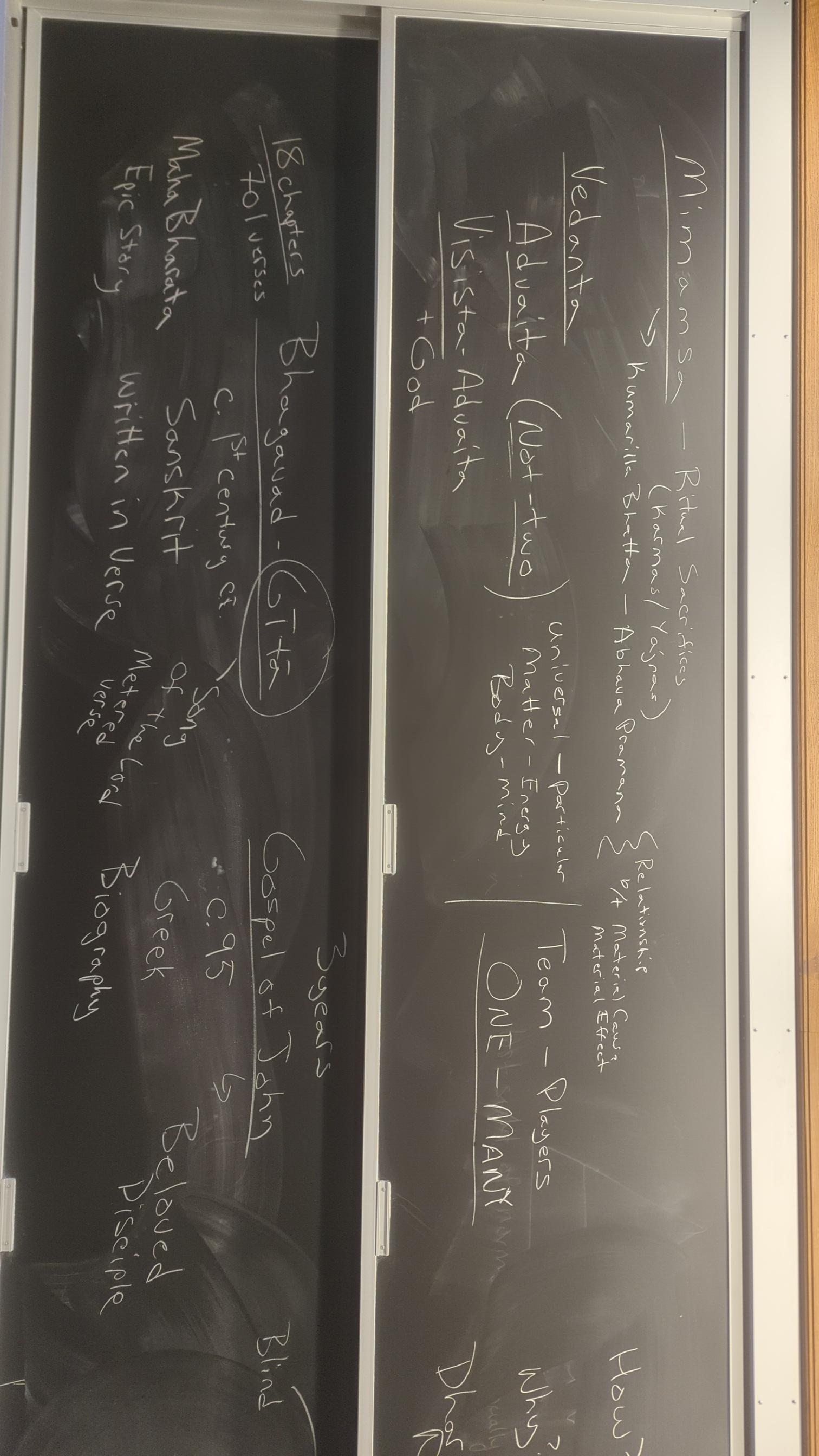
Brad: So, we're looking at these orthodox Hindu traditions, meaning that they anchor their theological discourse in the *Vedas*. And it's we're not looking even at all six. We're really just looking primarily at one, meaning *Vedanta*, with a little bit of *Mimamsa*, mostly for the sake of understanding *Vedanta*. And then a little bit later in the course, we'll as we're reading the *Gītā*, we'll do a little bit of yoga too. We've done a little bit of some other ones, but those mostly we're focusing on *Vedanta*. So, within with that context in mind, right? So we're narrowing, right? So we've got these six orthodox Hindu perspectives. One of the six is *Mimamsa*. And within *Mimamsa*, I've only emphasized a handful of things. One is that *Mimamsa* is a school of exegesis that focuses on reading the scriptures, primarily for the purpose of understanding ritual sacrifices, right? What is to be done. So it's something that is to be brought into being, namely the *karmas* or the *yajñas*, they're both words that mean the same thing, meaning the ritual sacrifices, which are described in the Brahmanas. And then *Vedanta*, which is a sister school of *Mimamsa*, which occupies most of our attention. *Vedanta* means the end of the *Veda*, meaning the *Upanishads*. And so *Vedanta* basically takes the exegetical hermeneutic rules that the Mimamsakas are so good at and applies them to the end of the *Veda*, meaning the *Upanishads*, right? Which we've read.
Brad: Within *Vedanta*, there are two primary schools of thought, two primary theological schools. One of them is *Advaita*. And *Advaita* means not two. And in order to understand what the hell that means, you've got to understand, so what is being denied duality, right? So what are the two things that we're saying are not two? One example we gave was the coin, right? Top and the bottom are not the same, but they're also not two different things. They're two aspects, two ontic distinctions of one ontological coin. Probably better though would be universal and particular, right? So we could have the universal meaning, I don't know, *Brahman*, right? So *Brahman* is ultimate reality, the one thing, but then Matt is a particular manifestation of that universal, right? And so to say that Matt is *Brahman* isn't to say that only part of Matt is *Brahman* or there's *Brahman* inside of Matt, but everything about Matt is *Brahman*, right? Every detail. So the particular is the universal, the universal is the particular, they are not the same, but they're also not two different things, right? Another pairing, another duality would be matter and energy, body and mind, right? Again, body and mind are not the same thing, but without my mind, my body is dead, right? And without my body, my mind is non-existent, right? So, they're not the same thing, but you can't have one without the other. What I want to give you now is two other quick metaphors, I guess. There's also another metaphor I gave you was Roy? Right? No. You know Roy at Blitzen Chips, right? The game that Morty got stuck in, they reboot it and then he fractured his consciousness into, you know, six billion different Mortys or whatever. Right? So the one and the many. So that was one metaphor. Another one, might be the team and the players, right? So let's say, if you're on a team, right? Luca, you play sports? Yeah. What what sport you play? Soccer, basketball. Okay, soccer, basketball. So if you're playing soccer, basketball, then slash slash soccer slash basketball. Oh, two different. Oh. I know. I was soccer basketball sounds more fun. But so if you're if you're playing soccer basketball, you have like a certain number of players, right? But that doesn't mean that they're all working together, right? Some of them might be playing soccer and some of them might be playing basketball. And then there's only Luca who's playing soccer basketball. Right? When my daughter, when Lila was like nine, I mean she was on a soccer team for like, you know, for years, till a couple years ago. And, you know, I remember when she was like nine going to a game. I think I was like teaching *Advaita* at the time. And watching, you know, her and her teammates on the field and they were like 11 players, nine player, whatever on her team. And they looked like a team, right? They all had uniforms, like the same uniforms. They were all facing the same direction most of the time. And they looked like they were a team, but they were playing like they were nine individuals, you know what I mean? So, if you see a nine-year-old on a soccer field, usually they're only thinking one thing and that is kick the ball. They aren't thinking like kick the ball that way or does my teammate have the ball currently, right? They're just like ball kick. That's it, right? And so usually they're just like, you know what I mean? You've seen people play like that, right? Or like or like any team that LeBron's on, right? It's just like, whatever, the people are just going for the ball, they want to pat their stats, they want to, you know what I mean? So like playing as a player, playing as a many, not playing as one. So not functioning as one. But there've times where you see a team come together, right? Where you just look and they're all just like they're functioning as one, right? They're feeling as one. Have you ever been on a team where that happened? Where you just like you kind of dissolve like you're rowing team and it's like we're not individual rowers, but we're just like all functioning as one, right? So, the one and the many in that case isn't necessarily, I mean it is ontological, but it's more functional, right? So the many, so the one team is the many functioning in a particular way, right? So there's an ethical aspect to *Advaita* in that sense, right? So if one thinks of oneself as a member of a team and then acts accordingly, they're likely to make different ethical decisions than if they think, I'm on my own, I'm an independent economic agent or something like that, right? Does that make sense? So the many players, don't necessarily make one team, one team is something functional or ethical, right?
Brad: So that's another version of the one and the many, or *Advaita*. *Vishishtadvaita* is the same thing, but we've got God in there, right? And as I've said a few times this semester, what I really want is starting on Tuesday when we start start with the *Bhagavad Gītā*. And maybe not next Tuesday, but the one after it. Certainly soon. You know, I'd really like the discussion leaders to pick a verse, whatever verse you're going to lead discussion on and what would be super great is for you to give it two different interpretations, right? One interpret one verse from *Advaita*'s perspective and then interpret the same verse from *Vishishtadvaita*'s perspective, right? So one with God and one without God. But what does that mean? Let me clarify what that means now.
Brad: Okay, so I skipped over *Kumārila Bhaṭṭa*. This would be a good time to bring him in. So when we talked about *Kumārila Bhaṭṭa*, who's a one of *Mimamsa*, *Mimamsa* adherence. We talked mostly about *Abhava Pramāṇa*, right? So *Pramāṇa* is a valid source of knowledge and different and there's different sources of knowledge and those different sources of knowledge leads to different kinds of knowledge, right? There are different ways of knowing and different things that can be known. And so *Abhava Pramāṇa*, *Abhava* means non-being. And so this way of knowing, this means of knowledge yields a different kind of knowing than say direct perception, right? Direct perception, you just see it and it's there. Whereas *Abhava Pramāṇa* is reveals something about the relationship between cause and effect, right? But not all cause and effect, but primarily material cause and material effect. And the example that *Kumārila Bhaṭṭa* used was yogurt and milk, right? So milk only becomes the cause of yogurt at the very moment that the milk ceases to exist, right? So that's the *abhava* part, non-existence. So that's milk becomes the material cause at the moment that the at the moment it is the effect, right? So that's the presence, the existence of the effect, naming the namely the the curd, is what tells you that the milk is the cause and only becomes that cause at the moment it ceases to exist. Now, earlier, we talked about the various forms of causality, mostly when we were talking about *Chandogya Upaniṣad* chapter 6, right? which was about the the clay, when Uddalaka gives, you know, clay to his son. He's like, if you understand clay, then you understand everything that's made of clay and everything that comes from clay and that everything is clay, right? So if you understand the the matter itself, then you understand every name and form that comes from that. And then he says, you know, *Tat Tvam Asi*, you are that, meaning you are the you are the clay, right? You're just you're just the clay. Don't think of yourself as all that.
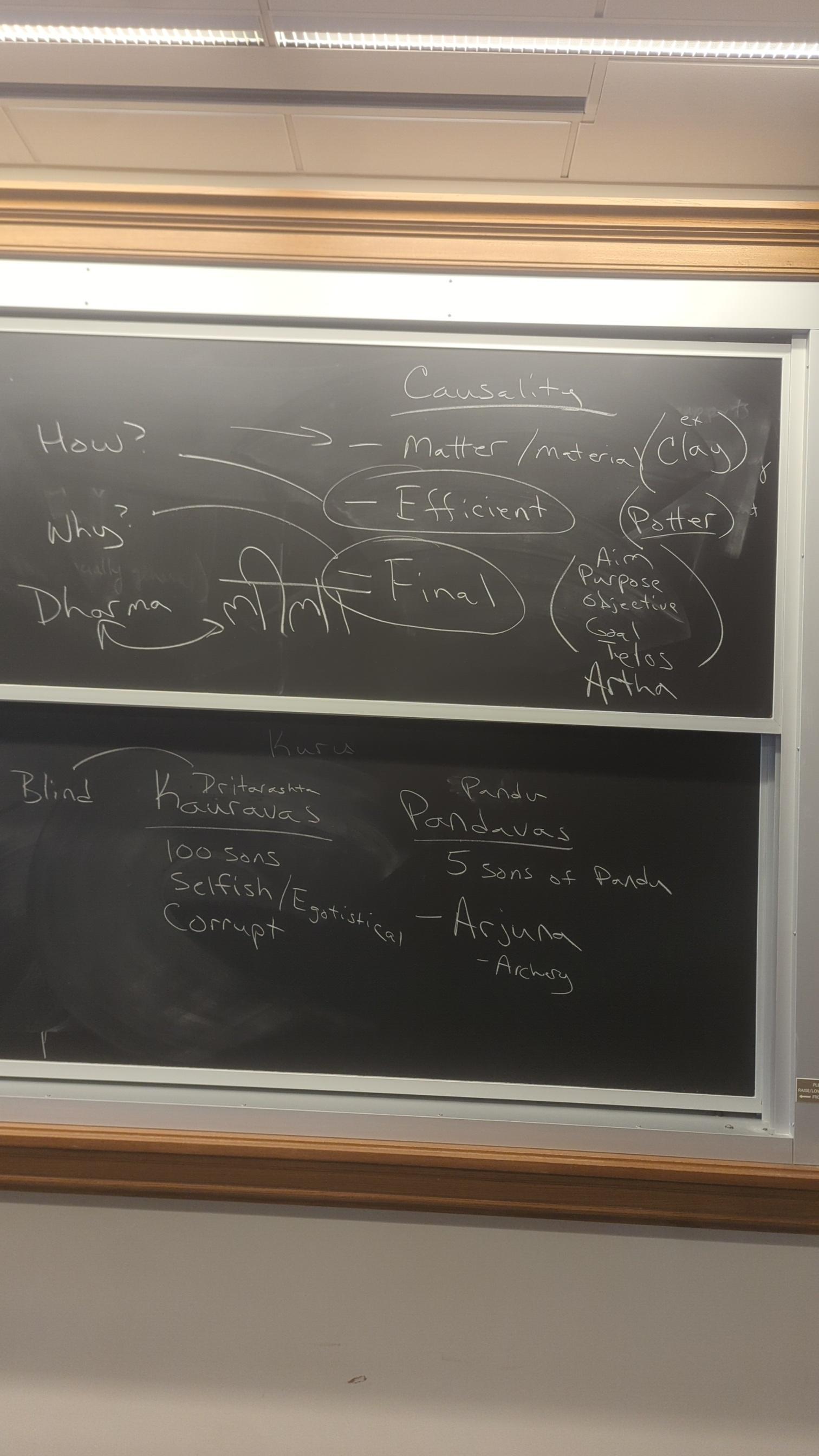
Brad: Then as I mentioned, there's three different kinds of causality, right? So material cause, such as the clay in that example. And so in order to have, let's say, right, I start with a lump of clay and then I can form it into some bowl or something. In order for the bowl to come into being, the lump has to stop existing, right? Or if I turn this bowl into a cup or something, right? Then the one material cause only becomes the cause of the effect at the moment that it ceases to be, right? So we've got that. But then the question is, that's not the only aspect of causality, right? Things don't just change on their own, things are changed by other things. So that's the efficient cause, right? So, in order for the clay to take the form of a pot, there needs to be a potter, right? So, in terms of so basically this gives us the the what, right? The stuff. And this gives us the how, right? So, how did *Brahman* become Gil? From *Vishishtadvaita*, the answer is God is the potter, right? So then God shaped Gil into this form. Why did God shape Gil into this form? This form that we call Gil, right? So you've got the form of Gil and you've got the name Gil. The answer, well, might be *Līlā*, right? Because a universe in which Gil is with us is more fun than Gil agrees with that, right? For sure. So it's just more fun to have a Gil than to not have a Gil, right? So, then that's why *Brahman* became Gil and the how is because, you know, God shaped *Brahman* into Gil. Cool? Does that make sense? Yeah.
Student 4: What would the efficient or yeah, the efficient cause be for *Advaita Vedanta*?
Brad: That was my next question. What do you? Yeah, anybody have an a guess or an answer to that? So then we've got we've got to do the same thing, but this time without the easy answer of God, right? So, how does so, yeah, anybody have an a guess or an answer? Yeah, what?
Student 5: Can you repeat the question?
Brad: So in for *Vishishtadvaita*, right? So non-dualism plus God, the answer is why did *Brahman* become Olot? And the answer is because God shaped *Brahman* into Olot, right? But then how do we get there for *Advaita* if there's not a God there to shape Olot? Everybody got the question? Yeah.
Student 4: Isn't it sort of back to like the coin analogy where we just kind of we always were both *Brahman* and everything and individual at the same time. It's like two sides of the same.
Brad: I think you're on the right track, yeah. So, well, let me point out one thing is that, I'll just use myself in this case, right? So if I say why or yeah, how did *Brahman* become Brad, right? If I can't just appeal to God as the molder or the shaper of me. Two things. One is that I'm not done yet, right? I'm still in process, I'm still in formation, right? To be is to be in a state of change, right? So as long as I am, then I am changing, I am forming myself, I am shaping myself. So then who is it that is forming me or shaping me? Who is the efficient cause of Brad? And the answer to that, I think, has to be both Brad and the world around me, right? So like I have a lot in I have a lot of say in my own formation, right? You have a lot of say in your own formation, right? You educate yourself, you shape your own brain, you shape your own bodies, you shape your own, you shape yourself, right? You create yourself, you recreate yourself, right? But it's not all up to you, isn't is it? Sometimes we might, I mean, a lot of times might wish it were, but the world around us has something to say about who we can become, right? Yeah.
Student 4: This might be a little bit too materialistic, but would physics also be sort of?
Brad: Yeah, I think that's not too materialistic. Yeah, I think the forces of existence are a big part. So I can't fly, I can't I could try to make myself into somebody who flies, but I can't, right? It's not so that's a limitation on on who I want to become or who I can become that's imposed on me on the basic laws of physics. I think that's very appropriate to point out. But also my parents, also my teachers, also the books that I read, the things that I read, also the my friends and family and the people around me shape me, right? So, on the one hand, I shape myself, right? But on the other hand, the selves around me shape me, right? So from *Advaita*'s perspective, there is only one self and that self is the self that's speaking right now, right? The self that's moving my body and moving the clay around, that's manipulating the world, shaping myself and the world around me. But Molly is also that self and Molly also shapes me and the world around Molly. Yeah.
Student 6: So you like explain that there was like you and others around you. But then how do they explain like like how genetics like shape you?
Brad: So genetics would be, I think genetics would fit in very well here, right? So then my my parents had a lot to do with that, right? And that I have virtually, I mean, I have no control over my genetics, right? So that's, so to say that I shape myself doesn't mean that I have absolute total control over shaping myself, right? I have some say in it, but also the world around me does, right? So self and not self or self like lower case letter self, right? My individual self and the world that's that I perceive as not myself, both of them have a big impact on who I who I am, right? And genetics is definitely a part of that. Yeah. Good? Look like you have a question? No?
Student 5: I'm a little bit confused with *Advaita* and then *Advaita* plus God. So there's no God in just *Advaita*?
Brad: Right.
Student 5: Okay. But we're all sort of God because *Brahman*?
Brad: Right.
Student 5: Okay.
Brad: So, so, I mean, we're all sort of God, meaning we have to change how we think about what that word means, right? So what does that?
Student 5: We're all sort of divine?
Brad: Divine works much better. Yeah. So we're all divine, meaning, Okay, so let's put it this way, right? On the one hand, you could have, let's take God as the potter, right? So if God is the potter, then when I shape the clay, the clay really has no say in how it's shaped, right? So from that perspective, if I say, I have no say in how God shapes me, then I mean, all of a sudden everything becomes fu- futile, right? Everything is pointless. So nobody really wants that. Better would be to say, okay, God has a role to play in shaping me, and maybe my role in that is to like have as little role as possible, right? So allow myself to be shaped by God, right? So then yielding my own volition to God's will. God make me a vessel for your will, that sort of thing. So then yield, so that's from an ethical perspective, I have power of self-determination, but I want to yield that to God so that God will form me or shape me into, you know, who I am. From *Advaita*'s perspective though, power is power, right? So I either have the power to shape myself or I yield that power to the world to shape me, right? But if, if the goal is play and flourishing, then I want to take action that will not only yield play, flourishing, fun for me, but also for the whole team, meaning the universe, right? Everything around me.
Brad: Let's take, let's take one example that we've seen of, did I show the video of *Kṛṣṇa* dancing on the head of the snake? I meant to. I showed it in the other class. I didn't show it in here. But I was in Johnston Largent. Did she talk about the snake dancing on the head of the snake? I'm seeing nos. So there's this story from the Bhagavata Purana about *Kṛṣṇa* as a young boy. I think, you know, at this point you could like young young teenager, 13, 14, something like that. And basically he was playing with other kids and then a snake a multi-headed snake comes into the river, it kills some people and it pollutes, very polluting, it pollutes the water, it kills some fish. And it's just terrorizing everybody. So then they go to *Kṛṣṇa* and like, bro, can you take care of this? *Kṛṣṇa* goes and he battles the snake. And when he subdues the snake, actually he subdues the snake by dancing on its heads. So like dancing all around on his doing his little Michael Flatley thing, you know, dancing on the heads. And, subdues the snake. He does not kill the snake, right? Actually the snake's family come as he's dancing on top of the heads of the snake, the snake's family say, hey, like, we need, we need him, like he's our, you know, he's dad. Don't kill dad. And then *Kṛṣṇa*'s like, yeah, you're right. I'm not going to kill, right? This is another creature. So I'm not going to kill Kaliya, the snake, but Kaliya can't be here polluting the river and eating the children and everything, right? So then convince then forces the snake to go somewhere else, right? So, in other words, *Dharma*, we could take *Dharma* to be a certain kind of order, right? And when things get out of order or things get disordered, then it's not fun, right? It things can lead to bad things, right? And so *Dharma* isn't killing the snake. *Dharma* is pushing the putting the snake where it can be a snake without destroying everything around it, right? So the goal then, the telos, the *artha*, the purpose, the point, the final cause is *Līlā* or play. But not *Līlā* play just for Ella, but for Ella and everybody else, right? So Ella's apart, we want Ella to have fun, but we want everybody else to have fun too. Does that make sense? Right? So, questions? Good? Does that helpful framing for how all these different pieces fit together? Cool. All right, good.
Brad: Then we'll shift gears. Why isn't life all play? Because not everyone believes that play is the goal. So, I guess, I mean, putting all these metaphors together, I think, right? Back to the soccer, soccer basketball, right? So the many working together as one is the point, right? So if play is the point, then you don't want to, you know, hit the other team along on the head or something, right? You want to play the game in a way that's fun for everybody. Sort of thing and that's the that's the operative goal. That's the ethical, that's the ethical goal. Cool. All right. So, in the time that we have left, I want to shift to introduce the two texts that we'll be discussing the rest of the semester. The *Bhagavad Gītā* and the Gospel of John or the fourth gospel. I'll spend most of the time on the *Bhagavad Gītā*.
Brad: So, the *Bhagavad Gītā*, first of all, the name, *Bhagavad Gītā*. *Gītā* means song. *Bhagavān* means the Lord. So it's the song of the Lord, the Lord's song, song of the Lord. Is what *Bhagavad Gītā* means. And it is a song, meaning it's in, it's written in verse. That sort of thing. I could read you the first verse. First verse of the text, just so you can kind of hear it. So it's written in a meter, a meter that we've experienced in here before, a meter, the same meter that your course learning objectives and the syllabus are written in, namely *śloka* meter. *Dharmakṣetre Kurukṣetre samavetā yuyutsavaḥ | Māmakāḥ Pāṇḍavāścaiva kim akurvata Sañjaya ||* So you can hear it's it's got a rhythm to it, it's got a meter to it, a series of long and short syllables. I could read almost every verse in the entire text using that same exact little meter that I just sang, right? There's a lot of other versions of it. It's just the one that I know. Both of these texts, they have a number of things in common. Both of the texts were written in the first century. So they date from right around the same period of time. The Gospel of John, we have a pretty firm date. I should probably say between 90 and 95, but there's a pretty narrow range, right? Within five years. So written down somewhere around 90 or 95. *Bhagavad Gītā*, we have a much bigger range. I'd say, you know, first century plus or minus, you know, 100 years, but probably right in the first century. *Bhagavad Gītā* is written in Sanskrit, Gospel of John written in Greek. I did bring the Greek New Testament, but I could flex, I guess and read the in Greek too. So, the first verse, the first verse from John's gospel, *En archē ēn ho logos, kai ho logos ēn pros ton Theon, kai Theos ēn ho logos*. I'll just pass this around. So, the Gospel of John is written in the form of a Greek biography, pretty traditional Greek biography. Sort of a it's a genre. So it follows that genre. *Bhagavad Gītā* is written in verse.
Brad: *Gītā* is part of a of a much bigger epic. So the this epic story, epic poem, epic story is called the *Mahābhārata*. Maha means great, just really big, it means big. And *Bharata* is the name *Bharata* is the name that's *Bharata* is like the original name of what we call India. So India is a name given to it primarily by the Persians north of India who referred to the land below the *Sindhu* River as India, right? So below the the *Sindhu* River. So it's a India is a name given to India by outsiders, right? By Persians. But India has always been referred to as *Bharata* by the inhabitants of India. Prime Minister Modi tends to call it *Bharata*, a lot of anyway, so *Mahābhārata*, meaning the great epic story of *Bharata* or India. The *Mahābhārata* just to give you some scope is roughly twice as long as Homer's Odyssey and Elliot combined. So it's like really, really, really, really big. It's a whole bunch of different stories. I have I have a like a graphic novel version of it, the Tiny Tots version of the *Mahābhārata*. I'll pass that around. So the *Mahābhārata* is massive. And the *Bhagavad Gītā* is just 18 chapters within this massive thing, right? So you've got, I don't know how many chapters, thousand chapters maybe, really, really long. And then the *Bhagavad Gītā* is just 18 of those and they're like, you know, kind of in the middleish, late half of the latter half of the middle of the text. So there's a lot that happens before it and a lot that happens after it. And we're just reading these 18 chapters, 701 verses. So, the *Mahābhārata* is about primarily about one family. It's usually said two families, but those two families are cousins, so it's really one family, one clan. Two different halves of the family. So the clan of the *Kuru*, *Kuru* is like the patriarch, like the grandfather, you know. And then he had two sons, *Dṛtarāṣṭra* and *Pāṇḍu*. *Dṛtarāṣṭra* had 100 sons. *Pāṇḍu* had five sons, okay? And, *Pāṇḍu* became the the *rāja*, the king of, of, you know, of the community, of the kingdom. And then he died, sad, rip. And left the kingdom to his five sons, the *Pāṇḍavas*. And they but they they kept they made a lot of mistakes, made a lot of mistakes. And they're almost a little bit too good. Sometimes people that are really good and moral can be taken advantage of by people who are less ethical and less moral, more deceptive and that kind of stuff. So you've got the, I mean, it's just straight up for simplicity's sake, let's just say the good guys and the bad guys, right? So the good guys are the sons of *Pāṇḍu*, the *Pāṇḍavas*. And the bad guys are the sons of *Dṛtarāṣṭra*. *Dṛtarāṣṭra* is not really bad, but his sons are pretty selfish and egotistical and corrupt. And I Loki didn't actually think about this until I was teaching the previous section, this morning, but the this story really resonates strongly with, if you're if you're into history, history buffs, to King Cyrus of Persia and he also had a hundred sons and when he died, right? So Cyrus took over like the entire known world. And then when he died and left literally a hundred sons, hundreds of sons. Then there was all this battling, right? Like who's going to take over? And then so all the sons were fighting with each other and they were all selfish and all kinds of stuff and anyway, the Persian Empire didn't do so well until Xerxes came along, who I think was Cyrus's grandson, right? And then brought things to order. So, I don't know, some interesting historical parallels there. Probably somebody's written a book about it that I haven't read. But so that's basically the story. Oh, so then the *Pāṇḍavas*, they they try, they get control over the kingdom a couple of times, but it keeps getting taken away from them. Usually they're swindled, they're they're tricked, they're deceived and all this kind of stuff by the the corrupt bad guys, right? Cheaters going to cheat, liars going to lie, right? So they're cheaters and liars, corrupt and selfish, and they keep just these these guys just keep trusting them over and over again and they keep getting taken advantage of over and over again. They literally have tried everything to to make everything groovy, but the *Kauravas* just keep keep screwing everything up. And basically the *Kauravas*, I mean, they're bad people, right? They are stealing from people. Sometimes, if you get somebody who's in a position of power over a country, they'll use that position of power to enrich themselves, to enrich their friends and just basically take advantage of the people that that are the subjects of the kingdom. And, you know, just really sort of ravaging the kingdom, raping women and killing people and stealing stuff and just using their positions of power for their own benefit rather than for the benefit of the kingdom, right? And so the *Pāṇḍavas*, who care about the country and care about the people in the country, they want to liberate the country from these bad guys. And so they keep trying to make deals with them, they keep trying to negotiate, they keep trying all these things. Everything fails. Finally they come to the realization that hey, we've like literally tried everything else numerous times. There's no other option than but to go to war, right? I guess option one is to just say, hey, it's not our problem. We're going to go off into the woods and just leave the country to the bad guys, but they can't they're too good for that. So they like, no, we're going to have to go and rescue the people from the bad guys, right? So they go in and they they call for war.
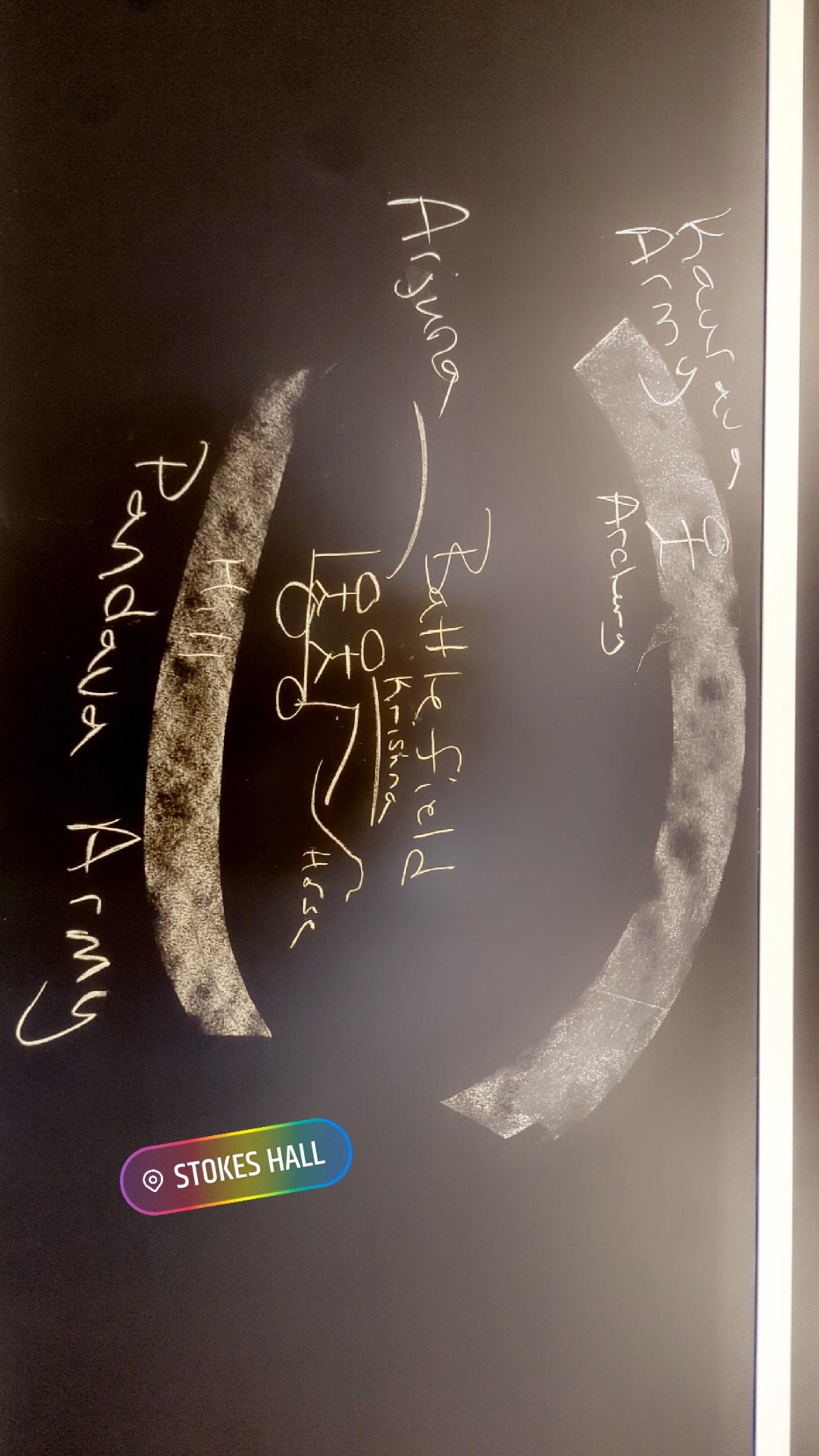
Brad: So, you've got these two sides that are about to go to war. And they've got this so of the five sons, one of the brothers is *Arjuna*, this kid named *Arjuna*. He's not the oldest, he's not the smartest, he's not the best, he's not the most ethical, he's not he's not any of the superlatives, right? This is a reference that I think's pretty dated for you guys. It won't won't resonate as well as it did 10 years ago. But if the *Pāṇḍavas* were, you know, the Bush family, then *Arjuna*'s W. You know what I mean? It's like not he's just he's just solid guy, not not he's he's not Jeb, right? I mean he's not. He's just he's just, you know, he's a solid guy. He's really good at archery. So very skilled at archery. And pretty good at, you know, he's a general, right? So he's the general of the army. And he's good at at archery. And so they so they're going to war. Now, in for Tuesday's class, right? Tuesday I've asked you to read chapter one and chapter two of the *Bhagavad Gītā*. Chapter one, I will tell you, when I read the *Gītā* for the first time, like, I don't know, 25 years ago or something like that. I didn't have a teacher. I just kind of was like, hey, this is a book I want to know and read. So I picked it up and started reading it on my own. And I didn't make it through the first chapter. I gave up halfway through the first chapter. I was like, why am I reading this? So don't let that happen to you. When you're reading the first chapter, don't get bogged down in it. It's a whole lot about conk shells. So and so's blowing their conk shell, so and so's blowing their conk shell. So super skim read chapter one. The only real important verses are verse one and then like the last five or six verses in the chapter. The rest of it is all, do skim through it very quickly, but you know, take like five, six minutes, 10 minutes tops to read chapter one. Chapter two on the other hand, chapter two contains pretty much all of the wisdom that's in the entire *Gītā* in super condensed, compressed 72 verses. So chapter two, we could I could literally teach an entire semester long course just on chapter two and not run out of things to talk about at all. But chapter one, don't get bogged down in. Chapter one is basically this. So you got this kid *Arjuna* and he's the leader of the army. The *Bhagavad Gītā* starts is right at the beginning of the war, right? So all that stuff I explained, the *Kauravas* are destroying the kingdom. The *Pāṇḍavas* are like, enough is enough. We have no other option than but to go to war. And then chapter one is like they're literally lining up and all the conk shells are their these people line up and they blow their conk shell to say, I'm ready to go, right? These people line up, they blow their conk shell to say, I'm ready to go. They're basically just waiting for *Arjuna* to like give the drop the flag, right? Fire the first arrow. As soon as he gives the signal, the war is on, right? So everybody's just saying ready. And at first *Arjuna*'s up here on the hill with all of his bros. and then he's like, I want to go down into the middle of the battlefield. I think it's a little bit of a flex, you know, like if Jack were like challenge me, I'd be like, yeah, you want to go? You want to go? Come on, right? Super scary, wasn't it? So then it's like a little bit of a flex like, you want a piece of me? Come on, this is your last chance to back down, sort of thing. So a little bit of a flex. But also he wants to see the faces of the enemies. He wants to give them one last chance to back down. He wants to see their faces and all that kind of stuff. And so he goes out there, everybody blows their horns, say we're ready to go. And *Arjuna* looks on the faces of the enemies and mostly he sees all those assholes, all those corrupt bad guys. But then he also sees in the midst of all the bad guys, he sees a lot of good guys over there too, right? He sees most notably his his archery teacher is over there, his ethics teacher is over there, his philosophy teacher is over there. All his uncles are over there, right? So he's got all these family members, people that he loves, people that he respects, people that are good people, that are on the other side. And this like totally confuses him and he is becomes overwhelmed and he's like, what good is civil war, right? Like if we if we have this civil war, does it really matter who wins? Whether we win, if we win, then the civil war is still civil war, right? So then the remnants, what's left over, there's not going to be much left over, right? Everything's going to be destroyed. And if they win, then obviously everything's bad. So he gets super despondent, super depressed. And as you will see at the end of chapter one, beginning of chapter two, he drops his bow. So he's supposed to be giving the signal to go to war, but instead he drops his bow, and gets depressed and it's like, I don't know what to do and he just kind of slump, you know, in his chair or whatever.
Brad: And then his charioteer, who's, you know, his chauffeur, his Uber driver, is there and his charioteer sings a song, sings a response, okay? And that's what the *Bhagavad Gītā* is. So everything after chapter one is basically *Kṛṣṇa*'s response to *Arjuna*, right? So *Arjuna* is the chariot *Arjuna* is the general and *Kṛṣṇa* is his charioteer. Now, *Kṛṣṇa* in addition to being his charioteer is also his cousin, right? So, if *Kṛṣṇa* is *Arjuna*'s cousin, then it also means that he's the *Kaurava*'s cousin too, right? Because that's how cousins work. So the cuz so *Kṛṣṇa* is cousin for both of these folks. But *Kṛṣṇa* recognizes that the *Pāṇḍavas* are the good guys, right? So he wants to be on the side he, so he goes to the *Pāṇḍavas* and he says, all right, y'all are about to go to war. I'm going to do you a solid and I'm going to give you a choice, right? Option one is, so *Kṛṣṇa* in addition to being a good Uber driver, also has a huge army, right? He's got a huge army. He's like, option one, you can take my army and my army will fight right beside your army. My army and your army together, right? And, so that's option one, and then I'll go for the other side. Or option two, I'll be on your side and my army will go fight against us, right? So the army's going to fight, his army is fighting on the *Kaurava* side. *Arjuna* the *Pāṇḍavas* choose to have *Kṛṣṇa* on their side. But *Kṛṣṇa* says, I mean, by the way, I'm God. And so it wouldn't be super fair for me to like fight on your side because I'm God. So I'm not going to fight, right? But I will be your chauffeur. I'll I'll drive the chariot for you, right? And I can give you some advice along the way, right? So you've got *Kṛṣṇa* who is *Arjuna*'s cousin, who is and he's not going to fight. His army's on the other side, fighting. And *Arjuna* decides, I'm not going to fight. and then *Kṛṣṇa* responds with the *Bhagavad Gītā*. How was how do you know *Kṛṣṇa*'s related to the *Kaurava*? Is it just because you said like *Arjuna* and *Kṛṣṇa* are cousins, so therefore he's related to the *Kaurava*, but how do you know that *Kṛṣṇa*'s related to the *Kaurava*? It's just in the it's part of the story. It's part of the *Mahābhārata*. He's related to them too. So he's cousins, he's cousins to both of them. They are cousins with each other and *Kṛṣṇa* is another cousin. So they're all they're all cousins. Yeah. So *Kṛṣṇa* goes, I can either be your chauffeur or you can have my army. Yeah. And he's offering the same thing to the He's not. He only offers that to the *Pāṇḍavas* and they choose to have *Kṛṣṇa* as the charioteer. So the other side gets his army. Yeah. I know, right? Yeah. Yeah. So then how is the conclusion that *Arjuna* decided not to fight if that comes from *Kṛṣṇa*? So, well, so he he you'll see at the end of the chapter. So when you read the the end of chapter one, the beginning of chapter two, pay attention to his the reasons that he gives because he gives reasons, right? But basically the long and short of it is what I said, which is that civil war, like nobody wins a civil war, right? So he's like in a civil war, we're going to I'm going to kill people over there, which is going to make a lot of widows, and they're going to kill people over here, which is going to leave a lot of widows. So a lot of orphans and widows, a lot of people that aren't going to be farming, aren't going to be working, aren't going to be doing things, aren't going to be making the society better because civil war doesn't make society better. Civil war destroys society, right? So, *Arjuna*'s like, civil war is bad. Yeah. But does the battle still happen? Yeah. So, good question. Yeah, I mean the battle still does happen, but the battle happens after the *Bhagavad Gītā*. So the whole *Gītā* is *Kṛṣṇa* answering, responding to *Arjuna*'s question or not his question, but his dilemma of like not wanting to fight, right? And so yeah, in fact the the battle does happen after the *Gītā* is over. And then after the *Gītā* after the battle is open over, *Kṛṣṇa* and *Arjuna* are chatting again and *Kṛṣṇa* *Arjuna* says something and *Kṛṣṇa*'s like, hey, don't you remember what I told you, meaning the *Bhagavad Gītā*? It's like, don't you remember all that great philosophy that I gave you in the *Gītā*? And *Arjuna*'s like, actually, no, I kind of forgot it all. And he just is like any other college professor then, you know, at that point. So like, fuck, what am I doing? But yeah, so they have and then he gives, he gives a shortened version of it, which is called the *Anu Gītā*. *Anu* meaning again. So he gives the *Gītā* again, but like in a shortened version. But yeah, the battle happens. Good.
Brad: Yeah, okay. Yeah. The Gospel of John. So, briefly on the Gospel of John. So, the Gospel of John was definitely not written by John. We don't know who it was written by. It doesn't say who it was written by. It could have been written by a guy named John, but the John that we refer to in the Gospel of John is one of the 12 disciples. So it was def it was, I mean, according to most all scholars, it wasn't written by that guy, that John. But probably his community, right? So I think the the version of the story that makes the most sense to me, not being a Bible scholar, there's plenty of them like around here, you could find one. But the the story that makes the most sense to me is that there was John of Zebede, one of the 12 disciples, and he was illiterate like most of the disciples were. So he couldn't read or write. And the you will see this phrase come up a few times in the gospel, quite a few times referring to the beloved disciple. Never says who the beloved disciple is, super mysterious. But it seems to be pointing to the disciple, one of the disciples. I mean, definitely one of the disciples because it's the beloved disciple. But a lot of folks attribute that to John, right? So John being the beloved disciple. And so after Jesus died, then John, you know, became kind of a leader of a community. That community was primarily Jewish. So John was Jewish and the community was Jewish, a synagogue, and they were really not they were really kind of divided over the whole like Jesus is the Messiah kind of thing, right? Obviously the beloved disciple regard him as the Messiah, but not everybody in the synagogue did. So the community kind of split over that. And were torn and divided. And then after that beloved disciple actually died, the community split again. And the epistles of John, John 1, 2 and 3, are kind of written about that split. So that guy died and then the community split again. So what makes the most sense to me is that that guy, the beloved disciple, didn't read or write, but as he was getting later in life, maybe nearing death, he dictated it to somebody else, right? And that somebody else was somebody who has exquisite Greek. The author of the fourth gospel had has very, very, very good Greek.
Brad: If you if you study basic Greek for a semester, you'll be able to read Mark's gospel. Mark's gospel, he's like clearly, you know, GSL, like Greek as a second language, like he's not his Greek is really, really, really rough. All of his sentences are like subject verb predicate period, right? So Mark's gospel is super simple. Anybody who knows Greek can read it. John's gospel not the case. John's gospel is long sentences, very complex grammar, very complex vocabulary, very abstract concepts, very philosophical, theological, lots of Greek, you know, philosophy in there, lots of Hebrew, Jewish philosophy in there. It's very erudite, very abstract, very complicated, long, you know, chapters, like the farewell discourse is one speech that goes on for three chapters. When Jesus is up on the cross in Mark's gospel, it's like Jesus is on the cross, then he died, you know? It's like super fast. In John's gospel, he gives like long speeches and long conversations. He gives a philosophical speech while he's on the cross, right? When he's in his trial with pilot, which doesn't even happen in all the gospels, but in John's gospel, it's very long and he asks, he asks pilot, *Quid est veritas?* What is truth? Like he asked, it's a very philosophical question, right? So anyway, definitely not written by somebody who was illiterate, but maybe dictated to somebody who was very literate by, you know, so basically the author of the gospel was probably not a what do you call? an eyewitness, but somebody who got his source, his primary source was an eyewitness. Eyewitness is a huge and important thing in the text as you'll see.
Brad: So, Yeah, good. Any questions? How am I like earlier in here than in the last class? Yeah, okay. Yeah. Good.