 ```html
Class Date: March 11th
This class session began with attendance and a brief centering meditation. Brad reviewed student podcast submissions and outlined upcoming class logistics, emphasizing the shift to a discussion-based format without screens starting Thursday, requiring printed texts. The core of the session was a detailed review of key concepts from Hindu philosophy, specifically contrasting the Mīmāṃsā and Vedānta schools (Ṣaḍ Darśana). Brad elaborated on Mīmāṃsā's focus on ritual (karma, yajña) and Abhāva Pramāṇa (non-being as knowledge source) via Kumārila Bhaṭṭa. They then revisited the two Vedānta sub-schools studied: Advaita (non-dualism, exploring concepts like Brahman/particular, matter/energy, team/players, brain function) and Viśiṣṭādvaita (qualified non-dualism, incorporating Īśvara/God). The discussion included different types of causality (material, efficient, final/telos/artha) and the concept of Līlā (divine play) as the purpose of existence. Student questions addressed Aristotle's formal cause and free will within Viśiṣṭādvaita. Finally, Brad introduced the two texts for the next phase of the course: the Bhagavad Gītā and the Gospel of John. They provided historical context (1st century CE origins), authorship questions, linguistic backgrounds (Sanskrit/Greek), and structural overviews. For the Gītā, the context within the Mahābhārata (Kauravas vs. Pāṇḍavas, Arjuna's despondency) was explained, highlighting Chapter 2's density. For John's Gospel, theories about the "beloved disciple" and its sophisticated theological nature were discussed, along with the significance of Passover. The session concluded with reading assignments for the Gospel of John.
Brad: Alright, let's get started. March 11th. We're missing, Allie?
*(Sound of student arriving)*
Brad: Drum roll. There she is. We're not missing Allie. Marina? Liam? And Alec? That's it, right? So Marina, Liam and Alec are out? Alright, let's take a... Let's take a breath. Put away all screens, please.
*(Pause, sound of singing bowl)*
Brad: Put away everything. Leave Punta Cana and Dominican Republic.
*(Long pause, sound of singing bowl continues)*
Brad: Let's take one breath together. Go ahead and breathe in. And let it out.
Brad: Hari Om. Welcome back.
Brad: Very nice work on podcasts. I listened to most of them for this class and very nice work. Very happy with them.
Brad: I have Play-Doh, if anybody wants Play-Doh. I'll just... Feel free to take one and pass. No obligation.
Brad: So, today should be the last lecture, until the very, until the last, you know, week or so. Till the last few classes. So starting Thursday, we'll let's get into circle and we'll just stay in circle the the rest of the semester until the last few classes. That's one thing. Also, absolutely no screens after today. So, so please bring a print- and I'm not going to give you a printed copy of the two texts. So, please bring a printed copy. Either print out of the translations that I gave you, or, you know, if you've got your own copy of the text. It does not, if you, if you bought this translation of the Gita, that's AOK. We don't have to have the the Barbara Stoler Miller one. If you want.
Brad: I also brought this little... this little cute one. Anyway, I used to get annoyed at Harvard, all these professors would come in with like these arm loads of books to class and just like stack them on the table. I think it's just some sort of like flex, like some sort of like, I don't know, you know what I mean? I was always so annoyed when they would do that. That's why I didn't bring an arm load of books. I put them in a bag.
Brad: Alright. Thank you for smiling, Thaddeus. Sorry, I am really insecure about my hair today. I've never worn it like this before and I just, I'm not sure about it.
Brad: So, let's do quick review. Let's see. I've got notes here. So, initial meeting with me. There's a few folks that still haven't met with me for that first meeting. So the chance for full credit is gone, but you can still get most of the credit. So go ahead and schedule that meeting with me. I've got office hours today, after the next period. And, and then, you know, just continue to be free on Fridays. So go ahead and get that out of the way if you haven't. No screens in class, full text starting Thursday. This Thursday, so we're going to start discussion leaders. So that's 10% of your grades, discussion leader. And that mostly comes down to two classes, although we're going to start it on Thursday. So I'd really like everybody to come prepared to to contribute something on Thursday, right? So obviously that doesn't mean that, you know, you're preparing a long thing because there's not enough time for everybody to do a long thing. But I'd like everybody to have like a verse or something or something to say about the text, you know? So this Thursday, we're reading the Gospel of Luke, fourth gospel. And the first five chapters. So, plenty, plenty to talk about in there, plenty, plenty of discussion there. And Thursday, I don't know, I might try something. I think some of you have experienced this with me before. I might try just not talking at all for at least most of the class, if not all of the class. If I can make it the whole 75 minutes and you guys are just having good dynamic conversations, you know, as a class, that would be, that would be super, super dope. And so we'll, we'll try something like that.
Brad: Yeah. So, quick review. And then I want to give introduction to the Bhagavad Gita and the fourth gospel, trying to cram both of those into today. And then like I said, that'll be the last lecture until sort of the conclusion of the course.
Brad: So, a quick review. Let's start with, so there's the Shad Darshana, right? The six perspectives of Yeah, please, one, one little thing about the podcasts and just generally, try to excise the word religion from your vocabulary, at least for the purposes of this course. I don't, you don't really need to use that word, at all. So we're not studying religion in here, we're studying theology. And theology is anchored in the texts. So we're just talking about these texts, right?
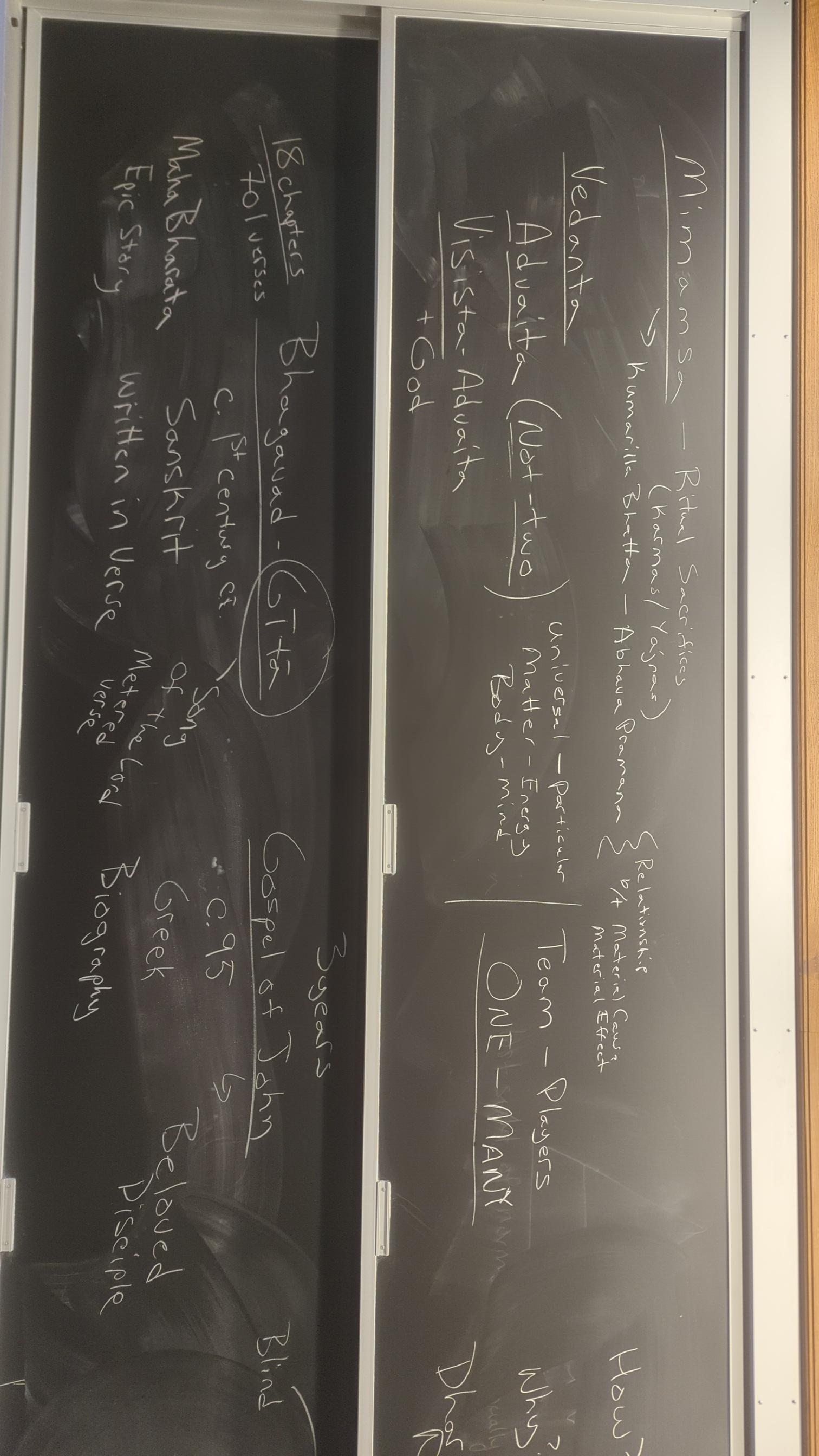
Brad: So, these Shad Darshana, the six perspectives, they're all orthodox Hindu traditions, and they're all anchored in the texts, right? That's what it means is to be, they all consider the Veda sacred. They all consider the Veda, yeah, sacred text, right? But they have these different perspectives on it. And the school that we've talked the most about is Vedanta. Mimamsa. So Mimamsa is the sister school of Vedanta, and it's focused on rituals, ritual sacrifices, which are called karmas, or yagnas.
Brad: And on the one of the previous classes, I think the last class, I talked a bit about this kid, Kumarila Bhatta. And in particular, talked about his notion, his understanding of Abhava Pramana.
Brad: So Pramana is a valid source of knowledge. Abhava means non-being. And so the, each one of the pramanas reveals something different, gives us a different kind of knowledge, different ways of knowing, different kinds of, different kinds of knowledge and different ways of knowing different kinds of knowledge. And so Abhava Pramana, according to Kumarila Bhatta, reveals to us the relationship between material cause and material effect. And, yeah, you guys had some really good discussions in that. Becca, I remember you talking about kenosis and perichoresis, which is really, really super awesome connection. But so this relationship between material cause and effect, like the Play-Doh, right? Transforming material cause from one thing into another. So in order to create a ball, you have to destroy the pot, right? So the pot becomes the cause of the ball at the moment that the pot ceases to exist, right? Because it's been transformed into that other thing. Or the example of the milk and the curd, right? So the milk only becomes the cause of the curd at the moment that the milk ceases to exist, ontically, at least.
Brad: And then, so, that's enough about Mimamsa for now at least. Then, in the Advaita, sorry, let me do it this way. In the Mimamsa school, nope. In the Vedanta school, then there's multiple different schools within Vedanta, right? What makes it Vedanta is it's applying the rules, the exegetical rules that Mimamsa applied and it applied it to the end of the Vedas, right? Vedanta is the end of the Vedas. Now these within the Vedanta school, we've studied two different schools of thought, right? One of them is Advaita. And the other is Vishishtadvaita. And this is really, I mean, we did kind of sneak in a little bit of Devi, like the goddess stuff in there in one of the units. But aside from that little detour, these are really the only aspects of Hindu tradition that we've talked about all semester, and we're just going to kind of continue with these. There's like so many more, right? I mean, at least, you know, there's Shad Darshana, and I'm only giving you two of the six perspectives, and those two are closely related to one another, right? We will sneak a little bit of yoga in here when we're doing the Gita too. But mostly we focused on these two. And we're going to continue focusing on these two. And I gave you this one so that you really understand how it relates to these two.
Brad: So Advaita, means what?
Student 1: Non-dual.
Brad: Non-dual, not two, non-dualism, not two, non-dual. And so, then in order to understand Advaita, you have to understand what is it that's being denied duality, right? So what is it that's not two? And there's a lot of different answers to that. But one, we could say, universal and particular, right? So the universal and the particular are not the same thing, but they're also not two different things, right? So, for example, Brahman, right? Brahman is everything. Brahman is ultimate reality. But then, which means if Brahman is everything, then that means that Bridget is Brahman, and everything about, it's not just that that Brahman is in Bridget, but everything about Bridget, every detail about Bridget is Brahman, right? Because Brahman is everything, so there's nothing that's not Brahman.
Brad: Like out of breath, talking too fast. Another one we could put here related to this. Oh, we also put, right, matter and energy or spirit, mind and body, body and mind. Another one I want to give you, just to kind of help lock it in. I think a lot of the groups really have a good understanding of Advaita, but a couple are still struggling with it a little bit, which is, I mean, you know, fine. It's like a very different way of thinking. Let's look at two more very quickly. One is team and, I don't know, just for fun, let's say players. So, in order to have a a team, you got to have players, right? You can't have a team if there's no players. But if you have players, that doesn't necessarily mean that you have a team, right? When my, when my daughter, Leela, was, you know, she used to play soccer, she doesn't play soccer anymore. But when she was like, I don't know, like 9, 10 years old or whatever, we'll go to her soccer games and, you know, they were on a team, they wore uniforms, you know, they all wore the same uniforms. They stood on one side of the field, they all faced the other side. They looked like a team, right? But they didn't act like a team, right? So they were, I mean, if you've seen a nine-year-old play soccer, right? What do they want to do? All they want to do is kick the ball, right? They don't always even think about which direction to kick the ball or who has the ball right now? Is this my teammate that I'm stealing the ball from? You know what I mean, right? So just because you have, you know, nine, 11 players or whatever on a team, on the field that are wearing the same uniforms, that doesn't mean that they're functioning as a team, right? So team has something to do with how they function together, right? But obviously the team isn't something more than the players. It's the players, right? But it's the players functioning in a particular way. Makes sense? Right? So you could have the, so another way to look at Advaita, maybe the, yeah, is between the one and the many, right? So the idea is that the one and the many are not two. They're not the same, but they're not two. So here we could have one team is not other than the players, right? The many players, but the many players could either be working together, functioning as one, or they could be functioning as many, right? So there's sort of a a functional or ethical aspect to Advaita.
Brad: Hopefully that was a helpful example. Another one, just because I know there's a more than a few, neuro psych kind of folks, and I like neuroscience. Then, you know, if you think about all the synapses in your brain, right? So your brain is just billion, what 10 billion neurons, that are firing in rapid succession and close proximity. Those 10 billion neurons could be focused on things that are going around, right? If you're in a state of hypervigilance, hyper awareness, if you feel like you're in danger or threatened or something like that, right? Then it's like all those neurons are kind of like focused on, you know, if somebody touches you on the small of your back or whatever, then you jump, right? Because you're like hyper aware. So that's sort of the many focused, the many focusing as many, right? Or sort of distributed as many. But then you can also have those same many 10 billion neurons kind of focused on one task, right? So attentive to one thing where they're where your attention is focused, right? So you've sort of dispersed attention or united attention, right? So, sympathetic nervous system or parasympathetic nervous system, fight or flight, however you want to say it, right? Does that kind of helpful? Right? So again, the one can, can refer not to just ontological oneness, but also to some sort of function or ethics.
Brad: So then, Vishishtadvaita. As I've said a few times, when we get to the Gita, starting Thursday, I want to, while their handwriting is so nice. I would like it for us to start, at least as a class, if not individually, but as a class, I'd like us to start trying to read each one of the verses that we're discussing in both of these different ways, right? So these are two very different ways to approach the text, two different perspectives or darshanas on the text. And, I think ideally, I'd like you to understand both of them and be able to kind of see both perspectives, right? So, let's, let's try and, let's try and do that. Right now.
Brad: I have a plan, don't worry.
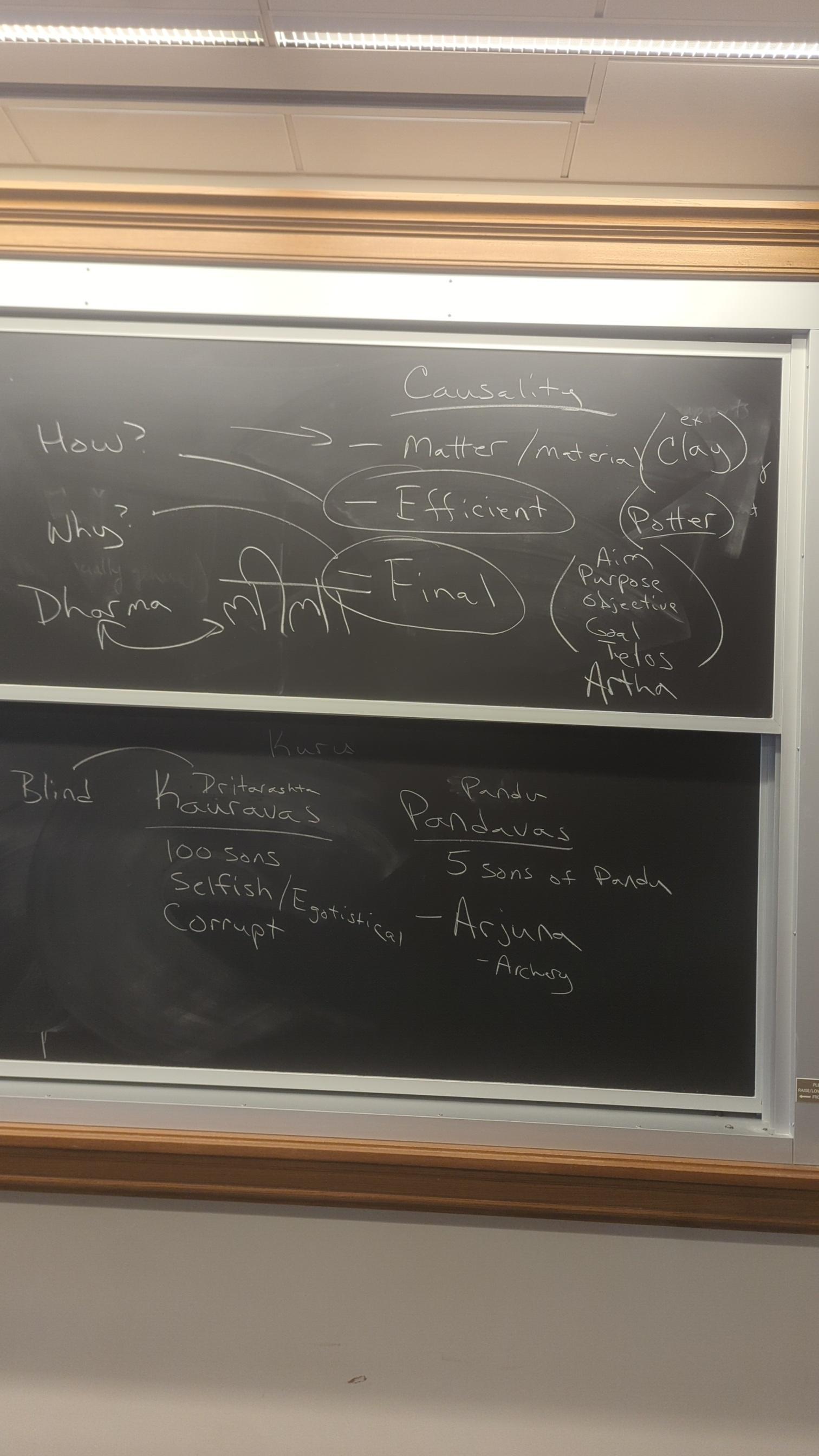
Brad: Uh, so one of the things I've emphasized a few times is there are various kinds of causality, right? Three primary kinds of causality. What are those three kinds of causality? So there's matter. Does material only has one T? Is that right? That's so weird. Why does it have one T? It should have two. Material, matter. And, so like the, like the clay, right? So the clay or the Play-Doh would be the material. But in order for the material to take some sort of, you know, one form over another, then there needs to be some sort of efficient cause, right? So we could have here the the clay, you know, example. And here, the example would be the potter, right? And then some sort of final cause, like the reason, right? The, the purpose, objective, goal, in Greek it's Telos. In Sanskrit, Artha, right? Some sort of aim, reason or purpose, right? So, one of the things that we focused on in the last unit, I mean, last unit we focused on this, right? So the, what is the reason for there to be anything at all from these perspectives? It's true of both of these perspectives. Why is there anything at all? What's the reason, the purpose for anything? Brett?
Student 2: Is it because the one was bored?
Brad: Yeah. So, play would be another way of saying it, but because the one was bored, you know, it's better for it to unfold or to evolve, right? Into the many. So that's the reason. So Lila is the reason for it to be many. And that originates, as Brett's pointing out, right from the Brihadaranyaka Upanishad, was just lonely and bored, right? So, so the reason for there to be anything at all, is play. So not work, but play. So then, that's true of, well, that's definitely true of both of these, right? I think it's true of this one too, but it's definitely 100% true of both of these. So then, and both of these, pretty much agree on that one as well, right? So both Advaita and Vishishtadvaita agree that matter and energy are not two different things, right? So the matter, the material stuff of creation of everything that exists is is non-dual.
Brad: What they might disagree on, is this, right? So the the how. So in other words, if I were to say, right, why, why did, why did Brad, I was going to use Bridget again, but she she disappeared, she's not there. She's unmanifest. So why did Brahman become Brad? Right? The answer is because it's, I mean, a universe with Brad is more fun than a universe without Brad, isn't it? Yeah, that's true. Got to be true. So, so why? Because it's more fun than not becoming Brad. But then the question, the efficient would be how, right? So, how did Brahman become Brad? Right? So here we could have two different answers between Advaita and Vishishtadvaita. What is the answer for Vishishtadvaita?
*(Pause)*
Brad: Might be more than a review, it might be, you know. So how? I mean, so for Vishishtadvaita, the biggest difference between these two is is God, right? So this is non-dualism and this is non-dualism plus God, right? So then if we were asked, how did Brahman become Brad? Well, somebody or something had to shape Brahman into Brad. That's the potter, right? And let's call that Ishvara, God, creator, something like that, right? Some sort of willful agent, who's giving things shape, right? Calling things into being. Makes sense? So then, I guess million dollar question then is, what would be the answer in Advaita? Yeah?
Student 3: Would it just be the same example that you gave with the two sheets and when matter and energy come together that creates a person?
Brad: No, so that's from yoga. So yoga is dualist. So that's the two sheets is the one sheet and they don't ever become the same. They never, so the matter energy never become the same. But when they touch, then you get those, then you get an alley or something, right? So not quite what I'm looking for here. Yeah?
Student 4: For Advaita, isn't it just essentially the self shaping itself into becoming?
Brad: Yes, and so the self is both Hannah and not Hannah, right? So Hannah shapes yourself into whoever you are, but also the world around you has a role to say, has something to say about it, right? So you can't just shape yourself into whatever you want to shape yourself into, but you have a significant role to play in that, right? So the how would be both self, I mean, self, you're right, there's only one self, right? So, but both your own self, Hannah's own self, but also everything that's not Hannah is still Hannah's own self, right? So the only one self of all beings, part of that self became Hannah. Why? Well, in part, I mean, there has to be some reason. So one reason is Lila, that's already good enough of a reason. But also because maybe there's something more to it than that, right? Maybe there's some other purpose, in addition to that or as part of that in terms of a bigger play. And so, we'll we'll continue investigating that question. But it's both ends, right? So we shape ourselves, but we're also shaped by the world around us. And we also shape the world around us, right? So we're shaping one another and we're being shaped by one another and by ourselves.
Brad: Good understanding of the differences between those two so far? Did that, was that helpful? Any questions about any of that? Yeah?
Student 5: Is there a reason why formal isn't included in the causality? Because in Aristotle he has four and formal, the formal cause is one of them.
Brad: What, remind me what formal cause is?
Student 5: Like what the thing is essentially.
Brad: Yeah, so, so when you're talking about essences, so that's back to dualism, right? So for a thing to be something in its essence, I'm not like super good on Aristotle, so I shouldn't really talk too much about Aristotle. Because even as I'm saying dualism, I'm also thinking of hylomorphism. So, right? So the morphe, that's the form, the formal, the formal cause. I don't know, I might have to punt that one. That's a good question. Yeah, probably has a role in there somewhere. Any other questions I don't know the answers to? Okay, good.
Brad: Let me see. Why did Brahman become Brad? Lila. How did Brahman become Brad? First of all, Brad isn't finished yet. I'm still, I'm still in process. Second of all, for Vishishtadvaita, God is the potter, I am the clay. So in there, we would have, sorry, so if I'm, if God is the potter and I'm the clay, then the goal from that perspective, for me, the goal, my goal would be to make myself moldable, malleable, flexible, right? Pliable, right? Yeah, Tasha?
Student 6: What would Plato say about like parents who are religious and pass those values down to their children like values of God? So, could that still be Advaita? Because you're being molded due to your parents' values? Right. But it's also the teachings of God. So, would that, would that be Vishishtadvaita?
Brad: Vishishtadvaita. Yeah. So I think rather than think about it which, I mean, because folks in both of those schools have parents and folks in both of those schools are shaped by their parents. So rather than think of which would the situation fall into, think about it, how would folks in both of those schools, you know, understand what you're asking about about how parents shape us, right? So, yeah, as you're pointing out, it's easier in Advaita because it's like, well, everything around me shapes me and who has more influence on the person that I become than my own parents, right? And siblings and culture and teachers and surrounding, right? But especially parents. In Vishishtadvaita, I think you could look at it at it certainly that way, the way we just said, it's nothing prob- that's not a problem in Vishishtadvaita. But you could also say maybe God is working through parents, God is working through the world around me, right? So it's not just God and then the world, but God working through the world. So I'm, so even, even when I say I have some sort of autonomy and some ability to shape myself, I could also say that if I am pliable, malleable, soft like clay, not like fired clay, but like the soft, wet, malleable clay, then I'm most open to being shaped in the way that God wants me to be shaped, which is God presumably has some purpose or plan in shaping me into this or that form. Yeah? Good? All the questions? Cool.
Brad: Advaita, I am the potter, but so are you, so we shape each other. Wow, this is sloppily written.
Brad: Why isn't life all play? Why isn't life all play? It's a good question, right? So if the whole point of being is play, but that's not the world we live in, life isn't all play. Well, one of the points I made a minute ago is that the difference between, you know, working as a team and just being a bunch of players on the field has to do with how we work together, right? So if the, you know, you've probably seen on, on a team or been on a team where somebody just, you know, there's one player that just wants to pad their stats or like score a bunch or something like that, right? They're just more interested in their own stats than in working as a team, right? They'd rather score the goal than pass the ball to somebody open. You know what I mean? So the objective changes. And if the objective is not just Lila for me, but Lila for everybody, right? Lila for all of existence, then all of a sudden, I'm not just interested in maximizing my own hedonistic pleasure, but I'm interested in the flourishing of all beings, right? The flourishing of everybody around me. The play of everybody around me. So that's an ethical distinction. And without that ethical impulse to, to act in accordance with that theological position, then maybe I would be an asshole or a jerk to the people around me, right? Which would not be very much fun for the people around me, right? So then why is, why isn't everything play? Well, because not everyone shares that Artha or that goal or that theological perspective. Makes sense? It's not the only answer to the question, but pretty good answer.
Brad: Cool. Any questions? I'm done with the review. Yeah, Jack?
Student 7: That question also pertains to like play is like associated with the divine Lila in that sense like since the divine can't have like perfectly like in the real world you can't have like 100% of the divinity like in the present like there's going to be like like 99.99%. Yeah. Like similar to like what we learned kind of like with the adding like another side to like the polygon where like you can get close to it. Yeah. But you can't truly achieve it because like the truly achieving that is like only like the divine?
Brad: I think maybe even not even applicable to the divine. So that to another way to to say, I think what consistent with what you're saying is, to be is to be in a state of change, right? So whatever is is is dynamic, not static. So change is inevitable. And so if change is inevitable, then everything's going to be always in process, which means that nothing perfect then, perfect, another word for perfect is like complete. Another word for complete and perfect would be dead and static, right? So unchanging. So unchanging, is on the one hand, we could see it from like the highest possible, most abstract view that the universe, matter energy are neither created nor destroyed. So there's a sort of stasis in there. But then we have to quickly add, everything's in a state of constant transformation, right? So if it's not at zero Kelvin, it's moving, right? So, so that could get, that could explain that short edge between the 100% and the 99%, right? Because everything is constantly changing. And why is everything constantly changing? Well, on the one hand, because it's like boring if it doesn't, right? It's like literally nothing to do or talk about. Good? Yeah. Work. Cool. Any other question? Yeah, Brett?
Student 5: A little off topic, but if Vishishtadvaita believes that everything comes from God, does that leave room for free will? Because I know that's a big question in Christianity is if God's omnipotent, can we really have free will?
Brad: Right. Yeah, so definitely yes. But the reason for the free will is because, so on the one hand, first of all, there's a lot of theologians within Vishishtadvaita, right? And some of them are way more on the Advaita side and some of them are way more on the Vishishta side, right? So it's like how much of entity or personhood or being do we attribute to God? Is God an entity, a thing that exists, a person? Or is God a focal point, a way of drawing attention, sort of more of an abstract focal point? If God is, if God is an entity, right? A person, then the question is, does that entity yield any volition, yield any freedom, right? And so if the answer is no, then why do anything, right? So then there's no action, there's no purpose and we're all just, I don't know, NPCs in Elon's game. But, or whoever God is. It's definitely Elon. That took us off track, didn't it? Scrap that Elon thing. So I think then then the answer would be that God yields some sort of freedom, right? And then so freely gives us freedom. That could be something that's taken away, right? So you could think of like Krishna dancing on the head of the serpent. Did I show that video? Oh. So Krishna dancing on the head of the serpent is like, hey, taking away a little bit of the serpent's freedom, but he doesn't kill him, right? Sends the serpent off back to someplace else, right? So taking away some freedom, some volition, some will, maybe only temporarily, in order to let the snake be the snake, but in the right place, in a way that doesn't disturb Brett and everybody around, right? Good? Cool. Alright.
Brad: So, this is a review but more than a review, right? Just trying to put all the pieces together. It's almost like I came into the semester with a plan. Alright, let me give you a little bit of an introduction to the Bhagavad Gita and the fourth gospel.
Brad: So, the Bhagavad Gita and the fourth gospel, which we'll refer to as the Gospel of John, John's gospel, they're both written around the same time. Interestingly enough. So both written in the first century. The first of the fourth gospel, so you've got the Bhagavad Gita. And the Gospel of John. So Gospel of John, most scholars put right around the year 90 or 95. 95 is a little bit late. But 90, 95. Bhagavad Gita, I think the closest we can get is sometime in the first century, CE. So, this one we have a pretty close date. This one, you know, we got like plus or minus 100 years. So somewhere in there. And obviously Bhagavad Gita written in Sanskrit. Gospel written in Greek. I did bring the Greek New Testament. I don't know why. And, the, one another thing they have in common is we don't know who wrote either one of them. So, and we also pretty confident that they're, they have multiple authors, right? So, kind of written at different times by different people and then brought together by a single person, most likely, right? So, I think that's safe to say that the gospel was pulled together by some person who did some writing and some gathering, some mix of both. Gita likewise, somebody did some gathering and some writing, and plenty of both of those kind of things. So some verses in the Gita are really, really, very, very ancient. Some of them are like verbatim pulled from some of the Upanishads and some of them are pulled from the Vedas and most of it's original but very inspired by those other texts. And this is written in written in verse. And the word Gita, the word Gita means song. And Bhagavan means the Lord. So, good translation of the Bhagavad Gita is the song of the Lord. The Lord's song. Gospel means good news. So this is the good news according to John. And this is a biography, or at least has the form of a of a Greek biography. Yeah.
Brad: So the Bhagavad Gita is part of, so it's 18 chapters, it's 701 verses. And these 18 chapters are part of a much longer, much longer story. So the much longer story is called the Mahabharata. Maha means great and Bharata, Bharata is the name of India. So in India, I mean in India today, they usually refer to it as India, but more often, particularly like Prime Minister Modi, almost always calls it Bharata. So Bharata is the more ancient name. Bharata is the name that, you know, more orthodox Hindus will refer to the the southern, the subcontinent. India was a name that was given to it by people outside of India, primarily in Persia. So Mahabharata is a huge epic story. It's not one story, it's a whole bunch of stories. It's a very, very long epic. The Mahabharata is twice as long as the, as Homer's Odyssey and Iliad combined. So really, really, really big. I have a, what do you call it? A graphic novel version of it. Just started reading to my, to my kids when they were young. They didn't like it, so we stopped. But I'll pass this around just in case you want to have a look at it.
Brad: But so the Mahabharata, so let's talk about it for a few minutes. So the Mahabharata is the a huge story between of this about one family really. I'm gonna describe it as two families, but it's they're they're brothers, right? So the two brothers are, well, let's they're called the Kauravas and the Pandavas. Basically there was, there are all kinds of sons of Kuru. So there's this sort of ancient, you know, patriarch of the family called Kuru. Had two brothers, Dhritarashtra, Uh, don't worry about how to spell that. Dhritarashtra and Pandu. And they were brothers. Pandu had five sons, and those are called the Pandavas. So the Pandavas are five sons of Pandu. And, the most, so one of the sons is named Arjuna. And, he's not the oldest son, he's definitely not the smartest son, he's not, he's, he he has very few superlatives. The the thing that he's the best at is archery. He's really good at archery. So he's an excellent excellent archer. I didn't use a compound bow. Yeah.
Student 7: Kuru is their brother or their father?
Brad: Kuru is the the father of all. He's sort of the grandfather, the patriarch. He's not in, I don't know any stories about him. So, he's long gone by the time the Bhagavad Gita starts. But he's the parent to both of these kids. And Pandu actually dies too. So Pandu's not really in the story. Dhritarashtra is. So there were these two sons, Pandu, I don't know why I'm saying. Pandu was the Raja, Raja means king. So he was the king of the of the kingdom. Then he died, super sad. And when he died, everything got thrown into turmoil, right? So who's going to take over for Pandu after he's gone? So on the one hand, you've got the five sons of Pandu. And now it would seem like the person who would take over would be Dhritarashtra, right? So Pandu was the oldest son. He was in charge, and then when he died, Dhritarashtra did take over, but Dhritarashtra is blind. So he's he can't see, blind. And I don't know, it's also maybe not just physical blindness, but maybe a little bit of metaphorical blindness. So a little bit of a, he's not a bad guy by, he's not a bad guy. His sons are though. So he had 100 sons. And, his sons were kind of vying for You know what? I didn't even think about this till right this second. But there's more than a lot of similarity between Dhritarashtra and his hundred sons and King Cyrus of Persia, if you're history buff, you know, Cyrus took over, you know, the entire known world. And then he had over 100 sons and when he died, his kingdom basically got thrown into turmoil because all the hundred sons wanted to leave, right? Xerxes, I guess eventually won over. But I think Xerxes was Cyrus's grandson, right? Any history people? No, yeah. Anyway, so he had 100 sons and his sons were were not good. They were very, very selfish, selfish, egotistical, all sorts of other words that mean the same thing. etc. And the the five Pandavas were very good, very good people, good ethical, moral, well-behaved, they're rule followers, very much rule followers. And so they, they kind of try to take over, but the anyway, the Mahabharata is very long and it's a lot of back and forth and a lot of it is these folks tricking these folks, right? And these folks taking advantage of these folks. They play dice games. They lose the kingdom in a game of dice where the Kauravas like clearly cheated and just lots of trickery, lots of deceit, lots of, lots of bad things. So these, these guys are very good and they keep getting taken advantage of by bad guys, basically, right?
Brad: And the battle, so in the Mahabharata, the bad guys, the Kauravas, are in control, they're in government, they're ruling the kingdom. Dhritarashtra is the sort of like the nominal head, the titular head, right? But he's not super functional. He doesn't totally know what's going on. And he just kind of relies on his sons who tell him what's going on, but they lie to him and cheat and all this kind of stuff, right? So it's kind of a bad situation. And they're all selfish and egotistical. And when people who are, you know, egomaniacs, megalomaniac, you know, that kind of stuff, when they get into positions of power, they become more dictatorial, become more authoritarian, become more, you know, they just kind of like grab everything for themselves, become corrupt and that kind of stuff. So, which results in suffering of the kingdom, right? So the the country was suffering under the weight of these corrupt, right? They're corrupt, super corrupt. Corrupt leaders who basically use their position of power over the country in order to enrich themselves and empower themselves and you get it, right? To take advantage of the people. The Pandavas are out there behaving and all that kind of stuff. They're like exiled from the kingdom because they lost the dice game and all these kind of things, that we don't need to get too caught up in the details. But basically, they've tried everything. The Mahabharata, like I said, it's really, really, really big. You don't need to know all the details. You just need to know that the Bhagavad Gita is 18 chapters, I should have said this before now. Bhagavad Gita is 18 chapters out of the whole, like sort of in the middle of the whole Mahabharata, right? So when we're reading the Bhagavad Gita, we're already in the middle of things, right? There's a whole lot that's happened before and a whole lot that happens after. We're just reading these 18 chapters and so I'm trying to give you a little bit of context. So that's the context, right? The context is these bad guys are in power. The Pandavas have tried everything. They've tried negotiating, they've tried making, they've tried everything really. They've tried everything to chill the Kauravas out and to come up with some sort of deal that would, you know, benefit everybody and that kind of stuff. But basically every time they try anything, the Kauravas end up taking advantage of it, right? They lie and they cheat and they steal. And people who lie and cheat and steal don't usually stop lying and cheating and stealing. They keep doing it. So finally the Pandavas were like, we can't allow this to go on, right? They, they're, it's one thing for them to be stealing everything and enriching themselves, but they're, you know, they're raping the women and they're stealing all their stuff and they're abusing people and they're, they're doing what selfish, egotistical, corrupt leaders do, which is, you know, just suck everybody dry, right? And so the Pandavas are like, we can't allow this to go on, the kingdom's going to be destroyed and we're just going to be left with these rich assholes. I mean, that's where they were, right? So the Pandavas finally decide, we have no other option. We've exhausted every other option. There's no other option but to go to war, right? We got to go kick their ass. So that's the, that's the context of the Bhagavad Gita.
Brad: In chapter one, you'll read chapter one for next Tuesday, if you haven't so that's due next Tuesday. Chapter one and chapter two. Let me say this, I the very first time that I read the Bhagavad Gita, 20 years ago or something like that, I had no teacher or just knew that it was like a book that I wanted to read, so I went and read it on my own, without any help. And I never made it past the first chapter. I got like most of the way through the first chapter and I was like, I don't know why I'm reading this. This is like, So if you have looked at, anybody looked at the first chapter yet? Uh, it's a lot of, uh, it's a lot of horn blowing, actually. It's just a lot. Chapter one is super dense. I want you to take like maximum 10 minutes reading chapter one, okay? Just like super skim through it. The most important parts of chapter one are maybe the first couple of verses, and then the last few verses of the chapter. Most of the rest of it is, well, it's literally this. Don't have another chalkboard? I don't. I'll do it over there for fun.
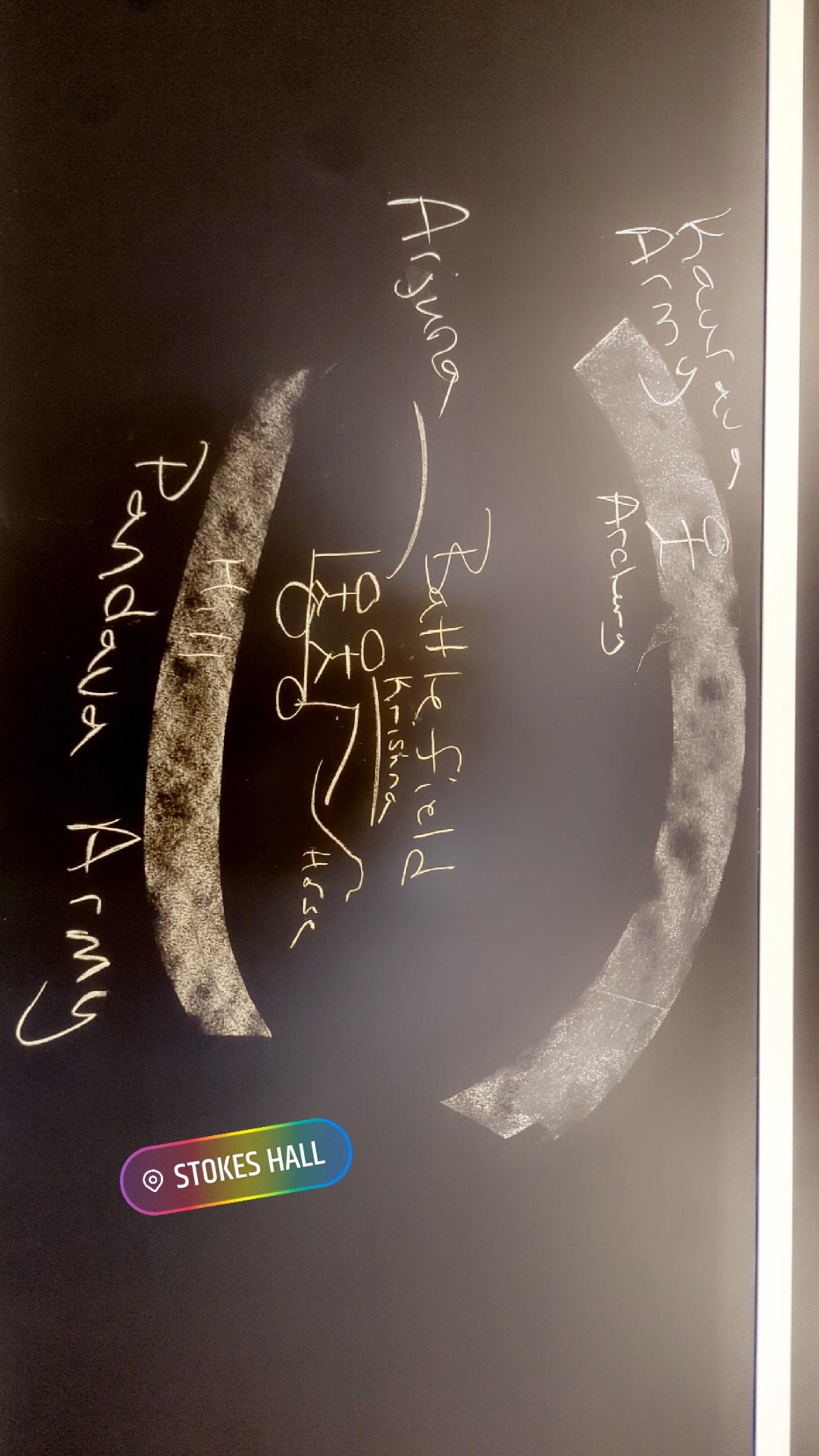
Brad: So, basically, here's the, here's the scene. You've got a big battlefield, right? Like a football stadium, right? And you've got all of these the Pandava army, all lined up on one side, the Kaurava, army, all lined up on the other side. And then here's the battlefield, right? So you can imagine sort of like a big, you know, like a big hill, like a stadium, really, it looks very much like a stadium. You see depictions of it, it's usually very much like a stadium. So there's hills on both sides and then there's just the the battlefield, right? So the battlefield, in the middle. And the Gita begins with the armies assembling. Actually, they've already there. It's like the morning of the battle, right? And they're ready to go to war. And the Pandavas are all lined up here, the Kauravas are all lined up there. Then you've got this chariot here, with yeah, I can't draw a horse. That's a that's a horse. And, inside the chariot are these two people. The driver of the chariot, right? The chauffeur, and the general. So the general of the army, put him in the back here. That's Arjuna. So Arjuna, like I said, I mean, he's not the, this might be a little dated for you guys. It was such a perfect, perfect metaphor. Still is, but if, if the Pandavas were the, were the Bush family, then Arjuna is Arjuna is W, right? So he's not, he's not Jeb, he's not the smartest, he's not the most ethical, he's not the coldest beer in the fridge, let's say. But, you know, he's a solid guy. You know what I mean? He's just a solid guy. So he's, he's a bro. And he's really good at archery, right? So, he's, that's his job. His job, they all have their different jobs, and his job is to be the, he's the general of the army, right? So, his job is to tell everybody when to fight. And so he goes down onto the battlefield right in the middle. He says, he tells his driver, hey, take me down to the middle of the battlefield so I can see the faces of the enemies, right? He goes down there, he blows on his conch shell, just to, you know, just it's like a horn or whatever. Blows on his conch shell to see if everybody's ready. And then that's most of chapter one is this person blows their conch shell to say, we're ready. This person blows their conch shell to say, we're ready. This person, right? So don't get bugged down in chapter one. It's a lot of that. Just all these people with all these names, blowing all these horns and all of their conch shells have names and they're whatever. Don't get bugged down in chapter one.
Brad: But that's what's going on. So basically everybody's lined up with their elephants and their horses and their bows and arrows, everything, they're ready to go to war, ready to battle it out. They're just basically waiting for Arjuna's signal to say, go, right? As soon as he says go, I also think it's a little bit of like a, you know, like a flex, you know? So like if Quincy challenged me, you know, like, I'll step outside and I'll be like, bro, you want to go? You know? Like all that kind of stuff. Like, you really want a piece of this? You know? So it's like a, you know what I mean? It's like a flex, right? So he's like, your last chance to back down sort of thing. And he also he wants to see the faces of the people on the other side. Like I said, like a flex. But then when he looks over there, he sees on the other side, he sees the faces of these people and among them, he sees all the bad guys, right? All the assholes that he's about to go fight, that he has to fight. But he also sees a bunch of good guys on the other side, right? And particularly on the other side, among those good guys are his archery teacher, his archery teacher, his ethics teachers, philosophy teacher, his uncles, his, right? All of his teachers and people that he admires. I mean, not all the people he admires, but a lot of the people he admires, right? So a lot of bad guys on that other side, but some good guys in there too, right? And then he just has this moment of doubt and you'll see this at the end of chapter one, and the beginning of chapter two. Where he just, he sees their faces and he's like, I don't, I don't feel good about this anymore, right? I don't know that going to battle is the right thing. Is it really going to lead to the telos that I want, right? Really going to lead to the goal, that we want? Or is it just going to, we're just all going to, I'm going to kill a bunch of people over there, they're going to kill a bunch of people over here, and then what's left, you know, after the civil war is over, right? Civil war is very destructive. So he has this moment of intense doubt about the whole thing. He grows despondent, and he drops his bow. So that happens at the end of chapter one, beginning of chapter two. He drops his bow, he like sinks down like this and he's like, I don't know. I don't know what to do, right? And so he turns to his charioteer, and he he tells him this. He's like, I don't know what to do. You know, tell me what to do. Give me some guidance. And then his charioteer, sings basically, the Bhagavad Gita, right? So the the Gita is this song that's sung by Arjuna's charioteer, whose name, you probably know, is Krishna. So Krishna is the Krishna we've already met, right? He's, he's also Arjuna's cousin. They are cousins. Oh, by the way, here's the detail I forgot. So, if if Krishna is Arjuna's cousin, that means that he's also the cousin of the Kauravas, right? So he's cousin of both sides. And when they decide to have this, this war, Krishna says, because Krishna has his own army too, right? He's got a huge army. And he's like, he goes to the Pandavas and he says, you're the good guys, right? And so I'm going to give you this choice, right? Option A, you can have my entire army. My army will join your side and my army will fight beside your army. And his army was huge, right? Or, instead of my army, you can choose me, right? And if you choose me, I'm not going to fight. I'm just going to be your chauffeur. I'll be your chariot driver and your counselor. Doesn't sound like a great option, right? Like, why would you choose that? Why do they choose that? Why did Arjuna choose that? Why did he choose this one guy who's not going to fight over his entire army that's going to fight against him? Because he's God, right? So he's God. So he knows that Arjuna on one level knows that Krishna is God. But on the other level, he's like, like you saw the video, right? Of Krishna playing with all the kids, you know, getting mangoes out of the trees and all those kind of things, right? So Arjuna grew up with him, playing and doing all those kind of things. And so on the one hand he knows that he's God, but on the other hand he knows that he's just like his cousin, right? And he keeps getting confused about that. But he wasn't confused when he chose Krishna as his charioteer. So this is the, this is the context of the Bhagavad Gita. So the entire thing is Krishna's answer to that question, why fight? Why, why engage against corrupt leaders? Why enter the fray at all? Why not just let the corrupt leaders have their way with the country? That sort of thing.
Brad: Good? One thing about chapter two, then I'll stop talking about the Gita. So chapter one, I told you just super scam, just read over that and the only important part is that despondency. So pay attention there at the end where Krishna starts to have all these doubts. What causes him to have doubts? What is his concerns about the civil war and stuff like that? But otherwise, don't spend much time at all on chapter one. Chapter two on the other hand is 72 verses and, I think, yeah, pretty pretty common, pretty common perspective is that almost the full philosophical, theological content of the entire Gita is like compressed and condensed into chapter two. So chapter two kind of contains everything that's in all 18 chapters, you know what I mean? It's the longest, it's the most difficult, it's the most rich. Every single verse in there, there are sort of little clusters of verses. But there is just no end. You we could spend, we could spend an entire semester just talking about chapter two and not anything else and we would never, we would not be exhausted from doing that at all. So very, very rich. In fact, it would be helpful as we continue throughout the rest of the semester, when we're reading, you know, chapter four, five, six or whatever, any other chapters, you can almost always find some parallel, some connection in chapter two that's like, okay, now I see that chapter four is like really an elaboration of this little cluster of verses in chapter two. You know what I'm saying? So that Sangraha Vistara, that the first goal of your learning objectives in the syllabus, that Sangraha and Vistara, the condensation, right? summarization and then the elaboration.
Brad: One last thing. The, the Gita, like I said, is a song, and that song is written in meter verse. Meaning, right? every So it's got it's got like a pattern to it, right? I'll just say the first, I'll just chant the first verse for you just so you can kind of hear. Dharmakshetre Kurukshetre samaveta yuyutsavah Mamaka Pandavaschaiva Kim akurvata Sanjaya. So that's the, that's the first verse. It's basically Dhritarashtra, begins by saying Dhritarashtra said, so the blind king said, on the Dharmakshetra, which is the Kurukshetra. So the field, Kshetra means field. So the field where the battle is going to take place, which is also the field of Dharma, right? So he calls the battlefield the Dharma field. So already sort of allegorical interpretation given right from the first sentence. The Samaveta Yuyutsavah, all the people gathered together for this battle. The Kauravas and the Pandavas together. And then Dhritarashtra said, Kim Akurvata Sanjaya. Sanjaya is like this, Sanjaya is his right-hand man, his assistant, right? His what do you call it? Like his right-hand man, right? His assistant. And he has a magical eye. So Dhritarashtra is blind, he can't see anything. And his right-hand man has a magical eye, so he can see, but he also has this magical eye and he can see things that happen farther, you know, farther away. So he's like, they're not near the battle, but he's seeing the battle in his magical eye, right? And then he's dictating it to Dhritarashtra. Cool. Enough context there.
Brad: I got seven minutes left. Let me be fast. And talk a little bit about the Gospel of John. So hopefully from the the the AI podcast or from the, that text I sent from Bart Ehrman's intro to the New Testament. So the Gospel of John, written sometime around 90, 95, something like that. As, it was not written by, it doesn't say who it was written by. It doesn't say this was written by anybody. It's been attributed to John, meaning one of the 12 disciples. And, I think, I'll just give you my interpretation. I'm not a Bible scholar or anything like that, but from the stuff, all the things that I've read, this is the interpretation that makes the most sense to me, which is that probably there was this John, one of the 12 disciples who was actually one of the 12 disciples who followed Jesus around, and that John was illiterate, didn't know how to read or write. And so definitely not the author of the fourth gospel, which is of the four gospels, it is really, really, really advanced Greek. The grammar, the vocabulary, it's very it's really advanced philosophy, advanced theology, advanced, it's not easy. Whereas you read Mark's gospel, Mark's gospel is just like subject verb predicate. Like every sentence is super, you know, if you study Greek, the Greek language, you can get enough your Greek can be good enough to read Mark's gospel in like, you know, a semester, right? So it's super easy. John's gospel is not like that. It's John's gospel is more like reading Plato, not quite like reading Plato, but it's more like reading Greek philosophy than it is, you know, say Mark's gospel. So definitely not written by somebody who's illiterate. But probably, you know, a lot of scholars seem to share the perspective that it was dictated, maybe dictated by that disciple who was illiterate, dictated to somebody who was very very literate, who was very well educated, probably near the end of his life, right? So the idea is that, this is one theory, not the only theory, but the theory is that there's this, as we read, you'll keep encountering this phrase, the beloved disciple. And so, one theory is that John, was one of the disciples. He was the beloved disciple and he, either was nearing death or had just died, and somebody, you know, took down, took down all the stuff that he said, right? So got these stories from him and wrote them down. And then also took stories from other sources and incorporated them in, right? So, some stories about Jesus from from this person, the beloved disciple, and some of them maybe from some other sources. And then wrote this very, very sophisticated, yeah, theological text in Greek.
Brad: Yeah. So for Thursday, I'd like you to read the first five chapters. I read them yesterday. And I would like you to try and just read them like you would read another book, right? Just don't do a bunch of research, don't do a bunch of footnotes, just don't do, don't just read the text as it is, right? Just read the text. Try to read all five chapters in one sitting, right? And just, just read it like a text. And anything that stands out to you, stand out. When I was reading it yesterday, having studied it a lot before, I kept getting confused. I felt like it didn't, so, you know, feel free to bring that up, things that you're confused about, or whatever. The, a couple of things about the text. One is it team, it seems to take place over the course of three years. The reason we discern that is because there's three Passovers in there. So Passover, do you know about Passover? So Passover was one from the book of Exodus, which is the second book in the in the Hebrew scriptures. And, in the Exodus, the Jews were or enslaved in Egypt. Then Moses comes along and says, let my people go. And Pharaoh says, no. And then so God sends these 10 plagues, progressive plagues on Egypt until finally, the Pharaoh relents and lets everybody go. The 10th of those 10 plagues was death of the firstborn in every household. And, the only way to avoid the death of the firstborn in every household. By the way, it wasn't just humans, it was the death of every firstborn in the household, meaning horses and cows and like everything, right? So every firstborn in the household. Unless you took, you slaughtered a lamb. That's important, right? Slaughter a lamb, you take the lamb's blood and like paint it around the the door frame, the sides of the door on the outside, all the doors and you know, the sides of, so you paint the door with the blood of the lamb. And if the, when the spirit of God came to, you know, murder all the children, then it would pass over the houses that had the lamb's blood on the door, right? So Passover is super important. There's three Passovers in the text. We'll have a look at those starting on Thursday.
Brad: Look forward to it. Peace out.