 ```html
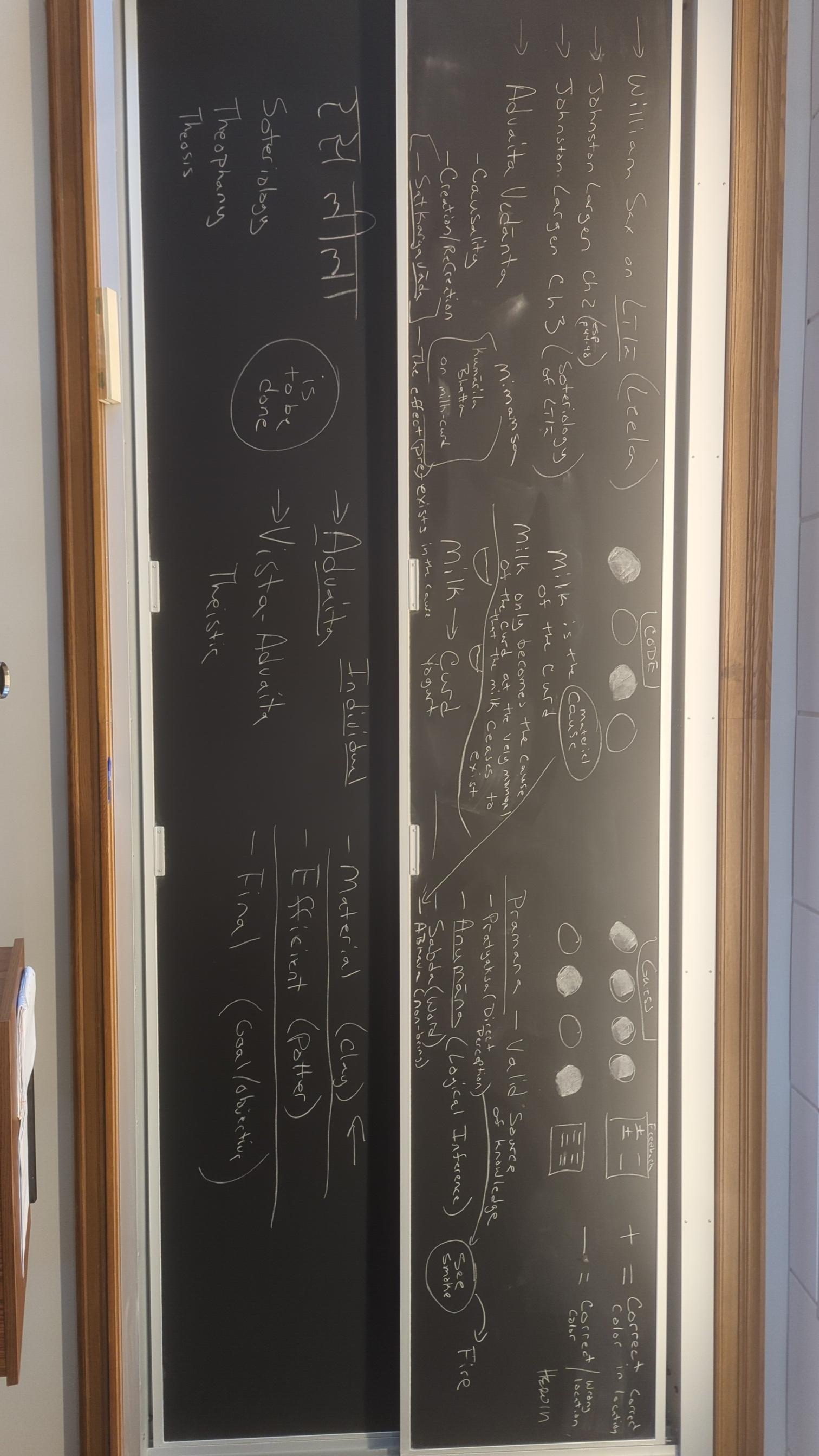
This class session began with a brief meditation and attendance check. Brad introduced the week's focus on the concept of *Līlā* (divine play), diverging slightly from the original syllabus. They discussed the assigned readings by William Sachs and Kristin Johnston Largen, clarifying expectations for the upcoming podcast assignment. Brad proposed dedicating class time on Thursday for students to record their podcasts. To explore the theme of play inherent in *Līlā*, the class engaged in a game of "Mastermind" using crayons. Following the game, Brad detailed the structure and content requirements for Podcast 3, emphasizing collaborative discussion on four key areas: Sachs's overview of *Līlā*, Johnston Largen's chapters on *Saguna/Nirguṇa* Brahman, Krishna's key stories, and *soteriology* (salvation), and a reflection on *Advaita Vedānta*. This reflection included revisiting causality (material, efficient, final) from both *Advaita* and *Viśiṣṭādvaita* perspectives, and introduced the *Mimāṁsā* concept of *Pramāṇas* (valid sources of knowledge), focusing particularly on *Abhāva* (non-being/absence) as explained by Kumārila Bhaṭṭa through the milk-to-curd analogy. This led to a discussion of *Satkāryavāda*, the doctrine that the effect pre-exists in the cause. The class concluded with time for students to begin planning their podcast discussions.
Brad: Okay.
Brad: I didn't do it.
Brad: All right, let's take a moment, be fully in the now.
Brad: It's the only thing that's real after all.
Brad: Put screens away.
Brad: Let's take one breath together. Go ahead and breathe in.
Brad: And let it all out.
Brad: Cool, cool, cool. So,
Brad: Let's see. February 25th. Have Amber? Amber? No, Amber? We're missing Rick, we're missing Claire. We're missing Alec and Liam? Everybody else here?
Brad: Cool. So, yeah, so this week, you know, we're not we're kind of diverting, diverging from original plan. Mostly I just really want to get Lila, right? So we're focusing on Lila in this unit. And so you've got two main readings on Lila. One is the one William Sachs, which I gave you last week, which we'll talk about today. And the other one is the two chapters for Christian Johnston Largen. I know it's a bit longer reading than I'm used to giving you. But really I just want you to have it, you know, under your belt before the next podcast. And and talk about it during the podcast. And I feel like chapter two is some of it's going to be useful review. Some of it is, you know, take with a grain of salt, if it diverges from things that I told you. Listen to me. Yep.
Student 1: Is that podcast due this Sunday or next Sunday?
Brad: I'm not really concerned. Yeah, I'm not really concerned. I feel like my intention is for you to get it out of the way so you can relax on vacation. But if it would be easier for you to take a week and do it, you know, as long as I as long as it's done before we start the next so before Tuesday after break, that then that's fine. I'm I'm really if you're going to be, you know, much later than this weekend, then just let me know. You don't need permission, just let me know. But but yeah, that's no problem. Yeah.
Student 2: Was it just these two like Lila readings?
Brad: I think, hopefully by the end of the class, I'll give you a list of topics that I want you to to do. How about this? I actually, this was this was on my agenda, but I forgot about it till just now. What if, what if on Thursday we we do like a 45-minute class and then we stop with 30 minutes to go? And then you use that time to record your podcast? So that way you can find, you know, a couple of people can couple of groups can take this room. Group could take my office. There's probably other, you know, classrooms around, other spaces you can find. So that you could just, you know, do it right then. Just get it out of the way. But you don't have to. So if you would rather put it off, then you can use that time however you want. Is that good? Does that sound good? Cool.
Brad: So, what I'd like to do today, is go through the William Sachs reading, really take away some of what you've learned from that. And, I'll give you, you know, those topics for the for the next podcast so we can, you know, and we can diverge from those. But also, I think one of the best ways to learn about Lila is through, you know, playing. So, let's play a game. Yeah? Probably Sarah and others know about this game. Anybody played a game called Mastermind?
Student 3: Yes.
Brad: Yeah, you know Mastermind? Anybody else besides Jackie? Okay, a few people. So this is basically basically Mastermind. It's just Mastermind with crayons instead of little pegs. So everybody take one.
Brad: If you haven't played Mastermind, but you played like Wordle or Qurdle or something like that, then they're pretty simple. They're pretty similar.
Brad: Are there two sheets? Yeah, you should have two sheets.
Brad: So, it's basically it's a code-breaking game. That's all it is. It's a code-breaking game, right? So, basically, if you have one of these sheets, you can, as it says, fold this over so you can just cover that up so folks can't see, but however you want to fold it, it's fine. And basically, we'll just do one-on-one first.
Brad: All right, so you'll have crayons. I brought crayons. Just take like... I don't know, two, three? Maybe three different colors? Oh wait. Yeah, no, that's fine. Keep three different colors. That's fine. Okay, so you basically you've got these four bubbles, right? Maybe for simplicity's sake, we'll do the first round with like one color. One color and blanks. So you've got one color and blanks. So if you've got four colors. I should have like color chalk, but I don't. Let's say somebody wait, where's the feedback? Oh yeah, feedback is here, right? So you've got
Brad: So let's say the code is this. White, blank, white, blank, right? And then the person guesses let's say they guess four colors. Thanks. Right? They guess that. Then you would give them... let's do... let's just do ones and pluses maybe? So you give them a plus and a plus.
Brad: Because... Okay, so let's do plus equals correct color in correct location. And then we could do the dash equals correct color and wrong location. Last professor put heroin on the board. I just I didn't want to touch heroin. I don't believe in touching heroin. So, makes sense, right? So plus for right color, right spot, and dash for right color, wrong spot. Wrong color, wrong spot, gives nothing, obviously, right? So let's say they then guessed second guess, they guess Oh wait, guess would be over here. Then they guess like this, right? If they guess that, then what would the feedback be? So this is the this is the this is the code code This is the guess And this is the feedback. So what would the feedback be in this case?
Student 4: Dash dash.
Brad: Dash dash. That's right. Yeah. Dash dash. And it doesn't matter where you put them. The location of the feedback has no correlation to the things over here. Can't emphasize that enough. I've taught this to a lot of classes. People get super confused about that. The location of the feedback has nothing to do with the location. That's not part of your feedback, right? So you can put the feedback in any of the four things, it doesn't mean anything. The only thing that means anything is those two things, right? So dash dash meaning, right? I could put the dashes anywhere. So that means right color, wrong spot. Although, that wouldn't be the correct feedback. What would the correct feedback be?
Student 4: Four dashes.
Brad: Four dashes. That's right. Four dashes. Because blanks are colors too, right? So this is the right color in the wrong spot. This is the right color in the wrong spot. This is the right color in the right? Get it? Yeah? If you have multiple colors, then it becomes more difficult, but so let's just do, let's just start with one color, which is really two colors, because one color and blanks, right? And, how about, pair up with somebody, find a partner, and each of you make a secret code, and then each of you try to guess the secret code. Yeah?
Student 5: So we have to put crayons back?
Brad: So, okay, okay, okay. Okay. Hold on. So what you need to do is you need to, you need to use your crayons to make the code and then give your crayons to the other person, right? So then swap crayons.
(Small group discussion and gameplay)
Brad: How's everybody doing?
Brad: Go ahead and round off the games you're playing.
Brad: Okay. Who's the big winner? Sounds like Sailor got it on the first try.
Student 6: Yeah.
Brad: Second round is going... Second round different? Okay.
Brad: Okay, how do you get it by the way?
Student 6: Now this is... Now this is... (inaudible explanation)
Brad: Okay. Good? Good? Good, good.
Brad: Okay, so, for the for the next podcast, podcast three, I'd like the the instructions are going to be a little bit different. So, so listen up. So instead of so and usually what I want you to do is each person lead a unit, right? Patrick lead a unit, Quincy lead a unit, Sailor lead a unit, right? And then usually we'd have four different sections and four people would lead the the discussion, right? That's our normal. But this one I want you to do a little bit different. This one I want to have four sections and I want everybody preparing all four sections. So I mean, obviously you prepare less, right? for each one of those four. But, I want everybody to have something to say, preferably something different, on William Sachs's on the William Sachs piece from last week. So, very important, text. I know the quality of the scan isn't that great, but but pretty good, pretty good comprehensive introduction to Lila in a very short space. One of the few in that length that covers all these different diverse interpretations and understandings of Lila. You can write it I don't so much like the regular L I L A because people then pronounce it Layla or something like that. But it's Leela. So you could also spell it L E E L A. That's how my That's how I spell my daughter's name. But either way, it's Leela, no matter how you spell it. There's again. So, you know, really like to I'd really like you as as much as you can, as a team, work as a team to try and cover all those different, you know, flavors of meaning of the word play. As Sachs, as Sachs goes through them. And as he notes, there's a, what he's trying to say in the beginning is that, in the Western academy, right, in Western universities, which is where we are, right? Universities in the in the United States and elsewhere, tend to divide departments up in terms of like anthropology, right? You have the anthropology department, you have the religion department, you have the theology department, you have the culture department, all these kind of things. And they all look at these different aspects of Leela, but Sachs is saying, really, we need a more interdisciplinary, we need to understand all of the different flavors of Leela in order to really understand any of them properly. So that's part of why I gave you that text.
Brad: Johnston Largen, you know, I gave you two chapters, and they're they're a bit different, in terms of purpose. I I really kind of stressed a lot over whether or not to basically delete the first few pages of it. I've assigned this text before and then students get in this trap of like, oh, I'm just going to talk about the first few pages. And the first few pages are like, I don't know, I find them tedious sometimes. So I don't even care if you skip the first few pages. I'd really like you to start maybe with the new mindset, she talks about there, so 28 and forward. That's where we get this Saguna and Nirguna, which we haven't talked about as a class. Some of you who had me last semester brought it up in your podcast in terms of Apophatic and Cataphatic because we talked about that a lot last semester. We'll talk about it more this semester. If you don't have any idea what I'm talking about, that's fine. We'll we'll go over those. But mostly, you know, again, I'd like everybody in the group to kind of say, hey, let's focus, I want to focus on this passage or that passage. So really try and cover as much of chapter two as you can. And especially these two stories. So, these two stories, she she calls them two key stories, and they very much are. So a lot of this, you know, really more interested in you getting a sense of like the biography of Krishna, right? So she talks about his birth, she talks about all those kind of things are focus really is on Krishna, not Johnston Largen, if that makes sense, right? So she's she's our secondary source, but but especially on these two stories. So you could even divide it up and have one person kind of lead a discussion on one and somebody lead a discussion on the other, or you can however you want. But these two stories are really key. So one of them is the vision of the universal form, which I we watched the video of that one last week, where Krishna looks into Yashoda's mouth, he looks into his mom's mouth. And he sees the entire universe, including himself looking in Yashoda's mouth, or sorry, Yashoda looking in his mouth. And, so that's an important episode. Oh, and also the fact that that he wipes her memory. Did we talk about that in here? Okay. So the fact that he wipes her memory is super important, right? Because then if if he's if she's worshipping him, then she can't be his mom, right? She can't play that role. She can't be who she's created to be.
Brad: Then, also shift and talk about chapter three. So these are kind of, you know, four different sections. So chapter three, definitely want to make sure that everybody in your team understands the word soteriology. Soteriology is the big vocab word of the of this chapter. What does soteriology mean?
Brad: It's okay, I haven't told you yet, right? Soteriology means like the study of salvation. So what does salvation mean, right? So we talked last week a bit or we've talked before about Moksha. Moksha means what? Moksha is one of the four Purusharthas, one of the four aims. Yeah, Matthew?
Student 7: Liberation.
Brad: Huh?
Student 7: Liberation.
Brad: Liberation. Yeah. So, liberation is not the same exactly as salvation, but they're pretty darn close, right? So I think for practical purposes, liberation and salvation kind of the same thing. So, so yeah, so the title of that chapter, is a is a really good question. The question, well, it's not a question. Sort of is a question. Krishna and his followers, how he saves. So saves, like salvation, saves, saving. So what is it about Leela that's salvific or saving? Saving grace of play. Really take the whole chapter as an answer to that question. So, I think she does a really good job of, yeah, I think that that chapter is really good. So focus on all those different and there's lots of different answers to it. It's not just one answer. There's lots of different answers to the question. And she gives a lot of different answers to the question. So, they don't always have to be, you know, they can conflict with one another and things.
Brad: And then, fourth, I'd like you as a team to to kind of reflect on Advaita Vedanta. So I know that's what you did in your last podcast, but I'd like you to just kind of bring it back in again. Remember one of the keys to, you'll hear me say this over and over and over again when we get to the second half of the course, which is after the break. But when we're reading the Bhagavad Gita, I'm going to want you to take what I'm going to want you when you're especially when you're leadership day, to pick one of the verses out of whatever unit we're reading for that day, to pick one of the verses in that pericope. And try to give two different interpretations of it. They may not always be different. They don't usually be contradictory, but two different interpretations. And the one interpretation is from Advaita's perspective, and the other perspective is from Vishishtadvaita. You may say, I don't really understand the difference between these two yet, right? But that's part of the point of the exercise is that so by the, you know, if everybody's doing that, then we'll kind of we'll get better at trying to give both of those two interpretations. Advaita means what?
Student 8: Non-dual.
Brad: Non-dual. Yeah. Not two, non-dual. And Vishishtadvaita is basically non-duality with one qualification. Vishishta means qualification, right? And what's that qualification? What's that exception? John?
Student 9: The theistic like personal.
Brad: Yeah, so there's some sort of theistic
Student 9: Yeah.
Brad: Yeah, that's right. So the there there are multiple theistic interpretations. There's lots of different schools that we could look at, but this semester to kind of narrow it down, we're focusing on Krishna, right? So, so yeah. One with God and one without, which is usually going to be some sort of more psychological, philosophical interpretation. They could both be psychological and philosophical, but more so maybe with the non-theistic.
Brad: Good? Cool. I want to do one other thing. So for the Advaita Vedanta part of your podcast, and we'll spend some more time in teams today and you we'll play more games too. But definitely want to give you a few minutes to kind of decide how to strategize so you can plan your podcast, especially if you're going to do it in class on Thursday. That way you can plan and then you can come in Thursday ready to, you know, ready to roll. But I'd kind of like you to decide divide this up into I'd like you to talk about all four of these if possible. They don't have to be separate topics, they could be all one topic. But one is causality. So, when we were talking about the Chandogya Upanishad in particular, I explained the three different forms of causality, or maybe that was way back when we did, the Purusha Sukta, this first Rig Veda hymns when I first introduced these. So what are the three kinds of causality? Yeah, Brett?
Student 10: Material, efficient, final.
Brad: Okay, so material causality. So that means like right the Play-Doh, right the clay. So the clay, think of the the clay as the material cause. And then efficient. What does that mean?
Student 11: Like an example of the clay, it's like the person like shaping the mold with their hands.
Brad: So like the potter, right? So like the, so think of the potter, the person who's shaping the clay with their hands, right? Exactly. So that's the efficient cause. And then the final cause is what?
Student 12: It's like the reason like the goal we're trying to achieve.
Brad: The the goal they're trying to achieve. That's perfectly fine. The goal that they're trying to achieve. The goal, objective, yeah, the goal or objective. So, you know, in the case of a a clay pot, then, you know, it would be the the clay is obviously the material, right? The potter is the one who shapes that clay into the pot. But it's not so much the pot that is the final goal as whatever you're going to use the pot for, right? You have some sort of goal, some sort of purpose, some function, right? So this is going to have some sort of function or something in mind, right? So, I feel like some of you in podcast two, some of you had a pretty good grasp on this one. But not so much on these other two, right? So then the question, the question from Advaita's perspective, is not, I mean, from from Advaita's perspective, Maggie is Brahman, right? Not from Brahman. Please, that was one of the things that as I was listening to the podcast, be sure you're not confusing those two things, right? There's a big difference between saying, I am Brad or I am from Brad. Those are very different things, right? So it's not I am from Brahman, but I am Brahman, right? Right now. Every bit of me, not and it's not Brahman inside of me. It's I am Brahman. Not Brahman is it's not Brad is inside of me. I am Brad. Every bit of me, right? Every part of me. So the entire material and yeah, everything that I'm made of, everything that I'm made of is Brahman. Period, right? But then, who would be the potter in that case, right? Because Brad didn't just emerge, right? It wasn't always here. So if I am made of Brahman, I am Brahman, then Brahman took this particular shape and form, right? Name, the name Brad is given to this form of Brahman, you know, with this particular form, not just the physical form, but my thoughts and my ideas and my goals and my motivations and everything about me, right? So then who would be the potter in that case? We might have differing answers from these two perspectives, right? So, in a theistic perspective, who would be the potter maybe?
Student 13: God.
Brad: It's a good answer. Yeah. So, if if we would say that God is the potter, then, you know, God formed Bridget into this form, right? And so then the so then God would be the efficient cause. But that can't be the case for Advaita, right? Because there isn't a theistic element. So then maybe it's a little bit more complicated, right? On the one hand, clearly, my mom and dad had something to do with the form that I have right now, right? My DNA and that kind of stuff comes from them. Not only my DNA, not only my physical material body, but also who I am as a person, the values that I hold and those kind of things. A lot of that comes from my parents, a lot of that comes from my education and background, right? So, but some of it, a lot of it comes from me, right? So on the one hand, I am my own potter, but I'm also not totally I'm not the only one, right? So, you right now, the whole purpose of being in college is to be shaped and formed by your professors and by your peers and by the people around you, right? But it's also to give you the tools so that you can form yourself, right? So it's both of those at the same time. So the efficient cause, at least that should get you on the right track. And then the final cause would be like, you know, why did, you know, why did Brahman become Tushar? So on the one hand, how did Brahman come Tushar? Well, it has something to do with your parents, it has something to do with all those teachers and everybody around you, and including yourself. But it also has some sort of there's some sort of purpose, some sort of reason, right? So maybe that could be reason for your shaping yourself or maybe it could be all those kind of things, right? So that's what I mean by causality. You could maybe get those terms creation and recreation in there. Satkaryavada haven't taught you about it all yet. And Kumarila Bhatta I haven't talked to you about yet. So, let me do those two. Any questions so far? Any questions? Yeah, John.
Student 9: So with the the theistic view like would say like I am the reason I'm from Brahman is because of God. The other view, the non-theistic view would say it's like more about like your immediate surrounding that's like less about kind of like the theistic view doesn't want to like go all the way back into like your I am Brahman to like the first cause thousands of years ago then more it's like focus on like the present now and like the surroundings that shape you?
Brad: So, I think if I understand the question, I mean, definitely the right now, right now is it right now is everything, right? So for all of these schools, for both of these schools, right now is the only thing that's real, period, right? Past isn't, past is past, future is future, right now is real, right? So to say Brahman was kind of doesn't even make sense, right? Or Brahman will be doesn't even make sense. Brahman is, right? So that's the, so Brahman is. Sorry, I I lost track of the question. You asked the question just fine, but then I...
Student 9: Oh yeah, I was like more like wondering like for the theistic approach, would they not want to say like the reason why they're having this like goal like the efficient mode isn't from like a first cause thousands of years ago like supreme being?
Brad: Yeah, so I okay, so all that that I just said, right? The now is all that matters. So we wouldn't want to think about God as somebody who in the past shaped Jack, although, you know, that's not untrue. But more importantly is God here and now shaping Jack, right? Here and now shaping the environment, here and now some sort of, there could also be a little bit of a futural element to it. So back when we were talking about Advaita, sorry, back when we were talking about Mimamsa, right? I said the whole the the scriptures from Mimamsa, the Veda from Mimamsa, doesn't reveal something about the past or the present. But and reveals something that is to be done, right? Something that is to be done. So, notice that that's that sounds like it's futural because it is to be done, that's future, but the is is right now, right? So it is right now something that is to be done. So do it, is the point, right? So if something, so that's ethics basically, right? So the scriptures reveal something that right now is to be done. And so you could you could look at that as God, right? God as telling me right now what I should do, right? And so what God tells me right now that I should do is probably going to be different than what God tells you right now that you should do, otherwise why would we be different, right? Good with that?
Student 9: Yeah.
Brad: Yeah? Okay. Again, I just want you to talk through these things, right? So I'm not looking for you to like there's not some magic answer that I'm looking for you to say. I want you to have genuine, you know, genuine wrestling with these kind of things, genuine talking through them. Good. Any other questions?
Brad: Let me do this super fast. I have a I had a student. She was my student many years ago. She's partner now at Ernst & Young. And, which is kind of cool. But, she told me she told me that at her interview with Ernst & Young, after she graduated or while she was graduating from Boston College, that she talked about this in her interview. So I just always bring that up. It's a little bit of a flex maybe. But, so, there's this kid, Kumarila Bhatta, he's a Mimamsa, right? So I've talked a little bit about Mimamsa. So he's a Mimamsaka, meaning somebody who's in that Mimamsa school of or perspective. And he gave these various Pramanas. Let me run through. Did I give you the Pramanas before? I meant to. Pramanas. By the way, the game we'll play on Thursday will be basically the questions that I was going to ask on the exam. So it's kind of like vocab, a lot of the questions that I asked on your quizzes, plus the handout that I gave you the other day, plus some stuff from Sachs and it just be questions, you know, from everything. So Pramanas. Pramana is a valid source of knowledge. And there are the different, the different Shad Darshanas, the different perspectives, have some differences between these. But they all agree on well, they all for sure agree on the top three. So the top the top one is Pratyaksha, which is direct perception. So direct perception is a valid source of knowledge, right? If you see something, then it's going to be pretty hard for anybody to convince you that what you're seeing isn't what you're seeing, right? So seeing, hearing, tasting, by seeing, I do not mean seeing on a screen, right? That doesn't count. Seeing means seeing with your eyes without any without any media in between. Prati means like right in front of you and Aksha means eyes. So right before your eyes, right in front of your eyes. So, direct perception, obviously a valid source of knowledge. The second one is Anumana. Anumana is logical inference. And literally, Anu means after and mana means thinking. So it's the thinking that comes after, thinking that comes after what? After Pratyaksha, right? So you see something and then you infer something else, right? So, for example, I see smoke, right? So that's seeing is direct perception. So I don't need Anumana to see smoke, but if I see smoke, then I can logically infer what?
Student 14: Fire.
Brad: Fire, right? So I can't I'm not seeing the fire, but I'm deducing or inferring the existence of fire, right? So I'm seeing one thing and then I'm thinking after what I'm seeing and deducing fire, right? So that's logical inference. The third one is Shabda, which means word, but, in particular, we mean the Vedas, right? So the Veda is a valid source of knowledge. And as we've said, what exactly it reveals may be different from the different kinds of schools, but all of the orthodox, all of the Shad Darshana, all the six systems, they all agree on those three for sure, right? And they all agree that that Shabda means the Veda. Then they have some other ones in there. There's like Upamana is like comparison. So what is it? Not comparison, like simile? or metaphors or allegories, those sort of things. So those kind of comparisons. So you can compare one situation to another one.
Brad: But what I want to talk about now is this other one, called Abhava. So this is another valid source of knowledge. Abhava, which means non-being. So one point about the Pramana, so all of the schools agree that the the kinds of knowledge, so they're all valid sources of knowledge, but the kinds of knowledge they reveal is a bit different from one another, right? So they all reveal different kinds of knowledge. They're all valid, they're all reliable. They can also have mistakes. It doesn't necessarily mean they're infallible, right? I could, I could see something that isn't there, especially if I'm like using heroin or something, right? So then that could sometimes I can have a direct perception of something that's not there or direct perception of something that's a little off. Like maybe it's dark at night or something like that and I see a a rope laying on the ground, but because I can't see it very clearly and I, you know, stumble across it, maybe I think it's a snake, right? So there's no snake there, but there's a rope there and then you get the point, right? So they're not they're can be problems with them. But for the most part, they're valid sources of knowledge as long as everything's right. But they reveal slightly different things, right? For example, as I said a minute ago, Mimamsa, the you know, scripture reveals something that is to be done. That's something that you couldn't know from any other source, right? You can't derive ought from is. But you can derive ought from scripture, right? From the word. So Abhava, I want to talk briefly about this one. This one is of all of them the most controversial, the most argued over between the schools of thought. They're argued over even within the schools of thought. So not all Mimamsas accept Abhava. But but Kumarila Bhatta does. And Kumarila Bhatta has this brilliant brilliant explanation of Abhava as a form of knowledge. So the the example he gives is this. Suppose I had I would try this, but I think I would get in all sorts of trouble. Imagine I brought in like a bowl of milk and just like left it there on the on the, you know, just left it there. Probably somebody would throw it out or whatever. But if I were to bring in, you know, some of Buttercup's milk, Buttercup's my cow, and put it there and leave it there, then it would eventually turn into curd, right? It actually turn into curd probably within a couple of days. So, you've got milk let's say milk in a in a bowl, right? And then after a couple days, you've got curd, right? Curdled milk, yogurt. Yogurt is what I'm talking about, right? Yogurt. Yogurt curd. Anybody made yogurt before? No? So this is how you make yogurt. You just take a bowl of milk and leave it out. And you got yogurt. And so in a few days, you look in the bowl and there's no milk, there's only curd, right? So how is this a So Kumarila Bhatta says that when you look at the curd, when you look at the curd, you're seeing the curd, that's pratyaksha, that's direct perception, right? So you're seeing the curd. But you're also seeing the non-existence of the milk. Okay? So what? Right? Big deal. So when you're looking at the curd, you're seeing the curd, but you're also seeing the non-existence of the milk. And for Kumarila Bhatta, what that reveals is that the milk is the cause of the curd. The milk... is the cause, obviously, obviously, what kind of cause?
Student 15: Material.
Brad: Material. Yeah. So milk is the material cause of the curd. So Abhava, the non-being, this Pramana, reveals to us a kind of causality, right? So it doesn't tell us what the curd is. We don't need Abhava for that. We've got direct perception to see the curd, right? We've got direct perception to see the milk, direct perception to see the curd. We don't need it for any of those things. But Abhava tells us something about causality, right? It says milk is the material cause of the curd.
Brad: Big whoop. That's no big deal. Here's the here's the reason, here's the reason I'm talking about it, right? This is way cool. As Kumarila Bhatta points out, when you see the curd and you see the non-existence of the milk, then you know that the milk is the material cause of the curd. But here's the mic drop moment is that the milk only becomes the cause of the curd at the very moment that the milk ceases to exist.
Brad: Follow? Is this a mind-blowing like, wow, my mind is blown sort of mind-blowing thing? It's very I can see all of your minds are completely blown. It's not mind-blowing? Is it? Do I need to say the words again slowly in exactly the same order that I said them? Or do you have a question? Yeah?
Student 16: What's like the so is it like a kind of like split second thing where that change happens or like what is the like intermediate phase where half of the milk has become current and half of it hasn't?
Brad: So, yeah, I get the I get the question like if you go in and half of the milk has turned into curd, then half of it is still milk, half of it So that part that's milk is not the cause of the curd because it's milk, right? So, yeah, so half of it is the cause of the curd and half of it is still milk. That help?
Brad: The milk only becomes the cause of the curd at the moment that the milk no longer exists. So if the milk still exists in your example, half of the milk still exists. So that half of the milk that still exists, it's not the cause of the curd because it's milk. It only becomes the cause of the curd at the moment that it stops being milk. Yeah?
Student 17: So if I verify, does that mean that like
Brad: Yeah?
Student 17: you can't define the material cause until the final cause has sort of been identified?
Brad: So, yeah, pretty much. I mean, I don't know about the identification part, but that it only comes into being at the moment that it it only becomes the cause at the moment that it stops existing. Yeah? So, I really should have brought the Play-Doh. Play-Doh would have made this whole thing more complicated. So let's say I had like a lump of clay, right? We've encountered this word a few times. This lump of clay. So in order to make a I don't know, a pot, all right? In order to make a pot, the lump has to stop being a lump, right? So then the lump becomes the cause of the pot at the very moment that the lump ceases to exist because it's now a pot. Now the clay is still clay, right? This is Udalaka's point to Svetaketu is that the the you know, the clay is still the clay. Brahman is still Brahman, right? When Brahman became Matthew Olinsky, it didn't stop being Brahman. It's still Brahman. It's just Brahman now that's Matthew Olinsky, right? How about this? Maybe this will maybe this will help. I had milk for breakfast. I had cereal for breakfast. And so when I drank the milk, right? The the milk was milk. But the whole point in eating the milk is so that the milk can become Brad, right? So at the moment that the milk becomes Brad, it's not yet, still kind of in my belly digesting, so it's still in process, right? But at the moment that it becomes Brad, it stops being milk. Makes sense, right? So the milk becomes the cause, the material cause of Brad at the very moment that it stops being milk and becomes Brad, right? At that moment it's Brad, it's not milk anymore. And but it's not the cause until it stops existing.
Brad: Follow? Why would that be so significant or or anything? What does it say What does it say about I don't know, God? So then if, if the creator is the material cause of the universe, then you've got two options. One is the creator creates matter out of nothing, right? But we've already seen over and over again that this is antithetical to all of these six systems, right? They all deny that something can come from nothing. Nothing can come from nothing, right? Something cannot possibly come from nothing. So if God is the material cause of the of the exist of the of the world, right? Then God only becomes the material cause of the universe at the very moment that God ceases to exist. Right? Could be one way to look at it. Yeah? Some heads nodding, some people like, wait, does he need to explain it again? Or All right, it's enough for your podcast, right? You can work it out in your podcast, chat about with each other. Word.
Brad: So that's Mimamsa, that's Kumarila Bhatta on milk curd, Abhava is the Pramana. There is within Advaita, takes that, as I've said, Advaita is a sister school of Mimamsa, right? And so this sister school of Mimamsa takes that logic that I just gave you, that we just went over, and applies it to well, to all causality, to all the material world. And the doctrine Vada Vada kind of means doctrine. So the Satkaryavada is the the doctrine of Satkarya, which means basically the, the effect, so the effect in this case would be the curd, right? So the effect I don't know, it's usually said, it's usually translated like this, pre-exists in the cause. Right? So, the the the the Play-Doh example works better, right? So like have you ever seen anybody been to Firenze, Florence, Italy? Been to the Uffizi Museum and Firenze? You should you should go if you get a chance. It's wicked cool. That's where Michelangelo's David is. And so in the hall, where Michelangelo's David is, you got the big rotunda with Michelangelo's David there. And then like leading up to it, there's all these statues called Michelangelo's Prisoners. You should you should just Google it. like do a Google image search, not right now, but look for Michelangelo's prisoners. They're basically statues that Michelangelo was unfin- they're unfinished sculptures, right? So they're called prisoners because they're just half finished, right? And so Michelangelo was like carving from the top down. So you get these like perfectly, you know, Michelangelo carvings, right? out of marble. And then just like raw marble underneath it, right? So it looks like they're prisoners because they're like trapped in the marble, right? The point being that the Michelangelo's David was already there in the marble before Michelangelo ever touched the marble, right? So he doesn't he didn't make Michelangelo's David, he just took away everything that wasn't it. Follow, right? He's removing the excess, leaving David, which was already there in the marble. Follow? So the effect, in that case, David, pre-exists in the cause, meaning the slab of marble, right? So then, got something hopefully a lot of this is helping you understand Advaita. Here's maybe a question that you could toss into your podcast. Think about this term individual. So what would it mean to be an individual, right? In meaning not divi meaning divided, right? Or divisible. And dual obviously meaning two, right? So it's basically this word Advaita. So what would an individual be within Advaita, right?
Brad: Let me give you we've only got two minutes left. Why don't we just stop and but you can kind of as you're packing up, chat with your team and figure out how you want to divide those up. Should have given you more time. Sorry about that. So chat about how you want to divide those up. And anyway, I will see you on Thursday regardless.