 ```html
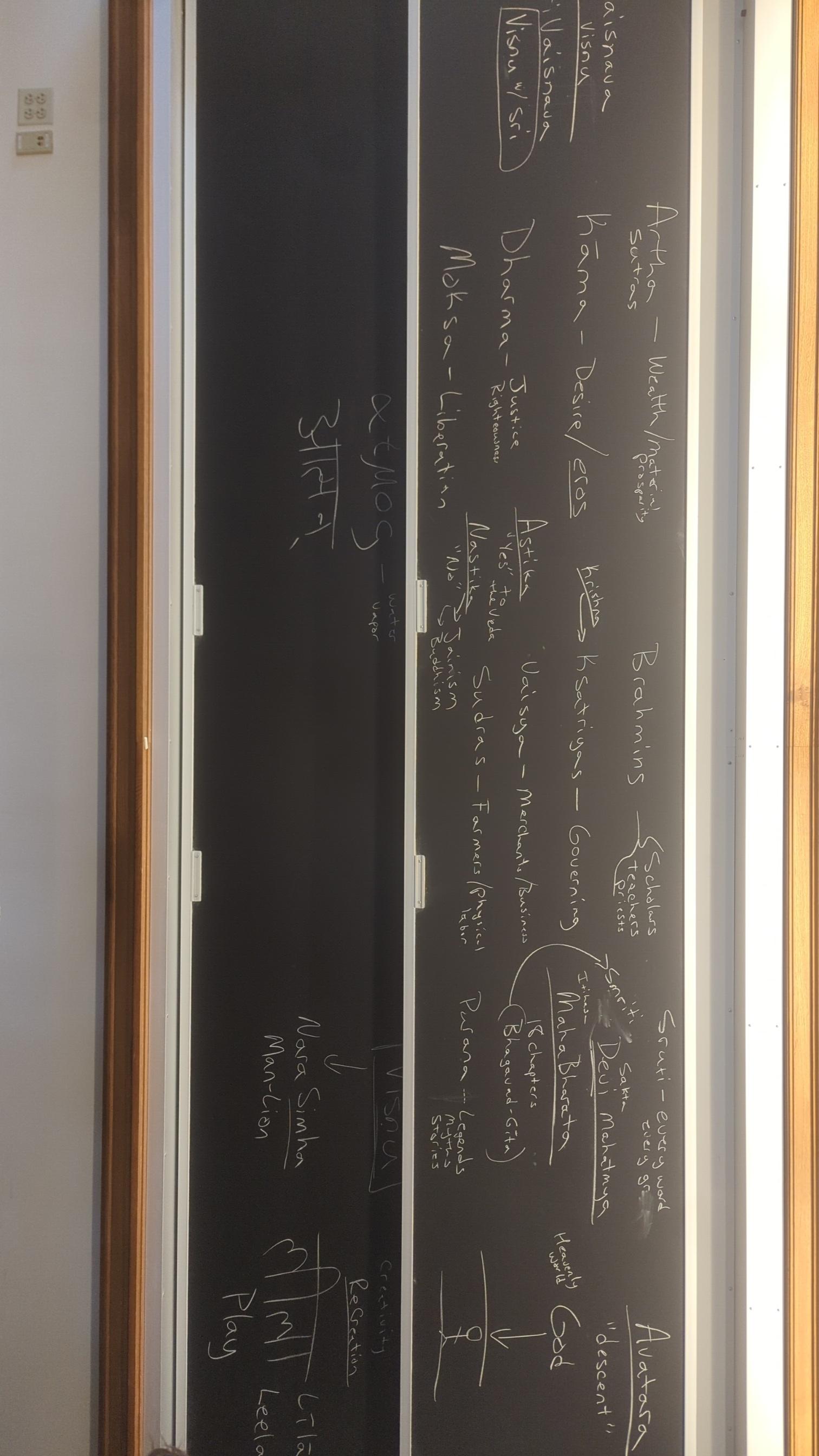
This class session began with a brief centering meditation. Following this, Brad discussed administrative matters, confirming with the class their preference to replace the final exam with a third podcast assignment, which was met with enthusiasm. The core of the lecture involved a detailed review of foundational concepts within Hindu traditions, presented initially as a study guide review. Key topics included the four *Purusharthas* (aims of life), the four *Ashramas* (stages of life), the four *Varnas* (societal divisions based on vocation), the four categories of sacred texts (*Shruti*, *Smriti*, *Itihasa*, *Purana*), the divisions within the Vedas, the *Trimarga* (three paths to liberation), the major divisions of *Bhakti* (*Shakta*, *Shaiva*, *Vaishnava*), the distinction between *Astika* (orthodox, Veda-accepting) and *Nastika* (non-orthodox) schools, and a brief overview of the *Shad Darshana* (six orthodox philosophical systems). Brad emphasized the importance of understanding these frameworks to grasp the context for deeper study, particularly for the upcoming comparison of the Bhagavad Gita and the Gospel of John. The session concluded with an introduction to Krishna as an *avatara* of Vishnu, explaining the concept of *avatara* (divine descent) and briefly outlining the ten primary avatars. A story from the Bhagavata *Purana* about the child Krishna (*Bala Krishna*) revealing the universe in his mouth to his mother Yashoda was shared via video and discussed, highlighting themes of divine play (*lila*) and relationship over worship.
[0:00-3:20] *(background chatter)*
Brad: Absolutely. *(background chatter continues)*
Brad: I'm here.
[3:22-3:39] *(background chatter and settling in)*
Brad: Alrighty.
[3:40-3:47] *(background chatter)*
Brad: Let's center ourselves.
[3:51-3:56] *(settling)*
Brad: I promise that these pants were clean when I put them on this morning. We just had a surprising amount of car repair to do this morning before I left.
Brad: Alright.
Brad: Let's put everything out of our minds, bring yourselves fully into the now.
Brad: As fully into the now as one can get in this world.
[4:28-4:47] *(silence, ambient noise, bell ringing)*
Brad: *(ambient noise continues)*
[4:53-5:46] *(silence, ambient noise)*
Brad: Let's just take one breath together. Go ahead and breathe in.
Brad: Alright. Howdy everybody.
Brad: So, I mentioned the other day that I had a small sample size for the assessment on podcast two. And I've listened to a lot more of them now. And so I think maybe I jumped to conclusions. So I was wondering if how y'all would feel about going back to plan A and having podcast three instead of an exam?
Student 1: *(Class reacts positively, applause)*
Brad: That's a much bigger reaction than the first class I had.
Student 2: *(laughter)*
Brad: Okay. Alright, cool.
Student 3: Oh my goodness.
Brad: Alright, cool.
[6:38-6:41] *(laughter, chatter)*
Brad: Okay.
Student 4: So it was going
Brad: Okay, okay, good, good, good.
Brad: I did create this study guide for the exam. It's not comprehensive by any means at all. But I want to review it together.
Brad: These are still, I think very important things for you to have the proper amount of context to really understand,
Brad: you know, Hindu theology, Hindu traditions is enormous, right? So incredibly enormous.
Brad: We are studying a teeny tiny little part of it. I'm not trying to give you an overview of the whole thing. Just trying to give you, you know, an overview as of some of it and then deep dive into smaller parts of it, right?
Brad: But I want you to understand how those smaller parts that we're diving deep into fit into the larger context of this thing that we refer to as Hindu theology.
Brad: So, to that end, let's go over some of these things. I think what we'll do is I'll give you some more in addition to this, but over the next half, the second half of the semester, we'll just have some more quizzes to kind of, you know, get you to, right, want this, want this stuff to be kind of up here, right?
Brad: So, the four *Purusharthas*. Everybody has one of these.
Brad: Oh, let me check attendance real fast.
Brad: We're missing George?
Brad: We're missing Jack?
Brad: Matt?
Brad: Jack's right there.
Brad: Matt? No, Matt's not here.
Brad: Molly? Molly? Yeah, Molly. Sorry. My bad.
Brad: Addison's there, right? Addison? Yep. Justin? Okay.
Brad: Alright.
Brad: I'm just really off today. I'm just totally off today. The whole first class I was crazy nervous. I broke Boston College. Like I'm nervous now about that. I just broke it. Like broke it.
Brad: Anyway,
Brad: Four *Purusharthas*. So there are lots of fours in here. So let's tackle the first one.
Brad: *Purusha*, *Purusha*, you know, means person. And *Artha*, in this case means, oh, before I start, let me start over.
Brad: What's wrong with me today, Drew? I don't know if it's, Drew's making me nervous.
Brad: So Vanya brought up this etymology of atmosphere. And so I did a deep dive into that. And so the,
Brad: the word atmosphere comes from the Greek *Atmos*. Can't even remember how to draw an alpha. How do you draw an alpha? Yeah, right? That's what I was going to do, but I was like, that's a G, but that's a G. Yeah, so *Atmos* (ἀτμός), which means vapor, water vapor,
Brad: But, obviously, obviously, I think as you're pointing out, connected in some way to this *Atman* (आत्मन्). And *Atman*, something like that. So they're both, Greek and Sanskrit both have this common Indo-European ancestry we've talked about before.
Brad: So clearly these both derive from the same thing. And as I dug a little bit more deeply into the original uses of the word atmosphere in English,
Brad: it seemed to be that the way that they were talking about it as the atmosphere is the why, this is so cool. This totally was like one of the coolest things that I've learned this month at least.
Brad: And so the reason they started calling it the atmosphere, the idea is that the planet, it's like this exhaling, it's like the breath of the planet, right?
Brad: So sort of like one atmosphere. So you've got that idea of the oneness, but also this sort of connection to breath, right?
Brad: So water vapor, so not water, but water vapor, which, you know, like your breath has water vapor, right?
Brad: So anyway, really, really cool, really cool connection.
Brad: *Purusharthas*. So the four *Purusha Arthas*. So *Purusha* means person and *Artha* means aim or goal.
Brad: *Artha* can mean a lot of different things. It kind of means pointing. But in this case, well, in this case, we've got two occurrences of the word *Artha* and they mean different things in both cases.
Brad: So *Purusha Artha*, meaning the aim or the goal of human persons. And the first of those is *Artha*, but with a different meaning. *Artha* in this case meaning wealth, but wealth we could get the wrong idea. I think we really mean just like material, having your needs met at a minimum, right? At a minimum having your, so you could think about it in terms of like Maslow's, the lowest rung of Maslow's hierarchy of needs. So, at the very least having your material needs met.
Brad: There are *shastras* or *sutras* associated with these. So books that are devoted entirely to the study of that thing. And so the *Artha Shastra* or the *Artha Sutras* are, you know, books, ancient books about the pursuit of, I mean they're business, they're business manuals, I think you could say, right? Manuals about business, how to run a business, how to manage finances and that sort of thing.
Brad: Second one is *Kama*. *Kama* meaning desire.
Brad: Really closely associated or very similar in meaning, philosophically and otherwise to the Greek word *Eros* (Ἔρως).
Brad: So if you've studied like Platonic, Plato's erotic dialogues or any sort of *Eros*, in Greek philosophy, serves a very, very similar function in both traditions.
Brad: Even a lot of the iconography is the same. So you've got *Eros* in the embodied form of *Eros*, like *Eros* as a, you know, when you see him, he's a him, right? When he's embodied, he has like a bow and arrow and he'll shoot you at Valentine's Day and, right, cause that desire.
Brad: *Kama* also shoots arrows. So very similar.
Brad: In terms of that. We'll come back to *Kama* later.
Brad: But the idea is that all humans have all four of these goals. So, and the pursuit of any one of them at the expense of the others could be detrimental, right?
Brad: So it's about finding a way to pursue all four in a way that doesn't contradict one another.
Brad: So, pursuing wealth as a human ideal, perfectly good, perfectly fine, perfectly nothing wrong with that whatsoever. It's something common human goal. But if you pursue wealth in a way that contradicts or controverts *Dharma*, right?
Brad: If I'm, if I get wealthy by stealing all of Luka's stuff, well, that's not *dharmic*, right?
Brad: So then I'd be violating this goal for the sake of this one, and the goal the idea is to pursue all of them, right? And to have a balance.
Brad: So, *Dharma*. *Dharma*, I think I tend to not translate, because it just means so many different things.
Brad: But to give you, I think justice and righteousness are good starting points for understanding *Dharma*.
Brad: Then *Moksha*. *Moksha* we haven't encountered before. So, *Moksha* means liberation.
Brad: But for the different schools, the different perspectives on all of these things, we'll have different understandings of what that means. So liberation from what, liberation to what? How do we understand liberation? is going to be different.
Brad: But all of them have in mind this goal of liberation, right? Which could mean in the case of *Advaita*,
Brad: so we've got skipping down to the *Trimarga*, three paths there, that we've covered before.
Brad: So the path of action or *karma*, so then, well, particularly the path of *Jnana*, so path of knowledge that we talked about in the last unit and we'll continue talking about.
Brad: In this case, *Moksha* would mean liberation from ignorance, right?
Brad: So if knowledge and wisdom is the goal, then ignorance would be that what you're liberated from, right?
Brad: And Shankara, the theologian that I've mentioned more than a few times now, the great theologian within from the *Advaita Vedanta* tradition, the non-dual tradition.
Brad: He points out that the scriptures are the only means to liberation. Have to have the scriptures. Can't get liberation without the scriptures.
Brad: But he also says that once you understand the scriptures, once you have that knowledge or wisdom, you don't need the scriptures anymore, right? Once you've once you understand the meaning of a book, you don't need the book anymore, right? Kind of thing.
Brad: And so *Moksha* in *Advaita*, first and foremost, I think means liberation from ignorance.
Brad: But it also ignorance of what? Ignorance of your identity with all, of your identity with *Brahman*.
Brad: So then if I understand myself not just as like a me against the whole universe, right? Jaden versus everything that's not Jaden, right? So that would be a duelist. There's Jaden and then there's a whole world, whole universe, right?
Brad: But instead, *Moksha* would mean Jaden understanding herself as sort of like a, this is me, like a thread in the fabric of the cosmos to quote Brian Green.
Brad: So, yeah, good.
Brad: Now, how these get played out or interpreted in the different systems is going to vary widely, but we're just trying to get a grasp on it.
Brad: Four stages of life, so *Varna Ashrama*.
Brad: I'll go over these very quickly.
Brad: *Brahmacharya* is the student stage. So, you recall when Udalaka, he sends his son Svetaketu off to school and he goes off for 12 years and then comes back.
Brad: That's really the *Brahmacharya* stage. But just because you go through all of that learning, just because you go through all that education, doesn't mean that you learn everything you're supposed to learn, right? Or understand everything you're supposed to understand.
Brad: So even though Svetaketu has technically sort of finished his *Brahmacharya* stage, he's not really ready to move on, right? He doesn't get it. He's conceited and arrogant, all those kind of things.
Brad: we study in the *Chandogya*. Then the *Grihasta*.
Brad: So, *Grih*, it's where we get the English word grasp, come from the same root. So like holding, grasping, right?
Brad: And *hasta* means house. So like *Grihasta* is a house, usually translated householder, because that's literally what the word means.
Brad: So here we can understand this, this is a stage of life, right? So the stage of life where you own a house and usually have a spouse or partner, and you have kids, and you raise a family, right? So *Grihasta* is that huge stage portion of your life where you're doing those kind of activities.
Brad: *Vanaprastha*. *Vana* means forest and *prastha* is like somebody who lives in the forest. So *Vanaprastha* is a forest dweller.
Brad: The idea here is that when your kids grow up and your kids move out of the house, then you have a lot fewer financial responsibilities because you don't have to feed all these people anymore, right? You don't have to take care of those kind of things.
Brad: Often those the ideas that those grown children now, they take over a lot of the responsibilities of farming or business carrying on or whatever. So you don't really have to do those any those things anymore.
Brad: So the closest parallel in our in our culture to *Vanaprastha* would be retirement.
Brad: But the dominant activity, at least traditionally in the *Vanaprastha* stage, is philosophy.
Brad: So this is the time when you go off into the forest. Forest dweller doesn't necessarily mean that they live in the forest, although some, you know, although sometimes, maybe.
Brad: But maybe more that you leave your home in the morning and you go off into the forest or you go off to a library or you go off to place where there are other people and you sit around studying the scriptures, primarily the Upanishads or the other Vedas, right?
Brad: So you're think it's more it's a philosophical stage, a stage of inquiry, investigation, learning, but at that advanced stage of life, right? So retirement for scholarship and learning.
Brad: And then that would lead ideally to *Sannyasa*.
Brad: So *Sannyasin* is the last stage of life. Or it's the, yeah, the last stage at least in this, in this framework.
Brad: *Sannyasin* is, if you go to India, lots of us going to India next week, right?
Brad: If you go to India, you'll see there's *Sannyasins* all over the place.
Brad: And so *Sannyasins* you'll be able to identify. Usually they have, usually they're wearing very, very simple clothing, meaning like a one long, it's almost like a night gown kind of thing, like one very plain cloth, like just like a long like a night robe, like a night gown, right?
Brad: And usually they're, they call them saffron. Saffron is a is an herb, like a spice. And it's deep red, but when you use that to color clothes, it can come out a wide range of shades.
Brad: So, I don't know, my experience, people call saffron clothes like a lot of different colors, anything ranging from like bright pink to kind of orange or red.
Brad: But if you see somebody wearing, you know, pink or orange or red robes, like simple clothing, especially if they're older.
Brad: So the idea is that during the *Vanaprastha* stage, you go off and you study the scriptures and all this kind of stuff. Hopefully, you attain enlightenment, state of, you know, non-duality or union with everything around you.
Brad: And once you reach that stage of enlightenment, then you renounce everything. You renounce all possessions, you even renounce your name, your family, you renounce everything. You have no possessions, no anything.
Brad: And on the most extreme version of it, be somebody who, yeah, like I said, renounces their name and they usually go somewhere where people don't know them, right?
Brad: So people don't know them in their old life, so that they can really be kind of anonymous.
Brad: They go, they sit in the streets usually with a bowl.
Brad: If you see somebody wearing the sort of *Sannyasin* robes and they're holding a bowl, typically, you're not ideally supposed to give them money, you're supposed to give them food, right?
Brad: So, and ideally, you should sit down with them and eat the food with them and study with them and learn from them and learn from their wisdom, right?
Brad: So give them food and share the food with them and learn from them.
Brad: Shankara, Shankara emphasizes that *Sannyasin* stage can come anytime, right? Because what identifies *Sannyasin* stage is not that you've gone through the other stages. He says you can go straight from *Brahmacharya* to *Sannyasin* stage.
Brad: All you have to do is reach enlightenment, right?
Brad: Shankara at least traditionally, attained *Sannyasin* stage as a teenager, so very young, right?
Brad: So anytime you have this understanding or moment of enlightenment, then you're *Sannyasin*.
Brad: We'll come back to a lot of these things later when we get to the Bhagavad Gita.
Brad: By the way, the whole course, I think I've mentioned this before, but just to emphasize, this sorry Gail, did you have a question?
Student 5: Oh yeah, I was wondering, have you ever sat with someone in the Sannyasin stage in like India?
Brad: Yeah, for sure. What'd you learn?
Brad: I mean, so many of them. Yes, so so many of them. Yeah.
Student 5: Oh, so it's like it's a common, like you don't just do it once. It's pretty common. Yeah. Yeah, it's pretty common.
Brad: Yeah. Yeah.
Student 6: Is it common in all parts of India or where did you study in India?
Brad: So I've never been to northern half of India. I've only been to Southern India. I've been there many times. But so Bangalore is where I did my master's work and most of my work.
Brad: So Bangalore is like, if you chop India in half north to south, Bangalore is like in the middle of the southern half. Yeah. Yeah.
Student 7: Does it happen all over India?
Brad: It happened, yeah, of course. Yeah. Yeah.
Student 8: Have you ever sat with a Sannyasin?
Brad: No, I don't think so. Most people just give them some food or something and walk by. Yeah, money is like nothing.
Student 8: Yeah. Yeah.
Brad: So, yeah.
Brad: Good.
Brad: So the whole course, really the first half of the course, my plan is to prepare you for the second half of the course, right? So the whole course, everything we're doing now and everything we have done, everything we'll do between now and spring break is kind of leading up to or preparing you for the deep dive that we're going to do into the Gospel of John and the Bhagavad Gita.
Brad: And so I'll give a little bit more. I will talk about the gospel. No, the Gospel of John. Sorry, I've taught this class, I think this is my ninth time teaching the course. And every other time I've done the Gospel of Luke. This semester I decided to switch it up and do Gospel of John.
Brad: But everything's kind of leading up to that.
Brad: So we'll come back to these things more. Four divisions of society, we encountered these first in the in the Rig Veda, Rig Veda 1090, the *Purusha Sukta*, right?
Brad: So the one of the first texts that we read, in the beginning was this one person, and that one person, you know, like didn't have anything to do, pretty boring to just be the one thing in the universe.
Brad: So it unfolded or became many, right? And from that one person, from the head of that one person came the Brahmins.
Brad: These are really vocational distinctions between between the different parts of society.
Brad: Over time it has become associated more with birth, like socioeconomic often does become associated with who your parents are.
Brad: But from the scriptures, just reading the scriptures alone, it's just more functional or vocational.
Brad: So everybody that's Brahman, so Brahmans are scholars, teachers and priests.
Brad: And usually all three of those at the same time, right? Not drawing, you know, Boston College, you know, lots of people that check all of those boxes, right?
Brad: So Brahmans are in that category.
Brad: Or students who are preparing for that.
Brad: *Kshatriyas* spring from the shoulders and arms.
Brad: *Kshatriyas* is usually translated as warriors, but I think that's very misleading.
Brad: I think better would be to understand *Kshatriyas* as just anything that falls under the category of governing, right?
Brad: So everything from being the king, the *raja*, to, you know, metermaid, like writing parking tickets on Beacon Ave and everything in between, right?
Brad: So anything that has to do with governing would fall under the *Kshatriya* category.
Brad: And we're going to be shifting starting today to talk more about Krishna.
Brad: And so I'll just tell you now, Krishna is a *Kshatriya*. So it falls into this category.
Brad: From the lower regions come the *Vaishyas*. *Vaishyas* are anybody associated with pretty much anything that has to do with business, commerce, anything like that.
Brad: Every crafts people, merchants, business owners, you know, anything that has most things fall into that category.
Brad: *Sudras* spring from the feet of this one person, and they would include farmers, any kind of anybody who does sort of physical labor, that kind of stuff, right?
Brad: So the idea is that this, you know, together they make up this one person in order to have, you know, functioning society.
Brad: You really need all of these things, right? Can't really forego any of them in order to have a functioning society.
Brad: So the idea is to see society as one, right? As one person needing all of these different parts.
Brad: Obviously, if you're more familiar with the Christian New Testament, might you know, Paul's Paul's letter, Corinthians comes to mind when he talks about the, you know, all parts of society making up one person. It's very similar kind of passage.
Brad: So that's the four divisions of society.
Brad: Four kinds of texts, we've talked about quite a bit. Particularly the first two. So *Shruti*, meaning that which is heard, that which is directly perceived, right?
Brad: And then the *Smriti*. *Smriti* means that which is remembered.
Brad: So it's sort of like one step removed, right?
Brad: So if Cameron told me something, then I've got first hand account of what Cameron told me, right? But if Stella comes along and says, you know, Cameron says this, then it's sort of like it's more it's one step removed. Makes sense, right?
Brad: So the idea is that *Shruti* is not only more authoritative, but it's really every every word, every grammatical structure, every, like the words are sacred, right? So the words themselves were heard.
Brad: So you want to make sure that you read and interpret every word.
Brad: So this was the idea behind the last podcast was to have you see how the words of this Upanishad and that Upanishad and that Upanishad, how they all fit together, right?
Brad: Because you've got to if every word matters and every text matters, then you want to make sure that you're reading this text in a way that's consistent with this other text too, right? So no cognitive dissonance or anything like that.
Brad: So in the case of creation stories, right? You've got hundreds, literally hundreds of creation stories and these in these texts, we've only read a small sampling of them, but then so to understand, what do we do with all these creation stories and how do you make sense of them, right?
Brad: And so that's the idea behind *Shruti*.
Brad: *Smriti*, we've already read, so some a number of texts fit in multiple categories at the same time, right? So, the *Devi Mahatmya*, technically is a *Purana*, but really has attained the status of *Smriti*.
Brad: So *Puranas* are legends, myths and stories, typically maybe always about deities.
Brad: And so the *Devi Mahatmya* are these legends, myths and stories about the goddess, right?
Brad: So we read a few of those. We read the story of Durga killing Mahishasura. We read the story of Kali taking out Raktabija, right?
Brad: Those are both from the *Devi Mahatmya*. So you know that they're, right, clearly fits in this category, but because of the importance of this particular text, it's reached the status of *Smriti*, particularly for those communities for whom it's important.
Brad: Then we've got next category oh, and the Bhagavad Gita would fit here too.
Brad: So basically *Devi Mahatmya* are the legends, myths and stories about *Shakta* or the goddess. Bhagavad Gita,
Brad: well, it's not so much stories, it's one story, that again, is technically, well, it's technically *Itihasa*, the next one, but has achieved the status of *Smriti*.
Brad: So *Itihasa*. *Itihasa* usually translated as histories, but they're really epics, they're like epic poems.
Brad: So the Mahabharata, Maha means great, so the great story of Bharata, which is a name for India before it was named India by outsiders.
Brad: But so the Mahabharata is this great epic and it's enormous.
Brad: It is the size of the of Homer's Odyssey and Iliad, it's twice the size of Homer's Odyssey and Iliad combined. So it's very, very big.
Brad: And out of this very, very big, just so many stories. It's, I mean, it's kind of one story, but it's really like a whole lot of stories.
Brad: We'll talk more about those stories later. But just trying to give you context, as much context as we can get today. So within the Mahabharata, out of those hundreds and hundreds of chapters, 18 of those hundreds and hundreds of chapters constitute the Bhagavad Gita.
Brad: So the Bhagavad Gita is 18 chapters out of this enormous epic.
Brad: And the Bhagavad Gita, as we will read, is the story of this dialogue between Krishna and Arjuna. Yeah.
Student 9: Do different communities like all agree on which like what is Smriti or not or is it sort of like
Brad: Good question. No, they don't. All of the, all of the orth, all of the *Shad Darshana*, all of the six systems, they all agree on *Shruti*.
Brad: Although, there's a lot of Upanishads that's like, is this one Upanishad in there or not? So there's some dispute there. But pretty much, pretty much they all agree on that.
Brad: But then the *Devi Mahatmya*, for example, would be considered *Puranas* by the people who aren't Shaktas and would be considered *Smriti* by the people who are Shaktas.
Brad: Yeah. Bhagavad Gita,
Brad: Bhagavad Gita has changed a lot over the last 150 years especially. Prior to that, it would have been considered *Smriti* for a relatively smaller group of
Brad: Hindus. Now it's received, it's attained, mostly through this one political leader, during the anyway, getting off track. But yeah, good question. Yeah.
Brad: *Itihasa*, I think everybody agrees on those. So the two main epics are the Mahabharata, as I just talked about and the Ramayana,
Brad: which is also which is about Rama.
Brad: Story about Rama and his wife Sita. Sita gets stolen kidnapped by a demon and then Rama goes and rescues her, right?
Brad: That's the that's the short version. Longer version has more details.
Brad: And then, yeah, *Puranas*. So we're going to look a little bit today.
Brad: I'm going to show a couple videos of yeah, just cartoon versions or acted out *lilas*, version plays, performances, right? Plays of the of the *Puranas*. And not just any *Purana*, but the Bhagavata *Purana*, which I think I wrote somewhere.
Brad: Cool.
Brad: Questions so far? No, it's a lot I'm throwing at you today, but yeah.
Student 10: Which one is the one that which is heard? *Shruti*.
Brad: *Shruti* is that which is heard. So that's the highest level.
Brad: And, yeah.
Brad: And the idea is once you understand the *Shruti*, it's not just that you've understood the text, but once you've understood the *Shruti*, you can hear it yourself, right? So it's it's like, yeah. Yeah.
Student 11: So, Shruti, that which is heard, Smriti, that which is remembered, Itihasa?
Brad: *Itihasa*, epics, epic stories, epic poems, epic, I mean, technically, it means histories. But history's more emphasis on the story part of history than the
Student 11: And then Puranas like legends. Puranas, legends and stories. Yeah. Yeah.
Brad: Yeah.
Student 12: Does Shruti kind of relate to like the clay analogy where it's like once you understand the clay, then you understand everything that's made up of the clay? Shruti is like you understand the words, then you understand everything that's made up of the words? Is that kind of a similar concept or is that distinct?
Brad: Yeah, yeah, maybe. Yeah.
Brad: Okay.
Brad: Four kinds of texts we've talked about. Four traditions or divisions, Rig, Yaju, Sama, Atharva.
Brad: Rig, Yaju, Sama, Atharva. Usually I write Rig, Sama, Yaju, Atharva. I don't know why I wrote them in that order.
Brad: The four kinds of texts within each division. We've gone over those so many times, right? *Samhitas* are the hymns.
Brad: We read three of those.
Brad: The *Brahmanas* are the ritual texts. The *Aranyakas* are sort of these proto philosophical. I mean, but we read the *Brihad Aranyaka*. *Brihad* meaning big and *Aranyaka*, right?
Brad: So, *Brihad Aranyaka* is one of those that kind of fits in both of those categories.
Brad: Meaning that category and then Upanishad.
Brad: *Upanishad* is a discussion about some debate about the etymology of the word. And I mean debate among among the most authoritative theologians. Even Shankara gives two different etymologies of the word.
Brad: So on the one hand, most people say the etymology of the word means at the feet of the teacher, right? So Upanishad is you're studying at the feet of the teacher.
Brad: All of the Upanishads, virtually all of the Upanishads, are dialogues between teacher and student. So we saw Udalaka and his son, Svetaketu, and you know, all of these there's like, they're dialogues almost, almost always.
Brad: The other definition of the other etymology of Upanishad that Shankara gives is it's it's that which destroys. It's like it's destroys. What does it destroy? Of course, ignorance, right? So it's the destroyer of ignorance.
Brad: Which is which is important because it's not about giving you knowledge, right? It's not about teaching Jack something as much as it is eliminating Jack's ignorance, right?
Brad: So ignorance is ignoring, right? So ignoring the non-dual the non-duality yeah, of yourself and not self.
Brad: Four levels of awareness. We've definitely gone over that, particularly in the Mandukya Upanishad. The *Trimarga*, I went over those, but I'll go over them again quickly.
Brad: So *Mimamsa* is *Karma Marga*, the path of action. *Moksha* through action. So *karma* is the means of liberation.
Brad: And *karma*, in particular, we'll come back to this when we get to the Bhagavad Gita, but *karma*, as I've said before, means performance of the Vedic rituals, which are described in the *Brahmanas*, right?
Brad: So, through performance, so when we say action, prior to the Bhagavad Gita, action or *karma* means the rituals, performance of the rituals. So that's the action that's meant here.
Brad: Vedanta is *Jnana Marga*, so the path of knowledge. So then *Moksha* means, right?
Brad: destroying *Moksha* or liberation from ignorance.
Brad: And *Bhakti Marga*, we'll look at more when we get to the Bhagavad Gita, but devotion, devotion to God, right?
Brad: So then if you're devoted to God, then God will take care of everything.
Brad: Three plus major divisions of *Bhakti* today. Also went over these when I introduced the *Devi Mahatmya*, but
Brad: just to it's a lot, so just to give it give you a little bit a little bit of a review. So there are roughly a third, roughly a third of all practicing Hindus today fall under the category of devotees of *Shakta*, *Shakti*. So the goddess, right?
Brad: So worshiping God in the form of Devi or in the form of the goddess, right? Durga or Kali or any of those.
Brad: About a third, a little less than a third, I would say, are devoted to
Brad: or worshiping God in the form of Shiva. Unfortunately, we won't really be talking about that at all this semester. *Shaiva Siddhanta* is dope, super dope, but just kind of a little bit more advanced than what we can cover in an intro course.
Brad: And then *Vaishnava*. So we'll spend a lot of time from here on forward talking about *Vaishnavism*.
Brad: *Vaishnava*, can be divided into or separated, I guess.
Brad: So there's *Vaishnava*, which is worship of God in the form of Vishnu.
Brad: Vishnu is really, really only a name that's used in the in the *Shruti*.
Brad: It doesn't come up that much elsewhere other than to say this is an *avatara* of Vishnu. We'll come up come back to that word in a second.
Brad: So you've got *Vaishnava* traditions which are devotion to God in the form of Vishnu.
Brad: And then *Shri Vaishnava*, which is devotion to God in the form of Vishnu with Shri. Shri is the feminine, the feminine consort, right?
Brad: So the idea of *Shri Vaishnava* traditions is that you can never think about, you can never properly think about God without having both the masculine and the feminine together, right?
Brad: So masculine and feminine don't collapse into one. Masculine is masculine, feminine is feminine, but you can never have one without the other. Yeah.
Student 13: Could you repeat what's the deal with Shiva?
Brad: Shiva? So devotion to God or worship of God in the form of Shiva. And I didn't really say much about it other than we're not really talking about it that much this semester.
Brad: But Shiva is just another another form of the divine. And, yeah, I would be happy to talk about it a little bit more later, but that's all you need to know for now.
Brad: Yeah. Yeah.
Student 14: A question. How many gods are there?
Brad: 330 million.
[44:44-44:49] *(laughter)*
Student 14: But they mostly just worship a few of them or?
Brad: Well, come back to that maybe. Yeah. So,
Brad: I mean, the idea is that God is infinite, right? So then infinite God has an infinite number of forms, right?
Brad: So, but you can't picture infinite, right? Infinite, if you picture it, it's not infinite, right?
Brad: So the idea is that an infinite an infinite deity would need an infinite number of forms and any one of these forms will suffice, right? We'll come back to that question. Yeah.
Student 15: Is there something particularly special about the form of Vishnu that makes it or him or her more worth worshipping as opposed to all the others?
Brad: I mean, for the Vaishnavas would answer that differently than the Shaktas, right?
Brad: Yeah, I don't think I need to tackle that one right now either. Yeah. Other questions that I'm not going to answer?
[45:48-45:49] *(laughter)*
Brad: Cool.
Brad: Fun fact, I was challenged to a duel. Yeah.
Brad: I didn't accept the challenge.
Brad: Yeah, I was, I was, this is a tiny bit of a flex, but I was on the, the Board of Review at Harvard Theological Review.
Brad: So like if you're going to get something published at Harvard Theological Review, you submit your paper and if it had anything to do with Hindu theology or or some or comparative theology, had to go through me, right? And then so, mostly my job was to reject papers or come up with a good reason to reject papers.
Brad: Anyway, this guy wrote wrote a paper and he was arguing something about the 108 *Divyadeshas* of the Shri Vaishnava tradition in Southern India and he had like identified these 108 locations.
Brad: And 108 is like a super special, super auspicious number. Very few people think that it means that there's 108 of them. It's just like a special number. You know what I'm saying?
Brad: So, but he really wanted to categorize and identify which of the thousands of places that can claim to be one of the 108 were the actual 108.
Brad: Anyway, I rejected it. But he, he resubmitted the article after revising it and I had to review that as well.
Brad: And in one of the footnotes, he directly challenged me, the reviewer who rejected his first proposal to a public duel and he had a place and time. I'm going to be at this place. It was like Chennai, you know, on this date and, you know, you I'll see you there basically. It was like
[47:42-47:43] *(laughter)*
Brad: That was kind of cool.
Student 16: Swords or pistols?
Brad: I think it was, you know, I mean, no, I think it was like a public debate, yeah. But I called it a duel.
Brad: Moving on.
Brad: *Smarta Brahmins* we can leave aside.
Brad: Authority of the Veda. So there's two, this is more meta than the *Shad Darshana*, right? So *Shad Darshana* is pretty meta.
Brad: Meaning these six orthodox, six orthodox perspectives. But what makes them orthodox is that they're *Astika*.
Brad: *Astika*, literally the word means person who says yes, but what it means is they say yes to the Vedas, meaning the Vedas, the Veda, Vedas, are sacred, right? Sacred revelation.
Brad: So the *Astika* traditions are the ones that we're studying this in this class. So those traditions that say yes to the Veda, meaning the Veda is is sacred.
Brad: *Nastika* are other, you know, traditions, Indian theological traditions that say no to the Veda.
Brad: And the most, the most prominent among these are Jainism, which I would love to smuggle somewhere into the smuggle into the course somewhere, if we can.
Brad: But Jainism is as old as Buddhism, but not as well known.
Brad: But they say they reject the authority of the Veda.
Brad: Buddha also. Buddha when he was, if you've
Brad: studied Buddha at all, you know that the Buddha grew up a very sheltered life, right? Helicopter parents, all that kind of stuff. Then when he became an adult, he left the palace and learned about suffering and all these kind of, you know, injustices in the world.
Brad: And at that point, he began his journey, his long journey of studying philosophy and theology.
Brad: And he studied with a *Sannyasin*. So he encountered a *Sannyasin*.
Brad: One of the things that surprised him about the *Sannyasin* is the *Sannyasin* was crazy poor, totally like old, dying, sick, you name it, right? All the things that nobody wants to be. But he was crazy happy, like super happy, right?
Brad: And the Buddha was super confused, like how can you have such a shitty life and be so happy, so fulfilled and all this kind of stuff.
Brad: So he started studying with the *Sannyasin*.
Brad: We don't know exactly what he taught this taught the Buddha, but pretty safe bet that it's a lot of the same stuff that we've been studying, right? The Upanishads or earlier versions of the Upanishads at least.
Brad: So studying studying all those things. And the Buddha at first was super into it. He was very, very into it.
Brad: But at some point became disenchanted with it and said, no, this this ain't quite doing it for me.
Brad: And then said no to the Vedas, right?
Brad: So then he came up with his own philosophy after that, which is certainly not unrelated to non-dualism, but but different nonetheless.
Brad: So that's *Astika* and *Nastika*, but really this class we're just talking about *Astika* traditions.
Brad: *Shad Darshana*, certainly
Brad: have plenty of insight about those. *Nyaya* and *Vaisheshika*, logic and atomism, went over those the other day.
Brad: Adam, matter and energy, teach that God is the author of the Vedas.
Brad: Moving to *Sankhya* and *Yoga*, dualist, *Purusha*, *Prakriti*, two bed sheets, matter and energy, all those kind of things that we talked about.
Brad: The existence or non-existence of God is really just not even talked about, just not even covered.
Brad: So, God doesn't, the word God doesn't really come up in any of those texts. And when it does, there's nothing really profound said about. So it's just really non-theistic, I think would be the best description.
Brad: *Moksha*. Okay, so here's one thing that I haven't given.
Brad: So, right, going back to the bed sheets analogy, right?
Brad: So, like, if I push down on these, then anytime you have this joining, yeah, a joining of spirit and matter.
Brad: Then we get, you know, an Eric or a Jorge or a Luka, right? So Luka is matter and spirit, right?
Brad: So, and they aren't joined.
Brad: So then what would *Moksha* mean? Because it's not really separation would be death, right? So *Moksha* in this case, means more like balance, I would say, right?
Brad: So, if you, I'm sure any BC students very familiar with this issue, like where you get super in your head, right?
Brad: Like you just can't, like sometimes you're just so into your head that you don't even know what's going around you, right? Maybe some of you are there right now. It's like super in your head that you're not aware of what's going on around you, right?
Brad: Sometimes it can go the other way, right? If you're in a state of, if you feel like you're in danger or uncomfortable or you're in the club and you don't know anybody, just my experience.
Brad: Then, like, you know, you're super hyper aware of everything around you and you're not in your head, you're very much in your body, you know what I mean?
Brad: So yoga then, we could understand *Moksha* in the yoga tradition is more is finding the right balance between these two, right? Finding a harmony between.
Brad: So if you're talking about yogic exercises, yoga *asana*, which is what most people think of when they think of yoga. It's about finding the balance, right?
Brad: A lot of yogic practices about the breath, breath control, and a lot of that is about quieting your mind, getting your mind and your body in the right balance, the right harmony, you could say, right?
Brad: So that's *Moksha* in those traditions. And then *Moksha* in Vedanta is, like I said, liberation from ignorance.
Brad: I gave you a little bit more there. So I gave you the first line from the *Purva Mimamsa Sutras*, *Athato Dharma Jijnasa*, which,
Brad: just means now then an investigation into *Dharma*.
Brad: So *Mimamsa* is focused on *Dharma*, but like I said, how *Dharma* is achieved is by understanding the Vedic rituals properly and not just understanding them properly, but doing them, right? So the action, the *karma* of doing the rituals is what really matters.
Brad: And the Veda tells us what is to be done, so something futural, right? Something that needs to be brought into being, and and how, that's the methods of the rituals.
Brad: I gave this early in the semester too, but just to repeat it, *Shabdamatram Devata*, God is nothing but a word.
Brad: So the most important thing for the *Mimamsakas*, I mean, most important thing about God, for the *Mimamsakas* is that you pronounce the word properly and at the right time, right?
Brad: And the only thing that really matters or special about the word is that it's in the dative, right? Because you can't give, you can't, you can't sacrifice unless you're sacrificing to something, right?
Brad: And so you need that word there.
Brad: The scriptures are *ananta* and *apaurusheyatva*. So *ananta* just means endless or eternal and *apaurusheyatva* means not from human origin. So not not authored.
Brad: They're just there to be heard, right? *Shruti* means heard.
Brad: Vedanta, the Vedanta Sutras begin *Athato Brahma Jijnasa*. So now then an investigation into Brahma.
Brad: Primarily concerned with the Upanishads. All these things I've said so many times.
Brad: We'll come back to that *Satkaryavada* later.
Brad: There are numerous schools within Vedanta. *Advaita* and *Vishishta Advaita* are the only two that we're really talking about this semester, although *Tantra* is definitely,
Brad: would be cool too. Probably less appropriate for Boston College.
Brad: Just because it has to do with sex. A lot of sex.
[56:09-56:10] *(laughter)*
Brad: I said sex. Sex.
[56:15-56:16] *(laughter)*
Brad: Then, all of these words there, *Karma*, *Dharma*, *Moksha*, *Atman*, and *Brahman*.
Brad: These are really important terms for all of these six perspectives, but they're understood quite differently by all of these six perspectives.
Brad: So understanding the nuances and the differences, sometimes significant differences between them. So they're using the same word, but often in very different ways, right?
Brad: But we're only studying, we're mostly studying Vedanta, and these two versions of Vedanta, *Advaita Vedanta* and *Vishishta Advaita Vedanta*, which we need to get to.
Brad: *Karma* means action, *Samskara* means trace. We'll come back to that later.
Brad: On the back side, I gave you the four *Mahavakyas*. Definitely not going to review those now, because we've reviewed them a lot.
Brad: I want to shift gears now in the last 20 minutes, 19 minutes. But any questions about any of that stuff?
[57:21-57:24] *(silence)*
Brad: Good. Then, let's talk a little bit about this kid named Krishna.
Brad: So, you got there that blank spot, Bhagavata *Purana*.
Brad: So it's one of the *Puranas*. These are the, so in the same way that the *Devi Mahatmya* is a *Purana* about Devi, the Bhagavata *Purana* is a *Purana* that's about Krishna.
Brad: Or Vishnu, but mostly Krishna.
Brad: So Krishna is an *avatara*. The word *avatara* means descent.
Brad: It will be, this is one of the main reasons I won't was interested in studying John's gospel together with the Bhagavad Gita because I think we could say that the,
Brad: Luke's understanding of Jesus as Christ is quite significantly different than *avatara*.
Brad: But John's, maybe not so much. So we'll, anyway, I'm getting ahead of myself. We'll look at that later. But *avatara* means descent.
Brad: So different than an incarnation. Incarnation is like you've got a body and then and a spirit becomes incarnate in the meat, right?
Brad: *Carne* meaning the flesh. So, the spirit
Brad: enters the flesh. But *avatara* is a bit different.
Brad: *Avatara* sort of like directly descends, right? So God descends, not taking sort of physical form, but appearing as physical form, appearing as a person, but never stopping being.
Brad: So in, in orth, in traditional Christian theology, certainly those in my class last semester learned, you've got the dual nature of Christ.
Brad: Christ is considered both fully human and fully divine. *Avatars* are not not the case at all.
Brad: *Avatars* are fully divine, period, not human, fully divine.
Brad: So Krishna is one of those avatars, but one of 10. So I give you the list 10 avatars of Vishnu.
Brad: The first three all have to do with the great flood. So *Matsya* rescued the rescued the earth, rescued Manu, the first person, like sort of the Adam, from a flood. *Kurma* rescued the earth from a great flood. *Varaha* rescued the earth from a great flood.
Brad: *Narasimha*. So let me tell the story of *Narasimha* super fast.
Brad: So, just sort of like as a as as an example of these sort of tropes.
Brad: So, when I taught the *Devi Mahatmya*, I gave you this I said the most of these *Puranas*, most of these myths and stories follow pretty similar trope, or at least there's a super common trope.
Brad: And that trope is that, you know, somebody somebody gets, somebody does some good stuff, right? Addison goes and he does some good stuff. And then the gods are like, whoa, look at what Addison's doing. Let's give Addison some more power, right? And then so that he can do more good stuff.
Brad: And then Addison does more good stuff. Cycle continues until finally Addison gets like all up in his head and he's like, I'm the greatest ever and I'm just going to I got a mandate to do everything. And then, then the gods are like, oh, snap, we got to intervene here, right?
Brad: So the story of *Narasimha* follows the same basic trope. You've got this kid with I just one of the coolest names ever. I briefly thought for like five minutes about naming my son Hiranyakashipu and then that that was suggested that that might not be the best idea. But Hiranyakashipu, it's kind of just a fun name to say, isn't it? So Hiranyakashipu, let's all say it together. Hiranyakashipu. Perfect. That's exactly right. Nailed it.
Brad: So Hiranyakashipu was, you know, he was he did some good stuff. The gods were like, yo, let's give Hiranyakashipu some some rewards. And
Brad: he was like, you know, I want to be immortal. I want to be I want I want to live forever, be immortal.
Brad: And they were like, bro, that's like the one thing we can't do. We're not going to do that, right?
Brad: And he's like, okay, fine. Well, how about I don't want to be killed inside or outside, right?
Brad: And they're like, yeah, sure, okay, we can do that.
Brad: You can't be killed inside or outside. He does some more good stuff. He gets another boon. He's like, I don't want to be killed during the day or during the night. And they're like, sure, we can do that for you.
Brad: And then does some more good stuff. And he's like, I don't want to kill, I don't want to be killed by a human or, you know, a non-human beast.
Brad: And they're like, sure, we can do that, right? Etc, etc. Some more, you get the gist, right? It goes on.
Brad: Hiranyakashipu becomes bad guy, right? And they're like, oh, we got to intervene and, you know, do something.
Brad: So they all go to Vishnu. People go and appeal to Vishnu, pray to Vishnu. Hey, can you take care of this kid?
Brad: Right? We saw the same exact trope in the *Devi Mahatmya* and all the gods pull their power together, give their power over, and then Devi is the manifestation, embodiment of that power, pure power.
Brad: Here, Vishnu's like, I don't need anybody else. I can do it. Take care of it.
Brad: And so Vishnu descends and he descends and takes the form of *Narasimha*.
Brad: So *Nara* meaning man and *Simha* meaning lion, like Simba, like the Lion King, right? So *Narasimha*, half man, half lion.
Brad: He appears at dusk. So it's neither day nor night.
Brad: So he's not a man or a lion, he's a man lion, right?
Brad: And it's neither day nor night, it's like dusk. He appears in like the door jam, you know, of the house.
Brad: So he's neither inside nor outside. You get the gist, right? And then he, he I got a picture.
Brad: Um, he, usually *Narasimha* has his hands like inside of his, he's disemboweling him. And in a lot of the depictions, a lot of depictions, Hiranyakashipu is like pretty stoked about this whole thing because he's like in God's lap and God is like got his hands all over him and he's like, what's not, you know, it's nice being so close to God.
Brad: Too bad he's like ripping my bowels out.
Brad: So anyway, that's one of the avatars. That's *Narasimha*.
Brad: Lots of other stories with these other avatars. But for most of this semester from here forward, we'll be talking about Krishna.
Brad: And so Krishna is another avatar. And Krishna's,
Brad: I think fair to say, Vanya could probably tell you Krishna's pretty popular, right? Krishna's kind of everywhere. You go to India, you see Krishna everywhere.
Brad: And probably most popular in his form as *Bala Krishna*. So *Bala* means child.
Brad: So Krishna as as in the form of a child.
Student 17: It's *Bal*.
Brad: *Bal*? *Bal*, yeah, *Bala*, *Bal*. Okay.
Brad: In Hindi? Yes. And so we'll watch we'll watch a little video. So this is
Brad: very famous story. So this is one of the stories from the, the Bhagavata *Purana*.
[1:05:42-1:07:19] *(Video playing with narration in another language and background music)*
Brad: Just so you can keep up.
[1:07:20-1:07:30] *(Video continues)*
Brad: Why is the one
[1:07:31-1:07:34] *(Video continues)*
Brad: I know watch
[1:07:35-1:07:47] *(Video continues)*
Brad: Live action one.
[1:07:48-1:08:16] *(Video continues)*
Brad: Where's the menu?
[1:08:18-1:08:20] *(Video continues)*
Brad: I'm just going to keep going.
[1:08:20-1:09:59] *(Video continues)*
Brad: the whole universe.
[1:10:00-1:10:13] *(Video continues)*
Brad: But yeah.
[1:10:14-1:10:16] *(Video continues)*
Brad: Um
[1:10:17-1:10:21] *(Video continues)*
Brad: So, a couple things about this couple things about this story. One is in the Bhagavata *Purana* version, the the original version of the story.
Brad: So Yashoda looks into his mouth and she sees the entire universe as you saw. But it kind of zooms more and more in.
Brad: And finally, you know, starts like seeing the whole universe and then galaxies and then, you know, the the planet, and zooming in, and she winds up seeing herself looking into Krishna's mouth, right?
Brad: So she sees, yeah, so it's sort of this whole Klein bottle inside outside, you know, kind of thing.
Brad: And then after that, like she didn't know, like it's kind of trippy, right? So she doesn't know how to respond.
Brad: But she realizes that he's, you know, God, right?
Brad: And so she she does what I think, you know, most people do, which is like kneel down and pray to him, right? Give him homage, like pray to pray to him as God because she realizes he's God.
Brad: And he's like, this like not what Krishna's about, right?
Brad: Like he didn't come to be worshiped or served or venerated or any of that kind of stuff, right? He came to play.
Brad: The whole point of of being is to play.
Brad: He comes down sometimes to like take care of bad guys that are destroying the play, right? But he really came down to to play and to to be, just to be, right?
Brad: So he does not want her to worship him and he's bothered by the fact that she's worshiping him.
Brad: So, what does she do? She erases his mind, he erases her mind, right?
Brad: So that she he causes her to forget that he's God, right? That he's Vishnu in avatar form.
Brad: so that she can go back because what he wants her to be is his mom and what he wants to be is her child, right?
Brad: So they're playing these roles and he wants her to play that role. He doesn't want her to worship him. Yeah.
Student 18: You say that they're that the Avatara aren't human though, like Jesus? Where does that come into play? It seems like they want that human relationship.
Brad: So he's pretend he's playing as a human and he wants that relationship very much so, right?
Brad: And so he can, so yeah, he that's really the form, that's really why Krishna has come is just to be in relationship with with others, right?
Student 18: Is that different from Jesus though in Christian texts, you know, where Jesus is kind of doing the same thing wants to be Sure.
Brad: I mean, I think that aspect is not very different. Yeah.
Brad: But the the point I was trying to draw is between traditional notion of incarnation versus Krishna isn't an incarnation, he's he's God descending and God form, right? Cool. Good.
Brad: Uh, so I will give you something to read for Tuesday. I'll email that or something like that. Um, hope you have a good weekend.