 ```html
This class session began with a brief meditation. Brad addressed the class regarding the recent podcasts, expressing satisfaction with the quality and proposing a return to the original plan of completing a third podcast instead of a final exam, which the class agreed to. They reminded students about text requirements for after spring break, emphasizing the need for printed copies and no screens. The core of the lecture involved a review and expansion of key Hindu concepts using a handout. Topics covered included the Purusharthas (goals of life), Ashramas (stages of life), Varnas (divisions of society), types of sacred texts (Shruti, Smriti, Itihasa, Purana), major Bhakti traditions (Shakta, Shaiva, Vaishnava), the distinction between Astika and Nastika schools, and core Vedanta concepts. The lecture then transitioned to the theme of Lila (divine play), linking it to the creation narrative in the Bṛhadāraṇyaka Upaniṣad and discussing Vishnu's avatars, particularly telling the story of Narasimha. The class watched and discussed short videos depicting stories of Krishna from the Bhagavata Purana, focusing on his playful nature and the concept of Lila as the purpose of existence.
[Silence]
Brad: Let's clear our minds, put everything out. Be fully in the now.
[Singing bowl sound]
[Silence]
Brad: Let's take one breath together. Go ahead and breathe in. And let it out.
[Students sneeze]
Brad: Bless you. Bless you.
[Student sneezes]
Brad: Bless you.
Brad: So, I listened to more of the podcasts now. I mentioned last time that it was a small sample size. And yeah, I've listened to far more of them now. And yeah, I think I, I think I may have jumped to the wrong conclusion there. Really very nice job. On the ones that I've listened to. With only a couple of, you know, some some issues, but that's normal for the second podcast, you know, especially for folks that's never done it before. So, so I think I'm just going to handle those a little bit, you know, more on a individual basis. And would anybody object to returning to plan A and going back to podcast three instead of the exam?
It's okay? It's okay? It's okay with everybody? All right, let's do that then. So we'll still have class next Thursday as usual. And still have podcast three. Basically just, you know, ideally done before you go off for break, but as long as I get it before the end of spring break, you're you're fine, you know.
But go ahead and get it out of the way so you can enjoy your spring break. That's important.
Brad: I do have a handout, so that one around. Did I get all the extras? There should be like twice as many. So, let's see, what to do today? We're we're starting to talk about Lila now. That's really what the shift is. We're still kind of out of the Tuesday, Thursday, you know, Hindu, Christian pattern, but we'll, we'll really stick to that after spring break. Like I said, I already talked about the the texts. Again, you do not have to purchase any texts. But if you were to purchase a copy of the Gita, then I gave you those two that I recommend. And the Oxford annotated English, New Revised Standard Version of the Bible is the preferred text, but I do have a PDF of that, so I can give that to you. I'm not going to print them all out for everybody. So, you know, but I'll give you the PDF so you I do want everybody to have a printed text. I don't want any no screens, no, not even tablets for the, for after spring break, right? So that we're just really want to keep the text at the center, to keep the text, yeah, at the center.
Let's go through, what do I want to do today? I want to start, oh, please, if anybody wants...
I'll just pass it around. You can take, you can take some if you want. It's not, we're not going to be really talking about it or anything. But but it's nice to have something to play with, right?
Okay. I don't know why I'm so nervous this morning. So, let's quickly go through some of this sheet. I created this sheet a few years ago. Actually, my last years of doctoral study, I created this. My my professor said that, you know, you should have like a one-page intro to Hinduism. Or Hindu theology. So, you know, so I did. Actually, this did fit on one page and then I added this this morning. But yeah, some of the, a lot of this we've gone over, and some of it we haven't. I'm not going to go over all of it now, but but I want to make sure that you have, that you have these terms.
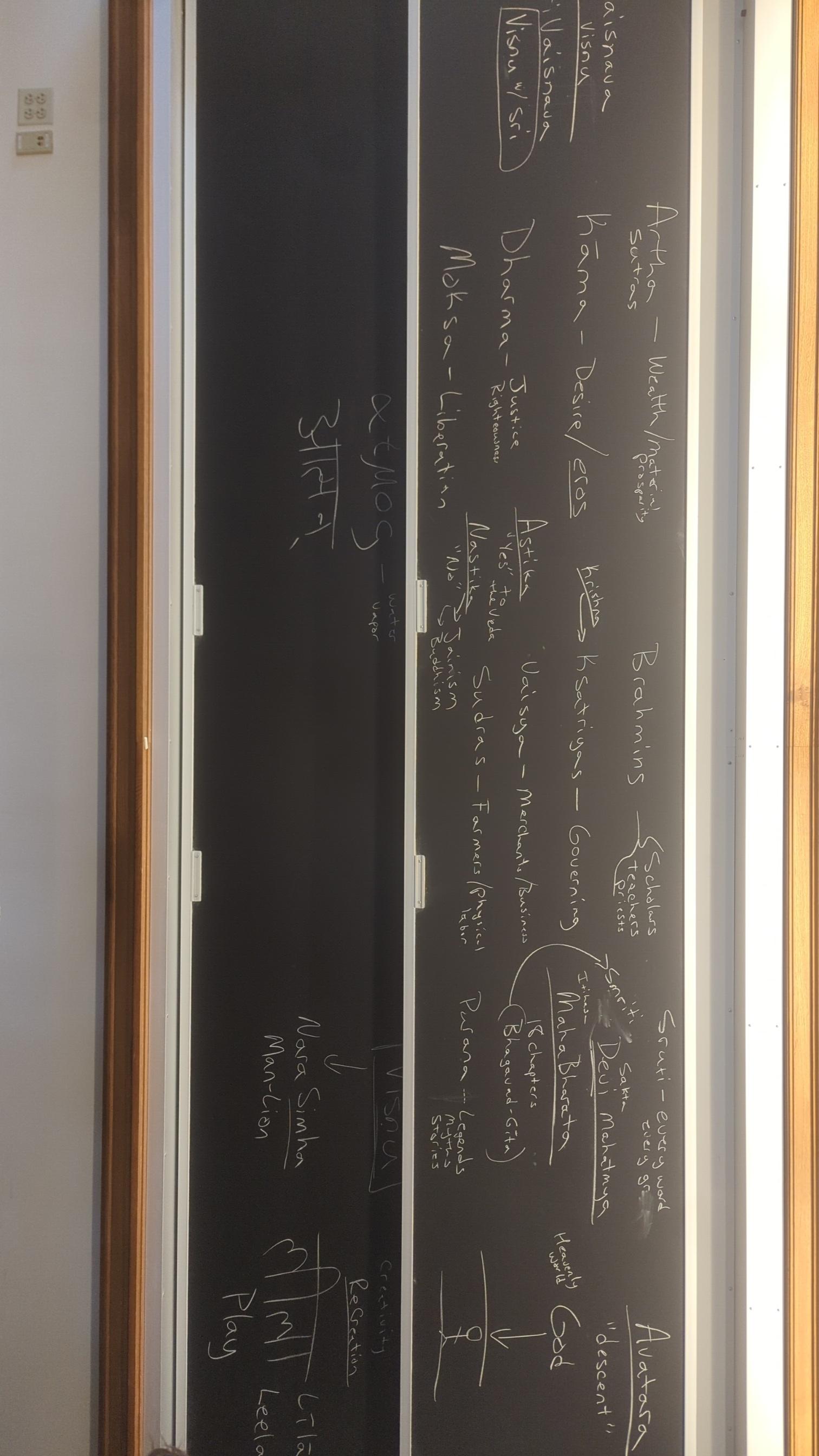
Brad: So, let's jump on the first one. So the Purusharthas. Purusha meaning person and Artha meaning goal. And so according to, you know, sort of traditional orthodox Hindu theology, the six systems, the six, the Shad Darshana, which is sort of like the the core orthodox perspectives. All of them identify these four. They may prioritize them in different ways and describe them in different ways. Plenty of differences, but they're always these four. So Artha, Artha can mean a lot of different things, but in this context, in terms of the Purusharthas, it really means material, material wealth, material prosperity. So, yeah, so Artha, again, this word in other contexts will mean other things. Even in the word Purushartha, it means something different. In Purushartha, it means the goal or the aim, that towards which you point. But when we talk about the it as a goal, we mean some sort of wealth, right? Material, I think material prosperity. Wealth can get, wealth may wealth may imply something a little bit different. But what we mean is everybody wants to have enough to take care of themselves, right? Everybody wants to have basic human needs, everyone wants to have a house, clothing, basic human needs, right? So bottom, bottom level of Maslow's hierarchy, et cetera. Kama, oh, there are also sutras, like sacred texts for each one of these. So the Artha sutra, is the, is, it's sort of, it's not, it's not a part of the Veda, it's like ancillary to the Veda, like a side thing to the Veda. But it has to do with wealth and material business ethics, business, a lot of business stuff. So how to have a successful business really. Kama means desire. It's almost exactly, almost exactly aligned with the Greek word Eros, which hopefully you studied a lot in your philosophy classes. So, like the, like Plato's erotic dialogues. Eros is something that yeah, in this context, Kama means primarily physical desire. So primarily physical or sexual desires, not exclusively, but primarily physical, yeah, physical, sexual desires. Then the third is Dharma. And Dharma, Dharma, I don't really think we can translate at all. Prefer if we just keep it Dharma. But but for the sake of, you know, giving you some sort of grasp on it. I think it could easily be translated especially in this case as justice, some sort of righteousness. Also kind of means like proper order of things or proper place. But I think justice and righteousness that that's pretty good, is pretty good start. And then Moksha. Moksha, we have talked about. Moksha means Moksha means liberation. Liberation from what is going to differ from various schools, liberation to what is going to differ from the various schools. But in terms of the Jnana Marga, which is what we've mostly been studying this this unit. Jnana, what is Jnana Marga?
It's there like halfway through the page.
Yeah, Brett?
Student 1: The path of knowledge.
Brad: Path of knowledge, path of wisdom, path of learning. So, in that case, Moksha would mean liberation from ignorance, right? In other contexts, it's going to mean different things for different schools. But oh yeah, Moksha through wisdom, Moksha from ignorance, basically. And in that case, in Advaita Vedanta, it really means liberation from isolation or loneliness, right? So then not thinking of yourself as isolated or separate from the world, right? Riley against all of the universe, but instead part of like you're a thread woven through the cosmos, right? So you're understanding yourself as non-separate or non-different ontologically from, from everything else that is. But Moksha can mean different things in different, in different contexts. Well, Moksha always means liberation, but it can mean liberation from or liberation to different things.
Brad: Four stages of life, we can explore this in more detail later. But let me just give you quickly sort of definition of each one of these. So Brahmacharya is, let's just say student stage. So really being a student, learning, this is the stage of learning. This is, if you remember in the Chandogya Upanishad, Svetaketu goes off for 12 years and then he comes back home after 12 years. And so he thinks that he's finished the Brahmacharya stage. That's why he's conceited and everything. But just because you graduate college doesn't mean that you know shit, right? So he's not exactly wise yet. So he's still kind of in that Brahmacharya phase, but he's technically finished it. Grihasta. Grihasta, literally means, so Gri means to grasp, and Hasta means house. So Grihasta is householder, literally means householder. So somebody, when we're thinking about Grihasta, we mean, you know, that stage where somebody gets married and they have a house and they have children and they grow, you know, their family, family kind of person, right? So that family stage when you're a parent. Vanaprastha, Vana means forest and Prastha means like one who lives in the forest, right? So Vanaprastha is a forest dweller, one who lives in the forest. They probably don't literally live in the forest. It's more about, I think in our, we don't really have a corollary to this in our society and culture, but the closest thing to it would be something like retirement. So when your kids are done, when your kids are moved out of the house, your kids are adults. Then you no longer have responsibility for your kids. Usually at that stage, your financial responsibilities are far lower. And so, you're not concerned with all those kind of things. Usually the kids that at that point take over the business and that kind of stuff. And during the Vanaprastha stage is when you go off into the forest, either literally or metaphorically, to study philosophy. So that's when you start questioning, what's the meaning and purpose of life? Asking those deeper questions. And then finally Sannyasa. Sannyasa, we can take this to mean enlightenment, right? Somebody who's who's fully enlightened. So when you reach that fully enlightened stage, this is not a stage that most people ever attain. It's a stage that when people do attain it, they it's more associated with somebody who's older, who's been around the block a few times, who knows what's what. And normally, traditionally when when a person reaches the stage of Sannyasin, they renounce their name, they renounce all possessions, they renounce all identity, they renounce everything. So they don't own anything, they don't even, they don't even have a name. They they're just called, they could be called Sadhu, they could called Guru, they could be called Sannyasin, they could called be called Swami, any sort of generic name that means like, oh, wise old respected. They don't have to be old, but typically if you've been to India, you've, you've seen Sannyasins. Sannyasins are all over the place in India, especially in cities and that kind of stuff. They typically wear saffron robes, which are like, you know, very, very plain like a like a night gown, you know, like one long robe. Very, very simple clothing, but usually orange or when they call it saffron. Saffron seems to mean a lot of different colors. But I guess it's like any garment that's made from saffron, which is the red spice, you know. So it could range anywhere from very pink to very very red. So, or orange.
I think that's enough about that. We will we'll definitely encounter all of these terms more as we move forward in and definitely all of them are in the Bhagavad Gita.
This whole course, by the way, case I haven't mentioned it before. The whole, the whole course, the way I've designed it, I counted it up. One, two, three, four, five, six, I think this is the ninth time that I've taught this this semester of this course. And this is the first time, I probably have mentioned this, the first time I'm studying the fourth gospel, John's gospel. Every other time I've done Luke's gospel. But in anyway, that's a sideline. The I don't know why I'm so nervous. Liam's just really really making me nervous today. The, what was I talking about? Literally, what was I talking about? Luke's gospel. Okay. Okay, so the whole course kind of leads up to reading the gospel and the Bhagavad Gita, right? So everything else is sort of like prelude to that. Everything else, everything we're doing now is giving you the tools and the vocabulary and the things that you need in order to really be able to read and interpret the the Gita. That's my that's my primary focus. You know, we could keep doing what we're doing, which is like this rapid fire, hey, let's spend a day on the Brihadaranyaka Upanishad, which we really should be spending like a year on, right? But we can't do that. So let me give you like a quick survey of a whole bunch of different texts that all kind of lead up hopefully to giving you the proper tools and background to be able to really kind of dig into the Bhagavad Gita and really be able to explore that one in more depth, right?
Brad: Four divisions of society. We already encountered these primarily in the Purusha Sukta, that Rigveda 1090, one of the first Hindu texts that we read. In the beginning was this one person, and then this person divided or unfolded into the many. And as it was unfolding, from the head of this person come the Brahmins. Brahmins, Brahmin, these are divisions that have to do with, you know, with vocation, really, with vocation. So the Brahmins are scholars, teachers, kind of goes along with that. Priests, I think, you know, we wouldn't really want to separate these. These are kind of like all the same thing, right? So Boston College, you know lots of people that check all those boxes, right? So they check all those boxes, scholars, teachers and priests, that's the, so they sprung from the head of this person. Then you have the Kshatriyas. Kshatriya, it's usually described as warriors, but I think it would be better to, I think that's way too narrow. Kshatriya is really anybody that's involved in anything that we would consider government, right? Anything that has to do with the governing of society. So definitely that includes, so any form of governing. Literally from like the the Raja, the king, the top, right? All the way down to the meter maids that, you know, write you tickets over on Beacon Street or whatever, right? So like, and definitely the army and the warriors and all those kind of things. We will start meeting Krishna today and Krishna, Krishna is a Kshatriya. So we will we'll definitely study the relationship between these four divisions of society in more detail later. Vaishya, Vaishya are, you know, really merchants, business people, commerce, crafts people also, like making, yeah, anything associated with like anything you'd find in the market basically is falls into that category. And then Sudras, I so Brahmins spring from the head, Kshatriya spring from the like shoulders and arms, upper body, strength, kind of thing. Vaishyas from the from the mid region and Sudras from the the feet. And Sudras are basically include farmers, any sort of physical physical labor. A lot of things fall under that category. So that's the four divisions of society.
Brad: Four kinds of texts. We've mostly focused on Shruti, right? Shruti, that which is just heard, which includes the Veda. When we get to the Bhagavad Gita, we'll talk a little bit more about Smriti. I think I did give these though, right? Shruti is that which is heard. Smriti is that which is remembered. So, when we were talking about the Devi Mahatmiya, so the Devi Mahatmiya, would fall into this category of Smriti. And I think important to kind of grasp a little bit of the relationship between there. Shruti is that which is directly heard, right? So, if I if Reed tells me something, then I heard it, right? I know what Reed told me. If later on, you know, I try to remember what Reed told me, well, that's still kind of going to be Shruti because I directly heard it, but it's more like second hand, you know, if Becca tells me what Reed said, then, you know, Becca might not have related exactly the way Reed meant, right, that kind of thing. So, it's basically like the gist is there. For our purposes, one of the important differences is this. For for Shruti, for Shruti, I'd say every single word, every word, every grammatical detail, that's definitely not how you spell grammatical, but every grammatical detail, all of them matter, right? Because this is, this is the most sacred text. It's directly heard, it's directly perceived. You don't want to change one syllable or one grammatical anything, right? You want to understand every word on its own. So that means that, you know, when you're reading across texts, like we did with the with the Mahavakyas, the words in this text and the words in this text are both equally important, right? So you've got to make sure that you're reading the words in this text in a way that don't contradict the words in this other text, right? Because that's what's really important, that's going to lead you to the meaning. For Smriti, it doesn't really, it does not matter nearly as much, right? Well, for Smriti, what matters is the story, what matters is the the gist, right? The story is really what matters. So like the Devi Mahatmiya, you wouldn't typically go and like analyze every single word and grammatical term and that kind of stuff. More typical is, you know, what matters is the the allegory, allegorical meaning, the story, that sort of thing. And so today we're going to learn some more Smriti, as we get into the we, I'll talk about Itihasa now, I guess, now would be a good time. So Itihasa, is I think literally it means history, but I think probably I mean, these are epic poems. So the Maha, so there's two of them, two of two primary Itihasa texts, and I have them both there, the Ramayana and the Mahabharata. And the Ramayana, the Mahabharata alone is twice the size of Homer's Odyssey and Illiad combined. So it's really big. And the and it's one very, very, very long story. The Ramayana is not nearly as long as the Mahabharata, but it's still quite long. So together, these are very, very long epic epic and they're just story after story after story. The Ramayana is the story of the life of Rama. We won't really be talking about it this semester, but basically, Rama is a Avatara of, of Vishnu. So Avatara means literally means descent. And yeah, we will, this is this is really why I'm super interested in reading the Gita together with John's gospel. Because they share, they share perspective on Anyway, I'm getting ahead of myself. So the word descent, right? So you can imagine like God descends to the, you know, from the heavenly world, or realm where there aren't bodies, basically, into this the world that we live in, right? And then so the Avatara is not an incarnation. We'll get into that later. The distinction, but doesn't quite mean incarnation, but incarnation's pretty close, right? So what we mean, is really, what would be the difference between those? Incarnation would be like the spirit descends and then goes into a body, right? That's incarnate in the meat, in the carne, right? Whereas an Avatara just kind of descends. It doesn't it just kind of takes bodily form, but isn't like it's not relevant today. So the Mahabharata, one thing I want you to know about the Mahabharata. So the Bhagavad Gita, which we're going to be studying quite a lot, so you've got the Mahabharata. And within that, you've got 18 chapters. It's like I said, the Mahabharata is enormous, just really, really huge. Maha means huge, big. And within that very, very huge text, you've got 18 chapters out of this 18 out of, you know, hundreds of chapters. So those 18 chapters are the Bhagavad Gita. So, kind of interestingly, right? So the Bhagavad Gita would be considered, is considered Smriti, which is higher, more important, more sacred, more special, whereas the Mahabharata is Itihasa, which is yeah, again, the stories matter more than anything else. The Bhagavad Gita is almost, almost reached the level of Shruti. It's almost it's super, super sacred. Purana, Purana we've we've encountered before. So Puranas, Puranas are stories. Puranas are stories primarily about the the Devas. So these legends, myths, stories. They're stories. The stories are really matter, matter. We're going to we're going to watch a couple stories today. So you get you get a direct experience of that. Divisions of the Veda, you know those, Rig, Sama, Yajur, Sama, Atharva. Samhita Brahmana, Aranyaka, Upanishad, Vedanta, we know all of those. Four levels of awareness, we went over those in the Maha in the Mandukya Upanishad. The Trimarga we've gone over those a couple of times. Yeah,
Brad: Today we're going to we're going to shift a little bit more towards towards Bhakti or devotion. The three major divisions of Bhakti, I did give these earlier, just want to review them again. So the the Devi Mahatmiya, right? That's when I gave these, these about a third of all Hindus worship God in the form of the goddess, so in form of Devi or Shakta. Divine feminine. We met Durga, we met Kali, we met who else somebody else? Kali, Durga, mostly those two, right? But that's only about a third, and then about a third worship God in the form of Shiva, which sadly we have no experience with in this semester. Shiva's pretty dope though. And then, and then but certainly the biggest, definitely more than a third of Hindus in the world worship or venerate God as Krishna. And then a significant chunk, I'm just kind of like lumping those together, but a significant chunk of those, they are, there's a difference between Vaishnava, Vaishnava meaning worshiping God in the form of Vishnu. And then there's Sri Vaishnava, which worship God in the form of Vishnu, with Sri. So, that's the masculine and the feminine together. And Sri Vaishnavas, you know, insist that you can never separate these two, that they're they're inseparable, the masculine and the feminine, the divine feminine, the divine masculine, they can't separate them, but they're also not one, right? So they're just kind of always together, right? So just think about them as always being together. So, yeah. If we able to next week, I'd like to look at a little bit of Sri Vaishnava stuff with Krishna and Radha. I think that was on the schedule for this week, but we'll push it to next week. Smarta Brahmins are kind of it's more we'll pass them by. So the authority of the Vedas, so there's this is a little bit this is more meta than the Shad Darshana, right? So the Shad Darshana are the six orthodox systems. All of those six orthodox systems are Astika. Astika means saying yes. Astika is like literally means saying yes. What it means saying yes to the Vedas, meaning the the Veda is sacred, the Veda is Shruti, the Veda is sacred. And then there's Nastika, which means they say no to the Veda, meaning they it's not saying that the Vedas are wrong, just saying the Vedas aren't they're just texts that humans wrote, humans write texts, humans wrote these texts. Maybe they're good wisdom, maybe they're worth reading, but don't take them as the gospel truth, you know, to mix traditions. Don't take them as, don't take them as sacred scripture. And the two primary Nastika traditions, are Jainism, would be super dope if we could study Jainism in the course. But I don't know, maybe I'll try and you know, smuggle a little bit in when we're studying the Gita. And Buddhism. The the Buddha during his before he before, after he kind of had his encounter with the sick sick person, the poor person and the and the funeral. Before he had that, you know, that sent him on the path towards sorry if you have no idea what I'm talking about, but this kid Siddhartha, he was an Indian, living in Northern India around, you know, 500s CE. And he was raised in this tradition. When he had his sort of path, this birth into philosophy, when he began studying philosophy, he studied primarily the Vedas with a Sannyasin. And that Sannyasin's priest, taught him the Vedas and he was really, really super compelled and interested in them for a while, but then eventually became dissatisfied with what he'd learned from them. And then said, no to the Vedas. So he did study the Vedas but then moved on to you know, develop his own theology.
Brad: Bima Vedanta, I've gone over these so many times. I don't think there's anything new there. Veda tells us what is to be done and how. Shabda Matram Devata, God is nothing but a word. And what matters most is that that word is in the dative and that you pronounce it properly. The Veda is eternal, Ananta, Ananta literally means endless, but eternal and Aparusheya, meaning not from human origin. It's just it's right? It's just those Rishis, those sages, those people who wrote it down, they just heard it, right? They were super in tune with the with the natural with just reality, right? And so they just And part of the idea is that, an important part of the idea is that the Vedas kind of lead us to hear for ourselves, right? So it's not just about trusting the Shruti that someone else heard, but it's more about reading the Shruti so that you can hear it for yourself. Does that make sense? Right? So it's, so you're not taking the the scriptures just because they're scriptures, but instead, the fact that they're scriptures, is the reason that you study them in the first place. And once you have studied them in depth and come to understand them, then you can kind of see what it's teaching for yourself, right? So Shankara readily, often, frequently says, once you attain enlightenment, once you understand Advaita, once you understand non-dualism, you don't need the Veda anymore, right? So the Veda is just sort of a means to get you there. It's he also says it's the only means, but but it's still just a means to the end of understanding. Karma and Samskara, we'll come back to later, although as I've emphasized numerous times, Karma means action. And Samskara we'll talk about later.
Brad: On the back there, I've given you the four Mahavakyas, the four great sentences that we studied in the last unit. So Aham Brahmasmi from the Brihadaranyaka Upanishad, Tatvamasi, thou art that from the Chandogya, Brahman is consciousness from the Aitareya and this self is Brahman from the Mandukya.
Any questions about any of that? I kind of want to say I've done all the teaching I need to do on all of those kind of things. I've repeated them. Now I've given them to you. So, any questions about any of that before we never talk about them again. That's not true. We're going to keep talking about them, but I'm not going to go over it like this. Any questions? Cool, word.
Let's take a break. This is way too much lecture, right? Let's take a let's take a different kind of break. So, I wanted to show you a couple of videos.
Brad: So the we're going to talk now about the Bhagavata Purana. So you can kind of put yeah. So the Bhagavata Purana, Bhagavan means Lord. Yeah. Bhagavan can also mean like you can you can refer often people will refer to a person as Bhagavan. You know, so usually it's a it's a term of respect like like Lord or sir or something like that, right? But definitely a a level high level of respect. But Bhagavata Purana, so Purana is legends and myths and stories. And this particular one, right? So the Devi Mahatmiya was a Purana. So you've already read a Purana. And that was stories about Devi. The Bhagavata Purana are stories about Krishna. Not just Krishna, but the various avatars of Vishnu. So Vishnu.
Brad: So, yeah. The So, let's let's just watch something. So the text that I asked you to read for today by William Sachs, on Lila. So this course is the religious quest, creation, creativity and recreation. So here we're talking really about recreation or Lila. It's sometimes written l i l a because that's how it's spelled in Sanskrit. But then people might mispronounce it as Layla, but it's Lila. So the long long E. So I think you probably already know my daughter's name is Lila, just like William Sachs's daughter actually. So, so yeah, so Lila, Lila means play. It just means play. Or recreation. So, let's roll back to the Brihadaranyaka Upanishad that we read last couple weeks ago, right? So in the chapter that we read, for that, in the beginning was this one person, that one Purusha, right? There was nothing else, right? And then how did that person, what happened? How did that person feel in the beginning? Yeah, Catherine. Lonely. Lonely? Yeah. First fear and then realized there's nobody else to be afraid of and then so it was lonely. And then so it unfolded, right? I was thinking about this on the drive in as I was listening to your podcasts. Instead of like taking a piece of paper and folding it like this, I should get I should get one of the course rosters that has all of your photos on it and then fold it up so that, you know, when I unfold it, then there's like Reed and Riley and Jack and Tashar, right? It'd be that would be more effective I think than my lines on the page. But there, you've got a visual image of it now. So that one that was lonely and bored and scared and all that kind of stuff, unfolds to become many, right? Because it's more fun, right? So why this kid's name Heidegger, I tend to refer to as Voldemort, but he, why why did I even spell that? That was now I have to explain it. I wrote my first book about this guy and then a few months after I wrote my book, his private diaries were published which confirmed that he was a Nazi. So he's had this really awesome philosophy and ethics, but like personally not so great. Anyway, he said that the most important question is why is there something rather than nothing? All philosophy basically comes down to the question, why is there something rather than nothing? Well, the Bhagavad Gita, the Brihadaranyaka Upanishad answers that question, right? We have a clear answer to that question. Because nothing or oneness is lonely and boring and well, lonely and boring, right? So something is definitely more fun than nothing. I think that's something we can all agree with, right? That something is more fun than nothing. So, so Lila is the very purpose of being. What's the reason and purpose for existence? Lila. It's more fun than non-existence. Again, true. So there,
Brad: so we're talking now about Vishnu. Vishnu is really this word, this name for God. It's not super common in sort of everyday religious practice. This is more of a Vedic name. So if you go back to the to the oldest portion of the Vedas, meaning the the hymns, right? That we read at the beginning of the semester, the like the Rigveda, all the the Samhitas, the first part, the hymns. They'll refer to Vishnu very frequently. But then the later tradition tend to refer to Avatars of Vishnu. And on your sheet there, I've given you the 10 Avatars of Vishnu. Matsya, this great fish, Kurma, this tortoise that saved the saved the earth. Both of those are kind of associated with flood stories. Varaha, also from a flood story. Those are all kind of flood stories.
Brad: Narasimha, Yeah, I'll tell the story real fast. So Narasimha, quick story, it's a good story. Narasimha, it's the same trope that I told you when we were studying the Devi Mahatmiya, right? So it's like, Hannah does something really cool, then we give Hannah like more power, right? Because Hannah's doing good stuff with her power. So we give Hannah more power, more you get the right and then so on. And then all of a sudden, you know, Hannah turns she gets corrupted by all of that power, becomes bad and then it's like, what do we do now, right? So in the Devi Mahatmiya, the answer is all the gods put their power together and Shakti come out and she, you know, takes care of business, right? In the in the Narasimha story, you've got this guy, he does some good and he goes and he gets a a boon, a reward from the gods. And they say, what do you want? And he says, I want to be, I want to be immortal. I want to be, you know, unbeatable, invincible. And they're like, nah, we can't do that. That's not something we're going to do for you. Ask again, try again, right? Spin again. And he says, all right, I don't want to, I don't want to die of natural causes. Or no, he says, I don't want to die inside or outside. Right? So covering his bases. I don't want to be, I don't want to die inside or outside. And they're like, okay, we can do that. And then he gets another boon, he does some more good stuff. And he's another boon. And say, what do you want now? And he says, I don't want to be killed by human or, you know, non-human animal. They're like, yeah, sure, okay, we can do that. And then he gets another boon. It's like, I don't want to be killed during the daytime or during the night time. And they're like, sure, you get the gist, right? So he keeps this goes on for a while and then he becomes corrupt, he becomes a tyrant, he starts doing bad things and they're like, oh shit, what do we do? We can't kill him inside, we can't kill him outside, we can't kill him during the day, we can't kill him during the night. We can't kill him with, you know, human-made weapons or or animal things. So, so Vishnu says, I can solve this and take care of this problem for you. And so Vishnu has a descent, he becomes an avatara. So he descends and he becomes Nara Simha. Simha, you might know like like the Lion King, like Simba. So Simha, Simba, Simba means lion and Nara means man. So he's a man lion. He's half man, half lion. And so he's neither a man nor an animal because he's both, right? And he appears in like the the door what do you call it? I don't know what you call it, but like the space between the door, right? So like the door Like if you open the door, what do you call it? Door frame, doorway? Yeah, so like, you know, he like appears like right here, right? So he's neither inside nor outside. He, he's also like half sitting, half standing, this weird little pose. And he has these terrible like claws that aren't quite human and aren't quite animal. He comes at dusk, so it's not day and not night. You get the idea, right? And then he, and then he basically disembowels this demon, who if you see any images of it, it's this very terrible image. I'll pull one up because I'm going to show some videos anyway. But a lot of times, the the demon is is not super sad about being ripped open by Krishna, because, you know, it's like it's still God that's ripping you apart, right? And so generally if you're like in God's lap, then it's not like a terrible thing.
Brad: Let's see. Let's try this one. I like this one. That's a good little break. So this is a video that is it's like a popular TV show in India. This popular TV show is it's it's mostly streaming on the web. And it is all these stories from the Bhagavata Purana. So basically, you know, like you would have veggie tales or something like that, sort of like children's stories that that convey the scriptures. So this is this is that.
[Video Plays: Animated story of Krishna eating mud]
Video Narrator: One day Krishna Balaram and all their friends went near the river to play. All of them jumped in the river turn by turn. Radha was sitting and watching them. They were swimming, splashing water on each other and having a great time. Radha too was very happy to see them playing. Krishna splashed some water on Radha. Radha got wet and angry. Krishna came out of the water to talk to Radha. Radha, don't get angry. Why did you splash water on me? Oh, come on. I was just having fun. I'm sorry. Tell me, what should I do to make you happy? Play some nice music for me. Krishna took his flute and started playing. Balaram and the other friends also came out of the water and gathered around Krishna. All of them were enjoying the music. After some time, Come on Krishna, now let's play something. But what should we play? I can tell you a nice game. See that mango tree? Whoever gets me a mango from the tree first wins the game. Everyone ran towards the tree. Krishna's friends started throwing stones to get the mangoes. Even Balaram tried the same thing. But Krishna took his sling, aimed at the mango and shot. Krishna's aim was perfect. The stone hit a mango and the mango fell down on the ground. Krishna ran towards the mango and picked it up. He then came to Radha and gave her the mango. Radha was very happy. This is not fair, Krishna. You always win. Oh, don't worry. We all are friends. Next time, I will let you win, okay? Krishna used his sling and got a few more mangoes for his friends as well. Everyone ate the mangoes. After some time, they decided to go back home. On the way home, when everyone was walking, Krishna suddenly bent down, took a handful of mud in his hand and ate it. Everyone was shocked to see this. Krishna, what are you doing? Krishna, remove that mud from your mouth immediately. Krishna, throw away that mud. But Krishna stood there smiling with the mud still in his mouth. Balaram ran towards Krishna's house to call Yashoda. He narrated the whole incident to Yashoda. Both Yashoda and Balaram came running towards Krishna. Krishna, what are you eating? But Krishna did not reply. He kept smiling. Open your mouth now. But Krishna did not open his mouth. Krishna, I said open your mouth now. Finally, Krishna opened his mouth. Everyone was shocked. They did not see any mud, but the entire universe, including the sun, moon, stars, skies, galaxy, oceans, hills, rivers, and mountains. Yashoda and the others realized that Krishna is not an ordinary child, but the God himself. Everyone joined hands and prayed to Krishna. Yashoda took Krishna close to her and hugged him. Balaram, Radha and the others started clapping. Krishna continued to do various miracles throughout his lifetime.
[Video Ends]
Brad: Okay, I think we can stop with that one for now. I'm sure you enjoyed watching this video. So much, thank you.
Brad: So what did you take away from that? What do you think of that? What do you think? Yeah. Yeah.
Student (Unidentified): Um well, I don't know. There was like playfulness.
Brad: Yeah. They it was enjoying life and like didn't want it to be boring in any way. Right. So his point, his purpose of being there is just to bring joy and happiness and fun, right? Yeah. Good. What else? So this this is a very shortened version of it. So in the in the Bhagavata Purana, when Yashoda comes and she looks in his mouth, and she sees the entire universe and it kind of like zooms in, starts with like the whole universe and then galaxies and stars and all that kind of stuff zooming in. And then finally she sees, she's still looking in his mouth, right? And she's looking in his mouth, she sees herself looking in his mouth, right? So a little bit of Klein bottle little inside becomes outside and everything kind of wraps in on itself, right? and collapses in on itself. So she sees in his mouth herself looking into his mouth, right? You could see that like And then after that she's like, uh, snap, right? Like my kid might be God, right? And so she immediately starts to worship him, right? She gets down on her knees and she's like, oh, worshiping him because he's God and he's right there in front of her. And Krishna, I mean, he's just a little baby at this point, but he was like, I don't I don't it's not really why I'm here. I'm not didn't like come here to be worshiped. That's not like what I'm all about. I'm about play, right? I'm about play and joy and fun, not about being worshiped or served or, you know, master of that kind of stuff, right? Here to play. So he's like, what do I do now that Yashoda thinks or knows that I'm God? So he erases her memory. Just like, right? No longer just erases her memory so that she doesn't remember that he is God. And what he wants her to be is his mom, right? Just wants her to be his mom. He wants her to play the part of his mom, right? He's playing the part of the boy. She should play the part of the mom. Yeah. Good.
Questions? Thoughts?
Brad: Yeah, right. Is he actually like not Is he blue? Is that real?
Brad: Yeah. Good question. It does come up a few times during the Mahabharata. So the word Krishna means black. So he's black. There's a lot of discussion about why he is always depicted as blue. There is one story, a creation story in the beginning, the the demons, the gods and the demons, the Suras and the Asuras were like they were having basically a tug of war. They each had this long rope and the rope was tied around this mountain, like one of the biggest Himalayan mountains. And they're pulling on this and as they're pulling on it, the mountain is like turning. It's in the ocean and as they're turning it, turning pulling it back and forth, the whole like rest of dry land, the whole rest of the world comes out of it. And then so that's like a creation of the of the land out of the ocean. But then they go too far and poison starts to come out. And so it's threatening to kill everything that was just created. So Krishna goes and he drinks the poison, but he doesn't swallow it. So he just holds it in his throat. And there it says that his throat became blue because of the poison that was in there. So that doesn't explain why Krishna, which means the black one, is depicted as blue. And there's so many, so I think if you ask any Hindu scholar, why is Krishna blue, they will give you a different answer. Pretty much all of them will tell the story that I just told about the blue thing because that's the only mention of it being blue. I think probably the historical answer is that blue is an incredibly difficult color to produce. So in iconography and paintings and all that kind of stuff, blue would be seen as like really, really uncommon, right? So you want to use that really super uncommon to color the the deities. But it does come up a few times like in the Mahabharata. People seem to notice sometimes that he has he also has four arms a lot sometimes. And so, yeah, this blue guy with four arms stands out from a crowd, like you're saying. But most of the time, it's just Krishna doesn't want to be he's not his whole purpose in being here isn't to be worshiped. So he just kind of makes everybody forget that he's that he's God. That's the best answer I can give. But yeah, it seems to be most of the stories don't depict him as any color. I mean, like I said, Krishna means black, but but I think it's not that he has any particular different color than the other people around him. But yeah. So it does come up a few times like, hey, aren't you like not not like the rest of us, right? You know, like Kendrick says. That's not what Kendrick meant is it? Good.
Brad: There's another, I was going to show another one, but I'm not sure we have time. Yeah, let's just watch another one. Yeah. He also is prone to eating butter. Oh, and dancing. Let's watch this one. This one is super short. It's totally out of context. But basically there's a there's a demon and the snake is like destroying the environment. Wow, this quality of this is terrible. The snake is destroying the environment, destroying everything, killing people, and Krishna's got to take care of it. So he plays his flute and he dances on the snake's heads. The snake has many different heads. Here he's only dancing on one, but in the story he's like dancing on all of the heads. And so he subdues the snake, but importantly, he decides not to kill the snake. So he dances on his head to subdue him. But then the snake's family, I don't know if it's in this clip or not, but the snake's family beg Krishna like, hey, he's one of your creatures too, right? So like don't don't kill him. And Krishna's like, yeah, I don't want to kill this great poisonous snake. I just don't want him to kill everybody around here, right? So go find a place where you're going to not cause so much trouble. Is the point. Obviously lots of sort of, that particular story has a lot of sort of ecological ethics associated with it. There's another story, Krishna stealing butter. He does that a lot. He really likes butter. And so he Anyway, he goes and he steals butter and usually he's alone and usually see him as a baby. It's one of the most common images of Krishna in India. You see him like just sitting there eating butter that he's stolen from somebody. So he likes to go and steal butter. Basically, yeah, this is not very good quality either. I'll share these with you if you want. But
Brad: okay lecture. I feel like it was a little frenetic, but we covered a lot of ground. Okay, word. Cool. Have a good weekend. I'll give you something for Tuesday. But the Sachs thing that you read for today, super important. Just didn't really go over a lot of it, but doesn't mean it's not important. What do I do about the fact that I broke Boston College? I don't know.
[Classroom interaction about a broken item, unrelated to lecture content]
Student (Mary): Hey, how's it going?
Brad: Yeah, good. Thanks.
Student (Mary): Uh, I really liked your lecture today. I thought it was great.
Brad: Okay, good. Good. I had a lot of fun.
Student (Mary): Um I thought it was incredibly funny how, well, okay, not funny. That's the wrong word, but how when his mom comes and looks in his mouth, she finally recognizes he's God. Even though he's quite literally blue.
Brad: Right. But now that makes a lot more sense. Yeah.
Student (Mary): Um, sorry. Um, I just wanted to say I wasn't in class on Tuesday. Sorry, I didn't send you an email.
Brad: That's okay. You don't need to send me an email.
Student (Mary): Okay, awesome. Um, and I saw like for the absence when you're absent, like you can like kind of like
Brad: Make it up? Yeah. Yep.
Student (Mary): Um, I signed up tomorrow like for the like one-on-one meeting, which I know is like separate but like
Brad: Yep. You can do them back-to-back though. So if you want to schedule the makeup um back-to-back then we don't have to like hang up and then meet again. We can just but doing it back-to-back gives us plenty of time. So that um so just schedule that time.
Student (Mary): Okay, perfect. That'll be great. Yeah.
Brad: And I uh uploaded the um recording. You know how to get to that? It's on the syllabus. And um I have sometimes been putting a picture up. I don't remember if I did for Tuesday's lecture, but I just been taking a picture of the board and then just putting that in the folder. So it might be there. I'll check.
Student (Mary): Sure. I'll look. Okay. Thank you so much.
Brad: Sure, Mary. Hey, you've been doing a nice job on your podcast also.
Student (Mary): Thank you. I appreciate it.