 ```html
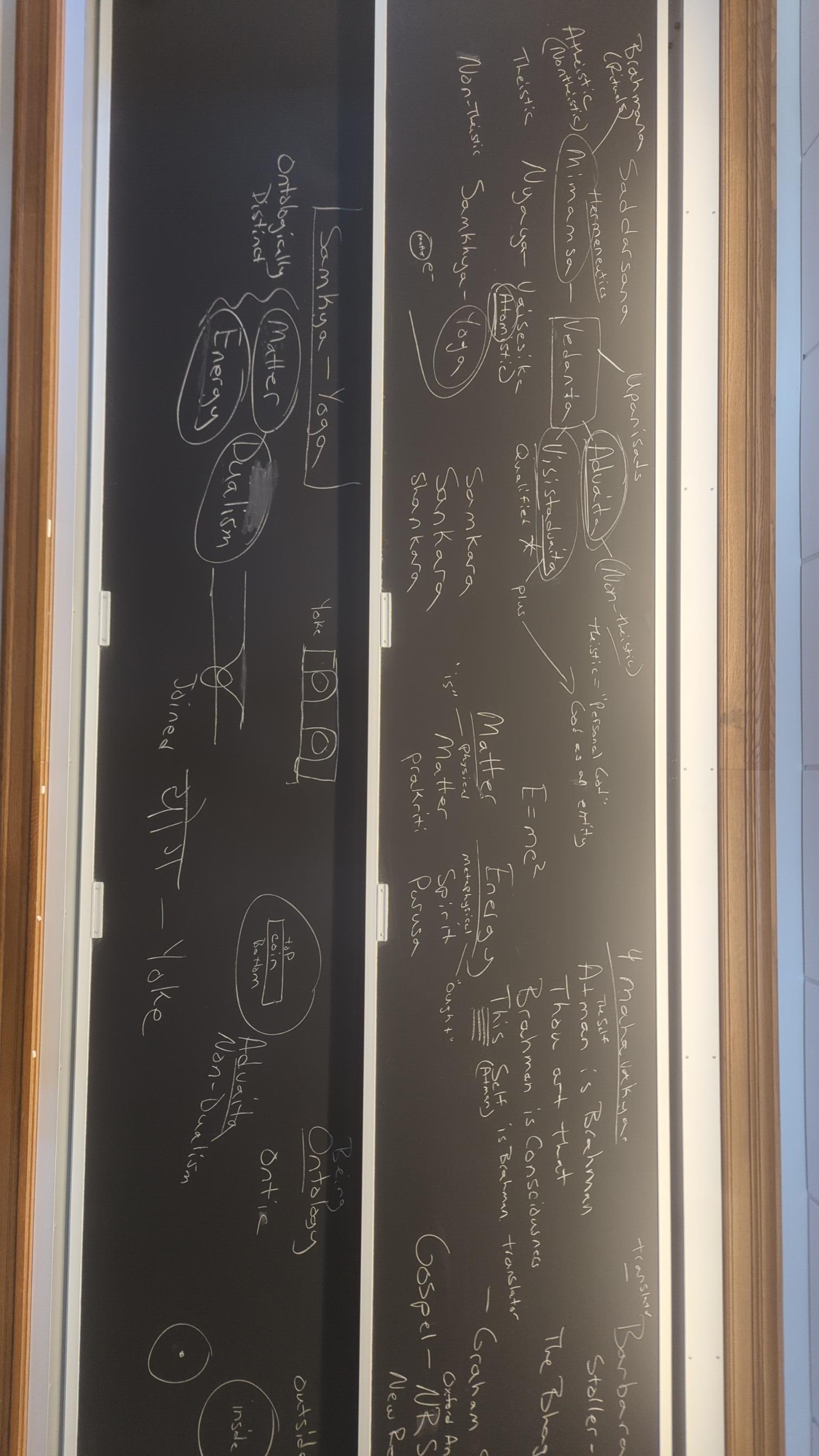
This class session began with a quiz covering recent material. Brad then discussed the need to slow down and review the Advaita Vedānta unit, noting some uneven performance on the recent podcasts. They emphasized the importance of understanding the differences between Mīmāṃsā and Vedānta before moving fully into Viśiṣṭādvaita Vedānta. A significant announcement was made: Podcast 3 is cancelled and will be replaced by an in-class midterm exam next Thursday, covering material similar to the quizzes; a study guide will be provided. Brad reviewed the podcast instructions, stressing the need to keep the sacred texts central to the analysis. They recommended specific translations for upcoming texts: Barbara Stoler Miller's or Graham Schweig's translation of the *Bhagavad Gītā* and the NRSV Oxford Annotated version of the *Gospel of John*. The main lecture portion involved a review of the Ṣaḍ Darśana (six schools of Hindu philosophy), focusing on the Sāṃkhya/Yoga perspective on the relationship between Prakṛti (matter) and Puruṣa (energy/spirit). Brad explained the Sāṃkhya/Yoga view that matter and energy are ontologically distinct but can be ontically joined, using analogies of bedsheets and yokes. The distinction between ontological and ontic differences was clarified using examples like a folded paper and a coin. The session concluded with student questions regarding non-dualism vs. atomism and the contemporary relevance of these philosophical schools, followed by dismissal.
[classroom noise]
Brad: Alrighty.
[classroom noise]
Brad: Let's get started.
[bell ringing]
Brad: Okay, let's take one breath together. Go ahead and breathe in.
And let's get started.
So, let's get started with the quiz.
Most of the questions you've seen before, so...
[paper shuffling]
Brad: Alright, so no notes, no talking.
[paper shuffling]
Brad: Should we get one?
Student 1: Yeah.
Brad: You look unsure.
[paper shuffling and murmuring]
Brad: Feel free to take two if you want.
[paper shuffling and murmuring]
Brad: So, I've only, I've only made it through like a, maybe a quarter of, podcast two. So, small sample size. And, some of them, some of them have been typically great as what one would expect from Boston College, you know. A few of them, not, not what I'm accustomed to. So, so I thought maybe, I mean it was a short unit, right? Four classes and then one of those classes got lost due to, snow day. So I think maybe it was just rushed, was the problem. So I want to, slow down, and make sure that you've got Advaita Vedānta, make sure that you've got, the last unit under your belts and that you understand the differences between, Mīmāṃsā that we've studied and Vedānta, that we've been studying. And now we're transitioning into Viśiṣṭādvaita Vedānta, which is a bit more difficult. But I want to, you know, everything builds on the previous unit. So I want to make sure that you've got what you've got, that we've got what we've covered, before we move on. And, everything in this course is really leading up to, to what part two, I'm just going to call it part two of the course, which is, what we're going to do after spring break, right? So let's use, from now until spring break to really, well, let's use this week to really round off what we've done so far and next week, to to set up what we're going to do for the rest of the semester.
Brad: And I think to that end, I'm going to, I'm going to replace podcast three, so you will not have to do podcast three. And in place of podcast three, just replace it in the grade structure and everything. We'll do like a midterm exam next Thursday and that'll be in class and it'll be along the same lines as the quizzes. It'll have a lot of the same questions that I've been asking over and over again. And I will give you a study guide, for that. This Thursday. I think that's seems good. So we'll make sure that you have, at least a pretty good idea of everything that'll be on there, by Thursday and then we'll just do that in class next Thursday. If you have an accommodation, you want to take it at the testing center or whatever, that's perfectly fine. Just, send me an email or whatever, do whatever you normally do for that. But, that'll be that. I do want to review the podcast instructions. So the podcast instructions are, especially for this course, particularly important. So you want to keep the text at the center, right? The whole, this is a sacred text class. So it's a theology class, but it's a theology class focused on sacred texts. So the whole idea is to get keep the texts at the center, right? So be sure that you're interpreting the texts, offering, you right, I don't expect anybody to have like the definitive all final interpretation of any of the texts. I don't, nobody does, right? So, but, but the idea is to, to give it your all really interpreting the text, right? And particularly in this unit, trying to see these, four texts that we forefronted in this unit, and how they fit together, how they relate to one another, reading them across lines, reading them together, seeing how they, how they function both cataphatically and apophatically, and also in terms of coordination and harmonization, as I mentioned last week. So, and also within, within the context of, Advaita Vedānta. I did want to say two things. This is, this is really looking ahead to the next half of the course. So not, not sure it makes total sense to do it today, although I just want to give you plenty of time in order to acquire these texts. First of all, you do not need to acquire these texts. But, but I kind of recommend it. So like option one is I'm going to give you a, PDF of a couple different translations. If I can, of the Bhagavad Gītā. But I highly recommend that you purchase one of the two of these, because we're going to be spending the rest of the semester on it. They're both very cheap. This one says $6 for a new copy. You can it's not hard to get a used copy for even less than that. So highly recommend this copy of the Bhagavad Gītā. This is Barbara Stoler Miller's, translation. I'll write that down. And I do have a PDF of this one. So, if you want to, I will definitely 100% share this translation with you as a PDF illegal copy and all that kind of stuff. So, that's, Barbara Stoler Miller, the Bhagavad Gītā. And she calls it, Krishna's counsel and, well, she calls it the Bhagavad Gītā and then the subtitle is Krishna's counsel in time of war. The other one is, also called the Bhagavad Gītā. This one, so this is the translator. And then the other translator is, Graham Schweig. The differences between these, they both have lots of advantages and disadvantages. Any translation does, right? They both bring their, their priorities to the text. Stoler Miller's, her priority really seems to, so the the pro and the con is she really translates every word of the text, which can be a con, I mean, can be a can be a pro, can be a con. I feel like some words like karma, dharma, Ātman, Brahman, these are words that, you know, I'm not sure we should translate, maybe just learn those words. But she translates everything. One of the things she does really, really well is she's, she, exceptionally well is trying to maintain the poetic, poetic aspect of the text. So she translates it, it's really amazing how she does it. I mean, she keeps like each word, each, you can see just from the structure of like she maintains as much of the sort of, syllable meter, as possible. So really trying to get a sense of the poetic nature of the text, and the four *pādas* of the text, the four, yeah, the four parts of every *śloka*, of every verse. Graham, is also an excellent translator. Tends to, tends to be more reluctant to translate certain words, particularly the word yoga. He's, he's an expert in yoga, and so his, and he is pretty open about I'm going to read the text forefronting yoga and yogic interpretations. So, so really excellent. And there's also some great, essays in the front and back. He has, he has the the regular translation, which is very good. He's got excellent footnotes at the bottom, on the translations and he gives the Sanskrit in, transliteration, you know, in Roman script so you can read it in the back. So lots of advantages to this and there's an index and pronunciation guide, all those kind of things. It's just generally a very good translation. So this says $16 for a new copy. You can probably get a used copy, you know, obviously for cheaper than that. But, again, not a requirement. I will, I don't have a PDF of this. Happy to receive one if anybody else has one. But I do have PDF of the, actually I have a words, like a Google Doc version of this, that I can give. The other text that we'll be looking at starting, you know, immediately after spring break is, the Gospel of John and we'll be pretty strict about, you know, Tuesday Gītā, Thursday, Gospel of John. And we'll we'll start the rotation of, leaders, at that point. So we'll do the ABCD kind of thing. And I'll give you those, you know, in advance of, of that so you can prep. Oh, but the translation, translation for the gospel, that we'll be using is NRSV. Whoops. So that's the New Revised Standard Version. And the, yeah, I guess the most, I didn't bring it today, but the most common academic version that pretty much every scholar uses, is the Oxford Annotated version. I don't know how much the new copy of that costs, but it's super common. It's probably a really, really, really high chance that there's tons of copies in the BC bookstore, probably tons of copies in the, in the library. Definitely you can get used copies for very cheap and, it's also not hard to get, online copy, so you can, you can copy and paste it. I'll also give it to you, but, you know, I think some advantages to having printed copy, just to take notes in and that kind of stuff. Cool. Any questions?
Right on.
Brad: So, yeah, let's, what to review today? Let's, let's do a little bit of just basic review, because I think in order to talk about a lot of the things at the level I want you to be talking about them, you got to have some vocabulary under your belt, right? You got to know some basic vocab. And some basic, structure. So, what's, what are the Ṣaḍ Darśana? Anybody give them all to me?
Yeah, Brett?
Student 1: They're like the three pairs of schools, the six perspectives, and it's the Mīmāṃsā and the Vedānta. Good. The Nyāya and the Vaiśeṣika. Yep. And the Sāṃkhya and the Yoga.
Brad: Good. Um, oops. I think it might be good to, for me to give you a little bit more detail about these schools. Some of this might be review, but I think review might be in order at this point. And I'm not confident that all of it's review. So, let's talk, a little bit about the, yeah, similarities and differences between these, as Brett gave us like the the they really are sister schools. So they they agree with each other, in these pairs agree with each other almost, you know, I think maybe the difference between them is more a matter of focus than it is like real deep philosophical, theological differences. But the differences between the the, pairs is more different is more difficult. Is more significant. So one of the things that we talked about is that Mīmāṃsā Vedānta tend to be atheistic, or at least non-theistic. Nyāya Vaiśeṣika tend to be more theistic. And Sāṃkhya Yoga is, more non-theistic.
Brad: So, but there's more significant differences between them. But one of the things that we'll be doing, yeah, I don't know. This might be even misleading because there's two, there's two distinct Vedānta schools that we'll be looking at this semester. One of them is Advaita. And the other is Viśiṣṭādvaita. Viśiṣṭādvaita is the one I wanted to start today, but I think we'll, we'll just punt a little bit. And the major differences between these is Advaita, which we just have been studying, is atheistic. Or or non-theistic. Meaning theistic in terms of a personal God, right? So a God as a person. Yeah, so by theistic, I really mean, like personal God are like, God as a, as an entity? Like a supreme being sort of thing, right? So as a as a being, really, as any kind of being. Whereas non-theistic would be, you know, not positing that. Whereas Viśiṣṭādvaita, this Viśiṣṭa, what does Viśiṣṭa mean in this context?
Qualified? Or I said before, like, you know, like an asterisk. So it's like Advaita, but Advaita plus, plus God, plus this, right? So what we're going to do when we read the Bhagavad Gītā is I'm going to want you to pick, maybe not the first couple of chapters, but once we get underway, I'm going to want, you to select a verse from whatever, you know, unit we're reading, whatever chapters we're reading that particular day. We want you to pick a verse or two and try to give two different interpretations of that verse, right? One from a theistic perspective and one from a, or one from a theistic perspective and one from a non-theistic perspective, right? So, one interpretation understanding Krishna, as God, and another one, understanding Krishna as more of a, voice of conscience or like a psycho like a, voice of ethics, an ethical voice, ethical conscience, right? Or conscious moral conscience, within oneself. Which is very different than, you know, God out in the outside of one's head.
Brad: Let's take a few moments to talk about, Nyāya Vaiśeṣika. So, all of these schools in one way or another are discussing the relationship between matter and energy. Those are the terms that I prefer. Other scholars will put it in terms of matter and spirit. The two terms in Sanskrit are Prakṛti, Prakṛti, which means matter, and Puruṣa. Puruṣa, which we've translated previously as person, which is definitely accurate. But it can also be, interpreted in these other ways. So really what we mean is matter and energy, right? In order to, everything that exists, either exists as a, a particle or as a field, something like that, right? So if you're talking about like the, Higgs boson field or something like that, then you're talking about, energy. If you're talking about, I don't know, quarks, then you're talking about matter, right? So whether you whatever you're talking about, there's, these two, right? Einstein, Einstein exhibits the relationship like this, right? E=mc². So by, matter, we really mean something that has mass, by energy, we mean something that is, that doesn't have mass, right? Something that acts. So all of these schools have to deal with these two fundamental properties, right? So these are fundamental aspects of reality, matter and, I think for simplicity, let's just say matter and energy. All six of them obviously have to deal with both of these two things because these are the things that exist, right? But the question is, what's the relationship between them? And yeah, I mean that's really the thing. What is the relationship between them?
Brad: So, let's start with, let's start with Sāṃkhya. So Sāṃkhya, Sāṃkhya is a kind of, actually for sake of simplicity, let's just treat Sāṃkhya and yoga for our purposes as the same thing, right? So Sāṃkhya yoga, they certainly agree, entirely on this point, that matter and energy are, fundamentally different. They're ontologically distinct. So matter and energy are onto logically, so I guess we should review some basic, philosophy. So ontology versus, so we've got ontological differences versus ontic differences.
Brad: So, I don't know. This is not not the best example. Let me go with, right, with the folded paper again. So for folded piece of paper, then we could say the distinctions between, A, B, C, D. So the differences between quadrants, say, B and D are ontic distinctions, but they're not ontological distinctions, meaning there's one piece of paper, right? And, D and B are both part of the same piece of paper, right? So the distinctions between, so that doesn't mean that B and D are the same, because they're not, right? B is here, D is here. There's differences between them, but they're ontologically one, right? The being, ontos means being. So the being, they're part of the same being, right? Remember I gave the example of a coin. So if you have a coin, then you have one coin and the top, and bottom represent ontic distinctions, whereas the oneness of the coin indicates a ontological oneness. Following so far? So you can think of it as one being, one entity, but with distinctions, right? So top and bottom, inside, outside, those sort of things, right? So, for Sāṃkhya and yoga, matter and energy are ontologically distinct, meaning, right, if we were to have, so ontologically distinct, meaning, actually, I'm going to take a different piece of paper. In the same way that these two pieces of paper are ontologically distinct, right? They're not one. Following? Right? So, let's let these two pieces of paper represent matter or actually matter and energy, right? So for Sāṃkhya and yoga, there's, matter is one ontological entity, spirit or, energy is a different ontological energy. Now, when, this is, yeah, so they're, they never become one. They're always, they're ontologically separate. They can't become ontologically united. They can become ontically united, right? So, if we have, the way that the Sāṃkhyans, some of the Sāṃkhyans explain it is let's say we've got, two sheets. I should start bringing sheets. It's be better as a exercise. Let's pretend that we have, two like bed sheets, right? And we put like Riley on a corner and Clara on a corner, and we put Lizzie on a corner and Amber on a corner, right? And they pull that bed sheet taut, right? So it's perfectly flat, you know, like, get the idea, right? And then let's say we get four other people, right? Sophia and Reed and, Sailor and, Matthew Wilinsky and we get you all to pull another bed sheet, taut, right? Above the other one. So the the two, you get the image in your head, right? So these two ontologically distinct pieces of paper. One representing matter and one representing energy. Now, for the sake of, illustration, let's pretend that these are like as close as they could be without touching, right? So they're not touching, but they're super, super, super close, right? Now, let's say I take my, my hand like this, right? And I and I, say y'all are holding those bed sheets and I were to go to the middle and like push down on them, right? So then what would happen is where wherever my fingers are pushing down, right? When I push down, then you're going to get like this sheet kind of like comes down and touches, right? So you get these two are joined in a certain way, but not they don't become one. They still are two separate ontologically distinct things. But they they are joined at a particular part. Following? Right? So this word joined, in in, Sanskrit it's yoga. Yoga means joint. Yoga means, it's the same root where we get the word yoke. So, what does yoke mean?
Yeah?
Student 2: It's like a bar you put on your shoulders to carry two things.
Brad: Yeah, exactly. A bar you put on your shoulders to carry two things, or a bar, the same kind of thing that you put like if you have two horses, right? If you have two horses and you put the yoke on both of the horses, right? One yoke, so you've got like horse one, horse two, and then the yoke is like this thing. That goes like that, right? Then you got like a bar underneath. So let those two circles be like the horses that the heads horse horses heads. Heads heads. Right? Then the yoke is what joins them together. Don't get confused with Y O L K, that's an egg yolk. Which is we've also talked about, but it's but it's a different word here, right? So these two things, these two horses in that case are joined together, but they don't become one horse, right? The two horses are still separate horses. Right? So the both of these, Sāṃkhyans use both of these to both of these examples to, illustrate what they mean by the relationship between matter and energy. So, if if I were to go and push these, push these two bed sheets down, then where they join, we get an Ally and a Tushar and a Riley and a Brett. Makes sense? So, on the one hand, Ally, Tushar, Brett and whoever else I said, are, they're still part of one, they're still one material universe, right? And there's still one, you know, spirit, spirit of all beings, but they're temporarily joined in these ontic, entities that we call, Brett and Clare and Tushar and, Jack and Ally. Does that kind of, yeah.
Student 3: So, is it would it be considered non-dual because like you have one atom that consists of both matter and energy or would it be dual because actually I don't know.
Brad: No, no, it's a great question. I got that question, I think. So I think, differing differing philosophers would answer that different ways, right? Most, most, from a historical perspective, they're not called non-dualist because they're, they're called atomist, which means everything's broken down into individual atoms. But I think the point that you're observing is that when you get to the level of atoms, it's all of a sudden non-dualist again, right? So, on the one hand, we've got, okay, let's go back to the coin. Maybe this will bring it into focus. So from Advaita's perspective, the entire universe, we could say is just one coin. Right? Where from an atomistic perspective, there's however many atoms there are in the universe, every atom is its own coin, right? So, as you're saying, like the coin, the atom, it's non-dual, right? It because it has both of these things and you can't separate matter from energy, even though they're they may change all the time, right? Right, the top may become the bottom and the bottom may become the top, but they're always going to be a top and a bottom. Whereas, for Advaita, it's just one, yeah. Good?
Student 3: Good.
Brad: That was a great question. Other questions? Yeah, Jack.
Student 4: So like this school of thought, like is it would you say have more like obviously has more scientific grounding in it? So like would you say that like it's more prevalent like nowadays? Like people try to use like scientific reasoning and combine it with the scripture to like further prove their points with that school of thought? Or like if so, like I know you said like the Advaita Vedānta is like one of the most popular like schools in terms of like people following it. But like I'm kind of surprised that like the the third school though isn't as popular because it combines science and faith like perfectly.
Brad: The the the, you mean the atomistic school? This one? What do you mean for the third school? Yeah.
Student 4: Oh sorry, I meant the second school, right?
Brad: This one? This? Yeah. So I would say that, I would say that, over the over the over recent, you know, decades, maybe the last, you know, 50 or 100 years, this this school has gotten a lot more attention as we learn more about, the nature particularly of quantum physics and those sort of things. Then, then you get a lot more attention here. As you heard Anat talking with the other physicists, not other physicists, but talking with physicists, physics professors. So then when you get into, quantum field theory or, entanglement and those sort of things, then all of a sudden, it starts to seem like one atom never exists on its own, but, you know, if you talk about super symmetry or talk about other different, models of the physical universe, then, atoms don't seem to, exist absent other atoms. All atoms are interrelated and have, you know, gravitational fields, all sorts of things, they interact with one another, right? So the individual atoms, don't exist in a vacuum. They exist in in partnership or in relationship to other atoms. And so, if we understand that, then all of a sudden we're start, we're shifting back to, which again, like, think about it this way, right? So, on the one hand, we could say Jack is made up of all of these different atoms. And on the one hand, like the atoms that make up Jack right now are really probably extremely different, than the atoms that made up Jack, say when you were five days old, right? You got a lot, you've at least you've got a lot more atoms now than you did when you were five days old. But the point is that when all of these atoms are sort of arranged in Jack form, that Jackness of Jack is all of these different atoms arranged in such a way that the relationship then takes on, a significant, a certain kind of a significance, right? At least a uniqueness. Right? In the same way that like if you were to arrange your Play-Doh or clay in a particular way, then that's, it's ontic, right? But for a particular purpose, like you're creating, so then from that perspective, Jack is shaping Jack, right? Giving form to Jack, for some purpose, right? And then that's significant. Okay, good. We're out of time. You can, leave the Play-Doh, just put leave the Play-Doh where it is, actually. Yeah. I mean, put it back in the container and leave it there. Yeah.
Student 5: Just to be clear, our midterm is going to be the 27th?
Brad: Midterm will be next Thursday. Yeah. Okay. And it'll just be worth like, you know, it'll be worth less than 10% of your grade. Yeah. So like 7 or 8%. Yeah. Same as the podcast.
Student 5: The entire class period?
Brad: Yeah, it'll take the entire class.
[classroom noise and chatter as students leave]
Brad: And it should not take 75 minutes, so... I'll give you the whole 75 minutes, but it shouldn't take less than that.
Student 6: My my TA though like goes over like the presentations like that's just like... classes leaving and we're also doing the presentation. So everyone's like...