 ```html
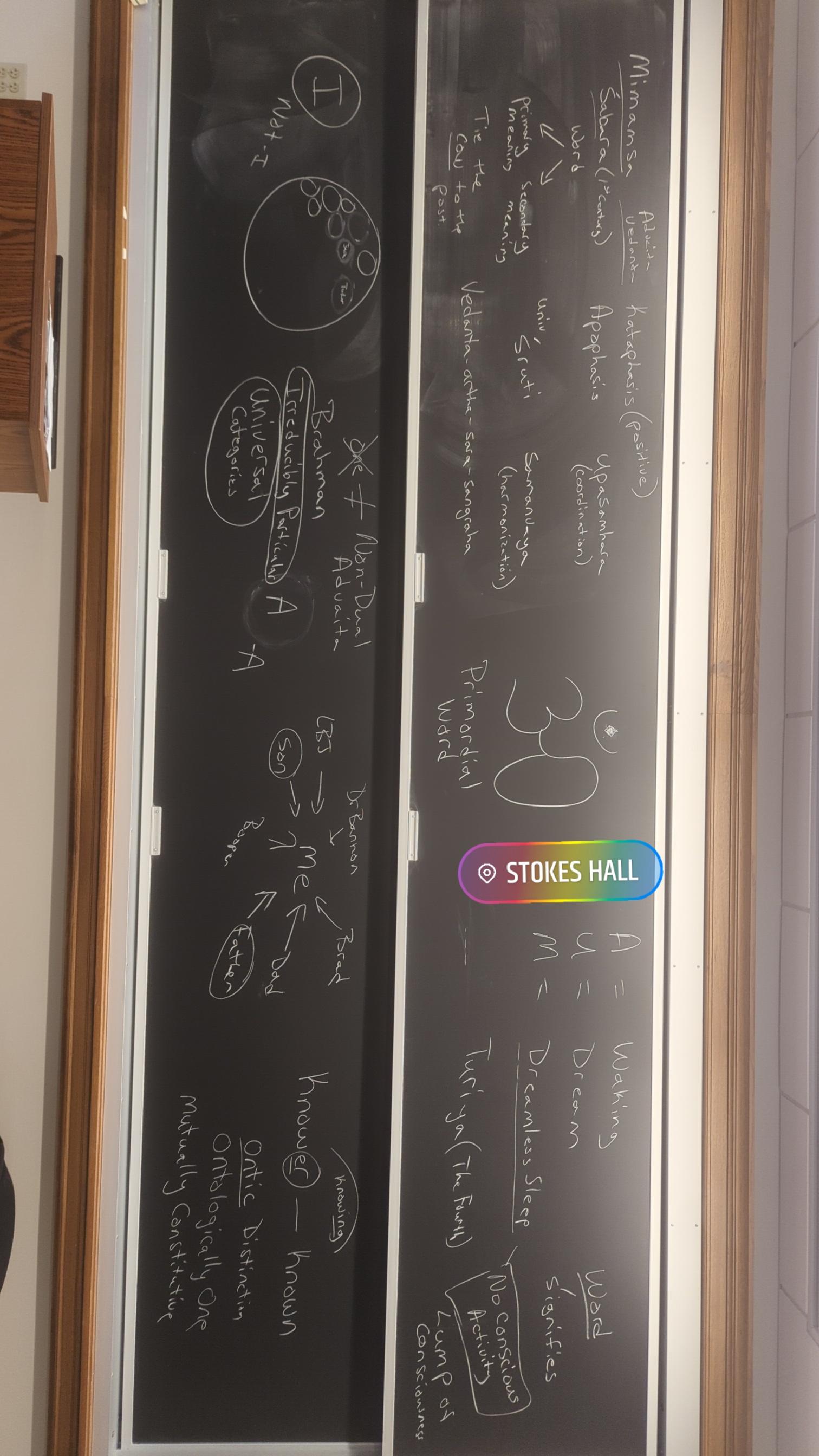
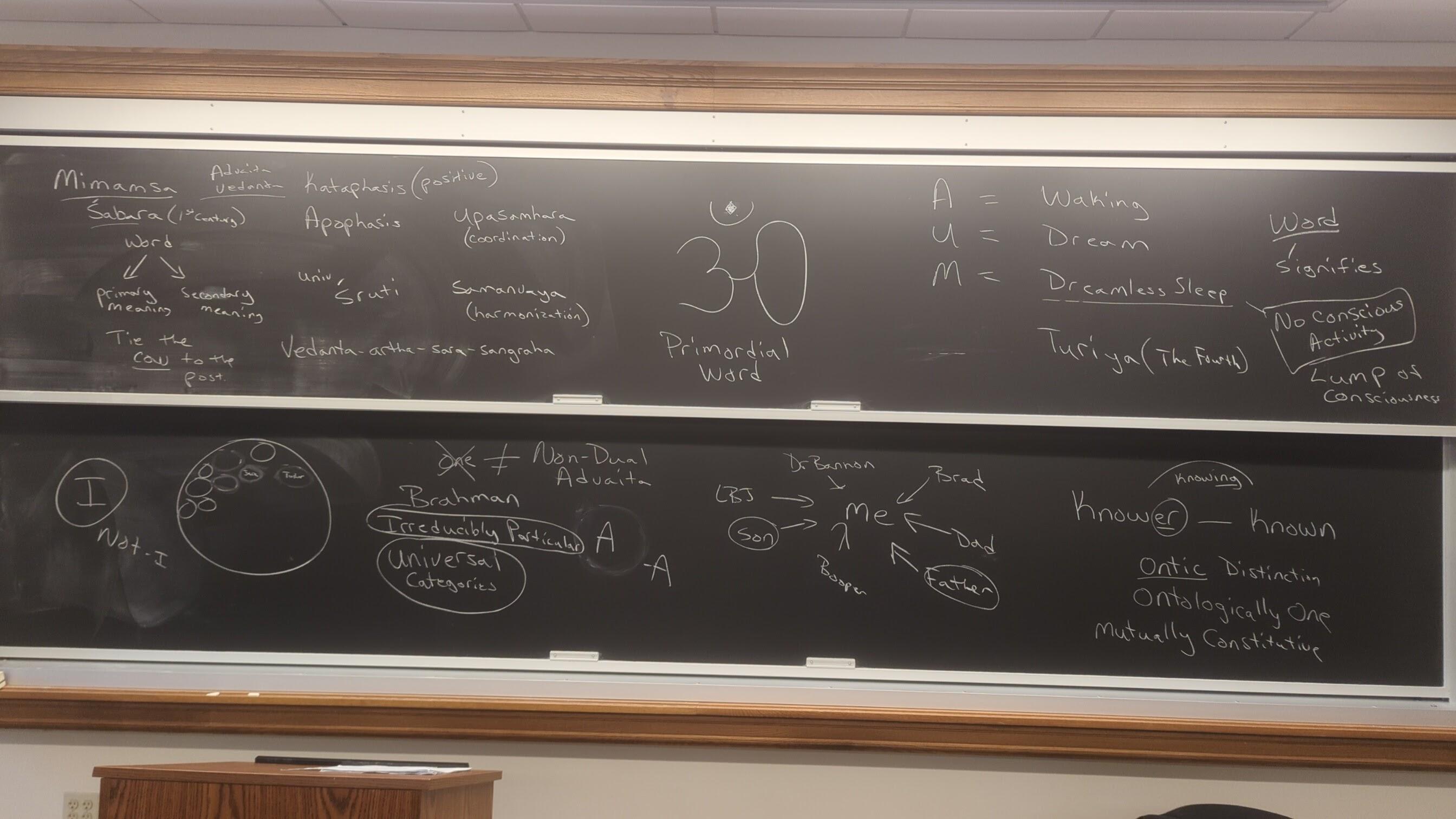
This lecture concludes a unit on Advaita Vedanta, focusing on the fourth and final Mahāvākya presented through the Māṇḍūkya Upaniṣad. Brad leads the class through a reading of the text, which explores the syllable Om (ॐ) and its correspondence to the four states of consciousness: waking (Vaiśvānara), dream (Taijasa), deep sleep (Prajñā), and the fourth state (Turiya), which represents the ultimate, non-dual reality (Brahman/Ātman). The lecture emphasizes interpreting the Upanishads synchronistically (Upasaṃhāra and Samanvaya). A significant portion of the class involves a question-and-answer session where students grapple with concepts like the silence following Om, the relationship between the three sounds of Om and the four states, the meaning of "lump of consciousness" (Prajñāna Ghana), the nature of the fourth state, the distinction between knower and known, and the implications of non-dualism for understanding the self and reality. Brad uses analogies like Play-Doh, a coin, and mathematical infinity to illustrate these complex philosophical ideas.
Brad: Alrighty. Let's put screens away and get started, please.
Brad: Okay. Now let's put screens away and be fully present. Back by popular demand. Well not popular demand, but back by demand.
Brad: See how many better I get now.
Brad: Let's take one breath together. Go ahead and breathe in. And let it all out.
Brad: Alrighty. So, we are finishing this very short, but very important unit of the course. Today, this unit on Advaita Vedanta. We're going to continue with Advaita Vedanta, you know, beyond just today. But here we're looking at the some of the real core texts of Advaita Vedanta, namely the Mahavakyas. And today is the fourth and final of our Mahavakyas. Let me just make sure I got the attendance right. We're missing Luca. We're missing Reagan. And Jaden and Addison.
Brad: The rails here? So, we're, what I want you to do a little bit differently on this podcast than on other podcasts, is I want you to do the normal thing. The normal thing, which is, you know, each person in your team should focus on one text, lead the discussion on one text, and then go to the next text. That's that's, you know, the default. That's always. Keep doing that. But in this particular unit, I really want you to, much more than other units, I want you to try and read across texts. See how the text, the four texts in this unit, how they connect to one another, how they speak to one another. I want you to try and read them synchronistically, harmoniously, right? Try to read them as if they're all part of one sacred scripture, even though they're different texts, they're still all part of the Veda. And when you try to interpret them in ways that, you know, the way a Mimamsaka would or a Vedantin would would be, if you read one passage and you give an interpretation, and then you read a different passage, then your interpretations should not contradict each other, right? So, yeah. So avoiding cognitive dissonance and those sort of things. This is a practice known as Upasamhara and Samanvaya. Upasamhara means coordination, and Samanvaya means harmonization. So, these words. So, and not just with these four texts in this unit, but also with the, maybe not so much with the Devi Mahatmyam, but with, but definitely with the Vedic hymns that we read before. So the four, the four Upanishads that we read in this section, and then also the Vedic hymns that we read before. So really try to see connections between them. And also today as well. We'll do that.
Brad: Yeah, I want to before we get into anything else that I've got planned, I really want you to chat with each other and come up with some good questions. I'd really love this to be question driven. I think there's a lot of, yeah. So let's let's sort of wrestle with the text. And actually, you know what? Before that, let's let's read the text. We'll just go through. Everybody have a copy of the text? I do have a couple of extra copies for folks.
Brad: Yeah, I don't have any others.
Brad: Let's just start, we'll start with Luca [Student 1], and then we'll kind of go wrap around. So, Yeah, so go with the Brad Bannon side while we read, we'll read that side. All right. So, we'll have Luca [Student 1] just read it till you get to like a period, you know, read a sentence. And when you come to any Sanskrit words, I'll say the Sanskrit words. You don't have to, you don't have to wrestle with it. But you can say Om. So, not AUM like they said in the AI podcast, but Om. Yeah.
Student 1: Om, that sacred syllable is all this.
Brad: Yep.
Student 2: Its explanation is all that was, is, and shall be is simply Om.
Student 3: And, moreover, that which transcends three periods of time, that too is simply Om.
Student 4: All, all this is certainly Brahman. This self is Brahman. And that Brahman self possesses four quarters.
Student 5: Vaishvanara, whose place is the waking state, who is conscious of the external world, who possesses seven limbs and 19 mouths, and who enjoys material things, is the first quarter.
Student 6: Taijasa, who is fixed in the dream state, who is conscious of the thing, who possesses seven limbs and 19 mouths, and who enjoys subtle things, is the second quarter.
Student 7: Where the sleeper does not desire any desire at end and does not see any dream, that is deep sleep.
Student 8: Prajna, who is fixed in the state of deep sleep, who is unified, and who is a lump of consciousness, who consists of bliss, who is certainly an enjoyer of bliss, and who is the entrance to the mind, is the third quarter.
Student 9: This is the Lord of all.
Student 10: This is the knower of all.
Student 11: This is the inner controller.
Student 12: This is the womb of all, indeed the origin and dissolution of beings.
Student 13: They consider the fourth to be not conscious of internal things, not conscious of external things, not conscious of both internal and external things, not a mass of consciousness, not consciousness, not conscious, not unconscious.
Student 14: Unseen, beyond the ordinary, ungrasped, undefined, unthought, not to be defined, whose essence is certainty of the one self, tranquility of the manifold, pacified, auspicious, and non-dual.
Student 15: That is the self. That is to be known.
Student 16: With respect to this syllable, Om is the self. With respect to the measures, the quarters are the measures, and the measures are the quarters.
Student 17: A U M.
Brad: Yeah, A U and M. That's fine.
Student 18: Whose place is the walking state.
Brad: Yeah, Vaishvanara is yeah, that's fine. We can go to Oz [Student 18], yeah.
Student 18: Whose place is the walking state is the first measure. A A so named because of obtaining Apti or because of being first Adimatva.
Brad: Yeah, good.
Student 19: One who knows this certainly obtains all that is desired and becomes first.
Student 20: Taijasa, whose place is the dream state, is the second measure U because of raising upwards or from economy.
Student 21: One who knows this certainly elevates the expanse of knowledge, becomes equal, and no one in his or her lineage will be ignorant of Brahman.
Student 22: Prajna, whose place is the, whose place is the state of deep sleep, is the third measure M, so named because of measuring or merging.
Student 23: One who knows this certainly measures all this and becomes the all.
Student 24: The fourth is without measure, beyond the ordinary, the tranquility of the manifold, auspicious, non-dual.
Student 25: Thus Om is indeed the self. One who knows this enters the self by the self.
Brad: Okay, great. So, what I'd like you to do is to get in your teams, chat with your teams and do two things. One is if you haven't decided when you're going to meet for your next podcast, go ahead and do that, but please don't take a lot of time doing that. Focus mostly on this text. And see if you can come up with some, you know, some good questions to ask. So, yeah, I think there's a lot of richness here. So, yeah, good. So take, take at least five or six minutes, something like that.
[Small group discussion occurred]
Brad: Okay, take take another 60 seconds to just organize your question into something.
[Small group discussion occurred]
Brad: Okay. Seems like the majority of the conversations are not. Anybody who wasn't here on Tuesday need a copy of the Chandogya Upanishad? I have quite a few. It's not a copy of the text today.
Brad: So this is, yeah. So this is the Chandogya Upanishad and also the Maitri Upanishad. Sure.
Brad: Okay. Questions. Who's got the best question?
Brad: Yeah, Olatz [Student 26]. Okay, let's let's let's focus.
Student 26: Hold on, start us. the best question but what we brought up with is why do you believe that silence after Om represents the ultimate reality?
Brad: Good question. Do I, what did you say, do I think? Or no. Gotcha, gotcha, gotcha. Why does anybody think? Yeah, I think, yeah. So, when we're talking about the Purusha Sukta, right? The the text that we looked at from one of the first texts that we looked at, right? In the beginning was this one person, it was also in the Brihadaranyaka Upanishad, this one person that knew nothing. There was nothing else to know, right? Nothing, nothing else. It was only one, then there's, I mean, there could only be silence, right? I mean, there's nobody to talk to, there's no words, there's nothing to know, there's nothing to see, nothing, there's nothing, right? So oneness is virtually equivalent to non-being. So then maybe we could understand, I mean, we I think we can equate oneness with a kind of silence there, right? And then so, so that's one answer. I think that's the main answer. The other answer is that you can't really have words without silence, right? In order to have one word has to end, another has to begin, and there's got to be some sort of pause or some sort of silence marking that transition from one word to another, or one thought from another. And I think some of that's going on here too. Great, great start. Yeah.
Student 27: Why are there only three letters in Om when it talks about the four quarters?
Brad: Yeah, good. I think that also connects with that with silence, right? So you've got sort of A U and M. Oh no, I erased it. So you've got A, kind of aligning with the waking state, right? U aligning with the dream state. M aligning with the dreamless sleep. Certainly some silence there, right? But then, but yeah, then there's this fourth, which is just called the fourth. Sometimes it's called Turya, but Turya is just a Sanskrit word that means the fourth. So, it's just the fourth, the fourth state, the one that's not the other three. And I think again, right? We've got some sort of silence here. When when Yogis, when people who, yeah, when Yogis or or gurus chant the word Om, when you hear somebody who really knows what they're doing, chant the word Om, they they typically recite or they pronounce Om in a way that includes all of the vowels, right? I can't really do it but like Oooom, right? So like trying to the idea is that Om is supposed to encompass all of the vowels. Why? Because you can't have any word, you can't speak any word at all without a vowel, right? So if all of the vowels are contained in Om, then in some way, Om is sort of this primordial let's not call it a well, I mean, we could call it a word, but it's really even before there's any it's really even prior to any word, right? So it's the it's that which makes words possible, right? It's like the potential. And there's something maybe in silence there too, that silence opens the possibility for sort of the unfolding of sound. Yeah, good. Great. Thanks George [Student 27]. Yeah, Vanya [Student 28].
Student 28: I think the question we had was one of them was the line that says not conscious of internal things, not conscious of like the entire consciousness. Like what does that mean? Like especially the ending like not a mass of consciousness, not consciousness, not unconsciousness.
Brad: Yeah, that's a big question. So what does it mean? Can you refine the question a little bit? Narrow it down a little bit?
Student 28: I mean, I got the part where it says they consider the fourth which is not conscious of internal things and like when it goes like not conscious of both, but like the ending when it says not a mass of consciousness, not consciousness.
Brad: Okay. So, I think in terms of the mass of consciousness, we can, as I mentioned the other day at the end of class, I don't I really I really don't know why it says mass of consciousness because I like my, this is this is my translation from my dissertation and like half my dissertation is on the importance of the word lump there. So I don't know why I translated it as mass instead of lump. But so you have sort of this lump of consciousness. The word in Sanskrit is Ghana. So Prajnana Ghana, literally a lump of consciousness. And maybe this lump kind of brings to mind Tuesday's activity? Yeah? A little bit? What am I thinking? Leana [Student 29], you have something in mind?
Student 29: The Play-Doh.
Brad: So, in order to shape anything, right? You've got to have like a there's like a default, right? When you open up the Play-Doh container, there's just a lump in there, right? So that lump, that lump can become anything else, right? It's like the primordial lump. It you it you got to have some clay that's just like a lump, right? And then from that lump, you can shape anything else. So, maybe in the same way that Udalaka was trying to teach his son about the difference between the the material cause, meaning the play the clay, right? And the effects, so like bowls and pots and bowls for your pot and those kind of thing, right? So like names and forms, right? So you've got this lump that can become, you know, various names and forms. Uh, but if we're trying to get to like, all right, we're going to start with Luca, right? And so Luca is a name and we've got this form here that's a Luca. But if we're trying to get something like what is, what is Luca made out of or something like that, then, then we're trying to get to some sort of like essence or being, right? So the the stuff from the stuff that Luca is. Yeah.
Student 29: Wait, so does the lump of consciousness also like with all like the material like things aspects that like make up like a being in the universe? Does it also include a soul or is like a soul separate?
Brad: Good question. Yeah. So, I think, you know, on the one hand, we got to be careful because when we're talking about clay, we're talking about something material, right? So, we've got the lump of clay, which is right, material, matter. Whereas, Prajna or consciousness is not matter. It's not material, right? Maybe we could say it's energy or some sort of process or something like that. But, so on the one hand we've got matter and then on the other hand we've got I don't know, I'm just going to call it energy, something called spirit. But in Stoke's Hall, spirit can be a little misleading. So, yeah, some sort of energy, right? Some sort of thing. So if we're concepts would be another way, right? So we've got on the one hand, material, then we've got on the other hand, names and forms, right? Names aren't material, forms aren't material. They're something more conceptual, something more on the side of mind, right? So you've got another way to chop it up would be body and mind. Did I answer your question?
Student 29: Yes, that's more clear.
Brad: Great. Cool. Yeah, Ella [Student 30].
Student 30: I was wondering like for the names of like the people, like universal woman, wise one, like how do each relate to like waking, dream and dreamless? Like how would the wise one be there for dreamless?
Brad: Yeah. Really complicated question. A really good question. I I I honestly spent like a year sort of investigating that question. And particularly particularly the one you asked about, the wise one. So you would think that in in a state of deep sleep, you're not there's no consciousness, right? You're not you're not wise, you're not anything. You don't know anything. So how could the the one that's totally devoid of conscious thought be called the wise one, right? And the answer is super complicated, but also pretty important. So in order to, let's go back to the Nasadiya Sukta that we looked at a couple of weeks ago, or we could also go to the Brihadaranyaka, few ways we could go. In order to have any sort of knowledge, in order to have any sort of knowledge, you've got to have a knower, right? And something that is known. Right? So there needs to be a what we call an ontic distinction between knower and known. On some level if I know myself, there's not an ontological distinction between knower and what is known, but still, I'm knowing myself as an object, right? I'm knowing myself as an object of what's known. I'm knowing my myself as something that's known. So, you've got to have this, you've got to have this pair in order to have any sort of knowledge whatsoever, right? Knowledge can't exist absent a knower, right? That's what knowledge means. Knowledge is something that's known in a knower, and a knower can't be a knower unless there's something that is known, right? So, you've got to have some sort of ontic distinction between knower and known in order for the knower to know anything at all. But the question then is whether or not there's like an ontological distinction between these two things. And Advaita, as the name suggests, denies this. What does Advaita mean?
Student 30: Non-dualism.
Brad: Non-dualism or just literally not two, but yeah, so not two or non dual. So, in this case, we could say knower and known are not two, but we just established that they're not the same thing, right?
Brad: Does somebody have a coin? I should really just bring a coin. Keep asking for a coin. Do you have a coin? Yeah. Don't really need a coin in order to make this point, but Thank you. So, this is ontologically one coin. Ontos means being, right? So it's one being, one entity, one thing, ontologically one thing. But, any coin, by definition, has to have both the top and a bottom, right? Can't have a coin unless it has both the top and the bottom. Top is not the bottom, bottom is not the top, right? So that's an ontic distinction between the top and the bottom. Following so far? Now, if I were to use my, believe me, I have them. If I were to use my Samurai ninja skills to slice this coin in half, right? This way, it would no longer have heads and tails, but it would still have a top and a bottom, right? No matter how many times I slice it, it's still going to have a top and a bottom, right? And so it's still going to be one coin. Well, I guess if I slice it, then it would be two, but that's not. So one coin, two just two ontic distinctions, right? Top and bottom. Similar to known and knower and known, right? So in order for there to be any such thing as knowledge, something that's known, there must be a distinction between knower and known. But in the state of deep sleep, knower and known sort of collapse into each other, right? So then there's no more distinction between knower and known when you're in a state of dreamless sleep, right? You could say, when when somebody's dreaming, they're the dreamer and the dream is the content of the dream, right? So you've got, in same way, knower and known, maybe particularly in waking state. In dream state, it'd be dreamer and the dream, whatever they're dreaming, right? But in state of dreamless sleep, you don't have that distinction. That distinction kind of collapses on itself. So, back to the question, Ella's question was, you would think there's no knowledge there at all, right? How would this be the wise one, if there's no, if nothing is known, nothing is known when you're in a state of deep sleep. But the the Upanishad is trying to say, well, it's because everything is kind of collapsed into this lump. In the same way that, remember the Brihadar, I'm sorry, the Chandogya Upanishad that we looked at Tuesday said, by knowing clay, one can know everything that's made of clay, all the cause, all the effects that come from that material cause, because it doesn't matter whether you're talking about a rose or whatever you made out of your Play-Doh, right? All of those things are still Play-Doh. So even though, how's that? Good? Very, very difficult question. Hopefully that answer helped. Thank you George. So then by knowing this, going back to, I forget who asked the question, but that is the self, it is to be known. Is that Avery? Yeah. So, so to know the self is to know the Atman, right? One of the ways to know the self is to know, like I said, Avery can only know Avery as knower. You can't know George or Leana as knower, right? But the goal is not to deny not to see Leana as something known, but to understand Leana as the self of all being, right? To try and erase, if you will, the distinctions, not to erase what makes Avery Avery, and not to erase what makes Leana Leana, but instead to try to erase the boundaries or the distinctions between them because those are nothing but epistemic categories, right? So when we refer to humans, you know, with different universal categories in terms of race or gender or ethnicity or nationality or any other sort of abstract universal category, we're missing what makes Jorge Jorge, right? Which is his particularity. Does that make sense? So, part of what how Shankara understands the Mandukya Upanishad is it's erasing the distinctions between knower and known, which doesn't erase the distinctions between George and Avery, but it erases the tendency to objectify either and the and it heightens the sense of like, all right, you've got to have I don't know how I'm doing. I feel like I'm all over the place. Are you yeah, George asked some questions. So is the erasing of the like the circles the same as like folding or unfolding? Like is that like does that have the same meaning as Yeah. So, the the goal would be right, so Georgia tends to think of herself before Advaita as like Georgia, right? This is me. But Advaita is trying to say, hey, you know, Georgia, everything that makes you you is really you're part of something bigger, right? You're a fold and that fold matters, right? There's a reason for Brahman to become Georgia, right? And so not erasing your particularity, but instead saying your particularity is part of what makes the infinite infinite. Let me do the how that help a little bit? Yeah?
Brad: Let's we can do math too. Let's say infinity + 1 equals what? Infinity, easy, right? So adding one to infinity doesn't do anything to infinity. But if we were to take infinity minus 1, what does infinity minus 1 equal? It's irreducible. It's infinity minus 1, right? So if it's, for example, if, I don't know how to say it. Right? So, infinity plus one is infinity, but infinity minus one is not infinity, right? It's infinity minus one. So, so then, Avery doesn't necessarily make the infinite more infinite, right? The infinite was infinite before Avery. But what if we were to take what what Avery is and we were to erase Avery, right? Leaving the you didn't like that, right? I could see. You didn't like that, right? So then there'd be like a hole there, right? So if the if the whole thing is infinite, but then we've like erased this one piece of the infinite, then there's it doesn't fill in the gap, right? We've lost that unique that irreducibly particular instantiation or manifestation of the self, right? So adding one to the self doesn't add anything to the self, but taking one away does take something away. Look like that helps some folks.
Brad: Other questions? Yeah, Gil. To help me understand concept that's like bringing up primary and secondary. Can you explain like a primary meaning and secondary meaning for the 19 mouths in the Manduka? On the like fourth line. I didn't really understand the meaning behind that. I think it'd be helpful to go split it up into two.
Brad: Sure. So, what what what I think it means is just a a human a human body in particular, right? So, a human body that has 19 mouths, all these five sense organs, etc. But Gil is one such body, right? A particular body. So the question is, does it when it says the 19 mouths, does it mean any human person or does it mean Gil in particular? Right? So, Plato would say it means human in general, and then from that human in general, we can get to Gil, who's a particular human, but the text doesn't, words don't mean Gil, words mean universals, right? For Shabara, that's not the case. For Shabara, the word always means both of these things at the same time. So, when it says 19 mouths, it means any human person, but also particularly Gil. Gil in particular. Does that make sense? Yeah, so which part of that would be the primary meaning and which part of that Okay, good. I got the question. So, Shabara's Shabara's point was that anytime we use the word, we're always mean both of these particulars and universals, but what it means in any given particular in any given case, one of these meanings is going to be primary and the other is going to be secondary, right? So if I say human person, human person is a general category, I kind of mean all general all people, but Shabara's point is that anytime I say human person, my secondary meaning, my primary meaning just be talk about humans in general. But anytime I say human person, I'm automatically pointing to every single human person in particular that there's been. Got it.
Brad: So, why does any of this matter? What does what does any of it have to do with, yeah, why does it matter? In part, let's say, let's do let's do I'm going to do I'm going to give you two different images, two different demonstrations. Hopefully, you'll see the connection between them. So, one of the things we talked about earlier this semester was the was the Purusha Sukta, right? The Rigveda 1090, the first Hindu text that we looked at, one of the first Hindu one of the three first ones that we looked at. We said in the beginning was this person, right? And this person was one. We also saw it in the Brihadaranyaka 14, that this one person was all that was and it was scared and then it realized there's nothing to be scared of, right? Because I'm scared of Jaylene, but I'm not just scared of like if there's nobody else, then why would I be scared? Right? But then as soon as it realized there's nobody else to be scared of, then it was like, oh shit, I'm like super lonely and bored, right? Because there's nobody else there. So then it became many, right? So let me become many, right? Or in the Purusha Sukta, this one person then divided or became many, right? And as I said then, from Advaita's perspective, it's an unfolding, right? Not a not a division where one becomes two or one becomes multiple, but instead an unfolding where one something that's ontologically one becomes ontically distinct, right? Through an unfolding. So that's one example. The other example, let's imagine that this circle right encompasses the entire everything, right? Everything that everything, right? The entire universe. In inside of there, we've got different ontic entities, right? So let's just say this is like one person and then there we've got George. No E, right? No, there's an E. For some reason it's not there's doesn't have that on my Yeah. I thought yeah, kind of basic. No, that's good. Right, and then there's like Leana, and then there's Vanya, and there's, you know, Luca, there's all these folks in there, right? Or we'll put here. And, so then there one, right? from the from Advaita's perspective, let's let this circle represent the Atman, right? So George is not Jorge. Right? Obviously. But Advaita is insisting that there's only one self, right? And so when George says I, pointing at the self, and when Jorge says I, he's talking about the same self, right? So one self, ontologically one, but ontically distinct because George is not Jorge. Right? So then what is being negated here? So anytime we say Atman, Oh, this is nice. This is relaxing. So when we say Atman, it could refer to generally, the generic universal category of self, right? Which then would include all selves. But Shabara is saying, it simultaneously points to each individual particular, right? So, it simultaneously pointing to the general self of all beings, but also to each self that is that self, right? Without so yeah.
Student: I still don't get what this has to do with the whole dream stuff.
Brad: Okay. So, I'm not totally sure what the question is, but maybe that maybe it's this. What do you mean the whole dream stuff? So, I mean, on the one hand, it's it's this, right? So there's, in order for there to be any sort of dreaming, there needs to be a dreamer, and then a content of that dreaming, which is the dream, right? So, in order for Jaylene to dream, there needs to be both a dreamer and the dream, right? So example? I don't know. Maybe I can't. No, you're stretching. Yeah.
Student: Yeah, so I feel like when you're saying that dreamer and a dream, it's like Cuz like I get that part. I myself like I am who I think, like I am what I think, what I like believe and stuff. And then what I dream comes out of me, like for example if like if I dreamed like last night I dreamed of like an old thing that had like had happened to my family, so that's like part of who I am. I don't know.
Brad: Yeah. That's well, but it's like basically like It's it's, I think I think really going back to the coin, right? So like you can't have So the coin is ontologically one, but you have to have both sides of the coin, right? Top and a bottom. Can't have a coin with one side. Likewise, you can't have a dreamer unless there is something to dream. So, if if going back to the that original person, let's say that that original person was Jaylene, there was nothing else in the whole universe except for you, right? Then you would be bored, right? You would at least dream. And then so that dreaming is creating something if only as an object of your own consciousness, but that object dreams in particular are something that you create, right? Your mind creates it. Agree? So it's just an example of knower and known.
Student: Yeah. It's it's slightly different, but it's not much different. It's basically that. Yeah. Good. Yeah.
Student: Yeah, I I don't really understand the differences between the second and third few states states because they're I was looking at the definitions, they're both like sort of an an like ultra consciousness. One is like the dream state, one is the sleep state and you're both thinking, you're not really living the present like the first state like you're walking state. So like what is like the key differences because both of them seem like you're dreaming or in a deep sleep, but I don't really see like the key differences there.
Brad: So the difference between the second and the third is dreaming when so both you're asleep, right? I mean, you could actually all of these could happen when you're awake, right? You could be awake, but not here, you could be day dreaming or thinking of something else, right? So you're even though you're awake, the object of your conscious mind is something that's not in front of you, right? That would be the dream state whether you're awake or asleep. The dreamless sleep is an absence of conscious activity, right? So like, you know, if you're in a coma or when you're just in dreamless sleep, right? So when you're in that state of sleep where there's no dreaming going on, right? That deep sleep, there's no distinction. So, and I think in particular one of the most important aspects of it is that when you're awake, you know the difference between Jose and well, not Jose, right? When you're dreaming, it's a little bit more difficult because you think of the dream as something that's not Jose, but we we know that it is Jose, right? Jose is the one that's making the dream. You're both the dreamer and the content of the dream, right? Because it's all happening in your head. But in dreamless state, you don't even know that you're Jose because you don't know anything. Yeah.
Student: But you can't really tell the person that they're what's sleeping or you have to
Brad: So, well, no, you can. So, I mean, you can't when you're in dreamless sleep because you don't have any content. But then so the question would be, what's the fourth state? How does the fourth state differ especially from the first state? And the answer to that is because it changes how I see everybody else, right? So it doesn't change the fact that Jose is a knower and I'm a knower and we're different knowers, but it does change the fact that I no longer see Jose as an object of my consciousness, but instead see Jose as another self, another thinker, another knower, another So that's the difference between the dream state because most people dream and the dream state could be like Yeah. Got it. Okay, now I understand a little bit more. Okay. Okay.
Student: What was it you said about the now? The now every day is destroyed and reborn? Is that what was that what it was?
Brad: So, every second, every passing second is but death of this second and the birth of another second. That's the whole idea behind meditation is to be very present in the now, right? To not think about what's coming ahead or what just happened, but to be fully in the moment. Does that make sense? Right? Yeah. I usually use the example of like Steph Curry. When Steph Curry shoots the ball, he doesn't wait around to see if it goes in the basket, right? Once it leaves his hand, it's like it's literally out of your hands, right? So like being fully present. Yeah. Let me see Avery everyone.
Student: Thanks. I wanted to talk to you about awesome. I really like what you said. Bye Brad, thank you.
Student: Fine. See you.
Student: meeting? Yeah, just give me. Yes. So we could just talk. One of the options for Fortnite. I played I played with Avery before. Yeah, I know. I heard it was like bad. But then maybe we can get Alex. My memory of it is that I carried them.
Student: Oh, yes, they also said they were so good. The thing is I'm so bad. So I would severely need someone to carry. Or um so but that's not the point. The point was that if I said who meeting with you, would I have to schedule two separate ones like one to make up the two and then one to make up Because if it takes
Brad: You can do one to make up the two and then yeah, that won't count for your meeting. Yeah.
Student: can be
Brad: Usually I say you have to do the meeting with me before you can do the makeups, but since I already know you, you can you can do it.
Student: Okay. Sounds good. I'll schedule the meeting for next week. And we can play Fortnite sometime.
Brad: Yeah. Sounds good. Thank you so much. I appreciate it. Yeah, Brett.
Student: Yeah. Um are you holding office hours for the uh individual meeting?