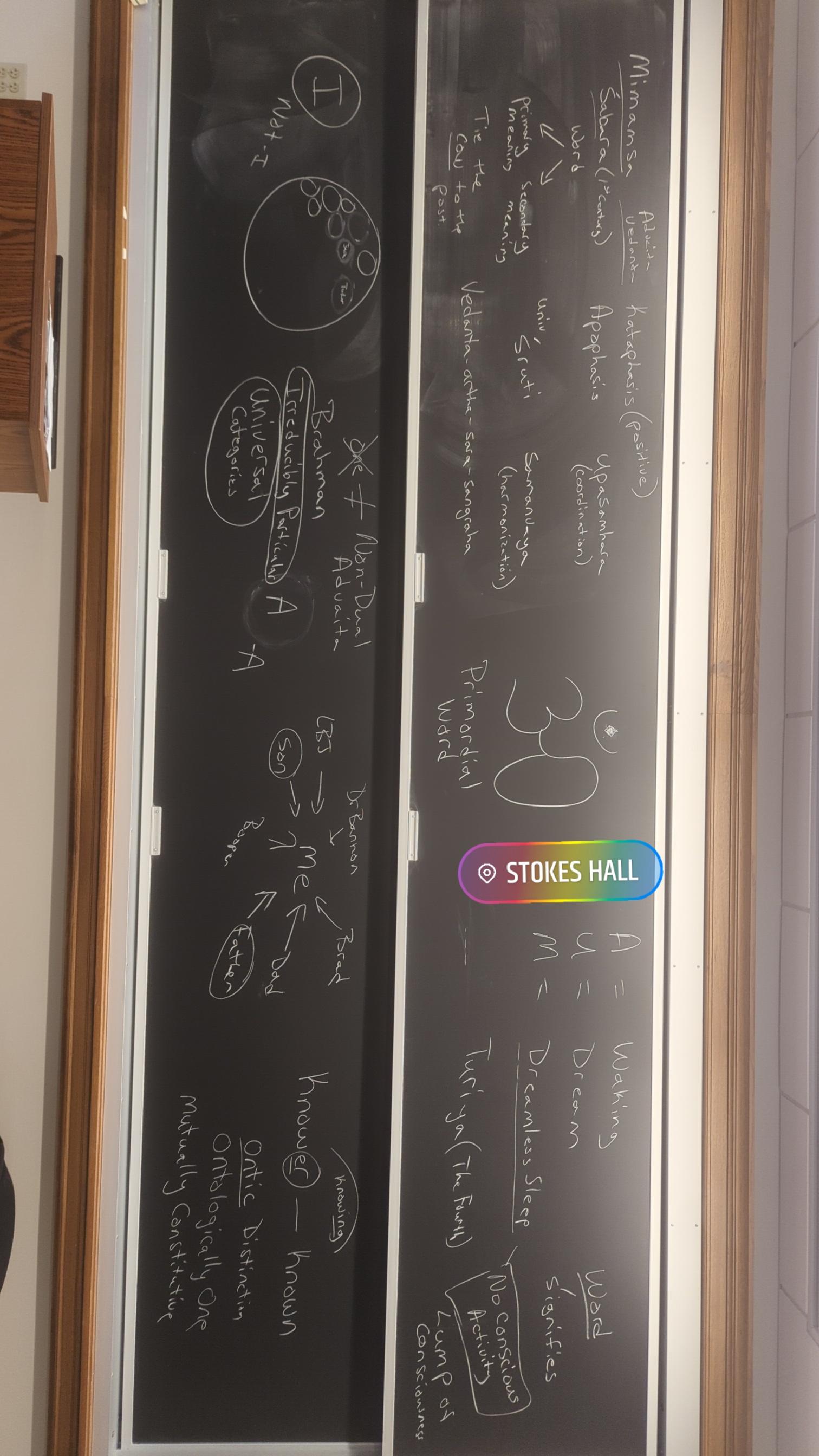
 "Son" -->"Me"
* **"Dr Bannon"--> "Me"**
* **"Brad" --> "Dad"**
* **"Booper"--> "Father"**
**Right Side (Bottom):**
* **"Knowing"**
* **"Knower - Known"**
* **"Ontic Distinction"**
* **"Ontologically One"**
* **"Mutually Constitutive"**
**Other Details:**
* The chalkboard is framed in a wooden border.
* There is a wooden ledge at the bottom of the chalkboard and a table in front of it.
* The writing is done with chalk and varies in size and style, some more detailed than others.
In general, the chalkboard seems to be used for philosophical discussions, likely in an academic or educational setting. It covers a variety of ideas, including language, consciousness, the nature of reality, and potentially aspects of Eastern philosophy.
" style="max-width:500px; margin: 10px auto; display: block; ">
```html
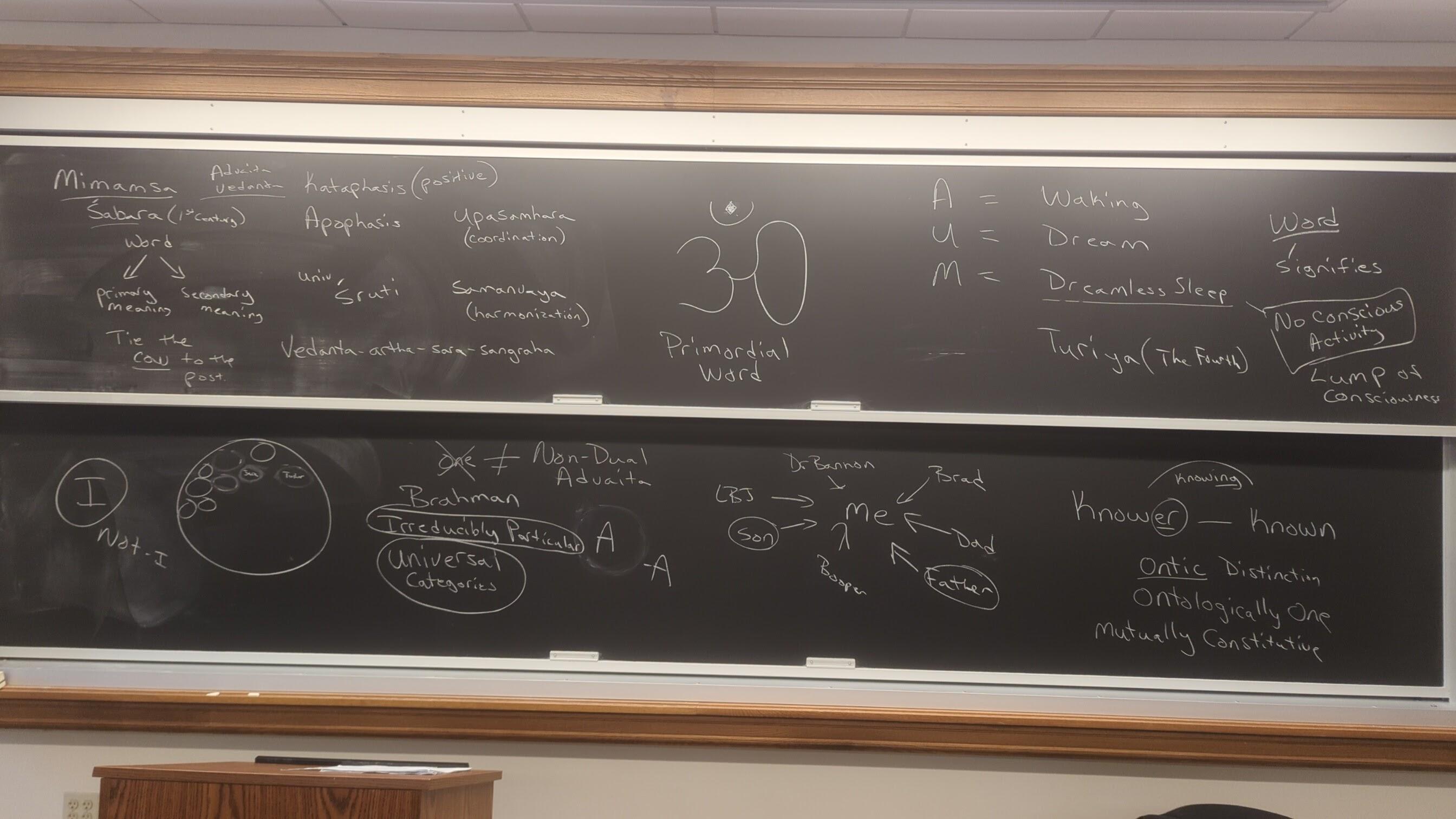
"Son" -->"Me"
* **"Dr Bannon"--> "Me"**
* **"Brad" --> "Dad"**
* **"Booper"--> "Father"**
**Right Side (Bottom):**
* **"Knowing"**
* **"Knower - Known"**
* **"Ontic Distinction"**
* **"Ontologically One"**
* **"Mutually Constitutive"**
**Other Details:**
* The chalkboard is framed in a wooden border.
* There is a wooden ledge at the bottom of the chalkboard and a table in front of it.
* The writing is done with chalk and varies in size and style, some more detailed than others.
In general, the chalkboard seems to be used for philosophical discussions, likely in an academic or educational setting. It covers a variety of ideas, including language, consciousness, the nature of reality, and potentially aspects of Eastern philosophy.
" style="max-width:500px; margin: 10px auto; display: block; ">
```html
This class session focused on the Māṇḍūkya Upaniṣad, concluding a short unit on the Mahāvākyas. The session began with attendance and a brief meditation using a singing bowl. The class then collectively read Brad Bannon's translation of the Māṇḍūkya Upaniṣad, with Brad providing the pronunciation for Sanskrit terms. A significant portion of the class involved discussion, starting with student questions about the nature of the "fourth state" (Turīya) and its relation to the other three states (waking, dream, deep sleep). Brad explained the concept of Turīya, emphasizing its negative description in the text and its meaning as simply "the fourth." The discussion explored the relationship between Om, Brahman, and the Self (Ātman), using analogies like different names for a person (Brad/Dad/Son) and the finger pointing to the moon to illustrate how words act as signifiers pointing towards reality without being the reality itself. Key concepts like cataphasis (positive description) and apophasis (negative description), ontic distinctions versus ontological unity, and non-duality (Advaita) were explored, drawing connections to the Bṛhadāraṇyaka Upaniṣad, the Nasadiya Sukta, Nicholas of Cusa, and the Gospel of John (specifically the encounter with the Samaritan woman). The class discussed how Advaita aims not to erase individuality but to see past the conceptual barriers separating individuals from the ultimate reality (Brahman), recognizing both the universal divinity and the irreducible particularity of each being.
Brad: How do y'all?
Brad: February 13th. Am I saying Amber? Yeah? Sailor? No? Colin? Claire? Reed?
Brad: I think that's it, yeah?
Brad: Alright.
Brad: Brought the bowl back. I had a request for the bowl, so.
Brad: Let's put screens away and try to be in the moment, as it were.
[singing bowl sounds for approx. 1 minute 10 seconds]
Brad: Let's take one breath together. When you breathe out, and then breathe in.
Brad: And exhale.
Brad: Howdy y'all.
Brad: So,
Brad: finishing our study of the Mahavakyas. And finishing up this short unit that we've got.
Brad: Look forward to your next podcast. First podcasts were fire, so just keep up the good work. Nice job. A little bit different this time, because these texts, I really want you to see them harmoniously and in sync with one another. So, I do want you to, you know, do the usual thing of going text by text, person by person. Same as last time, same as always. But, in this, this time, I really want you to focus on trying to draw connections, draw similarities, read across one text, read, read all the texts sort of synchronous synchron- synchro- in sync with one another, right? Synchronically, I guess. Harmoniously, would be would be the word I'm looking for, I think. So, let's dive into this text we've got here. Let's start by just, let's start by just reading it. I mean, it's pretty short, right? Do you mind starting, Liam? And we can kind of snake around, however. Anybody need an extra? I do have some extras.
Brad: Sure.
Brad: Uh huh.
Brad: Uh huh.
Brad: Yeah.
Brad: If you come across any Sanskrit, so we'll read the Brad Bannon translation. If you come across any Sanskrit, I'll just, I'll say the Sanskrit. Except for Om, you can say Om. The AI, if you listen to the podcast, they can't say Om. They say AUM, but we'll just say Om. So, yeah, Liam, well so we'll just go, you know, sentence by sentence or so, like usual.
Student 1: Okay. Sounds good. Om, that sacred syllable is all this.
Student 2: Its explanation is all that was, is, and shall be is simply Om.
Student 3: And moreover, that which transcends the three periods of time, that too is simply Om.
Student 4: All this is certainly Brahman.
Student 5: This self is Brahman.
Student 6: That Brahman is this self possessed of four quarters.
Brad: Vaiśvānara.
Student 7: The universal one, who is fixed in the waking state, who is conscious of the external, who possesses seven limbs and 19 mouths, and who enjoys material things, is the first quarter.
Brad: Taijasa.
Student 8: The luminous one, who is fixed in the dream state, who is conscious of the thing, who possesses seven limbs and 19 mouths, and who enjoys subtle things, is the second quarter.
Student 9: Should we go Amber?
Brad: Doesn't matter.
Student 9: Oh, okay. Wherein the sleeper does not desire any desirable thing, does not see any dream, that is deep sleep.
Brad: Prājña.
Student 10: The wise one, who is fixed in the state of deep sleep, who is unified, who is a mass of consciousness, who consists of bliss, who is certainly an enjoyer of bliss, and who is the entrance to the mind, is the third quarter.
Student 11: This is the Lord of all.
Student 12: This is the knower of all.
Student 13: This is the inner controller. This is the womb of all, indeed the origin and dissolution of beings.
Student 14: They consider the fourth to be not conscious of internal things, not conscious of external things, not conscious of both internal and external things, not a mass of consciousness, not conscious, not unconscious.
Student 15: Unseen, beyond the ordinary, ungrasped, undefined, unthought, not to be defined, whose essence is certainly of the one self, tranquility of the manifold, pacified, auspicious, and non-dual.
Student 16: That is the self. That is to be known.
Student 17: With respect to the syllable, Om is the self.
Student 18: With respect to the measures, the quarters are the measures and the measures are the quarters. A, U, and M.
Brad: Vaiśvānara.
Student 19: Whose place is the waking state, is the first measure, A, so named because of obtaining...
Brad: Yeah, Āpti.
Student 19: ...or because of being the first.
Brad: Ādimatva.
Student 20: One who knows this certainly obtains all that is desired and becomes first.
Brad: Taijasa.
Student 21: Whose place is the dream state, is the second measure, U, so named because of raising upwards...
Brad: Yeah, Utkarṣa.
Student 21: ...or from equanimity...
Brad: Ubhayatva.
Student 22: One who knows this certainly elevates the expanse of knowledge, becomes equal, and no one is, no one in his/her lineage will be ignorant of Brahman.
Brad: Prājña.
Student 23: Whose place is the state of deep sleep, is the third measure, M, so named because of measuring...
Brad: Miti.
Student 23: ...or merging.
Brad: Apīti.
Student 24: Yeah, continue.
Student 25: One who knows this fairly measures all this and becomes its merger.
Student 26: The fourth is without measure, beyond the ordinary, the tranquility of the manifold, auspicious and non-dual.
Student 27: Thus Om is indeed the self.
Student 28: One who knows this enters the self by the self.
Brad: Okay, word. Let's, let's start by, if there's any, any questions. I think I can anticipate one question.
Brad: Any questions?
Student 29: Yeah.
Brad: Yeah.
Student 29: So, is the fourth quarter? Yeah. Would it be more like a culmination of the all of the other three or is it like the lack of or anything that isn't?
Brad: Yeah, good question. So I mean, how is the fourth different from the other three, right? Yeah. That is, that is the question, I think. That is that is a significant question. I I can't, there's no sort of like simple direct answer to that question. But, but good question. One that we should wrestle with. It would be great, you know, topic for your podcast and, and also for this class. So we'll come back to that question. We're going to going to linger on that question. Sounds like I'm punting or ignoring it, but but I'm not. Yeah.
Student 30: So in the podcast, I think they mentioned your analogy of the four states of Brahman, how it's like different angles and viewpoints of the city.
Brad: Yeah.
Student 30: And then it said the, I can't pronounce this right, but the Turīya is the consciousness of the city? I when I was reading this I might have just missed it, but did they reference Turīya in the text at all?
Brad: So Turīya means the fourth. That particular part of the podcast was total hallucination. I didn't have any sort of comparison of the city. I mean, that I mean, you didn't hallucinate it, the AI did. I thought the it was it was interesting. It was interesting that there's like very few hallucinations in in NotebookLM, but but that was one of them. But yeah, Turīya, Turīya simply means the fourth. Like the word just means the fourth. That's literally just what the word means, the fourth. Doesn't even mean the fourth state, just means the fourth. So, yeah, so the the fourth, I just translated it as the fourth, like verse seven, they consider the fourth, meaning the fourth state, right? You've got Vaiśvānara, the waking state. So the yeah, the states generally are waking as one and then dream is two, dreamless sleep is the third and then Turīya or the fourth is the fourth. And again, it just means the fourth. So, unnamed and described, you know, in overwhelmingly negative terms. Almost entirely negative. What was the question again?
Student 30: I guess like I misunderstood like what it actually meant, like I know it translated to the fourth. So I was just confused on that.
Brad: Yeah, just means the fourth. Yeah. Good. Other questions?
Brad: A couple of things and then I want I really want you to get into teams and start chatting about the text and see if you can come up with some some good questions or comments to share with the with the class, especially questions. But you'll notice how I sort of organized the text on the page into three different sections. And, I've got, if I can pull it up. I'll pull it up in a second. I'm not getting signal for some reason. But, they all kind of line up. There there there's a lot of parallels between these three different sections. So obviously, you've got, you know, A, sort of equated with the waking, U equated somewhat with the dream, M some equated with the dreamless sleep. And then, and then what is that fourth? So the verse 12, the fourth is without measure, beyond the ordinary, the tranquility of the manifold, auspicious. That comes up twice, I believe, doesn't it? Tranquility of the manifold. I feel like it's maybe in verse seven somewhere. Yep, verse seven, tranquility of the manifold. So there's, yeah, and so it just says Om is the self. Doesn't really give us a an equation here. We could have, if we think about, so Om is supposed to be the, all of the, all of the vowels together. So, ah, uh, all the vowels. So, A O E, so all of the I can't say it. If you hear, if you hear like a Yogi, somebody who's very, you know, a traditional guru in India, when they chant Om, they pronounce it in a way that really pronounces all of the vowels, ending in anaswara or the M, which is a semi vowel. And then there should be some sort of, I don't know, silence. You can't really have a word without some sort of silence before and after it, right? We need these pauses in order to distinguish one word from another. So, we could take there's some sort of silence or some sort of pause here. The, the way Om is traditionally understood and particularly in comments commentaries on this particular text, is that because Om includes all of the vowels, and because you can't pronounce any words whatsoever without a vowel, then in some way, Om is sort of like the totality of all words, right? If you were to take all words together and sort of mush them into some sort of primordial, yeah, some primordial words, I mean, technically Om isn't exactly a word, it's more of a sound or a syllable, right? But it's the the first word, the sort of like the, I don't know, like a, if you were if you had Play-Doh or something and you were like shaping something, it would be like the lump, right? So like the lump from which you can shape anything else out of that lump, right? Something like that. Or primordial person that can then unfold into all these kind of things. So, yeah, there's, yeah, I'll pull up my graphic if I can get internet. But why don't you go ahead if there's any any questions, go ahead and ask them now. Otherwise, we'll, you know, chat with your teams. I assume you already know when you're meeting, but if you haven't decided that, then go ahead and chat about that when you're going to meet for the next podcast. But, but do try to stay on on topic and, yeah, see if you have any questions about this. Yeah.
Student 31: For the podcast, should we do your translation or the AI?
Brad: It doesn't matter. Yeah, either one. Either one. I don't think there's any like super substantial differences between the two. It's been a while since I read the the AI translation, but I think it's pretty, it's pretty literal. It's very faithful to the text. Anything else? Okay. Go ahead and, yeah, chat, see what you come up with. Looking for some impressive insights or questions, good questions. Take like five, seven, eight minutes, something like that, at least.
[small group discussion]
Brad: Anybody want to get started? Questions? Comments? Yeah.
Student 32: I don't really know how to put this, but basically we were trying to figure out like we have Om as this sacred syllable, but then it says that Om is the self, but then we also have Brahman as the self. So it's like Om a representation of Brahman? Like I was just trying to understand the relationship between Om as a syllable and Brahman self.
Brad: Good. Good, good. Good question. Got it the question. Yeah. So, words are, words are signifiers. Right? So a a word signifies in various different ways, right? So a word signifies, like, like a sign, right? Signs point, right? So, the sign to the bathroom isn't where you go to the bathroom. It points you to where you go to the bathroom, right? Don't don't take a whiz on the bathroom sign. Go where the bathroom tells you to go, right? So, words are signifiers, meaning that they point to a particular place in a particular way, right? So all of the words that you're asking about, you're pointing out that they all kind of point, there's all these different words that are pointing in different ways, right? So like, Om and the what is it, what is it, right? One way to think about this is, let me do, let me do what I usually prefer to do, which is to make everything about me, right? So, there's, there's me, right? I have lots of different names, lots of different significations, lots of different signifiers that can refer to me. One of them, obviously, is Brad. But I'm also called Dad. My son has started calling me Father. And my my mom calls me Cooper. My sisters call me LBJ, which stands for little baby Jesus. They don't mean that in a nice way. But I don't know. Right? I don't know. I have other names too. Dr. Bannon. Right? All these different signs point to me, but they don't just point to me and my body, they point to different aspects of me, different, right? Son, son is another one, right? So on the one hand, son and father are like kind of opposites, right? On the other hand, they both point to me, right? So I am a father with respect to my kids. I'm a son with respect to my parents, right? So, on the one hand, we're talking about Brahman as ultimate reality, but we could call this Brahman by lots of different names, right? And so part of the idea is understanding the goal of using any word, is to point to the thing that you're trying to signify. But you want to be careful that the signifier doesn't become the thing itself, right? There's this example that comes from another part of the Upanishads, that is usually associated with the Buddha, but actually it's before the Buddha. And it's refer the story goes something like this, like Buddha says, you know, what if you wanted to point out, you know, the moon or I'll say the clock because we don't have a moon in here. But if I wanted to point to the clock, right? Then in order to point to it, I would need to point to it, right? In order to see what I'm pointing at, you would first have to look at my finger, right? You can't see the clock or you can't see that at which I point unless you look at my finger, the pointer, right? But the pointer, if you just sit there staring at my finger the whole time, then you're never going to see that at which it points, right? So on the some level, you need the the pointing finger, let's call this, you know, a cataphasis, which is a positive description, and some sort of apophasis, meaning, look at what I'm pointing at, not at the pointing finger. But you need the pointing finger to get there, right? So you need both. But, does that kind of make sense? Kind of?
Student 32: So like Om is the the signifier towards Brahman?
Brad: Yeah. So, yes, sure. Yeah. Om is a little bit more than a simple signifier. So, all that said, is true of all signifiers, but Om is a little bit more than a signifier. It's more of a symbol or maybe even more than that. But it is at least a signifier. So Brahman, Brahman is definitely just a signifier, right? So, and in some ways Om is more more special than Brahman. Brahman's just a word, right? So, Brahman is just a signifier. And, so it's it's a signifier that's pointing at something, but but we need both the positive and the negative thing there. If I were to, I should have brought the Play-Doh. I almost brought the Play-Doh down just up in my office. But if I were to shape something, you know, use the Play-Doh to shape something. Or use the clay to shape something and then I were point to it. On the one hand, I'm pointing to, you know, you wouldn't if I say, what is this? Let's say I made a rose. I can't make a rose, but some of y'all make really cool roses. So if you, if you were to make a really cool rose out of Play-Doh and I were point to it and say, what is that? You wouldn't be wrong if you said a rose, right? But you also wouldn't be wrong if you said clay. So or Play-Doh. So the signifiers point to things, but point to things in a sort of complicated way. So it's about what aspect of it is it that you're pointing out, right? Does that kind of great question, awesome question. Any other question? Yeah, Rick.
Student 33: Like in Om is all that was, is and shall be like but it also contains that nothingness in these three parts and then the fourth one. Is it possible to like lose a part like one of the three things? Like are you still is it is it impossible then if you do lose it? Like are you still in that state or have you been like removed?
Brad: I'm not sure what you mean by losing a part of it.
Student 33: Like if you're trying to I don't know, if you're trying to reach this state, right? of like or understanding all what is and like is isn't at the same time like in waking, dream and dreamless sleep like I don't know. Is it I've kind of like divided those three as like things that people can do and can't do. But like what if there's one thing like that you aren't able to do? Can you still be the whole?
Brad: Which one would you not be able? I mean, so Rick, right? can you're awake right now. But you also dream, right? But when you're dreaming, you're still Rick, right? And when you're in a state of dreamless sleep, you're still Rick, right? Although, when you're in a state of dreamless sleep, there's literally nothing going on in your head, right? So you don't even know, this is important point. You don't even know that you're Rick when you're in a state of deep sleep, right? You know when you're, you know that you're Rick when you're waking. You probably know that you're Rick when you're dreaming, although maybe you dream that you're Tiger Woods or something, right? I just was looking for a golf person, that's what it came to mind. And, but that's that's more than who you are, right? So this is trying to say that the self, the self cannot be in none of these states. The state, the self has to be in one of these states. You can never not be in one of these states. So to to be is to be in one of these states. I mean, it's it's easy to say since Turīya is just sort of undefined, right? But I don't know what you mean by losing one of the states. Like, I mean, I guess if somebody's in a coma with no brain activity, then they're trapped in that state. So in that sense, they can't move between the states. But, they still are the self, just trapped in that state, I guess. Is that kind of on the line?
Student 33: Yeah. I guess I was thinking like like when you die, like you're not in that waking, would you like some people don't dream, they're not in the like what if they're in the dream state?
Brad: Yeah. So, one Shankara, this Advaita Vedānta, I think we've mentioned him a few times before. But in his commentary, you know, he spends a lot of time trying to figure out what is the difference between dreamless sleep where there is no, you know, no conscious activity. I won't say no consciousness, but no conscious activity. In and that seems to be a pretty good description of what death is too, right? In death, there's no conscious activity. So Shankara spends a lot of time pointing out or investigating like what's the difference on the one hand between dreamless sleep and death? What is the difference between dreamless sleep and death? There's one pretty obvious difference. You wake up in one. You don't wake up from death, right? So, you wake up from one of them and not from the other one. So he describes this dreamless sleep in the Upaniṣad describes this dreamless sleep as like a lump of consciousness. I don't know. I really don't know what I was thinking when I described it as a or translated it as a mass of consciousness. Really don't know because like so much of my dissertation is about the importance of it being a lump. So I don't know why I translated it as a mass. But it's a lump, right? Ghana, Prajñāna Ghana, this lump of consciousness, which I hope already brings to mind a little bit of the Chāndogya Upaniṣad, right? Lump of clay. So you've got this lump of conscious potentiality, right? Which is not there in death, but is there in the dreamless sleep. Does that kind of Yeah.
Student 33: Okay.
Brad: Great question. Yeah, Catherine.
Student 34: It says that the fourth state is like not to be known or grasped. But then it says one who knows this enters the self by the self. And so are you supposed to be able to understand all of the four states or is that one not meant to be known?
Brad: Right. Good question. So, harkening back to the Nasadiya Sukta that many of you talked about in your in your first podcast. So that's the one that ends with, you know, only God knows or maybe or maybe he doesn't, right? In order to know, three things are necessary in order for knowledge or knowing to take place. There first must be a knower, somebody who knows, right? Knowledge doesn't happen outside of a knower, right? So there must be a knower, and that knower must know some sort of something say something that is known, right? Or knowledge, you could say there. And then some sort of ongoing sort of activity or process of knowing, right? Some sort of temporal activity of knowing. So that means that there must be some sort of ontic distinction between what is known and the knower that knows it. What does ontic distinction mean? It's a big philosophy stuff. Anybody have a coin, quarter, half dollar? I don't need it. Yeah, you have one, Mary? So let's take I don't really have the whole of the coin in order to make this point, but it doesn't hurt. So, this is one coin, right? So it's ontologically one. Right? So one coin. And any coin, including this one, it has to have, by definition, it's got to have a top and a bottom, right? Doesn't have to be heads or tails, but it's got to be it has to have a top and a bottom. If I were to use my samurai powers to like slice this thing in half, right? It wouldn't have heads or tails anymore, but it still have a top and a bottom, right? So, top and bottom are necessary for anything like a coin, right? It has to be a top, there has to be a bottom. Top and bottom then are ontic distinctions. They're opposites, literally opposed to one another. But they're also mutually constitutive. Mutually constitutive means you can't have one without the other. You can't have, you can't have one without the other. They define one another. There can't be a parent unless there's a child, right? There can't be, there can't be a top without a bottom. There can't be an inside without an outside, right? Etc. So, anytime we have any like a circle, for example, there has to be an inside and an outside. You can't have a circle without inside and outside, but inside and outside are opposites, right? But you can't have one without the other. So they're mutually constitutive. So they could be ontologically one. In fact, they were ontologically one before I drew this ontic distinction of the circle because this wasn't outside and this wasn't inside until I drew the circle, right? And then they became inside and outside and they both came into being ontologically at exactly the same time, right? Could never have an inside without an outside. You could never have a center without a circumference would be another one, right? Kind of makes sense? So you've got the difference between ontic distinctions and ontological, thank you. So in order to know, that was your question, right? About knowing. So, here in Turīya, what were you asking about Turīya or the the third state or the fourth state?
Student 34: Fourth state.
Brad: Fourth state. So, so they consider the fourth to be not conscious of internal things, not conscious of external things, not conscious of both internal and external things, not a massive conscious, not conscious, not unconscious, unseen, beyond the ordinary, ungrasped, undefined, unthought, not to be defined, whose essence is certainly of the one self. Non-dual. So here we've got that word, non-dual, which you know in Sanskrit is Advaita. This whole unit, this whole unit two is on Advaita Vedānta. So here we've got the word Advaita, not two. So here we could take knower and known to be not two. We could take the top and the bottom of the coin to be not two, right? They're not the same, they're not one, right? You can't have top without bottom, top and bottom are opposites, inside and outside are opposites. They're not one, right? So not not two does not mean one, right? No. Because the inside and the outside are not one thing. But they're also not two things, as we just established, right? Because why are they not two things? Because they're ontologically dependent upon one another for their existence, right? So because they're ontologically dependent upon one another for their existence, then they're said to be not two. Since they're not the same thing, they're not one, but they're also not two. Kind of get it a little bit there? So then knower and known, you can't have a knower unless there's something known. So there has to be an ontic distinction between knower and known, right? That's a fundamental aspect of epistemology. Can't have any such thing as knower unless there's something that's not me that's known. Think back to the the Bṛhadāraṇyaka Bṛhadāraṇyaka Upaniṣad 1 4 and the beginning was that so that was one of your texts, one of the texts from your podcast for your podcast. And in the beginning was this one, this I came into being, and it did not know anything. And it was also, right, lonely and bored, right? So it was lonely and bored, so then it couldn't know anything because there was nothing to know. It couldn't see anything because there was nothing to see. It couldn't right? So there was neither seer nor seen when it was just one, right? Can't have any sort of anything like that without at least ontic distinctions between knower and known. So it became many, but those many came through division, very much like drawing a circle on the board. So then I'm dividing the circle.
Brad: Let's see if this helps. Right? So we've got this let the circle represent the Puruṣa, right? The the person in the beginning. And it it let's pretend that there is nothing outside of the circle, right? For the sake of this is just everything that is. But then it divide it becomes many, right? Let me become many. And so this many, right? It becomes Liam and an Alec and a Tushar and Riley and Jack and a Mary and a Brett, right? And so let each one of these sort of circles represent a an unfolding of the one, right? Or a division of the one. But those according to Advaita, these aren't independent entities, but instead an unfolding of the one. Remember I did the thing with the with the paper? Did I do the thing with the paper? Right? So like they're not it's not the one becoming two, but instead unfolding as, right? So unfolding, so it's still one paper, but so then maybe the goal of Advaita isn't to get rid of Tushar, but instead to erase the distinctions between Tushar and not Tushar. Does that make sense? Right? So, so not to annihilate Tushar, but to see past the barriers that separate Tushar from from not Tushar. Does that make sense? Right? So, what makes you you is is not other than what makes you Brahman, right? So it's you are Brahman, but you are Brahman in this very unique way, right? Just as Christ saw the Samaritan woman at the well in this very unique way. Saw her divinity and her uniqueness at the same time, right? The universal and the particular. Good. Great question. Yeah, back.
Student 35: follow up question, but I think it was maybe Jed who said it, but wasn't he the one too that was like oh you become closer to God by like understanding what isn't God? Is that sort of like a similar concept?
Brad: Yeah. Yeah. Yeah. So by become by understanding what isn't God, on the one hand, I could say, you know, I am Dr. Bannon, I am Brad, I am dad, I am father, I am son, I am all these things. But maybe truer, so that's cataphasis, right? That's the positive aspects. But maybe truer would be to say, I'm not father, I'm not dad, I'm not Brad, I'm not Dr. Bannon, I'm me, right? There's something that's unnamable, that's something that's that can't be objectified, that can't be signified, that can't be reduced in any way to any sort of universal category, but is we might say irreducibly particular. Right? So there's something about Becca that couldn't be possibly if we were to write, if all of us were to say, you know what, let's just devote our entire lives to writing biographies about Becca. And like we were all just to devote the rest of our lives to describing everything about you. Probably, I don't know how you'd feel about that. Probably I don't think I'd love that if that were the case for me. But even if we were to do that, and even if you were participate too, we still couldn't ever encompass everything about you, right? So likewise, there's something about you that can't even be put into words at all, right? So that's the sort of getting beyond the limitations of signifiers and signification, which is definitely something Nikki C was very focused on and something that Shankara was very focused on too, which is why I chose these kids to focus on. Awesome. Great. Others? Yeah, Jed.
Student 35: just going off that, they mentioned like the like the AI podcast how like they really like based the like contradictions like we see like you have to be like not something but is and how they both rely on each other.
Brad: Yeah.
Student 35: But it says like it's hard it's up to us to like see past these contradictions like the interconnectedness of it. Mhm. And then it said how like Jesus was like the one who's actually capable of doing this.
Brad: Yeah.
Student 35: So is that implying that it's divine in the sense to be able to do that and that like us humans we have the capacity to but we won't have the capacity to like 100% achieve it just because we aren't mortal? I mean because we are mortal but we also not divine so we'll not be able to like 100% do this all the time?
Brad: Yeah. Good. Good. So, the I gave the, I gave NotebookLM just my whole dissertation, right? And I said focus on the Māṇḍūkya Upaniṣad, but half of my dissertation is on Nicholas of Cusa and half of it's on, you know, a good chunk of it is on John chapter 4, which we studied a lot last semester, which is about learning to see one another in the way that Jesus saw one in that case, the Samaritan woman at the well, which we will be reading this text later this semester, right? So learning to see in the way that Christ saw, right? So Christ sees the Samaritan woman at the well and when he sees her, he doesn't see her, he doesn't identify her as any one of these categories, but he sees her as she is, right? He sees her without any of these filters, without any of these categorizations. He doesn't put her in any box. He doesn't see her universal universal characteristics such as, you know, skin color, gender, or ethnicity, religious differences. Those are all things that she was very concerned about, right? Why are you seeing me as a, why are you who are a Jew talking to me who's a Samaritan? That sort of stuff. So he sees past all those abstract universal categories. There's so many names for those, right? But boxes, trying about putting people in boxes. Instead of seeing past these boxes or in this case circles, right? So instead of seeing just the outside of the circle, the point that I was trying to make in my dissertation is that Cusa wants us to see past those and to see the inner divinity within us, right? And so in the same way that Christ saw that inner divinity within the Samaritan woman at the well and is therefore teaching us to try and see one another in that light. Something similar, I'm arguing is going on in the Māṇḍūkya Upaniṣad where it's about learning to see past these ontic distinctions to the ontological oneness without erasing the individual themselves. Does that make sense? Right? So, so not to annihilate Tushar, but to see past the barriers that separate Tushar from from not Tushar. Does that make sense? Yeah. Awesome. Great. Others?
Brad: Okay.