 ```html
Date: February 11th
This class session continued the study of Advaita Vedānta, focusing on the Mahāvākyas (Great Utterances), specifically *Tat Tvam Asi* ("Thou Art That") from the *Chāndogya Upaniṣad* and *Prajñānam Brahma* ("Consciousness is Brahman") from the *Aitareya Upaniṣad*. The instructor, Brad, emphasized the importance of reading these texts harmoniously, drawing parallels with the Mīmāṃsā school's approach to scriptural interpretation. The class engaged in a detailed discussion of various sections (8-16) of the *Chāndogya Upaniṣad*, using metaphors like clay, merging rivers, honey, salt in water, and seeds to explore the non-dual relationship between the individual self (Ātman) and ultimate reality (Brahman). Students participated in a small group activity involving Play-Doh to represent these concepts. The session concluded with a reading and brief analysis of *Aitareya Upaniṣad* Chapter 3, highlighting the nature of consciousness (Prajñāna) as Brahman, and planning for the upcoming podcast assignment on the Mahāvākyas.
Brad: Yeah.
Brad: Alrighty. How do y'all? So it's February 11th. We're missing Ella, Luca, Jack, Ruby, Addison, and Justin. Yeah? Everybody else here? Alright. Let's let's come to order, please. Screens away. Leave everything Thank you. Alright. Let's take a moment and just clear your minds, put everything else out. Let's just sort of be present.
Brad: Okay, let's take one breath together. Go ahead and breathe in. And let it all out.
Brad: Word. Thank you. Alright, retake attendance. So, we picked up Addison and Luca. Anybody else? Okay. Cool.
Brad: So, today, we've got a lot to cover. Since the weather held us held us back last Thursday. So, this is a short but important unit. So it's just it's just two weeks and missed a class. So it's really just three classes between your last podcast and your next podcast. So your next podcast is due this Sunday. And it should cover the Mahāvākyas. So this whole unit is on the Mahāvākyas.
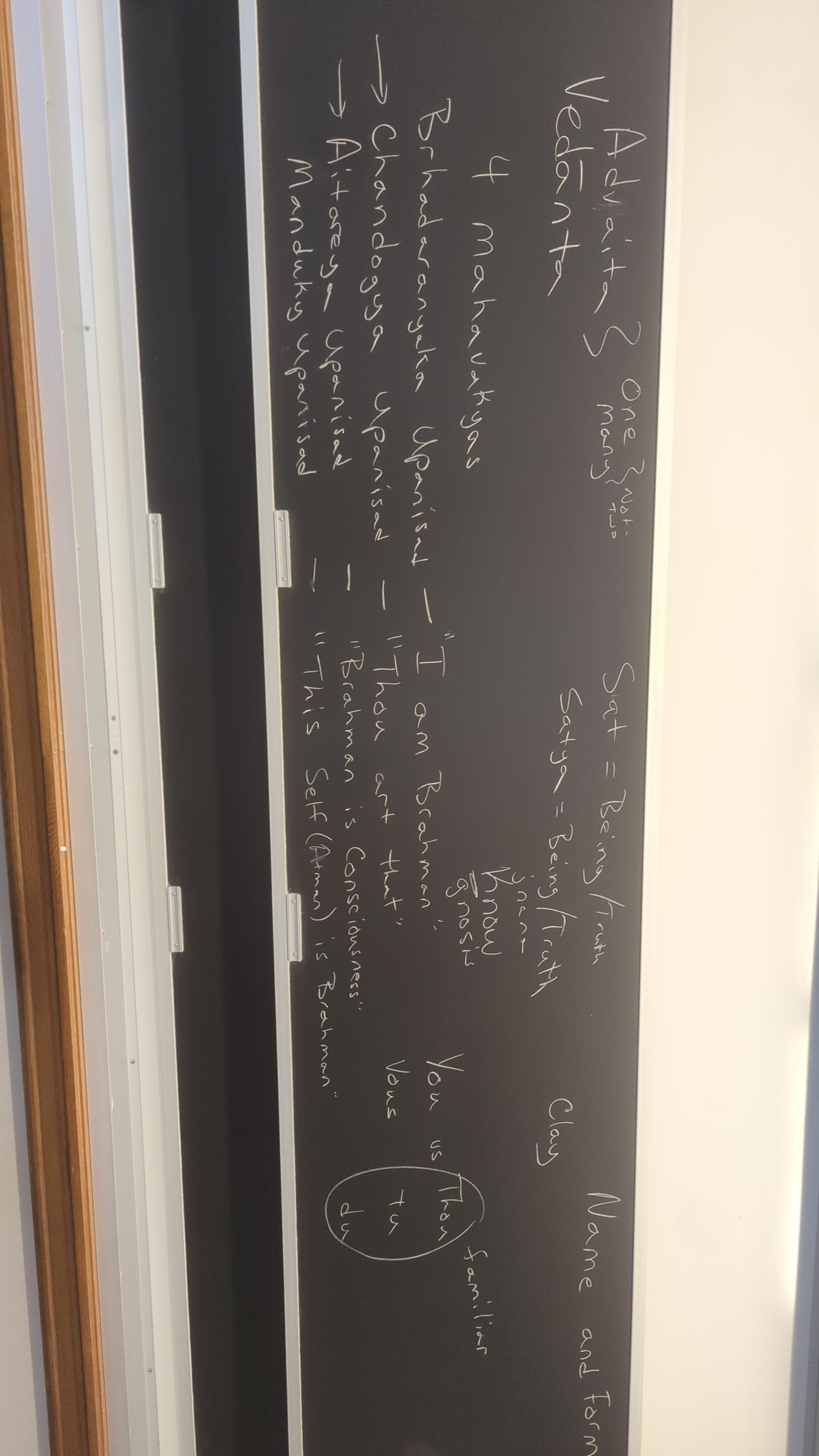
Brad: So we're continuing our study of Advaita Vedānta, which is one of the Śaṭ Darśana, one of the six perspectives in Orthodox Hindu thought. And or at least Vedānta is one of those Śaṭ Darśana. Advaita is Advaita Vedānta is a school within that system. And Advaita, of course, means not two, right? So not two. A meaning not and Dvaita meaning two. So not two or non-dualism. And we can continue to think throughout this unit, it'd be great topic for your podcast is to think through that term Advaita or not two. In a little bit more detail, think about what is what is being denied tuness? What's the privation that's going on there?
Brad: And this unit, we're covering these four Mahāvākyas. Mahā meaning great and Vākyas meaning sentences or utterances. And we've got one from each one of the four divisions of the Upaniṣad or divisions of the Veda. So the Bṛhadāraṇyaka that we looked at last week comes from the Yajur Veda. The Chāndogya comes from the Sāma Veda. The text we're looking at today, well, we're looking at both of these. Aitareya comes from the Ṛg Veda. And then the Māṇḍūkya, which we'll look at Thursday comes from the Atharva Veda.
Brad: I gave you a translation of the, well of all of these texts. But the Māṇḍūkya Upaniṣad that I gave you. This by the way is the entire Upaniṣad. This isn't an excerpt. The other other things we've looked at are excerpts, especially the Bṛhadāraṇyaka is huge. And we were just looking at, you know, a tiny tiny little sliver of it. Chāndogya is also very big and we're looking at a small section of it. The Aitareya is actually quite short. Could have given you the whole thing. It's only a few pages long. And the Māṇḍūkya is literally 12 verses. That's why I chose to write my dissertation about it because, you know, it's just 12 verses. So, but no, I seriously spent four years on this translation. So, this is my translation and on the other side is so this one took me four years and this one is probably a bit better. It took my chat GPT 4 about four seconds to to do. But I've given you both. So read that for Thursday. That's not for today.
Brad: What is for today is we're going to spend most of the time talking about the Chāndogya Upaniṣad and then we'll spend the the last 15 minutes or so focused on the Aitareya Upaniṣad, which is in the little packet that I gave you.
Brad: One of the key things that that I hope to accomplish in this unit, one of the key takeaways that I want you to take away, one of the key things that I want you to do in your podcast coming up is to start to read these texts together, right? So, we want so I want each one of you to choose one of these to focus on for your podcast. If you've got five people in your podcast, then you know, pick one of them to double up on. Probably either probably one of the any of them would be fine to double up on. Except the Aitareya I guess is pretty short. But but I really want you to start seeing how they harmonize together. So, harmonization is a key part of how the so remember at the beginning of the last unit, I talked about Mīmāṃsā. I've talked about Mīmāṃsā a few times. So Mīmāṃsā is one of the Śaṭ Darśana, right? One of the six systems. We're only looking at three systems this or three perspectives this semester. Mīmāṃsā which we did a little bit, Vedānta which we're going to do a lot, and then when we get to later in the semester, we'll do more on Yoga, which is the one of the six.
Brad: And one of the key things that I hope you took away from Mīmāṃsā is Mīmāṃsakas are focused on careful, meticulous, painstaking analysis of the scriptures, right? So they wanted or they want to make sure that there's no contradiction in their reading of this scripture and that scripture, right? So if if their interpretation of let's say the Bṛhadāraṇyaka Upaniṣad contradicts with their interpretation of the Chāndogya Upaniṣad, that means the interpretation is wrong, right? Because the texts aren't wrong. So if you're interpreting the text in a way that contradicts one another, then your interpretation of one of the texts is wrong. Right? So then by studying more and more texts, more and more of the Veda, then you can kind of narrow it down and get your interpretation more in line in a way, right? So that's so Mīmāṃsā want to Mīmāṃsakas want to read the scriptures in a way that doesn't have any contradiction. And then the Vedāntins are taking that same principle, the same approach just to the Upaniṣads, right? So we want to do the same thing here. So we want to make sure that what I really want you to try to do this unit is try to read as best as you can, read these texts through the lens of Advaita Vedānta. Try to really get, you know, granted, in order to understand Advaita Vedānta, you got to study it for, you know, decades. But and then still struggle with it. But we're trying to do as much as we can in a couple weeks, right? So, try to read it through that lens and I think the the lecture that you watched by Anant Professor Rambachan, hopefully he's I don't remember if I said this in the email, but he is one of the greatest maybe the arguably the best theologian of Advaita Vedānta in the world. He's certainly certainly highly, highly, highly respected scholar and practitioner in Advaita. Definitely a huge influence in on me and my teachers actually. So anyway, yeah, so the Mahāvākya from the Bṛhadāraṇyaka was Ahaṃ Brahmāsmi. I am Brahman, which we saw in Bṛhadāraṇyaka 1.4.10.
Brad: And then today, the text that we're looking at, you'll notice that the Mahāvākya is actually repeated over and over again from at the end of every section. So if you look at the handout that I gave you, we'll spend some time on section one, but then also beginning from section 8, see section 8 verse seven. Have a look at verse seven, section 8, so the second page here. That which is the finest essence, meaning the most subtle, the most yeah, the most subtle. This whole world has that as its soul. This is the truth. The word truth is Satya, Satyam. Satya as I've mentioned before, means both being and truth. Means both of those things at the same time. Being and truth are not two different things. That is the self, the Ātman, and then finally the you are the Mahāvākya, thou art that or Tat Tvam Asi. Literally it's Tat Tvam Asi. Tat meaning that and Tvam. Tvam is so it's usually translated thou. This is translated you. What's the difference between you and thou?
Student 1: Obviously formal versus informal.
Brad: Formal versus informal. Yeah. So, so you is formal. It's why in English you is both singular and plural, same as vous, right? And tu is informal, familiar, right? Also thou is informal and familiar. We think of it, we tend to think of it as more formal because it's like super unusual, like archaic. But it really means it's the familiar like tu or du in German. So here it makes sense because it's between father and son, right? So it should be familiar. So Tat Tvam Asi, Śvetaketu. Good. Then we'll look at the other ones in a bit. Good. Any questions?
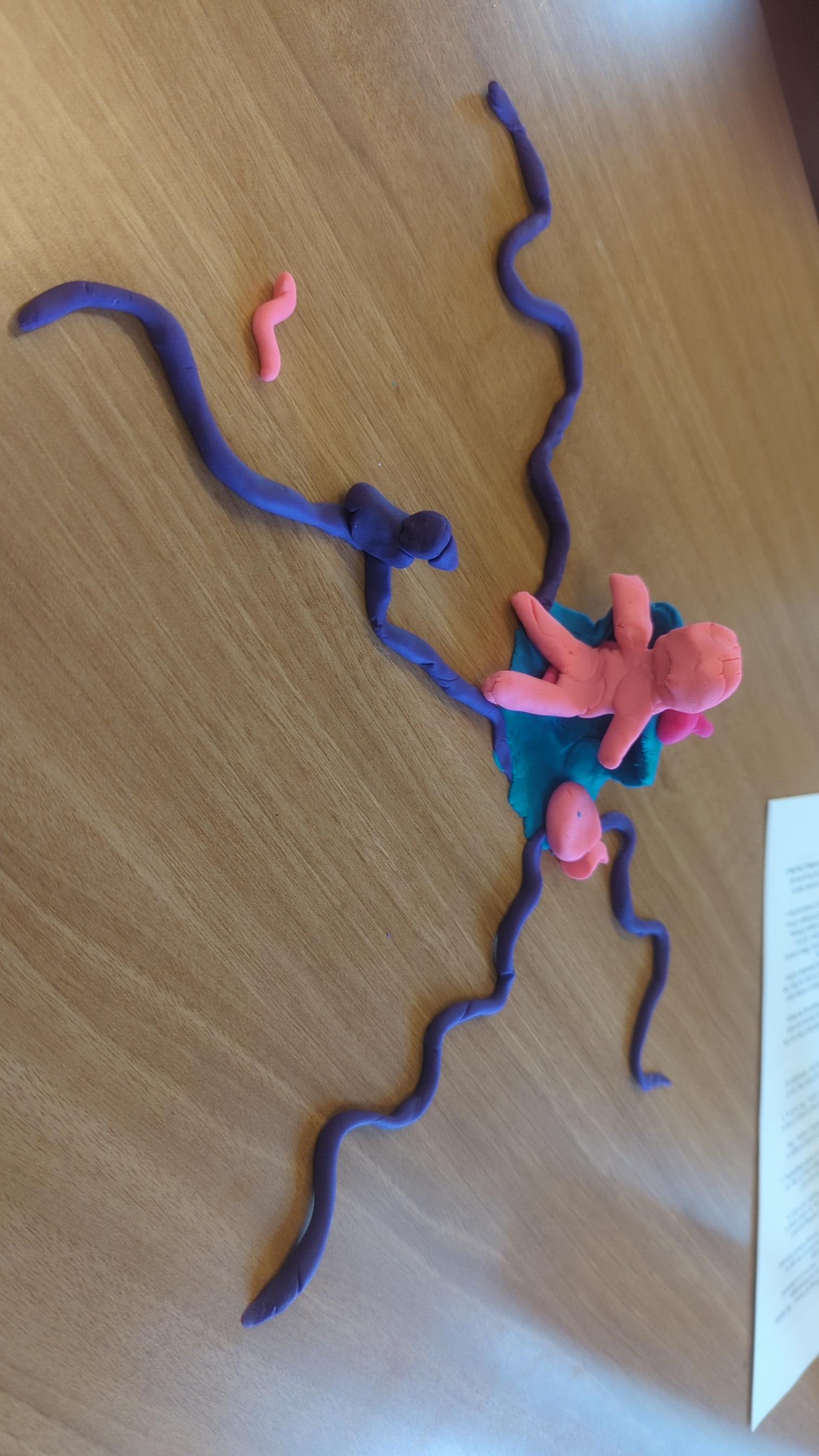
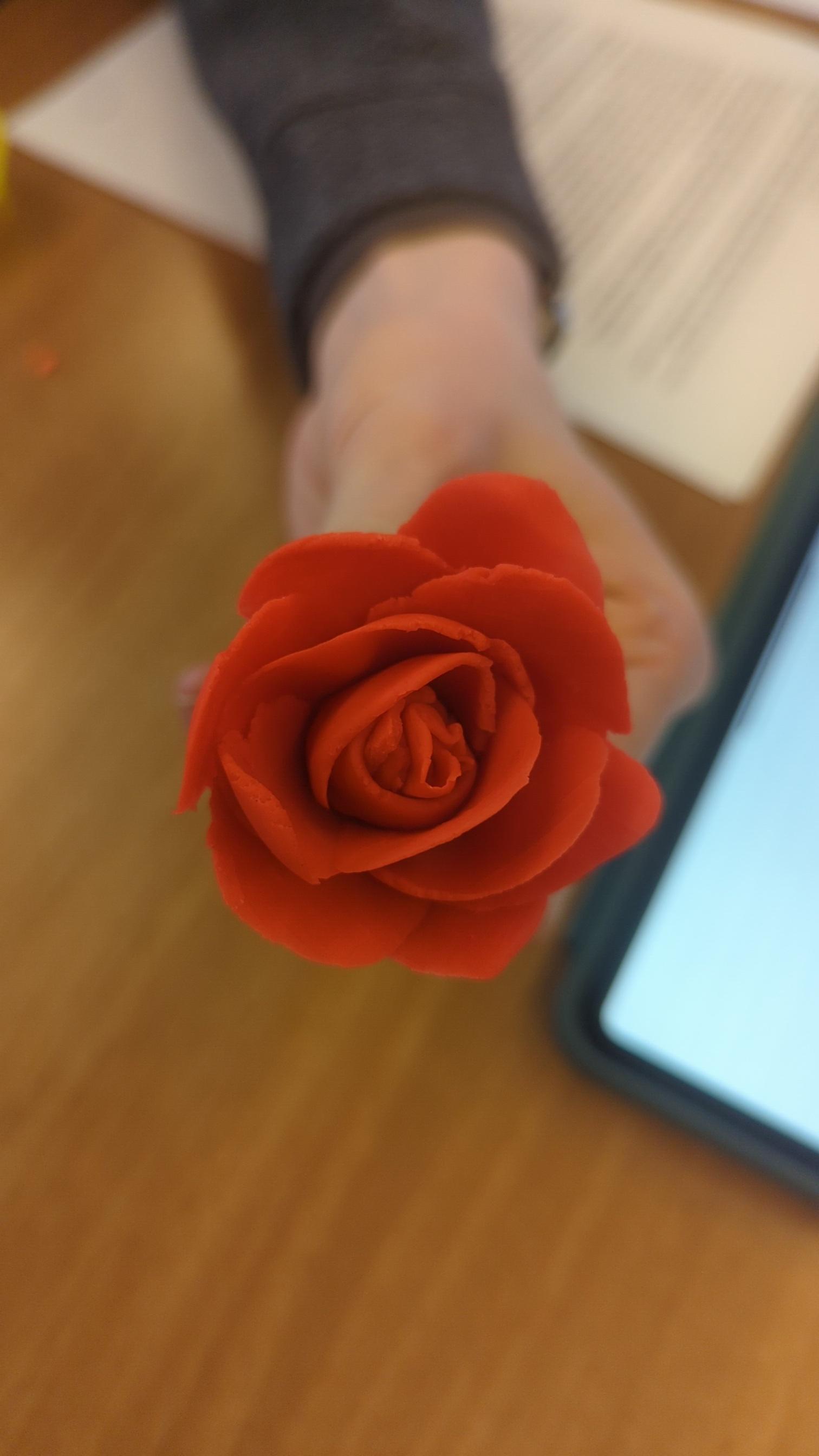
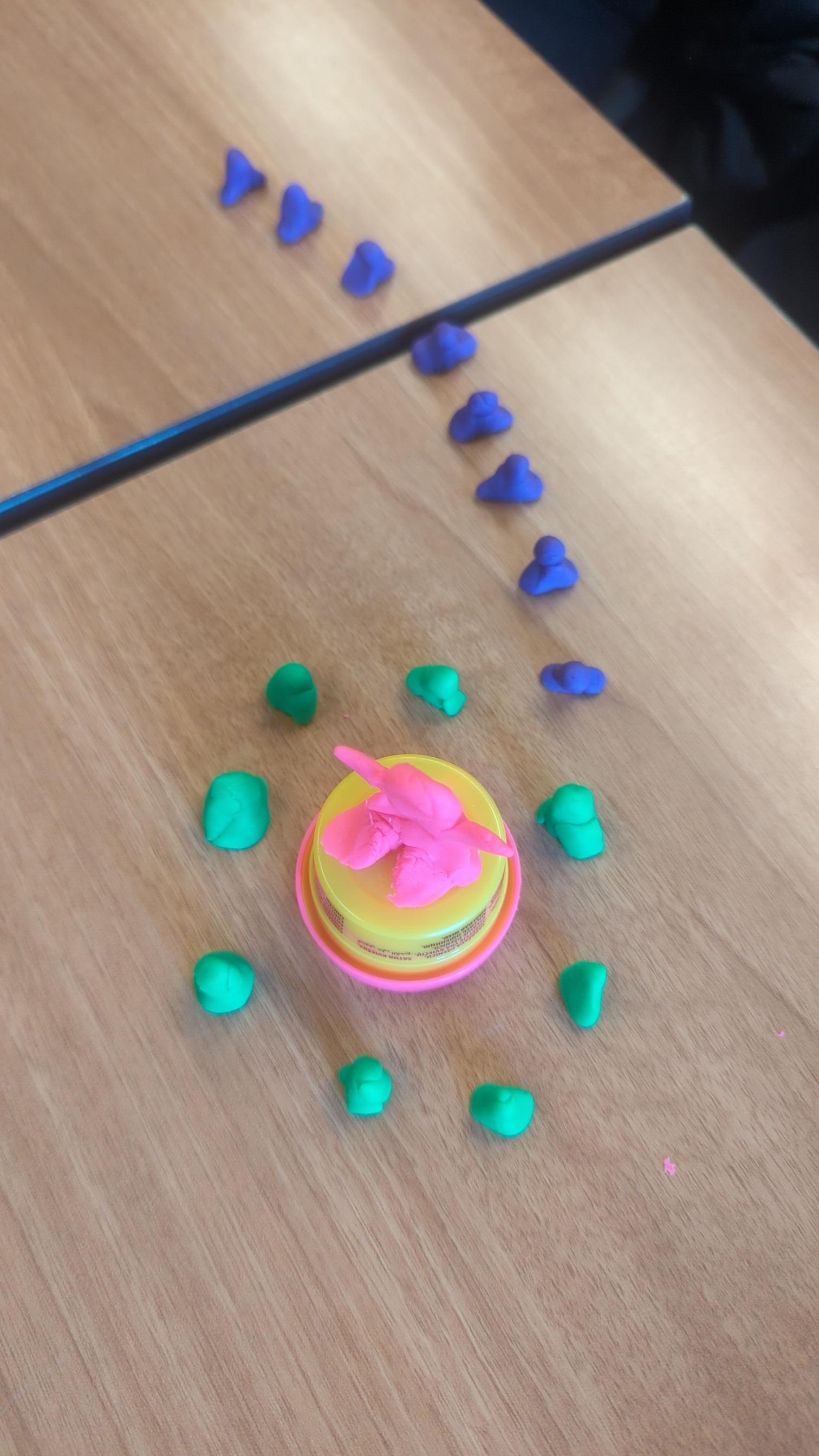
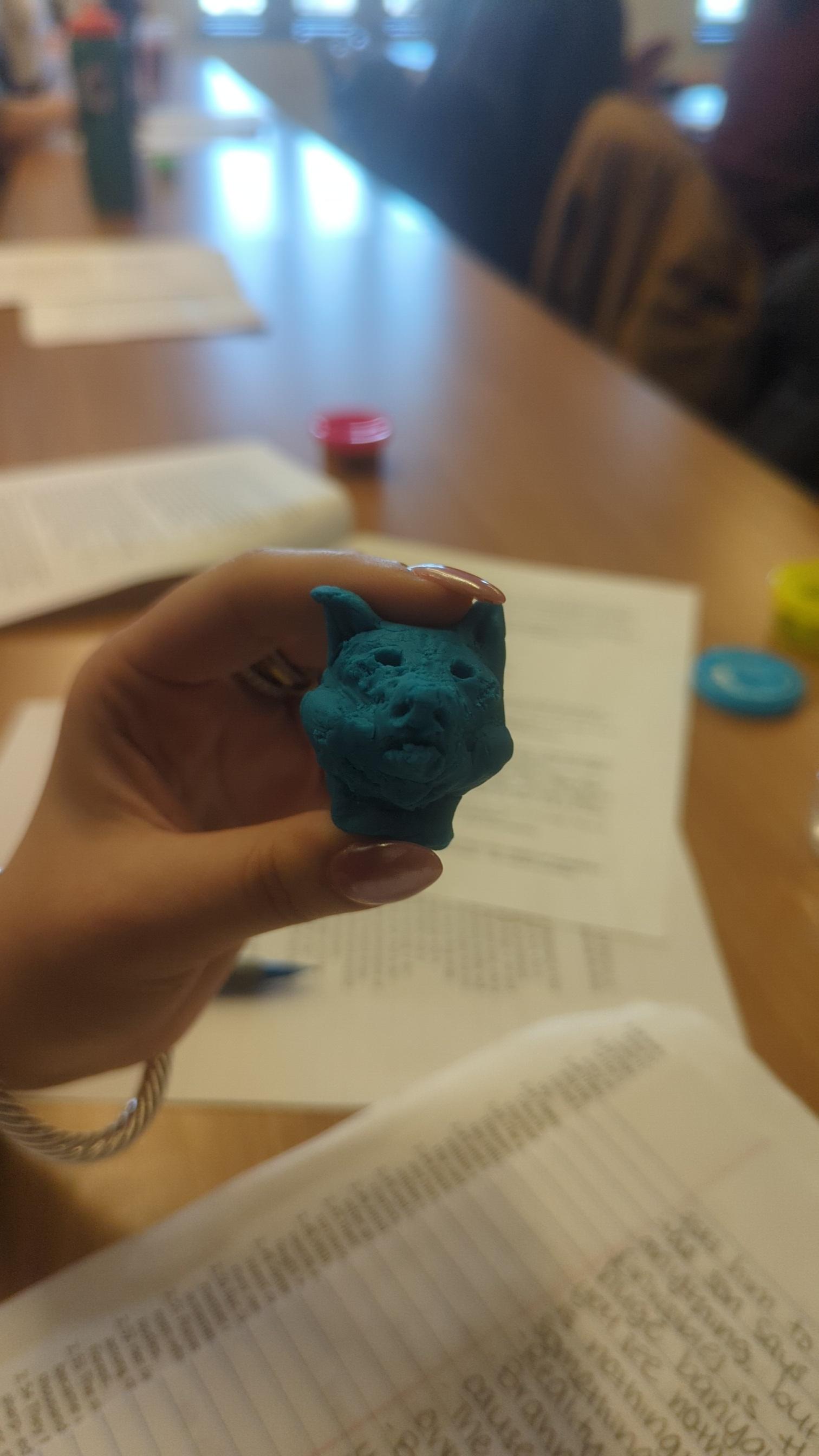
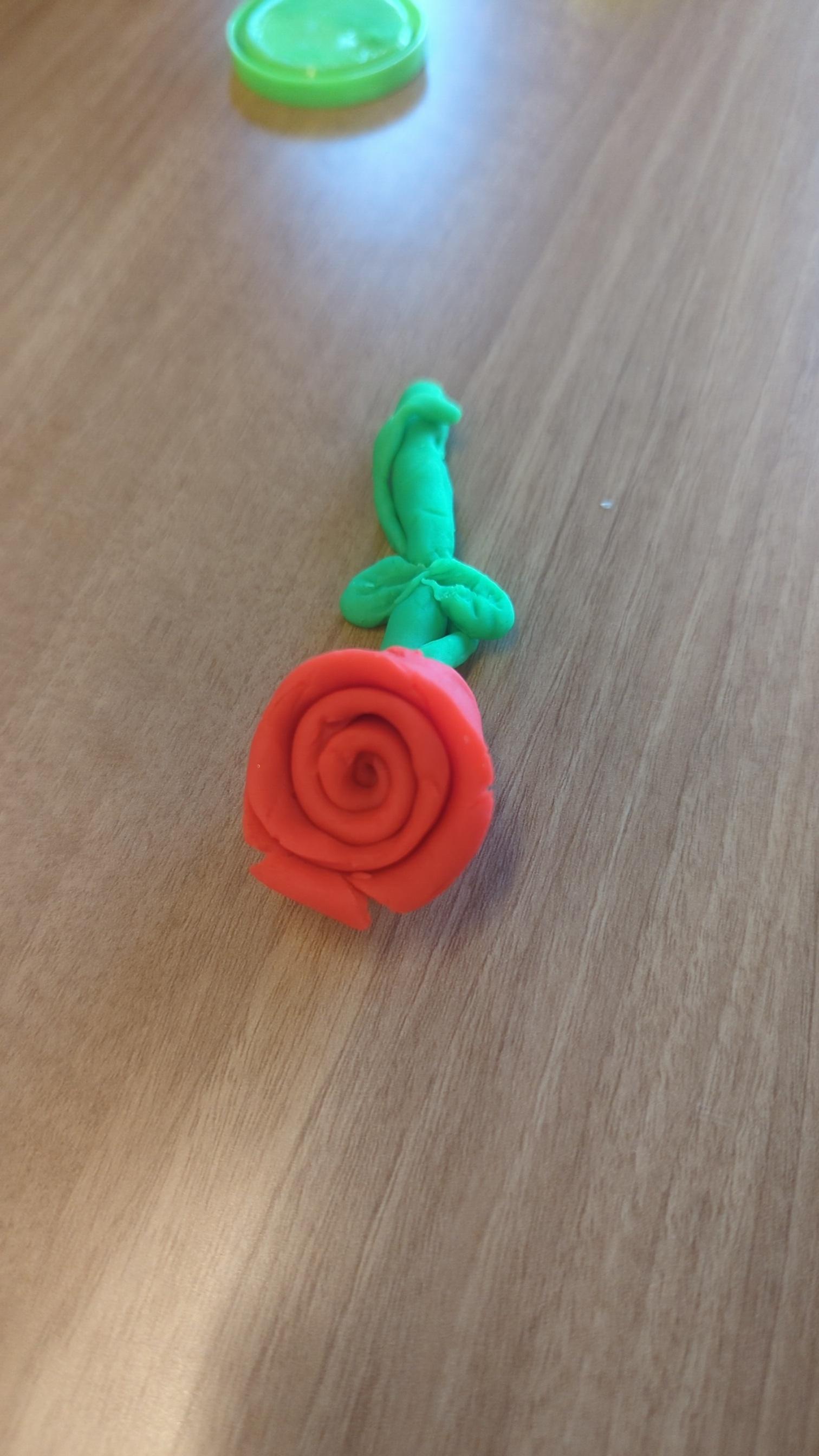
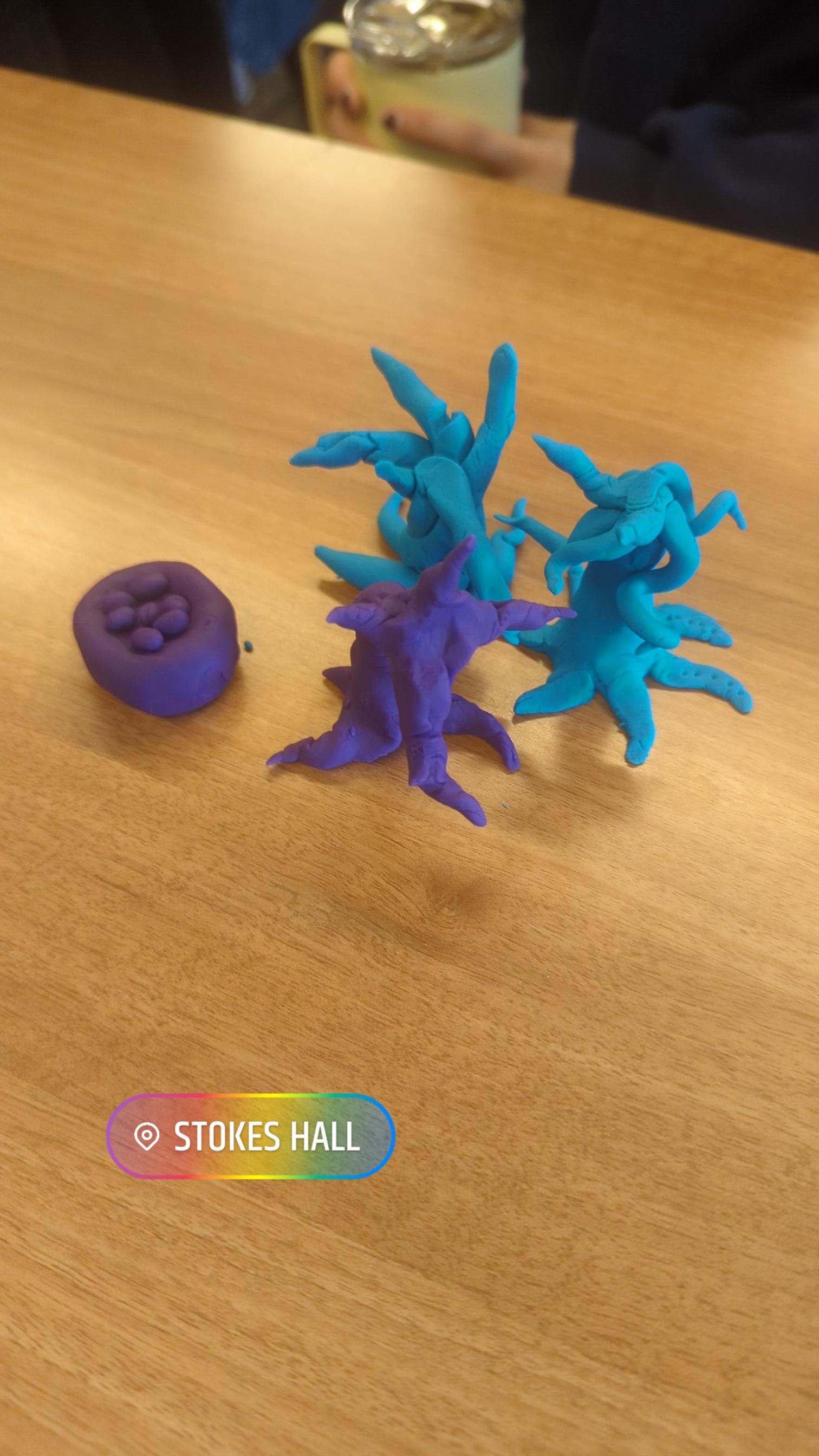
Brad: So let's do something then. I'd like you to spend a good chunk of time, maybe the next half hour. As long as every as long as conversations are staying on point. But I'd like you as a team to pick one of these sections. So we've got section 8 through 8 through 16. So chat about it with your group and decide which one of these you as a team want to focus on or two if you want to focus on more than one, but I think one is ideal. And just try to have a good conversation about it and maybe while you're doing that, it might make sense pedagogically at least to take some Play-Doh and see what you can make. The in the past, I've had I've done like a contest, like to see who did the best sculpture, but the problem with that is I do not want to be the judge of that contest, so I won't do that. So if anybody can come up with a system for judging a winter, that's fair, down with that. Otherwise, we'll just take the best ones and if you want, I'll post them on my Snapchats and stuff.
Student 1: Do a poll.
Brad: Do a poll. We could do a poll. Take one of the sections 8 through 16. You have one 8 through 16. Which one?
Student 1: What is Prāṇa?
Brad: Prāṇa means breath. It also is often translated as life force, but it's because breath is the life force.
Student 2: Are we meeting with our podcast groups now?
Brad: Yeah. Okay. Yeah, meet with your podcast groups now. Yeah. Oh, the groups right now. Yeah, sorry, I didn't make that clear. So you guys should be with your team, with your regular team and...
(Small group discussion time - content not transcribed)
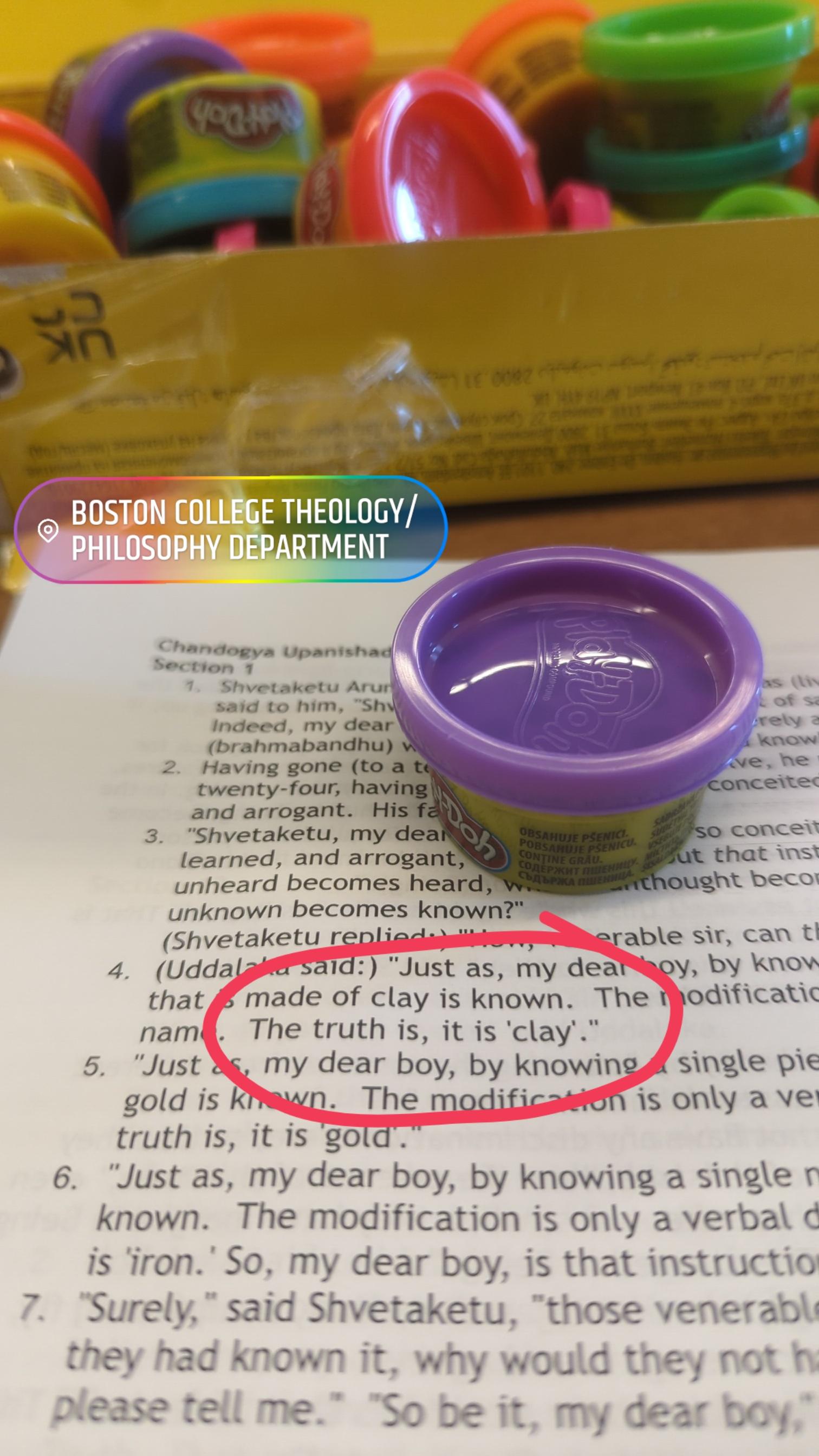
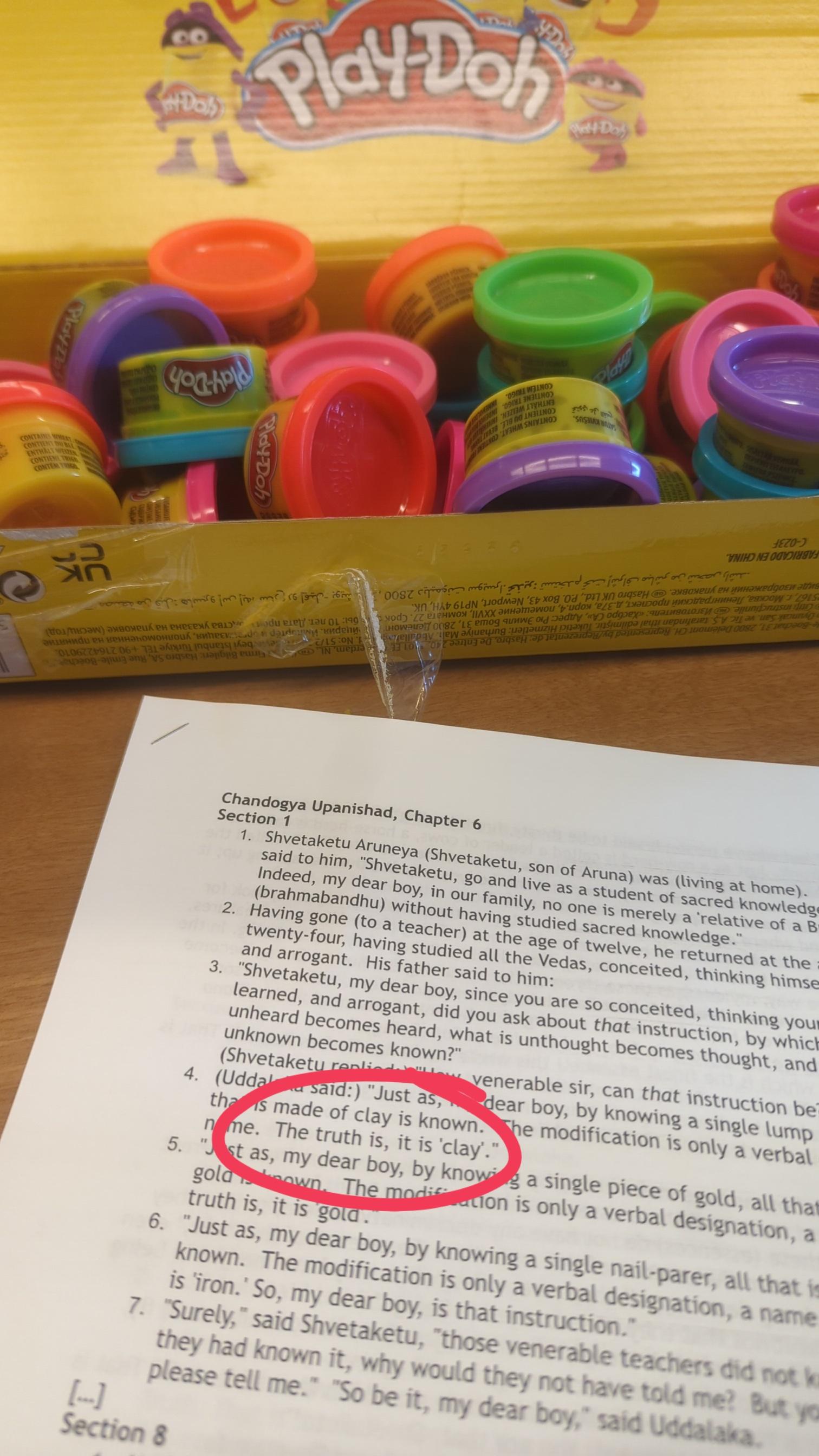
Brad: So, I know I assume nobody chose section one. But let's take a let's take a moment and look at section one together. Okay, let's take a moment to look at section one together. As you're still sculpting, feel free. This interesting so even though this is the Mahāvākya, thou art that or you are that, Śvetaketu. This verse 4 really is the most famous, I think from the Chāndogya Upaniṣad. It's one of the most it's very famous. So it's why we have Play-Doh or clay today. And notice one of the things that we're told about Śvetaketu. Can anybody just like give us a quick summary of section one here? What's the situation? Yeah, Olatz.
Student 3: There's a father called Āruṇi and his son. Yeah. And then the son when he's 12, he goes to study the Vedas. Yeah. And then he returns when he's 24. Yeah. And he comes back super arrogant, like super conceited thinking he's the best and everything he does. And then his dad was telling him and letting him know that his knowledge was not finished. Yeah. And there was like an ultimate truth for him to like recognize, which was at first it was humility and then it was more about the knowledge of like Brahman.
Brad: Excellent summary. Great. Thank you Olatz. Yeah, great. So one of the things I hope I emphasized last Tuesday, I hope I emphasized sufficiently last Tuesday, with this Bṛhadāraṇyaka is you know, it's supposed to emphasize that, you know, Matt is ultimate reality, right? So does make you feel good, right? It should make you feel good, right? So it's not just saying, you're not just another just another thing, right? But that you are the the the life for the for, you know, like the the ultimate being, ultimate reality, right? So that's that should make you feel good about, right? I mean, so not just in the image of God, but an embodiment of God, right? An unique embodiment of the one being. Whereas this one is maybe maybe doing kind of not I don't know if the opposite is the right, but opposite direction, right? So here you've got if Bṛhadāraṇyaka is trying to like lift you up and say, hey Addison, like you're you're somebody special, right? The Chāndogya is saying, you know, but not that special, right? If Mary gets this big head and it's like Mary's like, I'm ultimate reality and be like, you know, Mary, yeah, but, you know, so is Gill, right? So, so, so definitely tackling that, right? If everybody is equal embodiment, then then everybody's equal embodiment. Word, cool. And there's a lot of philosophically going on here with the clay and stuff too.
Brad: I think we had a group that wanted to focus on group on section two. Yeah? Serena and Drew, you want to get us started?
Student 4: We thought it was interesting how being emerged out of non-being. Like at first there was nothing, but then like a big part of like Hindu philosophy, at least that I can see is like everything kind of merges from the same source.
Brad: Yeah. Yep. And so, I mean, we have directly there, right?
Student 5: Material efficient final.
Brad: Yeah. So material, in this case would be like the the clay, right? Or in that case in the case of the first two. So everything comes from being itself, Sat, being truth. And then everything is just a modification, like a name and a form of that, right? So like a so then there's got to be some sort of shaper, somebody giving shape to the to the stuff, right? We're all makers of ourselves, right? We make and shape ourselves. We make and shape the world around us in the same way that you're making and shaping the clay into various things. So, good. Yeah, great.
Brad: Anybody choose section 8? That's okay. Let's look at section 8 together then. So one of the one of the as I've already mentioned, key takeaway from this unit, a key goal for this unit is to get you to start reading synchronously, reading harmoniously, trying to get all of these various certainly these texts, but also the texts that we've seen before such as the Ṛg Veda, all the all three of the Ṛg Veda hymns. I think you could relate any of them to varying degrees to any section, you know, to various sections of these texts. So the goal is to try and read harmoniously, right? The same thing I said earlier about Mīmāṃsakas, they're concerned about not having any contradiction as they're reading the text. Likewise, as we're reading the text, obviously we're taking a small sample size, right? But of the small sample size with your first experience reading them, at least make that effort to try and read harmoniously, synchronously, right?
Brad: So here in verse section 8, just to point out a few things. One, there's a lot here about sleep. And when you read the Māṇḍūkya Upaniṣad for Thursday, you'll see there's a big section on the waking state, sleeping state, dream state, and a deep sleep state. So we'll talk about that more on Thursday. And when we do, you can tie it back to here. Another one is Prāṇa. Prāṇa we've seen before, we'll see many times again. So Prāṇa means the primary meaning of Prāṇa is breath. Can be taken to mean other things, primarily life force is another way it's usually translated. But life force means life force because you you breathe, right? Living things breathe and dead things don't. So, breath is the life force and the the breath that Jorge is breathing in right now is the same breath that I'm breathing in right now, right? And so breath in that sense is a symbol for more than it's more than a symbol for life. Good. And then we're starting to see connections between all these food, eater of food, which we've seen before. The relationship between each of these things, folding and unfolding, speech in the mind, prāṇa, all this kind of things. And then finally the Mahāvākya in verse 7, which we've already looked at.
Brad: How about section 8? Anybody, any teams want to lead us through section 8? Section 9, I mean? So, honey, we will we will see honey coming back, bees and honey coming back more later. So just kind of pointing it out to you now. If we had read a little bit more of the Bṛhadāraṇyaka Upaniṣad, actually the second section of the text that we read, this section is part of the Madhukāṇḍa, which is the section Madhu means honey. So it's part of the honey section. So there's something going on here with honey. And we got that word merging, right? These essences do not have any discrimination. Discrimination is, you know, discerning or discriminating between one thing and another. So that they might say, I am the essence of this tree or that tree. Even so these creatures when they have merged into being, to Sat, know it not that they have merged into being. Cool. Good.
Brad: Section 10? Great, Leanna.
Student 6: Is that like the rivers flowing? Like east west and how everything is like in essence and is the self and is each other. So they can't really be separated based on different things like the different waters or like the different types of animals they're all one.
Brad: Yeah. So we've got I mean, on the one hand they are different, right? Like you've got the the rivers and the things there, right? So on the one hand you've got different rivers. This river is not that river. But on the other hand, they all kind of flow together. So they're also not connect they're not distinct. So there's sort of like one, which we could say all water or all bodies of water or just water, right? H2O. There's one water, but many bodies of water, many instances of water. And they're kind of flowing or merging. So we've still got this idea of you know, not being not being separate, right? Did that thing with the paper last time was folding the paper versus tearing the paper, right? So the one, so that's Puruṣa Sūkta, the Ṛg Veda 10.90 that we read, right? The one in the beginning was this one person and it divided itself, but not in terms of like ripping the paper, but instead of like folding, right? The thing with the folding of the paper. So here we've got this idea of merging, right? As Leanna said, sort of these rivers merging into one body. See kind of the trope that's going on, the parallel similarities there. Good. Anything else about section 10? It is really cool. Everybody see their their river ways and bodies of water there? They got fish and Good. Nice. Anybody else have anything on section 10 or 11? Yeah, Jose.
Student 7: section 10 Yeah.
Brad: Yeah.
Student 7: really good the emphasis on the repetition that the father had on his boy when he talked about you know, east eastern ones to east, western ones to west, oceans go to the ocean. And I think it all just comes back to the purpose of the void. He said my dear void, so be it. So his father is just giving the saying that the world all leads back to him. like he's giving him the importance of the world that he did everything and I think that's just helping the boy understand that he when he looks at the world at the soul, he understands that he he's the founder of it and like just giving creating the father is just praising the boy. Yeah. high level.
Brad: Okay. Yeah. Good. And also helping him see that the the thing that he's praising, which is his his uniqueness, is also what makes all these other things praiseworthy, right? So, so he's a unique embodiment of the one self, but also so are these the lion and the tiger and the wolf and the boar. Word. Cool.
Brad: Section 11? Okay. Nothing else on 11?
Student 7: I also have section 13.
Brad: Okay, yeah.
Student 8: That we were talking about that it was basically when the father asked the child to like divide a fruit and then say what he saw and then he was like seeds. Yeah. Divide the seeds and he was like, what do you see? And eventually led him to like nothing. Yeah. And then he made this metaphor of like how that nothing was actually not nothing, but it was like subtle reality of like the essence of all life.
Brad: Right. Yeah. Excellent. Me too, right? Like you could divide me into smaller and smaller pieces to figure out what is it that makes Brad like alive, right? And if you divide me further and further and further, I guess you're just going to end up with air, right? Which would be the prāṇa, that life force. I wouldn't enjoy that very much, but great. Thank you Olatz. Any other anything else on 12? Yeah, Jose.
Student 7: What was reading 13? Yeah. about the salt and the water and how like dissolves and it's like everywhere, no matter where you sit from the cups. Yeah. or something. Mhm. But then he says like like nothing left or something. but like I don't or they related like seeing nothing and like being everything? I don't
Brad: Well read read the the nothing passage that you're talking about?
Student 7: For which one?
Brad: So okay, so you're talking about 13, right? Yeah. So take a sip from this side. How does it taste? Salty. Take a sip from the middle, salty, sip from that side, salty. Throw it away and come to me. So he did so, yet the salt remained. Udālaka said to him, here also in this body, you do not you do not perceive the being, the Sat, but it's there nonetheless, right? So in the same way that you can't see the salt, but it's there, there's this life force that is in Jorge that you can't see, but even though you can't see it, it's still there.
Student 7: Oh, that's nonetheless as well.
Brad: It says nonetheless. Yeah, nonetheless, not nothing left. Is that what you're talking about?
Student 7: Yeah.
Brad: Yeah. So it's there nonetheless. Like it's there even though you can't see it. It's there regardless of the fact that you can't see it. Good? Yeah. Okay. Okay? Nothing else on 13? Yeah.
Student 9: We did 13.
Brad: Okay, word.
Student 9: We thought it was really interesting that they used this like metaphor Yeah. to describe like how the being Brahman is like with like Ātman, like they're like a single like essence. Yeah. And we just we made the bowl and the father and the son or the teacher and the son with the salt. Yeah. And put in the salt in there.
Brad: Word. I dig it. That was very good. Is he wearing like, looks like he's wearing like a little graduation hat there.
Student 9: Oh, it's hair.
Brad: Oh okay. All right. I thought maybe because he graduated from Yeah, from school that too. That too. That's what you meant. Yeah. Word. Cool. You got that how that relates to the other? Maybe this idea of merging and this invisible force that's there just can be not seen but tasted, you know? So experienced in some way but not necessarily visibly. Good.
Brad: 14? No one chose 14? It's interesting. Last year when I taught this course, actually usually when I choose this course, people like 14 a lot. Well, that's okay. How about 15? Yeah, lead us George.
Student 10: Yeah, we did 15. So it kind of just says that when a person's about to die, one's loved ones will only remember them if they're if they're like mind and body are not merged. And then they I guess their loved ones will not remember them if their mind and body are merged. So like we kind of interpreted it as like if you have like our lovely little like depiction here. But like if you have two little people and their bodies aren't merged, then like it's just themselves and like they like they can be remembered as like one person like you can be remembered as Brad. But if they merged, then you get like one really big person and like that's like a combination of a lot of different people so they can't be remembered as themselves. And like that merged body is like the truth, the self, and that is like Śvetaketu. Yeah. That's what that is.
Brad: Excellent. Great. Yeah. So we've got kind of the reverse of what we saw in in in Ṛgveda 10.90, right? With this one person is dividing into the many. And here we're saying, hey, this many is still just that one, right? So you're kind of merging all of these many into the one. But, you know, when you do that, then you you lose everything about Luka that makes Luka Luka, right? So it's like it's like dropping a drop of water in the ocean. Like, you know, does it really make a difference if there's a drop of the, right? It makes a difference if you're the drop. You don't probably don't want to, right? So yeah, good, great. Others?
Brad: 16 then? Yeah, Stella.
Student 11: We kind of talked about like on section 16, but the how the flames kind of like consume the axe and how it became like one thing. And we related that to how like the Ātman self becomes like indistinguishable from the Brahman. And once you realize like that true nature, you can't really separate. And we also this story in this section talks about like a thief and I thought that like the thief story can relate to the ignorance that Śvetaketu had in the beginning. I just thought that was an interesting connection. Yeah. Maybe that's why they talk about like the hot axe.
Brad: Yep, excellent. Great. Thanks, Stella. Others? More on that? Okay. Good. Any anybody else have anything to say about Chāndogya Upaniṣad? What'd you think of it? Word? Cool.
Brad: Alright, well let's take a few minutes and look at the Aitareya Upaniṣad. Chapter three. Let's just let's just read it if you don't mind. Andre, can you want to start us off and just read read like a sentence and then we'll go we'll go around.
Student 12: Which is the self that we worship?
Brad: Which one is that self?
Student 13: Is it by that by which one sees, by which one hears, by which one smells fragrances, by which one articulates speech, by which one distinguishes between the sweet and the non-sweet?
Student 14: (inaudible reading verse 2 start)
Student 15: That which is this heart and mind, it is consciousness, perception, discrimination, wisdom, intellect, vision, steadfastness, thinking, intelligence, impulse, memory, conception, purpose, life, desire, and control. All these indeed are names of consciousness.
Brad: Great. Thank you. Olatz, did you have a question?
Student 3: Sorry, we were a little lost.
Brad: So we're on the Aitareya Upaniṣad, so the almost the penultimate page in your packet. And Avani just read verse two. Addison, you pick up verse three?
Student 16: This is Brahman, this is Indra, this is Prajāpati. This is all the gods and these five great elements, earth, air, space, water, and light. And these combined with the minute and the other seeds of various kinds. And those born from eggs, and those born from wombs, and those born from sweat, and those born from sprouts, horses, cows, humans, elephants, and whatever else breathes and moves that moves, that flies, that is immovable. All that is guided by consciousness and established in consciousness.
Brad: Kind of won the lottery there with that sentence. Yeah, Stella.
Student 17: The world is guided by consciousness. Consciousness is the foundation. Brahman is consciousness.
Brad: And that's the that's actually the Mahāvākya there, Brahman is consciousness. (Prajñānam Brahma)
Student 17: Through this consciousness self rising from this world and attaining all desires in that heavenly world, he became immortal. He became immortal.
Brad: Good. Thank you. And so, what I gave you there at the bottom, some of it some of the meaning is lost in translation, of course. And so this passage that Vanya read, that which is heart and mind, it is consciousness, perception, discrimination, wisdom, the so those in particular. These are all different versions of the word Jñāna, which is where we get it's a Indo-European root. That's why we have this word like K in front of the word know, which is like this weird, right? So that harkens back to the Greek gnosis and then they both come from this common word that so Jñāna and gnosis. So meaning knowledge or knowing, something like that. But we've got all these different prefixes. So Saṃjñāna, sam meaning together. So pulling knowledge together, so integrating knowledge into sort of you know, more comprehensive, systematic sort of seeing together, knowing things together, knowing how things relate to one another. Ājñāna, ā meaning like complete, yeah, really complete. So complete understanding, comprehensive knowledge, knowing everything without kind of leaving anything out. Vijñāna, I think is super interesting. Vi Vi can mean a lot of different things as a prefix. I think of it more like this is like going through something. So, it is the difference between Jñāna and Vijñāna, we'll talk about it more when we get to the to the Bhagavad Gītā later this semester. Maybe it'll come up a few times between now and then. But it's almost like knowledge that you have to go through, right? So it's like some things that you can, some kind of knowledge you can get from a book, but there's some things that you got to go through, right? You've got to you've got to live through them. You've got to experience them, right? So there's a difference between knowing or as Morpheus says in the Matrix, right? There's a difference between knowing the path and walking the path. So there's something something some sort of knowledge that comes from living something out, really experiencing something more fully. And then Prajñāna, pra meaning like towards or something higher, more meta kind of knowledge. So it's higher form of knowledge, a more more meta. So that's the word that's being translated here as consciousness. So Brahman is Prajñā. I don't know that consciousness we do this in English where we add this we turn consciousness into a abstract noun, which then makes it very difficult and deceiving to work with, right? So what we really mean is it is a being that is conscious, right? Probably better would be just to say Brahman is conscious rather than Brahman is consciousness. But I don't know, it's kind of means both, I guess. Any questions about the Aitareya Upaniṣad?
Brad: Why don't you still got 15 minutes. Why don't you take a few minutes? I'm going to come around and take snaps if anybody's willing. No, it's opt in, no no pressure. But so I'm going to come around and take pictures. But be sure to chat with your group about when you're meeting and what which texture you're going through? Have you already discussed that? Go ahead take a few minutes now and discuss those two things. So decide which one of these four texts each one of you are going to do.
(Small group discussion time - content not transcribed)