 ```html
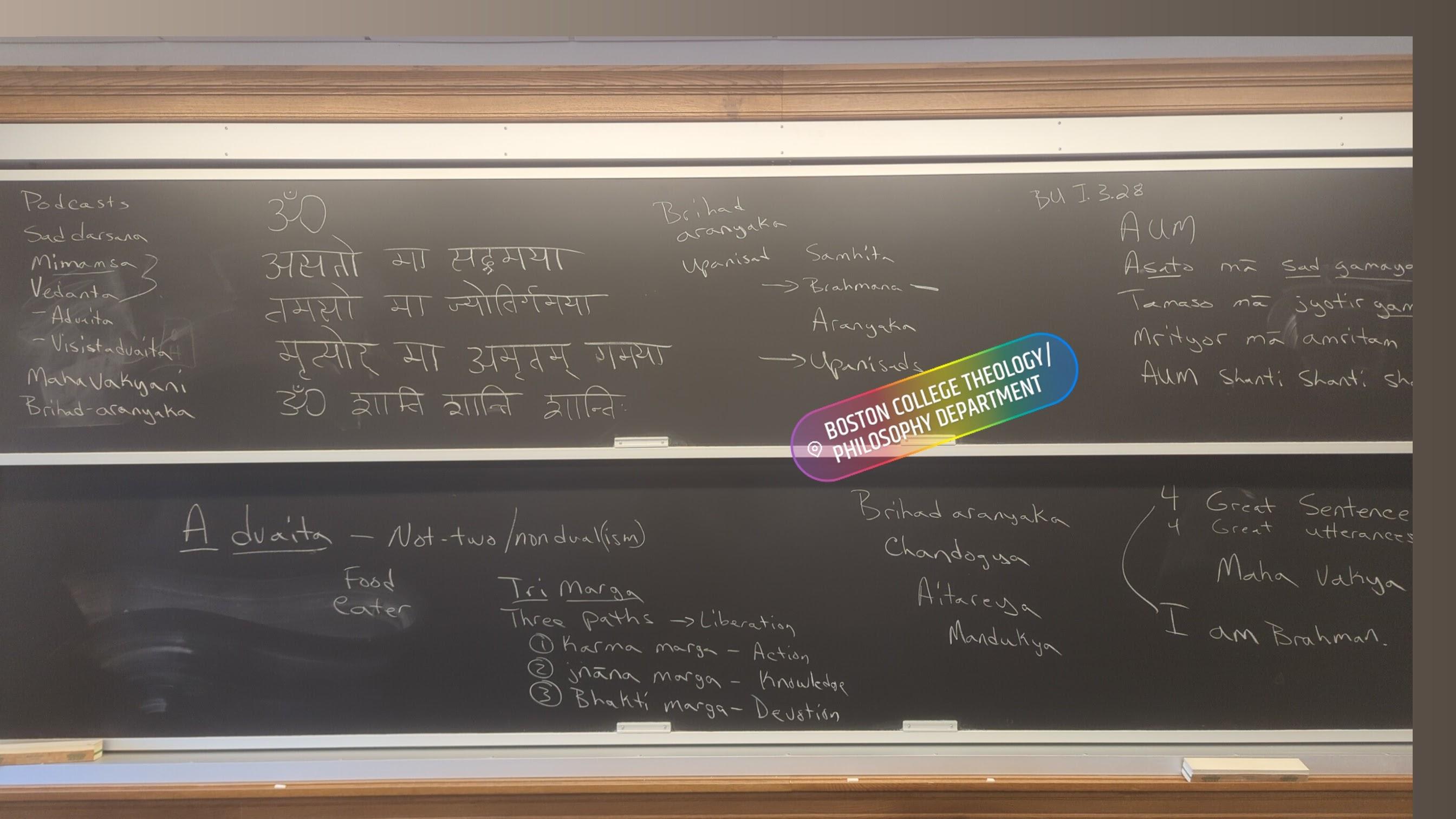
This class session began with a meditative silence followed by the chanting and explanation of the *Asato mā sadgamaya* mantra from the *Bṛhadāraṇyaka Upaniṣad*. After taking attendance, Brad reviewed the concept of *Ṣaḍ Darśana* (the six orthodox schools of Hindu philosophy), focusing on *Mīmāṃsā* and its emphasis on ritual and hermeneutics. They then introduced the topic for the new unit: *Vedānta* (also referred to as *Uttara Mīmāṃsā*), highlighting its close relationship with *Mīmāṃsā* but its focus on the *Upaniṣads* (theological texts). Brad distinguished between two major schools within *Vedānta*: the non-theistic *Advaita* (non-dualism) and the theistic *Viśiṣṭādvaita* (qualified non-dualism). The session focused primarily on *Advaita Vedānta*, introducing the concept of the *Mahāvākyas* (Great Utterances) found in specific *Upaniṣads*. The class then engaged in a collective reading and detailed discussion of a passage from the *Bṛhadāraṇyaka Upaniṣad* (1.4.1-10), which contains the *Mahāvākya* *Aham Brahmāsmi* ("I am Brahman"). Key themes explored included the origin of the universe from a single Self (*Ātman*), the motivation for creation (overcoming loneliness, play), the nature of the Self, the concept of creation as unfolding (*śṛṣṭi*) rather than division, the meaning of "I" (*Aham*), the relationship between *Ātman* and *Brahman*, different types of causality, and the *Tri Mārga* (three paths to liberation: *Karma*, *Jñāna*, *Bhakti*). The discussion compared the creation narrative to other texts like Genesis, *Puruṣa Sūkta*, and *Nāsadīya Sūkta*.
Brad: Let's get started. So we'll start as usual with a little bit of silence. And then I'd like to do this mantra. This mantra is from the
Brad: Everybody ready? This mantra is from the *Bṛhadāraṇyaka Upaniṣad*, which we're studying today. And it's extremely, extremely famous. It's one of the best known mantras, it's one of the best known mantras actually. And those of you who had me last semester probably remember that this is how I began the first day of class, maybe. With this particular mantra. But let's start with just a little bit of mental erasure.
Brad: So I'll chant it once on my own, and then invite you to join me on the second time.
Brad: Om Asato mā sadgamaya
Tamaso mā jyotir gamaya
Mṛtyor mā amṛtaṃ gamaya
Om Śānti Śānti Śāntiḥ
Brad: Om Asato mā sadgamaya
Tamaso mā jyotir gamaya
Mṛtyor mā amṛtaṃ gamaya
Om Śānti Śānti Śāntiḥ
Brad: Good. So like I said, this is from the *Bṛhadāraṇyaka Upaniṣad*. And from yeah, from 1.3.28. And yeah, so the Śānti mantra, you're already familiar with. Om Śānti Śānti Śānti. Śānti means peace. So peace in our bodies, peace in our minds, peace in our hearts, spirit, that sort of thing. The other ones, so *gamaya*, which you get in every line. *Gamaya* means lead me, guide me, take me, lead me. *Mā* means me. And then the other words are all opposites. So *Asato mā sad gamaya*. So from *asat* lead me to *sat*. *Sat* means being. Primary meaning is being, but it also means truth. So being and truth, same word. Even that alone is interesting. So from the opposite of being, so from non-being, lead me to being, or from non-truth, lead me to truth. Both of those things. *Tamas*. *Tamaso* means from the darkness. So from the darkness, lead me to the *jyotir*, the light. So from the darkness, lead me into the light. And *mṛt*. *Mṛt* means death, and *amṛtam* means the opposite of death. So lead me from death to, I don't know, I tend to think of it as like the fullness of life, right? Whatever the opposite of death is. So, anyway, very very nice. Yeah.
Student 1: Is it literally translated as death or is it like death as in like non-being?
Brad: Death, yeah, *mṛt* is death. Yeah. It's actually from the same from the same root word where we get the word murder. *Mṛt*, *mor*, yeah. So, but it doesn't mean murder, it just means death. Yeah. Yep. Good.
Brad: Alright, let me grab attendance real quick. Andric? And Luca? Avery?
Student 1: Here.
Brad: Mary's out, right? Cameron? Molly Divine? Saw, yep. Megan? Stella? Lauren? Molly Dix? And Serena?
Brad: I already marked you. Alright, cool. Alright, so we're just missing Mary, yeah? I think so. Cool.
Brad: So, lots to cover today. Starting a new unit, starting lots of new stuff. We'll start with a quick little review. Oh yeah, podcasts. So, I listened to the 10:30 section on my way in today. I'm going to listen to yours on my way home today. So I haven't listened to them yet, but I got them all queued up on my phone. Looking forward to it. What'd you think? Is it enjoyable? Good enough? Yeah? Good. Sure everybody did great. Full confidence.
Brad: *Ṣaḍ Darśana*. What does *Ṣaḍ Darśana* mean?
Student 1: Definitely, yeah.
Brad: The six perspectives?
Brad: Yes, *Ṣaḍ Darśana*. So *Darśana* means to to see or seeing. So the six perspectives, the six seeings, the six schools of thought, the six orthodox schools or whatever. But really it means the six perspectives. And so this semester, we don't really have time to go through all six. We barely have time to touch on three of them. So we're going to touch on three of them. *Mīmāṃsā*, we've already talked a bit about. Does anybody remind me what *Mīmāṃsā* is? What'd you learn about *Mīmāṃsā*? Yeah, Gail?
Student 2: It's all about following the rules.
Brad: Yes, that's right. Yeah, following rules. Other things? Yep, Molly?
Student 3: Like the rituals.
Brad: Yeah, so following the rule, so reading the scripture, following the hermeneutic rules so that we read the scripture carefully so that we can perform the rituals properly. Yep, George.
Student 4: It gives us like ethics or morals to help guide our interactions.
Brad: So the whole point of what defines a ritual is something that is to be done, something that's brought supposed to be brought into being, which is basically ethics. Yeah. Jose, did I see your hand up or somebody back there? No? Yeah.
Student 5: I believe most of them don't believe there's like a God.
Brad: Yeah.
Student 5: Not that it matters, but compared to the other ones.
Brad: They debate over whether or not the the gods exist. Whether they agree or disagree or whether they assert the existence or non-existence, what they full agreement on is that the gods have no agency, right? So if you if you perform this ritual, either there's a God who's going to supply the reward or there's not a God who supply the reward. But either case, the reward is the inevitable outcome of the ritual. So if you do it, then then it's, so it doesn't really matter if the gods exist or not. Yeah. Good.
Brad: Yeah, it's pretty good. So, we've got these four divisions of the Veda. We've got 16 divisions of the Veda really, right? But the four different parts of the text. So the *Saṃhitā*, which are the hymns, we already we looked at three of those, right? You talked about those in your podcast. So the three Rig Veda hymns. And the *Brāhmaṇas*, which we aren't talking about really. But so *Mīmāṃsā* is interested in the *Brāhmaṇas*, which are the texts that tell how to perform the rituals, right? And so *Mīmāṃsā* are very particular with making sure that they perform, that they read the text carefully, that there's no cognitive dissonance, that you don't read this text with this set of rules, this other text in a way that would, you got to have you you've got to have total consistency with your hermeneutics. You know what hermeneutics means? the hermeneutics is like the system for interpreting a text, right? So make sure that you have the rules and you don't, for example, you don't interpret a word to mean this in one context and then the same word to mean something totally different in another context, right? So trying to make have consistency with rules and all that kind of stuff. Focused on the performance of the rituals.
Brad: And then, today we're shifting gears a little bit to this other perspective, one of the other six systems. And, a handful of scholars, I'm among them, but a handful of scholars refer to these as *Uttara Mīmāṃsā* and, I'm sorry, *Pūrva Mīmāṃsā* and *Uttara Mīmāṃsā*. So *Pūrva* means the early Mīmāṃsā school and *Uttara* means the later Mīmāṃsā school. And the reason we do that is to emphasize that these two schools are really, really, really, really close to one another. And that the what's usually referred to as *Vedānta*. So *Vedānta*, *Vedānta* means the *anta* of the Veda, the end of the Veda, right? So the Upaniṣads are the end of the Veda. And those of us that refer to it as *Uttara Mīmāṃsā*, basically, when we read the *Mīmāṃsakas*, like I said, they're very concerned with coming up with these clear rules of interpretation, focused on the rituals. And then basically, some of those folks that were excellent *Mīmāṃsakas*, then kind of moved on to take the same rules and applying to to the Upaniṣads, right? So they're using the same rules, same hermeneutics, same everything that they applied to the ritual performances, and now they're applying those same rules and ways of reading to the theological texts, right? And even understanding that the theological texts are largely, basically, so part of why I'm emphasizing this so much is to say that these they're inextricable. You can't just jump in and read the theology, which is what most white folks do, and without sort of understanding the history of the and the role of the *karmas*, the the rituals, right? Is the point. So, so for this unit, we're focused on *Vedānta*. Good?
Brad: Even more narrowly, so we've got the *Vedānta*, which is one of the *Ṣaḍ*, one of the six systems. And then within *Vedānta*, there are numerous schools of thought too. numerous, yeah, many numerous schools of thought. And the two primary, there's three primary, but we're only going to worry about two of them. And these are the these are the most popular by far. The other the third one's super fringe actually. But *Advaita* and *Viśiṣṭādvaita*. So *Advaita*, means *a dvaita*. *A* meaning not and *dvaita* meaning two. So not two. So *Advaita* is translated, I mean, most literally as not two. It's often translated as non-dualism, but the ism isn't really there. So it's not two. So *Advaita* means not two. What are the two that are being denied? Well, that's hopefully we'll get there by the end of class or definitely by the end of the unit. There's a lot of different things. So, something to do with not two or non-dualism. *Viśiṣṭādvaita*. So this word *viśiṣṭa*, basically means like asterisk, like sort of like, it's usually described as or translated as qualified non-dualism. But qualified meaning like an asterisk, right? Not qualified like, hey, I qualified for the finals or whatever, or qualified for the lottery or something. But qualified like, with a catch, like with a with a catch, like with an asterisk, right? So like non-dualism with a catch, with a qualification, and that qualification is God, right? So, *Advaita* is non-theistic. Some are maybe atheistic, but definitely non-theistic, whereas qualified non-dualism is theistic, right? So non-dualism plus God. And we're going to look at both of these this semester. Most of our time this semester when we're looking at Hindu stuff, most of it will be focused on *Advaita Vedānta*. Well, most of it will be focused on *Vedānta*, and we're going to be focusing on *Advaita Vedānta* and *Viśiṣṭādvaita Vedānta*. So, yeah, we'll we're going to focus on *Viśiṣṭādvaita* mostly later. Today, this unit, we're mostly focused on *Advaita Vedānta*. Following me so far? Lots of Sanskrit, lots of vocab. Yeah.
Brad: When we get to the, when we get to the Bhagavad Gītā, which is the last, everything in the course kind of leads up to the last unit, seems appropriate. In the last unit, we're going to read the Bhagavad Gītā, and the the Gospel of John. And when we read the Bhagavad Gītā, one of the things I'm going to ask you to do when we read it is to try and interpret any given verse in two different ways. One is to interpret it from a non-dual perspective, and then also from a qualified non-dual perspective, right? So one reading it with God and one, non-theistic. So theistic and a non-theistic reading. But that's down the line. Any questions?
Brad: Alright, moving right on then. So, this week, or this unit, we're studying four texts. Today we'll start with the *Bṛhadāraṇyaka Upaniṣad*. Thursday we'll read the *Chāndogya Upaniṣad*. Tuesday, the *Aitareya Upaniṣad*, and then the *Māṇḍūkya Upaniṣad*. I wrote my dissertation on that one. And today we're talking about the *Bṛhadāraṇyaka*. We're also, as we're this unit is built why I chose these, why I chose what I did, was because each one of the passages we're going to read contains a different one of these, what are known as the four great utterances or the four great sentences. In Sanskrit, it's called the *Mahāvākyas*. *Maha* meaning great and *Vākya* meaning sentence. So the four great sentences. And basically there's one of these sentences in each one of these four texts. And so today we'll be reading the *Bṛhadāraṇyaka* and the great sentence there is *Aham Brahmāsmi* or I am Brahman.
Brad: The, last thing I think I want to say, preface. So the the name *Bṛhad Āraṇyaka Upaniṣad*. So it is a Upaniṣad. It's got, it's a Upaniṣad, so it's here. But it's also low key like an *Āraṇyaka*, right? It's got the name *Āraṇyaka* in it. *Bṛhad* means big or great. So the the great or big, it means both of those things. The big, great forest Upaniṣad. Yeah. I brought these. I totally forgot to like even show them the other class, but so this is just the *Bṛhadāraṇyaka Upaniṣad* with Shankara's commentary. So Shankara is one of the, he's I think regarded, widely regarded as the greatest theologian within the *Advaita Vedānta* tradition. And there's a picture of him. And then this I just brought, if you're looking for something to put onto on yourself and like looking for a translation of the Upaniṣads, this one's pretty good. This is Sarvepalli Radhakrishnan. He was the first president of India actually and a former Harvard professor, he's pretty dope. Anyway, yeah.
Student 6: When they get like commentary, what exactly are they commenting on?
Brad: Yeah, so, mostly just trying to explain what the text means. So Shankara, one of the things I love about him is he doesn't, he doesn't he sometimes gives you multiple options. So like, I think it means this, but it could mean this. So he'll give you multiple options if if it's not totally clear. And, but basically just going through the entire text, sometimes word by word, let's break down, what does this word mean? What's the grammar here? Yeah, a lot of that. What's the just reading, just trying to straight up interpret what does the text mean. And really, really, really careful kind of reading. One of the things, that, yeah, one of the things is, okay, so I said the *Mīmāṃsakas* want to be sure that they're reading faithfully and consistently, right? So using the same rules across all of the texts, right? So the Advaitans, especially Shankara, likewise. So he wants to make sure that he's reading, chapter 4 verse, five of this text in this in a way that's consistent. No cognitive dissonance, no contradiction, no, any of those kind of things. With any chapter from any other text, right? So basically taking the entire Veda and saying, well, the entire Veda is revealed, I've got to make sure that I'm reading this text in a way that's consistent with this other text. I can't interpret this one way and this other text another way. So that's a lot of what his commentary is though. Good? Okay. All right.
Brad: So, yeah, I think without further ado, let's dive into the text. So what we'll do is I'll have Andrea pick us off maybe. And we'll just let's just read the text. So, when we do exercises like this, I like to go person by person and basically just read until you get to like a period. So, a sentence or so, and then go on to the next person. Yeah, pick us off. Wait, everybody got one? Everybody good? Yeah, okay. So yeah, start with the first. So this is *Adhyāya* one. So there's four major chapters, four major books in the text, and then each book has a bunch of chapters. And so we're reading chapter four from book one. And, yeah, go ahead. Take it up.
Student 7: In the beginning, this world was just a single self, Ātman, shaped like a man [Puruṣa].
Student 8: He looked around and saw nothing but himself.
Student 9: The first thing he said was, "Here I am." And from that, the name I came into being.
Student 10: Therefore, even today, when you call someone, he first says, "It's I," and then states whatever the other name he may have.
Student 11: The first being received that name man because ahead of all of this, he burnt up all evil.
Student 12: When someone knows this, he burns up anyone who may try to get ahead of him.
Student 13: The first being became afraid. Therefore, one becomes afraid when one is alone.
Student 14: Then he thought to himself, "Of what should I be afraid of?" Great, when there is no one but me. So his fear left him, for what he, for what was he going to be afraid of?
Student 15: One is after all afraid of another.
Student 16: He found no pleasure at all, so one finds no pleasure when one is alone.
Student 17: He wanted to have a companion.
Student 18: Now he was as large as a man and a woman in close embrace.
Student 19: So he split his body in two, giving rise to husband and wife.
Student 20: Surely this is why Yajñavalkya used to say that two of us are like two halves on a block.
Student 21: This space here, therefore, is completely filled by the woman.
Student 22: He copulated with her, and from their union, human beings were born.
Student 23: Poor then, she thought to herself, "After begetting me from his own body, how could he copulate with me?"
Student 24: I know, I'll hide myself.
Student 25: So she became a cow.
Student 26: He became a bull and again copulated with her.
Student 27: From their union, cattle was born.
Student 28: Then she became a mare and he a stallion.
Student 29: She became a female donkey and he a male donkey.
Student 30: And again he copulated with her, and from their union, one-hoofed animals were born.
Student 31: Then she became a female goat and he a male goat.
Student 32: She became an ewe and he a ram.
Student 33: And again he copulated with her, and from their union, goats and sheep were born.
Student 34: In this way, they created every male and female pair that exists down to every ant.
Student 35: It then occurred to him, "I alone am the creation, for I created all this."
Student 36: From this creation came into being.
Student 37: Anyone who knows this prospers in the creation of his.
Student 38: Then he churned like this and using his hands produced fire from his mouth and hands, probably from a vagina.
Brad: As a result, the inner sides of both the hands and the mouth are without hair, for the insides of the vagina was without hair. Sacrifice to this God, sacrifice to that God. People do say these things, but in reality, each of these gods is his own creation, for he himself is all the gods.
Student 39: From his semen then, he created all that is moist here, which is really Soma.
Student 40: Food and eater, that is the extent of this whole world.
Student 41: Food is simply Soma, and the eater is fire.
Student 42: This is Brahman's supercreation.
Student 43: It is a supercreation because he created the gods who are superior to him, and being a mortal mortal himself, he created the immortals.
Student 44: Anyone who knows this stands within the supercreation of his.
Student 45: At that time, this world was without real distinction.
Student 46: It distinguished simply in terms of of name [*nāma*] and form [*rūpa*].
Student 47: He is so and so by name and has this sort of form.
Student 48: So even today, this world is distinguished simply in terms of name and form, as when we say he is so and so by name and has this sort of an appearance.
Student 49: Penetrating this body up to the very nail tips, he remains there like a razor within a case or termite within a termite hill.
Student 50: People do not see him, for he is incomplete as he comes to be called breath when he is breathing, speech when he is speaking, sight when he is seeing, hearing when he is hearing, and mind when he is thinking.
Student 51: These are only the names of his various activities.
Student 52: Anyone who worships these one by one does not understand him, for he is incomplete without any one of these.
Student 53: One should consider them as simply his self.
Student 54: For in it, all these become one.
Student 55: The same self, Ātman, is the trail to this entire world, for by following it, one comes to know this entire world, just as by following their tracks, one finds the cattle.
Student 56: Whoever knows this finds fame and glory.
Student 57: He, this innermost thought, the self, it is dearer than a son, it is dearer than wealth, it is dearer than everything else.
Student 58: If a man claims that something other than his self is dear to him, and someone were to tell him that he will lose what he holds dear, that is liable to happen.
Student 59: So man should regard only his self as dear to him.
Student 60: When a man regards only his self as dear to him, what he holds dear will never perish.
Student 61: Now the question is raised, since people think that they will become the whole by knowing Brahman, what did Brahman know that enabled it to become the whole?
Student 62: In the beginning, this world was only Brahman, and it only knew itself, thinking, "I am Brahman." [*Aham Brahmāsmi*]
Student 63: As a result, it became the whole.
Student 64: Among the gods likewise, whosoever realized this, only they became the whole.
Student 65: It was the same also among seers and among humans.
Student 66: Upon seeing this very point, the seer Vāmadeva proclaimed, "I was Manu and I was the sun."
Student 67: This is true even now. If a man knows I am Brahman [*Aham Brahmāsmi*] in this way, he becomes this whole world.
Student 68: Not even the gods are able to prevent it, for he becomes their very self atman.
Student 69: So when a man venerates another deity, thinking, "He is one and I am another," he does not understand.
Student 70: As livestock is for men, so is he for the gods.
Student 71: If having a lot of livestock is useful for men, so each man is useful to the gods.
Student 72: The loss of even a single head of livestock is painful. How much more if many are lost?
Brad: The gods therefore are not pleased with the prospect of men coming to understand this. Alright, so we'll stop there.
Brad: I know it's a lot, but we've we've come across our first of the four great sentences. And this is in verse 10. It's there twice, but for some reason only the first one is considered the Mahāvākya. But so, yeah, *Aham Brahmāsmi*. I am Brahman. Does this remind you of anything else that we've read so far this semester? Yeah, George.
Student 4: A little bit like Genesis 1 in terms of like the progression of how things were made and it's like in this it says started off as humans and cows and it just like went through the list and I felt like in Genesis 1 it was a similar sort of starting with, I don't know, like creating mountains and then rivers and then.
Brad: Day one, day two, day three. Yeah, okay. Yep. Good. Others? Yeah, Luca.
Student 53: Definitely reminds me also the Nāsadīya Sūkta in the Rig Veda of creation.
Brad: Yeah.
Student 53: Yeah. Yeah. Like I I thought there was some similarity in terms of how like it was describing how like there was like Brahman that was like like the entire like empty of the universe. There's something similar in the Rig Veda as well where it said there was first nothing and then existence came to be.
Brad: Yeah. So there was nothing and then and that the Nāsadīya talks about the the Virāj, the golden embryo or the Hiraṇyagarbha Sūkta also, that golden embryo, that, as we talked about like a, like a chicken egg, right? So you've got the yolk of the chicken egg is all, it's all one. There's no differentiation, there's no, yeah, no differentiation, and then it becomes differentiated, right? So like the beak and the feathers and all that kind of stuff of the chicken. Good. Anything else remind you of? Yeah, Jose.
Student 54: It also reminds me of Psalm 104 when they when they talk about the creation of the heavens and foundations because in one of the first page they talk about the super creation because he created the gods who were superior to him and being immortal himself. So I think it relates to how in Psalm God created not only himself but sustained the gods and other people who managed the animals, the livestock, the sea creatures of land, all that. So I think they're very similar.
Brad: Okay, yeah, good. Olatz.
Student 55: Also in the idea, going off from Jose Psalm 104 acts like a little like praise to this like one entity and I feel like in here it's also like praising this idea of the self being like so man should regard only his self as dear to him, what he holds dear will never perish if he doesn't do so things will not go as good. So that idea of like someone above which is the self that we have to like look at in order to do good ourselves?
Brad: Okay, alright. Others? How about remind you another text that we haven't heard from? One of the other Rig Veda texts?
Brad: So the Puruṣa Sūkta, 10.90, right? So in the beginning was this one person, Puruṣa. It's the same word that's used here throughout. Actually instead of shaped like a man, it should say shaped like a person. I missed that one. But yeah, so the word they use there is Puruṣa, which just means person. It's non it's not gendered. And so remember in the Rigveda 10.90, which we read a couple weeks ago, that was the first one of the first texts we read. At least first Hindu text. Right, you've got this one Puruṣa, this one person, and then that one Puruṣa sacrifices itself and becomes the many, right? From the head become the Brahmins, from the shoulders come the, etc, right? The, so here we've got this one person, this one Puruṣa. What, yeah.
Brad: So this in the beginning this word was just this single self, Ātman, in the shape of a Puruṣa. And, okay. And then how was it, how was it hanging? What was how was what was how's it feeling? This one person in the beginning? What do we learn from the text? Still in verse one. Yeah, Justin.
Student 6: Afraid.
Brad: It was the first first feeling was afraid, right? And so, but then I realized, well, that's dumb, right? Why would I be afraid? There's nobody else here, right? We're afraid of somebody else. If there's nobody else in existence anywhere, then, what's to be afraid of? Being alone. So then that's the next feeling, right? So then like, oh shit, there's like nobody else here, right? I'm the only being in the universe. There is nothing else. And that's that's, I mean, how would you feel alone if you were like the only thing in all of existence? What would you do all day? You do nothing. You would do nothing is the answer because there'd be nothing to do, right? There'd be nothing, it'd be crazy boring and crazy lonely, right? So, in the beginning was this one person. First it was afraid, then realized that's silly, and then it was like, there's nothing to be afraid of because I'm so incredibly, completely, totally alone, and that sucks, right? So then this one, didn't want to be alone anymore, so it does what? Yeah.
Student 56: Becomes many?
Brad: Yeah, becomes many, right?
Brad: You guys studied the three types of causality? Three, three types of causality in philosophy class or logic class or anything like that? Good. I teach theology and chalk, teach philosophy and marker. So, so three types of causality, right? Three primary kinds of of cause causality. First is, so there's, yeah, material causality, efficient causality and final causality. For example, let's, let's say I cut, right? We talked about cups all last semester, right? So, let's say that I I really, I don't know, I've got some single malt and I need a cup, right? So like, so I have a need for a cup. A cup is something to to drink right out of, right? So it has some preserves a particular function. And in order to perform that function, it needs a particular shape, right? So because I want to, have a drink or something, then I need a cup, right? So then I have a purpose that I'm trying to achieve, some goal I'm trying to achieve, which is to drink something, and for that I need a cup. So that's my final cause. That's the reason that I'm doing something, right? Then the efficient cause would be, I got to be able to, I've got to actually form it, right? So it can't just think about, hey, I need a cup and then poof, it's going to appear there, right? I have to do the work of giving it shape, of giving it form, of carving it, right? And shaping it. And but I also need some stuff, right? Need some matter, I need some material in order to make it from, right? So there's these three, three kinds of causality. Material causality, efficient causality, and final causality. Got the difference between the three of them? So the clay, let's say I'm trying to make a cup, then I'll take some clay, that's the material cause. Then I'll shape it into the form of a cup, and then fire it so that it's, ceramic now, so I can drink from it. So then that would be so the ceramic would be the material effect, right? So the clay is the material cause, ceramic would be the material effect. The efficient cause would be me because I'm shaping it, right? Or if I were, if I don't know how to make pottery, then I could go to Matt and say, hey, can you form a, right? And so the Matt could be the efficient cause or something like that. And then the final cause is the reason that I'm doing this thing, right? What's the goal that I'm trying to achieve, right? This is important because the the theologians that we're studying, particularly, Shankara, any of these, actually any of the folks that we'll be studying this semester. Very, very, I guess one of the, what am I trying to say? One of the logical principles is that nothing comes from nothing, right? In order only only the only things that come from, I mean nothing comes from nothing, right? So whatever exists, whatever *sat* there is, it had to come from something, right? So whatever material, whatever matter and energy exists in the world must have existed before, right? Nothing can come from nothing. Nothing, nobody, nothing, nobody or no cause, nothing can cause something to come into being that didn't already exist, right? So, when we're talking about forming a, creating a cup in that case, I'm forming the cup. The cup didn't exist before, but the clay did, right? So I'm taking something that already exists and giving it form, giving it shape.
Brad: So from, so from the perspective of Mīmāṃsā or Vedānta, whatever exists must have existed in some form or another previously, right? So therefore, if in the beginning was this all, that's that's the logic here then, right? So in the beginning was this one person, this Puruṣa, and then that Puruṣa because it was boring, and lonely, became many without ever ceasing to be itself, right? So it's sort of, if you look down to right after we stopped, verse 11, verse 11, 12, 13, 14, you see in parentheses I put the word *śṛṣṭi*. So Brahman had not wasn't *śṛṣṭi*, wasn't, he says not fully developed, but really the word there is has to do with like unfolding, right? So unfolding would be unfolding or evolving, right? So evolve means to unfold. So if we were to think about, right, so a different way, when we say this one Puruṣa, the Puruṣa that was there in the beginning, when it became many, right? Or sacrificed its oneness to become many, we could think about it, sort of like, yeah, I can do it. Right, splitting in half. So then the one becomes many, right? So then there's a distinction between, right? So the one has become two, right? But at least from Advaita's perspective, there's not two, right? So a better, the way Shankara would explains it, it's more like if you think about this is one piece of paper, right? And then if I unfold it, then, right, there's many folds, the manifold or the complex, so plex also means folds, right? So there's many folds in this unfolded thing, but it's still one, right? So then we can say like, alright, Reagan is a fold, and Molly is a fold, and Matt's a fold, right? And Jorge's a fold. That means, right, Jorge is not Matt, Reagan's not Molly, but, but they're also not other than one another, right? So the one has become many without ceasing to be the one, right? Or you could think about it like, like a team and players, right? Like, right? So like one row team working as one. So you've still got the many different rowers, but you've got they're functioning as one or something like that, right? Yeah.
Student 56: So would it be creation of the self or would it just be like manifestation?
Brad: Yeah, so good. So I think, well, when we look at the Bṛhadāraṇyaka, how does the Bṛhadāraṇyaka answer that? So it says right at the beginning, this one unfolded or became many, right?
Brad: And it the first thing that it said, the very first thing that it said was what? Here I am, right? And then so, and it it's I. And therefore, even today, when you call someone, he first says, it's I, Aham, right? So this I. So we're spending a lot of time on this this word, I, right? So, here, I is a I is an indexical pronoun, right? So when Jack says I, right, here, here's a just funny joke, right? So when I say I, I mean I. But when you say I, you mean
Brad: I thought it was funny. So, I is an indexical pronoun, right? Index means pointing, right? So, and indexical pronouns like when I say I, I'm pointing at here, right? And when Jack says I, pointing right there, right? So that's the the joke is the pointing. Anyway, this is actually funny. You'll get it later. Yeah. But, so the the point that's the point that's being made here is that anytime anybody says I, they're always pointing at the same person. Right? So when Leona says I, that I that Leona is pointing to is the same I that when Olat says I, that Olat is pointing to. Yeah.
Student 55: I'm just a little confused on what is the eye?
Brad: The eye is the is the self of all. So
Student 55: So just the idea of soul, self, what
Brad: Soul, yeah, yeah, the word, the magic word is self. So Ātman, Ātman or self. So one self, just a single self, this one self, right? So in this case, the paper is the one self, and then when I unfold it, right, then it's not like it's not like Leona and Olat, right? But instead it's like one self, Leona and Olat are different folds. Kind of, right? A little bit. Yeah.
Student 57: So are you saying that because we're all pointing to the self, that's why we're all I?
Brad: Yeah. So, yeah, I mean, so I and the one self is there's only one self, right? So when Jaleen says I, what you're pointing to is the same self that has always ever been. There's never been more than one self, right? So that Puruṣa that was in the beginning that divided and became the many, Jaleen is is the same. Yeah. Yeah.
Student 4: And that one self is the Brahman? Is that the whole like
Brad: So, yeah, yes. Yep. I don't want to, I don't want to get Brahman and Ātman super identified. They're not exactly synonymous, but but yes, the answer to your question is yes. Yeah.
Student 58: Is it like everything came from the single self or just living beings?
Brad: Good question. So, different theologians answer that different ways. The ones that we'll be studying almost, unanimously mean all beings, all definitely all living beings for sure, but most say whatever exists exists, right? So, so wouldn't want to draw too much of a distinction between inanimate and animate matter, but if there is a distinction, then it would be the animate, but the maybe that's the difference between Ātman and Brahman is animate, yeah, I don't want to yes. Yeah.
Student 53: So is it that the many different people in the world, but all the different people are connected to the same self?
Brad: Connected is is on the right track, right? It's not that you're connected to the same self, it's that you ontologically are that same self, right? So the self that is you and the self that is Ella is the same self, right? In the same way that like my pinky finger and my nose are the same self, but my pinky and my nose aren't the same. A little bit. Yeah.
Student 55: So in the case of the the Ātman when it divides itself, what is it actually doing then? Like what's the comparison we can make between that and our lives?
Brad: So, instead of dividing, think of it as unfolding, right? So because it's it's not it's not dividing, but unfold it. It doesn't stop being being one. But so then, I think maybe what you're getting at is, in the same way that there's so on the one hand, we can understand the material causality, right? There's only one universe. I mean it's universe, one, uni means one, right? There's just one universe, matter, it's in a constant state of transformation, every moment changing, forms, material, matter and energy are never created, but constant constantly transforming, right? So we can understand that is very consistent with this. But then the other question would be like, why would the Puruṣa, this one person, why would it become Olat? Right? So then the point is that it must have some reason for becoming Olat. It's not just like a bunch of people, right? On the one hand, the text answers that question, why would the one become many? Because being one is like fucking boring, right? So like who wants to be just one? So they want the diversification, but on the other hand, it's like, why, so diversification good, but then why become Olat, right? In particular. And that's a question that we can't quite answer today, but we will get there. But but there's got to be some reason, right? Yeah, that's the point. Yeah.
Student 6: So are you saying that like I would be like the same type of conscience in essence as like the I that anyone else would be? Like we're all the same kind of
Brad: So, sorry. No, no, no, it's a good question. Collective conscious it just it brings in, it brings in more interpretation than I want to give. It's not it's not necessarily right or wrong. It's just an interpretation, right? So I'm trying to give the most universal sort of interpretation. And so, so let's look at it like this. Which way do I want to go? Neuroscience. We got some neuroscience people in here, right? So if you think about sympathetic versus parasympathetic system responses, right? So when you're when you're in a state of heightened awareness, right? When somebody's coming after you, you've smoked too much sativa or something. Like you you're like all of your attention, right? All those neurons are going out, right? That's what we call anxiety, right? So like anxiety can be really good. If a tiger is coming after you, you want to be super alert and attentive to everything. When you're in that kind of mode and somebody comes up and like touches you on the back, then you jump, right? So like that sort of thing, right? So that's sort of like your conscious self, but divided in many different directions, right? Your attention is divided in all these different ways. Whereas when you're calm, contemplative, introspective, you've still got those same neurons, those same billions of neurons, but instead of being hypervigilant and concerned with all the data that's coming in, they're sort of like singularly focused, right? So you could have that, so there again, you've got the one and the many, right? So this one Justin, and you can think of your attention as many, right? So there could be one Justin with many, many different objects of attention, or there could be one Justin with a singular focus of attention, right? Likewise, we could have the same thing in the classroom, right? We could have everybody in the classroom singularly focused, in sync, accomplishing some goal, right? And if that were the case, we could probably accomplish a lot more together than we could on our own, right? So would be kind of the point, right? So collective consciousness, I feel like that's more of an activity or a mode of being than something ontological. Good? Other questions, comments, thoughts?
Brad: Okay. Other passages from here? We could go to another section if not, but
Brad: Yeah, okay. I just remember something else I did in the other class. So in, for all the all the *Ṣaḍ Darśana*, for all the orthodox Hindu perspectives. There are what are referred to as the *Tri Mārga*. *Tri* meaning three and *Mārga* meaning paths. So the three paths are the paths to *mokṣa* or liberation. We'll talk more about what that means later. But the three paths towards, towards the goal, end goal is liberation. The three paths are *Karma Mārga*. *Karma*, of course, means action, and not just any action, but primarily the the ritual actions, right? The rituals that are described in the *Brāhmaṇas*. So those sacrificial actions. By the way, the words, another word for those sacrificial rituals is *Yajña*. So we've got here, this character *Yajñavalkya*, *Yajña* meaning the the ritual. So the Lord of the ritual, somebody who understands the *Karma Mārga* very well. Next of the three paths is *Jñāna Mārga*. *Jñāna* means knowledge or wisdom. So the idea is that by understanding the world in the right way, that leads you on its own to liberation. So *Karma Mārga* is by you attain liberation by performing the ritual sacrifices, the rituals described in the *Brāhmaṇas*. *Jñāna Mārga* is you attain liberation by understanding the nature of reality, and you learn that primarily from the Upaniṣads. And then lastly, *Bhakti Mārga*. *Bhakti* means devotion, meaning devotion to God, devotion to a deity. So, any of these three paths can lead to liberation. There are, I would there there's infinitely number infinite number of different perspectives on these three. I would say probably by and large, most of the theologians would say that any of the three would work and what works for Cameron may not work for Jack, and Cameron should follow the path that seems right for Cameron and Jack should follow the path that leads that's right for Jack, right? And so if it's the path of devotion, great. If it's the path of *Jñāna*, great. It doesn't matter, right? But it's going to be unique to each different person and it has more to do with like just what path seems right for you, right? Which is kind of a you question. There are also more than a few theologians that say, actually they're not all equal and the only one is the one that I do, right? Usually. They don't ever say the one that the right one is the one somebody else does. It's always the one, right? So the right one is the one that I do. And so for Shankara, this guy I was talking about earlier, for Shankara, the only path is *Jñāna Mārga*. And these other paths are preparatory. So *Karma Mārga* can prepare you for *Jñāna Mārga*. *Bhakti Mārga* can prepare you for *Karma Mārga*. May take, different lifetimes or whatever, but, but *Jñāna Mārga* is ultimately where it goes. Yeah.
Student 6: How did he rectify that it's the Tri Marga then considering that he's like putting all the emphasis on the one?
Brad: So Tri Mārga is is not, there's not, I don't think that phrase is anywhere in the scriptures. So, this is something that theologians, in the Shad Darshana have recognized, hey, there's three paths and you've got the, it's more that like the the Karma Kāṇḍa, the Brahmanas, I mean that it only has the that one path, right? The path of action. The Upaniṣads, they never tell you to do any rituals, so it's really just the path of Jñāna. So, yeah. We will see in the Bhagavad Gītā, which we'll read, later this semester. When we read that, it does mention these three and it's there's 18 chapters in the Bhagavad Gītā and a number of traditional theologians have divided it up and say actually these you've got six chapters on each one of these and that all of them, I think, I think pretty straightforward reading of the Gītā would say any of the paths are equal. But then Shankara writes it and says, yeah, they're all equal except that Jñāna Mārga is right and the other ones are preparatory. So, yeah. So how does, how does knowing *Aham Brahmāsmi* change anything? So, Shankara, yeah, does knowing does knowing any of this change anything? Does having this knowledge change anything?
Brad: What is the knowledge I'm talking about here too? Yeah. Yeah, go ahead Justin.
Student 6: We're all Brahman and it doesn't really matter if we died or not, like we're all just we'll come back. We're all the same being so
Brad: So there's only one self and the self of all beings is going to be here whether Justin is here or not. Yeah? So how does that yeah. That could go in a couple of different ways, right? One could be then, well, if the self the self that's always been here and is always going to be here, it's going to be here whether Justin's here, after Justin's gone. So then why do we need Justin? You could take it two ways, right? One is we don't, right? Justin's just extra, right? So could have been has to be something, why not be adjust, right? The other, the other perspective though is that the self became Matt because there's something about Matt that we need, right? So there's some sort of final cause, some sort of purpose in the Brahman becoming or the self becoming whatever form, makes sense a little bit? Kind of? Good? Other questions, comments, thoughts?
Brad: Heavy stuff? Good stuff? All right. So, so we've got, we've got kind of a clear reason and purpose for creation, right? I think this is something, this is the first time that we've encountered this. All the creation stories that we've read so far, is this the first time we've encountered a real reason for creation? Why is, so what's the answer to that question? Why is, what's the reason for creation? Yeah, Luca.
Student 53: Loneliness?
Brad: Yeah, really? I mean it's to overcome lone because oneness is just boring and pointless, right? So then, or another way to say it, which is not exactly in the text, but another way to say it might be play, right? Joy, read, it's more fun, right? It's more fun to become many. Many is more fun, right? So there's diversification for the purpose of meaning, purpose, joy, right? Fun, *Līlā*, play. Yeah.
Student 59: I don't know if this is a right question to ask, but would is Brahman or was Brahman like the original being essentially?
Brad: So, I think it would be better to try and get rid of the notion, especially on the Hindu side of things, to get rid of the notion of creation as something that happened in the past, right? So on the one hand, we keep seeing this in the beginning, in the beginning, in the beginning, right? But maybe don't think about it in terms of chronological or historical or temporal beginning, but instead, understanding something, it's telling us something about who we are right now and how we're supposed to, who we are right now, really, right? So then, to be is to be, first of all, in relation with others. Nobody is, nobody exists in isolation. We all exist in relationship with others, right? So and this is kind of telling us, well, yeah, we're in relationship with one another, but ultimately we're part of one larger being, right? So, and then the mode of creation. So let's say, all this like the food and the eater of food, right? So then, we could take this the food and the eater of food, where is that verse?
Brad: Anyway, you get there, yeah. Yeah.
Student 6: Does that mean that like the Brahman is continuously unfolding/folding as existence is like Yes. happening?
Brad: You could take it to continuing to fold and unfold, unfold and fold. So to be is to be in a state of folding and unfolding, right? And so when I eat food, I'm folding Brahman into myself, right? I'm taking something unique, whatever I'm eating, right? A muffin, something, and I'm turning that into Brad, right? So I'm taking this unique manifestation of Brahman, and then I'm turning it into Brad, right? So that's that's a folding in, an infolding, right? To fold into Brad. But then, eventually I will become food for something else, right? So, part of what it's saying is that the the food that I'm eating and also the eater, both are Brahman, right? So everything that is is an unfolding of this one. And so creation, is it's just the state of being, right? So not something that happened in the past, but something that is every time you eat, you're eating Brahman and you are Brahman and it's just states of transformation of the one self of all beings.
Brad: That did that answer question kind of? Good. Other questions, comments?
Brad: Okay. We're out of time. For Thursday, I will give you, I'll give you passages from the Chāndogya Upaniṣad. I'll send those out today. Just a few pages, not very long. This is a dialogue between father and son. I have office hours now.