 ```html
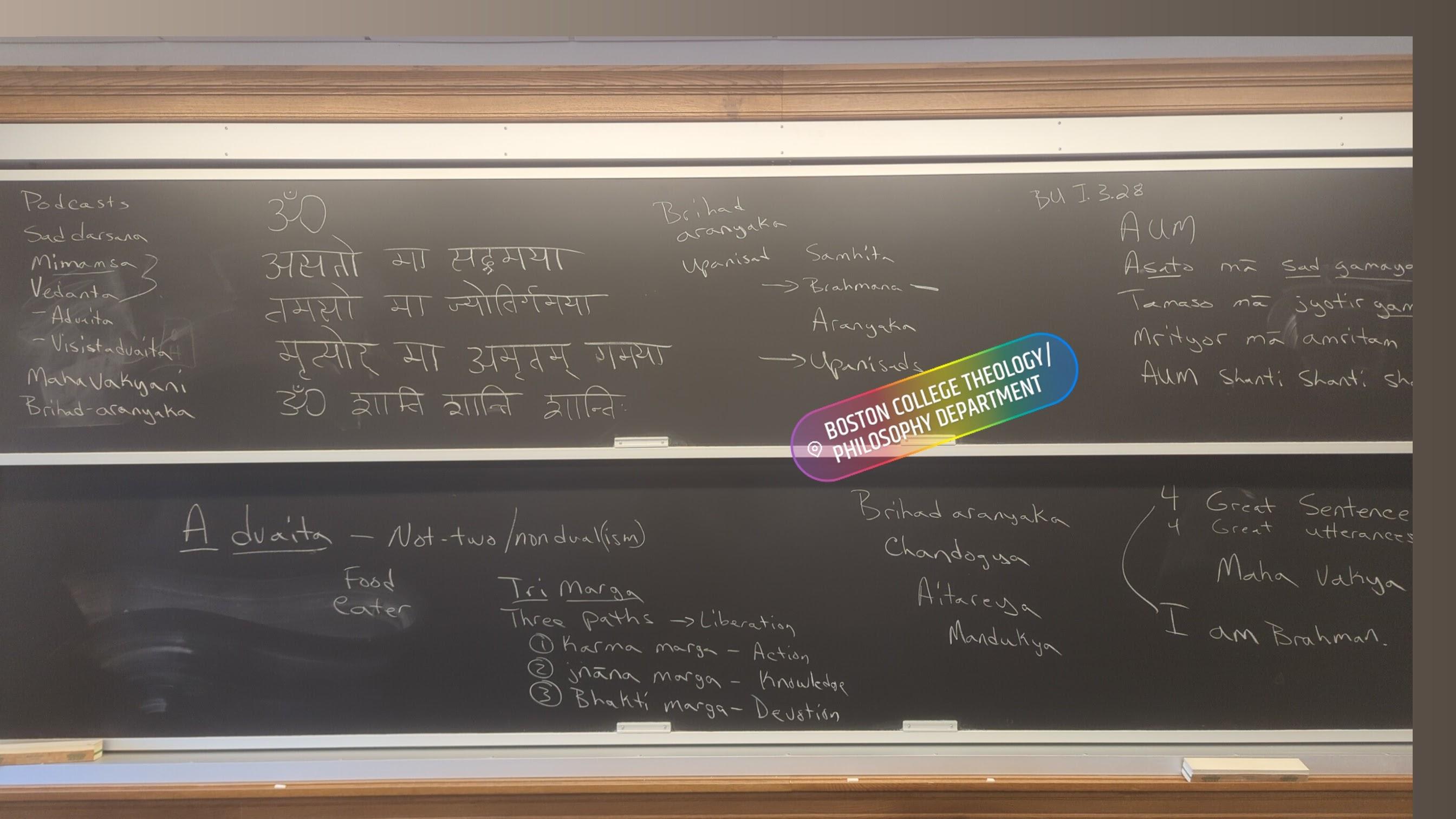
This class session began with a meditative mantra from the Bṛhadāraṇyaka Upaniṣad, followed by attendance. Brad reviewed the concept of Ṣaḍdarśana (six perspectives of orthodox Hindu thought), focusing on the relationship between Mīmāṃsā (ritual-focused hermeneutics) and Vedānta (knowledge-focused, dealing with the Upaniṣads). They introduced Vedānta as Uttara Mīmāṃsā, emphasizing its roots in Mīmāṃsā's interpretive methods. The discussion highlighted the historical context of the Upaniṣads as oral traditions later written down during periods of prosperity. Brad introduced the two major schools of Vedānta: Advaita (non-dualism) and Viśiṣṭādvaita (qualified non-dualism), noting the semester's focus on Advaita initially. The concept of the four Mahāvākyas (Great Sentences) was introduced, with the class focusing on the first, "Ahaṃ Brahmāsmi," from the Bṛhadāraṇyaka Upaniṣad. The class then collectively read and discussed a passage from this Upaniṣad, exploring its creation narrative (the single Puruṣa dividing itself due to loneliness), the concept of causality, the identification of the individual self (Aham) with the ultimate reality (Brahman), and the implications for understanding unity, diversity, and the path of knowledge (Jñāna Mārga) versus devotion (Bhakti Mārga).
Brad: Alright, let's get underway. I'm going to record your class this time. Like twice this semester. Not not like twice, but actually twice this semester. I've forgotten to record for this section. So.
Brad: Let's take a moment. We'll start with a little silence as usual. And then I'd like to do this mantra. This mantra is from the Brihadaranyaka Upanishad, which we're studying today. Those of you who had me last semester, probably don't remember, but we did this the very first day of class. Very, very, very, very famous mantra, maybe one of the most famous from Sanskrit tradition.
Brad: So, yeah, feel free to read either one.
Brad: Let's just take a minute, leave everything else outside. Just wipe the slate clean.
Brad: So, I'll do the mantra once on my own, and then we can all do it together.
Brad: Om.
Brad: Asato ma sat gamaya.
Brad: Tamaso ma jyotir gamaya.
Brad: Mrityor ma amritam gamaya.
Brad: Om Shanti Shanti Shantihi.
Brad: Right. So if you would join me.
Brad: Asato ma sat gamaya. Sorry, I forgot the Om. Tamaso ma jyotir gamaya.
Brad: Mrityor ma amritam gamaya.
Brad: Om Shanti Shanti Shantihi.
Brad: Or it's stuff. The meaning's pretty straightforward.
Brad: So, Om Shanti, Shanti, Shanti, you already know, right? Om, peace, peace, peace. Peace in your body, peace in your mind, peace in your heart or soul, spirit.
Brad: The rest of it is all everything's kind of opposite. So, we have Sat or Asat and Sat. Sat means, Sat means being, but also means truth. So, double very important double meaning in that word, both being and truth. So from, usually it's translated
Brad: And we've got Gamaya. Gamaya means lead me, take me, lead me, guide me, lead me. Ma means me. So, every every line's basically the same just with different vocab. So, from non-being, lead me to being. Could also be from non-truth, lead me to truth. It's both at the same time. Tamaso ma jyotir gamaya. Thomas means darkness. So take me, lead me from the darkness to the jyotir, the light. So from the darkness to the light. Mrit is death, and Amrit is the opposite of death. So from death, lead me to whatever the opposite of death is. So, I think of it as the Pleroma, the fullness of life, full life, right? Fullness of life, full being. So from death to fullness of life. And then Om, peace, peace, peace. So this is from the Brihadaranyaka Upanishad we're studying today.
Brad: Let me run down the attendance real fast. Where's this? 24. Patrick.
Student 1: Howdy.
Brad: Howdy. Quincy I saw, Amber I saw. Sailor.
Student 2: Howdy.
Brad: Howdy. Mary.
Student 3: Howdy.
Brad: Sophia.
Student 4: Here.
Brad: Jack.
Student 5: Here.
Brad: Brett.
Student 6: Here.
Brad: Rick left. Becca.
Student 7: Here.
Brad: Tushar.
Student 8: Here.
Brad: Colin.
Student 9: Here.
Brad: Claire.
Brad: Claire? No Claire. Bridget.
Student 10: Here.
Brad: Sean, I saw Sean. Henry.
Student 11: Howdy.
Brad: Ally.
Student 12: Here.
Brad: Other Ally is not here.
Brad: Shay is here. Marina.
Student 13: Here.
Brad: Reed.
Student 14: Here.
Brad: I just imagine seeing Reed, didn't I? Riley I saw. Reagan.
Student 15: Here.
Brad: Jackie.
Student 16: Here.
Brad: Lizzie.
Student 17: Here.
Brad: Matthew.
Student 18: Here.
Brad: Ellie.
Student 19: Here.
Brad: Lawyer.
Student 20: Here.
Brad: Liam is not here. Alec is not here. Maggie.
Student 21: Here.
Brad: Catherine.
Student 22: Here.
Brad: And Hannah.
Student 23: Here.
Brad: All right. Sorry, I will learn everybody super fast. That's part of why I call the attendance so I can.
Brad: Okay, so podcast. I listened to the podcast for this section on my way in. Very nice job. Enjoyed listening to them very much. Especially for your first ones, just really really good job. Yeah, there was one group, I don't remember off the hand, but one group recorded in like a busy communal busy area. Don't do that. But other than that, everything's great. And I did actually hear that group just fine for the most part. So Shad Darshana. What's the Shad Darshana? Let's do a little bit of a review.
Brad: One of your learning objectives, Amber?
Student 4: The six perspectives.
Brad: The six perspectives. Yeah, the six seeings, six schools of thought, six schools of Orthodox Hindu theology. But really the six perspectives. That's the most I think that's the best translation. And this semester we're really only looking at three of the six. As much as it it as nice as it would be to go into depth about all of them. We've already talked a bit about Mimamsa. Remind me what's what's the whole deal with Mimamsa? We talked about, yeah, Brett.
Student 6: Its main focus is on the performance.
Brad: Yeah, so performance of the karmas, performance of the rituals, performance of the ritual sacrifices. And so their focus is on making sure that they're reading the grammar correctly, the vocab correctly, reading, they're really it's a hermeneutic school. So they're really concerned with making sure that they read the scriptures precisely, carefully, meticulously, consistently, with no cognitive dissonance. You can't just interpret this ritual this way and this other ritual this other way, right? Everything's got to be consistent across all of the interpretations and their primary focus as Brett said is on the performance of the rituals. So the yajnas or the karmas.
Brad: Now, Vedanta, these are also by by small handful of scholars, self-included, usually referred to as Purva Mimamsa, so the early Mimamsa school and Uttara Mimamsa, the later Mimamsa school. But to the vast majority of the world, it's just Mimamsa and Vedanta. Vedanta means the anta of the Veda. So the end of the Veda, the last part of the Veda, right? So we've got
Brad: super fast review. We've got the Samhitas, right? which are the hymns. We've got the Brahmanas, which are the ritual texts. The Aranyakas, which are like the early theological texts, and then the Upanishads.
Brad: And so in this entire unit here that we're doing starting today, we're just focused on the Upanishads. Although this text that we're reading today is actually called the Brihad Aranyaka Upanishad.
Brad: So, it's it's an Upanishad, but it's also like an Aranyaka, right? So it's got it's got the name in there. Brihad means great or big. So it's the the big Aranyaka Upanishad. It's one of the earliest ones, so, you know, maybe crosses the boundary between these these two categories.
Brad: and Aranyaka means forest text. So out of the forest. So the idea is like this is the great forest teaching, meaning like, you know, the sages when they when you reach a certain age, then you renounce all possessions, you renounce everything, and you just go off to be a theologian, just sitting in the forest, just meditating, reading the scriptures, reflecting on the meaning of the sacrifices and all that kind of stuff. And then those were recorded. I was thinking about this yesterday or Sunday, I guess. That, I think we we talked about the oral tradition that the Hebrew text, the Hebrew Bible was a oral was an oral tradition until it was written down. And we talked about, why was the or why was it written down in the Hebrew in the Jewish tradition?
Brad: Why was this text that was always an oral tradition? Yeah, Brett.
Student 6: Because maybe they were worried that there weren't there wasn't enough people to keep continuing.
Brad: Exactly right. Yeah, there was just an existential threat to the community, and concerned that we wouldn't be able to pass it on generation after generation. So then the Essenes went off into some caves and wrote them down, right? And John the Baptist was one of those folks.
Brad: But it was written down because of an existential threat. That's not So these were also oral traditions. They still are oral traditions. It's still expected for an orthodox Hindu, for many of these traditions that you would memorize the entire Veda, or at least your part of the Veda, right? So there's the four recensions, Rig Veda, Sama Veda, Yajur Veda and Atharva Veda. So the idea is that like, you know, if Jackie's from this Sama Veda tradition, then she and everybody in her family would memorize the entire all four of these, but in the Sama Veda tradition, right? So you may not memorize all of the Upanishads and all of everything, but you remember, you memorize your, what's called your portion, your family portion or whatever.
Brad: But the this these oral traditions were written down, and have been written down. But they were written down for a very different reason. They weren't written down because of an existential threat to the community, like you find in the Hebrew tradition. But instead, these especially the Upanishads, they were primarily written down Okay, so like if you've got if you're if you're rich, right? If you're wealthy, if you're a very successful, you know, king, a Raja, right? So if you've got a very successful little, like mini little empire, mini little kingdom, right? Then you've got what's called the the court. and the court is usually filled with scholars and like artists and experts and all these sort of, you know, people who are because you've got excess money, right? So you've got excess money, you've got excess time. So you take that excess money and excess time and you hire sculptors and artists and you build magnificent temples and you hire scholars to study the scriptures and to teach the scriptures and all those kind of things, right? So it's a during periods of prosperity, you've studied this in history class, right? During periods of prosperity, you get this flourishing of artistic culture, all that kind of stuff. That is more the that's mostly how most of these texts came to be written down. So they were written down by by scholars who already knew them, right? Already had been studying them. And then they were like, you know, some king, some Raja says, hey, why don't you, you know, take this, you know, I'm going to hire you to just do research, just to be a scholar, right? And then so they went and sort of gathered down, gathered up all these different oral versions of the of the Upanishads and collected them into what we have today.
Brad: So, one key thing that I want you to to take away is the relationship between these two schools. So Mimamsa we've already said is concerned with really careful, meticulous hermeneutics, right? Reading the scriptures, reading the text precisely, carefully, consistently, focused on the on the rituals. The Vedantins are a later development of the school, they grow out of that school. According to at least my dissertation, they the people, the Vedantins, the Vedantins at least that I study, they never left that other school. They were always in that school, right? So these aren't really two differing schools. It's just like an early part of the school and a later, you know, later part of the school. And basically they took the the same hermeneutics, the same discipline, the same, let's read the scriptures carefully, consistently, you know, without any sort of cognitive dissonance and that sort of thing. Very consistent interpretations. And let's apply those, the same rules that we've been applying here, let's just apply them there, right? And then so, so yeah. So that's Then within Vedanta, sorry I hope you can see it over there. Within Vedanta, there are Okay, so any questions about any of that? I know I'm kind of moving fast.
Brad: So we're up here in my little outline. So within the Vedanta school, or perspective, there are multiple different schools of thought, multiple different, yeah, schools of traditions. And the two biggest ones, are Advaita and Vishishtadvaita. And we're going to study these for the remainder of the semester. Pretty much. So, Advaita, Advaita. A means not and Dvaita means dual. So it's a non-dual school, school of non-dualism. We will I can't explain that in like 30 seconds. So we're gonna we're gonna unpack what does that mean? But basically Advaita literally means not two. Usually translated as non-dualism. But, you know, kind of like adding that ism there. So non-dual, not two. Vishishta Advaita. So we've still got the not two in there, but Vishishta means, honestly, I think the best translation of it is like asterisk, right? Like, it's non-dual, but with an asterisk, right? So like it's non-dual with a, it's usually translated as qualified, like a qualification. Not like, hey, I qualified for the lottery or something. But instead like, like an asterisk, right? Like it's non-dual, but with the catch, with a with one little side note, right? And the little side note is God, right? So it's basically non-dualism and then non-dualism plus God, let's say, right? God as like a personal, as a personal deity, as a personal, as a person, sort of thing, right? So we're going to look at both of these this semester. We're kind of narrowing in and we'll spend, we'll spend a lot of our time on both of these. And the goal of the last unit of the course, when we focus on the Bhagavad Gita, will be to read the Bhagavad Gita in both of these ways, and to notice the difference between them. And we'll bring in a little bit of Mimamsa and a little bit of yoga also.
Brad: So for for this unit, we're going to focus mostly on the non-dual Advaita interpretation. And then we'll add this this we'll add in some God later. Cool.
Brad: So probably in your mind it's like, not too what, right? Like you can't have, I mean, so it's got to be like not too somethings, right? So what are the not two? We'll definitely get into that. Cool. Now, last bit of preface, I think, and then we'll dive into the text. So this unit, we've got four classes this unit, today, Thursday, Tuesday, Thursday. And for this entire unit, we're going to be studying four texts, what are known as the four great, well, That's not here. Uh, four great sentences. Also sometimes called the four great utterances. In Sanskrit, it's Maha, which means great, and Vakya, which means sentence or utterance. So pretty literal there, right? Here I wrote Mahavakyani, that's just the plural form in the Sanskrit, but Mahavakyas would be sort of like a weird like pluralize. I don't ever never know how to pluralize Mahavakya. Do you put Mahavakya s or Mahavakyani? Which, you know what I mean? Nerd questions. So, today we're looking at the first of these four. These four come from the four texts that we're going to be studying this unit. First today is the Brihadaranyaka. Then the, I think Chandogya is on Thursday.
Brad: Yeah, it's fine. I believe Chandogya is on Thursday. And then, I think Aitareya. And then the Mandukya. All of those are Upanishads. And they are from the four different, they're each from the four different recensions. But they're all Upanishads. Cool. So, let me pass out these. I wasn't going to make it such a long reading, but it's hard to know what to exclude anyway. This is like your, this is one of the greatest, you know, philosophy texts, in the human record and we're just like we've just got one class on it. So it's like, you know, what are we going to do?
Brad: So, this this text as you learned from Wikipedia, is probably around fifth or sixth century BCE. I think I think maybe a more helpful dating is, you know, you've got, you've got before Muhammad, before before Jesus and before Buddha, right? So this is before Buddha. So this is, thank you.
Brad: Before Buddha. It's very, very, very, very likely, extremely likely that the Buddha studied this text, in fact, during his if you've studied Buddhism at all, maybe you know the story, the Buddha, you know, went into this orchard grove to to study with a with a Sadhu, with a Swami, like a Hindu sage, Hindu wise person. And he studied for we don't know how long, but years probably, a few years. And we don't know exactly what he studied, but pretty good bet that it was some of the the texts that we're reading this. You know, maybe slightly different version of them and that kind of thing. But, but pretty good bet that he read these. So, let's, any questions?
Brad: Okay. Why don't we why don't we start with Sailor and just go along, we'll kind of snake through the class. So, if you don't mind, just read, I don't know, read until you come to a period, you know, about that. So like about a sentence or so.
Student 2: In the beginning, this world was just a single self, the Purusha.
Student 3: He looked around and saw nothing but himself.
Student 4: The first thing he said was, "Here I am." And from the name I came into being.
Student 5: Therefore, even today, when you call someone, he first says, "It's I." And then states whatever other name he may have.
Student 6: The first being received the name man because ahead of all this, he burnt up all evils.
Student 7: From someone knows this, he burns up anyone who may try to get ahead of him.
Student 8: That first being became afraid. Therefore, one becomes afraid when one is alone.
Student 9: Then he thought to himself, "Of what should I be afraid when there is no one but me?"
Student 10: So his fear left him, for what was he going to be afraid of? One is, after all, afraid of another.
Student 11: He found no pleasure at all, so one finds no pleasure when one is alone.
Student 12: He wanted to have a companion.
Student 13: Now, he was large as a man and a woman in close embrace.
Student 14: So he split his body into two, giving rise to husband and wife.
Student 15: Surely this is why Yajnavalkya used to say the two of us are like two halves of a block.
Student 16: The space here, therefore, is completely filled by the woman.
Student 17: He copulated her with he copulated with her and from their union human beings were born.
Student 18: She then thought to herself, "After begetting me from his own body, how could he copulate with me?"
Student 19: I know I'll hide for myself.
Student 20: So she became a cow.
Student 21: But he became a bull and again copulated with her.
Student 22: From their union, cattle were born. Then she became a mare.
Student 23: And he a stallion.
Student 1: She became a female donkey and he a male donkey.
Student 2: And again he copulated with her, and from their union one-hoofed animals were born.
Student 3: And then she became a female goat, and he a male goat. She became an ewe, and he a ram.
Student 4: And again he copulated with her, and from their union goats and sheep were born.
Brad: Yeah, in this way they created every male and female pair that exists down to the very ants. Yeah, we'll go back to Sailor.
Student 2: He then thought to himself, "I alone am the creation, for I created all this."
Student 3: From this creation came into being.
Student 4: Anyone who knows this prospers in this creation of his.
Student 5: Then he churned like this, and using his hands, produced fire from his mouth as from the depths.
Student 6: As a result, the inner sides of both these, the hands and the mouth, are without hair, for the inside of the vagina is without hair.
Student 7: Sacrifice to this God, sacrifice to that God, people do say these things, but in reality each of these gods is his own creation.
Student 8: For he himself is all these gods. From his semen then he created all that is moist here. Which is really Soma.
Student 9: Food and eater, that is the extent of this whole world.
Student 10: Food is simply Soma and the eater is fire.
Student 11: This is Brahman's super creation.
Student 12: It is a super creation because he created the gods who are superior to him, and being mortal himself, created the immortals.
Student 13: Anyone who knows this stands within the super creation of his.
Student 14: At that time, this world was without real distinctions. It was distinguished simply in terms of name and form.
Student 15: He is still and so by name and has this sort of form.
Student 16: So even today this world is distinguished simply in terms of name and form. As when we say he is so and so by name and he has this sort of appearance.
Student 17: Penetrating this body up to the very nail tips, he remains there like a razor within a case or termite within a termite hill.
Student 18: People do not see him, for he is incomplete as he comes to be called breath when he is breathing, speech when he is speaking, sight when he is seeing, hearing when he is hearing, and mind when he is thinking.
Student 19: These are only the names for his various activities. A man who considers him to be any one of these does not understand him, for he is incomplete within any one of these.
Student 20: One should consider them as simply his self, for in it all these become one.
Student 21: This same self is the trail to the entire world, for by following it one comes to know the entire world. And just as by following the tracks one finds cattle.
Student 22: Whoever knows this finds fame and glory.
Student 23: The innermost thing, this self, it is dearer than a son, it is dearer than wealth, it is dearer than anything than everything else.
Student 1: If a man claims that something other than his self is dear to him, and someone were to tell him that he will lose what he holds dear, this is liable to happen.
Student 2: So a man should regard only his self as dear to him.
Student 3: When a man regards only his self as dear to him, what he holds dear will never perish.
Student 4: Now the question is raised. Since people think that they will become the whole by knowing Brahman, what did Brahman know that enabled it to become the whole?
Brad: And I'll read verse 10 and we'll stop there. In the beginning this world was only Brahman, and it knew only itself, Atman, thinking, Aham Brahmasmi, I am Brahman. As a result, it became the whole. Among the gods likewise, whoever realized this, only they became the whole. It was the same also among the seers and among humans. Upon this very point, the seer Vamadeva proclaimed, I was Manu and I was the son. This is true even now. If a man knows I am Brahman in this way, he becomes this whole world. Not even the gods are able to prevent it, for he becomes their very self. So when a man venerates another deity thinking, he is one and I am another, he don't get it. As livestock is for men, so is he for the gods. As having a lot of livestock is useful to a man, so each proves useful to the gods. The loss of even a single head of livestock is painful. How much more so if many are lost? The gods therefore are not pleased at the prospect of men coming to understand this.
Brad: Okay, so we'll stop there. Definitely mark verse 10. You've got twice in there this very famous line. Aham Brahmasmi. I am Brahman. This is our first, so we've got four great sentences, like I said. So it all comes down to these four great sentences or four great uttering utterances. This is the first one. So the first one is I am Brahman.
Brad: And we'll see the second one on Thursday. But before we get to that one, let's roll back because there's really a lot of great stuff here in the in the beginning.
Brad: let's just let's start let's start right at the top, right? So maybe this brings to mind, as reminds you of some of the texts that we've read before on the Hindu side of things so far this semester.
Brad: Yeah, Matthew.
Student 18: It kind of reminds me of Genesis when it was just Adam at first because it says he was like by himself.
Brad: Okay.
Student 18: God made Eve after that.
Brad: Okay, and so Eve is made from Adam's rib and here we've got the female is being made, you know, coming out of the man. There's like this odd thing about incest, right? She's super concerned about incest because she like comes from him, which is oddly not a concern in Genesis even though she's sort of clearly like a clone. But yeah.
Student 7: I was gonna say it reminds me of the Purusha Sukta with the like person with the 10,000 heads and feet.
Brad: Right. In fact, we've got the word Purusha here, same word. Coming up in the beginning was this Purusha. And then even kind of like takes apart the etymology there, the Purva and Ush.
Brad: But yeah, so in the beginning was this one person, this Purusha. And then that divided itself. Just quick philosophy. I assume you all have this already, but what are the, are you familiar with the different kinds of causality? Three kind three primary kinds of causalities?
Brad: Yeah, no? We'll be in a minute. So there's I teach philosophy and markers, so teach theology and chalk. So the three types of causality, one is material causality. One is efficient, and one is final. There's a fourth one also, but these are the these are the three for us. What do they understand these? Anybody familiar with these? The material cause of something, the efficient cause of something, and the final cause of something?
Brad: No?
Brad: Okay, let's say, let's say I've got lump of clay, right? And what I really want is to make a pot, right? To make a pot. Or a bowl to hold my pot. So like a, so like a bowl, right? So I want to take this clay and I want to form it into a bowl so I can hold whatever I want to hold, right? Then, I would have to have the skill to do that, right? And I have to like actually use my hands and form this clay into a pot, right? So, or bowl, whatever. So here we've got the, we've got all three of these causes. So the final cause is, is actually like I've got some purpose that I'm trying to fulfill, right? I need I need a bowl to hold my cereal or whatever, right? So that's the that's the purpose. That's the thing I'm trying to achieve, right? So I have some goal in mind, some purpose in mind, some motivation in mind, right? Something I'm trying to accomplish. That's my final cause. In that case, like creating a bowl, right? Or really not even just creating a bowl, but because a bowl has a particular function and I need that function, you know, need something to fulfill that function. The efficient cause in that case would be me because I'm shaping it, right? The clay isn't going to shape itself. So somebody's got to do the work of shaping it, right? So I'm the cause of the bowl in so far as I'm shaping the pot, right? Giving shape to the to the clay. And then the material cause?
Brad: Yeah.
Student 2: The clay.
Brad: The clay itself, right? So, you can't you can't do all those other things unless you've got the matter. So then the clay is the material cause. And then you could say, you've got the the clay is the material, and then maybe the ceramic or something like that would be the, you know, the final the material effect, right? So you've got the material cause of the clay, and then the ceramic, right? Because ceramic is different than the clay, right? So once the clay has been fired, you can't you can't shape it again, right? It's done. So then the ceramic would be the final cause or final material cause. Sorry, the ceramic would be the material effect and the clay would be the material cause, right? So here, there is the logic of all of Vedantins, I'll just focus on Vedantins, right? So the logic of Vedantins is that something cannot come from nothing. Nothing comes from nothing, right? So, if there's something, then that something had to come from something else, right? So there's no sort of some some creation theories have in mind like all of a sudden there there was nothing and then all of a sudden there was something, right? This is illogical from Vedantin's perspective. From a Vedantin perspective, whatever exists, sat, must have been there, right? So things don't come into being from nothing. So something must have been there before to cause whatever is there to to be, right?
Brad: So, in the case of the Purusha Sukta, Rigveda 1090, in the beginning was this one person, right? The Purusha. And that one person then divided itself into many, right? Here, we've got another version of the same thing, right? So for Vedantin, they would read that and they would immediately think of the Purusha Sukta and okay, so in the beginning was this one person, the self, so in the shape of a actually I don't love this translation that says shaped like a man, but actually the text says shaped like a Purusha, which just means person. So it's not it's not gendered. So in the beginning it was just world just a single self shaped like a person. Looked around and saw nothing but himself. Said, here I am. And from that the name I, Aham, I came into being, right? So we've got I. And the idea is that this is not just a is not a simple indexical pronoun, but is is really identified here. So, what does that mean? That means that Aham, whenever whenever anybody says Aham, anybody says I, what they mean is that one person, right? Only one person, period, that one person said I, and when Riley says I, what Riley is saying when she's saying I, you're pointing to that one person that is you, right? So it's not, so the, so Riley is made of the matter that was that one person, right? Nothing comes from nothing. So everything that exists came from that one person. In the beginning was that one person, that one person divided itself into many, and anytime anybody says I, they're referring to that person. Makes sense? Okay.
Brad: Then, what happens next in verse two?
Brad: Just give it to me in your own words.
Brad: Yeah, Jack.
Student 21: the person who's there becomes like afraid because there's like no one around them, they don't have any companionship. which kind of makes me like I know we're not supposed to like compare it like the Bible but like it kind of remind me how when Adam and Eve like eat from the apple they kind of are aware that like of their nakedness and like that like exclusion kind of might be similar that like they're afraid.
Brad: Okay, all right. Yeah. So, was afraid? Yeah.
Student 7: I was just thinking like he just sounds lonely.
Brad: Yeah, right? So, first afraid and then lonely, right? First afraid. So, as I said, like when we're when we're, sometimes we get scared when we're alone, right? And so this one person was all that was, there was nothing else in the universe except for this one person. And at first he was scared, but then it was like, well, what should I be afraid of? There's nobody else to be afraid of, right? It's just me. And then it was like, oh fuck, like I'm so lonely, right? Like there's nobody else except for me, right? So because he's incredibly lonely, he because they are incredibly lonely, then they decide to become many, right? So this is one, this is an important point, right? So the the text isn't just telling us some means of creation, some how of creation or some history of creation, but also giving us a reason why, right? So saying that diversity is better than unity, right? Unity is lonely, right? Lonely, boring, right? I mean, if you were the only, if Shay, if you were the only thing in the entire universe, there was nothing else, what would you do all day? Just sit around wishing that there was something else to do, right? Like it wouldn't it would just be right? That wouldn't be fun. So then so this one person was like, well, there's nothing to do. So let me become many, right? Is the idea. So then that's that one the one person was all that existed materially, and then it unfolded or divided itself to become many, diversified itself, right? Because it was lonely and because, right? So it's the it's all these things. But the material causality is especially important. Good. Other questions, thoughts? What do you think of that? I mean, I feel like what we just went over is super profound and deep. Yeah, Brett.
Student 6: I feel like it also feels to me a little bit like a development, like how as children we're really afraid of the dark and being alone. But when you grow up you realize like if you're genuinely alone, there's nothing to be afraid of.
Brad: Right. True. Yeah. Except for loneliness. But yeah, absolutely. Yeah.
Brad: Other thoughts?
Brad: Do you think this text is as awesome as I do? No? Is that a pretty good reason for existence, right? So then if if cosmologies, meaning creation stories, stories of creation, if they if they tell us something about who we are and about the state of the world around us, then what does this creation story tell us about who we are and, you know, what's around us?
Brad: Yeah, Amber.
Student 4: In a way, I feel like like the person or the man here, it's more like they're more humanized because we have that sense of loneliness and that sense of like isolation. Whereas like in other creation stories, it's kind of like this being is all powerful Right. and don't really have that weakness in them. Yeah. So I think it just kind of gives you insight into like the humanness of this being.
Brad: For sure. Yeah, yeah. We've got those emotional qualities and sort of creating out of emotion and that kind of stuff. Yeah, great. Thanks, Amber. Yeah.
Student 22: I was also thinking about like the the physical division of this one being into the many just makes it again more humanized but also like relating back to this this one being is that we are all one and we are all whole Right. when we were all together. Yeah. because it was like because you are a physical part of of that being.
Brad: Right. And so in the same way that like, you know, I mean, so we're different, right? In the same way that like my my pinky is different than my nose, right? So like, but still part of something, part of something whole, right? So then recognizing that our differences then are are purposeful actually, right? So then our the same way that my pinky has a different shape because it has a different purpose than my nose, likewise, we all have different shapes because we have different purposes, right? Uh but nevertheless, those purposes contribute to some larger whole or larger sense of self. Yeah, great. Tushar.
Student 8: I was thinking like it goes to show like how amazing like being with others is. Yeah. And like everyone comes from like one being. Yeah. So it goes and like everyone's afraid of loneliness then it brings up the question of why is there so much conflict? Yeah. And just like hate in the world currently. Right. And if we started as wanting to like lessen the loneliness. Yes. So why do we like other people like why do people feel like the other?
Brad: Great. Yeah. So, I mean, Mimamsa would answer that. I mean, I'm sorry, Vedantin would answer that by saying, the reason we act like that is because we don't understand this or we don't know this, right? So if you know and understand this, then why would there be conflict, right? So I mean, differences are are differences are a reason for existing, but put conflict not so much, right? So it didn't say in the beginning was this one person and this person was like, there's not enough conflict. Let me divide so there can be conflict. That's not the reason, right? But divided because of to avoid loneliness and because, you know, I mean, just being one is pretty pretty dull, right? Dull and boring, kind of stuff. Great.
Brad: So you've got an ethics built into the Yeah, good. Other thoughts, insights?
Brad: Yeah, Mary.
Student 3: I'm just like a little confused about like the relationship between the two because like it seems like she's always trying to like get away. Yeah. And like I don't is it like just because of like obviously like the incest is bad and all that, but Right. I don't know. It's just like interesting.
Brad: Yeah, yeah. Yeah, I don't know what to say to that about other than yeah, it's it's a little bit weird, isn't it? Yeah. I guess what one of the things that I mean, the oddity of it, doesn't it raise the question of like why you could understand why at least the logic behind the incest, right? Because it's like, well there was just this one, and then this one became many. And so everything that's part of that many is like it's the same one, right? So then, ew, right? Why isn't that same, isn't the same exact logic and situation there in Genesis 2, but we don't have that sort of, you know, concern or whatever about that incest? In that case cloning, right? Yeah.
Brad: I mean in both cases cloning, I guess. But yeah, so I don't know what to say than that other than good observation.
Brad: Cool. Uh, let me pause before we move ahead. There are, it's just always so much exposition. There are three primary paths, they're called paths, called the Trimarga. Tri meaning three and Marga meaning path. So the three paths, three paths to what? Uh, you could say Moksha, liberation, the goal, the ultimate goal, right? We can talk about that ultimate goal later, but three paths to the, to liberation. And the first path is called karma. So karma marga. And that's the path of actions. This path, the path of the Mimamsas, the path of performing the the karmas, right? Which are actions, sacrificial actions described in the Brahmanas. So by performing these rituals, that's a path towards liberation, right? So that's the first marga. The second one is Jnana. marga. Jnana means knowledge. So you could say the path of action and the path of knowledge. And basically you can see these captured in these two different darshanas. So Mimamsa is very focused on, you know, the path of action, path of ritual rituals, right? And then Vedanta is taking those same rules and everything and applying them to a different part of the scripture, and saying, you know, knowledge. So from that knowledge, we can attain liberation. And then the third one, which we will talk about later this semester, is Bhakti. Marga. Bhakti means devotion. So, yeah, so the path of devotion, primarily being devoted to God. And this is so this unit, we're focused on Jnana Marga, the path of knowledge, right? And as we just went over, with Tushar's question, so like if we understand, right? So there's conflict, disagreement, hostility, all those kind of things. But if we understand the truth, if we understand that we are all this, you know, all versions of this one person, that there's just, and the reason our reason for being is to be ourselves, to be different, to be who we are, those sort of things. Then that leads to I mean that's liberating already, right? So that's that's what we mean by liberation by means of knowledge. Right? Cool. Good. Uh, any questions so far?
Brad: Right? Feel free to interrupt or it doesn't even have to be questions, comments, great. Yeah, sir.
Student 8: I feel like that's where the conflict comes from is like knowledge versus devotion. Yeah. Like where are you getting your knowledge from and where are you devoting yourself or believing? Yeah. So I feel like even though they're like the three paths, they might contradict or conflict with each other.
Brad: Yeah. And in fact, thank you. And in fact, if we if we jump a little bit to, where was it? The gods, the gods hold dear.
Brad: Do you know what I'm asking about? Where uh the gods if the gods if you lose this one, it's like losing cattle.
Brad: Is it 10? Is it 10?
Brad: Yes, thank you. So, uh, so then here we've got there there is some, there is definitely tension and competition between these different perspectives. There are plenty, tons, tons and tons of theologians who from all of these different traditions who say there's no conflict between these at all, right? And if you're seeing conflict between them, it's because you're not understanding them properly, right? And then there are other theologians that'll say, no, this is this is not, you know, there's only one true path and the other ones are just preparatory for the one true path. There's folks on all on all sides of the equation. But here, I think maybe we would have a little bit of evidence to say, you know, maybe the scripture is suggesting that this is the only true path, Jnana Marga, not Bhakti Marga. So, right? If a person, yeah, let's look at 10 again. So in the beginning this world was only Brahman and it knew only itself, right? So we've got Jnana, it knew only itself. So that was it doesn't need the path to understand that because it already understood it. And thinking only Aham Brahmasmi, I am Brahman. As a result, it became the whole. So then you've got this one becoming many, right? So the first it's the one, it's the whole, and then it it it it becomes this whole world. Not even the gods are able to prevent it for he becomes their very self, right? So then if that so what it means, right? is that if in the beginning was only this one person, this one Purusha, and that person divided, so the material cause of everything, right? then everything that is is that one person. Nothing's not that one person, including the deities, including the gods, right? So then from that perspective, there's no real, there's no hierarchy, there's no difference between Sean and Tushar or Sean and Indra, right? Or any of the gods. So then you're realizing that what you, you know, what makes you you is that person, the personhood of the person and that's also what makes Indra or, you know, any of the deities who they are, right? So it's the Aham always points to that same person. So then why would anybody be devoted to to a God, worshiping a God, once they realize that, oh, I am that, right? And not only did I, not only am I the same being or essence as that deity, but I exist for a reason and purpose, right? So there's a reason that I'm not that deity. There's a reason I'm not Riley, right? There's a reason Riley's not me. That's kind of thing, right?
Brad: Cool. Good. Uh, other thoughts, insights? Yeah, Mary.
Brad: Uh, other things from this from what we read that you want to talk about?
Brad: Yeah, Jack.
Student 21: So this text is before Buddha, correct? Yep. So like I know like like when we're reading like Psalm Genesis like the Bible which came like which came before which one? Like how like one text might include writing the other. Yeah. Is the same for like the text we're reading right now? Is there any like based off previous texts but like any question whether like this was based off a text that was read or maybe it's like set the stage for the ones where like is this the first text we read in this class chronologically?
Brad: No, the oldest text that we've read would be the three Rig Veda texts that we read at the beginning. So the Purusha Sukta, the Nasadiya Sukta, all three of the Rig Veda hymns. And I think anybody, I think we can all see that this is definitely bringing to it's calling to mind that Purusha Sukta. Maybe some of the other ones too, but definitely, so yeah, that one is way, way older than this one. You could take this as like, I mean a philosoph a theological reflection on that other one. So, right? So it's like somebody trying to, yeah.
Student 21: Oh, so it makes more sense like it's almost like like a reinterpretation of the creation story kind of similar to like Psalm. Yeah. Yeah.
Brad: Good. For Thursday, I will email you the text that I'd like you to read. It's just a few pages, not that long. It's from the Chandogya Upanishad, another one of these great sentences. And the only thing I want to mention is it's a dialogue between father and son. So, that that's kind of important. Anyway, we're see you on Thursday.
Student 8: And I have office hours today as usual. Thanks.