 ```html
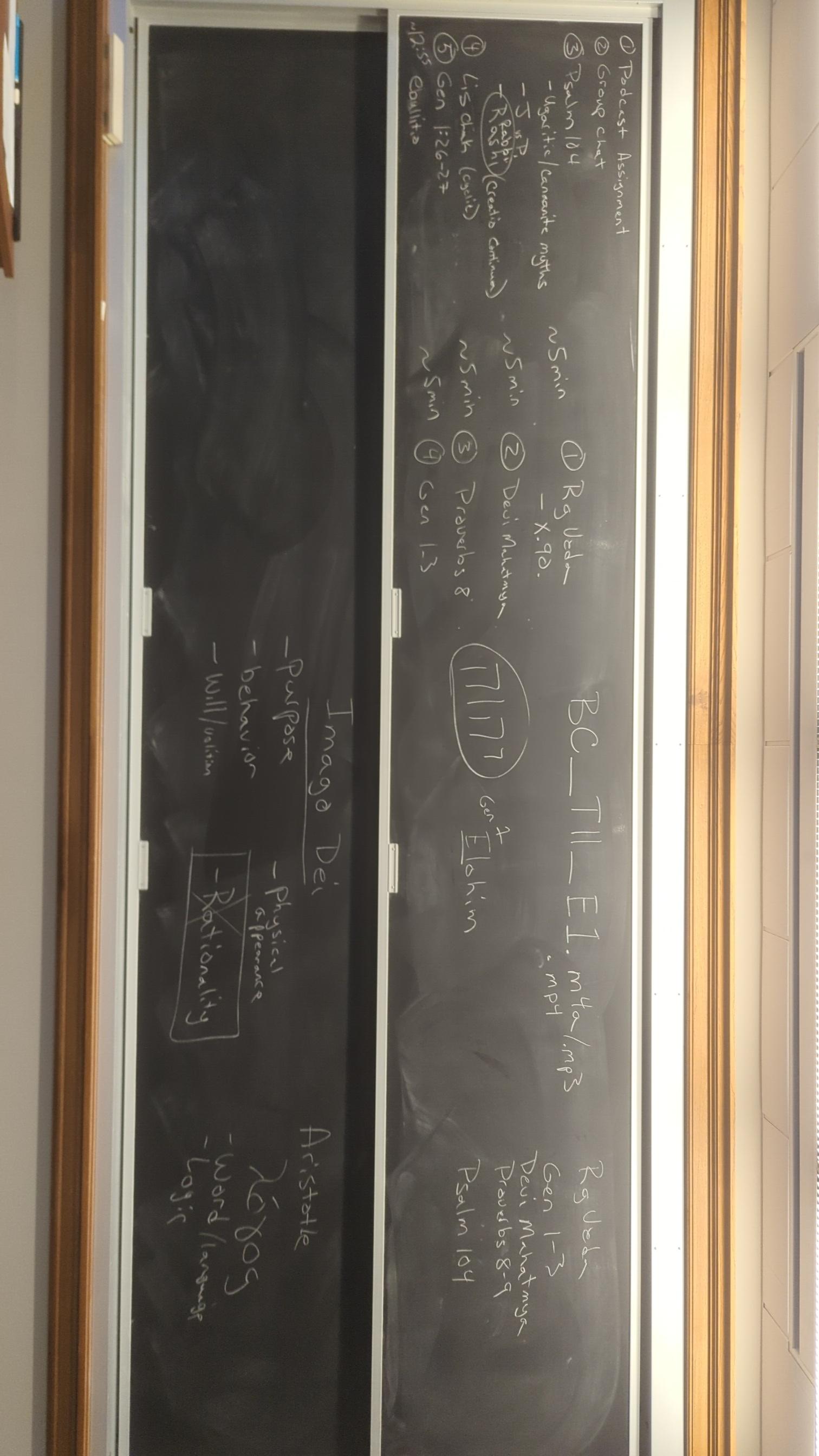
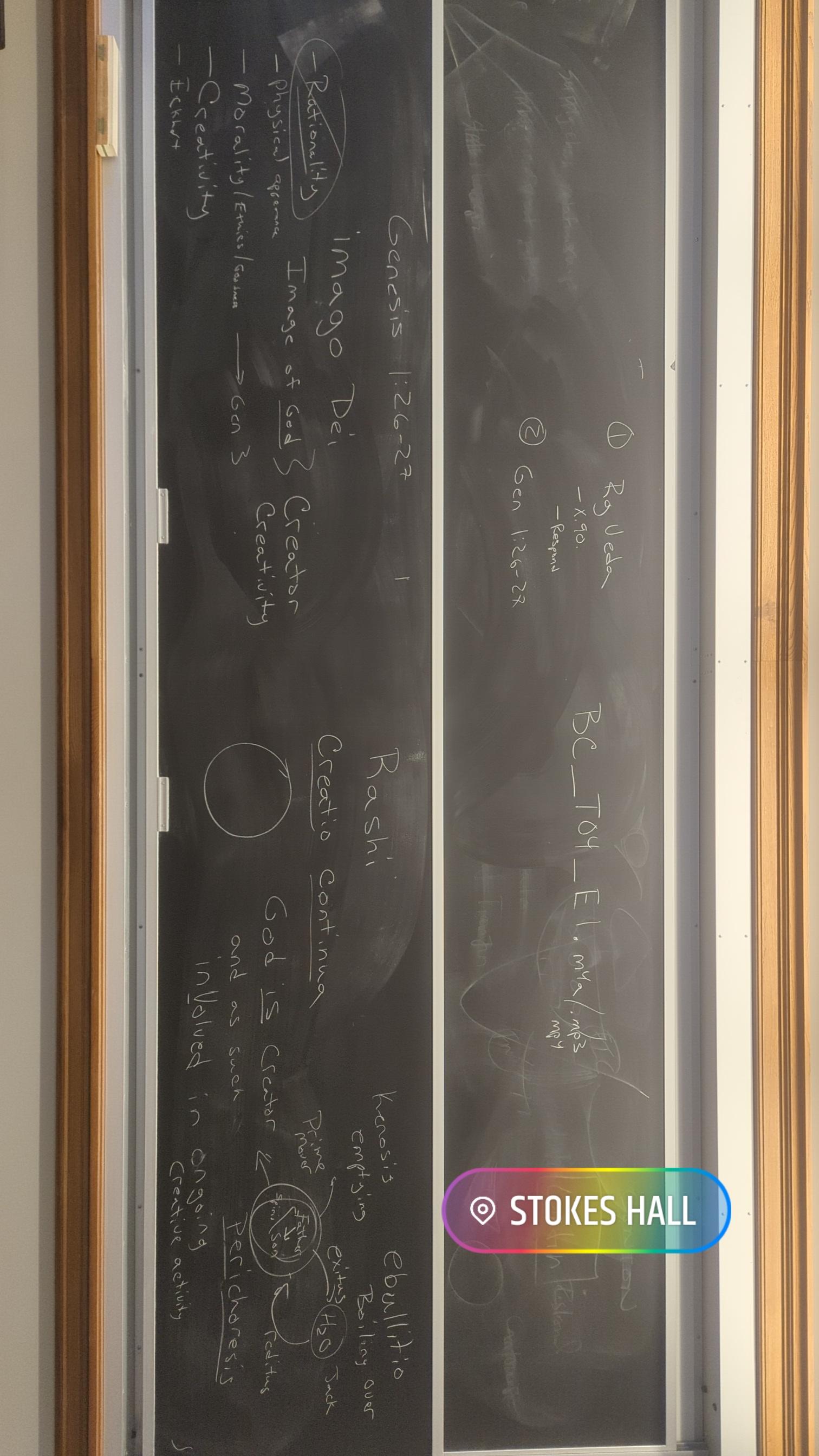
This class session began with administrative details regarding the upcoming podcast assignment, covering recording options (in-person audio vs. Zoom video), submission procedures via shared folders, the required file naming convention (BC_T[Team#]_E[Episode#]), and the expected structure (each member presents a focused passage from assigned texts, followed by group discussion). Brad offered advice, emphasizing preparation and keeping the text central. After a brief small group session for teams to plan their podcasts, the class transitioned to a lecture and discussion centered on Psalm 104. Brad explored the scholarly debate regarding its dating relative to Genesis 1, highlighting its structural similarities and differences, including references possibly linked to older Canaanite myths (Baal, Yam) and the use of the Tetragrammaton (YHWH/Hashem) versus Elohim. The interpretation of Rabbi Rashi was introduced, emphasizing creation as ongoing separation (*bara*) and continuous process (*creatio continua*). The remainder of the class involved a rich discussion where students shared observations on Psalm 104, comparing it to Genesis and Proverbs, noting themes of God's sustaining presence, renewal, wisdom in creation, the role of work, and the text's generally positive depiction of the created order.
Brad: Okay, January 30th. Let's let's come to order. January 30th, we're missing Luca and Cameron. Yeah?
Brad: Alright. Howdy y'all. How's everybody?
Brad: I forgot to record the last class, so you know, gotta make this sure this one is as good as that one. Pressure's on. Pressure's on me. Y'all do fine.
Brad: Let's take a minute and just, you know, leave everything else outside and just try to be.
Brad: Let's take one breath together. Go ahead and let's breathe in. Let it all out.
Brad: Cool. Word.
Brad: So, I got a lot to do today. So, for starters, so let's talk about the podcast assignment. The podcast one, due Sunday night at midnight-ish. I'm pretty flexible, like I said before, especially on the first one. So, yeah. As long as, you know, I know that the hardest thing about the podcast assignment is scheduling it. And yeah, that's usually, that's usually most people's experience. So, you know, if you need an extra day, just let me know. So it's no problem. Otherwise, I'll be looking for everybody, you know, to have them basically by Monday morning when I wake up. Also do, if you, if you record it earlier, please submit it as soon as you record it, because I do like to listen to them on Saturdays and Sundays if they're done. You know, as far as submitting it, I have not yet created shared folders for you, but I will do that, probably tomorrow. Yeah, probably not going to do it today. But tomorrow I'll create shared folders for every team. And when I create the shared folder, you know, I'll share it with everybody on the team, and then you'll immediately get a auto-generated, you know, email with the link to that folder saying, hey, you've been added to this folder. And the folder will have your team number. So it'll just that actually that should be the name of the team of the folder, just be your number. So if you don't know your number, you don't, you don't need to worry about it until, then. So I'll share that with you. If you happen to do your podcast, you know, today or tomorrow, if you happen to do it before I create that folder, just hold on to your podcast until you you get that email, and then just save it in there. The I do have, yeah, Ola, did you have?
Student 1: I mean you put this in the instructions, but can I just put my phone and like record the podcast? Is that?
Brad: Yes. Yeah.
Student 1: Should too? Like do you want to see us?
Brad: No, I'm I'm getting there. I'm about to answer it. Yeah, no worries. So for, so for recording the podcast, yeah, very much on that point. You can record it one of two ways. I think, you know, 99% of BC students record in person, which is ideal. So if you're recording in person, then just, you know, I guess one option, there is a podcast recording studio on campus, which you're free to use if you want to. Don't feel any obligation to use it at all. But, anybody used it before?
Student 2: Yeah.
Brad: Yeah? Did you use it last semester for this?
Student 2: Yeah, last semester. Yeah.
Brad: Yeah? And
Student 2: Works fine.
Brad: Works fine? How do you, what's the process for that?
Student 2: You just need to plug in your computer and you can just...
Brad: Do you have to like book it in advance or?
Student 2: Yeah, you do have to book it in advance.
Brad: Okay.
Student 2: On the website.
Brad: Okay. So, so for more information, probably ask, ask Senator Drew, right? You said you've done it before? Yeah. So you can ask them if you want, if you need. But don't feel any pressure to use the podcast recording studio. You can just do it in your dorm room or somewhere like that. I did I did have one group try to record in the like the dining hall, like during lunch with like 8,000 people in there. Like, yeah, that's just a bad idea. Don't do that. Come on, that's that's Don't do that. So as long as it's a relatively quiet place, if you're, you know, if people are I'm not I'm not it's not a professional podcast. We're not looking for anything like that. So just, as long as you're doing reasonable, things like, using your phone to record, put the phone down. Don't move it. Please don't do this thing where they're like, hey, you know, it's Molly's turn. Let me slide the phone over there and then the recording sounds like [imitates sliding noise] I don't do that to me, please. Just put the phone down somewhere in the middle. Everybody kind of talk about the same level volume and you'll be you'll be cool in the game. And that's it. You know, please don't edit it. I don't want any editing. Don't need to like pause or pause out the You don't need to do it. Just hit record, hit stop, and that's it, right? And upload it. And yeah. Since, if you're recording via Zoom or Google Meet, then please keep your camera on. That's, that's a requirement. Mostly so you can see each other. Yeah, that's that's the main reason. So keep your cameras on and record the video and audio, if you do that. So, and then you can just share that with me. If you record in person, then definitely don't do video, just, you know, just like I said, just hit record the audio, put the phone down, you're good. For submitting the podcasts, submit them in that shared folder once I share them with you. And the naming convention is super important. So even though it's in the syllabus, I'm going to go over it again now because it's very important to me. So name every podcast should begin with the letters BC. That stands for Boston College. Because I also teach at Fitchburg State. So theirs don't start with BC because they go to Fitchburg State. So they start with FSU. So BC underscore, and then the letter T, want a capital, capital makes sense. And then your team number. So, I was team 11 just because. So, so you guys will be T 11 underscore E for episodes, because you're going to have six podcasts by the end. So just the letter E and then the number. So in this case it'd be one. And then should have, you know, the normal file extension after that. If you're recording in audio, then, pretty much every case, it should be either M4A or MP3. And if you're recording video, it should be MP4. Yeah? Yeah, I think for, you know, default, that's that's probably going to be the default for most folks. Any questions? If you happen to name the file incorrectly, it's not going to affect your grade. Okay? It's really just, going to, I mean, it will, you know, irritate your professor in the moments before they grade your podcast, but I wouldn't let that influence you, right? So the reason that I care so much about this is because, you know, I've got 140 students. I teach five classes. I use podcast assignment in every single class. And, what I do is I, you know, wrote a little script since so I don't have to go into every folder and see, you know, the podcast, the team 11 record it yet or whatever. I just hit, you know, run script, and it goes through all the folders and it, pulls them all into one folder so that I can sync it on my phone and listen to it. And when it does that, then it should have all of these names and I can see, hey, team 14 is missing, right? Or team 27 is missing. And they're at, you know, BC or they're at Fitchburg State and I'll go and, you know, follow up. If you name it podcast 2, and I've got like, you know, 14 podcasts 2, then that's that's going to irritate me, right? So, so just name it that, that way should be cool in the game. If you don't know your number yet, don't worry about it. You'll get that when you get the shared, email, shared, yeah, shared folder email. As far as podcast structure, again, this is in the syllabus. So it's a very rare time when Brad is saying things that are in the syllabus, which you were supposed to have read. But because it's important. The structure of the podcast is, well, it's structured. There's a particular structure that I want. And, basically it goes something like this, right? There should, there are four people on every team. And when it's your turn, so basically have, you know, each just decide, well, decide what order you're going to go in. First person should choose one of the texts that we've read. I mean, each person should choose one of the texts that we've read. And so in this case, we've got, I believe five options. I mean, you've got more than five options, but you've got five clumps to choose from, right? And so, you know, one person could start with the Rigveda. Now, I gave you three hymns from the Rigveda. That would be way too much to cover, right? So, I would prefer you choose one of the hymns and even more specifically, you know, choose like a section of one of the hymns, right? More narrow, more particular, the better. The most particular is the most universal, one might say. Just, I don't know. I've heard that before. So choose a particular passage from the Rigveda. I don't know, say I'm going to do like 10 90, you know, like, I don't know, like this clump of verses, verses 5 through 10 or something like that, right? Then, then whoever goes first, say Drew goes first and says, all right, this is, first of all, I'm Drew. And then say, I want to choose, I want to talk about this passage. If it's, if it's relatively short, you know, if you're really talking about like a few verses, then it'd be a good idea to read them. Just read them. And it'd be a good idea for everybody in the team to have the text in front of them, right? I've given you printouts of all the texts, so just go in with those in hand. And, you know, Drew would say like, I I want to talk about this and, here's what I want to say about it. I think, good advice is to have some sort of questions, some sort of discussion question. Try to avoid questions like, what do y'all think it means? But, you know, try to go a little bit, you know, well, you know, just give some people a little bit more to kind of go on, but, whatever. You should spend, you know, approximately five minutes-ish. Definitely not less than that. But five, seven minutes, something like that per person, right? And then so, Drew would maybe take like a minute, minute and a half, something like that to kind of like introduce the topic, set it up, say what you want to, you know, introduce some question. And then let the group, you know, discuss it, right? It's really discussion. So, so each person in the team should have something to say about that passage, right? Makes sense? So then, you figure, person who's leading discussion takes like two minutes, and then each other person takes a minute or so, and you kind of, in terms of like whether to have a really organic, natural conversation or to have a structured sort of conversation, especially for the first few podcasts, I'd rather you air on the side of too structured than too organic, right? As you go, as the semester goes on, then you can shift towards, you know, more, now we know what we're doing and we can be a little bit more natural. But, but I do care about the process, of making sure that you're keeping the text at the center and you're having a discussion about the text, right? And the text that's at the center is going to change from each person that's leading the discussion. Cool? The order that you can go in, you can go in any order you want. You could do, you know, two Hindu, it should be, especially for this podcast, this should be, you know, two people covering Hindu texts and two people covering, Hebrew texts in this case. And again, like, if you're covering Genesis 1, 2, and 3, there's no way you can cover Genesis 1, 2, and 3, right? So just kind of narrow focus onto a few verses within Genesis 1, 2, and 3. Makes sense, right? For, the first few podcasts, especially, like I said, I got 140 students, a lot of podcasts. Still learning, I'm still putting names to faces. Names to voices is next level, right? So, I I'll get it. I will get them, I'll get them pretty quickly, but I can't get them at all unless I know who's talking, right? So, for the first few podcasts especially, you just got to say, you know, hey, this is Molly talking. Hey, this is Reagan talking, whatever. Or you can do it, you know, more organically, you can be like, hey, that was a really good point, Georgia, or Jaline, what do you think? You know, something, whatever. So just sort of like, drop your names as often as you can through the podcast. Yep.
Brad: First of all, so I want to do two things. I want to ask if you have any questions, and I want to give the folks that have done this before, because there's a lot of folks in the class that have done this before. If you have any advice, you're, you know, sage experience advice, to share with, with everybody. So I'll toss that out for either group. Have anything, any questions or advice? Yeah.
Student 3: I have a question. When we pick like our like lines or whatever that we're going to use, should we bring them to you or just go through the podcast?
Brad: Just record the podcast. Yeah. Yeah.
Student 4: Do you have any advice? It's pretty straightforward assignment.
Brad: It is really, yeah.
Student 4: Just like don't stress about it at all.
Brad: Good. You know, some, some groups have, fun with it, you know. Some groups are more business-like. That's okay. Either, however you do, you do you, right? But I, I tend to like fun, so, you know, fun's not a bad thing. Yeah, Ola.
Student 1: Yeah, do you like when we mention stuff that we covered in class or do you just want us to stick with the reading?
Brad: I want, I mean, I would say the class discussions should inform your, you know, what you're saying. I don't want you to be just repeat, I don't want you reading your notes or repeating things that we've already said, unless you have a point to make, right? So like, I want to repeat this thing that was said in class so that I can make this point or raise this question or something like that. So, don't try to just like use it as like an exam review kind of thing, but instead, but yeah, definitely, especially as you're preparing. I would say that each person, the difference between a good podcast and a bad is how well prepared the people involved are, right? So if each person spends, I would think, you know, 20 minutes would be plenty to well, to prepare well. If you're spending less than 10 minutes, you're probably not doing enough, right? So somewhere between 10 and 20 minutes in order to prepare well for the podcast, think about exactly what passage you want to say, or discuss and what you want to say about it, especially if you can have a good question about it. And then just, you know, let it, let it roll. I've had groups in the past that wrote out like a full script of what every person was going to say and then they went through the script. Most part, I don't love those. So, you know, I'd say just go, you know, it's a discussion. But, but I have also had some of those that were really awesome, so I'm not going to say do or don't that, but, other questions, advice? Don't eat during the podcast. Please, please don't eat or chew gum during the podcast. Don't move the mic. Okay, good. Sounds like we're good? All right, word.
Brad: So let's take a few minutes then to get together with your team and discuss just clarify who's doing what, right? So that you know what you're doing. What are the what are the So I'll jot down the possibilities. Possibilities are three things from the Rigveda. Genesis 1 through 3. Proverbs 8. Oh, Ecclesiastes.
[small group discussion period]
Brad: Okay.
[small group discussion period]
Brad: All right, let's kind of wrap it up.
[small group discussion period]
Brad: Also, I don't remember if I said this or not, but it you've got the printouts of all the texts, right? That we used in class. So you really should, I think, have all of them with you when you're recording the podcast. So then, you know, if Reagan's leading a discussion, then, you know, you could, you could maybe give everybody a second, say, hey, let's talk about, you know, Psalm 104 verse 12, and then everybody can kind of turn to it, you know, have it in front of them. Or even better, you could kind of discuss that for a minute before you start recording, and then everybody kind of have it lined up. But everybody should have the text in front of you. The whole point of this course is to anchor the discourse in the text, right? Keep the text at the center. Cool in the game?
Brad: All right. Let's okay, so this text, Psalm 104. I I kind of got I went down so many rabbit holes past 24 hours trying to, you know, see what scholars think about the dating of this text. It is, there's there's a lot of debate on whether or not this Psalm 104 was written before Genesis 1 or after Genesis 1. I think there's no doubt at all, anybody who reads both of the texts will say, hey, these, whichever one came second, definitely knew the first one, right? They both they're they're there's too many commonalities, too many similarities, too much structural similarities, too much too much for them, they have way too much in common for them not to know one another. But the differences then become increasingly confusing for for scholars about trying to figure out which one is first.
Brad: So let's think a little bit about what what is this about it that that causes the confusion. Basically, there's these references, you can look at verse two, cover us thyself with light as with a garment. And then this reference to one who makes the clouds thy chariot. We don't see that sort of language of God riding a chariot elsewhere in the text. We certainly don't have it in Genesis 1. Who walks upon the wings of the world, and makes the winds thy messengers, all these kind of images of, I think, morphologically, you would say, very similar to Zeus, right? Or Indra. Indra is the one we talked about last on Tuesday. So this God who is in the heavens who like has a chariot, right? And who's the God of thunder and the God of lightning and those sort of things. That rides a chariot.
Brad: But here, I mean, definitely the, definitely the reference isn't to Indra, but, and not to Zeus either, but probably to this kid named Baal. Who is a Canaanite, Canaanite deity. But very similar to Zeus and, Indra, in terms of, you know, riding a chariot and being the God of thunder and lightning and all those kind of things. So then that would raise the possibility since this is, you know, Canaanite myth, but we've also got a lot of the elements that we saw in Genesis 1 that kind of connect back to that older, Babylonian myth, you know, Enuma Elish. So you've got this blending of at least two different, two different myths. And probably more than that, but definitely these two. And then there's this also, this, with the reference to the garment that I mentioned, and then another garment here in verse six, thou just cover it, meaning the earth, the land, the dry land. Cover it with the deep. So we've got that Tehom, the the deep that we saw in Genesis 1 verse 2, which I think this is the third or fourth class now that I've mentioned that. So take note. But, thou just cover the deep as with a vesture, as like with a coat, right? So the idea here is like the, the land, there's this dry land, and then Yam, is the deity here. Yam, cover, he's the God of the waters, the God of the oceans, the God of, you know, sort of like Neptune or Jupiter, something like that. So the God of the, the God of the waters, the God of the oceans. And, but he lays the water down on the dry lands like you would lay your coat down on the ground, right? So he lays the waters down like a garment, vestiture. So there's all these references to these Canaanite or Ugaritic, deities and creation myths, which would suggest that maybe this is, I mean, strongly suggests that this is older than Genesis 1. Why would it suggest that it's, that it's older than Genesis 1?
Student 5: Is it because in Genesis 1 they were talking about how there was already water?
Brad: That's true. Yeah, the wind blew over the face of the deep. So the face, so the deep was already there. Yeah.
Student 6: I think on that note, like if Genesis 1 came before, maybe that would have made references to to Baal and Yam as opposed to Psalm 104. So like you could just think like by chronological order, the first one would make those references and everything else would build on that.
Brad: Right. So you would, you wouldn't so much take away those kind of things, right? So yeah, yep.
Student 7: Kind of building on that sort of like genetically or that's not the right word because that's math, but essentially like Baal and Yam are older and so you would they would they're the more commonality there is with the older religions, the more likely it is to also be an older religion as opposed to Genesis which seems to have diverged from that.
Brad: Yeah, good. Great. Any other? Yeah, I think that I think that's right, right? So, so if there were these references to Baal and Yam, then you would expect like, okay, if we're going to move away from those theological traditions, then you would take out those references, right? But if, if this came later, then that would mean that they added in those references, which would be weird, right? Like, why would you have this Jewish tradition that then adds in these non-Jewish deities, right? Make more sense for the Jewish, like we saw with the Enuma Elish, right? Enuma Elish, there's no doubt that that's much older than the Genesis 1, and that Genesis is taking the Enuma Elish myth and then making it, so then we noticed like one of the most important differences between those was about slavery, right? That, Marduk says humans are created to be slaves, right? To be servants. And this is a myth that was told by the Babylonians to the slaves, to their slaves, right? To the Israelites in that case. The Israelites heard that and they're like, well, you know, actually maybe not so much, right? Maybe, maybe we aren't created to be slaves, but instead we're created in the image and likeness of the creator. So we aren't intended to be slaves, right? So then that would be an example of something that's, you've got the older myth and then the newer version like changes those things and takes out those references to Tiamat and things, right? If it added them in, that'd be weird.
Brad: So the, why does it matter? Which came first? I really have no, no answer to that question. So we'll move on. I really don't know why it matters. I don't know why it matters so much to me. To me it matters a lot which came first, but I don't I can't really give a reason of why it matters. So, we'll move on then. Okay, so another, another curious difference, here is, some there's, there's a word that's used in this text 104 that is not used in Genesis 1. Anybody notice what that is? It's a word that we find in Genesis 2:3, but not in Genesis 1. Somebody talked about it during that lecture that day. Thinking, you remember? You kind of remember?
Student 8: I remember I asked the question. Yeah. I think it was like the Lord or something.
Brad: It, yeah, anybody? I gave you the, I gave you the Hebrew there in verse one. Yeah.
Student 8: Lord?
Brad: Yeah. So the the Tetragrammaton, right? Yud He Vav He. So the, which is usually translated as Lord because, the name is forbidden, right? Usually written all caps so that you know, hey, it's not actually the word Lord, it's this, right? And I wrote Hashem there just because that's the, that's, how, how it's written. But Hashem just means the name, right? So this is, we've got these two different, theological tradition, two different histories of the scriptures. One is the, the what's called the priestly text, which refer to God as Elohim. Right? L meaning, we did that. We covered that already. I don't want to repeat that, but right? L is L means like lowercase G God, and Elohim is like the pantheon would be another way. So it's like a singular plural sort of word, like water and waters, remember we talked about that. So this is what we find in Genesis 1. And then Genesis 2:3 [Brad likely meant 2:4b onwards], we instead of referring to God as Elohim, God is referred to with this, mystical name, right? This, forbidden name, the name, Hashem, the name. So that's another significant, difference. Worth pointing out. Which again, again, like if this one were older, then that would imply that Genesis 1, when they rewrote it, they took out those references, which would also be kind of weird, right? So, I don't know. I don't know. It's a mystery. Including why it matters.
Brad: All right, then coming to this guy, sorry, I'm just got a lot to cover. Rabbi Rashi, I've talked about Rabbi Rashi before. I talked about Rabbi Rashi particularly when we read Genesis 1. I don't remember if I mentioned Rashi a little bit in Proverbs 8, but mostly in Genesis 1, when we're talking about Genesis Genesis 1. Rabbi Rashi's interpretation is actually why for all three of the Hebrew scriptures that we've studied so far, I've given you the JPS translation, the Jewish, Publication Society translation because they tend to follow more the Talmudic scholars, the Jewish scholars, including Rashi. And one of the things that you may have noticed, hopefully you noticed, hopefully I pointed it out, but the very beginning of, Genesis 1:1, the translation that I gave you before, instead of, like a lot of translations, especially Christian translations will usually translate Bereshit Bara Elohim Hashamayim V'et Ha'aretz as in the beginning, God created. But Rashi interprets the Bereshit as when God began to separate, right? So Bara is separating, like I talked about cutting bread or Bara, you know, Bara is what you do to bread when you're like slicing bread. So, when God began to separate the heavens from the earth, when God begins to separate the light from the darkness. When God began to separate the earth, you know, the dry land from the wet land, right? So, that idea that things were already there, right? And God is separating, pulling things into order, separating things, calling things into some sort of order. So order out of chaos. So the Tehom could be the, everything was formless and void and then God began to give shape or form to things. And that that's an ongoing process. Rashi in his commentary on, Psalm 104, one of the things, I should say a little bit about who Rashi is. So Rashi was this, rabbi, 11th century, you know, 11th century CE. And, among other things, he was concerned about, he was concerned that a lot of Jewish interpretations, had tended more and more towards Christian interpretations. So the Christians were giving interpretation of the text. And he wanted to get back to the Hebrew roots and the Hebrew text and really prioritize the the Hebrew scriptures and try to read them on on their own terms without all of those. And he's, he's one of the, you know, one of the most important, Talmudic scholars. I mean, one of among many, I don't want to give him too much weight, but definitely important one. And so his, one of the things that he emphasizes in his commentary on, Psalm 104 is pointing out that the whole thing is, or most of it is written in the present tense, right? So it's something, it's not in the beginning, something happened long ago. So this sort of notion of creation is something is a historical past event. But instead, creation is something that's ongoing, right? So what's, is described as, well, I've written it there, Creatio continua, right? So you've got this sort of circle or cycle, of creation, this ongoing process of creation. So that's one thing to to notice. What are some other things that, yeah, Justin?
Student [Justin?]: Um, sorry, this Creatio thing, Creatio continua? Yeah, Creatio, this is Latin. So Creatio meaning creation and continua meaning like continuous, right? So like ongoing creation. Does that relate kind of like what you were saying with the Trimurti um last class and how they they they were saying that it's not or it's a mistake to think of it as like a linear like what happened in the past kind of thing that they're all still creating sort of continuously? Is that related?
Brad: I mean, it definitely seems similar. Yeah, I don't want to jump too quickly to comparison, but I think that you're not wrong and noticing there's some similarity there. Yeah. Others?
Brad: So, all right, well then let's turn, our attention to the the text. So I've given you a little bit of interpretation, but, it's now your chance to show off and show how well prepared you are and what you got to say. Yeah, Ola, you want to get us started?
Student 1 [Ola]: What I thought of this text was I thought it was like really similar as we were saying to Genesis 1 because of laying out the events. But then I saw some differences being like Genesis 1 just pointing out what happened and this one saying like, well, sounds we know it's praised to God and like thanking for whatever he did. Yeah. But it's I saw it as a more like continuous thanking. For example, when it says in verse 30 when it says, and thou renewest the face of the earth. It's the idea that creation not only was like a past event, but like rather an ongoing process sustained by this idea of God.
Brad: Excellent. Yeah, which uh verse 30? Is that what it is? Yeah. So yeah, so that renewest, yeah, so that's sort of, yeah, renewal, right? So then creation as a sort of renewal. That's good stuff. Yeah? So, yep, good. Yeah, Gil?
Student 8 [Gil?]: I found it super interesting. In line 14, right after the uh, third line, bringing forth bread out of the earth. I thought that was super interesting because as all signs point to this, what we talked about being before Genesis, just how that line of then way down the line in, you know, the New Testament, Jesus comes, of course, he brings back that idea of bread and it being kind of part of God in the creation. So I just thought it was really interesting to bring forth bread out of the earth that God has through this medium of bread.
Brad: Yeah, good, good. It's it's not a topic that I know a whole lot about. I know enough to know that bread is actually a pretty important theme running through the Hebrew scriptures, which does get continued as you're pointing out, particularly through the words of Jesus and the actions of Jesus. Bread is something, I mean, bread is like a life force, right? It's so it's like, yeah, it's something.
Student 8: It's like a starter, like that could be renewal. You know, you have a starter that can always create bread over and over.
Brad: Yeah, yeah, absolutely. Yep, yep, Matt.
Student 9 [Matt?]: I thought it was interesting in line 24 when it reference to wisdom, which I thought was pretty like because you talked about wisdom in Proverbs, so it kind of showed how God wants us to seek wisdom as people, but then he also uses wisdom to create the earth.
Brad: Right. Yep. So then, that so this could be echoing Psalm, I mean Proverbs 8 or it could be foreshadowing Proverbs 8 depending on where this text lies. But definitely a connection, right? Really good connection between the wisdom of creation and the, and that that, yeah, divine feminine in there. Yeah, thanks Jaden. Yeah, Ella.
Student 17 [Ella?]: That's where that kind of reminded me of like Proverbs 8, like I think there was like that playing throughout like and they gave you power like not exactly knowing exactly what to do with they have.
Brad: Yeah. Yep. Okay. Whereas in like Genesis 3, there's more clear, there's like rules and break the rules and yep, okay, got it. Good. Yeah, Jose?
Student 12 [Jose?]: Look too also add on the differences between how God is viewed in Genesis and Psalm because in Genesis, God is viewed as the creator, as the authoritarian, as God created everything, knows everything. But now in this reading, he they talk about more about he's part of the earth, he's part of the creature and he sustains everyone. Mhm. And I thought interesting in line 28 when he says, thou opens thy hand and they are satisfied with good. Thou hide thy face, they vanish. So it talks about the how God, you can't really live without God. He didn't just create it, he lives through you and if he ignores you, you'll vanish.
Brad: Something that's like sustaining, right? So not just like created in the past, but something that's still here and like if God weren't there, then we wouldn't exist continuously, right? Yeah. Yep, good. Yeah.
Student 18: I thought it was interesting kind of line 23, the description of man working until evening or laboring until evening because it just really just demonstrates proves the description of man as like servants, but also servants for God.
Brad: Yeah. But not in a slave sort of way, right? But more like, so I mean, from that perspective, I mean, God is also kind of working here, right? God is also sort of calling things into being. So, maybe we're, I mean, definitely, it's not saying you don't have to work, right? But, did I understand you right? Oh, yeah. Yeah, good. Yep, Drew.
Student 15 [Drew?]: One line that caught my eye was 32 with who looketh on the earth and it trembleth, he touches the mountains and they smoke. So earlier we were talking about how like God is really like promoting like longevity and sustainability with like humans and animals and all forms of life. Here he seems to like show his power through like starting a like fire on a mountain, so seems like a like contrast that caught my eye.
Brad: Okay, yeah. Well, and I've also got the, I mean, touching, right? So I mean, pretty tangible, hands-on sort of thing, adding on to that. Yeah, good. Yeah.
Student 16: I thought it was interesting how it's descriptive but it doesn't really seem to be asserting anything of like distinctions between like the good and the bad and like in Genesis how it calls like the serpent like the shrewdest of all creatures. It's not really saying and asserting any like distinctive opinions but it's just kind of telling us how it is throughout.
Brad: Yeah, everything's kind of declared as good, right? Yeah, great. Thanks Jaden. Yeah, Ella?
[Note: The following section seems to be a repetition or slight variation of previous student comments, possibly due to transcript error or overlapping discussion.]
Student 17 [Ella?]: That's where that kind of reminded me of like Proverbs 8, like I think there was like that playing throughout like and they gave you power like not exactly knowing exactly what to do with they have. Okay. Whereas in like Genesis 3, there's more clear, there's like rules and break the rules and yep, okay, got it. Good. Yep, Jose?
Student 12 [Jose?]: Look too also add on the differences between how God is viewed in Genesis and Psalm because in Genesis, God is viewed as the creator, as the authoritarian, as God created everything, knows everything. But now in this reading, he they talk about more about he's part of the earth, he's part of the creature and he sustains everyone. Mhm. And I thought interesting in line 28 when he says, thou opens thy hand and they are satisfied with good. Thou hide thy face, they vanish. So it talks about the how God, you can't really live without God. He didn't just create it, he lives through you and if he ignores you, you'll vanish. Something that's like sustaining, right? So not just like created in the past, but something that's still here and like if God weren't there, then we wouldn't exist continuously, right? Yeah. Yep, good. Yeah.
Student [?]: I thought it was interesting kind of line 23, the description of man working until evening or laboring until evening because it just really just demonstrates proves the description of man as like servants, but also servants for God. Yeah. But not in a slave sort of way, right? But more like, so I mean, from that perspective, I mean, God is also kind of working here, right? God is also sort of calling things into being. So, maybe we're, I mean, definitely, it's not saying you don't have to work, right? But, did I understand you right? Oh, yeah. Yeah, good. Yep, Drew.
Student 15 [Drew?]: One line that caught my eye was 32 with who looketh on the earth and it trembleth, he touches the mountains and they smoke. So earlier we were talking about how like God is really like promoting like longevity and sustainability with like humans and animals and all forms of life. Here he seems to like show his power through like starting a like fire on a mountain, so seems like a like contrast that caught my eye. Okay, yeah. Well, and I've also got the, I mean, touching, right? So I mean, pretty tangible, hands-on sort of thing, adding on to that. Yeah, good. Yeah.
Student [?]: I thought it was interesting how it's descriptive but it doesn't really seem to be asserting anything of like distinctions between like the good and the bad and like in Genesis how it calls like the serpent like the shrewdest of all creatures. It's not really saying and asserting any like distinctive opinions but it's just kind of telling us how it is throughout. Yeah, everything's kind of declared as good, right? Yeah, great. Thanks Jaden. Yeah, Ella.
[Repetitions continue and fade out]