 ```html
This lecture introduces the concept of Devī (the Goddess) within Hinduism and focuses on the important scripture, the Devī Māhātmyam. The class began with a brief Sanskrit chant from the text. Instructor Brad then facilitated the formation of student teams for an upcoming podcast assignment, outlining logistics and deadlines. Following this, they provided context on the prevalence of Devī worship, noting it constitutes roughly a third of Hindu practice, alongside Vaiṣṇavism (Viṣṇu worship) and Śaivism (Śiva worship). Brad introduced key forms of Devī, including Durgā (slayer of Mahīṣāsura) and Kālī (the Black One, associated with time), illustrating with various artistic depictions. A crucial distinction was made between Śruti ("that which is heard," e.g., the Vedas) and Smṛti ("that which is remembered," e.g., the Bhagavad Gītā and the Devī Māhātmyam). The Devī Māhātmyam, dated around the 5th-6th century CE and part of the Mārkaṇḍeya Purāṇa, was presented as an allegorical text. Its opening frame story involves characters named Suratha (good charioteer/body control), Samādhi (meditative state/spirit control), and Medhas (intellect/mind control). The lecture explained how the text's narrative, including the slaying of demons like Mahīṣāsura and Raktabīja, can be interpreted allegorically through the lens of the three guṇas (Tamas - ignorance, Rajas - passion/selfish desire, Sattva - purity/beingness) as a process of overcoming inner obstacles (ignorance, egoism) and finding a balance between the individual self and the divine.
[Sanskrit chant playing 0:01:41 - 0:03:05]
*(Hantum madhum kaitabham... Om namas chandikaye... Om aim markandeya uvacha... Savarni surya tanayo yo manur kathyateshtamah... Nishamayata dutpattim vistara gadato mama... Mahamayanubhavena yatha manvantaradhipah... Sabhuva mahabhagah savarnistana yoraveh... Svarochishe tare purvam chaitra vamsa samudbhavah... Suratho nama rajabhut samaste kshiti mandale... Tasya palayata samyak praja putranivaurasam... Babhuvu shatravo bhupah kolavidhvamsinastada... Tasya tairabhavad yuddhamatiprabala dandhinah... Nyunairapi satair yuddhe kolavidhvamsibhirjitah...)*
Brad: Alright. There's... We won't play the whole thing since, we'll just listen to the first six verses since there are 700 verses, so it'd be a bit much. Howdy, y'all. I have a few different lectures planned for today. We got a lot to do, so much to do today. Diving into Devī and yeah, we got a lot to do. Top top priority by far is we got to pick teams. So, team teams top priority. So let's take a few minutes and do that. Everybody in the room, I think, has at least one person that they want to be paired with. I think. What I'd like you to do is just, take a few minutes and see if you can form yourselves into teams. Teams of four. My only requirement is that, I don't want any duplicate groups from last semester. I mean, you can be what, you know, one person, but not a whole team. And the other is, I want more than one gender in every group. So, as long as you have more than one gender in your group, and you know at least one person that, you know, that's it. That's the only requirements. Other than that, I'm looking for teams of four. There's 32 people in the class, so we should be able to have eight teams of four. So why don't you take a minute and or a couple minutes, see if you can get into teams. If you can't get into a team, that's fine. We're going to do we'll we'll we'll figure it out. Yeah, we'll solve that problem. So, go ahead and see if you can figure it on your own, and if not, then I'll intervene.
[0:04:52 - 0:07:39]
*(Students rearrange themselves and talk to form groups. Brad walks around facilitating.)*
Brad: Anybody lose this last class?
Student 1: Yeah. I found it.
Brad: Do you need a group?
Student 2: Yeah.
Brad: Are you just alone?
Student 2: I need two.
Brad: Yeah, do you have a group formed? Oh yeah. That's fine. You don't have to sit together. That'll be fun. Wait, you're all three rowers, right?
Brad: Okay. How many people are in a group of four? Okay, I know this is silly, but I'd like everybody that's in a group of four to get out of the way. Good exercise, come on. Do we have any groups of two? No groups of two? How many groups of three do we have? So everybody else is in a group of three? Okay. You're about to. Yeah. Y'all are... Okay, you got four? You're good? All right, get out of the way. Who else? Who we got in groups? Need help? Okay. You two? And you and Luke? Cool. Y'all can come together then? Who else we got? Addison, what's going on over there? One, two, three and Dylan, that's four. Oh, okay. All of you are out of the way. Okay. Everybody standing up needs a group? So it's just you four? Solved. Okay, so then everybody's in a group of four then, yeah? So, yeah, so you can return to your seats. And when you do, I'd like you to take, you know, scrap piece of paper or something like that, half piece of paper or something, and just write down all all four of your names for me, please. And if you can come up with a team name super fast, then write your team name down. If not, then you can come up with it later. No worries. Oh, it would also be a good idea to trade contact info with each other.
Student 5: Do I just, it's just with our names, right? Yep. Okay.
Brad: Thank you. Thank you. Thank you. Thank you. Alright, let's try and wrap it up. If you haven't already, just pass up your papers. Thank you. So, podcast one, I will, I will say a lot more about the podcast assignment on Thursday. You shouldn't do it before then, you should do it after Thursday. It is due on Sunday-ish. I would very much like it by, you know, I mean, I would like it as soon as, please submit it as soon as you're done. Share it with me as soon as you're done. I'll create, I'll use these to create folders for you to submit them in. So I'll create a shared folder for everybody in your group. So the only people that have access to it would be people in your group and me. And, and then, you know, once you record the podcast, you just pop it in there. And I do have a very strict naming convention that's in the syllabus. So please follow that. So yeah, I would, I would like it, you know, Sunday night, if at all possible. I'm super flexible, especially on the first one or two. Especially because, you know, we're just forming the teams now. So, if you need a little bit of extra time, it's not going to, it's not going to be a problem. But if at all possible, try to get it to me by Sunday evening. And if not by Sunday evening, then try to get it to me, by Monday evening. What I usually do is, I usually kind of listen to them as they come in. On Sunday afternoons, I clean the house and listen to podcasts, kind of my, my MO. But, for sure on Tuesday during my commute in, that's when I, I listen to most of them. So, as long as I have it, you know, before 6:00 a.m. on Tuesday, then I'll be able to listen to it before class on Tuesday. Which is my, which is my preference. I'll say more about the assignment on Thursday. You may have done it before and, obviously, directions in the syllabus. Cool. We got like 8 million things to do today. If I were to accomplish all the things I wanted to do today, it would take like all semester. So, anyway, we're going to get as far as we, as far as we can.
Brad: So, anytime you're putting together a class like this, it's, it's grueling to think, I mean, it's never about like, what do I put in the course? It's always about what do I have to leave out, right? It's like so many more things that I want to include that I can't. I definitely couldn't do a semester without some Devī in here. And, but we don't have as much time on to focus on Devī as I would like. So we're going to try and cram as much as we can into today. Let's do, first let me give you just like a brief introduction to, to Devī. And then, and then we'll, we'll dive into this text. Oh, I handed out the, the lecture notes and things. Okay, so, Devī. So, this is not a religion class. I do teach introduction to religion. This is not that class. This is a theology class. But, every once in a while, it's helpful to teach you a little bit about religion, world religions. And so, in that vein, there's roughly a billion, you know, billion, billion and quarter-ish, Hindus in the world. And about a third, they fall more or less into, you know, a little less than a third worship, Śiva. Sorry, worship God in the form of Śiva. Definitely more than a third, this is the largest group, worship God in the form of, Viṣṇu. And we will focus a lot of our attention on Viṣṇu this semester. We're going to spend the last, last month of the course on the Bhagavad Gītā. This is a scene from the Bhagavad Gītā. This is chapter 11 of the Bhagavad Gītā, where Kṛṣṇa shows his universal form as Viṣṇu. We might come back to that later. And right around a third, of Hindus worship God in the form of Devī. And so, just to put that into context, that's roughly the entire population of the United States, right? So about that many people, worship God in the form of Devī.
Brad: So today we're, we're talking mostly about Devī in these two different forms. First, in the form of Durgā. Seen here, slaying Mahisha, the, or Mahīṣāsura, the demon in the form of a buffalo. This is a Madhubani painting. So Madhubani paintings are, by, by doctrine, only created by women, only supposed to be created by women. It's actually quite an empowering, liberating, art movement. Here's another, much older statue, carved statue of Devī. I'm sorry, Durgā. I mean, Devī as Durgā. Slaying again, Mahisha. You always see, Mahisha, right, in the form of a buffalo, usually getting stomped on or kicked out of the buffalo. So you see, Mahisha coming out of himself. And there he's kind of coming out of his mouth also. She's also, manifests or personified in this, form of Gaurī, the white one. And definitely in the form of Gaṅgā or the Ganges, river. This is, Mela where everybody comes to, to honor Devī in the form of the Gaṅgā river. She's, pretty much all water is a symbol of Devī, but the Gaṅgā in particular, actually the seven sacred rivers in India. And also Kālī. So we'll, so the two main forms that we'll look at today are Durgā and Kālī. Kālī, the word Kālī means the black one. So she's usually, pictured as black. And often, depicted dancing or standing on the corpse of her dead husband after she killed him. Here she is again. There's, I'm part of a list serve of all these professors, like Hindu studies, Indian studies professors on a list serve. It's probably like, I don't know, like 3,000, 4,000 professors around the world around this list serve. And somebody one time, this was a few years ago, asked the question like, why is Kālī pictured in blue? Because, you know, her names means black. Why, why are, why is she pictured as? Kṛṣṇa too. Kṛṣṇa is usually depicted as blue. Even though Kṛṣṇa also means black. And there were like 8,000, that, that discussion thread was like 8,000 threads long. It was crazy how many different, responses there was to that. Basically, either nobody knows or everybody has different, everybody has different answer to it. I think maybe the, maybe the most compelling answer is that way back when, blue was just a really, really, really difficult, color to produce. And so, so blue was seen as like the most auspicious color because it was really hard to produce in a, in a painting. But Kālī means black. And, yeah, we'll look at this more later. More images of Kālī as the black one. Also, as we'll, see a little bit in this text, the word Kāla means time. And so Kālī, in addition to meaning the black one, also kind of means like the controller of time or the personification of time. Either of those, both of those. Usually seen, with her mouth covered in blood, after she's, you know, drunk the blood of Raktabīja, as you read in that story. Here's sort of the, the holy family, holy, yeah, holy family. So, Śiva and, Śakti, Pārvatī, the goddess. And then they have two, they're not really their kids. I mean, we can't, because really, Gaṇeśa, was created directly by, Pārvatī and, Kārtikeya was created directly by, so they have, they, they're married and they have two kids, but they didn't, they didn't get those kids from sex. They got those kids from, creating them directly. That's a different story. I don't know why you're asking me about that. I guess that's it for that. There's not really much time for us to go into much religion stuff. Cool.
Brad: So, let's uh, a few things we got to do. More context. I'm going to go on to this lecture now. Okay, let me get centered. Feeling off center. So, Let's go to number two, from Śruti to Smṛti. So what does, what does Śruti mean? Not all at once. I never get told. Śruti? No?
Student 6: Isn't it that which is heard?
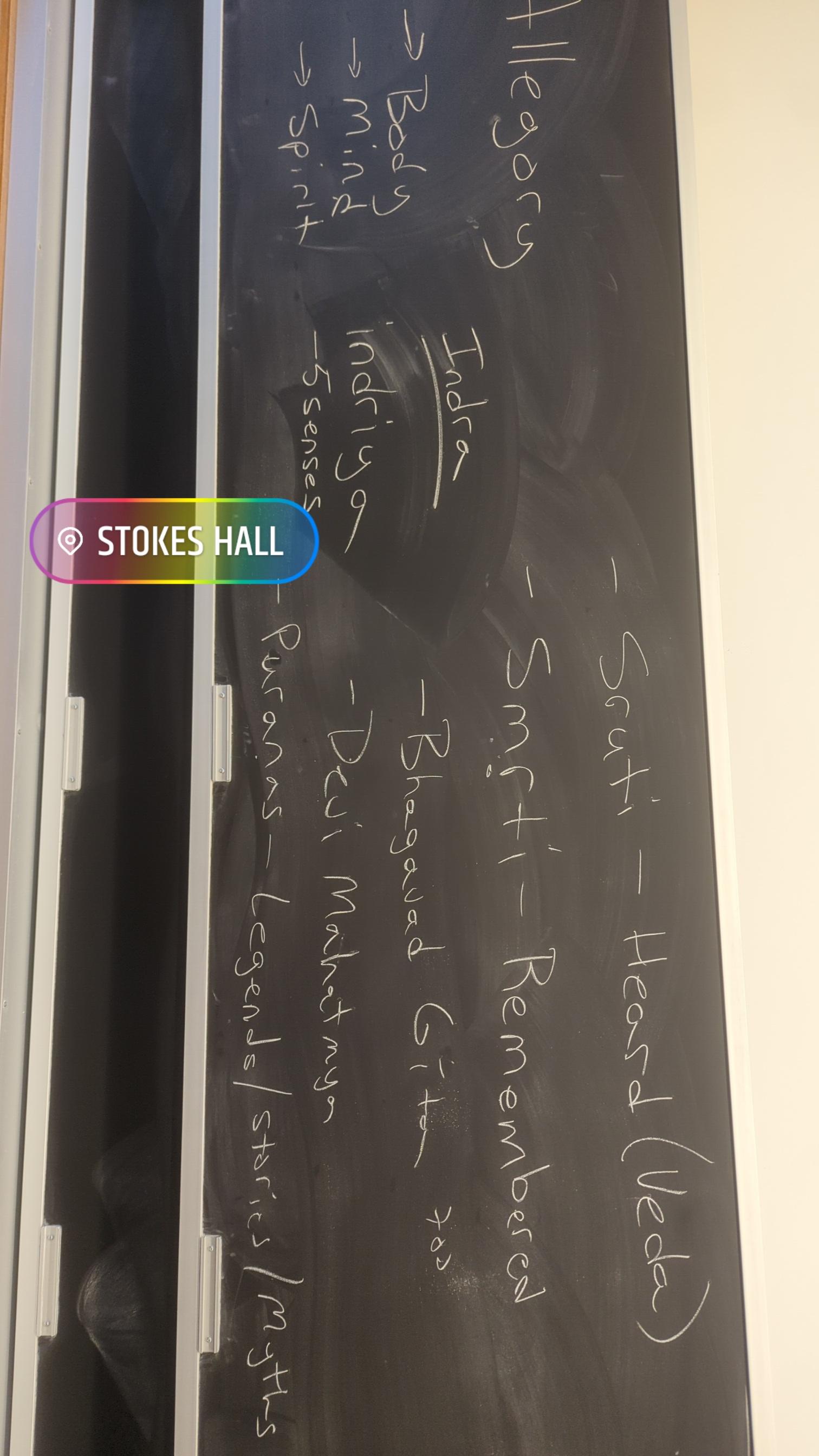
Brad: Yes, literally it means that which is heard. And, it is, it is synonymous with the Veda. But the Veda means, that which is known. But it's known because it was heard directly, right? It's the point. So it's, you know, if you hear something sort of like, I don't know if, Ruby tells me something and then I go and I tell Jorge what Ruby said, then like that's, it's like the game of telephone, right? So it's not like direct transmission. So Śruti is direct transmission. Somebody heard it and then they just, what you're hearing is what they heard, right? So that's the idea, of Śruti. And most of this semester we're going to be talking about Śruti. Next unit is all Śruti. When we go back to the Upaniṣads. Last week was Śruti. But today we're not on Śruti. We're on Smṛti. So Smṛti, means, that which is remembered. So, a little bit like telephone, right? So it's like somebody heard it directly, but then that person that heard it directly, they didn't like pass it down in that form, right? They're giving us what they remembered. Yeah.
Student 7: Sorry to interrupt, but we need two extra copies.
Brad: Yeah, yeah. I think I have more, right? Wait, I think I passed them all out though. Does every Okay, there's one.
Student 8: There's just like four.
Brad: Okay. Yeah, should be. You take them back. Oh, sorry, yeah. Okay. So Smṛti is that which is remembered. Now, there's there's no like, there's no like rule book where it's written down. This is what the Veda is. This is what the Smṛti is. So it does vary from tradition and community and group and that kind of stuff. Śruti doesn't really. Śruti is Śruti's pretty set. Well, no, that's not true. There are some Upaniṣads that people debate about what's in Śruti or whatever. But Smṛti, the two most, the two best known examples of Smṛti, maybe, are the Bhagavad Gītā. Which again, we'll, we'll study in the last month of the semester. And that's a Vaiṣṇava text, so focused on Viṣṇu. And that's 700 verses long. And then the Devī Māhātmyam which we're looking at now. I do not mean to suggest that these are the only things in Smṛti. There's a ton of stuff in Smṛti. Ton, ton, ton. But these are two, two things that are in Smṛti. And they're things that these two groups may not totally agree on whether or not that's Smṛti or whatever. Doesn't matter. That's also 700 verses by the way. And the Gītā, we're not sure, maybe around first century CE, and the Devī Māhātmyam more like fifth or sixth century CE. And both written in Sanskrit. There's also, in addition to these, there are Itihāsa, which we're not going to look at at all this semester, and Purāṇas, which we will look at, this semester. So the, there can be weird relationships between a lot of these kind of things. Like the Bhagavad Gītā is definitely Smṛti, but it's part of a larger text that's not Smṛti. So it's like 18 chapters out of a big text. The big text is not Smṛti, but the these 18 chapters are. Yeah.
Student 9: What does Purāṇa mean?
Brad: Purāṇa means Purāṇas are just legends. So legends and stories. Legends, stories, myths. I mean, there can be legends and stories and myths and the other ones, but that's kind of what Purāṇa means. Yeah. And and that's really what they are.
Brad: So, this so the Devī Māhātmyam is part, is like a section of a larger text called the Mārkaṇḍeya Purāṇa. And that's filled with legends, stories, and myths, etc. But then the Devī Māhātmyam is a section of that text that has over time become increasingly important, right? So it's like, it's like not, it's it's elevated beyond the status of the other chapters in that book, if that makes sense, right? We will look at some Purāṇas, a little bit later in the semester, but this is our only chance to see the Devī Purāṇas. Yeah, I think we're done with number point number two. Uh, number three, composed around 5th or 7th century, said that, embedded in the Mārkaṇḍeya Purāṇa, said that. Okay, so on the origins of the Devī Māhātmyam. So the I think by most scholars perspective, the the stories that are contained in the text are older than the text itself. But you have one person, a poet, a sage, a, you know, wise person that took these older stories and then compiled them into one book. And that new book, which we're reading the Devī Māhātmyam, then, you know, puts all of these stories into one overarching narrative, right? And so the overarching narrative, is in the form of an allegory. So, let's what is an allegory? What presume everybody knows what an allegory is. What is an allegory? Yeah, Molly.
Student 2: It's kind of like a story where like things like represent like real life like aspects.
Brad: Yeah, so layer with symbolism and representation. So it's not it's not like a history. It's not telling something that happened. It's something that's like, like you said, like it represent the things in the story represent everyday life or something like that, right? So it's a symbolic story that's trying to communicate some other philosophical, theological, introspective sort of meaning, right? Yeah, good. So, let's let's talk a little bit about this allegory. I apologize for kind of the excerpts I gave you. I had more time and preparation, I would have done a better job of giving you excerpts that really hold together better and would have been shorter and I would have given you something from the beginning of the text, but I was just like, hey, I got to get this out. So, the the text begins, we heard the chanting there. First of all, it is chanted. So it's in a meter. It's an Anuṣṭubh meter, which we've encountered a few times this semester, right? It's one of our one of the core learning objectives in the syllabus, is to understand this, at least that a lot of Hindu theology is written in meter. What do we mean by meter? Yeah.
Student 10: Like the cadence in which it's read?
Brad: Yeah, cadence in which it was read. Yes. Sorry, I heard that. Yeah. And so, so it's it's got and the meter is in terms of long and short syllables, X number of syllables per, so Anuṣṭubh is is four it's the the śloka is usually one sentence in two lines. Those two lines are each divided in half with long and short syllables alternating in a specific pattern. And, you know, so it's a it's a particular writing style. It's a meter, right? So writing in a poetic meter. So the learning objective, right? I wrote all of our learning objectives in that Anuṣṭubh Anuṣṭubh meter. And the point is to see how this is how theology is done by conden- by condensing knowledge, right? Refining knowledge, condensing knowledge. I don't want to say abstracting, but condensing, maybe some level of abstraction there. And condensing into these short little aphorisms or proverbs or, you know, poem, you know, couplets. And then the Vistāra. So Saṅgraha, Vistāra, right? Saṅgraha, pulling things together. Vistāra, elaboration or expanding. So the which makes it, you know, useful for a lot of reasons. On one hand, it makes it easier to memorize, right? If it's got a cadence and a rhythm and sometimes there's a rhyming scheme, not often. And, so it makes it easier to memorize, know if you've got every, you know, every syllable correct, because if you mess up a syllable, then it sounds wrong, right? So, this this the text begins with these three characters, which you see there begin point number four, Suratha, Samādhi and Medhas.
Brad: So, these already, anybody who knows any Sanskrit will recognize this, this got to be allegory because these aren't just random names, right? These names are very philosophical, philosophical terms. Samādhi is like never a name. In fact, it's really just it's like it's a philosophical term meaning like, the highest level of meditation or awareness, being like enlightened, being in one with, being being yeah, enlightened state, right? Suratha, Su means good and Ratha means chariot. So, another allegory that you might be familiar with, from philosophy class, if you've taken philosophy human person or something, probably know, Plato's Phaedrus dialogue gives the the allegory of a chariot, right? And so the allegory of the chariot for Plato is your well, actually he doesn't, well the the the allegory here is the the body is the chariot, right? So your human the physical material body is the chariot. And Suratha basically is taken to mean somebody who's good at driving their chariot, right? So, a person, you could think about being good at, what does that mean being good? What do you think that means being good at driving your chariot? I mean, LeBron James is good at driving his chariot, but it's, I mean, that's actually not, I mean, that actually would work in this context, but that's not quite what it means. Yeah.
Student 11: It could be like chariot is sort of like what you're good at, what you're passionate about, what you're good at, or I suppose what you like to do and then being good at it is means like being a master of your craft I suppose or not?
Brad: Okay, yeah, on the right track. Really being good at controlling your body, right? So being good, being a, being in control of your chariot means being in control over your impulse control. You know, like maybe sometimes you see something that you want, but you know it's not the best thing to do, right? Like maybe if you, I don't know, you know that you should eat a salad, but instead you really want to smoke a salad or something, right? So like that, so you're, so Suratha would be somebody who's in control of their impulses, in control of their desires and that sort of thing, right? So Suratha, is somebody who's in control of their body. Anybody remember back from the very first day of class, I sat on the table and did the whole mantra and stuff. I was complaining because I didn't have my jacket on and all that kind of stuff. So, and I gave the Śānti mantra at the end, Śānti, Śānti, Śānti and then this whole thing about why is the Śānti there three times? Anybody remember that? Quick review. Go.
Student 12: I I got to remember what it means, but I know it's three different things for what is it enlightenment?
Brad: Śānti means peace.
Student 12: Peace. Okay, it's three different forms of peace. It's peace with yourself, peace with like your your mind, body and then peace with others.
Brad: Yeah, almost there. Yeah.
Student 2: I was going to say it's peace.
Brad: So so peace in your body, that's one. Peace in your mind is another. And then more of like a spiritual spiritual kind of peace, right? Or you could say will or something like that. So we've got so this is a a common perspective, right? That you've got like the human person is body, mind and spirit. Right? So we've got Suratha meaning sort of somebody who's really in control of their body, right? Samādhi maybe may more somebody who's more in terms of in control of their spirit, their will, their desire, those sort of things. And then, Medhas, Medhas means intellect. So somebody who's in control of their their minds, right? So basically, the details of the story don't matter that much for us right now, but Surata and and Samādhi go and they ask intellect, for advice and guidance. And then, his response is the rest of the text, right? So all of the chapters that come after that, right? So that's the beginning, setting it up. So, yeah, really very, very clearly, right? An allegory for understanding, you know, how to be in control of self, mind and spirit, and understanding the relationship between those. Briefly outline how the Devī Māhātmyam opens. Yeah, I did that. The conversation system with the framework, did that.
Brad: So Tamas, Rajas and Sattva. These also we will cover again, a few times throughout the semester, particularly when we get to the Bhagavad Gītā. The Gītā talks about these three, at quite a bit of length. So Tamas meaning, darkness, kind of passions, ignorance is also, the darkness of ignorance is a good way to take it, right? So it's sort of darkness in mind and that sort of stuff. So, ignorance, we can just take for for our purposes right now, let's take Tamas to kind of mean ignorance. It means more than that, but Rajas is more, the passions, particularly the passion of, material desires, desire to consume, desire to control, desire to sort of selfish desires, right? So desire for self selfish desires. And then Sattva, we can take, in addition to being a mattress company, which is a little bit disturbing. It's a, Sattva means like, so Sat means being, and Tva means it's like the abstract noun, so like beingness. So literally beingness, but sort of like, you can take it to mean enlightened, right? Being in a state of enlightenment or something like that, sort of the highest, the highest form of being. So you kind of like overcome these three, you know, overcome ignorance and passions to get to this, state of, being. I think, here we could take it in a more mystical sense of like being united with God, being one, being one with God, right? But, this is a little bit more complicated. I mean, that's always more complicated what we mean by that. But, yeah, something like that. So being, being, at one with God. So then the whole text, right? The whole text, I've only gave you two of the three stories. So you read the story of Durgā and Mahīṣāsura, and the story of Kālī and Raktabīja. At the beginning, there's another story. And so the way many theologians, Hindu theologians interpret this is the first story is about conquering, ignorance. And that conquering ignorance in a large sense, this is an important point. This is a theme that we'll see running over and over and over again all semester. And we will emphasize again, in particular in the next unit.
Brad: But, finding this right balance between, this right balance between ego and, or between I and not I, self and not self, or I and not I, really. Right? So on the one hand, you know, we want Cameron to understand that Cameron is unique, unprecedented, unlike anybody else, right? So that's, that's a positive look at ego, right? So, Cameron is this unique individual, right? So unique individual is what we really mean in that sense. So, so, so part of that would be to sort of build up Cameron's ego and get a sense of like autonomy, independence, individuality, right? But obviously, that can go too far, right? If Cameron all of a sudden thinks that he's like the shit and like starts oppressing everybody, then we'd be like, Cameron, you need to calm down, right? So like, so finding that right balance between the individual, between the one and the many, is another way of saying it, right? So, between ego, of understanding, you know, why Reagan is Reagan, but also trying to, you're just like one member of the team, right? So like, you're an important member of the team, but you're also just one member of the team, right? It's kind of thing. So finding that right balance, we could also look at Tamas, Rajas and Sattva as trying to like a a so, as somebody I think said, right, an allegory is something educational, supposed to teach something. And so what is it trying to teach? Something about finding that right balance between body, mind and spirit, between ego and you know, everything that's not you, basically. Questions? I know it's a lot today, but cool. All right, where, let's keep rolling then.
Brad: Okay, I'll just end on this, kind of answering the the violence question that wasn't exactly asked, but it was kind of introduced. You know, we should take this as an allegory, right? As I've said. So, when she's killing these demons and stuff, right? About conquering that, so all those things I said before, right? So you want to, conquer ignorance is the first demon that needs to be conquered, right? So conquering ignorance and understanding yourself and your place in this world, that's sort of like building up the ego like I said, building up Cameron, right? The second one is like overcoming that selfishness, right? So going too far in that direction of like, I want to control everything, I want to take everything, right? All that kind of stuff. And then the third thing to be conquered is, understanding your relationship with the divine, right? So not in a re- in a position of being totally subservient to the deity, but also not being totally subsumed in the deity, like, you know, a drop of water in the ocean. It's like, well, okay, so added a drop, but like it didn't actually add anything, you know what I mean? So like finding that balance between those two things is part of what's going on here. Where I'll see you on Thursday.