 ```html
This class session began with a brief meditation accompanied by chanting from the Devī Māhātmyam. The primary administrative task was organizing students into teams of four for an upcoming podcast assignment, with a requirement for gender diversity within teams. Following team formation, Brad introduced the topic of Devī (Goddess) worship within Hinduism, contextualizing it alongside Śiva and Viṣṇu worship and noting its significance (approximately one-third of Hindus). They clarified the course's theological focus rather than religious practice. The lecture then delved into the Devī Māhātmyam, a key Śākta text considered Smṛti (remembered scripture) and part of the Mārkaṇḍeya Purāṇa. Brad discussed its allegorical nature, interpreting the frame story characters (Suratha, Samādhi, Medas) and relating the text's main episodes to the three guṇas (Tamas, Rajas, Sattva). Key concepts like Śruti vs. Smṛti, Śakti (divine power/energy), and the recurring trope of power corrupting were explained. The class discussed the iconography of Durgā slaying Mahiṣāsura and Kālī. The session concluded with discussions of two major episodes from the text: Durgā's emergence from the combined power of the gods to defeat Mahiṣāsura, and Kālī's role in defeating Raktabīja by drinking his blood, highlighting themes of divine power, its potential uncontrollability, and allegorical interpretations.
Brad: Instead of... Actually, let's let's still start with silent mantra or silent meditation, and then sometime during the silent meditation I'll start playing the Devi Mahatmyam so we can hear it chanted a little bit.
Brad: Hi. Let's leave everything outside.
Brad: Be fully here.
(*Chanting begins*) Om Markandeya Uvacha
Savarnih Suryatanayo
Yo Manuh Kathyateshtamah
Nisha Mayatad Utpattim
Vistarat Gadato Mama
Mahamayanubhavena
Yatha Manvantaradhipah
Sa Babhuva Mahabhagah
Savarnistanayo Raveh
Swarochishentare Purvam
Chaitra Vamsha Samudbhavah
Suratho Nama Rajabhut Samaste Kshitimandale
Tasya Palayatah Samyak Prajah Putranivaurasan
Babhuvuh Shatravo Bhupah Kolavidhvamsinastada
Tasyatairabhavad Yuddhamatiprabaladandinah
Nyunairapi Satair Yuddhe Kolavidhvamsibhirjitah
Tatah Svapuramayato Nijadeshadhipobhavat
Akrantah Sa Mahabhagastaihstadaprabalaribhih
Brad: Alright, we'll stop there.
Brad: Howdy, y'all.
Brad: I think in order to accomplish everything that I wanted to accomplish today would require like three or four classes. So, you know, we're going to get done as much as we are able. One thing we absolutely must do is organize into teams. So that's because your first podcast is due like Sunday, right?
Brad: Yeah, I see some people nodding and some people are like, oh shit. But yeah, first podcast is due Sunday. I'm pretty pretty, you know, easy going on the deadlines, especially for the first few podcasts, especially for this one since I'm just, you know, we haven't even gotten teams yet. So, if at all possible to get it to me by, you know, by commute time Monday morning, you know, by 6:00 a.m. Monday morning, that's ideal. And if you if you can't, then try to get to me by commute time on Tuesday morning, something like that, right? Just get it to me as soon as you can. But,
Brad: I'll say more about the requirements for the podcast, answer any questions like that on Thursday. Thursday we'll have more time to talk over things.
Brad: But, I think for teams, I don't know. Let's just see how fast we can do it. I I think everybody has at least one person that you're planning to team up with. Some people have more than one person. My only requirement is that you have more than one gender in your team. That's the only requirement. So, as long as you have more than one gender, however you identify, self-identify, whatever's cool with me. But I want more than one gender on every team. Cool? If that's even possible. Yeah. Anyway, what can you, you think you can do that in in like three, four minutes?
Brad: Let's try it. Let's try it. Let's see how far we can get. So if you can pair up with the person that you were paired with, and if you can't find another team, I'll randomly pair you up. Word? Cool. See see what you can come up with in a couple minutes.
[Small group discussion]
Student 1: Brad, are we doing four or five?
Brad: Four would be ideal. Yeah, let's try four. There's 32 in the class, so that should be eight teams of four.
[Small group discussion]
Brad: Alright. How many people? Raise your hand if you're in a team of four right now.
[Small group discussion]
Brad: Okay. Let's do this. Let's have everybody that's this is silly, but it's just easy for me. Everybody that's in a team of four, go over that side, please.
[Small group discussion]
Brad: Okay, y'all are missing one? Y'all are missing one? Y'all are missing one? You're missing one and you're missing two. Okay. We shouldn't be missing, maybe we're missing a couple folks because we should have 32.
Brad: I mean, y'all want to be together, right? That's the that's the that's the because there's an easy solution here.
Student 2: Can we do a team of five?
Brad: Let's do the team of five. Word. Team of five. And I mean, we've got, team of six is kind of big though. I think there's one more person absent today. I think there's got to be at least one, one or two. Yeah, Claire's not here. We'll put Claire with you guys. That's your four. And then, either y'all will be a team of three or we'll we'll we'll we'll hold the space open because I think there's at least one person, I think there's two people missing. But, alright, cool. Everybody got their teams now? So what I'd like you to do then is take a take a moment, pull out a scrap piece of paper or something. Write down everybody's name on your team and you want to come up with a name for your team now? If you have a name for your team, come up with a name for your team. If you don't have a name for your team, that's fine.
[Small group discussion]
Brad: Maybe, maybe you should go ahead and trade, so I'll need the scrap paper that you're writing down. And maybe you should also trade contact info, you know, you can either
[Small group discussion]
Brad: Alright.
Brad: Good? Everybody good? Yeah, can you pass your little scrap sheets please?
Brad: It's okay.
Brad: Thank you. Yeah.
Brad: Alright, so today we're shifting shifting gears. At least for the day. It's always, you know, challenging in any course like this to figure out what to what to try and cram in and what to try and leave out. You know, what do you have to leave out? And I couldn't leave Davey out for sure. But yeah, I don't know. We just have to scram cram as much as we can in today and we'll come back to Davey another another day as well. So Davey is just the feminine feminine word for God. So goddess, right?
Brad: And this is Fitchburg State University, but it's well. So there's so we're not really focused much on Hindu devotional practices. That's not really my vibe. I do teach a religion class. This is not a religion class. This is a theology class. And so, but just to give you a little bit of insight into the religion, Hindu religion. There's roughly, you know, a billion, give or take Hindus in the world. And about a third, a little less than a third, you know, maybe 250 million or so, worship God in the form of Shiva. And about 300 million or so, well, 300, the majority worship God in the form of Vishnu. Who will, this is a scene from the Bhagavad Gita. This is a scene from chapter 11 of the Bhagavad Gita, which we'll we'll dive into most deeply later this semester. And then about a third, worship God in the form of Devi. So, you know, 300 million,
Brad: it's a very abstract number, but you figure roughly the entire population size of the United States, right? So about that many people. And this is Devi in the form of Durga. That you read part of from today. So, this is most of these are scenes from the Devi Mahatmyam, which you're studying today, which you read for today.
Brad: This is Devi slaying Mahisha. This is a Madhubani painting. Madhubani paintings come from Madhubani region of India. And they are paintings that by by rule, by doctrine can only be produced by women. And so it's so this is yeah, so this is a form of Durga. This is Durga standing on the neck, right? and slaying Mahisha. The great Buffalo demon. You see this, you know, in various iconography very frequently. With Durga and, you know, you've always got Mahisha there. Usually he's coming out of his own mouth or something like that, right? So there's Mahisha coming out of the Buffalo. Don't have time for Gauri and Ganga. These are just other forms of the the goddess. This is the Mela, Ganga Mela. These are people. It's like a very big pilgrimage each year. This is Kali. We'll get to her. Kali read the the passage from the Devi Mahatmyam about Kali. We'll get to her, but this here she's dancing on the dead corpse of her husband. There she is again. Kali and Shiva. Kali, the word literally the word Kali literally means the black one. But it also comes from the word Kala, which means time. So she's, so she's, you know, depicted as black, but also the name means time. So she almost always has blood, you know, all over her mouth. She's kind of a little bit of a sloppy eater, you know, no judgment. But but she gets as you read from the Devi Mahatmyam, she's drinking the blood of Raktabija, she becomes increasingly intoxicated. And you know, when we're intoxicated, we sometimes spill blood around our mouth.
Brad: Yeah. Yeah, I think that may be it for this little slideshow.
Brad: Let's let's turn our attention to this little outline. Moving on to lecture number two of the day, I suppose. So, Devi is the supreme one of the thing, well, we'll study a lot more of the philosophy and the theology behind the one and the many, when we get well next week, when next unit, we'll we'll start talking about that more. Don't try to like wrap your head around everything, just kind of take it in the order that I'm giving it to you and we'll put the pieces together as we go. Trust me, anyways. So the goddess, nobody, this is maybe my hot take, but I don't believe that anybody is polytheist. That's just my just my just my experience. So nobody worships like one of many. Like that just doesn't why? Would you do that, right? You worship the one God in the form, in this or that form, right? So there's infinite number of forms, of God, because God is infinite. But in the Shakta tradition, so it's also called the Shakta tradition. Shakta, Shakta means power, and the and it's a feminine word. So Shakta means the Shakta means power, and so the Shakta tradition is the tradition that regards the the divine in this very powerful, feminine form, that actually many, many different forms. And kind of contrasted Shakta with with the body, right? So you've got the material, physical world, but then power or energy, right? You've got matter energy. So energy is what moves things, right? It's the anima or the the force, right? F equals MA, so the the force, the thing that pushes, the power, or the force. And then the matter or material is the thing that's moved, right? So you can't really have existence without both of these forces. So you've got something that's being moved, which is the material world, and then something that is moving the material world, and that's the feminine, the Shakta.
Brad: So a couple of other vocabulary. So we talked previously about Shruti. What does Shruti mean?
Brad: Not all at once.
Brad: Yeah, Jack. It means that which is known.
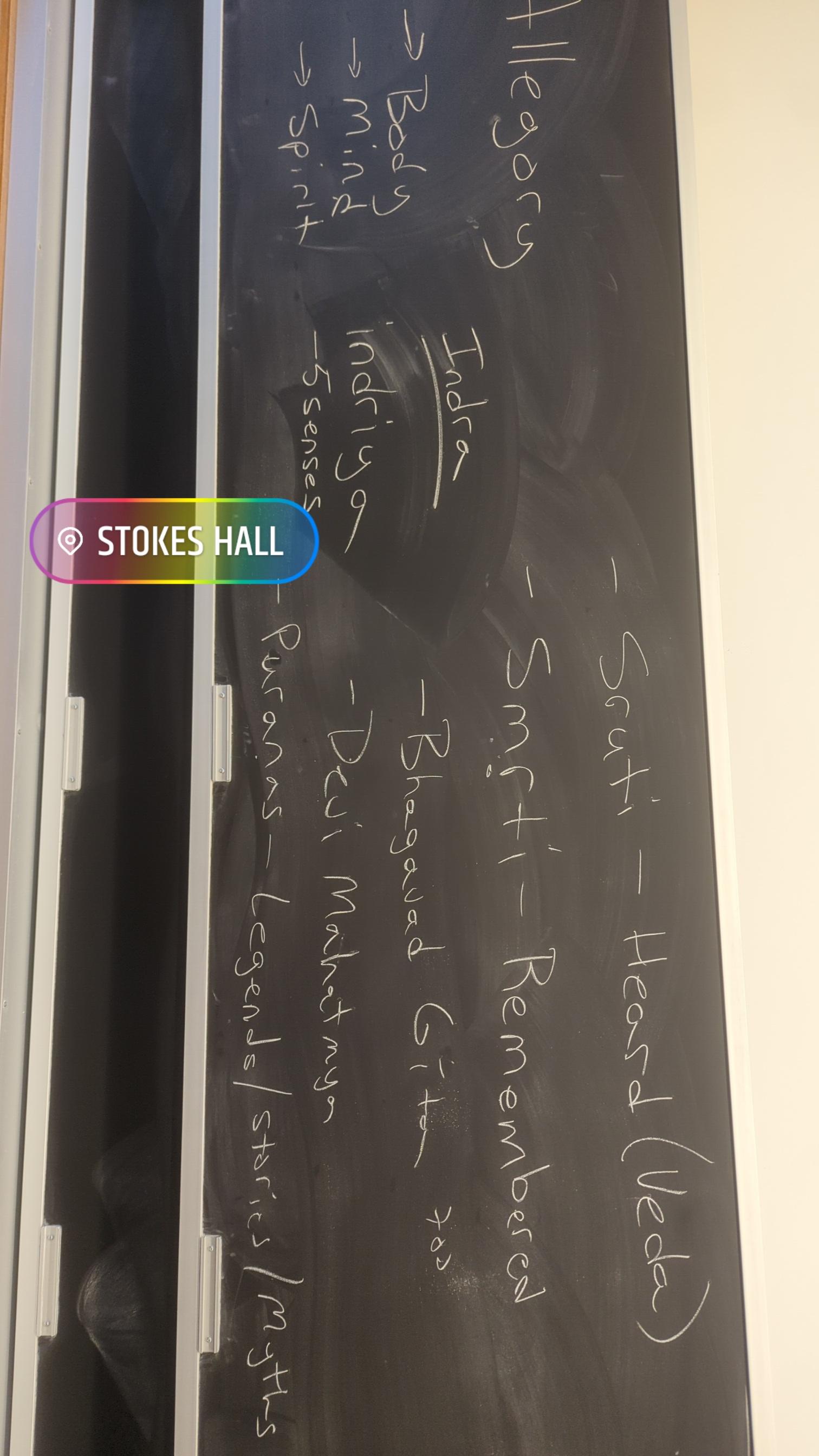
Brad: That which is heard. That which is heard. Yeah. Shruti means that which is heard. And it refers to the to the Vedas. That may be where you got confused because the word Veda means that which is known. So Veda is that which is known. How is it known? Because it was heard. How was it heard? It was heard directly by the sages long ago that heard it, right? So when you're hearing it, you're not hearing something that was written by a human, you're hearing something that was heard by a human and then passed along, right? So this is the highest level of scripture. Well, scripture isn't the right word, right? Because scripture means written down. But you know what I mean? Sacred, sacred canon. Then the next most sacred is called Smriti. Smriti is, Smriti means that which is remembered. So not quite as sacred, right? Because that which is heard is directly heard, first hand account, right? So like first hand accounts always more reliable than a second hand account. So first hand account is that which is heard. And then Smriti is that which is remembered. So somebody heard it, but then they're not giving us exactly what they heard, but they're giving us what they remember. is the idea, right? And in this group of texts, we've got lots of different things, but most notably the Bhagavad Gita, which we'll study again, at the end of this semester, last month of the semester. And then you've got other
Brad: So a lot of well Shaktas would tend to put the Devi Mahatmyam here too. You also have other other categories of texts, the Itihasa, which you don't have to worry about right now, and the Puranas. So the Puranas are these stories, yeah, myths, mythical stories. That sort of thing, right? Legends and that kind of stuff. So, when you move out of the realm of Shruti, then different different Hindus will categorize texts that aren't in Shruti in different ways. Meaning, if you're a Vaishnava study, you know, the the third that are devoted to Vishnu, then they'll definitely regard the Bhagavad Gita as Smriti, but maybe not the Devi Mahatmyam, right? And if you're a Shakta, then then you're more likely to put the Devi Mahatmyam in Smriti, but anyway, you get the kind of gist, right? It's a sacred text, but not as sacred as the Veda. This is if you're looking for the simplified version.
Brad: So this text is part of the Markandeya Purana. So it's a small section of it. And as it says there, so dated sometime around the fifth or sixth century CE. I think again, we might take a lot of the stories that are in the Devi Mahatmyam as much older, probably handed down, you know, but then probably collected by one person into the form that we have now, into this one poem. So taking these three, primarily these three episodes, three accounts, you read two of the three accounts for today. Taking these three stories and putting them all into one cohesive poem. And as you heard, it's in Anushtubh meter. So it has has a particular rhythm and cadence, right? The syllabic structure, that sort of thing. Like your like the learning objectives for the semester written in the written in the just reminder, no screens here. in the syllabus, right? So the key themes, yeah,
Brad: Let's jump to the to number four. So beginning of the text. So the beginning of the text, which I I didn't give you because it was already too much, I think. It was already too much, but I just if I had more time, I would have given you less. But this was all I had time to give you. Sorry about that. So in the beginning of the text, we've got this these three characters. Which are mentioned there in your in your handout. So Surata, the first one, Surata, Samadhi and Medas. So these are the names of these different characters, but these are also important philosophical words. So already from the naming of these from these characters, we get the sense this is not a story, this is not a history, this is this is theology, right? This is a this is an allegory. So we're supposed to interpret it allegorically and understand it on multiple different levels. What is an allegory?
Brad: We assume too much there. Anybody? Yeah, Jack. I think the first thing I think of like the allegory of the cave, so maybe it's like a deeper meaning from the story that's told.
Brad: Yeah, absolutely. Great. Others?
Student 3: Is it like a symbolic story?
Brad: Yep. So it's a it's a story that's intended to teach and it's a story that's layered with lots of symbolism, right? And usually those symbolisms have deep philosophical sometimes, you know, often like the allegory of the cave, you know, certainly lots of social political allegories as well. Which you have some of that in here, but this is more personal, right? So this sort of personal philosophical, theological journey within. And so these three characters, so the first one is Surata. Surata, Su means good and Rata means chariot. The the image here, you have this in Plato, you have this in many different traditions around the world, but the, the body, the human person is compared to a chariot, right? With the the body being the chariot and the driver of the chariot being the charioteer, right? So like your intellect, your will, the again, the force that drives you, the force that makes your body, right? If I were to drop dead right here, right now,
Brad: what would you do to Shar? Would you wait until like the end of class to leave or would you be like, I should better sit here in case somebody?
Student 4: Just sit here.
Brad: Just sit there. Yeah. I had a professor that that passed out during class. It was super she didn't totally try she didn't actually pass out. She just collapsed on the floor. She had like a microphone. It was a big lecture hall. She was doing she was giving a lecture on Hindu Temple agriculture Hindu Temple architecture. Easy for me to say. And she was like going through her slides and all of a sudden she started like wobbling like this and like randomly scrolling through her slides and then she like hit the deck. And she's like sprawled out on the floor below the lecturn and she just kept talking. She was like on the floor and she's like, I'm fine. And she kept actually talking about Hindu Temple architecture. One of the other I ran down, I'm like holding her, like caressing her, like holding. Super weird. And while she's like still talking to the class, you know, other teaching fellow comes up and she's like, what should I do? And I'm like, well, I'm doing this, you know, why don't you like go get help or something. So she went to get help and paramedics came and by the time the paramedics got there, which was like four minutes or five minutes, Diana was back at the podium continuing her lecture on Hindu Temple architecture. And she told the the paramedics, she's like, just give me a minute. I'm almost done. She got five minutes left in class. I'm going to use it. It's kind of dope. Anyway, she was only in the hospital a few days. Surata means the chariot, right? So the the one who drives the chariot well, meaning somebody who's in good control of their body, right? So, like I said, Socrates uses this example also, this metaphor or allegory, in the Phaedrus dialogue as well. But, you know, just because so you've got desires, right? Especially desires for food and sex and sleep and, you know, physical desires. And sometimes your intellect is telling you, hey, do this, but then your body is telling you, oh, but I really want to do this other thing, right? Like, I really should eat a salad, but I'd much rather, you know, smoke a salad or something like that. So like those those competing, right, horse, like a chariot has horses, right? So like these horses, some horses are going that way, some horses are going this way. The charioteer is trying to control the horses, right? So Surata means somebody who's in control of his chariot, right? Who has control over his impulses, impulse control would be another way for saying it. Samadhi is almost the the other pole. Samadhi is, Samadhi is like the highest form of meditation, highest form of awareness. So it's like an intellectual enlightenment has nothing really whatsoever to do with the with the body. And then Medas means intellect. So you've got kind of these, you could take them, I don't know, if you remember back to the very first day of class, I sat on the table and I did a mantra, chanted the Sahana Vavatu, Sahana Bhunaktu, Sahaviyam Karavahe. And then at the end of that, I talked about the Shanti mantra, Shanti, Shanti, Shanti. And the human person in the Hindu tradition has these three, three aspects to being a human person, right? You have the physical body, you have your mind, right? But then you also got like spirit, something like that, right? So, will, desires, spirit, those sort of things. So you've got those three represented here, right? Surata, person who's control of their body, Samadhi, really maybe somebody who's more spiritually, spiritually enlightened. And then Medas, that sort of more intellectual, intellect, sort of thing.
Brad: Sorry, I'm feeling off center, so I'm going to center myself. Literally. Alright. So basically, Surata and this merchant, they're feeling a little bit disconnected or whatever and they go to Medas ask intellect saying, you know, can you sort of like give us some guidance and that kind of stuff. And then his response is to tell the Devi Mahatmyam, right? So the Devi Mahatmyam is this is told by the intellect to the spirit and body, right? So we've got this allegory set up between these three.
Brad: And then what we find are three three main episodes. Two that you read and one that you didn't. And the way many Hindu the most Hindu theologians interpret this is in terms of Thomas, well, I don't need to write it down. It's right there. Tamas, Rajas and Satva, Satva. We'll learn about these three also in the Gita. We've got lots and lots of chapters about these three in the Bhagavad Gita. They have very similar structures and similar content in many ways. And Thomas means like darkness, you could also be sort of like passions, desires, those sort of things. Rajas is sort of selfishness, materialism, that sort of thing. And Satva is more like being being enlightened or something like that, being, right? It's the highest purest form. Sat means to be and tvam means is a abstract form. So beingness or like being, just being, right? Beingness or something like that. The idea is that, you've got these three, I mean one way to take it then is these these three stories kind of outline this progression of ego, right? First sort of understanding yourself as an individual, right? As a, right? Shawn is not Ally and so giving yourself like this this is who I am sort of thing. That's what we mean by ego. Somebody unique, somebody who stands out, somebody who's not like everybody else, right? Somebody who's unique and particular, the most particular is the most universal, that sort of thing. But then you can go too far in your individuality, right? In your isolationist and then the desire to be oneself, right? If Shay's just like, I want to be Shay. But then if Shay accomplishes this sense of like being fully Shay, then maybe she then becomes selfish and starts like selfish and materialistic and like consuming interested in consumption and power and those sort of things. So then, right, you can see how that's sort of like a a trajectory, right? So you want to be autonomous and individual, but not you want to the idea would be to understand the equality of all beings, right? So Tashar is not less important than anybody else, but also like Tashar is not like the most important, right? So like you want to be that's the idea, right? So the first move is to kind of give you a sense of like, hey, you're unique, you stand out, you're somebody individual, and then, hey, but you're not too. We'll see this again. This is a major theme running throughout all of Indian philosophy. And then the third is more in terms of the divine to understand oneself as not separate from the divine, but an embodiment, a unique embodiment of the divine. So trying to break down those barriers between self and divine. That's just the foreshadowing. We'll we'll we'll dive into that way more deeply as the semester unfolds.
Brad: I already talked about Anushtubh meter. So the just as we saw right, that's one of your learning objectives, is Sangha Vistara, collecting things together, right? pulling things together in these sort of like aphorisms, these small little like condensed forms of proverbs or axioms, right? sort of thing. And then an unfolding or a vistara sort of explanation of that. This is another major theme running throughout the course and running throughout so yeah.
Brad: All right, let's enough of all this. Let's let's dive into the story. So what is the so we're going to focus first on the Mahishasura episode. So what is what is the story? As you were able to Grant I I understand that this is the first time you've ever read anything like this. It's completely out of context, completely like, what is going on? And this is super foreign. And I told you explicitly not to look up any context or any sort of outside reading, right? So, so what as you were able to get from the reading assignment, what's the basic story line? What's the story here? The story of Mahesha? What yeah, Ally.
Student 3: There was a war between the gods and the Asuras.
Brad: Yeah, Asura means demon or bad just take it as bad guy, right? So the the Sura is another name for gods and Asura is like the opposite, right? So the gods and the demons is perfectly fine. Yep, so there's this war between them.
Student 3: All the gods were cast out from heaven.
Brad: Yep.
Student 3: And then I think they went to other gods like Indra and Siva.
Brad: Yes.
Student 3: And they all came together and parts of them formed the Devi who then tried to defeat the bad army. That's what I gathered.
Brad: No, that was perfect. That was great. That was excellent. So, a lot of really important things in in that. One is
Brad: OCD, I just don't like. Anybody studied Derrida? Like the Derridean trace?
Brad: Derrida has this whole thing about the indelible mark of knowledge that even when you forget something, it's always like there in your biases and it's this shadow. Every time I look at a board that's not been properly erased, I think of Derrida's indelible trace because I'm a nerd. Indra. So, Indra is a, Indra is a super important God. I've talked about Indra before. Indra is very similar in terms of like if you're familiar with Zeus, there's a lot of commonalities between the two of them. They, I think pretty much all scholars regard them as like coming from some Uber myth or some original, you know, they were originally sort of the same. So, Indra is the God of thunder and lightning and weather and he lives in the clouds and all that kind of stuff. He has a, he has his chariot is not driven by horses but by elephants. So, you know, he makes a lot of noise when he's like storming across the sky, whatever. Why spend so much time on Indra? So Indra is the king of the gods, the leader of the gods, right? So, as Ali said like, all the gods are cast out including Indra. But reading allegorically, Indra is not just the like mythical God of the heavens and all those kind of things. But also we get this word Indriya. Indriya means the the five senses, right? So seeing, hearing, tasting, touching, smelling, right? So, we can see here maybe a little bit of a parallel between the Surata, the chariot driver, right? And Indra is sort of the God of the senses. So, in other words, like you've got a, you know, sometimes you're just like, I don't know if Amber sees some muffin or something she really want to eat, right? And it's like your mouth starts to water and you're like, I want to eat this thing, right? That's your senses talking, but sometimes you have to restrain yourself, right? And not do that. So Indra is the God of the senses. So he again, he's like Surata, he's like in control of himself, right? Impulse control, all that kind of stuff. Good. And as Ally said, so you've got the gods are cast out by the Asuras. By the way, there's another super common trope I should throw in here. We'll see this over and over and over again. It comes over and over and over again in the Devi Mahatmyam. It's like the most common trope in all of Hindu mythology. It's not universal, of course, nothing is, but it's super common. And here's the trope, you know, like the pattern or whatever, right? You've got somebody does something wicked cool, right? Becca goes and she like feeds the hungry or something, right? And everybody's like, whoa, Becca's like doing cool shit, right? She's doing good things. She's helping the world. She's benefiting the world. She's a good person. She's doing good stuff. Then the gods look at look at Becca favorably and they're like, hey, you know, let's empower Becca. Let's give Becca more power, right? She's using her power for good. So let's elevate her so she can do more good, right? And then Becca starts doing more and more good, right? With this new power. And the gods see that and they're like, whoa, Becca's doing even more good shit with the power that we gave her, right? So let's give Becca even more power. And then, it goes on and on and on until all of a sudden, it's like a switch flips and then Becca is like, well, you know, look at all this power I got, you know, I'm kind of the shit now, right? I don't have to I don't have to listen to anybody, right? I don't have to do anything for anybody. I've got I've got all the power now, right? So then this idea that power corrupts, right? And so more power corrupts more. And so this is the this is the trope. Sages or people do something good, gods give them power. They do more good, they get more power. They do more good, they get more power. Then all of a sudden something flips and then they get corrupted by that power. And then all the gods are like, oh, snap, right? Like, what do we do now? Cuz we gave Becca all this power and now Becca's like destroying everything, right? So what do we do? And so all the gods get together, exactly as Ally said, and they they pull their power, Shakti, right? So power is what moves everything, right? So Indra has powers, and the idea is that Indra takes his power and just kind of like, I don't know, exports it, right? And then if all the gods, all the gods just sort of pile up, it's it's kind of a weird visual, right? If you just took all of your power and just put it together, condense it, and see what comes out. And what came out was Durga, right? So Durga, Durga meaning bad and ga meaning go. So, I don't know if heard people, I was listening to Swami Hari Namananda this morning. So scholar talking about it and said Durga means when the going gets bad, you know, or like she's who you go with when the going gets bad. I don't know. That seems like a weird. I feel like she makes bad stuff go away, right? So when bad stuff going goes on, then Durga shows up. As here. And so they all put their power together and Durga is what comes out, right? And she starts killing this guy, Mahisha, Mahisha Asura. So Asura meaning the demon and Mahisha meaning well that's his name, but Mahisha also means buffalo. So he's like the buffalo demon. The one that we saw in the iconography a moment ago.
Brad: Good. Anybody else? Let's why don't we look at a little bit of the passages? Yeah. So anybody have a verse to pick out from actually anywhere in chapter two? Verse or a little section that you had any questions about or that stuck out to you or that something you can read?
Brad: Yeah, Tashar.
Student 4: Is it something that's like opposite of violence in chapter two? If you look at like 2.16. It's like her feet took the shape of Brahma's legs and her toes from Surya's brilliance. So it's like you can see like creation like happening in front of your eyes and it's like it feels wholesome in a sense. It's like it's like when you like when you have a kid, you're giving the best parts of well hopefully the best parts of yourself to the child. So it's like I don't know, it makes creation seem beautiful.
Brad: Word, very nice. Yeah, cool. I can dig it. Good. Yeah, read.
Student 5: I had a question some kind of about like the trope you were talking about earlier? Yeah. like the how power is like corrupting. Was that more about like the like Mahishasura? Yeah. Okay. Because then I felt like with the like Devi being created too, it could almost be the same kind of thing where like Yeah. especially at the end you see her like they like are all yelling stop, stop. Yes. She doesn't stop.
Brad: Yes. Can you point us to a verse there? Yeah, 64.
Student 5: 64 she stopped stopped and then like 68 she's prowled about in the circle of life breath. Mhm. still hunting kind of is the description.
Brad: Yeah. Yeah. So, this is another trope that we see particularly in the Shakta traditions. Is that power so on the one hand, Devi is is power. It's not just that she's powerful. She is power. Like all power is her, right? The power that's enabling me to speak right now is Devi, right? So it's not that she's just powerful, but she is pure power. But pure power is something that can, you know, go crazy, can go wild, it can get it can get out of control, right? And so, so this is a a common theme that we see, yeah, throughout any of the most of the Shakta literature and particularly, we see that in here and we'll see it again in the next in the next story too with Raktabija. Any other things on this? I want to I definitely want to get to Raktabija because it's a cool story. But what about chapter three? So we have then the, you know, this sort of what chapter three? Why did I give you chapter three? Anybody have anything from chapter three to point out or that you want to draw attention to?
Brad: Yeah, Ally.
Student 3: I thought the lion keeps coming up. Yes. like it's mounted on it. like what is the lion?
Brad: Yes, good question. So, I'm gonna switch hats again and be a religion professor for a quick second. So all of the, most all of the Hindu Pantheon, you have men, you have women and children. And almost all of them, maybe all of them, have a what's called a Vahana. Vahana is just a a vehicle, a mode of transport, right? a vehicle. And, they all have one. Ganesha has a mouse, which is his transport. And Durga has a lion. So, so yeah, so her, yeah, everybody has a everybody yeah, and they mostly, most of the men and women are also paired up. So they usually have a consort and, you know, a couple of pets, I guess you could say, right? And, so her her symbol is the is the lion. So wearing the religion scholar hat for a second. So there are, there are historians, like religious historians who have a theory. It's a little bit controversial, but there's, you know, more than a little evidence to support it that, when, so India, you know, looks like that or something. You've got like the Indo- Europeans, what's called the Indo- European, they're called they're called Aryans actually. Came into the the Indian peninsula and there were already people there, right? And so the people that were there, especially down here, you have Dravidian people. And we know that because they have totally their languages developed completely independently of one another, right? You got a lot of languages that kind of grow out of one another. And then you've got other languages that developed completely independently, right? So like Chinese has nothing in common with Latin, right? Sanskrit has nothing in common with Dravidian languages. So you've got these Dravidian languages which historians say, well, there's people already that were there in India when then the people who spoke Sanskrit came came in from the north, right? And the idea is that the people that came in from the north, these Aryan folks, the the Sanskrit tradition. So Sanskrit actually shares a whole lot in common with Greek. So Greek and most, I think all linguists, all, you know, language scholars pretty much agree that Sanskrit and Greek came from a common language, right? They have very similar grammatical structures, they have some, they have more than a few cognates, you know, like same vocabulary between them. Like we've talked about Sangha, like grasping, right? So we get those some of those, they carry on even into English. The idea is that, I mean, according to these scholars, you had two kinds of people that were already in India. The Dravidians who were primarily Shakta tradition. So they worshiped the they worshiped God in female form, right? And so you've got all these female deities like the ones in the Devi Mahatmyam, right? So tons and tons, not just one, but you know, you've got Durga and you've got Kali and you've got, I mean, those are the two we're talking about today. Lots of other names for her, lots of other forms of her. Some of the ones that I showed in the thing, right? So those were like the Dravidian folks. But then there were also what are called Adivasis or or what you'd call more I don't even know what this term means anymore, but like indigenous people, like people who have been living in the more more traditional sort of folks that live Adivasi means forest dweller, people live in the forest, people live, right? And they tended to worship God in animal form, right? At least this is the this is one common historical religious history perspective. So, and then you've got these Indo-European Sanskrit people who worship God primarily in masculine form, right? So you've got, what happens is usually throughout human history, when one group of people, you know, comes into a land where there are already people there, you know, like America or something, they just kill them all or, you know, or at least try to convert them into their culture, right? You don't typically have a a true melding of these two cultures and religions and beliefs. That's not super common, you know, around the world. But, at least this is very common view of exactly what happened in India, you know, a couple of thousand years ago, 3,000, 4,000 years ago. So you've got these sort of Sanskrit tradition that worships God as male. You've got the Dravidian that worships God as female, and you've got the Adivasis who worship God as these animal in lots of different animal forms. And then what happens is they don't conflict with one another, they don't try to convert one another, but instead they syncretize, right? And they're like, hey, you know, this feminine form that you've got, we've got a male counterpart and they just, you know, they get married basically. And then, hey, you've got this animal. Well, that animal goes with this, right? So they just kind of do all these little groupings. I don't I'm not a religion scholar or religion definitely not a history scholar. So I don't know how well that theory has stood up over time, but, I don't know, it's a compelling story, I think. Seems to fit the facts. Good. That was a long answer too. Very good question. Any other questions or comments?
Brad: We've got like four minutes left, don't we? Well, snap. Okay, so Raktabija. Anybody want to tell the Raktabija story like super fast? Who's Raktabija? What'd you get from from reading it? This is like the dopest of dope stories, I think. Anybody, any brave souls want to give it a shot?
Brad: So you've got another bad guy. Bad guy's name is Raktabija. Rakta means blood and Bija means seed. And so every time you cut him, what happens?
Student 4: More Asuras.
Brad: Yeah, as soon as like a drop of blood hits, it just like. I mean, come on, that would be a dope like Marvel, you know, villain or something, right? It's pretty dope villain. So yeah, so drop of blood falls and he pops up another one. Yep. No. Yeah. Any other? So, how do you defeat this guy? Yeah.
Student 4: I was going to say like Kali and Durga like team up and then Kali drinks the blood before it touches the ground. Yes. So it doesn't create like make more of himself. Yeah. So that they can defeat him.
Brad: Exactly, right. So she, I mean, how could we interpret this allegorically? Maybe that's a question that we really don't have time for right now, but I'll toss it out there. you can at least think about it. Right? So, so Raktabija, when he's cut, he pops up more. And so Kali's answer to that is, well, I'll just drink the blood, right? Downside is she gets increasingly intoxicated. and as she gets intoxicated, she gets increasingly angry and reckless and threatens to destroy the whole the whole world. And then what happens? Is that in there?
Brad: While Kali avidly lapped up his blood, Raktabija turned to Chandika with his club. But with his cudgel blows caused her not even the slightest pain. Okay, it's not even in there. So what happens is, she becomes increasingly intoxicated, increasingly angry, increasingly reckless, all that kind of stuff. And then she destroys Raktabija. There's no more Raktabija left. She's killed him, she's drank all of his blood. But she's like, then the other gods are like, oh, snap, right? Like like we killed the bad guy and now the the Devi is like going to destroy everything, right? And so, we've got the the image that I showed at the beginning of, Kali dancing on the corpse of Shiva's body. That that happens right after this. So, she she loses control and then Shiva goes and he's like, I'm gonna just I'm gonna go try and chill her out, right? And he goes up and he's like, hey babe, you know, chill out. And she strikes him dead and starts dancing on his body. And as she's dancing on his lifeless body, she kind of looks down and sees him and then seeing his inert body causes her to calm down and then she then as she calms down, her Shakti then dissipates and starts going back to and re-enliven, right? So in the same way that all the gods put their one Shakti together, the Shakti can go back and disperse again through all the many. So,
Brad: lots more to say about all that, but we're out of time. I will see you on Thursday.
Brad: It was a little disjointed, but we got a lot done, yeah?