 ```html
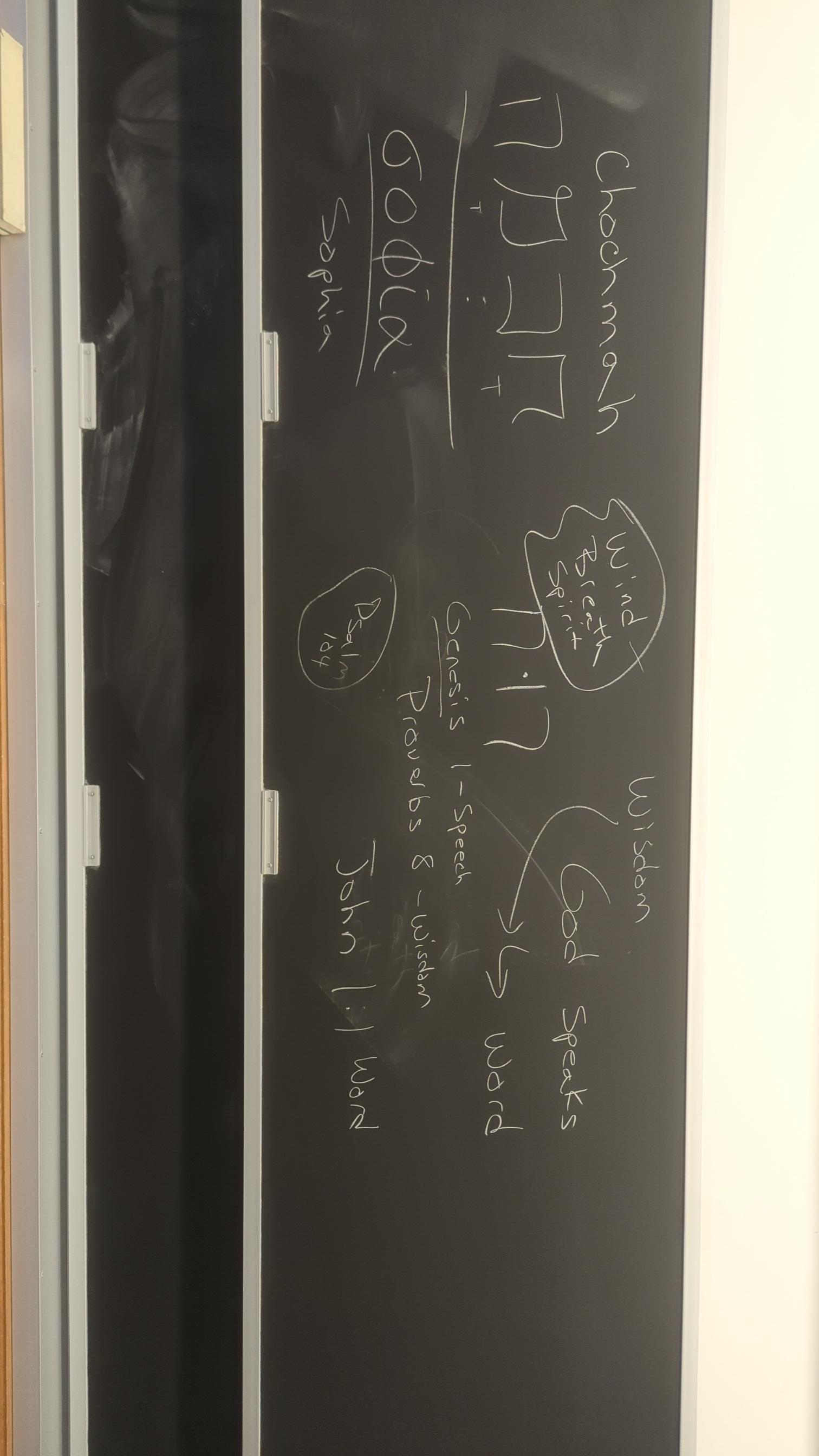
This class session centered on analyzing Proverbs chapters 8 and 9, focusing on the personification of Wisdom (Ḥokmāh/Sophia). The discussion began with students sharing observations from small group work, highlighting the stark contrast between the exalted feminine Wisdom in Proverbs 8 and the negative portrayal of the "stupid woman" in Proverbs 9. Students noted the tension between Proverbs' celebration of wisdom and Genesis 3's depiction of acquiring knowledge (of good and evil) leading to negative consequences. The concept of Wisdom existing before creation (Proverbs 8:22ff) was explored, positioning it as a potential "prequel" to Genesis 1. The meaning of "the fear of the Lord" as the beginning of wisdom was debated, with interpretations ranging from literal fear to awe and reverence. Brad guided the discussion towards connections with Genesis 1-3, the role of the divine Word (Logos) in creation, and comparisons with the older Mesopotamian creation myth, *Enūma Eliš*. They emphasized the significance of the Greek translation (Sophia) for early Gentile Christians and the Hebrew concept of *Rūaḥ* (spirit/wind/breath) in the creation accounts.
Brad: Okay. Anybody want to get us started? Anything you want to draw attention to? George?
Student 1: Yeah, one of the, I think biggest differences between the two proverbs that we noticed was in Proverbs 8, it talks about women as this wisdom figure and how like everything she says is just, is right. And then in Proverbs 9 towards the end, it says, the stupid woman bustles about, she is simple and knows nothing. Yeah. So we were just wondering how can we go from holding women in such high regard as wisdom to like that stark contrast in Proverbs 9?
Brad: Yeah. And the language that's used there is pretty harsh too, right? I mean it sounds harsh. Yeah. And so you've got this on the one hand it's super, you know, feminine text, but then when an actual woman comes in, they're not Yeah, you got a great point. Yeah, Ella?
Student 2: And to add on to that, the shift sort of seemed like it was like the wisdom was made to give to men. Like that's the sort of vibe I was getting from Proverbs 9 as opposed to like Proverbs 8 just establishing wisdom as like this feminine figure, but then towards the end of or the middle towards the end of Proverbs 9 talking about starting at like 8, like do not reprove a scoffer for he will hate you, reprove a wise man and he will love you. Like that language sort of shifted the meaning for me.
Brad: Mhm. Mhm. Yep, good. Hear that. Yep. Yep. Fine you.
Student 3: Wisdom was like presented more superior to like wealth. Mhm. So that it stands out like it was more important, wisdom is more important than any materialistic wealth.
Brad: Mhm. Yep. Good. But then there's also seems to be like a almost the opposite seems to also be said, right? That's like wisdom is definitely better than all these material treasures, but if you are wise, then you kind of get material pleasure treasures. So, yeah, yeah. Justin.
Student 4: We found it interesting that they personified wisdom as a woman, especially considering like in Genesis, you have wisdom being the apple and then being taken by Eve. Mhm. So we found that that kind of that kind of correlation interesting. But also just it was a little strange that they personify wisdom as good here. Like wisdom is something that you should have and it's good to have and humanity should should follow wisdom. And yet when Eve takes the apple, she is punished by God for that. So it's you've gone from and the apple symbolizes wisdom. So you've gone from wisdom bad, you're going to be punished for having it to actually you should follow wisdom. You should you should be wise. I find that we found that to be a little hypocritical/ interesting.
Brad: Right. Yeah, good. got it. Yep. Yep. Remind me your name, I'm sorry.
Student 5: Jaden.
Brad: Jaden?
Student 5: Yeah. I think it's interesting how you have like the source kind of describing wisdom as being like the, you know, this overall focus, but when they kind of switch talking about how he set the heavens, he fixed the horizon and there's like an active part about like the he as well, like doing things. But then at the end, we like kind of circle back to it says, but he who misses me, injures himself, all who hate me love death. And I thought it was just an interesting circle of like gender switching roles. Mhm. And I guess maybe like the power that's being played because it seems to be distributed kind of both ways and differently throughout.
Brad: Yep, good. Good observation. Yep, Jack.
Student 6: I think it's interesting that like it says that wisdom was his first work. Mhm. Meaning like when we read Genesis, that's just not said at all. Uh-huh.
Brad: So we got a little bit of a prequel here, maybe? Yeah. So, yeah. Good. Yep.
Student 7: I had a question. I don't What is a scoffer?
Brad: Yeah, I'm not sure. I mean, I think a scoffer is I think of somebody's kind of like, like a almost like a homeless kind of person, right? That's just sort of like, just kind of like scraping by something? Is that right? Is that what other people think of? Scoffer? Yeah. but definitely not just somebody who's sort of like a vagabond sort of like scraping by sort of thing. Yeah.
Student 8: Yeah. Yeah. Oh, we were curious about the seven pillars as well. Wisdom has built her house, she has hewn her seven pillars, but we don't we had no idea what the seven pillars were. So we were curious about that.
Brad: Good. I have no insights on that. Yeah, I'm not a Hebrew scholar, so but but good observation. Yeah, I don't know what it means either. Anybody have an idea what it might mean? Seven pillars? No, no. Yeah.
Student 9: Is that just the seven pillars of wisdom?
Brad: What is that a thing? The seven pillars of wisdom? Is that like a?
Student 9: Yeah.
Brad: Okay.
Student 9: I don't know what they are.
Brad: Okay, all right. Yeah. No, I don't either. So, yeah, so, yeah, good. I I'll I'll do I'll do my homework and and look up the seven pillars of wisdom. Yeah, Jorge.
Student 10: That's where I stopped to talk about like because on Proverbs 8, it says how it was like grabbing God by the hand while he created creation. But like does God really need wisdom? Like will God be God if he needs wisdom?
Brad: Okay.
Student 10: That was the question we we stopped to think about but we couldn't get an answer.
Brad: Okay, yeah. Yep.
Student 11: I noticed in last or second last year in in in philosophy, we learned we have we learned about this like this unmoved mover. Uh-huh. And I assume that's what we thought of God and I kind of thought to myself like maybe wisdom is like not quite the unmoved mover, but but like one of the higher powers who's kind of like under God in a way. So I so I kind of viewed wisdom as like almost like in I guess like this like angel like figure almost who like isn't quite God but yet was there with him, yet isn't like the unmoved mover like.
Brad: Mhm. Yeah, good. So, yeah, and we definitely want to focus on that that Greek connection there for sure. Yep, Luca.
Student 13: Yeah, I thought in Proverbs 9 it was interesting how the symbolism of wisdom when it says she has prepared the feast, mixed the wine and also set the table. And after doing like after like preparing this feast, whoever like is invited or whoever shows up and actually participates in the feast then gains the benefits of wisdom.
Brad: Okay, yeah. Mhm. Yep. Good. Yep.
Student 14: Yeah, I wanted to point out the last line of Proverbs Proverbs 8. Which says that all who hate wisdom love death. Yeah. I I understood that as like if you remain like ignorant, you're destined to death. Mhm. It kind of sounds like that. So I thought that was interesting.
Brad: So connecting back to what Justin brought up a little bit earlier, it seems to be a little bit of a clash there or at least at least causes us to wait, how do we reconcile knowledge of good and evil, right? From Genesis 3, which seems like once you eat of that knowledge of good and bad, which presumably would make you more wise, right? That leads to death, whereas here, it seems like the opposite is being said, right? So, on the one hand, maybe it gets us to at least pause and consider, do we mean the same thing by knowledge and wisdom? Are wisdom and knowledge the same? And I mean, I'm not sure that that line of thinking will get us where we want to go because there's such a start contrast, right? That knowledge of right and wrong leads to death. But those who hate wisdom are also kind of drawn to death. So, yeah. Yeah, good. Yeah.
Student 15: Also that same like line made me think a lot about how if they're pushing wisdom in like such a good way, why is it almost like in a threat of if you don't choose wisdom, then you're choosing death or like I think it also said no goods can equal her. So like it's kind of has like an undertone of like kind of being threatening, which is interesting to me.
Brad: Yeah, mhm. Yep, go.
Student 12: I was wondering, I forget, what was the text we read on Tuesday?
Brad: The Rig Veda?
Student 12: Yeah, the Rig Veda. I was I wanted to point out the trembling in there, like that was a good sense of fear, like a God who's not evil, but a God who like loves you. I find it interesting connecting to this where on 12 or 13 it says the fear of the Lord is to hate evil. I find that interesting like both religions have like a good God, like a God you fear in a good way. Whereas like connecting back to what was the religion that the son killed his mother.
Brad: Yeah, Enuma Elish, yeah.
Student 12: That's an evil Lord. Like I just find it interesting that now we have this kind Lord in the sense that like gives you chances and like there to help you both religions just suppose to like some lords an evil one and
Brad: Okay. Mhm. Mhm. Jose.
Student 10: I found it interesting in line number 13 it says to fear the Lord is to hate evil. And when I read that, I one would think to fear the Lord, you should accept him or whatever. Mhm. And when I looked into the line, I thought that reverence to the Lord, when you appreciate the Lord's moral stance, which is his wisdom, you automatically deny the opposite, the opposite of that. And the second line says, I hate pride, arrogance and the evil way. So with this adaptation of wisdom and Lord's stance, you automatically reject evil and everything that it doesn't stand for, which I found it interesting, very interesting.
Brad: Mhm. Okay, yeah, good. Yep.
Student 16: I noticed that so in Proverbs 9 they were talking about how like wisdom was like going like announcing everyone to come into her house like desperately kind of like wanting like to obviously like spread wisdom to like all the people. Yeah. And I thought that that accurately represented wisdom itself because like obviously like God I feel like is saying like he wants everyone to like be educated and have wisdom and like know him and like know like the text and like so I thought that was interesting that they were using the personification to like exemplify that.
Brad: Yeah, I mean this this imagery of the banquet and like coming and feasting on wisdom and that sort of thing and that it's open to open to all. It's good. Yeah. Others? Yeah.
Student 17: I mean this is kind of like reiterating, but I kind of saw like the feast and the wine and the setting food at the table was like a foreshadowing of the last supper where like Jesus had his disciples and they mixed wine with bread and everything. But I feel like he was kind of like I think it relates to like the the line at the end of Proverbs 8, like all who hate me love death where like you know, Jesus died after the last supper and I don't know, there's like a symbol like I feel like there's kind of like similarities between the the meal with wisdom with the meal of the last supper with death and choosing Jesus side anyway.
Brad: Okay, yeah, yeah. So the the stories about the the last we will read one of those later when we get to John. And so saying that those are kind of reminiscent of this or bringing this this back. Yeah, maybe referencing in some way. Good. There's a a line verse 10, chapter 9 verse 10. The beginning of wisdom is fear of the Lord. Anybody recognize that from BC campus? The building, I can't remember the name of it. I think it starts with an L, but the the one where like you get you go for your parking pass and parking stuff.
Student 1: Lions?
Brad: Lions? Yeah. Over there, yeah, if you look at the front of Lions, they have that they have that verse there. Definitely one of my least favorite verses in the scriptures, but you know, it's it's cool. You do you. What do you think of that connection between wisdom, what wisdom and fear? Don't we think of wisdom as usually being like empowering? Yeah.
Student 4: I feel like they're equating wisdom to like a very like wisdom of the scripture, wisdom of like what would might happen to you if you're not, you know, like properly penitent, if you're not following the scripture, as opposed to being like earthly wisdom. Which I think again makes it kind of weird to put on BC campus, but it's doesn't seem to be wisdom of like earthly wisdom, it seems to be wisdom of like the Lord, wisdom of scripture, wisdom of like how to be holy, which is a different definition I think we'd use.
Brad: Okay, good. Yep.
Student 5: Well, I think it's kind of interesting though like thinking about the word fear in this context because like I think it was Gil who the other day was talking about Kierkegaard and how it's not like or like this like perception that's not necessarily like a negative thing, but actually could be like something kind of positive way of like this fear of like the almighty powerful being or something that I don't know if that's what he was saying. But I just thought it was interesting while reading and thinking about that. Maybe not because you know, wisdom does seem like inherently like positive, good thing. So then when you add this word fear onto it that we like initially will might think of as a negative word. It's just I think interesting to maybe think about, okay, how could this be intended in a different way?
Brad: Mhm. Okay, yeah, good. Yeah, Luca.
Student 13: Yeah, I think it's also referring to the fact that that those who are wise would fear the Lord because they would be wise enough to acknowledge and have knowledge of like the Lord's power and his his just overall like power and greatness that they would fear him because they know of his capabilities.
Brad: Mhm. Okay, good. Yeah, Georgia.
Student 18: Yeah, I was going to say, I was going to say that I I was thinking of it more as like awe than necessarily fear. Okay. And I think like I guess or even if you define it as like fear in a normal sense, I was thinking of it as like like it would like spark fear in your like unknowing and then that would change your desire to like want to learn more of whatever they're trying to define wisdom as, which I honestly unsure about, but
Brad: Yeah, yeah. So that's a really that's a really interesting insight. Yeah, good. Yeah.
Student 4: Yeah, just to Justin's point, it's interesting in the Bible like I was learning in my other class I took last semester there's almost like two types of fear. Like we read the book of David which is around this time and or two types of wisdom, my bad. And like one type is like kind of earthly wisdom and the other type is like, you know, divine. There's one guy Jonadab who's like, you know, earthly wisdom, but he's like a really bad guy. So it's just interesting to see the contrast between the two.
Brad: Okay, yeah, good. Others? Yep.
Student 19: Going back to the fear point, I I like what you were saying about like the awe because like in Proverbs 8 on line 35, it says like for he who finds me finds life and obtains favor from the Lord. Mhm. And I feel like that kind of goes back to the point where it's like fear doesn't necessarily have to mean like a bad outcome, but it's more of like a process that could like get you somewhere good or into knowing.
Brad: Okay, yeah. Mhm. Good. Yeah.
Student 20: I also think talking about fear to what how we were talking about the apple before, know how when they ate the apple, they started getting it wasn't like fear but they were like ashamed of things that they weren't before like being naked and stuff. I feel like that fear is just not being like being in a completely different mindset at that time. So everything you felt like you're not feeling anymore. So it's that fear to the new like you're discovering new things and having a wisdom that you previously were like not know full of. So I think it's that kind of fear.
Brad: Good. Yeah, Molly.
Student 21: I kind of thought of it in a similar way of like exploring the unknown is scary and like that was the fear because you're beginning to like walk into something you don't entirely understand.
Brad: Mhm. Mhm. Good. Yep.
Student 22: Kind of going off of that too is in Proverbs 9, the 10th line, it says, and knowledge of the Holy one is understanding. So I think that adds like at first it is kind of scary or it could be like it just seems like a lot, but as you learn more, you could understand it a bit better.
Brad: Yeah, okay, good. Yep. Ella.
Student 2: I kind of thought of it as like a natural like human reaction almost because like I feel like if I don't like everyone says like oh like ignorance is bliss and like I feel like it's very natural with more knowledge to come fear and it's more like about like addressing that as opposed to the fear itself.
Brad: Okay. Good. Okay, good. Good. I think we're off to a great start.
Brad: Let's what I'd like you to do is is chat again with your with your neighbors. But this time I kind of want you to hunt. I really want you to like, you know, peruse the text and and be on the hunt. But let's try and find verses from chapter 8 and chapter 9, that seem to directly and some way or or, you know, directly or indirectly seem to be calling Genesis 1, 2 and 3 to mind, right? So some in some way echoing it or being in dialogue with it or just look for connections that you might see between those three.
[Small group discussion time - not transcribed]
Brad: Okay. What'd you notice? Yeah, okay, you start. Hold on. All right, let's come Let's Let's come sit. Remind me of your name?
Student 5: Jaden.
Brad: Jaden? No.
Student 4: Cameron.
Brad: Cameron. Cameron. Cameron. Okay. Yep. Okay, let's let's listen to Cameron.
Student 4: I was going to say from lines Proverbs 8 lines 22 to 30 kind of mirrors like the whole Genesis 1 basically. Mhm. Like how like God created the world each day. Like God created the world each day.
Brad: Yeah, so I mean some some clear direct parallels there, right? Even the order and everything. Yeah, good. Yep.
Student 16: Proverbs 8 verse 31. It says rejoicing in his inhabited world, finding delight with humankind. That kind of made me think of the like he saw it was good repetition. Uh-huh. Like finding joy in it.
Brad: Yeah, that's that's that seems on point for sure. Yep. Yep. Jose.
Student 10: I think in Proverbs 8 line 27 when it says I was there when set the heavens. I think this starts the explanation of the parallel between Genesis Genesis 1 and 2. And it basically recounts wisdom as God's companion in shaping the universe and how one you have to have both of them at the same time in order to create the universe with wisdom and God's intention. You're like these are interconnected and you can't have one without the other.
Brad: Okay, yeah. So wait, what are the two that you can't have without? So you can't have and God's creation. So, I mean the wisdom kind of comes first, right? I mean, you can't have creation unless there's like a wisdom that's behind that. created the world and the world as we know it as explained in Genesis 1 and 2 with his wisdom that he acquired and learned and shared in both Genesis.
Brad: Okay, yeah, good. Yep, Alonso.
Student 20: Yeah, good quote to back up Jose's point also is in 22 when it says, the Lord created me at the beginning of his work as the first of his works of old. I feel like that's a good quote that like says like I came before. So I don't know who mentioned before that they didn't know who came before, but I feel like that like sets it really clear that it was like Lord who came before and then created something to guide him through the process. So just following point.
Brad: Yeah. But good, but as Jack pointed out, I mean it's it's a prequel, right? So I mean like it's that part isn't in Genesis 1, but it's clearly saying, hey, you know Genesis 1, like this happened before, right? Yeah. Mhm.
Student 4: To put off Jose's point. Sorry. Put off Jose's point. I do find it interesting that wisdom was there and was involved with all this, but humanity didn't receive wisdom until, you know, Adam or until Eve took the apple. So it's kind of like isn't has been a part of God's creation the entire time but was like consciously omitted from humanity even though humanity is is in God's image. So I find I find that interesting. I would be curious to, you know, hear more about that.
Brad: I mean, we're still we're still I think noticing some some tension there, right? Between what you're pointing to I think again is that there's some tension between wisdom is clearly like a great thing here, right? But knowledge doesn't seem, I mean knowledge is definitely not celebrated in Genesis 3, right? Seems to be Yeah, good. Yeah, Megan.
Student 11: Yeah. And also I know in Genesis 1, God pretty much speaks things into into creation and and I feel like here like there's lots of different pretty much verses that that quickly says like my cry is to all mankind and then in 8 verse 7 it says my my mouth utters the truth. So I feel like we hear lots of language of basically wisdom spreading throughout word just like how like God like created like life with word and I feel like that's another parallel.
Brad: Right. That is such a perfect segue. And thank you so much. Those are all those really important points. And I was basically going to repeat a lot of what what Reagan just said, which is that so yeah, Reagan like pulled the jackpot on that one. So so yeah, so just to just to emphasize the point, right? So how does creation happen in Genesis 1? Word. Yeah, word. So, God right, God speaks and and things happen, right? So God speaks creation into being. But and so God speaks and what God speaks eventually, although we don't get the word word in Genesis. But we do have clearly God speaks, right? God speaks and what and when God speaks, then what God speaks happens, right? Comes into being. But as Reagan's pointing out, I mean so you got to speak a word, right? And there needs to be some sort of prior to that, I mean, hopefully before you speak words, you give some thought, right? And so that thinking, that sort of wisdom that comes before you know, so God is speaking the wisdom that then comes out as word, right? So, one of the one of the ways I've laid out this semester, we're leading towards the final month of the semester. It seems obvious. But the final month of the semester, we're going to be reading the fourth gospel. And so the fourth gospel begins so John John 1, John 1 verse one, in [arkhē] ēn ho Logos, uh in the beginning was the word. Kai ho Logos ēn pros ton Theon kai Theos ēn ho Logos. So in the beginning was the Logos, the word. and right, so here we've got Proverbs 8 89, I don't just mean eight, right? but the whole section. Emphasizing that the the wisdom of creation and there's a clear connection there with the with the wisdom and the word and then we've got Genesis primarily Genesis 1, right? So through speech and then wisdom kind of like this prequel like we said, right? So wisdom actually came before the speech and the word is what was spoken in the speech, right? And next there's a we'll look at Psalm 104 which we're putting here but actually as we'll see next Thursday, this this Psalm, most scholars agree is actually older than Genesis 1. So you've got sort of Genesis 1 is like the first draft and then you've got, I'm sorry, Proverbs [Psalm] 104 is like the original. I don't know, you can ask some Hebrew scholars. There's a lot of them on the floor. They may have different, I'm sure they have a lot more details about that. But that's my understanding is that Psalm [104] is generally thought to be older than Genesis 1, but as you'll see, there's just tons and tons of parallels. And then we're definitely noticing the parallels here, I think between Proverbs 8, you know, kind of a retelling or a reversioning of Genesis 1. So that could be one way to sort of interpret some of these tensions that that Justin's been, I mean many of us have been pointing out about the between wisdom, which is clearly celebrated, right? Over and over again versus knowledge of right and wrong, which in Genesis 3 seems like we've said a little bit sus, right? So then maybe if we take Proverbs 8 and 9 as a sort of reversioning or retelling of the story, we might notice as much that's left out as that's reclaimed and you know, emphasized. Makes sense a little bit? Good. So let's go back to who brought up Enuma Elish? Somebody brought up Enuma Elish.
Student 12: I think I did.
Brad: Yeah. Yeah, but you were talking about it, right? So let's let's revisit that because we've got some some parallels here also. So what is the Enuma Elish? Wait about, yeah, go.
Student 12: She's like creative force like anything she kind of did like created stuff.
Brad: Well, so Enuma Elish is the name of the story. So or the yeah. So what is the story? Anybody remind us what this story of creation is like? Yeah.
Student 6: This is where I forget her name, but there was all the mother creator and then she was killed by her son and also her dad, her dad or her husband was also killed by her son. Yeah. And then her son creates humanity from her flesh. Right. flesh. Yeah.
Brad: Yep. Yep, very good, right? So you've got, yep, George, did you have something to add?
Student 18: Oh, I was just And then like he had like everyone worked as his slave kind of.
Brad: Right, yeah. Yeah. So good. So this this story historically, I mean it's it's it's well before all of these other ones, right? Well before. And so we we could should you know, at least understand Genesis 1 and Proverbs [Psalm] 104, you know, whatever the relationship they have to each other, their relation to to Enuma Elish is pretty clear, right? Which is they come after it and they're reversioning, retelling the story, right? Taking the story and telling a different story, changing really key details, right? But keeping a lot of details too. So in this story, we've got Tiamat is her name. Anybody play Magic the Gathering? Yeah. I have a commander set built around Tiamat as my commander. She's five colors. It's quite a set. I need some more ramp, but anyway, why why are you talking about that? Tiamat, so Tiamat, she has other names too, right? Mother Mother Nature, Mother Earth. And again, yeah, so Marduk killed Tiamat, then her her body, she just couldn't help but be creative, right? Even her dead corpse is still so filled with this creative energy that the trees and the grasses and, you know, all living beings on earth except for humans, you know, arise or emerge out of her decomposing body, right? So that's what Mother Earth is or Mother Nature. Some other some other things. And then yeah, so the oh, another name, slightly different tradition, but she also gets the name Gaia. Do you have a lot of these divine feminine traditions just kind of like overlap and, you know, influence one another. It's not all clear. It's not all clear. As you know from history, especially human history, things don't go in straight lines always, right? But so Gaia is another name for all of these things, Mother Nature, Mother Earth, Tiamat. So sort of the the living force of nature. And here I'll ask a question. So I keep emphasizing the Greek, right? So we've got in Proverbs 8, we've got Ḥokmāh, which means wisdom. but often so often translated, so translated into Greek as Sophia, right? Which is I mean they're both feminine words and they're both they both feminine words that mean wisdom. The the question is this, so why why spend so much why pay any attention to the Greek at all, right? So we're talking about a Hebrew scripture, Hebrew text. We're we're speaking in English. It's a perfectly easy to go directly from the Hebrew to the English. So why spend any time thinking about the Greek tradition? What do you think? Yeah, look.
Student 13: The Greek came first.
Brad: No, the Hebrew came first.
Student 13: Oh, then I have no idea.
Brad: The reason, maybe looking a little bit towards my last semester people. But so the the okay, so this is a Christian theology class, right? So we're doing Christian theology and Hindu theology. We're not doing Jewish theology. I mean, you can't avoid doing some of it, right? Because that's part of the tradition. But so in the early in the early church, Christianity comes out of Judaism, comes out of the Jewish tradition. Jesus was a Jew, right? And so Jews, after Jesus died, RIP, then like people who came after him, some folks focused very much on proselytizing to Jews, right? To get Jews to become Christians. And there was very limited success in that. There was not there was some, but not a lot of success in that, right? Matthew's gospel is clearly in that tradition. So Matthew is a Jew who's writing to other Jews, to get them to become Christian, right? So staying Jews, not stopping to be Jew. But then you've got folks like Paul and other early Christians who take this this isn't yeah. Who take this message to the Gentiles, right? And they're proselytizing to Gentiles. And that movement was incredibly successful, right? So most of the early Christians were Gentiles and not just any Gentiles, but they were Greek speaking Gentiles, right? So Greek speaking Gentiles and not just Greek speaking, but Greek Greek Pantheon, Greek theology, Greek thought, Greek philosophy, and philosophy, right? is obviously Sophia is that love of Sophia, right? So philosophy is the love of Sophia. So when so then one of the things we covered in God self and society was that the early Christians, especially the early Greek speaking Christians, they were really converted on the strength of the Greek scriptures, right? And then the fact that the Greek scriptures emphasize that Jesus was a Hebrew speaking Jew who cared a lot about the Hebrew scriptures, then they're like, well, we better go read those, right? And then they read those and they're like, this is not about us. This is not for us. This is for people who are descendants of Israel or descendants of Judah, descendants of all these descendants of people that we're not descended from, right? That have all these rules and things for a community that's not ours. So then they're like, what do we do with this text, right? And there was a lot of confusion about that. But then when they read this passage, right? This section on Sophia, they're like, whoa, we got like a long, rich, you know, diverse or long, long, rich, divine feminine tradition within the Greek with within the Greek Pantheon, the Greek the called Greek philosophical, right? Sophia in there. And then so they really grab onto this. So then that's where these traditions of the divine feminine really get merged, right? From the Enuma Elish, which I mean, on the one hand, divine mother who's the mother of all, sounds pretty pretty divine feminine divine, right? But but she she doesn't, but she gets murdered super early. So you get it, right? Does that make sense? What I'm trying to say here and helping you to see the historical connections through all of those. One more piece I want to get in here, which is the Ruach. So in Genesis 1 verse 2, so Genesis 1, Bereshit Bara Elohim Hashamim but at Hats, the in the be or when God began to separate the heavens from the earth, and then a Rūaḥ ʾĔlōhīm blew over the face of the deep. The Ruach, Ruach is Hebrew word which can be simultaneously, but I had it written somewhere. Simultaneously translated as wind or breath, or spirit. right? So, on the one hand, it is the Rūaḥ ʾĔlōhīm, the breath, I mean the wind of God that blows over the face of the waters, right? So we've got the face of the waters in Genesis 1:2. We also have Proverbs 8 verse 24, there was still no deep. That so that deep there is the Tehom. It's a reference to Genesis 1 verse two. We've got it again in verse 27. When I was there, he set the heavens into place, when he fixed the horizon upon the deep, right? So so the deep are those primordial waters then so the the breath of God, the wind of God blows over those and then that's another means of creation. So on the one hand, it's creation through breath or wind, but when you speak, you're also exhaling, right? So I mean there's pretty phenomenological similarity between speaking and breathing, right? or blowing. We also have in Genesis 2, this word Ruach comes up again. This word is feminine too. I don't know if I mentioned that. So Ruach is also a feminine word. And so that it comes up in Genesis 2 after God forms the Adam out of or Adam out of the Adamah, right? out of the the earth and soil, gives shape to this human and then breathes life into it, right? So the Ruach is the animating principle, the the the life force that animates the inert lifeless material in Genesis 2. And then all of this you know, can be can be understood as the the spirit of all or the the spirit of the earth or the animating spirit, the spirit that brings everything to life, right? From even from so that spirit of creation, that spirit of creativity, that spirit of creating. Good. Yeah, that's all my notes.
Brad: Any questions? So we've got like one minute left. So any quick questions or clarification or anything? Okay. Cool. So I will I'm I kind of like changed my mind about the assignment for Tuesday. And anyway, I'll give you an assignment for Tuesday as soon as possible and have a good weekend. I'll see many of you tomorrow, I think online.