 ```html
This lecture introduces foundational concepts for studying Hindu theology. Brad begins with a brief meditation and mantra before diving into key vocabulary, primarily Sanskrit terms. They explain the concept of *Shruti* (revealed scripture) as "that which is heard" by ancient *Rishis*, emphasizing its *Apaurusheya* (non-human origin) nature in many traditions. The structure of the Vedas is outlined, covering the four main recensions (Rig, Sama, Yajur, Atharva) and the four types of texts within each (*Samhita*, *Brahmana*, *Aranyaka*, *Upanishad*). Brad introduces the *Shad Darshana* (six perspectives) of Hindu philosophy, focusing particularly on the *Mimamsa* school. *Mimamsa* is presented as a ritual-centric perspective deeply concerned with the precise interpretation of scripture (*Shruti*) to understand *Dharma* (what is to be done). Key *Mimamsa* principles are discussed, including the idea that scripture dictates duty/action rather than describing reality (which is the domain of perception, *Pratyaksha*), and the concept of *Arthavada* (motivational texts). The lecture concludes by framing the assigned Rigveda creation hymns through the *Mimamsa* lens before transitioning into a class discussion of Rigveda X.129.
Brad: So, let's start with, you know, meditation, kind of center ourselves, leave everything else outside and be fully present. And I'm also going to recite a little mantra. You don't have to do it with me. And then we'll we'll just then we'll get started.
(meditation)
Brad: Om Asato Ma Sadgamaya Tamaso Ma Jyotir Gamaya Mrityor Ma Amritam Gamaya Om Shanti Shanti Shantihi
(meditation)
Brad: Let's just take one breath together. Go ahead and breathe out. And then together we'll breathe in.
And let it all out.
Words. Howdy y'all. Welcome back.
So, lot of vocabulary to give you today. Just going to kind of rapid fire a bunch of vocab at you. Please take good notes and try to learn as much of it as you can. And a lot of it's going to be in Sanskrit. All of it's pretty much on the board now.
So, first, this word, *Shruti*. So,
So throughout the semester, right, we're going to, as I've mentioned before, we're going to alternate between Tuesdays and Thursdays. And Tuesdays we're going to anchor our discourse in Hindu texts, Hindu scriptures, right? Thursday we'll anchor our text, anchor our discourse in Christian texts. This is what theology is. So theology is philosophical discourse, you know, talking, anchored in canonical texts. And so the difference between Hindu theology and Christian theology is which canon of texts it's anchored in, really. That's it, right? So Islamic theology is just philosophical discourse anchored in the Quran Hadith, right? Hindu discourse, Hindu theology is grounded in the Vedas. Jewish theology is grounded in the Hebrew scriptures, Christian theology anchored in the Hebrew and Greek scriptures, etc, right? Could do the same thing. Buddhist theology anchored in the in the Sanskrit canon or the Pali canon or something like that, right?
So, Tuesdays will be anchoring our discourse mostly in *Shruti*. So *Shruti* is the name, the preferred name for the Hindu scriptures. *Shruti* literally means that which is heard. So it doesn't really, what matters is it's directly perceived, right? So it's directly heard. So the one of the most valid sources of knowledge, which we'll get to in a few minutes, is direct perception. And the idea is that the Vedas are directly perceived, directly perceived by who? Directly perceived by these folks usually called *Rishis*. And a *Rishi* is just somebody who directly perceived the scriptures, right? Usually by hearing it. So, the idea is that for most, I mean, there's there's a lot of Hindu theology and a lot, you know, almost everything you say could be contradicted by tons of examples. But by and large, shoot, what was I going to say? Totally lost my train of thought. By and large, I don't know. I don't know what I was going to say.
So *Shruti* is that which is heard. Oh, I knew what I was going to say. By and large, most Hindu schools of thought, say that the Veda is not authored. It has no author at all. It's *Apaurusheya*. So mean means it comes from no human origin. Instead, it's just sort of, it's just sort of in the universe, right? It's just out there. It's just truth. Truth is there. Truth is to be truth is truth. It's not, doesn't come from anybody, it doesn't come from anything. It's just there. And people that are especially attuned to the universe, especially attuned to reality can be still enough, calm enough, attentive enough to hear the truth, right? So that's what *Shruti* is, that which was has been heard. And then so the *Shruti* is once heard, you know, by these *Rishis* many, many, many thousands of years ago, eventually written down. But as we very similar as we saw with the Hebrew tradition last week, primarily an oral tradition, an oral tradition that was intended my my guru in India, very, very traditional, very traditional Smartha Brahmin. And his, you know, his kids, first thing they did, memorize the entire Veda, right? Entire, it's a lot, trust me, it's a lot to memorize. So, and you memorize the entire Veda before you even learn Sanskrit grammar or Sanskrit vocabulary, anything. In fact, one of the first things they memorized was the entire dictionary. They memorized the dictionary before they learned any words. So then, you know, it's kind of, it's kind of a neat way to learn actually. But, so, *Rishis* are those that have received or heard the the scripture, which again isn't really revealed by anybody, but just kind of like in the universe, right? The truth.
In fact, the word for truth, is So *Sat*, is both the word for truth and the word for being. So being and truth are the same thing. So the the *Rishis* are the ones that just heard the truth and conveyed it through, you know, the the texts of the Veda. Veda, the word Veda means or it's a derivative of the root verb *Vid*, which means to know. So Veda could just take to mean knowledge or that which is known. But probably it's more commonly referred to as *Shruti*, at least among the commentators that I read. I just kind of wrote in in Sanskrit, you have three different letters for what we would call S. So this is basically English letter S. And these two are two different slightly different versions of SH. So like sh, right? So *Shruti* is this one, but just, you know, *Shruti*. So if you see like a dot above or below, then it's pronounced like a SH. And if it's no dot, then it's pronounced like an S, right?
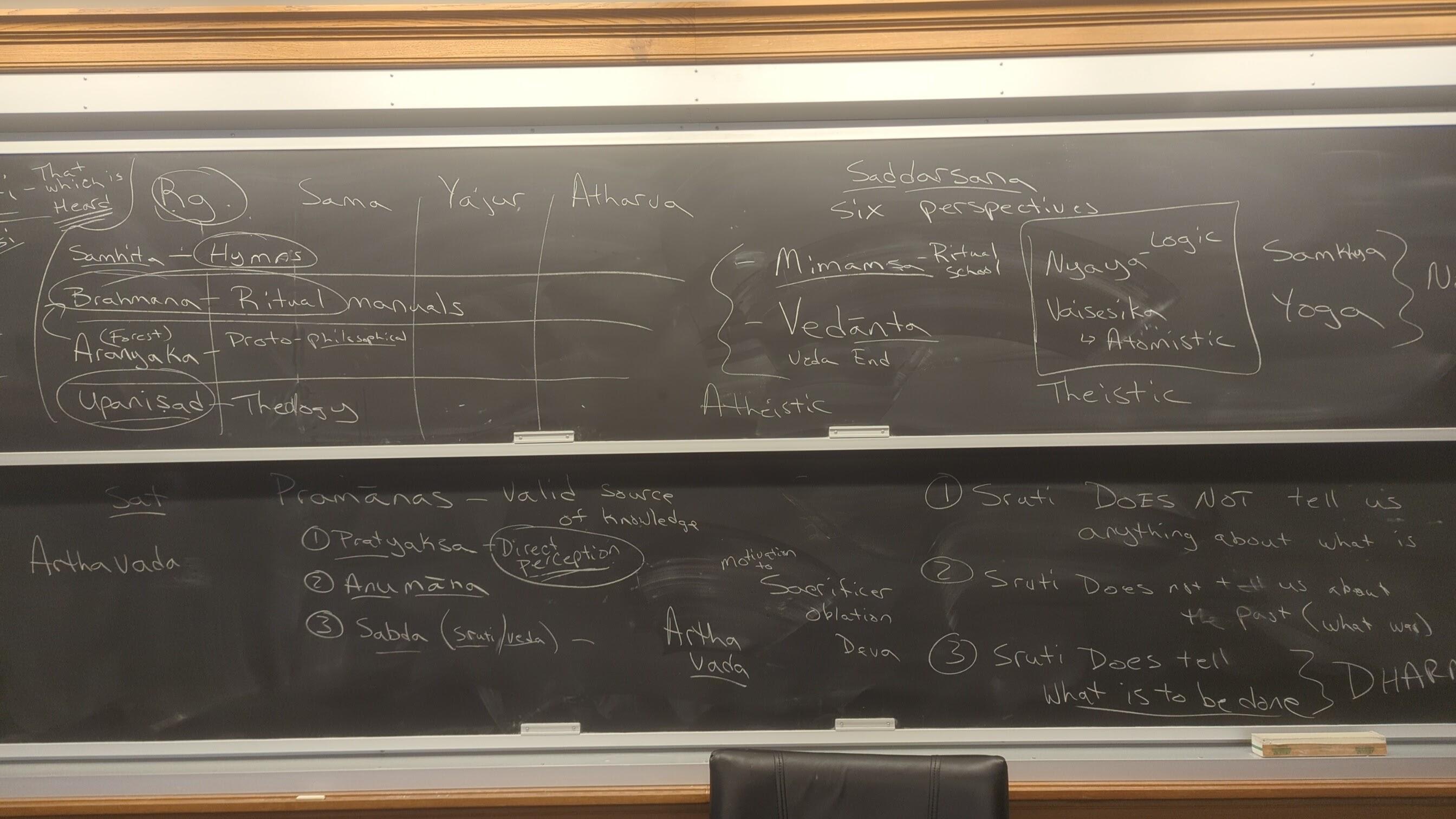
Good. So, *Shruti*, Veda, good. Now the, so let's talk about the Veda text itself. So the Veda is really divided into, let's say 16 different, different parts. It's really four and four. So there's four major divisions of the text, and then four what are usually called recensions. And so this should be over here. So the the four divisions of the text we'll come to in a second, but the four recensions are basically, I mean, the way most Orthodox Hindus receive this is sort of like your family, right? Your family is in charge of your family comes from the Rig tradition, which really means you're supposed to memorize the entirety of this, right? So you may not memorize all 16 boxes, but you memorize all everything within the Rig tradition or everything within the Sama tradition, right? And then a different family would memorize a different recension or division of the text, right? It's not 100%, but that's a pretty good rule of thumb. Each one of these different recensions, has the same four different divisions of the text. And these are more or less chronological as well. So the *Samhita* are the oldest by a long shot, actually. *Brahmanas* are almost as old as those, and then *Aranyakas* are much younger, and then *Upanishads* are the most recent, you could say. And most recent meaning some of the Upanishads date as late as second or third century CE. The oldest Upanishads, like the Chandogya and Brihadaranyaka, the the chant that I gave at the beginning of class today was from the Brihadaranyaka Upanishad. Those are, you know, usually dated to around 600, 700 BCE. Maybe a little later, but that's kind of in the earlier or later, but that's in the range. Yeah.
Student 1: Were there ever like disagreements on like adopting an Upanishad or like a new form of text to learn at all or anything like that?
Brad: Yeah, good question. So there's, there are, there are a lot of disagreements even today about exactly which Upanishads are part of the Veda. So you've got some that are just no question at all. All of the Upanishads that we're going to be studying, oh, that's not even true. All of the Upanishads that we're studying this semester are now currently regarded as scriptural by virtually all Hindus. The only exception is the Mandukya Upanishad, which is definitely the later of the ones that we're going to be looking at. But then there are certainly a lot of Upanishads that date, you know, even six or seventh century CE, which are by some, you know, some communities hold them as the most sacred and other communities not at all, right? So, yeah, certainly plenty of disagreement among, but for most part, there's not really much disagreement. Like there aren't any sort of hymns that are claimed to be part of the Rigveda that aren't. So the only discrepancies are in some of the much later Upanishads. Yeah, good question. Any others?
Okay. So in addition to knowing these 16 divisions, I want you to know a little bit about them. So the, we're not going to really make too many distinctions between the different these different recensions. But a good deal of of distinction between these four divisions of the Veda. By the way, this semester in unit two, next unit, it'll be the only time that we deviate from the pattern of Tuesdays anchored in Hindu scriptures and Thursdays anchored in Christian scriptures. And in the second unit, we're going to focus exclusively on Hindu texts, and we're going to look at we're going to focus exclusively on Upanishads, and we're going to look at one from each one of these four. So, yep. Okay, so *Samhitas*. *Samhitas* are, like I said, the oldest, and they are, for our for our purposes, we'll just call them hymns. And so for today's for today's class, we read three hymns and all of them were from the Rigveda *Samhita*. So that's how you'd say it, right? Rigveda *Samhita* portion, right? Or the Samaveda *Samhita* portion or the, you get it? So all three of the ones we looked at were from the Rigveda *Samhita* portion.
The *Brahmanas*. So the hymns, these are, these are so old that even the people that originally wrote them down didn't know the context of most of them. So some of them are so old that even even a thousand, even 1500 years BC, even then they'd already lost the context. So they still had the hymns. The hymns were still sacred. They still transmitted the hymns, but they just didn't have any sort of like any other context for them, if that makes sense, right? So they're very, very old. And some of them, including the three that we read for today, are among the oldest theological texts, the oldest creation stories in all of human history. So we're not just, I mean, so we're talking about wicked old, right? Things that have been passed down. I just, I don't know. That to me is significant, right? That a particular text, a particular hymn, particular poem, right? Has been passed down for as long as humans have been around, you know? I mean, that's, that to me makes it makes me want to read it.
Okay, so *Brahmanas*. *Brahmanas*, we're just going to call them ritual manuals. Manual sounds like such a weird title, you know, term to label them. But it is it is accurate. So they are *Brahmanas* contain descriptions of rituals. Actually, when you read the *Brahmanas*, it's sometimes super hard to tell that there's a ritual here, because they aren't written in like the way you might expect them. But this is where all the all the rituals are described. And that they're described in great detail. Generally, what we mean by a ritual, so rituals or *Yajnas*, are karmas, karma is another name for them. These are all things that are they're rituals, ritual sacrifices. So all of them are sacrifices. So in order to sacrifice, you have to have what? You have to have a person to perform the sacrifice, right? A sacrificer. You have to have something to sacrifice, right? Some material to throw into the fire. Right? So we'll call that the oblation. the thing that is sacrificed. And then you've got to have somebody to sacrifice too, right? So the the *Deva*. *Deva*, English we have the word dative, right? So like the grammatical term dative. What does dative mean? What's a dative case? anybody? study any declined languages? Yeah.
Student 1: Is that like two or...
Brad: Exactly. So like if I'm going to, you know, give something to you, then I'd use the dative because it's two, right? Exactly. So in English, you usually form the dative by just adding the pronoun two, or not the pronoun, the preposition two. So dative in Sanskrit, really just means that to whom it is given, right? So you have to have the sacrificer who's making the sacrifice, the oblation, the thing that's being thrown into the fire, and the *Deva*, the to whom to whom it's being given. So all of this is described in the *Brahmanas*. There are a lot of other, those aren't the only three things of import, but for today, that's fine.
*Aranyakas*. These, these are usually described as proto, proto-philosophical. They're sort of like early philosophical reflections on the meaning of the rituals, right? So, and *Aranyaka* means forest. So the idea is that when a, we'll talk about the four stages of life and stuff later. But the idea is that when a person reaches a certain stage in life, you know, usually, usually later in life, usually after the kids have grown, the business is done, you know, all that kind of stuff, when what you might call, you know, retirement or something like that. When somebody reaches a certain age, then they kind of devote their life to theology and philosophy, understanding the meaning and purpose of life, right? So philosophical reflection, theological reflection. And they're what they're reflecting on is the ritual sacrifices and the hymns, right? So they're reflecting on these earlier things and saying, you know, what's the point of life? What does it all mean? Why are we doing these things? Why do we do the rituals? Why do we do these? Why do they, right? Why? So the sort of philosophical questions, and those are recorded in the *Aranyakas*.
And then the *Upanishads* are, yeah, just, I don't know. Let's just call them theology. So theology, theological reflections, so text, yeah, theological texts. So not proto-philosophical, but full on philosophical, right? Some of the, at least in my opinion, I'm not alone, some of the greatest philosophy in the human record. So, good stuff. And like I said, we will in the next unit, we'll read one Upanishad from each one of these four recensions. So you'll get, you know, a good taste of them. Cool. Any questions?
Cool. So if I had a quiz that said like give me the four recensions and the four divisions of the text, you'd be like golden. Yeah?
Not today, but, you know, soon. Any questions?
Okay. We'll shift then to, faster. To the *Shad Darshana*. Why did I write that? So *Shad Darshana*. *Shad Darshana*, I gave this to you on the first day of class. Anybody remember? Have that in your notes? *Shad Darshana*? One of the learning objectives in the syllabus. *Shad Darshana*.
What? What's the point of learning things? *Shad* means six, and *Darshana*? Let's translate it as perspectives. Does that place ringing a bell? So *Darshana* comes from the root word *drish*, which means to see. So *drish* *Darshana* is like seeings. So probably a more literal translation would be like the six seeings, the six ways of seeing, the six, yeah, but perspectives, I think does a lot of work there. So the six perspectives. Sometimes and I slip into this language because this is how I was taught way back in the day before I knew any better. Sometimes they're described as the six schools, but I don't feel like that really does justice to *drish* to *Darshana*, right? *Darshana* is six ways of seeing.
So, these six ways of seeing, definitely want you to know these six. We're going to focus this semester mostly on three of them, but be good to know all six. So the, one we're going to talk about today is *Mimamsa*. And then the one we'll talk about in the next unit is *Vedanta*. Okay, I forgot to mention. So, we've got these four divisions of the text. The Upanishads are the the last, they're the last chronologically, they're also the last, they're just the last, right? They're just at the end. So the word *Vedanta*, *anta* means end. And so it's literally the end of the Veda, right? So, the Vedantans are focused on the end of the Veda. But the end of the Veda has a double entendre, you know, same in Sanskrit as in English. So the double entendre of course is that they're they're at the end of the Vedas, but they're also the end in terms of like the summit, right? Or the peak or the the high as far as you can go, right? So not just the end, they are literally at the end, but they're also like the the final word, right? The whole the final truth, the end in terms of the goal, the *telos*, the *dénouement*, the thing, right?
So these two, so these are two of the, I don't want to number them because they're not really in any particular number. But the *Shad Darshana* can be divided into three pairs, three pairs of like sister, sister perspectives, right? So each one has a sister. So *Mimamsa* and *Vedanta* are sister perspectives, sister *Darshanas*. *Mimamsa* we're going to focus more on today, and then probably not really much after today. Then we'll focus a lot on *Vedanta* later. Probably won't say much at all about *Nyaya* or *Vaisheshika*. At least not after today. And then the final pair are *Samkhya* and *Yoga*. So we'll focus on *Yoga*, well *Samkhya* and *Yoga*, when we get to the Bhagavad Gita, we'll come back to *Yoga* then. We'll focus on *Vedanta* a lot in chapter in unit two. And then I'll try to cover this one today and then just really, really, really briefly right now, talk about these two schools.
So *Nyaya* is the school of logic. They're very, very devoted to logic and reasoning. A lot of their treatises are, I don't know, just really, really sublime debates on, you know, really fine nuances of of logic. *Vaisheshika* is usually usually described as atomistic. So their understanding of reality that everything in the universe can be broken down to irreducibly to irreducibly small particles of reality called atoms. And those atoms contain, you know, both matter and energy, E and you know, M. And, yeah, there's a lot more to those schools, but we're not going to go too much into them. One thing about them though, that I will say today. So these schools, *Nyaya* and *Vaisheshika* are theistic. There are tons of examples that, you know, counter examples. We could find *Nyayans* that are non-theistic and *Vaisheshikans* that are non-theistic. But by and large, the tradition, the most orthodox, like traditional teachers within those schools are theistic, meaning they believe in the existence of a God, right? And that God is usually described as creator and for *Nyaya* in particular, the author of the Vedas, right? So then the Vedas even though you still have those *Rishis* who heard the Vedas and wrote it down, that when it was heard, it was spoken by, you know, God, right? So, theistic.
*Mimamsa* and *Vedanta* are firmly atheistic. And *Samkhya* and *Yoga* are rather firmly non-theistic. So *Samkhya* and *Yoga* talk almost nothing about God. There's almost no, very rarely do you even find the word *Deva* or *Isha* or any of the words for God in in the core texts or teachings from these kind of from these schools. Which is really to say non-theistic, right? Doesn't mean that they're atheistic, it just means that they just don't really talk about God at all. It's just not, God isn't something that seems to be a major thing to discuss. Whereas for *Mimamsa* and *Vedanta*, they're more more overtly atheistic, although we can find lots of counter examples within those schools or perspectives as well. Any questions about any of these? I'm going to shift to focus on *Mimamsa* right now.
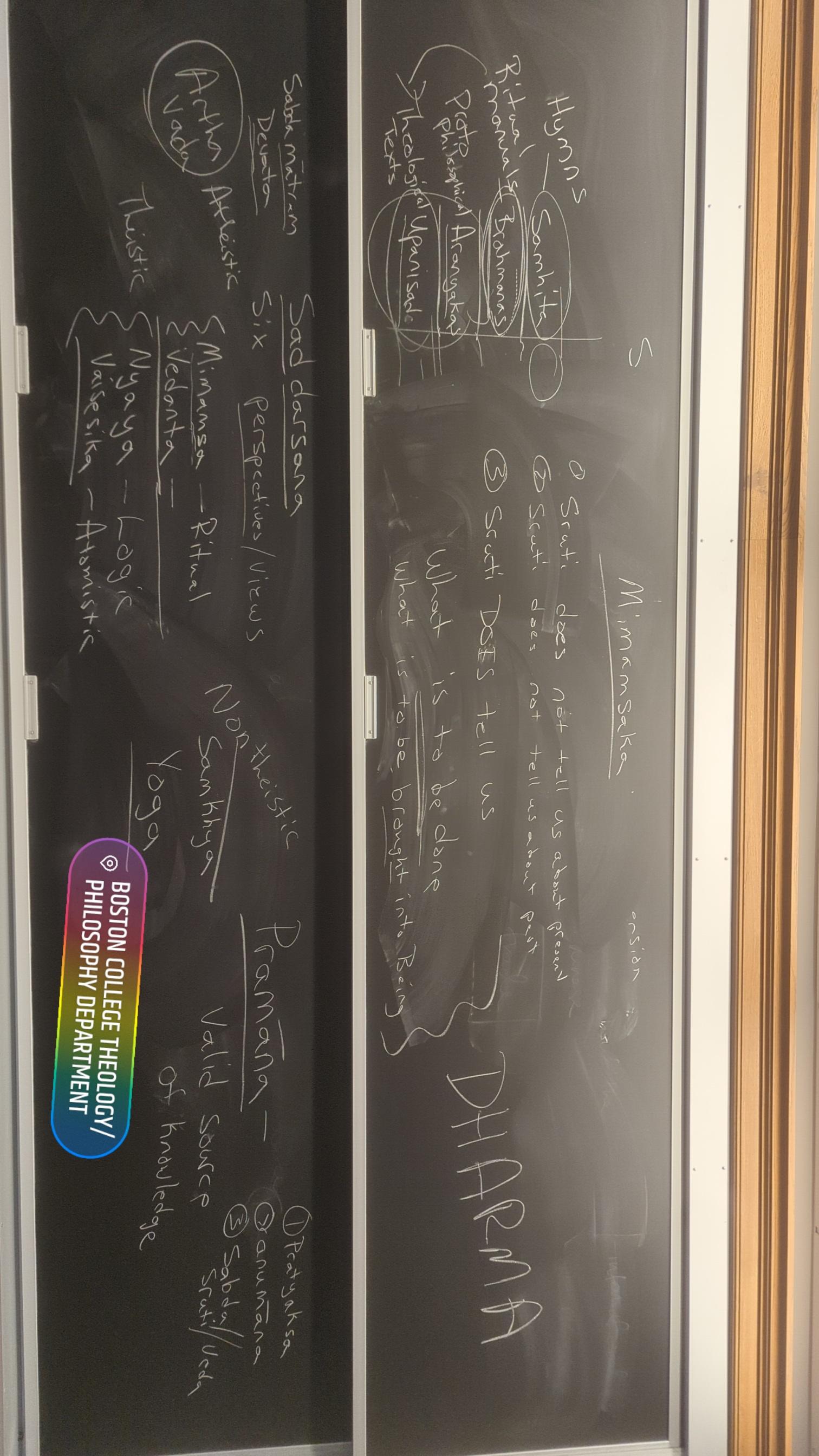
Good? Clear enough? So, sorry for all the lecture. Sometimes you just got to get, you know, stuff out there, right? So, *Mimamsa*. *Mimamsakas* are dope, man. This thing that I erased for no apparent reason. Says *Shabda Matram Devata*. *Shabda* *Shabda* means words. *Matram*, basically means, really it means like the full extent of, but nothing but is the way it's usually *Devata*. *Devata* meaning God is nothing but a word. Right? So *Shabda Matram Devata*, this is a core teaching of the *Mimamsakas*. They do actually, there are within the *Mimamsaka* debates, which are quite fascinating to read, they'll they'll debate over whether or not the gods exist. But among the the schools that argue whether the gods do exist and the whether the gods don't exist, they both fully, completely, totally agree on one thing, which is that it does not matter at all. Doesn't matter if the gods exist or the matter if the gods don't exist. If the gods exist, they have basically no free will. And if they don't exist, well, they don't exist. So, even among the *Mimamsakas* that debate that God does exist, they're like, doesn't really matter. God is nothing but a word. The *Mimamsakas* care about one thing, and that is performing the rituals, performing the rituals in precisely the right way. So *Mimamsaka* like I already or *Mimamsaka* is a ritual school. Here I am using the word school again. But they're they're deeply, deeply, deeply concerned with in with reading the scripture precisely, exactly, exactly as it is, right? Understanding the scripture precisely without any ambiguity, shouldn't be any, anything left up for judgment or opinion or anything, right? Rules are the rules. You got the rules for interpreting the scripture. You can't go and read this text this way, and then following these sort of rules, like hermeneutic rules, rules for interpretation. You've got to keep the rules for interpretation the same, no matter what text you're reading, right? So if you're reading this text, you got to read it with certain rules, such as, you know, sometimes words are figurative, right? Metaphorical. Sometimes they're literal. And so knowing what text is literal or when to read a word literally and when to read it figuratively, there's rules for that, right? So *Mimamsa* is, they're writing, they write extensively about really clarifying the rules. And then so they'll give a case like, here's how you interpret this text. This word means this. Here's the rule that governs why we're reading that word this way. And then you give lots of examples from other texts like, see here, we've interpreted it this way, right? So really, really concerned with consistency across interpretation, right? So making sure that they're always reading the same text or always reading every text following the same rules. So some of the greatest text readers, yeah, that I've ever read.
*Vedanta*, basically is taking, like I said, these are all sister schools. So *Vedanta* basically takes the same rules, the same rules that *Mimamsa* developed and applies them to a different set of texts, right? So *Mimamsa* uses those rules in order to understand the rituals. *Vedanta* under uses the same rules to read the Upanishads, right? So trying to be consistent between the two. But they they convey different kinds of knowledge. A couple of other things about the, so, *Shabda Matram Devata*, for the *Mimamsakas*, what really, really matters is that, honestly, more important about whether or not the God exists is whether or not you pronounce the word properly, right? So proper pronunciation of the words, proper timing, proper, proper everything, is super important. This kid Nagarjuna, he was a Buddhist philosopher. He refers to the *Mimamsakas* as the *Itikartavyatavadins*. It's a great name. I wish I was an *Itikartavyatavadin*. But *vadin* means like the people who say, and then *Itikartavyata* means *iti* is like quotes, and *kartavyata* means like how you do something. So the *Itikartavyatavadins* are the people who say that you should do the ritual this way, right? So they're very like, do it this way, right? And so they care very much about interpreting the text precisely, pronouncing everything properly, they have rules about if you mispronounce something, what do you do to make up for that, you know, for that mispronunciation, etc.
Now, one other thing, this this is leading up to sort of the main takeaway from today. In addition to all these just facts and rules. So for the *Mimamsakas*, the whole point is to do the ritual, right? That's the whole point of everything. Everything is to do the ritual. All the rest of it then, what's all the rest of the Veda? Why do I have all the Veda if the whole point of everything is to perform the rituals, then why do we need to like reflect on what do they mean or what's the, you know, why or anything, right? For the *Mimamsakas*, all that matters is performing the ritual. And so everything else is basically, they they refer to as *Arthavada*. Meaning *vada* meaning sentences, things that are said, right? Things that are said with the *artha* or the goal to get you to perform the ritual, right? So, this is, right, if we want to understand these hymns for today, we've got to read that with that in mind, right? So these for the *Mimamsakas* are *Arthavadas*, meaning the whole point of the hymns, well, there's two points of the hymns. One is to use the hymns in the ritual, right? So a lot of the rituals say, hey, use this hymn or use that hymn in the ritual, right? So the ritual hymns are there as things that are elements for the sacrifice, right? That you need. But beyond that, reading them on their own is just to get you to perform the sacrifices, right? I know this is super thrilling, but follow me here.
So therefore, the *Pramanas*, each of the *Pramanas*, not only are they differing sources of knowledge, but each of them give us different kinds of knowledge, right? So, *Pratyaksha* tells us about the things that are, the things that are, meaning the things that exist, the things that are right around us, right? So, we don't need the Vedas to tell us science, right? Science is here, science, direct observation, measurement, everything is in *Pratyaksha*. These the *Pramanas* cannot possibly be in conflict with one another because they're different domains, right? They tell, they tell us different things. So scripture doesn't tell us things that we can know with our direct perception. Why? Because we have our direct perception. Why would we trust scripture, right? Why would we trust something that's thousands of years old when we can see for ourselves, right? Like the whole Ella example, right? No matter how many scriptures you read, it's not going to convince you hopefully of that what you're seeing is not what you're seeing, right? So direct perception is direct perception of what exists now, right?
So for *Mimamsakas*, some important rules, right? *Shruti* does not and cannot tell us anything about what is. Okay? *Shruti* cannot tell us anything about what is. And we don't need it for that. We don't need it, that's not a default, that's not a problem, because that's what *Pratyaksha* is for, right? *Pratyaksha* tells us what is. *Shruti* doesn't tell us what is. Second, *Shruti* also just to clarify, these are the rules for the *Mimamsakas*, not just for like for all Indians ever, right? Yeah.
Student 1: So is the Pramanas that is also...
Brad: So *Pramanas*, all of all of the *Shad Darshana* have their *Pramanas* and all of them have the same three *Pramanas* here. They they have, some of them have seven, eight, 10 *Pramanas*. They don't agree after after these three, but all of them agree on these three *Pramanas* for sure, 100%.
So, *Shruti* does not tell us anything about what is. *Shruti* does not tell us about the past. I.e. what was, right? So they don't tell us about what is, and they don't tell us about what was. So if they don't tell us about what is, and they don't tell us about what was, what's left?
Student 1: What will be?
Brad: Well, yes, they can't exactly predict the future.
Student 1: Like how to act or...
Brad: They can tell us how we should be, right? So they should tell us, so, *Shruti* does tell us what is to be done. What is to be done, right? So it can't tell us what will be done, but they can tell us what Justin is supposed to do, right? So then, if you're reading all of these other scriptures, right, which are *Arthavadas*, and an *Arthavada* is what?
I know I'm throwing so much at you today, aren't I?
Yeah.
Student 1: Is that the motivation to perform?
Brad: So *Arthavada* is just a text that has as its goal to motivate you to perform the script the rituals, right? So everything you read, whether it's a Upanishad or philosophy or a hymn, anything, whether you're reading any of the *Arthavadas*, the goal of the *Arthavada* is to get you to perform the ritual, right? In order in other words, to get you to do what is to be done, right? In other words, ethics, right? So the whole point of the Veda is ethics. It's to tell you what is to be done. And what is to be done is in *Mimamsa* sutra, all of this, what is to be done is *Dharma*. Long road, but I hope the payoff was real, right?
So, scriptures don't tell us what is, they don't tell us what was, the past is. They only tell us what is to be done. And what is to be done is performance of the rituals. Why perform the rituals? Because the rituals bring *Dharma* into being. Right? So, in other words, if none of us perform the rituals, existence will continue, right? World's going to keep rolling, things are going to keep happening, nothing's going to, right? Change is inevitable, things are going to continue to change, right? But if we perform the rituals in the way that are described, then we are bringing *Dharma* into being, right? And bringing *Dharma* into being, *Dharma* is, *Dharma* you can't really translate into anything, but let's we could use a host of words to kind of stand in for *Dharma*. Words like justice, goodness, righteousness, good things, right? *Dharma* is what the ideal, right? The good. What what Socrates called the good. So *Dharma* is something that doesn't exist. *Dharma* is something that is to be brought into being, right? And then so if we all do our part, and if we, if I read the text and I'm like, oh, I'm supposed to perform this ritual, and then I perform that ritual, then the ritual is to be is brought into being, which means *Dharma* is brought into being. Forever and ever? No, obviously not, because the world constantly changes, right? So then if everybody brings *Dharma* into being, then *Dharma* exists so long as that's the case, right? But if people stop doing the rituals, then *Dharma* you know, *Dharma* doesn't rule, right? But if everybody does the rituals, then *Dharma* rules. Cool?
So, with all of that in mind, which is all the things that I had on my list today. Well, all of that in mind, maybe we can think about these three creation stories that we read for today, right? With through that lens a little bit and think, all right, so the point of reading this text from a *Mimamsaka* perspective isn't to tell us something about the past because that's not what scripture does, right? So it's not telling us about something that happened long ago in some far off place or whatever, right? But instead, it's an *Arthavada* that's convincing us to bring something into being, right? So creation, creativity and recreation. Got our first understanding of the title. Yeah.
Student 9: Does the Shruti mention anything about like conversion of like people who don't believe? Like I know like Christianity it's like that's a it's a sin so you're trying you're trying to save them from sin whereas like I can see it like it's good for everyone to participate and create Dharma so like you should convert them but I don't know does it say anything about any of that?
Brad: Yeah, I'm going to say no. Yeah. The fact, I mean, according to the *Mimamsakas*, so when you read these rituals, they, they tell you, there's certain qualifications to be a sacrificer. And so it's not just like anybody, anybody, it's not just open to anybody. It's open to people that meet these qualifications. And if you have those qualifications, then you have *adhikara* to perform the ritual. And so there's certainly no idea that like everybody should perform these rituals. It's only the people that are supposed to perform these rituals. But here's the thing, like you are required and expected to perform the ritual even if you never read the text, right? So when you read the text and you understand the scripture, then you understand that this is an obligation that you haven't been fulfilling. I see. Right? And then as soon as you realize that, then it's like, oh, well, I better go fulfill my responsibility because it's my responsibility, sort of thing. Yeah.
Student 9: That's kind of different than Christianity, right? Where it's like, hey, if you don't get baptized or whatever, you know, before dying, it's not like on you just because you just never knew about the practice, right?
Brad: Yeah. So the, I mean, to bring *Dharma* is to being requires work. And so if nobody does the work, then the then the *Dharma* doesn't happen. So, if you know about bringing *Dharma* into being, then hopefully that's enough to inspire you to bring it into being. But certainly no sort of like reward, like if you do this, then you'll go to heaven or something like that.
Student 9: Just should kind of be...
Brad: Yeah. Yeah. Good.
Shall we get into our circle and talk about the text? Sorry for such a long lecture content, but important stuff. So, we got 20 minutes left. Let's see what we can get through.
(shuffling chairs, moving into circle)
Brad: Hopefully you got enough your Like probably already have the print out just need the Okay, to get us started, let's shift gears and stuff. What if we just read this first hymn? So it's just seven verses long. We just go in order and just have, you know, everybody read one one verse. Anybody want to get us started? Yeah, Ella.
Student 2: The translation or no translation?
Brad: You can read the translation on the left hand side. Yeah.
Student 2: At first was neither being nor non-being. There was not air nor yet the sky beyond. What was its wrapping? Where? In whose protection? Was water there, unfathomed and deep?
Student 3: There was no death then, nor yet deathlessness, nor night or day. There was not any sign. The One breathed without breath by its own impulse. Other than that was nothing else at all.
Student 4: Darkness was there, all wrapped around by darkness, and all was water indiscriminate. Then that which was hidden by the void, that One, emerging, stirring, through power of Ardor, came to be.
Student 5: In the beginning, Love arose, which was the primal germ cell of the mind. The Seers, searching in their hearts with wisdom, discovered the connection of Being in Non-being.
Student 6: Across the dividing line extended their ray: Was it below or was it above? Bearers of seed there were and mighty forces, thrust from below and forward move above.
Student 7: Who really knows? Who can presume to tell it? Whence was it born? Whence issued this creation? Even the gods came after its emergence. Then who can tell from whence it came to be?
Student 8: That out of which creation has arisen, whether it held it firm or it did not, He who surveys it in the highest heaven, He surely knows—or maybe He does not.
Brad: Awesome. Thank you. So anybody want to get us started? Anything you want to draw attention to? Questions?
Student 9: So just like in the Genesis it talked about there was like the nothingness but also there's something there kind of like something but it's nothing kind of.
Brad: Yeah, something nothing that's not quite nothing. Yeah. Yeah, get you.
Student 10: Talking about repetition as well. I saw that in the first three paragraphs, the first verse of each one, there's a repetition between being and non-being, death and deathlessness, and darkness and around by darkness. So I found that pattern interesting that he's trying to repeat his message about about the uncertainty of the events. Mhm. How each each event contradicts itself. I found interesting. Okay. Yeah. What do you mean each event contradicts itself? That for example, in the first line, it was being or non-being. So he was no one really understands like that's the first line you read of the paragraph. No one really knows what's going on. Yeah. Then the second one, it was talking about death and deathlessness. So you don't really know, I mean, he's talking about death, what if someone's dying or not. So Right. So negation on top of negation on top of negation. So everything's just everything's ultimately negated. Yeah, good. Good.
Student 12: I think some of like the unclearness of it is what brings about like the idea of purpose and like kind of thinking about it now in like an ethical standpoint, like reading it now makes more sense because like you're supposed to take the purpose upon yourself to like find it and like Dharma itself.
Brad: So it's not so much about finding answers as it is kind of taking action and doing something, bringing, bringing Dharma into being. Good. Yeah.
Student 13: I was just going to say the questions feel like they create a sense of like humility especially, who really knows, who can presume to tell it, sort of saying like, you know, like humans are not like, you know, supernatural problem solvers or answer finders, you know.
Brad: Mhm. Okay, so recognizing the limitations of our knowledge kind of thing. Mhm. Yeah.
Student 14: I thought it was interesting that like water was like in existence, it seemed like what they're saying, like because that's kind of implying that it lives outside of like existence, non-existence, being, non-being, like which is interesting because it's like what's so like significant about water?
Brad: But what is so significant about water, right? I mean, yeah. Yep, good. So water's definitely being significant. Yeah.
Student 15: I was going to say the same like I like how the text acknowledges like uncertainty where like it ends with how even God might know, might not know about the origin or like even the creator might or might not know. And also like how it leaves room for like interpretation because there's no certainty. And like helps us form like different perspectives to it.
Brad: Mhm. Yeah, so uncertainty is kind of built into the system a bit. Yeah.
Student 17: Going off the point that it might not be as important to know. I think that like that's like shown in like the very last line, he surely knows or maybe he does not because like you would think like it's the one person that would know, but like they're saying or maybe he doesn't know. So it's kind of like taking away the importance from it.
Brad: Mhm. Mhm. Okay.
Student 19: I thought it was interesting how it's not, well, it's saying how the gods came after no one really knows the origin, but it's still also implying that there is that person who's above all the rest. And even if he does not have the knowledge, he still like it says like he's recent perhaps like in the highest heaven, so and then he go it goes like only he knows or perhaps he does not know. So it's the same thing that we were saying, but also it's like pointing out that there is something up there that may have the knowledge that none of us have the capability.
Brad: Okay, may, but emphasis on may or may not. Yep. Mhm. Yeah. Good.
Student 18: I feel like that kind of relates to what you were saying with the Veda is like not directly perceived or doesn't come from like human form but just like exists kind of out there already. It's like what it's kind of continuing like it's alluding to almost like there's no like direct creation or like human made it or maybe doesn't know.
Brad: Mhm. Mhm. Good.
Student 20: Yeah, I do another Christian connection. I was thinking when I read six, that idea of trembling, like it's not a fear that is a bad fear. It's almost like a good fear for the power of God and like what God can do for you. Yeah. I kind of connected it to the idea in Christianity where God's like fearful but not in the sense where you're scared, but like well, in a way, but not.
Brad: Sure, sure. Yeah, yeah, word. In April, like late April, one of the very, very last lectures we'll have, we'll look at Bhagavad Gita chapter 11 and that trembling will come back. And trembling, there's also Sanskrit word *spanda*, which is like vibrating. So the idea of creation as a form of vibrating. So I think that's something in there of like, I don't know, string theory or something. Yeah.
Student 21: I found it interesting that both use the word germ, but the first one talked about the primal germ cell and then the second one talked about the golden germ. I was wondering why they use that just because usually the word germ has like a negative connotation.
Brad: For sure. Yeah, really good question. important question. So, the it's not intended to bring any negative connotation. The word germ means seed, right? So like germinate means germination is a process of a seed turning into a a plant, right? So it's and the the golden germ or the golden embryo here, which is a direct translation of *Hiranyagarbha*. *Hiranya* means gold and *garbha* means seed. What what comes to your mind when you there's there's supposed to be a particular sort of image evoked here with this golden embryo, golden seed. What comes to mind? Thinking of a golden seed? What are you thinking, Georgia?
Student 12: Well, I I'm I guess just like star or like I mean, like the embryo or like the golden seed kind of thinks of like makes me think of like the beginning of something good. Like I was thinking of it in like in like the germ context. I was thinking of it as like a germ cell, which is like how like reproduction happens.
Brad: Right. Yeah.
Student 12: So that's kind of how I was thinking of it just like where more so like where creation began, but the golden germ. Right. Was that like when I don't know because I'm trying to think it was I'm just word vomiting.
Brad: No, no, you're doing fine. You're fine. Yeah, I'm just I also recognize that I've got like 15 seconds left. So, let me give I would love to keep going. But the the idea is coming to mind is of a of an egg. I want you to think of like an egg, right? So like an egg yolk, meaning like the the golden, the golden embryo, right? So an egg yolk, if you were to take an egg yolk and you were to try to take a fork to it or something, it's all yolk, right? There's not different parts in it. It's all one thing, right? Undifferentiated. But then that egg yolk becomes the whole chicken, right? With its feathers and beak and, you know, all the all the different parts of the chicken, which then becomes So it's definitely a chicken and egg kind of thing, right? But the one becoming the many, becoming the one, becoming the many.
So sorry that we didn't get more into it, but very good class. I'll see you on Thursday. I'll share Proverbs 8 with you today. And I have office hours now.