 ```html
This class session served as an introduction to Hindu traditions, emphasizing the importance of specific terminology and avoiding the generalized term "Hinduism." Brad began with a moment of quiet and a chant from the Bṛhadāraṇyaka Upaniṣad. They then outlined the foundational canon of Hindu theology, the śruti ("that which is heard"), focusing on the Vedas. The structure of the Vedas (Ṛg, Sāma, Yajur, Atharva) and their fourfold divisions (Saṃhitā, Brāhmaṇa, Āraṇyaka, Upaniṣad) were explained. Brad introduced the six orthodox schools of thought (Ṣaḍ-darśana), providing a deeper look into the Mīmāṃsā school. Key concepts discussed included the Mīmāṃsā focus on ritual performance derived from the Brāhmaṇas, the idea of scripture as arthavāda (incentive/motivation for action), the concept of dharma as something to be brought into being through action (karma), and the phrase śabda mātraṃ devatā ("God is nothing but a word"). The latter half of the class involved a group reading and discussion of three hymns from the ṚgVeda Saṃhitā: the Nāsadīya Sūkta (X.129), the Hiraṇyagarbha Sūkta (X.121), and the Puruṣa Sūkta (X.90), exploring themes of creation, questioning, sacrifice, and the nature of reality from various perspectives, including the Mīmāṃsā lens.
Brad: Let's begin. Let's start as before with just kind of a moment of quiet. I'm going to chant a little mantra from the Bṛhadāraṇyaka Upaniṣad. You don't have to do it with me. And then we'll just have a little breathing together after that. So.
Brad: Let's be fully present.
Brad: Om
Brad: Asato ma sadgamaya
Brad: Tamaso ma jyotir gamaya
Brad: Mṛtyor ma amṛtaṃ gamaya
Brad: Om Śānti Śānti Śānti
Brad: Let's just take one big breath together. Go ahead and breathe out. And then we'll breathe in.
Brad: Let it all out.
Brad: Word. Hope everybody had a very good weekend.
Brad: So we're going to be talking about, well, this is our first foray really into Hindu traditions. So I've got to do a little bit of lecture just to mostly give you some vocabulary. So lots of vocabulary. So take good notes mostly on this vocabulary. It's going to be a lot of Sanskrit terms. But I think in order to really understand...
Brad: In order to really understand the tradition, you have to, you know, have some of its language terminology.
Brad: So let's try desperately, hope I don't violate this rule, but let's try earnestly to avoid using the word Hinduism. Let's try and remove that word entirely from our vocabulary. You can use the word Hindu, particularly as an adjective. But let's avoid using it as a noun, particularly as an abstract noun. Like most abstract nouns, they're, you know, made up.
Brad: So, what we mean by Hindu tradition, Hindu theology is grounded in like all theology. Theology is grounded in a canon of scripture, canon of texts. That's what distinguishes philosophy from theology is theology is grounded in a canon of texts. Could be any canon of text, right? Could be in this case the Vedas, it could be the Hebrew scriptures in the Jewish tradition, could be the Jewish and the Hebrew and Greek traditions. Sorry. Hebrew and Greek scriptures in the Christian tradition, could be the Quran in the Islamic tradition, could be the honestly, it could be the collected works of Shakespeare. It can be anything, right? In Proclus and Plotinus, who are sort of the original theologians in many ways, at least the original ones in the West to use that term. They grounded their discourse in the writings of Plato. So, anything can be the canon, right? But what distinguishes one kind of theology from another kind of theology is what that canon is, right? So, this semester, we're switching back and forth mostly. Tuesdays will be grounded in one canon, Thursdays will be grounded in a different canon, right? That's the whole idea is to go back and forth. So today we're grounding in the Hebrew, I'm sorry, in the Hindu canon. And that canon is referred to as the Śruti.
Brad: So, Śruti, there's three different Ss in Sanskrit. You don't really need to sort of general knowledge, but śa, ṣa, or sa. Sorry, yeah. No worries, no worries.
Brad: Yeah, you can plant yourself in the middle for now. We'll we're going to shift to the circle a little bit in a little bit. So this is pronounced like SH. This is also SH and this is like S. So this Śruti is like SH, right? So Śruti.
Brad: Śruti means, literally it means that which is heard.
Brad: I mean, literally it just means heard, but it refers to the texts that have been heard. So, that's very, that's already very important. So these aren't written, so the Śruti are not written texts. They're not, they don't have an author. They're what's called Apauruṣeya. You don't need to know that, but...
Brad: But what the word means is not of human origin. They're not humanly composed. Instead, they're heard, right? So the idea is that there were Ṛṣis, it's another sh, so Ṛṣi, a Ṛṣi literally means seer. Well, it's usually pronounced seer, but it really should be like perceiver, right? So it doesn't have to seeing means with your eyes, but perceiving means, you know, could be any of your senses, right? Hearing, seeing, tasting. But the idea of a Ṛṣi is somebody who's had direct perception of the scriptures, right? Not and by scriptures, see, even the word scriptures is problematic because scriptures means that which is written down, right? That's what the word scripture means, something written down. But here we're not talking about something that's written down, we're talking about something that is heard, directly perceived, by the hearer.
Brad: So, this Śruti, is also referred to as the Veda. So the Veda is a collection of texts. Comes from the root word vid, which means to know. So the Veda are, you know, Veda could sort of loosely be translated as like knowledge, right? But sacred knowledge. That which is known, that which is known by being heard by the Ṛṣis, by the seers or hearers.
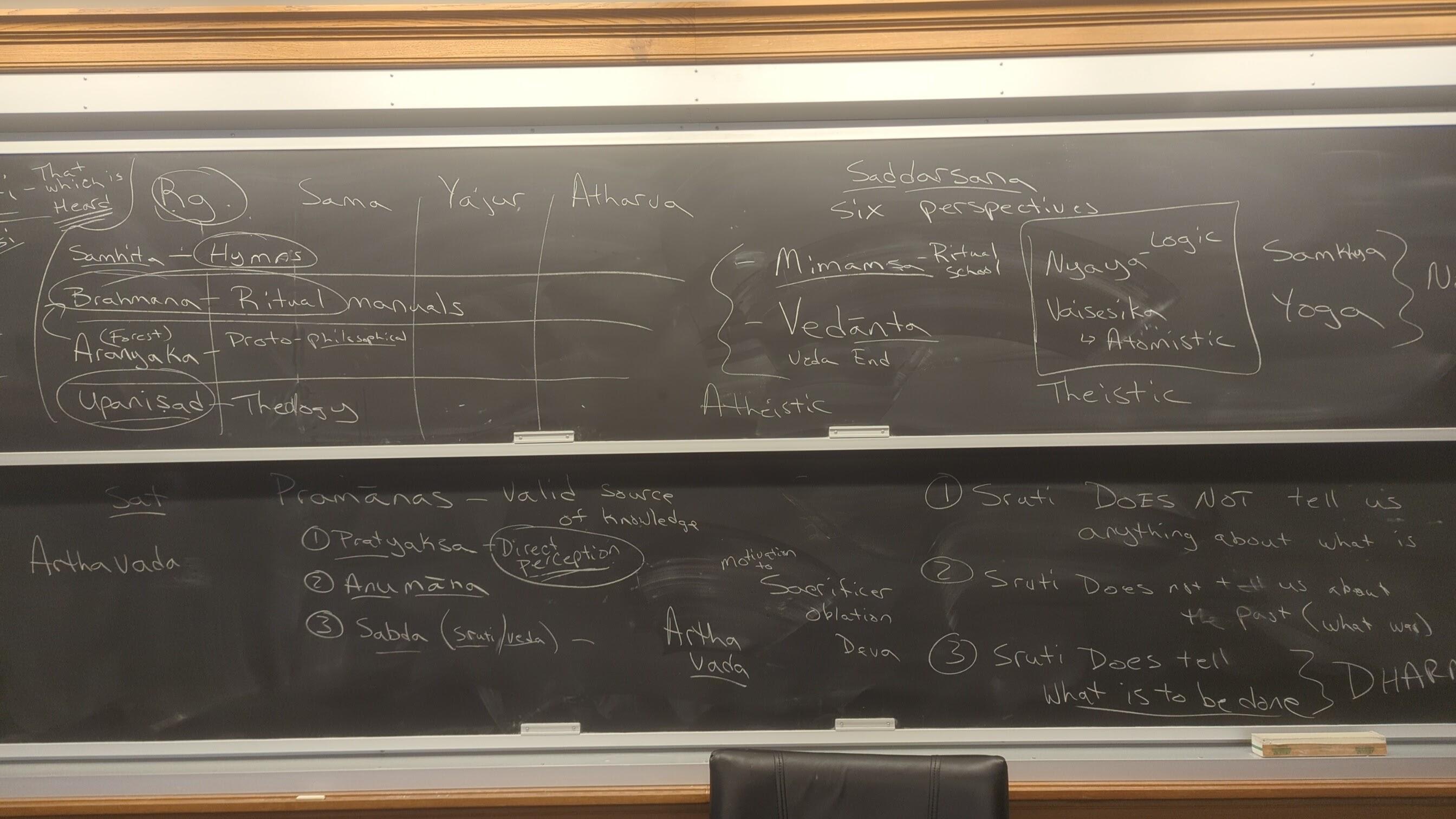
Brad: Now the Veda has 16 divisions. Sort of a grid. So there's the Ṛg, which is what we're studying today. Then the Sāma, Yajur, and Atharva.
Brad: Atharva. And then each one of these has four different divisions. So we could refer to these as, they're usually referred to as recensions.
Brad: But I don't know how to describe it. It's just three different versions, three different canons, three different groups of texts that really come from sort of historical different historical lines, right? So India is a very big place and these these sort of traditions rose in different families across India at different times. There's a lot of overlap. There's a lot of there's a tremendous amount of overlap between these four. But there are also plenty of differences.
Brad: Then within these four, each of the four has the same four divisions, the four divisions of the text. The first one are the Saṃhitās. Saṃhitā means, Saṃhitā really means collection, but for our purposes, let's just call them hymns.
Brad: And so today, the three hymns that I gave you are all from here. So all three texts that we're looking at are from this box, right? So we've got a grid of 16 texts. All of ours come from this box.
Brad: So there's the Saṃhitā, then there's the Brāhmaṇas. We'll be talking about them. We won't be reading them. The Āraṇyakas and the Upaniṣads.
Brad: So, and these extend through all these different recensions. So there's the Ṛgveda Saṃhitā, which is what we're reading today, some of them. There's Ṛgveda Brāhmaṇas, there's Ṛgveda Āraṇyakas, there's Ṛgveda Upaniṣads, right? There's Sāma Veda Saṃhitā, Sāma Veda, you get the idea, right? So, so we've got our little grid here.
Brad: So hymns, the hymns, which we're looking at today are the most ancient of ancient. They are, in fact, some of the hymns that we're looking at today are widely considered by scholars to be some of the most ancient human scriptures that we have, period. From any, from any culture around the world. So how old are they? Well, like most things that are that old, we don't know, right? We just know that they're really, really old. So, written down sometime around, you know, say 12, 1500 BCE, so about 3,500 years ago when they were written down. But already by that time, already by the time they were written down, the original context was so old that even the people who wrote it down, you know, 3,500 years ago didn't know the origins of it. So, but something that's been memorized and transmitted, you know, non-stop for thousands of years. Until, you know, continuing through today.
Brad: So the Brāhmaṇas, Brāhmaṇas, we're going to call these ritual manuals.
Brad: Manual just sounds like such a technical, like weird name for them. That's what kind of what most people call them and it is pretty descriptive. So the Brāhmaṇas describe rituals, rituals that are to be performed. And we'll talk a good, we'll talk about that in more detail today. Āraṇyakas, so Āraṇyaka literally means forest, I mean from the forest. So these are texts that are, they're called forest texts. Many scholars refer to them as proto-philosophical.
Brad: Whatever that means. I think proto-philosophical is a kind of a code word for saying philosophy that's not that great. They are, they tend to be philosophical reflections on the rituals, right? Then the Upaniṣads, which are some of the greatest philosophy in the world, at least from my perspective, and not alone in that.
Brad: So these are the end of the Vedas. So we'll just call them, yeah, theological texts.
Brad: And they are referred to, since they are at the, right? So all of this is the Veda, and since this part of the Veda, right, is at the end of the Veda, then it's collectively referred to as Vedānta,
Brad: which Anta means the end of the Vedas, right? So literally the end of Vedas. But end carries the double meaning in English, or same double meaning in Sanskrit as it has in English, right? So the end in terms of like, well, here we're at the end, right? It's the last part, but also end, in terms of like the summit or the pinnacle or the peak, right? So like the highest goal, the telos, that towards which everything aims. The ultimate meaning, that sort of thing.
Brad: Cool? Any questions so far?
Brad: Good.
Brad: That is enough for that then. So what I want you to know, you know, if we do have a quiz or something like that in the future, then I'd want you to know these four names, Ṛg, Sāma, Yajur, Atharva, and these divisions, Saṃhitā, Brāhmaṇa, Āraṇyaka, and Upaniṣad, and have some basic idea of what they are.
Brad: Like I said, today we're talking about the Saṃhitās and in the next unit, we're going to focus exclusively on the Upaniṣads and have a deep dive into four of those. And I'll add what, so the next unit is the only unit where we stray from this sort of Tuesday, Thursday pattern. So the next unit will be all on Hindu texts. And we'll do Tuesday, Thursday, Tuesday, Thursday. So we're going to do a Veda, an Upaniṣad from each one of these four.
Brad: So that's just more looking ahead. Okay. So shifting gears a little bit. So anything that is anything that is anchored in these, we would call Hindu theology, right? So Hindu theology is philosophical discourse anchored in these canonical texts, right?
Brad: Now, among those, what you'd call or what are usually called orthodox, I don't love that term, but orthodox Hindu theologies, there are six kinds. And this you might remember from my first day lecture. Because it's one of our learning goals for the course. Are called Ṣaḍ Darśana. What does Ṣaḍ Darśana mean?
Brad: Not all at once.
Brad: Anybody? First day stuff?
Brad: We weren't taking notes during that part.
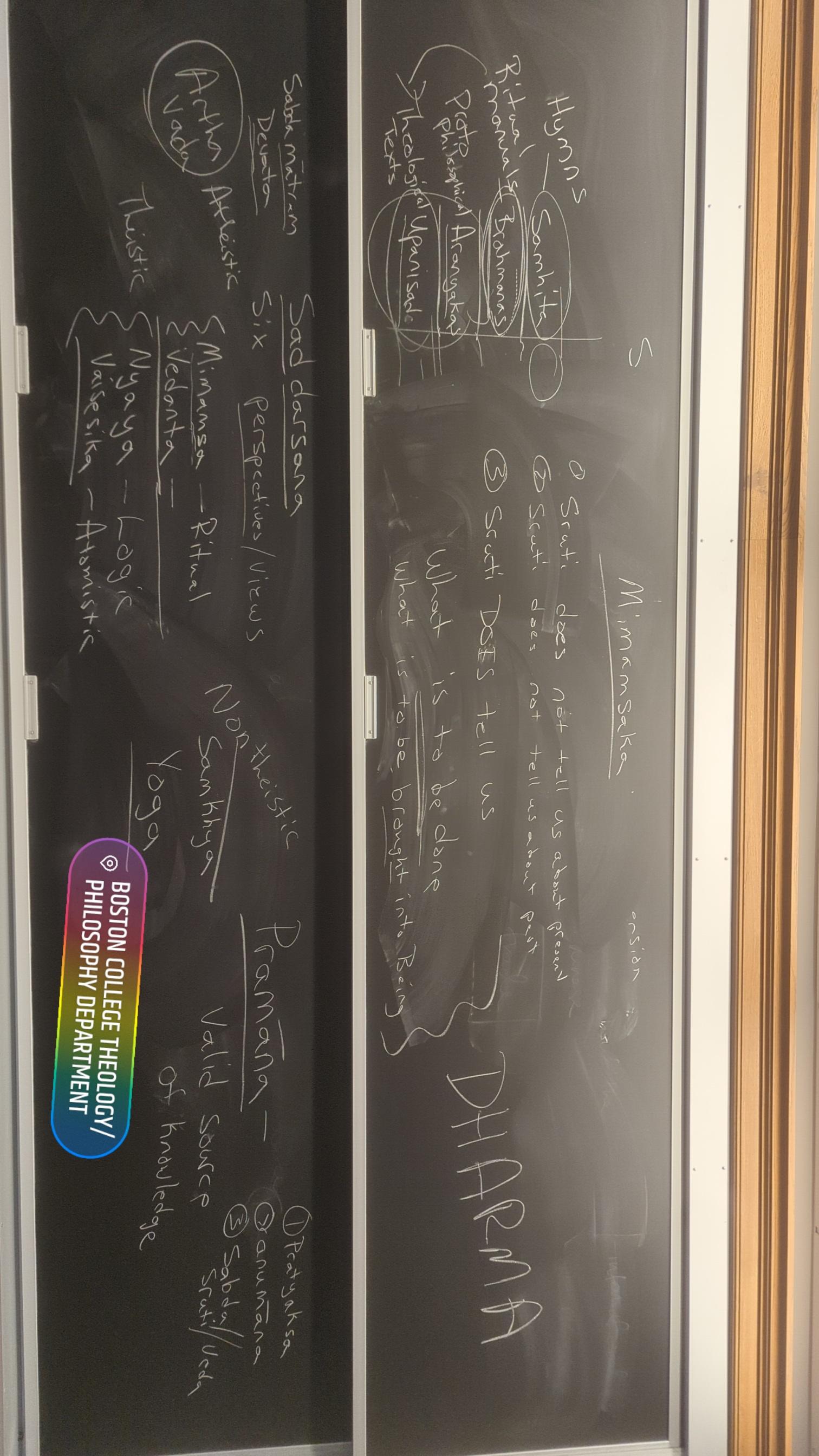
Brad: Okay. Ṣaḍ, Ṣaḍ in this case means six and Darśana means, let's translate it as perspectives. Dṛś means to see. Darśana means seeing. So it's literally the six seeings. But that's kind of awkward, so we'll just call them the six perspectives, right? Six views, I mean, perspective is really, really a good, really good word. So that, you know, the specs, the where you're looking at from this perspective, from this viewpoint.
Brad: So these six Darśana, Ṣaḍ Darśana, they are, there's six of them, but they are really three pairs. So they're paired in what are called sort of sister perspectives. And the six are Mīmāṃsā, which I'd like to speak a little bit about today. Then Vedānta,
Brad: So these are two sister schools, Mīmāṃsā and Vedānta. Then there's Nyāya and Vaiśeṣika.
Brad: And then Sāṃkhya,
Brad: and Yoga.
Brad: So this semester we're going to focus mostly on Vedānta and Yoga. We'll focus on yoga towards later in the semester. We'll focus on Vedānta throughout the semester, but especially in unit two. And today will probably be our only foray into Mīmāṃsā. And likewise Nyāya and Vaiśeṣika. So let me give you just a teeny tiny little bit of overview of each one of these. I could lecture about them for a really long time. I don't want to do that. But let's get a sense of what these schools are kind of or these perspectives are all about.
Brad: So, Mīmāṃsā is primarily a ritual school.
Brad: What they care about what they mostly care about are the Brāhmaṇas. So their focus not exclusively but by by and large on the Brāhmaṇas. Their primary goal is to make sure that they're reading the Brāhmaṇas correctly, so that they can perform the rituals accurately, right? So you read the if you've understood the ritual as it's described in the in the scriptures, then then you can perform it accurately, right? If you don't read it properly, then you can't perform it properly. So they're concerned with reading the ritual manuals carefully, precisely. So a lot of a lot of hermeneutics. Hermeneutics is like fancy term for interpretation, rules of interpretation, right? Making sure that you're interpreting the text consistently, that you've got rules, that you're not just like picking and choosing and I'm going to, you know, read this text this way and this text another way and wind up with cognitive dissonance and everything. So, they're really concerned with grammar, all those sorts of things.
Brad: Vedānta is basically taking, so Mīmāṃsā is one of the, one of the best schools, well, I mean just their primary focus is on reading the scriptures properly and carefully, right? So they they devote a lot of attention to how the rules for reading and interpreting scripture, like I already said. Vedānta, is a sister school of this one, meaning, I mean, at least by my and and a number of other scholars interpretations, Vedānta and Mīmāṃsā aren't even separate schools that really the Vedāntins take these all of the rules that they used in in order to read the ritual manuals properly, they use those same rules and just apply it to the Upaniṣads, right? So, well, I mean, really to all the scriptures, but primarily the Upaniṣads. So, basically the Mīmāṃsā is about reading and interpreting these texts [Brāhmaṇas]. Vedānta is using the same methods, same rules to read and interpret these texts [Upaniṣads].
Brad: Yeah, I think that's enough about those for right now. Nyāya is primarily, it's usually called the rule of, I mean, school of logic, fiercely devoted to logic, rules of logic, forms of logic, precise, careful, very scientific, very scientific logical school.
Brad: Vaiśeṣika likewise, Vaiśeṣika is most identified by some of its philosophy.
Brad: Yeah. Gosh, how do I, let me, since this is kind of the only day I'll talk about this school, let me give you a little bit of insight into Vaiśeṣika. So, a couple of distinctions about the schools. Nyāya and Vaiśeṣika tend to be tend to be theistic. Theistic meaning believing in existence of a God, right? As a deity. And primarily that deity is creator, sustainer, ruler of the universe, that sort of thing. And also as author of the Vedas. So even though they refer to the Vedas as Śruti, that which is heard, sort of like there's a speaker on the other side, right? And that speaker on the other side is God.
Brad: So that's Nyāya and Vaiśeṣika. Mīmāṃsā and Vedānta are rather, I think, I think atheistic would be the right term. Some discussion over whether, so these I would think you could describe as non-theistic, as basically saying, they don't really talk about God. God isn't something that is something important. The word God or words for God come up very rarely in these texts and when they do, they're almost just like an invocation you say at the beginning, sort of a mantra or a prayer. Just not really interested in God. The Mīmāṃsās have this important...
Brad: phrase, Śabda mātraṃ Devatā. Which is sort of a mantra that's repeated often by Mīmāṃsakas. And it means Devatā, God, God is mātraṃ means nothing but a word. So God is nothing but a word. So the like I said, the Mīmāṃsakas are deeply and concerned with reading and interpreting the Brāhmaṇas in the proper way. And in order to perform the rituals, right? The whole point of studying the ritual texts is so that you can perform the rituals. And if you're going to perform the rituals and it, so every ritual in all of these rituals are sacrifices. They're called yajñas, or sacrifices or karmas. And so you perform this karma and it's always a sacrifice, meaning you're you're literally involves a fire, right? I mean, usually two or three fires. But involves a fire and basically you're throwing stuff into the fire, right? So that stuff is usually, usually rice, could be like dry rice or boiled rice or dried rice or husked rice. There's like so many different rules about the rice, you know? So one like rice that's been boiled but not husked and then formed into a the shape of a kite or into the shape of a bird or those sort of things, right? So very, very specific rules about the things that are to be sacrificed into the fire. Most of those things are rice, and dairy products. So milk or ghee or butter or different yogurt, those sort of things. And in order to sacrifice, you always have to sacrifice, so the primary things are, in order to sacrifice, you have to have a sacrificer, right? Somebody who's performing the sacrifice. You have to have the the things that are being sacrificed, right? The materials that are being thrown into the fire. You have to have the proper words that you're going to chant while you, you know, throw the stuff into the fire. And you have to have a deity. In fact, the word deity or deva, Deva, in Sanskrit means that to whom it is given, right? So it's the dative. It's where we get the word dative. So those of you are language folks, right? Dative is you give something to. And Mīmāṃsakas insist that the only reason the scriptures even use any name of God is because you have to sacrifice to something, right? So in order to sacrifice to something, you have to have someone to whom a sacrifice is given and that word is, you know, Deva, to whom it's given. And the most important thing about the Devas from Mīmāṃsaka's perspective are that you pronounce the word properly. Nothing else matters, right? Because Devas are just words. Devas nothing but a word, but it's a word that you've got to pronounce properly at the right time and the right place. Makes sense?
Brad: So, everything else, everything that's not telling you how to do a ritual, which are pretty much in this text [Brāhmaṇas]. Everything else is called by the Mīmāṃsas is called an Arthavāda.
Brad: Vāda means something that is said, a sentence that is said, and Artha means in this particular case, Artha means, it's like if I were to, it's like an incentive, right? Something to incentivize you, something to motivate you, right? If I were to say, we're going to have a quiz on this at the end of class today, right? To see how much of it you got, that would be an Arthavāda, right? It's like an incentive to get you to pay attention and to learn what I'm saying, right? So for, for the Mīmāṃsakas, all of the scriptures, all of these [Saṃhitās, Āraṇyakas, Upaniṣads] and this [Brāhmaṇas, when not giving direct injunctions], everything is an Arthavāda and the whole point of those Arthavādas are to get you to perform rituals.
Brad: Makes sense? Super important point.
Brad: Especially since we're about to have a discussion about these texts from the Ṛgveda Saṃhitā, which we just learned are Arthavādas, right? So they're things that, they're not trying to communicate knowledge or they're not trying to, they're definitely not trying to communicate history or something like that, but instead trying to cultivate a desire within the listener to perform the rituals. Right? So ultimately, what that means is that for Mīmāṃsakas, the whole point of reading the scriptures is ethics, right? The whole point, the the scriptures do not tell us what exists. Do not tell us about things that exist in the world. That's what science is for. That's what direct perception is for. That's what logic and inference is for, right? So if you see something and you know it's there, you don't need scripture to tell you anything about it, right? Scripture does not tell us anything about what we see in front of our eyes. That's what Pratyakṣa is for. Makes sense? So they're not, they're not at all in any competition or disagreement. So they do not, scripture, I don't like calling it scripture. Śruti, does not tell us about the present. Śruti does not tell us about the past.
Brad: So what does Śruti tell us about?
Brad: Well, Śruti tells us about the rituals that are supposed to be performed, right? So tells us, like I said before, everything that's not a, so the Brāhmaṇas tell us how to perform rituals. Everything else is an Arthavāda that convinces us or motivates us to perform the rituals, right? So a ritual is something that is to be done. Śruti does tell us what is to be done. And, in fact, the opponents, the people that are kind of like mocking or making fun of Mīmāṃsakas, particularly this kids Nagarjuna is a Buddhist. you don't need to know all this. But most of them were they're often referred to as the Itikartavyatāvādins. Easy for me to say, right? Itikartavyatāvādins. Vādin means the people who say Itikartavyatā, which means Itti means like quotation marks and Kartavyatā means like how it's supposed to be done. So Itikartavyatāvādins means the people who say that you're supposed to do things in this way, right? So they're like very particular about doing things and doing things in this way. This is how you're supposed to do things, right? So they tell us what is to be done, notice the future, or another way to say that, what is to be brought into being.
Brad: I mean, to me as an ethicist, all this just sounds like ethics, right? So like it's telling you, it's not telling you about the past, it's not telling you about the present, it's telling you what is to be done and how to do it, right? And hopefully, these Arthavādas are also supposed to also supposed to motivate you to do those things, right? So, in this case, today we've got these three texts which we're going to shift to in a second. Three texts from the Ṛgveda Saṃhitā. We know from today's lecture that they are Arthavādas, means they're supposed to motivate you to do something, right? And so what would a text about creation motivate you to do? Maybe the first thing that I, you know, the mantra that I gave you the first day, to heroically transform the world around you, right? To do something to change the world around you, to recreate the world, right? To create and recreate the world, to give new form, new shape. Why would you do that? Because ultimately what guides all of this is Dharma, right? So by, so Dharma is something, at least for the Mīmāṃsakas, Dharma is something that doesn't exactly exist. It's like goodness, right? Or justice. Or any of those sort of Platonic ideals that you might have studied about in your other courses. They're ideals and ideals don't exist, right? The whole point of an ideal is you're supposed to bring it into existence, right? Justice as such doesn't exist, but if you have an understanding of what justice is, then you can bring justice into being, right? Goodness doesn't exist, but if you know what goodness is and you act good, then you can bring goodness into being, right? So goodness comes into being through your actions. Justice comes into being through your actions. Both of those could be loose synonyms for Dharma, right? So Dharma is something that is to be brought to be brought into being. Dharma we could translate, we can't translate Dharma. Dharma has no translation, but something to do with justice, something to do with goodness, something to do with righteousness, something to do with harmony, something to do with balance, something to do with just good, right? It's a good thing. So the whole point is to bring Dharma into existence. Now, existence is something that constantly changes, right? Doesn't just because existence is everything that everything that is is in a constant state of change. And so Dharma is something that needs to be brought into being constantly, right? Dharma needs to be created and created and created and recreated over and over and over again, right? Makes sense? A little bit? So, check my notes. Pramāṇas, teach us to make knowledge. Arthavādas.
Brad: Yeah. I have another like segment of my lecture, but I think I'm going to stop there for today. Any questions? Any any questions?
Brad: Feel good? Give you a quiz on all that stuff and you'll be like, oh, it's easy.
Brad: Cool? No questions? All right, cool. Then let's shift our focus. I will pass this around. I'm not sure why, just maybe just cuz. But this is the, that's just the Ṛgveda Saṃhitā. So it's the the text that we're studying today. We're looking at three different hymns. All three of them are from the Ṛgveda Saṃhitā.
Brad: Mhm.
Brad: Sorry, I don't know why I just handed those one direction. Let's yeah, I've been talking a lot.
Brad: Why don't we start with the Nāsadīya Sūkta? What if we start by just reading the translation and then see during that I'm going to pass it over and I'm going to try to stop talking. So, do we want, what if we just go kind of counter clockwise since I passed those in that way? Do you mind reading first one? Ellie? Okay.
Student 1: Sure. From there was neither?
Brad: Yeah, at first there was neither. Yep.
Student 1: At first there was neither being nor non-being. There was not air, nor yet sky beyond. What was it wrapping? Where? In whose protection? Was water there, unfathomable and deep?
Brad: Yeah, keep going.
Student 1: There was no death then, nor yet deathlessness, of night or day, there was not a sign. The one breathed without breath by its own impulse. Other than that was nothing else at all.
Student 2: Darkness was there, all wrapped around by darkness, and all water indiscriminate. Then that which was hidden by the void, that one, emerging, stirring, through power of ardor came to be.
Student 3: In the beginning love arose, which was the primal germ cell of the mind. The seers searching in their hearts with wisdom discovered the connection of being and non-being.
Student 4: A crosswise line cut being from non-being. What was described above it, what below? Bearers of seed there were and mighty forces, thrust from below and forward move above.
Student 5: Who really knows? Who can presume to tell it? Whence was it born? Whence issued this creation? Even the gods came after its emergence. Then who can tell from whence it came to be?
Student 6: That out of which creation has arisen, whether it held it firm or it did not. He who surveys it in the highest heaven, he surely knows or maybe he does not.
Brad: Cool. So anybody want to get us started? You can take us in any direction. You don't have to try and interpret it the way Mīmāṃsā does. Just anything that caught your attention, Patrick?
Student 7: Well, I I really like the third line where it kind of plays on the dual meaning of darkness. I I thought that was really interesting and it really leaves it up to interpretation of the reader.
Brad: Mhm. Mhm. Good. Yeah.
Student 8: I thought it was interesting how, you know, before creation, everything's described as there's no contrast. Like there's no air, no sky, being or non-being, everything's just kind of this one encapsulating thing before creation. And then I thought that was interesting maybe after creation that that contrast arises.
Brad: So duality, bifurcation. So, yeah, so before that there's just no differentiation. And then what happens is differentiation. Yeah, that's great. Remind me your name?
Student 8: Henry.
Brad: Henry. Great. Thank you. Yep.
Student 9: I thought it was interesting that there are a lot of questions asked and I feel like a lot of the scripture that I've like read throughout a lot of different classes is very statement-based. So I thought it was interesting that it's leaving us kind of in a state of asking ourselves those questions instead of just reading this is how it was and this is how it came to be. So I thought that was interesting.
Brad: Yeah, yeah, really good, excellent observation. So more interrogative than than declarative. And remind me your name?
Student 9: Hannah.
Brad: Hannah. Yep.
Student 10: To go off of that too, I was also really intrigued by the questions because it sort of, you know, I feel like when it's statement-based, there's not as many opportunities for you to sort of question the text, but here it's like inviting those questions for you to accept the unknown and that sort of feeling one.
Brad: Yeah, so really the point is not to give you the answers, but to give you the questions to explore. Yeah, great. Thank you. Yep.
Student 11: I found it interesting that, you know, you said these texts are so old and it feels like there's still kind of the same amount of questioning. You know, there's no like clear answer still like throughout the years.
Brad: Right. Yeah. Yeah. Good. And remind me your name?
Student 11: Marina.
Brad: Marina. Thank you, Marina. Yeah.
Student 12: I think it's interesting how it ends. It says, he surely knows or maybe he does not. Yeah. And it kind of leaves like the reader with like, it's just like very open-ended. You don't really know what to make of it. Like, you don't know if, you know, whatever happened was purposeful or not. It's interesting like that.
Brad: Yeah, yeah, great. Can you remind me your name too?
Student 12: Ellie.
Brad: Ellie. Thank you, Ellie. Yeah.
Student 13: Yes, and remind me your name?
Student 14: Tushar.
Brad: Tushar.
Student 14: I was going to say like I took engagement Catholicism last semester and this also focuses on a lot of mystery. Like it encourages you to like play or question and like have like some of like the blind faith force faith, like you have to like sometimes like leave your logic behind to like appreciate or like have belief in something sort of because there's no concrete proof. And I found like maybe it's like for all religions because I studied Catholicism. I thought okay, maybe it was just like a Catholic or Christian thing where you have to like play with the faith or like just leave some stuff up to chance, but like I guess it's like similar in like
Brad: So it's kind of it's faith questioning itself, question faith questioning your understandings. So, yeah, great. Yep. Yep.
Student 15: Catherine.
Brad: Catherine, thank you.
Student 15: It's interesting that I think it's referring to God saying that he surely knows or maybe he does not and that kind of contradicts a lot of what I assumed to be like an all-knowing God whereas in this it's saying maybe he doesn't know.
Brad: For sure. Yeah, great. Yeah.
Student 1: What was interesting to me is I feel like usually we see that gods created the universe, especially in like Greek mythology and things like that. But here it says that the gods came after the emergence of the universe. So it's something else.
Brad: Yeah. So they're I mean, not there's so many questions and uncertainties, but that's declarative, right? That's really clear. No, the gods weren't there. Yeah, came after. Yeah, Rick.
Student 4: I think it's important to remember this stuff from last semester with you where you were kind of talking about how language is like humanly created. And so like we're not going to be able to describe divine principles or divine things with human language. And so like thinking to this stuff like darkness and also like presumed or surrounded by darkness or there was no air and stuff like that. Like it's hard to picture from our words and how we describe those things. But I feel like when I think of it in that context of like, okay, we're not going to be able to describe these type of things, then it becomes a little bit easier to like comprehend.
Brad: So language is something that sort of like points us, but it can't like take us all the way there, right? So it's a point and it and it points us more effectively if we kind of remind ourselves that it's just pointers, right? And so there's only language can only take us so far. I'm going to point us in the right direction, but not get us all the way there. Yeah, thanks Rick. Yeah.
Student 1: I forgot who it was that said this last semester, but it was also the the unmoved mover. Mhm. So I feel like that relates here, the one breathed without breath by its own impulse. So I feel like that's kind of saying the same thing.
Brad: Yeah, yeah, for sure. So they're again, something, something is moving. Yeah, and that's that prime mover is maybe not, it's even more primal than God. Yeah. Good. Yep.
Student 16: I was interested by like the choice of like like the grammatical choices specifically like the capitalization. Mhm. Because like in six it says even the gods came after its emergence. Mhm. And they capitalized gods. And I always like in my previous readings whenever I read gods it would always be like the lower case G.
Brad: Especially when the plural, right? Yeah. Yeah. Yeah, good. And what's your name?
Student 16: Mary.
Brad: Mary. Any other thoughts, insights? Yeah.
Student 17: I thought it was interesting that it's almost like unlike the Christian creation story, it's not really asking me to have any faith in in some sort of concrete like statement based story of what happened. Mhm. And I think that's kind of interesting because it's pointing us to sort of look for meaning more in like what is and like who we are now as opposed to like looking for meaning in how we began, who we were.
Brad: Who we yeah, who we are now or who we should make ourselves into or become. Yep, great. Remind me your name?
Student 17: Sailor.
Brad: Sailor. I thought I saw another hand. Yeah.
Student 18: I thought another thing that was interesting was that like between like verses four and five, the last line of four it says like the seers discovered the connection of being and non-being. And then immediately after there's like a line being cut between them. So there's kind of like the juxposition of like the connection between those two versus then the division between them.
Brad: Which then, I mean, could also take us back all the way to to Henry's point, right? about bifurcation and that maybe if we were to to take this you know, in a totally different way, right? What if we were to to say that maybe this is really trying to and this is how a number of Mīmāṃsakas interpret it is that maybe this is really trying to get us to shed, you know, turn our attention on what we mean by knowledge and knowing, right? That in order to know, this is important point. I know I say that a lot, don't I? In order to know, there needs to be a distinction between the knower and what is known. Right? Everybody follow that? Important point. In order to know, in order for there to be something called knowledge, there needs to be a knower and the thing that is known, right? So that's a bifurcation, right? So as Henry's pointing out, there's no bifurcation at the beginning. That's sort of like what's happening in the text is at first there was neither being nor non-being. So no bifurcation at all, no distinction at all, right? And then it's only through this process of differentiation or diversification, right? Of the one becoming more than one, only then can you have things like knower and known, right? Only then could you have God and not God or anything like that, right? So before before even the differentiation between being and non-being, there's something that's beyond both of those, beyond that distinction, beyond that bifurcation, right? And then so the question of how, right, so you could read the last couple of lines as maybe God doesn't know or maybe you or maybe it's giving you a reason, right? That God doesn't know because to know means to already stand on this side of differentiation, right? So prior to there being differentiation, there couldn't be anything like knower or knower, created, creator, any of those kind of things. Makes sense? Cool. Word.
Brad: Let's shift then to Hiraṇyagarbha.
Brad: Yeah, it's going to be hard to make it through both of these. So instead of reading this, because I do want to get to both of them. Anybody have anything that they were hoping to draw our attention to on you want to kick us off on this Hiraṇyagarbha? Yeah, tell me your name again?
Student 19: Brett.
Brad: Brett.
Student 19: I thought this was interesting especially when I learned the point that you made that with the rituals it was like the only reason that they had God as a word was to have someone to devote something to. I thought that was interesting when every line ends with what God shall we adore with our oblation.
Brad: Yes, exactly. So for a Mīmāṃsaka, they would be like, well, yeah, right? I mean, you got to figure out which one. It's a very practical question, yeah? Which one, which one should we do? Yeah, thank you, Brett. Others? Yep.
Student 12: Between the two translations, I thought it was interesting that one is described as germ and the other embryo. Yeah. Just because a germ's growth rate is like exponential. It doesn't have like a rhyme or reason well an embryo it's a nurtured growth.
Brad: Yeah. Germ is such a really weird term to find there, isn't it? Yeah, remind me your name?
Student 12: Bridget.
Brad: Bridget. So the word germ, you know, means seed. So it's where we get words like germinate, right? It's like a seed unfolding from the one to the many, right? So this sort of and embryo, likewise is sort of this undifferentiated seed. The Hiraṇyagarbha, anybody figure out what the golden embryo? What comes to mind when you think golden embryo? Yeah.
Student 7: Sun?
Brad: Sun. So for sure, the golden, so for sure, the sun, is directly correlated with Hiraṇyagarbha, for sure. Yeah. Something a little more closer to home? Something along the side the line of seeds? So, I think what's really the image that's really evoked here is is an egg, like a chicken egg, you know, like a bird egg, like a poultry egg. If you crack an egg open, maybe not the ones you get from the grocery store, but the ones you get from my farm are, you know, orange, right? So like this deep golden, golden orangey color. And so that if you were to take a an egg yolk and try to, you know, take a fork or something and you like break it up, there's nothing, it's it's not differentiated at all, right? It's all the same thing. It's all undifferentiated. Yeah, even when even when my roosters get get a hold of one of the, they still still undifferentiated, right? So the idea is this one undifferentiated, maybe you could take it back to the, you know, some connection to the previous verse. This one undifferentiated egg yolk, then differentiates or unfolds or evolves, right? Uh becomes this one becomes the many, right? In the same way that an egg yolk becomes the feathers and the talons and the beak and the, right? the whole all parts of the chicken come from this one undifferentiated egg yolk. Likewise, the entire universe has come from this one undifferentiated thing. Makes sense, right? So, I mean it is chicken egg, but on a cosmic scale, right? Good. Sorry. Others want to jump in there? Yeah.
Student 18: I thought another thing that was interesting was that when reading the first one and then this one back to back, how like it said in the beginning love was created and like the translation for that was desire in the previous passage. And then here it talks about in the last stanza or paragraph, grant us our hearts desire for which we pray. Mhm. Then learning about like the whole desire for the rituals is the desire being that like we were filled with love which is inclining us that like carry out these rituals and get us closer to God.
Brad: Yeah, it's definitely probably better translation would be desire, than, I mean, not the kind of love that we would think of like between partners or, you know, family members or something, but more of a a desire to become something, to become something else. So yeah, maybe this desire to become oneself, to become different from those around, to differentiate yourself from those around you, maybe, but but yeah, good point about desire. Yeah.
Student 1: I thought the repetition was interesting for what God shall we adore with our oblation? Mhm. So that's repeated everywhere. So I just is it answering the question in the next stanza? Like is there a reason it's at the end of the last one and not the beginning of the next one? Do you know what that?
Brad: Yeah, I mean, great. This is back to Brett's point too. So, I mean, I think from a Mīmāṃsā perspective, the the point is, right, they want to read everything as Arthavādas, which are things that are supposed to give you a desire, really to cultivate a desire to perform the rituals, right? Because the only way Dharma actually happens, Dharma doesn't happen by us sitting around talking about the text. Dharma only happens when we take action, right? So that karma, those actions, those rituals, those are the only ways to bring Dharma into being, right? And so everything else is just details. Everything else is just trying to get you to perform the rituals so that you can actually create Dharma in the world, right? Dharma doesn't exist unless we create it. So this whole which God should we adore with our oblation? At least from a Mīmāṃsā perspective is trying to get you to have a desire. Oh, I want to perform this ritual, right? And then so which God would depend on which ritual and which oblation means what are you throwing into the fire, right? So which God shall we adore by throwing whatever material into the fire. Good? Yeah.
Student 10: I was also really intrigued by throughout the passage how they keep talking about like pregnancy and birth and embryos and how I don't know if it's to make like make this idea of creation somewhat more relatable to the reader, but versus, you know, in other texts it's like, oh, it just is. Yeah. And so I thought that was interesting.
Brad: So, great point. Thank you, Becca. Another, you know, theme that we see over and over again in these texts, and in these two that we've looked at so far, is this ongoing cycle, right? So cycles. So things that are recurring. So, the whole chicken and egg thing, the whole point is chicken becomes a, you know, egg becomes a chicken, which becomes an egg, which becomes a chicken. So there's cycles, right? Seed becomes the tree, the tree becomes the seed, plants, etc. You know, parents have children, children grow up and become parents. So you got the same cycle over and over again. So the question isn't, the at least from these orthodox schools, none of them, literally none of them read it as history. None of it read it as like, hey, these are creation story because even if you did, what do you do with the fact that we've got a lot of different creation stories all together in the same text, right? So they're mutually exclusive. How could they all be true, right? If the point is to tell something about history. But if the point's more along what Becca's saying is to point us to an ongoing cycle, something that is keeps repeating over and over again, then the question is, when Liam creates or procreates, is he going to create and procreate in a way that's dharmic, right? So like, makes sense? Right? So what are we bringing into being? Are we going to the cycle isn't just a simple repetition of what came before, right? But the cycle is a particular kind of repetition. So is it going to be repeating something that's dharmic or repeating something that's adharmic? Non-dharmic. Good? Yeah.
Student 16: I also noticed that in the second translation, there's new mentions of like specific names or like proper nouns like in 8 and 10 compared to the first one which kind of, it doesn't get rid of the mystery, but I think it's more solidified in like understanding of these things in a way.
Brad: Yeah. Yeah, interesting point. I don't know why those decisions were made to to yeah. Dakṣa means, Dakṣa could be a synonym for the oblation, the things that's thrown in. Dakṣa really means like the gift, the gift that's being given. But here, making that the deity. So making the thing that's thrown into the fire. So maybe that's why the they decided to keep it that way because it's a little bit of a, but yeah, good. Good. I mean, when we're studying scriptures, I think part of one thing I hope you take away from this course is that when we're studying scripture, the scripture is written in a particular language. And if we don't have access to that language, then we're bound to miss really important things about the text, right? If we don't have Hebrew, then we're going to miss important things that are in the Hebrew text. We don't know Greek, they're going to miss important things that are in the Greek text. We don't know Sanskrit, we're going to miss important things that are in the Sanskrit text, right? So our only real defense against that is to have multiple translations and then say, all right, you know, I mean, that's that's one, that's not our only defense, but that's a good one, right? So that's part of why I try to give you multiple translations. And yeah, great. Great observation. Remind me your name?
Student 16: Amber.
Brad: Amber. Thank you, Amber. Okay, anything else to say about this one? Yeah, Colin.
Student 18: I had a quick question on the translation also because they do a lot of like like you said like the embryo pregnancy like those themes, but then they refer to him as the father. Is that like just Like I wouldn't it be more likely be mother then in this case or
Brad: Yeah, great question. So this the the translation on this side of the page, the translation that chooses father, is translated by a Catholic priest. So that may have an impact on, but not just any Catholic priest, those of you had me last semester know about Raymond Pannikar. We had talked about Pannikar in the chapter two. So somebody who identified as Catholic and as and as Hindu, and as Buddhist. So I think he's very, very clearly making the choice to use the word father. That's not in the Sanskrit. What is in the Sanskrit is Prajāpati, and Pati, well, you know what? Pati, gives where we get the word Pater, which means father. So it kind of is a little bit in the text. So I think his translation is reasonable. Yeah, definitely has the sense of parent, for sure, right? And it is the masculine form of parent, so that would be father. But Prajāpati is the, well, more properly, related to the next hymn. So, did I answer your question there a little bit, kind of? It's a good question.
Brad: All right, let's look at the, let's look at the back. This is, kind of a translation that I've taken from a few different places and then also edited a little bit myself. Yeah, seven minutes, we don't have time to read it.
Brad: But we have here that this is maybe the most famous, maybe the oldest, maybe the most important, it's super important. Maybe of the three, maybe the most, the most significant of the three. And it's called the Puruṣa Sūkta. If you don't remember any of the other names, it'd be good to remember that one. Puruṣa, Puruṣa means person and that word is certainly non-binary. In English, I'm sorry, in Sanskrit, you have three different genders, masculine, feminine and non-gendered or neuter gender. And Puruṣa is is the third, is the non non-gendered.
Brad: So, yeah, thoughts, verses, anything you want to point us to, especially folks that haven't spoken yet today? But anyone? Yeah, Quincy.
Student 20: I was kind of interested by like the well-defined distinction between how far the person sort of extends into each realm. Like it says directly that three quarters of that is kind of the immortal or Yeah, three quarters of that are the immortal and then one quarter of that is like the physical realm that we exist in. I thought that was interesting that it was well defined like that.
Brad: Why give the math at all and stuff like that? Yeah, there's, yeah, good. Yep. Yep.
Student 16: After we learned about like the sacrifices in class today, I could see it in the text where it says like the butter and the melted fat.
Brad: So much so. Yes, absolutely. Great. really important. What's your remind me your name?
Student 16: Lawyer.
Brad: Lawyer. Yeah.
Student 12: This text is very different from the other ones because I feel like this one is much more descriptive like especially with the different gods and everything. So it just like stood out to me while I was reading it.
Brad: Say say more what do you mean? Can you point to a particular verse? What do you have in mind?
Student 12: Like 13. 13? Indra and Agni, I don't know if I said them right.
Brad: Yes, you did.
Student 12: Like it just points out things there and like in 16, these very powers reach the dome of the sky where dwell the Sādhyas. I still probably didn't say that right, but just like looking over it like I feel like it points out a lot of more particular things than the other ones that we read.
Brad: Okay, yeah, great. Remind me your name?
Student 12: Maggie.
Brad: Maggie. Actually your pronunciation of all those words was spot on, so good. Yeah, so Indra, Indra is Indra is super important Vedic deity, maybe the most prominent Vedic deity. Indra is usually portrayed, Indra is very, very close in term if you were to just examine them in terms of phenomenology, Indra is very, very similar to Zeus in the in the mythology. They're both, you know, gods of thunder, they're both gods of, you know, they control the rain and the weather and the lightning and that kind of stuff. Indra's got like a whole, you know, like herd of elephants and so thunder is like, you know, Indra and his elephants like storming across the sky. Agni, Agni as it says there is fire. So Agni is one of the most important deities, definitely connects back to, you know, as Colin was saying, the the sun in the sky, but also the the fire in the middle of the sacrifice, right? And then everywhere in between.
Brad: Great. Yeah, so important noticing those sort of particularity there. Yeah.
Student 18: I was just confused because in the first stanza it said the person had a thousand heads and a thousand eyes but then in 13 it said the sun was born from his eye. Right. It says singular eye. So I didn't know if one eye was more important than the others or I just didn't know how to interpret that.
Brad: Sure. I mean, I don't have a real answer to that. The only thing that I could say is that the thousand, the thousand part at the beginning isn't really meant as a number. It's really meant as like just almost limitless, almost like infinite. So just as far as you could imagine. So the thousand there isn't exactly exactly meant to be a number. Although it is literally written as a thousand, so that's why it's usually translated that way. But I think in that particular case, we could take it just being like, you know, just a lot, right? Just like more than you can can see or something. But I think important that you're noticing that the second eye is singular. Yeah, I think that's that's good. Yeah.
Student 16: In line five, I thought it was interesting that like the relation between the Virāj and the person is kind of similar to like the Trinity in which like one does not stem from another, they just kind of all in relation.
Brad: Yeah. Yeah, exactly right. So the the the Virāj again is that is the Hiraṇyagarbha is the same thing we're talking about before, the egg yolk, right? The seed. And then the person is like the thing that grows out of it. But as you're pointing out, they're not really distinction, they're not really different, right? They're sort of like the top, you can't have a, if you have a coin, you're going to have a top and a bottom, but you can't have a coin without a top and a bottom. So top and bottom aren't the same, but you can't have one without the other. Likewise, you can't have the Virāj without the person. You can't have the person without the Virāj. You can't have the chicken without the egg or the egg without the chicken. Yeah, great. Yeah, Rick.
Student 4: A similar question to the eye question, which may or may not be answerable, but in line 12, it says from its feet the servants were born and then line 14, from its two feet came the earth. Yeah. Are they the same thing or are we supposed to like interpret that the servants and like servitude has something to do with creating the earth and and something like that or is that just two separate incidents that don't relate?
Brad: No, no, no, they they do. Yeah, good notice there too. This is this particular verse, we probably need to punt because it's 11, well, it's 11:48, so I have to stop. As much as I want to answer that. But but yeah, that's a really great question. So if you can bring that up again next class. Really great.
Brad: I was I will give you the readings. So for Thursday we're reading at least Proverbs 8 and 9, and then I may give you a passage from the wisdom of Solomon also. But I'll share those with you today.