 ```html
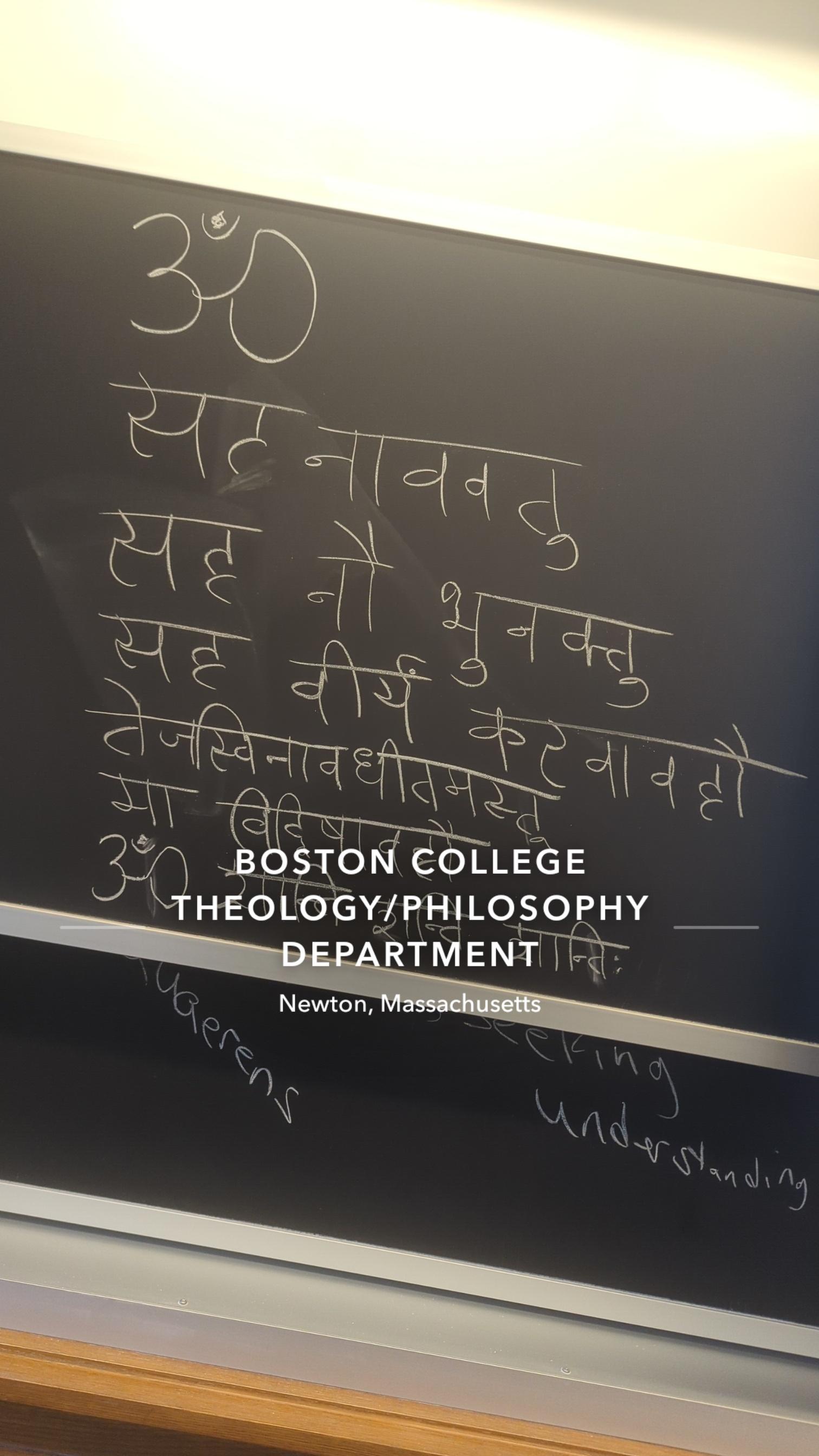
This session marked the beginning of the course "The Religious Quest," focusing on comparative study of Hindu and Christian sacred texts. Brad opened the class by leading the students in chanting a Sanskrit Shanti mantra, "Saha nāvavatu," and provided a detailed explanation of its meaning, emphasizing collaborative learning, mutual protection, nourishment, heroic action, and non-hostility. They then shared their personal journey, transitioning from a successful career in finance (including working at the World Trade Center before 9/11) to studying theology, inter-religious dialogue, living and studying Sanskrit in India, earning a doctorate at Harvard, and their current life on a farm in New Hampshire. The class structure was outlined, dedicating Tuesdays to Hindu scriptures and Thursdays to Hebrew/Greek scriptures. Key course themes like Līlā (divine play), Advaita (non-dualism), and Dharma (ethics) were introduced. Brad reviewed the syllabus, highlighting the podcast discussion assignments, the no-laptop policy (with exceptions), the Saṅgraha-Vistara method, AI policy, and the importance of individual meetings. The session concluded with the first reading assignment: Genesis chapters 1-3.
[SOUND of writing on a board]
Brad: Cool.
Brad: Four MPCs.
[SOUND of writing on a board]
Brad: Everybody read this okay?
Student 1: Yeah.
Brad: Okay. I know my handwriting's a little messy.
Brad: Okay.
Brad: Let's take a minute and just leave everything behind, leave everything outside. Just remember that I forgot to put my jacket on. I was supposed to put it on, then take it off because it's too hot to wear it, but look good. Imagine I'm wearing a jacket. It's right there. It's tweed.
Brad: Om.
Brad: Saha nāvavatu. Saha nau bhunaktu. Saha vīryaṁ karavāvahai.
Brad: Tejasvi nāvadhītamastu.
Brad: Ma vidviṣāvahai.
Brad: Om Śānti Śānti Śāntiḥ.
Brad: So I'm gonna do that again. It's also written over there, if you don't know Devanāgarī. I'm gonna do it again, and then we're gonna do it together. No laptops in my class right now.
Brad: Cool? Good.
Brad: Om.
Brad: Saha nāvavatu.
Brad: Saha nau bhunaktu.
Brad: Saha vīryaṁ karavāvahai.
Brad: Tejasvi nāvadhītamastu.
Brad: Ma vidviṣāvahai.
Brad: Om Śānti Śānti Śāntiḥ.
Brad: Cool? I should probably put that up. Can you see it okay? In the back? Yeah?
Brad: Okay. I also forgot one other thing.
Brad: Sorry. It's not, it's not for everybody. I know, that was so awkward, wasn't it?
[SOUND of rustling paper]
Brad: The rest of you can have one next semester.
[SOUND of rustling paper]
Brad: Okay. So, let's do it together. Cool? Everybody got it down? If you don't have it memorized yet, you can read it. It's cool. All right, let's do it.
Brad & Class: Om. Saha nāvavatu. Saha nau bhunaktu. Saha vīryaṁ karavāvahai. Tejasvi nāvadhītamastu. Ma vidviṣāvahai. Om Śānti Śānti Śāntiḥ.
Brad: That was absolutely terrible. That's not, that was not good at all. It's like the first time you've ever done it.
Brad: All right. Now that you've done it, let's do it again. This time, don't just say the words, like, mean them. You know what I'm saying? Like from the heart. Right? Yeah.
Student 2: What do they mean?
Brad: Oh, I'll tell you that later.
Brad: Alright, let's let's let's do it nice and nice and loud. Make the the chair of the department, like the department chair people, everything is right over there, right? So I really love you to just make them say, what the fuck is going on over there? Right? Right? So like, nice, from the heart. Let's do it. Nice and loud. Word? Cool.
Brad & Class: Om. Saha nāvavatu. Saha nau bhunaktu. Saha vīryaṁ karavāvahai. Tejasvi nāvadhītamastu. Ma vidviṣāvahai. Om Śānti Śānti Śāntiḥ.
Brad: Word. I'll take that. Word. So, this is a mantra from the Taitirīya Upaniṣad. Taitirīya Upaniṣad itself is about 2,500 years old.
Brad: Okay.
Student 3: I just unplugged you.
Brad: Sorry. About 2,500 years old from India and it was Oh, this is, just to clarify, make sure everybody's in the right place. This is Calculus 1.
Brad: So, yeah, the the Upaniṣad itself is 2,500 years old, but that's just kind of when it was collected, from oral tradition, which is way, way older. So, how old is this mantra? Nobody really knows. Super old, right? But way older than 2,500 years. This is a mantra that is, it's one of many mantras that are typically recited by teachers and students together at the beginning of a lesson. Particularly a theological lesson, philosophical lesson, something like that. In fact, the word Saha means together. You can see the word Saha is in there three times. So together, over and over again. So it's something that's recited together. And this word na, nau, naḥ that's in there three times means us. And it's in the dual, right? So us, and the us here is teacher and student. So let us, teacher and student. Let us together be Vavatu. Vavatu means protected. So knowledge is power. If you have more knowledge than the person next to you, you've got an edge, right? If they have more knowledge than you do, they've got an edge, right? So knowledge is power. So let's use this knowledge and wisdom that we're learning together. Let's use it to protect ourselves and to protect the, you know, those that we care about. So let this knowledge and wisdom that we're learning, let it protect us. Saha nau bhunaktu. So bhuj is to eat or food, right? So, bhunaktu here means let us be nourished. Obviously not so much from, like physically nourished. But nourished in other ways, right? Nourished intellectually, nourished spiritually. So let this wisdom that we're learning together, let it be nourishing to our hearts and our souls and our minds, right? Saha vīryaṁ karavāvahai. So Vīryam, Vīryam is a hero. Every time I hear this I always think of this pose. Kind of like Wonder Woman or, Iron Man or something like that. But really I'm thinking of Hanuman. There's this from Indian epic poetry, this character named Hanuman, from the Rāmāyaṇa in particular. And he's a monkey, but he's like a fierce warrior monkey. And he has this ability when, he's got a superpower and his superpower is he can get really big, right? And he does this and he grows really big. There's like this kind of low-key competition between little towns across India to build, like the biggest Hanuman statue. Read this academic article a few years ago from a scholar and the title of the article was, my Hanuman's bigger than your Hanuman. So it's like, heroes, like getting big and, but for the benefit of protecting, right? For to combat injustice. But here it's not a noun, hero, but it's adverb. So, heroically, right? So let's heroically, together, let's heroically karavāvahai. So the word kara is comes from the same Indo-European root where we get the English word carve, right? So carve, kara, meaning something very hands-on, right? It's very hands-on sort of carving something with your hands. So not so much creating something from nothing, but giving new shape to something, carving, creating, right? That sort of sense. So carving, shaping. And and this particular nominal form, or verbal form, it's for the benefit of others, right? So, in other words, let's not just use this knowledge and wisdom that we're learning together in order to get some bullshit grade that really doesn't matter or something like that. It's some credential or something like that. But instead, let's use the knowledge and wisdom that we're learning together to heroically transform the world for the benefit of others, right? So pretty nice little meaning there in those two words. So, let's together, let's use this knowledge and wisdom to protect ourselves, to nourish our hearts, minds and souls, and heroically use it to transform the world for the benefit of others. Tejas. Tejas means light. So like in Latin, lux, right? So not just not just light like, photons coming out of the light bulbs, but like the light side, right? Like Luke and Leia and those kind of like the the light side, not the dark side, the good, the positive, that kind of stuff. Right? naḥ is us. Aditam is like the things that we're accomplishing together, right? So let the things that we're accomplishing together, let them be filled with light. Let them be protecting, let us, protect us, let us let them nourish us, and let's use this knowledge and wisdom to heroically transform the world, right? The last line, Ma vidviṣāvahai. Ma means never at all in any way, never ever, never ever. Never ever Vidviṣāvahai. Vid means like bad words, right? Like, not just like, profanity or something, but like hostile words, right? Like saying mean things, right? So, basically, let's not, no smoke, right? No no hostility, no, when we're when we're studying the kinds of things that we're going to be studying in this course, which are theology, ethics, philosophy, questions of ultimacy and meaning and purpose in life, we are going, if we're doing it right, we're going to have differences of perspective. We're going to have differing views, right? Kind of what the whole point of the course is, is to explore different views. So we're not going to agree on everything. That's not the point of if we all agreed with one another, there would be no point in having discourse at all, right? The point of having dialogue is so that we can learn from one another's differences, right? So let's have this dialogue so that we can learn to see the world from these different perspectives, but let's not let those, even though these are questions of ultimate meaning and ultimate purpose and ultimacy, let's not let those differences and those major fundamental questions turn into sort of hostility or tensions between us, right? So let's it's not just agreeing to disagree, but that's certainly part of it, right? So no smoke, no hostility. Be Irie. So I think Om, we'll come back to Om, we'll unpack Om in more detail later in the semester when we get to the Mandukya Upaniṣad in particular. But for now, suffice it to say that Om is a sacred syllable with profound depths of meaning. And let me give you one tiny bit of that meaning. Which is that the word Om, particularly if it's pronounced, properly, not professing to be one who can do that. But when you hear the sadhus, when you hear the sages in India, chant the word, the the goal is to pronounce all of the vowels, right? So it should sort of seamlessly go from like Ah Om, right? So sort of all of the vowels. And the reason is you can't pronounce any word without a vowel, right? So if Om contains all of the vowels, then in some way it contains all of the words, or like the it's like the you can't pronounce any word without some part of Om would be a more accurate way of saying, right? Like I said, we'll come back to Om later in the semester. Śānti. Śānti simply means peace, and here it's repeated three times. Technically, so you heard me say this was the last line of the mantra. So technically this is one mantra and then this is a separate mantra. This is called the Śānti mantra. The Śānti mantra is sort of tacked on to the, it's the way, it's just tacked on to like a lot of mantras, right? So Śaṅkara, this kid that we'll be studying quite a bit about and some of you had me last semester, we learned a little bit about Śaṅkara. But Ādi Śaṅkarācārya is great Hindu theologian that we'll be learning more about as we go along. wrote a commentary on the Śānti mantra. One of the important principles of Hindu theology, is that every word in the scripture has some meaning, purpose and significance. Nothing in there is extraneous, nothing is pointless, right? So the fact that the word Śānti is repeated three times must it must mean something at least slightly different every time, right? So Śaṅkara reflecting on that says, well the words Śānti obviously means peace, it means peace every time. But a human person is complex, right? We aren't just disembodied minds or something like that. I mean, we might just be, NPCs in Elon Musk's simulation. I think that's increasingly likely. But we seem to have bodies, right? So we seem to have more than just minds. We're minds, bodies and souls, or minds, body and spirit. And so Śaṅkara says, well, perhaps each one of these Śānti refers to that, right? If you can't, you can't study questions of meaning and ultimacy, purpose of life, all that kind of stuff, if you're hungry. If you're hungry, all you're thinking about is what?
Student 4: Food.
Brad: Food. If you're exhausted, all you're thinking about is sleep, right? So, if you're not in a safe space, if somebody's like threatening you, right? physically threatening you, then you can't focus on questions of, ultimacy, right? So it has to be a peace in our bodies. So that's sort of a prerequisite for, studying philosophy, studying theology. So let our bodies be at peace. The second Śānti, of course refers to the mind. Let our minds be peaceful. And here, there's a beautiful metaphor that Śaṅkara gives that I want to share with you. And he describes it like this. Imagine you're, like try to actually picture this in your head. Right? Imagine that you're up in the mountains, you're like going on a hike, for a weekend or something like that. And you're up in some, just out in nature, out in some, mountainous wilderness. And, the sun is set and it's a clear, beautiful night, full moon, stars out and all that kind of stuff. Right? And you come across this pond, right? Like a mountain mountain pond. There's no wind or anything like that. What's the what's the water in the pond going to look like? What are you going to see when you look in the waters of the pond? Yeah.
Student 5: Flat. It'll be flat.
Brad: It's going to be super like like glass, right? Just like perfectly calm, perfectly serene, right? So that's sort of that's what we're going for. this Śānti, this peaceful stillness of the waters. And when it is peaceful and still in the waters, then what do you look, what do you see when you look at the water? Yeah.
Student 5: Reflection.
Brad: Reflection of what?
Student 5: Of nature, yourself.
Brad: All of those things, right? So if you look in, you're going to see yourself more clearly, right? And sometimes we can see ourselves and understand ourselves more clearly when we're in these sort of quiet, meditative, contemplative, right? spaces. But also the world around you and particularly the heavens, right? Seeing the the moon and the stars and the clouds and all those kind of things, right? So, here's the that's the that's the metaphor, right? Let's unpack the metaphor a little bit. Probably most of you got, but so the idea is that the scriptures, the Śruti and Smṛti, the scriptures that we're going to be studying, the scriptures are like a reflection of those heavenly abstract wisdom, right? The meaning and purpose of life and those kind of things. So the scriptures themselves are like these clear reflections of those ancient wisdom that's been passed down. But just because the scripture says this clear it's reflects that wisdom doesn't mean that it's going to get into Ruby's head, right? clearly. As clearly it's written there. In order for that to happen, you've got to have a clear, calm mind, right? Your mind has to be calm and serene in order to receive that reflection accurately, right? What if Ella or some other asshole, comes in and like throws a rock in the pond. How what's gonna how's that going to affect like the the image of the moon and the stars? It's going to like distort it, right? It's going to make it all like you're still going to see them, but you're going to see a distorted view of them, right? And so Śaṅkara's point there is that like if your mind is turbulent, if your mind is distracted, if you're thinking about something else like, why'd she leave me on opened or something like that, then like your your mind isn't going to receive the images, right? the reflection of those more abstract wisdom clearly. You're going to get it, but you're going to get like a distorted view of it. And so a lot of philosophers, myself included, think that if that's the case, then it's probably better not to learn it at all. Right? It's better to not know something than to misunderstand something. It's better to have, especially if you think you understand it. So it's better to not understand it, it's better to not learn it at all than to misunderstand it and feel like you've got it. Makes sense? Right? So, so let's have a peaceful bodies and let's have peaceful minds, and then let's also, peaceful hearts, peaceful spirit, right? Peaceful, open-minded, open-hearted so that we can receive the spiritual wisdom passed from the ancients. Word? Yeah.
Student 5: What is the the 'hi' at the end of the last?
Brad: So, it's, it's just a grammatical thing. It's a grammatical thing and it's more of just like a poetry kind of thing. It's Yeah, it's just at the end of at the end of certain words, they use this little thing. Yeah, I don't know. So, and when you pronounce it, you you don't write it like that. You write it like this, these little two dots there [referring to visarga: ḥ]. But when you pronounce it, usually just kind of like repeat the last syllable or something like that. So it doesn't mean anything. It's just more like a poetic grammatical sort of little thing. Cool? Good? Any other questions? Great question.
Brad: Should we do it one more time? Now that you know what it means? Okay, cool. Let's do it. All right.
Brad & Class: Om. Saha nāvavatu. Saha nau bhunaktu. Saha vīryaṁ karavāvahai. Tejasvi nāvadhītamastu. Ma vidviṣāvahai. Om Śānti Śānti Śāntiḥ.
Brad: Word. Nice. Good job.
Brad: Okay. So, a couple of, I guess the next thing to do would be to tell you a little bit about myself. Some of you, just specifically nine of you, already know me a little bit. But the rest of you don't. So, here's my, my little, my little story. My name's Brad. Prefer that you call me Brad. If not, if you're not comfortable with that, some people aren't comfortable calling their professors by their first name. And if that's the case, Brad is my middle name, so it's, please don't call me by my first name. That shit pisses me off. But Brad is my middle name, so you can call me Brad. Or if you're not comfortable, you can call me Dr. Bannon, Professor Bannon, or Professor Doc, something like that. But Brad's my name, so I prefer, I'm cool with that. That's what I prefer. I self-identify as non-binary, so I prefer they/them pronouns. But not, like hung up on it or anything like that. I am from Spartanburg, South Carolina, so upstate South Carolina. Born and raised there. All my family is still there. I went to visit them over Christmas. First time I've been down there since the hurricane and that kind of stuff. They got hit pretty hard actually. Like my parents used to live in a forest and now they now they don't. So they got hit pretty hard. Fortunately, none of the trees landed on the house though. It's like crazy. It's like the trees literally fell like every way except for on the house. So I went to Furman University for my undergraduate, which is in upstate South Carolina. I majored in saxophone performance. Double majored in so music and finance. And, yeah, after I graduated, I got married. I have a bad habit of that. Trying to stop. And I married my accompanist. Quick story. I was for for Christmas, down there with my family, hanging out with my dad and, conversations kind of hit a lull, or whatever. Just kind of quiet time and dad trying to fill the silence decided that the the most appropriate topic would be my first wife. So he's like, hey, how's your first wife doing? I'm like, Who asks that? Then I couldn't get it out of my head. So I'm like, well, I better Google her and like find out, what's the latest or whatever. So I Googled her and yeah, it turned out that she won a Grammy last year. So, cool. She already had a Tony, so she was halfway to an EGOT. It's just one of those things. Usually she pops up in interesting places like when I found out that she she taught at Boston College and was teaching you and St. Thomas. Or the fact that we had both moved to Bangalore, India at the same time. Yeah, and anyway. Yeah, she's she's pretty dope for sure. Why? Why, why, why are you asking about her? That's just why it's so awkward. Let's move on. So got married, moved to New York City. My wife's big Broadway star, all that kind of stuff. I went into finance. I got a job working at Morgan Stanley Dean Witter on the 73rd floor of Tower 2 of the World Trade Center, which used to be in Lower Manhattan. And, I worked there from '99 until 2001. I left there before the 9/11. But just months before. And, when, by the time that happened, so when I was 24 years old, I was self-made millionaire. I was associate vice president of Thompson Institutional Services. I was third in line in the company, this institutional trading firm. And, I owned a four-unit apartment building in Manhattan. And 50 acres of land right outside of, I mean, an hour outside of Manhattan that I was planning on building a farm on. And, then September 11th happened and, climbed up on the roof of my apartment building with one of my tenants and watched my old, office building burn and collapse to the ground. And during that time, I was just, it caused a lot of introspection, right? Just kind of asking myself, what is, like, what if I died tomorrow, right? Or what, what is the meaning and purpose in my life? Am I doing something that, when I'm at my deathbed or something, I'll feel like I, used my life well or whatever. And I decided that the answer was no. That I wasn't that I was enjoying finance and all that kind of stuff. I was obviously doing okay in it. But, it just wasn't really fulfilling in a lot of different ways, right? For me at least. And so I left finance, got divorced, collect ex-wives. And, went to went to seminary. So I went to Drew Theological Seminary in Madison, New Jersey. Was there for three years, mostly to study inter-religious dialogue. That's I wasn't exactly sure what I wanted to do. I just knew that I I knew what I wanted to study. Does that make sense? So I knew that that's what I wanted to study. I wanted to study inter-religious learning. I wanted to study my own tradition and, for various reasons, I've been drawn to Hindu Hindu, my best friend was Hindu when I was a kid. So, just raised all these questions that had been unanswered. And that led me to seminary. I studied with this guy, Wesley Ariarajah, my guru, my mentor. And before he was at Drew, he was, director of Interfaith Dialogue for like two decades at the World Council of Churches in Geneva. So basically traveled all over the world like doing inter-religious dialogue at a at the highest level, right? So really building bridges and that kind of stuff. So studied with him. And then he, encouraged me, strongly encouraged me to, to explore more by moving to India. So when I graduated from seminary, got married again. And then moved to India. Lived in Bangalore, India, when, Eminem dropped curtain call. So I'm like driving my, my motorcycle all over the streets of Bangalore, like rapping to Slim Shady. And, as one does. And, studied, I went there to to study, mostly I went there to study Sanskrit. I mean, mostly I went there to live in India, but I also went there to study Sanskrit. So, in addition to doing my second masters, which is in comparative comparative philosophy, really focused on ecological ethics. In addition to that, I also studied with the guru, Suresh is his name, who learned Sanskrit in the very traditional school. He went to Shringeri Matha. He's from Shringeri, which is in lower is in Southern India. And he had studied at the Shringeri Matha, which is a very traditional, it's traditionally founded by Śaṅkara, the guy I was talking about earlier. So centuries old. And anyway, so and after we'd studied for a year or so, just basic grammar and that kind of stuff. Then we started studying the Bhagavad Gītā, which we'll read later in this semester. So we started studying the Gītā. That was the first time that I began studying the Gītā. So that was kind of cool. Then moved to Somerville, Massachusetts to do my doctoral studies at Harvard. started having kids. stopped at two. But so my daughter, Līlā is now 16. She stole my Jeep. And, my son Cyrus is almost 14, be 14 in March. And, together, the three of us live on a nine acre farm in Southern New Hampshire. Got I graduated in 2015. and started teaching here actually in 2016. and teaching a course called the religious Quest, which I'll get to in a second. And so we live there. Nine acre farm, with the cow, milk the cow every day. And calf, her name is Dandy and she's so dandy. She's, she was born in May, so she's like what, seven, eight months like that. And three cats and a dog and as some of you saw before class, a new puppy that we just got. and she's 11 weeks old today, actually. German Shepherd named Renny. Our other dog is called puppy. So it's super complicated because we have a puppy now, but then we can't call her puppy because if I call her puppy, then puppy gets mad. She's like, my name's puppy. Why are you calling her? She's, yeah, I realized that I was really upsetting her. So anyway. Cool? Word? I think that's pretty much everything you need to know about me. Try to grow as much as my own food, meats and weed and stuff as I can. And not fully self-sufficient, but that's sort of the that's sort of the goal. Cool. So, I've been teaching this course it's I when I taught the course back in 2016, 17, 18, 19, it was a year-long course. So like philosophy of human person is and some other you have a couple of courses that are year-long courses. This was one of those. This was a year-long course. And they decided to stop that. I don't know why. I think that it was great to have, students two semesters in a row and to, you can accomplish a lot more when you have familiarity, right? So it's super dope that I've got nine folks in this room who I had last semester. 14 in the other section than the same boat. And anyway, what else about it? Let me let's let's see if you have any questions. You have any questions about anything? Okay, some questions. Yeah, in the back.
Student 1: I was wondering, how long is your commute commute each day?
Brad: Yeah. Yeah. Without traffic is two hours. But it usually takes me three in the morning and about two, two and a half in the afternoon. So, it's not, it's not small. Yeah. And I oh yeah, I also teach at Fitchburg State University. So I'm here on Tuesdays and Thursdays, and then I'm at Fitchburg State on Mondays and Wednesdays. And there my commute's only 25 minutes, gorgeous. But, yeah. Yeah.
Student 5: After your career in finance, just kind of curious. You said you knew what you wanted to study, but not what you wanted to do. How did you know what you wanted to study?
Brad: Just really had a lot of questions, right? I had a lot of questions about meaning and purpose. I had a lot of questions about why is there I mean at that time after, September 11th, there was a lot of religious hostility, hostility between religious parties. Now we do it mostly between political parties. But, but that, I just I don't know, I just really wanted to answer some of those questions about what do we do about the diversity of religious traditions and the diversity of these kind of things and what are we called to do and how to make sense of all this kind of stuff? And also just realizing, how much I didn't know from other traditions and just really, really felt drawn to Hindu theology in particular. And the deeper I went into it, the more I wanted to explore it. So, yeah, I think that's it. Just had a lot of questions and a lot of things that I wanted to explore. I knew that I I kind of thought like maybe teaching might be something I was interested in. I was ordination track for a long time. So, yeah, on track to be an ordained pastor. Then I discovered that I I don't have the best like pastoral skills. I say fuck a lot and that kind of stuff. So, I decided that I'm super interested in the theology and exploring the sacred texts and stuff. And so teaching seemed to be good. Yeah, great question.
Student 3: This is more of a random question, but you talked about weddings in India. I'm going to an Indian wedding February, so I'm just wondering, have you ever been to an Indian because I heard they're like they last like seven days. It's like super massive, so.
Brad: Yeah, I mean, it's sort of like weddings here. There's, there's all different kinds of ways to do it. Yeah, I've only been, I only went to one, yeah, one wedding when I was there. And that was because my my guru, Suresh was one of the priests and it usually there's like a lot of priests involved in it and they'll do karmas. Karma means karma is a religious ritual. And so they'll do these, yeah, mostly chanting in Sanskrit from from the Vedas and that sort of thing. And so the seven days, that's most most of that is just the priests doing stuff. So a lot of the times the bride and groom aren't even involved in a lot of that kind of stuff, but the priests will be doing those sort of things. Yeah, happy to talk about it more sometime. It's not something I know a whole lot about, but when are you going?
Student 3: I'm going February 27th.
Brad: Okay, cool. Nice.
Student 3: In India?
Brad: In India? Yeah, New Delhi.
Student 3: New Delhi. Okay, cool.
Student 4: I live in New Delhi.
Brad: Oh, really? Yeah.
Student 4: I'm an Indian, that's why I'm saying that. Yeah. Like I attend Indian weddings all the time. Like I just had my brother's wedding before I came here.
Student 3: Oh, I'm going to a friend's brother's wedding.
Student 4: Oh, yeah, makes sense. Like yeah, New Delhi is known for its weddings. I like, yeah. Like so even if you go like somewhere out of the state, like out of New Delhi, you get someone married, it's like a four days long tradition. Yeah, that's why. So like here like if you like just propose and like, you're engaged, but there it's like a two-day thing to get engaged. It's not that easy. And it's like a year-long thing to get married.
Brad: Cool. Word. And so you said your brother just got married? Yeah. Cool. Nice. Any other questions? Comments? Cool. All right.
Brad: So, let's take let's take a short break to chat with each other. Some of you already know each other. Some of you don't. So I really like you to, ideally try and meet somebody that you don't know, or at least, chat with the folks around you. We're going I do a lot of team-based learning and a lot of a lot of discourse, a lot of discussion. And we're actually going to play a lot of games this semester too. So I'll say more about that and they'll be team-based team-based games. So part of this, we're not we're not going to pick teams just yet. We'll probably take my goal certainly to have teams picked by the end of next week. Yeah, Addison.
Student 2: This is more just like kind of, I don't want to call it administrative, but like Tuesday Tuesday nights you still won't respond to anything, right?
Brad: Tuesday nights? I don't know. I mean, it depends. Yeah. I depends on a lot of things. Usually I'm pretty tired on Tuesday nights. But, and also I play, I play, I have a game night on Tuesday nights. Yeah. Video games. It's a game called Age of Empires. Yeah, you know Age of Empires? Yeah, so we play Age of Empires every Tuesday night. I play with all these like tech bros, like all these like Silicon Valley folks, like startup people and that kind of stuff. So, yeah, so but, Tuesday I I did try to have office hours on Discord on Tuesday evenings, but I usually am pretty like spent on Tuesday evenings, so so, yeah. But I my Discord is on there on the syllabus. So, I don't know, you can always try me or something like that. Also, we'll go over the syllabus in a few minutes, but one of the first things that we'll do in the semester, 5% of your grade comes from meeting individually with me. And I like to do that if at all possible within the first four weeks, trying to meet with everybody in the first four weeks. I have five classes, two universities, and a long commute, and homestead, and that kind of stuff. So, we'll cram as many as we can in. But I think what I'm going to do is on Fridays, you can schedule meetings with me on Fridays, but then you could also like if you don't schedule a meeting on Friday, but you want to see if I'm free last minute kind of thing, then you can hop on Discord and see if I'm in my so I have like a little office hours, on my Discord server. So, Oh, for the nine folks that had me last semester, if you since we've already had that initial meeting where I got to know you, if you want, if you play Fortnite and you want to run squads or something like that, then then yeah, we could do that. This is my epic ID. Beck_1401. Yeah, it's why it's there. Yeah. Beck just because like Beck has been my gamer tag since I was like 15. And 1401 as you as you know is when Nicholas of Cusa was born, so Uh, cool. Yeah.
Student 2: What do you think of the OG season?
Brad: Yeah, I thought it was, yeah, it was good. I like, yeah, I like the Yeah.
Student 2: Wait, the nine original students that were in your class last semester, if you play Fortnite with you, that's counts as our five-minute meeting?
Brad: 15-minute meeting, but 5%. Yeah. Mhm. Yeah. Oh. Word.
Student 2: You played the new ballistic mode yet at all?
Brad: Yeah, I did, actually. Yeah.
Student 2: Did you enjoy it?
Brad: Yeah, it was pretty good. I mean it's kind of like, so that's like Valorant, right? It's like Valorant. Yeah.
Student 2: I'd say it's more like CS, but you know, that's just
Brad: CS? Counter Strike? Okay, I haven't played Counter Strike, so. Okay. Yeah, but it's like the same maps as Valorant. Like
Student 2: I think it's just because they have like similar animation styles.
Brad: Okay, I don't know. Anyway, yeah, sure. Any other questions? All right, take take a few minutes, we'll take five minutes now, just to chat and also get the the computer up and then we'll kind of go through the syllabus together. But take five minutes just to kind of chat with one another. Get to know some, especially get to know somebody.
[small group discussion]
Brad: Okay. I'm going to do attendance in a second. One thing I before I forget, so I have pretty severe ADHD, and so I they I really can't sit still. I can't even imagine sitting there for 75 minutes paying attention to a lecture. I would like I would I mean I did it for a long time, right? 16 years of college as a student. That's crazy, isn't it? Four years of undergrad, three years for my first masters, two years for my second masters, and seven years for my doctorate. So, I did it a lot, but I don't think I could do it now. And I pace a lot, I walk a lot during the class. And so I had a student a couple years ago that she was like, I can't sit still for an entire class. It was like nothing else here. I just can't sit still for an entire class. I'm like, well, I can't either. So, get up, walk around. It's cool. And so she she would pace back and forth along the left side of the class while I was pacing back and forth along this side. We got into a little choreography kind of thing. Somebody in your class last semester that would get up and stretch and stuff during class. It's totally cool. It doesn't bother me at all. I like low key kind of curious about what would happen if all 32 people just got up and started walking around. I don't know, but we'll cross that bridge when we come to it, I guess. So all that's to say, if you need to get up and go to the bathroom, if you need to get up and just stretch, you need to get up and walk around, it's cool, right? You don't need permission for any. You're adults, so and that doesn't bother me. All right, let's do attendance real fast. So we've got Jack, and we've got Ruby. Cameron. And, and please let me know if I mispronounce your name or if you prefer a different name. Jorge? No. Ella. Luka? Molly? Allison? Allison Height? Nope. Georgia? Vanya? Jaline? George? Gil? Eric? Ots? Did I say it right? Ots? Stella? Andric? No, Andric Mora? Mary Mullen. Hi. Lauren? Addison? Jose? Reagan? Lyanna? Serena? Serena? Serena. Matthew? Avery? Ndea? Justin? Luke? Drew Williams? Andrea? and Camel. Okay, anybody I didn't call? Can't be right because we've got three absences and no empty seats. No, we've got one. All right. Okay. So I didn't miss anybody's name? Everybody? Okay. Cool. I will I I typically do attendance all semester long. But but it definitely for sure helps me to get to know everybody's names at the beginning. I try to learn everybody's names as soon as possible. That's really hard for me to like lock it into my brain until we've had that one-on-one individual meeting. And then after that, hopefully I should have it down.
Brad: So, yeah, let's try and go spend the remaining time going through the syllabus. So I didn't print out the whole syllabus for you, but I did print out the the last two pages of the syllabus. So last two pages are the full agenda for the entire semester. And as you can see, we will be spending with only only very few exceptions, we will be spending Tuesday studying Hindu scriptures and Thursday studying scripture Greek and Hebrew scriptures. So the only exception to that is kind of unit two is well we're going to focus all on Hindu material for that one. But for the most part, we're going to go back and forth all semester. You will see and some students get, I'll say more about this later on, but some students are very surprised that there's not a lot of comparison in this course. We're not going to do a lot. The way that my mentor, Frank Clooney, who founded this course way back 35 years ago at Boston College. The way I learned from him, the way he's taught, the the comparison only happens, it kind of emerges out of the deep dive into each tradition. So you really want to study each tradition on its own, really allow let it have its integrity, really study it, from its own, on its own feet, so to speak. And then the comparisons kind of come after that happens. So we're mostly going to spend, like I said, Tuesdays on Hindu material and Thursdays on Christian material, and then the comparisons will kind of emerge after and out of and through that. But there's not really a lot of time that we're going to spend explicitly comparing the two. But sometimes it'll be hard to avoid. So if it's hard to avoid, you shouldn't avoid it, right? Let it come out. There's my email address. I don't really I don't really I'm really, really, really bad at email. and I am making no effort to get any better. So I'm going to remain bad at email. There's my discord. In order to schedule appointments with me. So my office hours will be on Tuesdays immediately after this class and my office is like right upstairs here. So, so for most of you, if you don't, if you have a free period after this, it'll be easy to knock out that meeting or any other meetings with me, just then. But if you if you're not free during my office hours, which are Tuesdays 1:30 to 2:30, right upstairs. Then you can schedule meetings with me. Just click the link. I did block out this Friday, just because I have a lot of other work that I need to do. Because I'm behind. But so you see starting next Friday, I've got pretty much from 9:00 a.m. until 2:30, 2:45, 3:00, pretty much every Friday. So, to schedule a meeting with me, just come in here, click, fill out your information. Doesn't matter which email address you put in, just as long as it's correct, because that's how you'll get the link to the meeting. As soon as you, book this, then it will block that out on my calendar so nobody else can book that time. It will send me a link. It will actually put it on my calendar, on my Google calendar. So, so no need to like tell me that you booked a meeting or any or confirm or anything like that, right? Just book it. I will be there. And so I do expect you to be there. So pretty straightforward there. Oh, also, if you do need to cancel, so if you schedule one of those meetings and you have to cancel, please cancel with, as much advanced notice as you can. If you cancel the day before, doesn't phase me at all. If you cancel 10 minutes before, it's going to irritate me. So avoid doing that. But cancel if you're not going to show up. But the best way to cancel it is don't send me an email. I don't do email. I already said that, right? If you need to cancel it, when you when you book it, you will get an email that has the link in there and that email will also have a cancel button. So you hit click that link, click click that cancel button and it will cancel it. Quotes. No laptops. This is this is like a table of contents. So, I'll let you go through the course content the the course syllabus on your own time. We're not going to go through all of these through all this. But I will read some of the things to you now. So course description. The religious quest, creation, creativity and recreation or recreation. Got a clear double meaning there, right? With that word. So recreation meaning play or Līlā, but also recreation, sort of like the Karavāvahai, creating, like shaping, reforming society, those sort of things. So, certainly say more about those that little Trinity there as we go through the course. In Hindu and Christian sacred texts. This is for those of you who had me last semester, this unlike that class, this is this was really an intro to theology class. This is a sacred text class. So we're really going to everything is grounded in the scriptures. So every class we're going to focus on scriptures. And it'll be different scriptures. And Tuesdays, like I already said, will be Hindu scriptures and Thursdays, Greek and Hebrew scriptures. So, this course invites students to explore fundamental human questions, questions of first principles through sacred scriptures such as God, self and society, right? Who am I? What's this world that I find myself within and what's my purpose or meaning? Why am I here? By examining creation myths, most of it we're going to look at more than just creation myths, but we're going to focus a lot on creation myths. Beginning with Genesis 1 through 3 on Thursday. epistemologies, ontologies and ethical teachings from both Hindu and Christian traditions. This course fosters dialogue between diverse perspectives. Anchored in Śruti and Smṛti on Tuesdays and Hebrew and Greek Testaments on Thursdays, students will closely examine the fourth gospel, usually called the Gospel of John and the Bhagavad Gītā to engage with themes of divine play or Līlā, non-dualism, Advaita, and ethical responsibility or Dharma. Integrating ecological, feminist and liberation theologies. This course challenges participants to view sacred texts not merely as ancient records, but as dynamic, sort of living, changing, breathing resources for meaning making in today's and our pluralistic world. I try every semester to have like a thesis statement of the course, like the core, trying to sum up as much of the course in one sentence as I can. And so here's that sentence for this course. Together, so bringing bringing the Saha mantra that we started with, that togetherness. Together, we will faithfully seek to understand and those of you might recognize, right? St. Anselm's definition of theology. If you don't, that's okay. We'll come back to it. But a faith seeking understanding. So together we will faithfully seek to understand the diversely creative ways that humans who identify as Hindu and humans who identify as Christian, how they make meaning, how they value creation, how they respond to injustice and playfully recreate a sustainable future. And as I assume you already know, this meets the core requirement for theology, sacred text and traditions. I for for some reason didn't have enough to do this weekend creating syllabuses for my five courses. And so I decided decided not just to write the course learning objectives for this class, but to translate them into Sanskrit, and write them in Anuśloka form. Flex. So I I'll read the first one to you in Sanskrit and then we'll kind of dive into the the first one and then I'll just read the English translation on the other ones. Sat Darśane Abhiṣikte Sṛṣṭi Samyak Niritam Dharma Jñānam Cha Bhuta Pritvim chi Vivate. Flawless. Within this Ṣaḍdarśana. So this word Ṣaḍdarśana, we'll discuss sorry, just this part. Ṣaḍdarśana. ṣaḍ means in this context six and Darśana means view or like way of seeing. means to see. So Ṣaḍdarśana is like the six ways of seeing, the six perspectives. They're usually referred to in English as the six orthodox schools of Hindu theology. But I feel like school really kind of loses the sense of that perspective, right? The seeing part of it. So Ṣaḍdarśana. So we're going we're not going to have time to study all six of them in the detail that I would like. So we're going to focus mostly on two or three. And those three will be Pūrva Mīmāṁsā, which is ritual ritual theory school, school of ritual theory. Advaita Vedānta, which is a much more widely studied tradition. And we'll do a bit of yoga. Yoga is one of the six that so we'll do those we'll focus on yoga more towards the end of the semester. So within these six perspectives and Abhiṣikta traditions. So Abhiṣikta is a Sanskrit word which means anointed one. So sort of a reasonable translation of Christos or Christ or Messiah. So within these Hindu and Christian traditions, let's creation, Sṛṣṭi, but Sṛṣṭi also kind of means really has this sense of like unfolding, kind of like like evolving or spooling out. So sort of this unfolding. So creation in terms of like this unfolding. Let that creation be thoroughly examined. Let's Dharma or ethics and Jñāna. Jñāna is really like wisdom, right? So not quite knowledge but wisdom, right? So something particularly kind of knowledge through experience. So let those things be discerned and may one also contemplate the the earth. So I'll let you read through read through the syllabus and read through these between now and Thursday. may have a quiz or something like that on Thursday. We also focus a lot on Līlā. Līlā as I think I mentioned, is my daughter's name. Līlā means play. So creation or that recreation aspect. So may divine play or Līlā be contemplated which resides in both philosophy and ethics through devoted ritual and enthusiasm, let it lead to fresh creativity. Third, interreligious dialogue. So among diverse viewpoints, let there be dialogue considered feminist perspectives and worldly wisdom, reflect upon paths of liberation and act for the welfare of all. We'll yeah, kind of yeah. May one always practice both. Okay, so this Saṅgraha Vistara. So I will this is a really central focus of the semester. As I was designing the course and designing everything, I really wanted this to be a core focus of our attention this semester. this so I want to not just that's why it's one of the learning objectives. I want to teach you this method. I want you to understand this method, but also I want to practice this method. And so that's why I wrote the the learning objectives in the way that I did, which is Saṅgraha, Graha is a Sanskrit root that it's the same Indo-European root where we get the word grasp. So kind of like Kara, it's a very hands-on, right? hands-on, so grasping. And Saṃ- means together. So Saṅgraha means like grasping together. think of like collecting, right? So like let me gather from here, gather from here and kind of pull things together. And then Vistara is like exposition, exposition, like spreading out, right? So the idea of this practice, Saṅgraha Vistara method is writing philosophy, kind of boiling things down to like these core aphorisms, right? These core little short like pieces of wisdom, right? Like a stitch in time saves nine or something like that, right? would be an example. But then, the Vistara is like the elaboration, the explanation of it, right? So you may have as we get when we get to the Bhagavad Gītā, you'll see the whole Gītā is written in these śloka verses. It's a very short aphorisms, but then you'll have commentaries by Śaṅkara and others that will go on for pages and pages and pages sort of unpacking the rich meaning of those, right? And to really understand the aphorism, you need both. You need the short boiled down version, but you also need the expansive commentary thereon, right? So that's So may one always practice both Saṅgraha and Vistara in study and teaching of sacred texts, use broad applications wisely and illuminate the traditional pathways. This those of you who know me and probably the rest of you have already started to figure out I'm pretty I'm pretty into artificial intelligence and pretty hardcore into artificial intelligence. really thinking my field of expertise is in epistemology. So really thinking about AI and knowledge learning systems through knowledge graphs and a lot of sort of, machine learning, AI kind of stuff. So, yeah, there's there's just so much that's why I was really drawn back to Mīmāṁsā and Saṅgraha Vistara, which I know those things may sound completely disconnected. Actually, you don't know what any of them means, so. Anyway, we're going to talk about a lot of shit. It's going to be way cool. And then, may one integrate creation, relationship, unity, and diversity as a shared foundation, bringing them into discussions and writings, thus cultivating inner realization. And this bonus objective, there's a bonus objective I aim for you, like hardcore, to understand that the word karma means action, work, or Vedic ritual, has some other meanings too, but it doesn't mean any of the things that Taylor Swift says it means. Like literally none of them. Like so, Assignments and grading. So, probably even those of you haven't had me before, maybe you've heard through the grape vine or whatever that I use podcast discussions as a major part of my pedagogy. And so, as I said, we'll organize in we'll organize into teams over the next, week and a half. And that'll be that's the bulk of your grade is these podcast discussions. There's lots of lots about that in the syllabus, so I'm not going to read that to you, especially since we're running out of time. But please look over that. Attendance participation and quizzes is only 20% of your grade, so it's not major, chunk of your grade. Yeah, has more to do with like the pluses and minuses at the end usually than determining anybody's grade. My rules for making up making up absences. I treat all absences the same. It doesn't matter why you're absent. I don't need to know. You're all adults. I assume that you have perfectly good reasons for being absent. And so I basically give you a way to make up any absences that you have for whatever reasons you have them. So please read that policy so that you're familiar with that and the rules thereof. It does say in here that, generally you should make up the absence within three weeks. And that is true, but in the beginning, my priority for the next few weeks is meeting individually with every student. So that's so we're not going to do any makeup absences until I meet with most folks. So that means that I'll be even more flexible with that sort of three week thing. Leadership days. I'll let you read about that since we're running out of time. But the the super fast version is, if you have a podcast of four people, then you'll have you should have leadership A B C D, right? And then so we have basically yeah, I'll say read the syllabus about that. And then final comprehensive podcast exam. So this is going to be exactly like we did it almost exactly like we did it last semester. So it'll just be kind of like we'll do the exam as a group, you and your podcast team, meeting with me at the end. Again, I could say more about that later. Yeah. Certainly not going to read all of this. Course policies. So yeah, I do have, I don't know, a little bit of a schizophrenic policy on on computer devices because I really don't want to have screens or computers in the classroom. I only recently started using like screens in the classroom because I really like to avoid them. But I also teach, like sustainability and care a lot about that kind of stuff. So I don't know. So that's why that's the ambivalence in there, I guess. But so computers are not to be used to read digital readings or to take notes. For the purposes of these rules, a computer includes anything with a keyboard. Using your computer prevents you from fully engaging in the course, distracts other students and the instructor, especially me, like I already mentioned, I have pretty severe ADHD. And if I see somebody on a screen, it just like, I don't know, my brain just like, ah, just breaks. So if if you have to, I think I already said this, but if you need to get in touch with somebody, if something's going on in your life and you're like, I can't be out of contact with family or something because grandma's sick or something. That's fine. Just leave, right? Just step out of the class, right? I'm not really concerned with people going in and out, I mean if it becomes too much, that's something, but if you have to, if you have to text or something like that, just step out. Cool? And do what you need to do and then come back in. Tablets without a keyboard, with that you're using a stylus. I don't really have an issue with that. I feel like that's fine. So if you're taking notes and you would be taking notes with paper and pen, but you're using a stylus and a tablet. As long as you're not like, looking shit up or checking DMs or that kind of stuff, then it should be should be fine. The exception here is registration. So when it comes time for course registration, if your registration happens to fall during my class, just talk to me at the beginning of class that day and be like, I got to log in and do my registration halfway through class. Like been here long enough. I get it and certainly if it's an option between, skipping class to do registration or being here and doing it in class, I'd much rather you be here doing it in class. No text to purchase. I updated my AI policy. You might want to look at. Yada yada yada.
Brad: So, in the 30 seconds I have left, for this Thursday, I don't I I will usually give you either a printed text or at least have it online. That's part of what I'm going to do this weekend. But I don't have that for this Thursday. This Thursday, we're going to look at Genesis 1 through 3. Chances are pretty good that some of you have read this text before. Whether you've read it a million times like I have or never at all, regardless, I would like you to read it between now and Thursday and come ready to discuss it. We're going to focus probably mostly on chapters two and three, but we will look at one too.
Student 4: Are the quizzes about the readings or what you teach in class?
Brad: The quizzes, so the only thing I want to say about the quizzes is that it's the relationship between your quiz grade and your participation grade is not at all straightforward or even mathematical. A lot of times I'll ask questions or I'll give quizzes, and they they have an impact on your grade, but it's not a direct. It's not like an average of your quiz grade or something like that. So the quiz grades sometimes I have quizzes at the beginning of class, which will be about the readings, and sometimes I'll have quizzes at the end of the class about the things that I talked about that day. So, yeah. Word. Cool. All right, see you all on Thursday.