 ```html
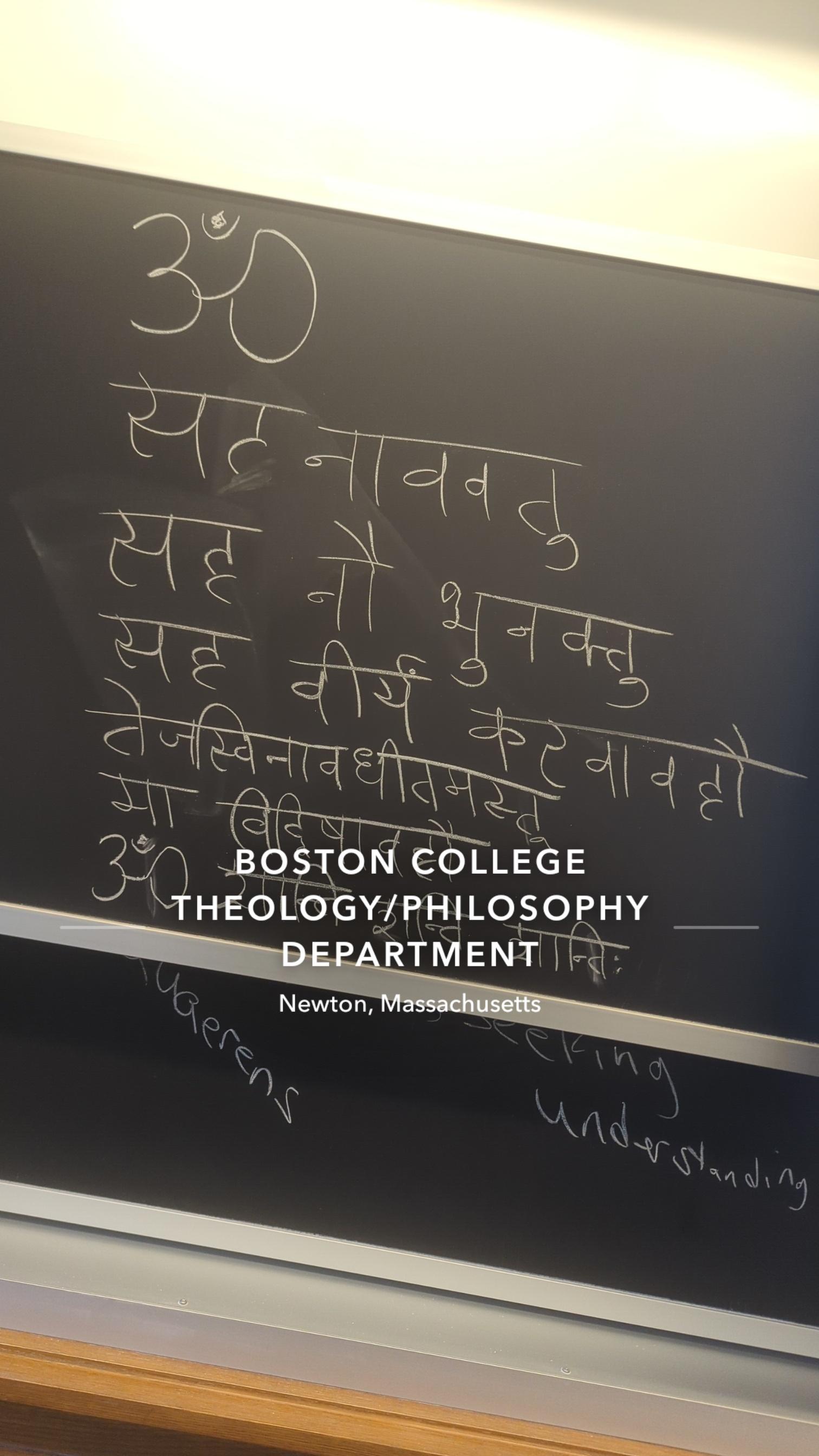
This session marked the beginning of the course "The Religious Quest (Theology 1432)". Brad opened the class with a traditional Sanskrit mantra from the Taitirīya Upaniṣad, chanting it first alone and then leading the class in recitation multiple times. They then provided a detailed line-by-line explanation of the mantra's meaning, emphasizing themes of togetherness, protection through knowledge, nourishment, heroic action, light, and avoiding animosity. Brad introduced themself, sharing their academic background (music, finance, theology), personal experiences (including being in NYC during 9/11 which prompted a life re-evaluation), studies in India (Sanskrit, Bhagavad Gītā), time at Harvard, family life, and current homesteading lifestyle. They outlined the course structure, focusing on the comparative study of Hindu and Christian sacred texts (Tuesdays for Hinduism, Thursdays for Christianity), with specific attention to creation, creativity, recreation/play (*līlā*), non-dualism (*advaita*), and ethics (*dharma*). Brad discussed Anselm's definition of theology (*fides quaerens intellectum*), the course objectives (written in Sanskrit *śloka* meter), and the importance of *saṃgraha* (summary) and *vistāra* (expansion) in studying texts. They reviewed syllabus details, including grading (attendance, participation, quizzes, leadership days, podcast discussions, final exam), policies (no laptops, absence policy), and introduced the team-based learning approach. The class included a brief small group discussion for students to get acquainted and concluded with the assignment to read Genesis 1-3 for the next session.
Brad: Now we can start.
Brad: Everybody read good, okay?
Brad: Can you see this clearly? Or not?
Brad: Let's take a moment and just leave everything outside. Be fully present.
Brad: Om
Brad: Saha nāv avatu
Brad: Saha nau bhunaktu
Brad: Saha vīryaṃ karavāvahai
Brad: Tejasvi nāv adhītam astu
Brad: Mā vidviṣāvahai
Brad: Om Śānti Śānti Śāntiḥ
Brad: Hi.
Student 1: Hi.
Brad: So I'm gonna do it one more time, and then we're all gonna do it together. Feel me?
Brad: Om
Brad: Saha nāv avatu
Brad: Saha nau bhunaktu
Brad: Saha vīryaṃ karavāvahai
Brad: Tejasvi nāv adhītam astu
Brad: Mā vidviṣāvahai
Brad: Om Śānti Śānti Śāntiḥ
Brad: Alright, everybody ready to do it? Ready? Anybody opting out? Let me know now so I can make it awkward. Alright, where? Let's go ahead.
Brad & Class: Om Saha nāv avatu Saha nau bhunaktu Saha vīryaṃ karavāvahai Tejasvi nāv adhītam astu Mā vidviṣāvahai Om Śānti Śānti Śāntiḥ
Brad: Not bad. Just to be clear, this is Calculus 1, right?
Brad: Alright, let's do it one more time. This time like you really mean it, alright? Like from the heart. Don't just say the words, but, you know, put, put all the feeling and emotion behind it. The office, the chair of the department and everything are right around the corner, so really make them, you know, wonder what the fuck is going on in here, right? Cool? Nice and loud.
Brad & Class: Om Saha nāv avatu Saha nau bhunaktu Saha vīryaṃ karavāvahai Tejasvi nāv adhītam astu Mā vidviṣāvahai Om Śānti Śānti Śāntiḥ
Brad: Alright, not bad. So this was a mantra. It's about, well, comes from the Taitirīya Upaniṣad.
Brad: And the Taitirīya Upaniṣad is roughly 25, 2600 years old, as a text, but it's really a text that's a collection of a lot of oral traditions. So this particular mantra is certainly way older than that. How old? Who knows? This is a mantra, one of very many, that are typically respond typically recited together by teacher and student at the beginning of a lesson. In fact, the word Saha, which you can see comes up begins each of the first three lines. Saha means together. And so it's supposed to be recited together, teacher and student together. So the together means the two of us. In fact, nau also means the two of us. It's a dual form. So, let us together, let us together be Vavatu. Vavatu means protected, right? So knowledge is power. If you have more knowledge than the person next to you, you have more power than the person next to you. If they have more knowledge than you, then, right? You get it. So, let us be protected by what we're learning. Let this knowledge be something empowering, be something that protects us, enables us and empowers us to protect the people around us, right? So we're not just learning things for the sake of learning things, but we're learning things because it can protect us, right? Sahanau Bhunaktu. So, bhuj means to eat and Bhunaktu means nourishment, like food, like nourishing, really. So, here, not so much meaning, you know, physical nourishment, as well, but in more in terms of mental, intellectual nourishment, spiritual nourishment, right? So those sort of nourishing the soul, nourishing the mind, right? So together, let us be nourished by what we're learning. Again, it's not just some sort of self-masturbatory exercise that we're doing, learning for some who knows what reason or to get some grade or something, right? But we're learning because the things that we're learning are things that can protect us and things that can nourish our hearts and minds, right? Sahavīryaṃ Karavāvahai. So Vīrya is, Vīryam is a hero. I can't read that line without kind of thinking of, I know this looks more like Wonder Woman or something, but Hanuman. Hanuman is this hero, in Indian philosophy and Indian, poetry and always does this and when Hanuman is being, when he's coming to the rescue or whatever, he can grow in size. So he's a monkey, but he can become gigantic. There's actually kind of a low-key competition in India among these little towns, to build like this massive, you know, Hanuman statue. Read an article by a scholar a couple years ago and the title of the article was, My Hanuman is bigger than your Hanuman. So it's like all these, you know, towns that are like competing to build these huge massive Hanumans. So anyway, Hanuman is a hero and here Vīryam means hero. But here it's an adjective form. So, sorry, it's an adjectival form. So it's an adjective, right? So not so much hero but heroic. So let our learning be heroic, but actually heroically, let's heroically Karavāvahai. So Kara means, it's where we, it's from the same Indo-European root where we get the word carve. So like carving something out of clay or carving something out of stone or something like that. So Kara really means sort of like hands-on making, hands-on shaping, hands-on carving, right? Usually translated as something like, well I think giving shape, giving shape really makes sense. And here it's in the, here it's in the, the dative, it means like for the benefit of others, right? So let us, again, not just learning because we're trying to get some bullshit grade or because we're trying to get out of Boston College and go like some make lots of money or something like that. But the things that we're learning, we should use these things heroically, bravely, courageously, use what we're learning, using this wisdom to heroically transform the world for the benefit of others, right? So it's a nice little nice little two-word phrase there. So together, let us heroically transform the world for the benefit of others using the knowledge that we're learning together, right? Tejas. Tejas means light, lux in Latin. So light and sort of not just light like out of the light bulbs light, but light like, you know, the good, the force, the light the light side, not the dark side, the forces of good, that sort of thing. So light, truth, justice, all those kind of things. And here it means, let the things that we're, Tejas, nāv is again that, let us, maybe, adhītam, let the things that we're accomplishing together, the things that we're producing together, all those things, right? So let the things, let the things that we're learning lead to something productively that's courageously transforming the world, that's nourishing our hearts and minds, that's protecting ourselves and others and filled with light, goodness, and positivity, right? Is the point. Mā. Mā means, never, at least in this context, never at all in any way, never ever, right? Never ever, would be a good translation. So, never ever let there be Vidviṣāvahai. Vid is like, bad, like bad words, bad, I don't know, bad vibes, bad, it's like no smoke, right? No smoke. Let there be no smoke between us. Everything's chill, everything's groovy, right? So, when we're learning things like theology, particularly in a comparative context like we will be in this class, you know, we're going to be dealing with thing questions of ultimacy, questions of meaning and purpose, questions of God, self, and society. We're going to be dealing with, right, ethics and think questions of ultimacy. We're going to have, if we're doing it right, we're going to have different perspectives, right? Than one another and then then one another. That's good. That's in fact, the value, that's what makes discourse valuable, right? The fact that if we all agreed with each other, what would be the point of talking about it, right? So the discourse that we have with each other is so that we can learn from one another's differing perspectives, right? But let's not let those differences of perspectives turn into something sort of hostility or bad vibes or that kind of thing, right? Is the point. So, Om is, no easy way to talk about Om. We'll try and get into Om in a couple of weeks when we get to the Mandukya Upaniṣad. But Om, for now, let's just say it's a sacred syllable. That's really not easy to translate. The long and the short of it is Om, if you say it right, I'm not I can't, I'm not professing that I do. I can say it the way the Sadhus do, but if you say it right, then you're kind of pronouncing all of the vowels, like ā o, and then M at the end is like an Anusvāra. So the idea is you can't pronounce any word, you can't pronounce any word without a vowel, right? It's kind of what makes a vowel a vowel. So Om is sort of like all of the vowels taken together, right? So, sort of like if you took all words and mixed them together, you'd wind up with Om, sort of the point. Śānti simply means peace. So repeated three times, Śānti, Śānti, Śānti. Peace, peace, peace. This kid named Ādi Śaṅkarācārya, we'll learn a lot about this semester. Some of you have already learned a little bit about him from me in previous course. He writes a comment. So this technically, this is not technically part of the mantra. There's like this mantra and then this is the Śānti mantra and the Śānti mantra just kind of gets tacked on to a lot of other different kind of mantras, right? Lots of mantras end with the Śānti mantra. And so Śaṅkara has a comment, commentary on the Śānti mantra and basically asking like, why is it, why is it repeated three times, right? One of the key tenets, teachings, doctrines, within at least Śaṅkara's tradition is that every word of scripture is meaningful and therefore, if every word of scripture is meaningful, then there must be some meaning why the same word is repeated three times. It can't mean the same thing every time, right? It's got to mean something slightly different. So, Śaṅkara's reasoning for it is this. Human person is very complex, right? We aren't just bodies, but bodies are part of who we are, right? So we're bodies, we're minds, and we're souls or spirits, right? And so Śaṅkara takes each one of these Śānti and applies it in that way. If you're very hungry, how's that affect your ability to learn? Negatively, right? It's not, it's not good. If you're, if you're super hungry, if you're starving, all you can think about is food, right? So if you're distracted because you're hungry, or if you're not in a safe space, if you feel like somebody's gonna whack you upside the head or something like that, right? If you feel like you're not physically safe, that makes it pretty hard to focus and learn and do intellectual work too, right? So like, let our bodies, so Śaṅkara takes the first one to mean, let our bodies be peaceful, right? Let's be in a state of, you know, chillness. The second one is, you know, minds, right? So the way Śaṅkara explains it, uses this beautiful imagery, beautiful metaphor, which we'll come back to a few times this semester. He uses the example of like, if you can picture in your mind, try to picture in your mind, like a, you know, like you're up in the mountains, you know, some beautiful, you're like on a hiking trip or something like that, right? And it's like evening time, the sun has gone down and the moon is, you know, there's like moon's out, full moon, stars and that kind of stuff. And you're up in the mountains and you come across this like mountain lake, right? What's the surface of that in the in the image you have in your mind? What's the surface of the water of that mountain lake in the evening? What's it look like? What do you see, Garrick? Calm. Calm, super calm. And what does that calm water look like, especially in the evening? So you're looking at the calm water, it's still, there's no waves or ripples or anything like that. What are you going to see when you look in the water? You going to see fish? No, what are you going to see? You got, yeah, first of all, if you look in straight down, you're going to see your reflection, right? And if you look out a little bit farther, you're going to see the reflection of the stars and the moon and all those kind of things, right? Maybe clouds and that kind of stuff. Now, if some asshole or something, Riley comes over and throws a rock in the pond, right? Then how's that going to affect the image of yourself or the moon or the stars? Yeah? It's going to be warped. It's going to be warped and distorted, right? So then you get the metaphor, right? The metaphor is when you're learning philosophy, if you're when you're learning philosophy, you're learning these or theology, right? theology class now. When you're learning theology, you're learning all these abstract sort of higher heavenly sort of, you know, abstract ideas and things. And the words that you're studying like in the texts, right? So you could take the scriptures to be like the still waters, right? And so the still waters, they don't contain that wisdom, they're just like reflections of the wisdom, right? And your mind, you want your mind to be calm and peaceful and chill, right? Like those like the still waters of the pond. And if it is, then you're going to be able to reflect those higher ideas and reflect those, right, that wisdom in your own mind in the same way that the scriptures reflective of it. But if your mind is turbulent, if you're thinking about other things like why'd she leave me on opened or something like that, right? Then, why did she leave me on opened? Right? If you're thinking about those kind of things, then like it's not just that you're not going to understand, but maybe even more nefariously or more detrimentally, you might misunderstand and you might get a distorted view of things, right? And particularly when you're studying something from a culture or religious tradition, theological tradition that's not your own, that could be super bad, right? It's one thing to not understand somebody, it's quite a different thing to misunderstand them, right? So it's better to not understand than to misunderstand. So let's let our minds be calm and chill. The last Śānti, right, let's be open, open-minded. I know open-minded we think of, I think of open-minded more like open-hearted, right? So like being have, be open to different spiritual ideas, be open to different perspectives, that kind of stuff. Word? Want do it one more time? Let's do it one more time. That's the right answer. All right, let's do it one more time.
Brad & Class: Om Saha nāv avatu Saha nau bhunaktu Saha vīryaṃ karavāvahai Tejasvi nāv adhītam astu Mā vidviṣāvahai Om Śānti Śānti Śāntiḥ
Brad: Word. Alright.
Brad: I decided not to print out the syllabus because you got the whole syllabus there. I'll put the syllabus up on the screen and we'll go over it in a few minutes. But I did print out the the last two pages of the syllabus because I just feel like it would be helpful to to have that like that. Just take one and pass it. not in any hurry, so. Also, I like never wear a coat like this and I don't really intend to again. So I'm going to take it off. It's crazy hot. So, welcome to whatever this course is, theology something, 14 62? 1432, like I said. I call the course The Religious Quest. That's not the name that's in the catalog or anything like that. That's actually an old name for the course. The Religious Quest was a course that was started at Boston College around 30, 34, 35 years ago, something like that, by my mentor, my Dr. Father. Frank Clooney, Francis Clooney. And Frank taught at Boston College for 30 years before moving across the Charles River to Harvard and teaches teaches theology there and that's when I, that's where I studied with him. So I studied with him for seven years there. And then after I graduated from there, I came over to Boston College and I taught The Religious Quest for its final three years, then it was retired in 2019. And basically by retired, I mean it was a year-long course, like you have Philosophy of Human Person and some other courses you have that are year-long courses. So it was like that. I don't know why they discontinued that. But anyway, some of you get to kind of experience something similar, right? Because we had me God self and society in the fall and now this course. Which I'm calling the religious quest. And probably at least 14 of you in the room when you hear that phrase, the religious quest, hopefully you immediately think of Yeah, St. Anselm, right? St. Anselm's definition of theology, which is *fides quaerens intellectum*, which means faith seeking understanding, that *quaerens*, like a quest, right? So, theology means faith seeking understanding, at least according to Anselm. Maybe I ought to write that down. So, St. Anselm defines theology as faith seeking understanding. Important, like this word, so in Latin it's *quaerens*, *fides quaerens intellectum*. Like *quaerens*. So *quaerens* should raise a few, there's a number of English cognates that we get from that Latin word. One of them, of course, is quest. What's some other ones that come to mind from *quaerens*? Yeah, Rick?
Student 2: Question.
Brad: Questioning. Yep, questioning. So questioning, particularly questioning your understanding, right? So it's faith that leads you to question your understanding, right? So it's not I mean, it is seeking understanding, but it's not finding understanding. Does that make sense? Right? So, this other kid that I'm a fan of named Socrates, said that the lover of wisdom, the philosopher, philosopher, philosophy means the love of wisdom. And he said the lover of wisdom is not the possessor of wisdom, right? So he's always acknowledging his own ignorance. Likewise, Anselm building on that says theology is an effort, you know, an exertion of effort, intellectual effort, driven by faith and that faith is what drives you to seek understanding, and that seeking understanding always begins by questioning your understanding. In fact, it never stops questioning your understanding, right? Questioning your assumptions, questioning your presuppositions, biases, all those kind of things. Cool.
Brad: So, the religious quest, I've gotten through the title so far. Seeking understanding in Christian and Hindu traditions. Creation, creativity and recreation. So, recreation, we've got two different, two different ways of pronouncing this word. And those two different pronunciations lead to two very different interpretations of what the word means, right? So one, recreation, meaning play, right? Playing games. What do you think of when you think of recreation? Like recess, right? Going out on the bus ramp, that's where we had recess. Like, you know, that kind of stuff, just chilling, playing games, that kind of stuff, right? Playtime. Recreating. But the same word, same spelling, has a very different meaning of recreating, right? So again, sort of like Kara. Kara isn't like creating like poof, something is there that wasn't there before, but instead is more this like recreating or carving, bringing to shape, giving to a shape, a different shape to things, right? So taking what's already there and doing something else with it, recreating it, giving it a new shape, reforming, that sort of stuff. So, this is the, these are the main principles of this semester. Right, I didn't give you a copy of the syllabus, so we're not looking at syllabus. I'll pull up the, actually I'll pull up the syllabus in a second. Let me tell you a little bit about myself. Some of you already know all about me. So this will be review. But whatever. So my name's Brad. I prefer Brad. Dr. Brad Bannon, but I prefer Brad. Brad's my middle name. Don't call me Richard, nobody calls me Richard. Brad, I prefer Brad. Brad's my name, so just call me Brad, right? If you're not comfortable with that, some people aren't comfortable calling their professors by their first name. That's okay. It's my middle name, so it's not my first name. But if you're not comfortable calling me Brad, that's fine. Some people aren't, then call me Dr. Bannon or Professor, Professor Bannon, something like that. Don't call me Mr. Bannon. That shit pisses me off, man. Worked my ass off for that doctorate. So, seven years at Harvard, no joke, right? So don't call me Mr. Bannon. That's almost as bad as calling me Richard. Just call me Brad or Dr. Bannon or Professor, but Brad's Brad's my name. I do self-identify as non-binary and prefer non-binary pronouns, so they them. But, you know, not insistent on that or whatever, but that's definitely my preference. Yeah, so I, let me tell you a little bit about myself. So I was born and raised in South Carolina, Spartanburg, South Carolina, so upstate South Carolina. My family's all still there. I went down and visited them for the first time in a few years, for for Christmas. And yeah, I went to Furman University, which is in Greenville, South Carolina. Went on a music scholarship and got a degree in music, double majored in music and finance. But I mostly went there on music scholarship for for music. Playing saxophone and I married my accompanist right after I graduated, graduated, got married two weeks later. I have a bad habit of that. Trying to trying to break it. And we got married and moved to New York City. Super awkward moment at Christmas, like Christmas Eve, sitting around, you know, chilling, enjoying Christmas Eve and that kind of stuff. And then my my father, I don't know, just looking for some sort of like conversation. Hey, let's talk about something or whatever. And he decides that the most the best question would be to ask me, hey, what's your first wife up to these days? You know, how's she doing? I'm like, I don't know. So, so yeah, I like, now I have to know. So I like googled her and yeah, it turned out she won a Grammy last year. So, good, cool. Great for her. And she's like a big Broadway star and all that kind of stuff, right? I think she already has a Tony, so now she's got a Grammy. So she's need to Emmy and whatever the other one is. What is it? Oscar. Yeah. Yeah, it was like a, so another awkward moment was like watching Saturday Night Live with my kids. It was a couple years ago. Just like chilling, watching Saturday Night Live, you know, and then all of a sudden it's like, oh shit, there's my, there's my ex-wife right there on, you know, Saturday Night Live. You know, one of those kind of things, right? I mean, who hasn't been there, right? So anyway, I got married, moved to New York City. My wife's big Broadway Broadway star, that kind of stuff. She actually did teach at Boston College for a few years too. But that's stop talking about. Why are you bringing her up, Ally? It's so awkward. So moved to New York City, got a job working in finance, working for Morgan Stanley Dean Witter on the 73rd floor of Tower 2 of the World Trade Center. In Lower Manhattan in 1999, I guess when I was hired. And probably see where this is going. By the time I was 24 years old, I was a self-made millionaire. Had over a million dollars in assets. I was associate vice president of Thompson Institutional Services, third in line in the company, multi-million dollar company, now owned by Thompson Reuters. And owned a four unit apartment building in Manhattan, owned 50 acres of land an hour outside of Manhattan where I was going to build a farm. Everything was, you know, everything was chill, everything was good. And then September 11th happened and really just fucked everything up for me, honestly. And so me and a couple of tenants like went up to the roof of my apartment building and watched my old office building burn and collapse to the ground. I wasn't there or anything. I didn't actually work there in 2001. I worked down the street, at 7 Wall Street, which is where JP Morgan was headquartered at the time, where they had a major office there. Anyway, so when that happened, just really kind of caused me to re-evaluate, you know, what am I doing with my life? What's the point? What's the meaning? What's the purpose? Why am I doing what I'm doing? If I were to die, you know, just makes you reflect, right? On like what is the meaning and purpose and am I doing something? Am I happy with how I'm spending my life, right? And I basically decided the answer was no, I'm not happy with how I'm spending my life. Wasn't exactly sure what I wanted to do. I knew that I wanted to do something, I knew that I had a lot of questions, a lot of theological questions that were unanswered. And so I wanted to go sort of at least explore those. So I got divorced. I have a, I collect ex-wives. And went to seminary. So I went to seminary at Drew Theological Seminary, in Madison, New Jersey. And so no screens in the class, please. Sorry if it's not engaging enough. I'll try and go faster. So, went to Drew Theological Seminary in Madison, New Jersey. was there for three years. And that was the first time that I went to India, my during my second year, I went to study in India for a month. And my advisor, Wesley Ariarajah, who was the my guru, my my guide, in so many things. He had spent almost two decades working for the World Council of Churches in Geneva, building, I mean, doing interfaith dialogue, building bridges, building discourse, across across religious lines. Then, after seminary, I got married again. Really, really trying to stop that. And moved to India. Driving my old motorcycle around India, right when, M&M dropped curtain call. So I'm like listening to, you know, like white boy rapping to, to M&M. driving around the streets of Bangalore. Stories to tell there. And yeah, I did my masters, my second masters at a place called Dharmaram Vidya Kshetram, which is, as the name suggests, a Catholic institution, a Pontifical University. I am, low flex. I'm Protestant, but I'm one of the few Protestants who's licensed by the Vatican to teach philosophy. So, yeah, flex. Also wrote my first book there. Main reason I went to India though, was to study Sanskrit. So I went and studied Sanskrit and I found a traditional guru, Suresh Acharya, and studied the Bhagavad Gītā and in Sanskrit with him. So main purpose was to study Sanskrit, but we wound up studying the Bhagavad Gītā as a way, as a means to that end. Then, yeah, then went to Harvard for comparative theology, rest is history. Oh, had a couple of kids. They're, Cyrus now is almost 14, be 14 in March, and Līlā is 16, driving. She took my Jeep, all this kind of stuff. Like took my Jeep. Crazy, man. And big news, last Thursday night, we got a puppy. So, yeah, her name's Renny. And I'm sure you'll see pictures of her at some point. But yeah, she's a German Shepherd puppy. And if I seem very tired, it's because I'm very tired because the puppy doesn't sleep. She just wants constant attention. Anyway, yeah, I think that's about me. Oh, right. I also, so now, I live on a farm in New Hampshire. So I have a nine acre homestead farm in New Hampshire with cow and calf and chickens and roosters and now two dogs and three cats, bees, hopefully they're doing okay in the winter. I lose tend to lose them every winter. Yeah, that's pretty much, that's pretty much me. Try to grow, you know, I'm not able to grow all of my own food, but I grow as much of my own food, and meat and beef and eggs and that kind of stuff. And certainly, you know, grow my grow my own weed and that kind of stuff. So, I get by, it's not like I can be totally self-sufficient, but but try, like living, living that sort of lifestyle. And I, like I said already, so I graduated Harvard in 2015 and then started teaching at Boston College in 2016 and taught here until 2019 when the religious quest ended and then taught a little bit at Stonehill College, a little bit at Anna Maria College, and I've been teaching consistently at Fitchburg State for the last decade. So I also teach there. So I'm here on Tuesdays and Thursdays and I'm at Fitchburg State on Mondays and Wednesdays. And then Fridays, I have meetings online. So, you can schedule meetings with me on Friday. The link to schedule the meetings with me is right at the top of the syllabus. There's also a link to my Discord. Those of you've had me before know that I'm not actually on Discord very much or at least I don't make myself available on there. But I think what I'm going to do this semester is, you can schedule a meeting with me on Friday, just like always, right? So you can click the link and schedule a meeting with me if you want. Or if, if you want to try just like last minute, like, hey, let me see if Brad's free, then you can hop on Discord on Fridays and like during that same window when I'm meeting with students, if I'm free, then, you know, that's a a way to connect. And then maybe I'll try to be available on there other times. I tried to do Tuesday evening office hours, but I just wind up, usually Tuesday evening, I'm just way too tired, you know what I mean? So, yeah, that's a little bit about me. Yeah, what else are we doing?
Brad: Let's take, let's take attendance. How about that? Do attendance. And then I'll go over the syllabus and see if you have any questions. And we'll do some group stuff. All right, so we've got Ally is here. And Reagan?
Student 3: Yeah.
Brad: Hi. Mary Carter?
Student 4: Here.
Brad: Hi. Cole Conway?
Student 5: Here.
Brad: Howdy. We've got Shay and Rick and Margaret?
Student 6: I go by Maggie.
Brad: Maggie? And Jackie? Jackie, hi. And Becca, and Ellie Graham?
Student 7: Here.
Brad: Patrick, I saw. Catherine Hooley? Howdy. Quincy's there. Claire? Sophia? There you go. Lawler?
Student 8: It's Lawyer.
Brad: Lawyer? Okay, Lawyer. And Lizzie? And Amber? Howdy. Sailor? Hannah? Bridget, Marky? Marky? Sean McCarthy? Tushar? Did I pronounce it right?
Student 9: Yep.
Brad: Colin? Marina?
Student 10: Here.
Brad: Reed? Henry? Jack? Riley? Liam? Alec Fios? And Matthew? Anybody I didn't call? Cool. Word. All right. That makes it easy.
Brad: Cool. So those of you have had me before, probably those of you who haven't had me before already know this about me too. But the, the way I, the main tool, main learning tool that I use in all of my classes is podcast discussions. So, I do a lot of team-based learning, try to do even more team-based learning than I already do. So, so, you know, try to have a lot of fun, especially in this course with recreation right there in the title. So we're going to play a lot of games over the course of the semester. And there'll be team, there'll be team-based games. So we need to kind of form teams. We don't have to form teams today. But I want to form teams, you know, at least by the end of next week, if not sooner. So, what I'd like you to do, we're not forming teams now, that's just all prologue. But why don't you try and get to know, you know, at least one person around you, preferably somebody that you don't already know, but if you're surrounded by people you know, then get to know each other better or something like that, right? So take five minutes, take five minutes and just get to know the people around you. Word? Cool. Go for it.
[small group discussion period]
Brad: Cool. Word. So, good. Glad you got to meet somebody. So like I said, over, over the next week, we'll pick teams. I think I am going to put a little caveat on it is that, you can pair with some if you were in my class last semester, you can pair with one person from your team last semester, but not, I don't want y'all a whole team with your with the same people. So, so we're going to mix things up a little bit. But definitely, for sure, at the very least, everybody can be with somebody that they that they want to be paired with, right? So, so if that's the case, and if you haven't had me before and you want to form your own team of four, that's OK. Or five, we can do four or five. More on that on that later.
Brad: So, let's go through the syllabus quickly. My email address is there. I am really, really, really, really not good at email at all. It's like really, I would say that I'm trying to get better, but I'm really not. So, so that I'm not going to say that. My Discord is there, my online calendar. So if you click on the online calendar, might show a little bit different since it's mine. But, let's see what others see. So nothing this week, but as you can see there, next Friday, and pretty much every Friday, I've got a lot of time. So, in order to schedule a meeting with me, you just, you know, click, type your name and email address and you're good to go. Doesn't matter which email address, doesn't have to be your Boston College, just as long as you type it correctly, then you'll get, you know, the link from the email address. And it will automatically go on my calendar, so you don't need to send me an email or anything like that. You know, it's just it's pretty good little tool. Yeah. Let's see, what else? Yeah, I'm not going to read the whole syllabus to you. We'll we'll read the course description. So, the religious quest, creation, creativity and recreation or recreation in Hindu and Christian sacred texts invites students to explore fundamental human questions through sacred scriptures. So this is, this entire semester, everything's built around scriptures. So we're going to be focusing on scriptural passages every single class. We may we'll also study some theologians and theologians interpretations of those scriptures, but every class, the whole semester is built around sacred scriptures. So this is sacred sacred text class. Such as, so we're answer these fundamental questions, these questions of first philosophy, such as, you know, self, God, self and society. Who am I? What is this world that I'm in? And why am I here? What's my purpose? By examining creation myths, epistemologies, ontologies, and ethical teachings from both Hindu and Christian traditions. This course fosters dialogue between diverse perspectives. Anchored, kind of a key term, for me. Anchored in Śruti and Smṛti. Śruti will define those a little bit later, but for now I'll just take it to mean the Vedas, right? The sacred Hindu sacred texts. So the, Śruti and Smṛti, on Tuesdays. So every Tuesday, will be doing basically, the way the whole course with one, with, with two Tuesday except with two days exceptions. Tuesdays are Hindu days, Thursdays are Christian days, right? So we're going to constantly be going back and forth. We aren't going to, we're going to do, students are always very surprised, at least students who take my class are usually pretty surprised that we don't do a lot of comparison. In fact, I will frequently try to discourage comparison, especially in the beginning. As we go along, it'll come out when it comes out and we just like, I know we're not supposed to do comparison, but I just have to say this, that's okay, right? Because those are the, I don't want you to force any comparison. I really want to try and understand each tradition on its own, right? Give each one its its its own significance and its own, you know, let each tradition anchor itself. But the point of comparative theology, at least how I do it and how my mentor, Frank Clooney, who I mentioned earlier, how he taught me to do it and taught many people to do it, is going, it's the back and forth that is the is the important thing, right? So really anchoring yourself in the Hindu tradition on Tuesday, really anchoring yourself in the Christian tradition on Thursday, and that experience of going back and forth, particularly in the same week with the same people, you know, it can be very jarring and that jarring aspect is actually often part of the point. And then sometimes you'll just say, oh, I can't just help, I can't avoid comparing. And that's, that's usually where the magic happens. So, anchored in Śruti and Smṛti on Tuesdays and Hebrew and Greek Testaments on Thursdays, students will closely examine the fourth gospel, usually called the Gospel of John, and the Bhagavad Gītā, to engage with themes of divine play or Līlā, non-dualism, Advaita, and ethical responsibility or Dharma. Integrating ecological, feminist, and liberation theologies, the course challenges participants to view sacred texts not merely as ancient records, but as dynamic resources for meaning-making in today's pluralistic world. And then I try for every course that I teach, especially course like this one, I try to have like a thesis statement, right? Something that really kind of holds everything together, that's like the the thesis statement. You know what a thesis statement is. So here's the thesis statement. Together, right? So bringing in that Saha from the mantra. Together, we will faithfully seek, so bringing in that Anselm's *fides quaerens intellectum*. So together, we will faithfully seek to understand the diversely creative ways that humans who identify as Hindu and humans who identify as Christian, make meaning, value creation, respond to injustice, and playfully recreate a sustainable future. This satisfies the core requirement for theology, sacred text. You probably wouldn't be here if you didn't know that. So, so there are five primary learning objectives for this course, and one bonus one. And for some reason this weekend, not having enough to do, I decided to write them in Sanskrit. So the course learning objectives are in Sanskrit. Which is kind of cool, maybe. And they're not only in Sanskrit, they're actually in Anuṣṭubh Śloka meter. So, it's a Sanskrit, like poetry, like I almost said Kavia, but it's just another Sanskrit word for poetry. So like, you know, a lot of text, like if you've read Song of Solomon or the Psalms, you know, they're they're poems, right? So they're written in a particular meter, they have philosophical, theological import. But Śloka is written in a particular meter. I'll try, I'll try, I'll try and chant this one. More familiar with, you know, ones that I didn't just write, but *Ṣaḍ Darśane Abhiṣikte*, *Sṛṣṭi Samyak Nirūpyatām*, *Dharma Jñānaṃ Ca Budhyatā*, *Pṛthvī Ca Vibhāvayet*. So, as you can hear, it has a a meter, right? *Ṣaḍ Darśane*. So Ṣaḍ means in this context six, and Darśana means views or perspectives. So in Hindu, in Hindu theology, there are six, what's called the Ṣaḍ Darśana, the six orthodox views of Hindu theology. And they're sometimes called, I think schools is a good, is a good translation of Darśana. Well, Darśana means perspective or seeing. So really has to do with seeing. So six ways of seeing reality, right? So those are the, six, orthodox schools and we're going to try and go through, we we there's no way we could cover all six of them in detail, even if that was the only thing that I focused on. So we're just going to try and get a little taste of them, but we're going to go, we're going to dive a little bit more deeply into a couple of the traditions, primarily, Pūrva Mīmāṃsā, Advaita Vedānta, and, do some yoga too. We'll focus on yoga, particularly, yoga is one of the six schools. So we'll look at Sāṅkhya and yoga, particularly when we get to the Bhagavad Gītā later in the semester. And then, Abhiṣikta, Abhiṣikta is a Sanskrit word that means anointed. And so it is often by me and others, used as a translation, as a Sanskrit translation of Christ, right? So, because Christ means the anointed one. So within the Ṣaḍ Darśana and the, Christian traditions, let creation, Sṛṣṭi, also kind of means like unfolding. It's like a diversification. It's like a, it's like this, it's like spreading out, right? Like Sṛṣṭi, like diversifying and spreading out. So, particular, there's lots of different words for creation, and yeah, so we're going to study creation, in these ways. And also, Dharma and Jñāna. So Jñāna meaning wisdom. So wisdom is a little different than knowledge, right? So here it really means wisdom, and Dharma, we'll we'll talk a lot more about what that means. So, I'm not going to go through all of the course objectives right now. Yeah, so okay, yeah. But, but I invite you to, maybe even have a quiz or something about like that. On Thursday. But so with this, within these traditions, we're going to focus on creation, ethics, and and spiritual knowledge or wisdom. Second one is on Līlā. Līlā's means play. We're going to talk a lot about Līlā. So that that word, recreation and recreation as already mentioned, really comes from this Sanskrit word Līlā, which, some of you may remember is my daughter's name. It's my daughter's name is Līlā. So we'll talk a lot about Līlā. So may divine play or Līlā be contemplated, which resides in both philosophy and ethics through devoted ritual and enthusiasm, let it lead to fresh creativity. So this ritual really is pointing to Mīmāṃsā, Pūrva Mīmāṃsā. So we're going to study a lot more ritual theory. So I encourage you to seriously contemplate the idea of divine play, recognizing its theological depth and how this and allow this playful approach to inspire new ways of thinking and creating. I'll just read the English one. So among diverse viewpoints, let there be dialogue, consider feminist perspectives and worldly wisdom, reflect on paths of liberation and act for the welfare of all. May one always practice both summary and expansion. So this, actually, this little phrase, *Saṃgrahaṃ Vistāram*, this is going to be a major focus all semester. This is why I wrote the course objectives, I like to not just teach things but practice what I teach, right? Demonstrate what I teach. So this is part of my intention of putting the writing the course objectives in this particular way. It's not just to boost my scores on that, you know, the course review at the end of the semester where they ask you like, did you understand the course objectives? I'm like, no, because they wrote them in Sanskrit. But so Saṃgraha, Saṃ means Saṃgraha means like, Graha, is where we get the word grasp, right? So like grasping, it's very hands-on sort of hand. And saṃ means together. So like grasping together, like, so the idea is like pulling things together, grasping things together, right? Collecting might be another another word for Saṃgraha. And then Vistāra is almost the other the other direction, right? Spreading out, elaboration. So this is how, at least the schools, some of the schools that we're going to be studying, it's hard to say anything about Hindu traditions because there's like, you know, every possibility out there, right? So we're going to focus on just some of them and the traditions we focus on, really do this practice of Saṃgraha Vistāra. So basically taking like aphorisms, right? Like short little concise little aphorisms, particularly in meter like this that are just sort of well-constructed little sentences. And then you'll have like pages and pages and pages and pages and pages of commentary on them, right? And so that's the Vistāra. So in order to understand the the the what's being said, you have to understand sort of like the boiled down essence, like give me the the the shortened version, right? The the tweet version of it or whatever. But then I also need the like elaboration of it, right? So, yeah, trying to teach the whole course in one day. So may one always practice both summary and expansion in the study and teaching of sacred texts, use broad applications wisely and illuminate the traditional pathways. May one integrate creation, relationship, unity and diversity as a shared foundation, bringing them into discussions and writings, thus cultivating inner realization. And then as a bonus objective, I aim for you to understand the word karma. That the word karma means action or work or Vedic ritual and is not any of the things that Taylor Swift says it is. So, please, please don't come in and say something. Yeah. So, we'll talk more about karma. We'll we'll yeah. Okay, so assignments and grading. So, 20% comes from attendance, participation and quizzes, and I have more in there on the quizzes. It's not exactly, I don't calculate the quizzes exactly the way other people do. The quizzes have more import than just evaluating your learning. They're also evaluating what I'm teaching and how I'm doing. So, you know, if everybody gets a question wrong, I view that as a reflection on me, right? So those sort of things. So, attendance, participation and quizzes, it's only 20% of your grade, so it's not even that significant. Leadership days. So, I've got a lot in here on leadership days. I think maybe I'll just, I'm not going to read and go over that, but the basic idea is you're going to be teams of four or five. We're going to aim for four. I don't know. We'll see how it works out. But teams of four or five. And then, there's going to be four leadership days, A B C D, right? And so then, basically, if you're in a team of four, then you should have an A B C and D on your team, right? And then so basically every little unit, one person will have leadership. Now, leadership, keep in mind, right? If we're going to have like eight groups in here, then your leadership is like not a huge, we're not talking about, we're not talking about like you're going to stand up here and lead the class or anything like that. I just mean, just slightly more expectation for participation on those days. Makes sense, right? So, yeah. Podcast discussions, 50%. And then individual meeting with Brad, you can read that about the syllabus. But basically I'd like to meet individually with every student, at the beginning of the semester. For the 14 of you that had me last semester, since I already know you pretty well, I still want to meet with you for sure. But, you know, we can, we don't have to like meet so formally, we could play Fortnite or something else, I don't know, but but yeah, so we could do something like that just to kind of catch up and reconnect. And then final comprehensive podcast exam. So for those of you who had me last semester, it's exactly the same as that. Maybe not exactly the same, but 90% the same. I'm not going to read you all these rules. This is the same, same practice I've used for a long time. I just kind of decided to spell it out a little bit more. There's my policy for absences. I used to call it extra credit, but then it just got confusing. I do record every class. We don't have Panopto in this room, unfortunately. There's no like automatic recording. So I just have to do like, you know, old school just recording on my phone. And then immediately after class, well, not immediately, but the same day usually, I just upload those recordings to this to this folder, which is currently empty. But it will not be empty. Why did I do that? Now I can't go back. Is there no like go back? Leadership days, yada yada yada. Let's skip down. Class policies and rules. Computers may not be used to read digital readings or to take notes. For the purposes of these rules, computer includes anything with a keyboard. Using your computer prevents you from fully engaging in the course, distracts other students and the instructor. I have severe ADHD, so it really does, it just, it just like breaks my brain. So that's just, you know, I know that's on me, but it's also I I just it's just me. So if if something's going on and you need to be in contact with somebody out, you know, you know, that I understand, right? You're all adults. So if you need to, I'm not really concerned with people going in and out of the classroom. So, if something's going on and you need to be in touch with family or something like that, you get some text that's urgent, just go out, right? Just exit. Also, by the way, I don't have this in the syllabus anywhere. I should I should add it. But not only do I have pretty severe ADHD, but also just I just can't sit sit still. Like the idea of sitting there for 75 minutes, like you guys do. I don't I just don't think I could do it. It's like, I don't know. It's been a long time since I sat for 75 minutes in a classroom. I can't sit and talk. I just can't do it. So, if that's the case for you, feel free to get up, feel free to walk around, feel free to to pace or whatever. Had a couple of students do that last semester. I had, I had one student, she was the first student, she came up and she was like, I can't sit still, you know, the whole time. And I was like, yeah, I mean, I can't either, you know? And she said, is it okay if I pace during class? And I said, sure, let's see how that goes. And so we got in this thing because I'm constantly moving, I'm constantly pacing and I usually like pace back and forth this way. And she was pacing back and forth that way and we got in this little choreographed little dance thing. And then part of me was thinking like, what if everybody did that? Like if the whole class was just pacing around the room. I don't know, it'd be an interesting problem to have if it would be a problem. So anyway, all that's to say, feel free if you're, you know, falling asleep or if you're just having trouble paying attention or whatever, feel free to get up, stand on one leg or do whatever you need to do. It's all good. We're here to learn, not to sit still. Yeah. So the only exception to the laptop rule is during registration. You can, if your registration falls during this class, I don't want you to skip class in order to do registration. And so, you know, if you need to register, just tell me at the beginning of class that day, like, hey, I've got registration. I'll be like, yeah, I got it, you know, no worries. No required text for per to purchase for this class. I didn't write a textbook for this one. Although kind of maybe low key working on that. Stuff, stuff, stuff. AI, class recording policy. I did update a lot of this from last semester.
Brad: Okay. Now to the to the agenda. So, got two minutes left. So the only thing that I will say is about Thursdays text. So for Thursday, I'd like you to read Genesis 1 through 3. It's easy to find. So whatever version you have is fine. Sort of the the if you don't have a version, you're like, just tell me what version to read, please read the new revised standard version, NRSV. That one is a little bit harder to find online, but you can as long as you search for NRSV. But, if you are looking to purchase a text, then purchasing copy of the new revised standard version would be good. But you're not required to. So please read that for Thursday. I imagine that you probably have already read it before, many of you or had some exposure to it, but please read it again. Please read it between now and Thursday. I'm I've read it like 8,000 times, but I'm going to read it again between now and Thursday, right? So, go ahead. Word. Thank you very much and I'll see you on Thursday. Peace out.